How the nuclear industry abuses tax-payers’ subsidies

|
Is The Nuclear Industry Abusing Subsidies? https://oilprice.com/Energy/Crude-Oil/Is-The-Nuclear-Industry-Abusing-Subsidies.html One such state is Connecticut, where local news source the Connecticut Mirror just published a direct-to-the-point op-ed aptly titled “Nuclear plants will require ever-increasing subsidies”. The author Joel Gordes, a Connecticut-based energy and environmental strategist, argues that since the very beginning of nuclear energy in their country, when the argument for the resource was that nuclear energy was dirt cheap, nuclear has been deceptively pricey and getting pricier all the time.
Gordes goes on to finish his denunciation of his state’s nuclear policy by imploring the government to rethink their history handouts: “With that, I suggest our leaders and regulators very carefully consider any actions contemplated to further subsidize this technology since that might add to its eventual stranded cost that will hold up newer, lower cost decentralized, modular and more secure options. Even more important is that aging plants may, themselves, present an existential danger to the citizens of the state.” Meanwhile, energy insiders in Illinois are singing a similar tune. Chicago-based nuclear electric power generation company Exelon won ratepayer-funded subsidies for two nuclear plants in its home state just three years ago, and now it’s back in Springfield to ask for similar monetary support for other cash-strapped nuclear plants that have not yet had the benefit of a bailout. The bill will be voted on by the State of Illinois’ House Public Utilities Committee this week. While Exelon is lobbying hard for more government support, however, it is receiving a fair amount of scrutiny and backlash. Just this month Monitoring Analytics released a “bombshell report” with the surprising findings that all five of Exelon’s nuclear plants in Northern Illinois are not in dire financial distress, but are in fact profitable, and are projected to continue to be so through 2021–by conservative estimates. From Exelon’s point of view, positive profit margins notwithstanding, the nuclear industry needs help, and they are no exception. Exelon executives use the fact that neither their Morris, Illinois-based plant nor most of the Byron station near Rockford could clear the 2021-22 capacity auction as evidence for their financial need. In a Securities & Exchange Commission filing this year, Exelon claimed that these two plants as well as the Will County-based Braidwood station could be contenders for “early retirement” in light of their deteriorating financial circumstances. Exelon’s search for ratepayer-funded subsidies is not just limited to Illinois. They have appealed to the State of Pennsylvania as well, underscoring the fact that while nuclear subsidies may operate on a state by state basis, it is far from an isolated issue. With nuclear becoming more and more of a buzzed about energy alternative in the wake of the Green New Deal and innumerable op-eds lavishing praises on the energy-efficient fuel source, nuclear subsidies will have to become a bigger part of the conversation as well. |
|
Companies like Holtec planning to make $billions by a quick fix for nuclear wastes


Companies are buying defunct nuclear reactors, planning to demolish them quickly https://www.latimes.com/business/la-fi-nuclear-reactors-fast-decommission-radioactive-20190522-story.html BOB SALSBERG, 22 May 19 Companies specializing in the handling of radioactive material are buying retired U.S. nuclear reactors from utilities and promising to clean them up and demolish them in dramatically less time than usual — eight years instead of 60, in some cases.
Turning nuclear plants over to outside companies and decommissioning them on such a fast track represents a completely new approach in the United States, never before carried to completion in this country, and involves new technology as well.
Supporters say the accelerated method can get rid of a hazard more quickly and return the land to productive use sooner. But regulators, activists and others question whether the rapid timetables are safe and whether the companies have the expertise and the financial means to do the job.
“We were up in arms that it was 60 years,” Janet Tauro, head of the environmental group New Jersey Clean Water Action, said of the initial plans for decommissioning the Oyster Creek plant in Forked River, N.J. “And then we hear it’s going to be expedited to eight years. It’s great to get it over with, but are there corners that are going to be cut?”
Once a reactor is shut down, the radioactive mess must be cleaned up, spent nuclear fuel packed for long-term storage and the plant itself dismantled. The most common approach can last decades, with the plant placed in a long period of dormancy while radioactive elements slowly decay.
Spent fuel rods that can no longer sustain a nuclear reaction remain radioactive and still generate substantial heat. They are typically placed in pools of water to cool, staying there at least five years, with 10 years the industry norm, according to the Nuclear Regulatory Commission. After that, they are removed and placed in giant cylindrical casks, typically made of steel and encased in concrete.
But Holtec International, which in the last year has been buying up several retired or soon-to-be-retired nuclear plants in the United States, has designed a cask it says can accept spent fuel after only two years of cooling.
Holtec, a corporation with more than 30 years of experience in handling radioactive waste, struck a deal last year to buy the Oyster Creek plant.
It also has deals in place to buy several plants owned by Entergy Corp., including Pilgrim, in historic Plymouth, Mass., closing May 31; Palisades, in Covert, Mich., set to shut down in 2022; and two reactors expected to close within two years in Buchanan, N.Y.
“Our commitment to the nuclear industry includes taking ownership of shut-down nuclear plants so that we can safely and efficiently decommission the plants so that the land can be returned to productive use,” Holtec spokeswoman Joy Russell said in an email.
The proposed sales await NRC approval, with decisions expected in the coming weeks and months.
Similarly, in January, NorthStar Group Services, a specialist in nuclear demolition, completed the purchase of Vermont Yankee from Entergy with plans for its accelerated decommissioning.
The full financial details of the pending deals have not been disclosed. But if the agreements are approved, Holtec will inherit the multibillion-dollar decommissioning trust funds set up by the utilities for the plants’ eventual retirement.
The company could keep anything left over in each fund after the plant’s cleanup. Holtec and Northstar are also banking on the prospect of recouping money from the federal government for storing spent fuel during and after the decommissioning, because there is no national disposal site for high-level nuclear waste.
The companies jumping into the business believe they can make a profit. For the utilities, such deals free them from having to oversee long, complex projects involving decades of work and round-the-clock guarding of the dangerous waste.
While there are risks in transferring spent fuel too quickly, experts also note there are dangers while the fuel rods are sitting in the pools, including the chances of a catastrophic fire or leak resulting from a natural disaster, terrorist attack or other event.
There’s a natural tendency to say, ‘Oh, they’re doing it fast, they’re going to make mistakes, it’s not going to be safe,’” said Rod McCullum, senior director of decommissioning and used fuel at the Nuclear Energy Institute, a Washington-based advocacy group for nuclear power. “You’re actually getting safer by getting faster.”
In legal briefs filed with the NRC, however, Massachusetts state officials have expressed skepticism about Holtec’s plan to decommission Pilgrim on an expedited schedule “never before achieved.” Holtec has never managed a decommissioning start to finish.
Holtec has come under scrutiny over its role in a mishap last August during the somewhat less aggressive decommissioning of the San Onofre Nuclear Generating Station on the northwestern edge of San Diego County, where two reactors were retired in 2013 and the estimated completion date is 2030.
Holtec contractors were lowering a 45-ton spent fuel cask into an underground storage vault at San Onofre when it became misaligned and nearly plunged 18 feet, investigators said. No radiation was released.
Federal regulators fined Southern California Edison, the plant’s owner, $116,000, and an investigation found that some Holtec procedures had been inadequate or not properly followed.
Massachusetts officials have stopped short of asking the NRC to block Pilgrim’s sale but have cited the San Onofre incident while questioning whether the money in Pilgrim’s decommissioning trust fund is sufficient to cover unexpected delays or overruns.
By Holtec’s accounting, the Pilgrim decommissioning will cost an estimated $1.13 billion, leaving $3.6 million in the fund. State officials have described that cushion as “meager” and have warned of “significant health, safety, environmental, financial and economic risks.”
Holtec said its equipment has never been involved in a major accident and stands by its cost estimates.
Pilgrim, which is along scenic, environmentally sensitive Cape Cod Bay and is being retired after 47 years, has a history of unscheduled shutdowns and was only recently removed from an NRC list of the nation’s least safe reactors.
The citizen group Pilgrim Watch, which has long pushed for the closing of the plant, is leery of what lies ahead during the decommissioning.
“The story isn’t over. There’s a sequel,” said Mary Lampert, the organization’s director. “And sometimes the sequel, like in the movies, is worse than the main show.”
New research into plutonium workers’ internal radiation exposure.
  Job-exposure matrix sheds light on plutonium workers’ radiation exposure https://physicsworld.com/a/job-exposure-matrix-sheds-light-on-plutonium-workers-radiation-exposure/ Job-exposure matrix sheds light on plutonium workers’ radiation exposure https://physicsworld.com/a/job-exposure-matrix-sheds-light-on-plutonium-workers-radiation-exposure/
Internal exposure to plutonium, which decays via alpha particle emission, is a recognised health hazard. But with little specific information available, potential risks from plutonium exposure have largely been assessed through knowledge of radiation exposure risks in general, much of which comes from external exposure to photon radiation such as gamma and X-rays. However, due to its high linear energy transfer rate, alpha particle radiation exhibits significantly enhanced biological effects at the cellular level, creating a specific need to investigate the associated exposure risks. To obtain more direct estimates of potential internal exposure risks, epidemiological studies of plutonium workers need to be conducted,” explains lead author Tony Riddell, from Public Health England’s Centre for Radiation, Chemical and Environmental Hazards. “These studies require individual plutonium exposure estimates that are as accurate and unbiased as possible.” The Sellafield workforce includes one of the world’s largest cohorts of plutonium workers. Through the support of the workforce, this group has been comprehensively monitored for internal exposure to plutonium, primarily through inhalation. However, for 630 workers employed there at the start of plutonium operations, from 1952 to 1963, the historical urinalysis results available do not provide sufficiently accurate and unbiased exposure assessments. These results were based on a threshold level of urinary plutonium excretion, which was suitable for operational protection purposes at the time, but tended to overestimate exposure, leading to underestimation of any risks if used in epidemiological analyses. “This means these early workers are excluded from epidemiological studies of exposure risks, which significantly reduces the power of these studies,” says Riddell. “Early workers are important for assessing potential exposure risks because they usually received some of the highest plutonium exposures and, due to the passage of time, health outcomes for these workers will now be largely known.” To solve this problem, Riddell and colleagues employed an approach called a job-exposure matrix (JEM). The JEM approach uses exposure data from other sources to estimate the average exposure that a typical worker (in the same work group) would have received in a given period. Substituting the missing data with these JEM estimates allowed the researchers to build a more reliable picture of the early workers’ radiation exposure. “To overcome the problem of missing or deficient exposure data, we used more reliable data from other relevant workers (‘exposure analogues’) along with statistical, mathematical and empirical analyses to estimate the average exposures for a typical worker at Windscale/Sellafield for all combinations of specific occupation and year required to build the JEM,” explains principal investigator Frank De Vocht from the University of Bristol. The authors note that the exposure analogues approach developed in this study provides a generic methodological advance that is potentially transferable to other internally exposed workers, and which may permit other epidemiological cohorts to include significant groups of workers who otherwise might have been excluded due to the lack of reliable exposure information. “It’s likely that replacing the missing or unreliable exposure data with JEM-derived values in future epidemiological studies could have considerable impact on the risk estimates which can be produced,” adds De Vocht. |
|
As nuclear power sinks, nuclear “remediation”companies like Northstar look to clean up big – financially
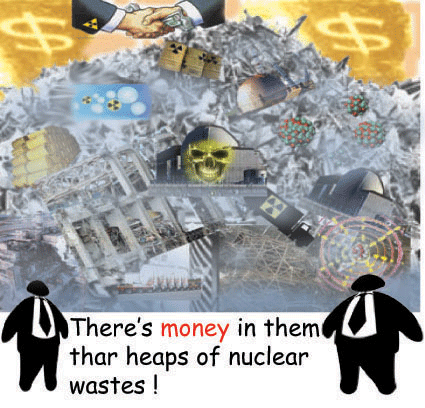 U.S. Nuclear Is Struggling, And These Companies Are Profiting From It, Oil Price,
 Chernobyl’s spent nuclear fuel to be stored (Holtec’s in on this one, too)
 Final trials begin on a facility to store Chernobyl’s spent nuclear fuel The Chemical Engineer Amanda Jasi 2 May 19, ON 6 May the final system-wide trials of a new dry storage facility at Chernobyl began. ISF2, located at the site of the Chernobyl nuclear power plant, will process and store spent nuclear fuel to allow for decommissioning of the plant…….. Final trials begin on a facility to store Chernobyl’s spent nuclear fuel The Chemical Engineer Amanda Jasi 2 May 19, ON 6 May the final system-wide trials of a new dry storage facility at Chernobyl began. ISF2, located at the site of the Chernobyl nuclear power plant, will process and store spent nuclear fuel to allow for decommissioning of the plant……..
Holtec said it would complete “stem-to-stern” functional demonstrations of spent fuel handling and storage processes over the next two months. Following the demonstrations, the facility will be handed over to Ukraine’s state-owned enterprise Chernobyl Nuclear Power Plant (ChNPP), which will initiate commissioning. WNN reported that the Chenobyl nuclear power plant entered decommissioning last year after gaining approval from Ukraine’s State Nuclear Regulatory Inspectorate. According to the news service, the first stage of decommissioning – the so-called final shutdown and preservation stage – is expected to take ten years. The ISF2 project began in the 1990s but stalled for nearly a decade when the previous contractors’ technology proved to be “inadequate to meet the facility’s functional and regulatory requirements”. Holtec was awarded the project contract in 2011. Principal contactors on the ISF2 project are UTEM, BNG, and Maloni, reports WNN. It is funded by a group of Western countries and Japan, and administered by the European Bank for Reconstruction and Development (EBRD). ….. In partnership with Energoatom, Holtec is also constructing the Central Spent Fuel Storage Facility (CSFSF), which will receive and store spent nuclear fuel assemblies from Ukraine’s pressurised water reactors (VVERs). The facility will mean Ukraine will no longer have to spend US$200m/y to store nuclear fuel in Russia, says WNN. Full operation is expected in 2020. https://www.thechemicalengineer.com/news/final-trials-begin-on-a-facility-to-store-chernobyl-s-spent-nuclear-fuel/ |
|
|
Illness and death legacy of employment in America’s nuclear weapons business
As US modernizes its nuclear weapons, NCR looks at the legacy of one Cold War-era plant, National Catholic Reporter, May 20, 2019 by Claire Schaeffer-Duffy
Ohio’s Nuclear Plant Subsidy Proposal, Should Be Rejected – 5 Reasons Why

 5 Reason’s Why HB 6, Ohio’s Nuclear Plant Subsidy Proposal, Should Be
  Rejected, Uniion of Concerned Scientists, STEVE CLEMMER, DIRECTOR OF ENERGY RESEARCH, CLEAN ENERGY | MAY 16, 2019 Last November, UCS released Nuclear Power Dilemma, which found that more than one-third of existing nuclear plants, representing 22 percent of total US nuclear capacity, are uneconomic or slated to close over the next decade. This included the Davis-Besse and Perry plants in Ohio that are owned by Akron-based FirstEnergy Solutions. Replacing these plants with natural gas would cause emissions to rise at a time when we need to achieve deep cuts in emissions to limit the worst impacts of climate change.
When we released our report, my colleague Jeff Deyette described how a proposal backed by FirstEnergy to subsidize its unprofitable nuclear plants in Ohio was deeply flawed and did not meet the conditions recommended in our report. By providing a blatant handout to the nuclear and fossil fuel industries at the expense of renewable energy and energy efficiency, ironically, the latest proposal to create a “Clean Air Program” in Ohio (House Bill 6) is bad for consumers, the economy and the environment.
Here are five reasons why this proposal is flawed and should be rejected:
1. HB 6 doesn’t protect consumers
…………..HB 6 doesn’t require FirstEnergy Solutions to demonstrate need or limit the amount and duration of the subsidies to protect consumers and avoid windfall profits as recommended in our report. It simply sets the starting price at $9.25/MWh and increases that value annually for inflation. ……… FirstEnergy Solutions nuclear plants would receive approximately $170 million per year in subsidies, or 55% of the total…..
2. HB 6 is a bait and switch tactic to gut Ohio’s clean energy laws
But here’s the rub. HB 6 would effectively gut the state’s renewable energy and energy efficiency standards to pay for the subsidies for Ohio’s existing nuclear, coal and natural gas plants. It would make the standards voluntary by exempting customers from the charges collected from these affordable and successful programs unless they chose to opt-in to the standards. This could result in a net increase in emissions and a net loss of jobs in Ohio over time.
This political hit job is outrageous, but not at all surprising. It is just another attempt in a long series of efforts by clean energy opponents to rollback Ohio’s renewable and efficiency standards over the past five years …….
the cost of wind and solar has fallen by more than 70 percent over the past decade, making them more affordable for consumers and competitive with natural gas power plants in many parts of the country. ……
Energy efficiency programs are especially important for low-income households. By lowering their energy bills, they have more money to spend on food, health care and other necessities.
3. HB6 creates a false sense of competition
While renewable energy technologies are technically eligible to compete for funding under HB 6, several criteria would effectively exclude them:
- It excludes any projects that have received tax incentives like the federal production tax credit or investment tax credit, which applies to nearly every renewable energy project.
- Eligible facilities must be larger than 50 MW, which excludes most solar projects, and wind projects have to be between 5 MW and 50 MW, which is smaller than most existing utility scale wind projects in the state.
- Eligible projects must receive compensation through organized wholesale energy markets, which excludes smaller customer-owned projects like rooftop solar photovoltaic systems.
When combined with the rollback to the renewable standard, this absurdly stringent criteria would create too much uncertainty for renewable developers to obtain financing to build new projects in Ohio.
4. HB 6 will increase Ohio’s reliance on natural gas
While HB 6 could temporarily prevent the replacement of Ohio’s nuclear plants with natural gas, gutting the renewables and efficiency standards would undermine the state’s pathway to achieving a truly low-carbon future by locking in more gas generation as coal plants retire. …….
5. HB 6 includes no safety criteria or transition plans
HB 6 does not require FirstEnergy’s nuclear plants to meet strong safety standards as a condition for receiving subsidies, as recommended in our report. While Davis-Besse and Perry are currently meeting the Nuclear Regulatory Commission’s (NRC) safety standards–as measured by their reactor oversight process (ROP) action matrix quarterly rating system–both plants have had problems with critical back-up systems during the past two years that put them out of compliance.
The nuclear industry has been trying to weaken the ROP for years………
A better approach
On May 2, House Democrats announced an alternative “Clean Energy Jobs Plan” that would address many of the problems with HB 6. The plan would modify the state’s Alternative Energy Standard (AES) by increasing the contribution from renewable energy from 12.5% by 2027 to 50% by 2050and fix the onerous set-back requirements that have been a major impediment to large scale wind development. It would expand the AES to maintain a 15% baseline for nuclear power. In addition, it would improve the state’s energy efficiency standards, expand weatherization programs for low-income households, and create new clean energy job training programs…….
With more than 112,000 clean energy jobs in 2018, Ohio ranks third in the Midwest and eighth in the country. Ohio added nearly 5,000 new clean energy jobs in 2018. While most of the clean energy jobs are in the energy efficiency industry, Ohio is also a leading manufacturer of components for the wind and solar industries.
To capitalize on these rapidly growing global industries, lawmakers in Ohio should reject HB 6 and move forward with a real clean air program that ramps-up investments in renewables and efficiency and achieves the deep cuts in emissions that are needed to limit the worst impacts of climate change. https://blog.ucsusa.org/steve-clemmer/5-reasons-why-hb6-should-be-rejected
Advertising industry is urged to use its power for good
Extinction Rebellion urges ad industry to use its power for good, Guardian, Seth Jacobson, 19 May 2019 Letter to senior figures urges them to use their power to influence public opinion on climate change Environmental activists Extinction Rebellion have turned their fire on the advertising industry in a public letter, encouraging it to use its expertise in manipulating public opinion for good or risk mass public protests against it.
Speaking to the Guardian, one of the authors of the letter, which was written by Extinction Rebellion members with decades of experience of the advertising industry, said the group was not “singling out advertising, as we previously disrupted fashion week and are systematically challenging all industries who have the platform, influence and skills to tackle this epoch-defining crisis but are failing to do so in any meaningful way”.
“Though our letter is addressed to the boardroom, we ask everyone within the industry to ‘Tell the Truth’ about the climate and ecological emergency,” he continued. “This is the first of Extinction Rebellion’s demands, to business and governments; the vital step required to wake everyone up and drive action to deal with this crisis……. https://www.theguardian.com/environment/2019/may/19/extinction-rebellion-urges-ad-industry-to-use-its-power-for-good
Unnecessary to bail out Ohio’s nuclear and coal plants, but a bonanza for FirstEnergy Solutions

|
IEEFA update: Bailing out Ohio’s nuclear and coal plants unnecessary for supply or rate stability
But $300 million annual charge would be bonanza for FirstEnergy Solutions (IEEFA U.S.) – A bill before the Ohio General Assembly (HB 6), aimed at rescuing FirstEnergy Solutions’ economically uncompetitive aging nuclear and coal-fired power plants is misguided, according to a briefing note released by the Cleveland-based Institute for Energy Economics and Financial Analysis (IEEFA).The briefing note: Bailout Bill a Bonanza for FirstEnergy Solutions, may end up costing Ohio consumers and businesses more than $300 million per year “in perpetuity,” according to IEEFA. “Proponents of this ill-advised bill are using misleading arguments to warn about nonexistent dangers to the electricity supply and rising energy costs,” said IEEFA director of resource planning analysis and author of the briefing note David Schlissel. “The data shows, to the contrary, that Ohio has ample energy supply and that retiring the plants in question would in no way undermine the reliability of the system or raise costs.” The bill would keep open FirstEnergy Solutions’ Davis-Besse and Perry nuclear power plants and could also provide revenue for the Sammis coal-fired plant in Ohio. There is no evidence to suggest that extending their operational lifespans would benefit consumers. EEFA found that:
PJM, the operator of the regional electricity market, has concluded that the deactivation of FirstEnergy Solutions’ nuclear power plants in Ohio and Pennsylvania will have no effect on the reliability of the electric power grid…….. Those studies by the Brattle Group were based on misleading assumptions about the cost of renewables and inflated notions about how much energy the nuclear plants were actually providing to the system,” said Schlissel. “This bill is clearly designed to benefit FirstEnergy Solutions and not Ohio ratepayers.” IEEFA recommends that Ohio follow the lead of New York state and allocate resources to support the tax bases of school districts and communities undergoing economic transition caused by the closure of coal and nuclear plants. The briefing note suggests that the state design a program to support workers who lose their jobs when coal and nuclear plants close. Such a program should also include thorough and timely clean-up and decommissioning of these facilities, with hiring preferences given to former plant employees, according to IEEFA. http://ieefa.org/ieefa-update-bailing-out-ohios-nuclear-and-coal-plants-unnecessary-for-supply-or-rate-stability/?fbclid=IwAR1t8o2qjaqzn995F360PTVYtV5fimZUaPX1ls7R-gDd1q15XyUnO3AjuQA |
|
U.S. Democrats trying to stop funding for US nuclear transfers to Saudi Arabia
 Congress tries to defund US nuclear transfers to Saudi Arabia. Al-Monitor May 9, 2019 House Democrats are trying to use the power of the purse to block the transfer of US nuclear technology to Saudi Arabia amid concerns that the Donald Trump administration is too keen to strike a deal with the kingdom.
The House foreign aid panel’s spending bill for fiscal year 2020, released today, would bar the use of federal funds to “support the sale of nuclear technology to Saudi Arabia.” The provision comes as Democrats accuse the Trump administration of using a legal loophole to provide undisclosed nuclear technology and assistance to Riyadh.
“Given the administration’s failure to share important information about these activities with Congress, we included this provision, which prevents the administration from allowing the sale of nuclear technology to Saudi Arabia,” a House Democratic aide who did not want to be identified told Al-Monitor. “We hope this will force much-needed transparency on this issue.”
Lawmakers are concerned that Riyadh has not agreed to terms that would preclude it from enriching uranium or reprocessing plutonium on its territory, precursors to a nuclear weapons program. Crown Prince Mohammed bin Salman notably raised eyebrows last year by vowing that Saudi Arabia would pursue a nuclear weapon if Iran obtained one.
But some nonproliferation experts are skeptical that the legislation unveiled today would effectively deter the administration, which is determined to strike a civil nuclear deal with Riyadh, from continuing nuclear transfers……… https://www.al-monitor.com/pulse/originals/2019/05/congress-tries-defund-us-nuclear-transfers-saudi-arabia.html
Rosatom keenly pursuing international nuclear sales, especially nuclear-weapons related
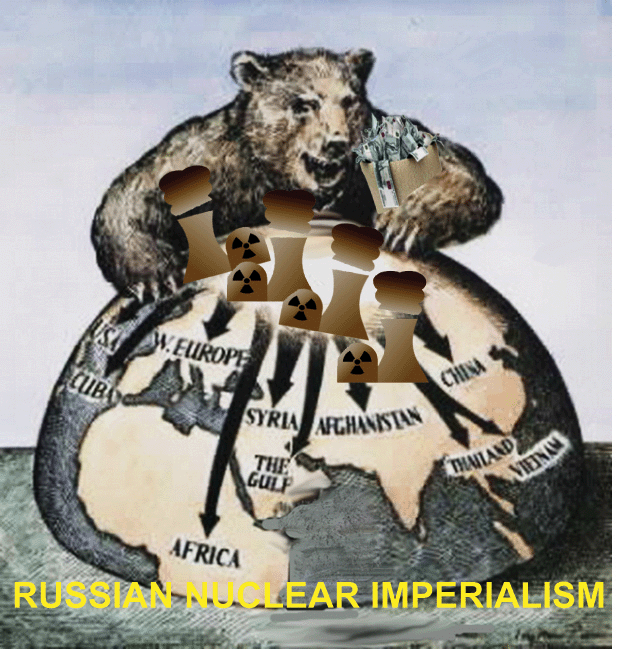
Rosatom expects foreign business income to double by 2024, WNN,10 May 2019 Rosatom expects to double revenue from its overseas business, from USD6.6 billion last year to USD15 billion by 2024, its director general, Alexey Likhachov, has told Russian Prime Minister Dmitry Medvedev. In their meeting, on 6 May, Likhachov said foreign projects were the “key theme” of the state nuclear corporation’s future growth.
Russia using nuclear power loans and sales to have political influence – nuclear colonialism
 Russia’s Nuclear Power Exports are Booming, Moscow Times, 10 May 19,
Rosatom has been using nuclear power plants as a way of cementing ties with its fellow emerging markets.Russia’s state-owned agency Rosatom is on a tear. The company operates 35 nuclear power stations in Russia that produce 28 gigawatts (GW) of power, and it is actively exporting its nuclear technology to countries around the world.
Russia has been using nuclear power plants as a way of cementing ties with its fellow emerging markets with no nuclear power tradition and the BRICS countries, a group that started as a marketing tool for Goldman Sachs to sell equity but has increasingly turned into a real geopolitical alliance amongst the leading emerging market governments.
In recent years Rosatom has completed the construction of six nuclear power reactors in India, Iran and China and it has another nine reactors under construction in Turkey, Belarus, India, Bangladesh and China. Rosatom confirmed to bne IntelliNews that it has a total of 19 more “firmly planned” projects and an additional 14 “proposed” projects, almost all in emerging markets around the world.
Rosatom has become the world’s largest nuclear reactor builder as the financial problems of the two big Western firms Westinghouse Areva have crimped their ability to develop nuclear plants abroad . as the financial problems of the two big Western firms Westinghouse Areva have crimped their ability to develop nuclear plants abroad. Westinghouse and Areva, now owned by EDF, have for years negotiated deals to build reactors in India but have made little progress, partly because Indian nuclear liability legislation gives reactor manufacturers less protection against claims for damages in case of accidents.
The sales drive was organised by former Prime Minister Sergei Kiriyenko, who presided over Russia during the 1998 financial crisis but was given the job of running Rosatom after leaving office and tasked with selling 40 nuclear power plants internationally.
…… Part of Rosatom’s appeal is not only Russia’s lower prices and state-of-the-art technology, but the fact that company usually provides most of the financing for the typically $10 billion price tag.
Last year the Russian firm said it had an order book worth $134 billion and contracts to build 22 nuclear reactors in nine countries over the next decade, including Belarus, Bangladesh, China, India, Turkey, Finland, Hungary, Egypt and Iran. The size of the order book puts nuclear power station exports on a par with Russia’s booming arms export business.
But underpinning the business is politics. Russia has long used energy as the sweetener when offering a package of trade deal to its international partners. Like gas pipelines, nuclear power stations are a way of binding countries to Russia, as nuclear power stations come with 60-year long maintenance deals and uranium supply contracts.
……. Iran Bushehr
One of the most controversial nuclear power stations built by Moscow was Iran’s Bushehr that was completed in 2013 over strong U.S. objections.
…….Russia has been producing new parts for the second nuclear power plant to be built at Bushehr on the Persian Gulf and now Russia is preparing to push ahead with the construction of the second unit. ……
India Kudankulam…..
Hungary Paks……
Belarus Grodno……
Turkey Akkuyu……
Egypt El Dabaa…… https://www.themoscowtimes.com/2019/05/09/russias-nuclear-power-exports-are-booming-a65533
Nuclear weapons companies doing very profitably out of governments

But nuclear weapons are more than just a terrifying threat to every living thing on earth. For decades, they’ve been a terrific way to make money.
A new report from PAX, a Dutch peace organization, both illuminates how profitable it can be for multinational corporations to manufacture Armageddon and provides a roadmap for taking the money out of mass death.
The PAX report identifies a total of $116 billion in current contracts between governments and the private sector to design, build, and maintain the world’s nuclear arsenals. The actual amount may be significantly higher, since all nine nuclear powers maintain some degree of opacity about their nuclear programs. “We know what we can trace,” says Susi Snyder, the report’s principal author, “but there’s definitely more out there.”
Many powerful corporations therefore have incentives to push governments to expand their nuclear stockpiles. At a recent investor conference, a managing director of the investment bank Cowen Inc. questioned the CEO of Raytheon, one of the nuclear contractors listed by PAX. “We’re about to exit the INF [Intermediate-Range Nuclear Forces Treaty] with Russia,” the managing director said, and excitedly asked if this means that “we will really get a defense budget that will really benefit Raytheon.” (The planet may be destroyed, but for a beautiful moment in time, they will have created a lot of value for shareholders.)
Snyder believes that President Donald Trump’s decision to pull out of the INF Treaty may be paying literal dividends for Raytheon already. She points out that over a period of three months after Trump announced the U.S. withdrawal last fall, Raytheon received an anomalous 44 separate missile contracts worth more than $500 million.
Moreover, corporate lobbying has already nudged the U.S. to commit to a nuclear “modernization” program — initiated under former President Barack Obama and expanded under Trump — that will cost an estimated $1.2 trillion over the next 30 years. And while modernization sounds good, what’s planned will actually make U.S. nukes much more deadly, something to which Russia is already planning to respond. The final result may be an extremely modern nuclear war.
PAX, however, does not counsel despair, but instead sees the intertwining of the private sector and nuclear weapons as a potential point of leverage.
The five largest known current beneficiaries of nuclear weapons spending are all U.S.-based multinationals: Huntington Ingalls Industries ($29.9 billion), Lockheed Martin ($25.2 billion), Honeywell International ($16.5 billion), General Dynamics ($5.8 billion), and Jacobs Engineering ($5.3 billion).
The report also identifies large nuclear contracts with companies elsewhere. Airbus, headquartered in the Netherlands, develops nuclear-armed missiles for France. A British company called Serco has a 25-year contract to help manage and operate the U.K. Atomic Weapons Establishment, the center of the United Kingdom’s nuclear program. Bharat Dynamics Limited in Hyderabad helps make two of India’s nuclear-capable missiles.
Among the hundreds of nuclear contracts are some gems of nuclear insanity. Boeing has received $16 million to develop a “Flight Termination Receiver” that would theoretically allow nuclear missiles to be destroyed after a mistaken launch.
This could change the U.S. nuclear calculus in an extremely dangerous way. There have been many false alarms in the past that Russian missiles were headed toward the U.S. We’re here now only because no president responded to the alarms, in part because they knew such a response would be irrevocable. If future presidents believe that they have an end of the world “take back,” they may be tempted to launch U.S. nuclear missiles in response to another false alarm. But of course, no technology is ever 100 percent effective — especially when it’s built by the company that brought us the 737 Max. And if just one missile failed to self-destruct, a full-out nuclear war would soon follow.
That’s the bad news. Here’s the qualified good news…………….https://theintercept.com/2019/05/04/nuclear-weapons-profits/
Listing the companies that make nuclear weapons

|
These 28 companies are building nuclear weapons http://www.icanw.org/action/these-28-companies-are-building-nuclear-weapons/?mc_cid=435c8bc6ec&mc_eid=e79c019cc0, May 2, 2019
ICAN and its partner organisation Pax have released a report with full profiles of 28 companies connected to the production of nuclear weapons.
Here are the 28 companies on ICAN’s Red Flag list. Download the full report here.
|
|

Southern Company says – no more nuclear projects after the costly Vogtle project in Georgia
|
Georgia Power’s parent: After Vogtle, no new nuclear until maybe 2040, AJC, 3 May 19, Georgia Power’s parent company is the only utility constructing nuclear power reactors in the United States, and it doesn’t plan to do it again anytime soon.
It probably will be in the 2030s or 2040s before Atlanta-based Southern Company attempts another nuclear construction project, Southern CEO Tom Fanning told analysts Wednesday. ……. on Wednesday, Fanning told analysts that his administration won’t embark on more nuclear. …..
Liz Coyle, the executive director of Georgia Watch, a consumer advocacy group that has long warned about the Vogtle’s ballooning costs, questions whether ratepayers should fund another nuclear project incorporating new reactor designs. “What we don’t want to see is Georgia once again being made the guinea pig … for unproven technologies that end up taking much longer to build and at a significantly higher cost than other forms of generation,” she said……… https://www.ajc.com/business/georgia-power-parent-after-vogtle-new-nuclear-until-maybe-2040/ADjetBmiCnISHQIOP10uvJ/
|
|
|
1 This Month
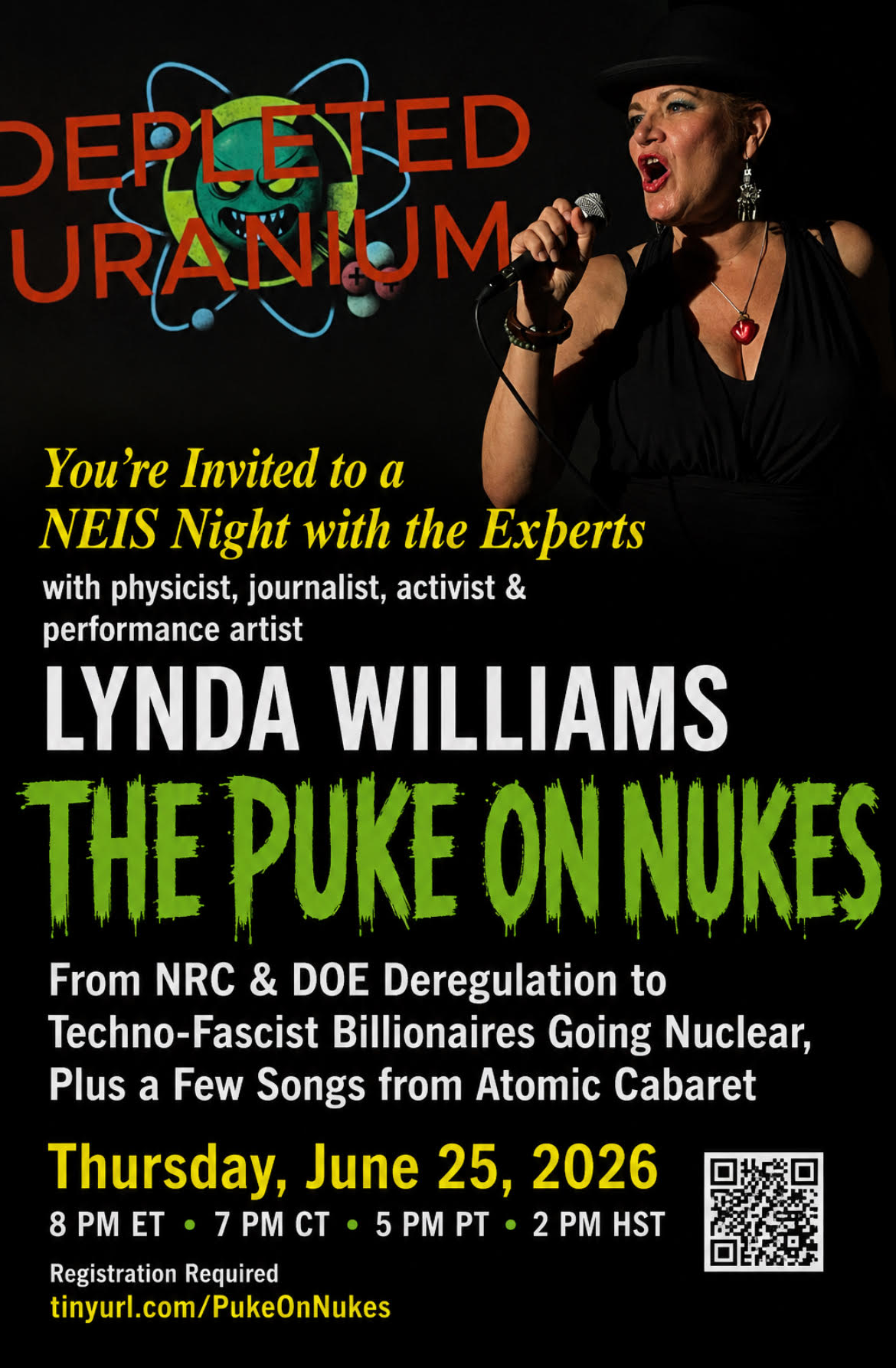
25 June- THE PUKE ON NUKES
Thursday, June 25, 2026
7pm Central Time (8pm ET, 6pm MT, 5pm PT) UTC – 5
From NRC & DOE Deregulation to Techno-Fascist Billionaires Going Nuclear, Plus a Few Songs from Atomic Cabaret REGISTER
26 June – Radiation Trainwreck at the NRC / Join the Protect Better Campaign – https://us02web.zoom.us/meeting/register/4ZlZ5_qLSHGiLSCg8FF6Bg#/registration

1st July – Webinar Waste of Space: The Environmental Harm of Military and Civil Space Activity st July, 7 pm

Report Launch Online: We are seeing an increasing exploitation of space for military and commercial purposes. This must change.

Protect Sazan Island from the Trump family! https://secure.avaaz.org/campaign/en/protect_sazan_island_from_the_trump_family_loc/?bqFCVab&v=174511&cl=22707147157&_checksum=5e9dde668860e8231c33699735e16a1fbf22ab2cb01da50c999fe8732b9775ef&utm_source=email&utm_medium=blast_email&utm_campaign=174511


Cuba Is Not a Failed State – It Is a Besieged State
PETITION: “Global Appeal to Endorse Palestinian Right of Return of Refugees”
To see nuclear-related stories in greater depth and intensity – go to https://nuclearinformation.wordpress.com
-
Archives
- June 2026 (230)
- May 2026 (306)
- April 2026 (356)
- March 2026 (251)
- February 2026 (268)
- January 2026 (308)
- December 2025 (358)
- November 2025 (359)
- October 2025 (376)
- September 2025 (257)
- August 2025 (319)
- July 2025 (230)
-
Categories
- 1
- 1 NUCLEAR ISSUES
- business and costs
- climate change
- culture and arts
- ENERGY
- environment
- health
- history
- indigenous issues
- Legal
- marketing of nuclear
- media
- opposition to nuclear
- PERSONAL STORIES
- politics
- politics international
- Religion and ethics
- safety
- secrets,lies and civil liberties
- spinbuster
- technology
- Uranium
- wastes
- weapons and war
- Women
- 2 WORLD
- ACTION
- AFRICA
- Atrocities
- AUSTRALIA
- Christina's notes
- Christina's themes
- culture and arts
- Events
- Fuk 2022
- Fuk 2023
- Fukushima 2017
- Fukushima 2018
- fukushima 2019
- Fukushima 2020
- Fukushima 2021
- general
- global warming
- Humour (God we need it)
- Nuclear
- RARE EARTHS
- Reference
- resources – print
- Resources -audiovicual
- Weekly Newsletter
- World
- World Nuclear
- YouTube
-
RSS
Entries RSS
Comments RSS
 nuclear-news