 Environmental group says new nuclear power plant too pricey for Utah’s municipal utilities, KSL.com By Lisa Riley Roche, Jun 21st, 2019 SALT LAKE CITY — A group opposed to a new type of nuclear plant being developed said Thursday the price of power produced there would be more than other carbon-free energy sources, making it a bad investment for Utah’s municipal utilities.
“We feel the numbers are independent and speak for themselves,” Michael Shea, a senior policy associate for the Healthy Environmental Alliance of Utah, told reporters at a news conference discussing the findings in a new study.
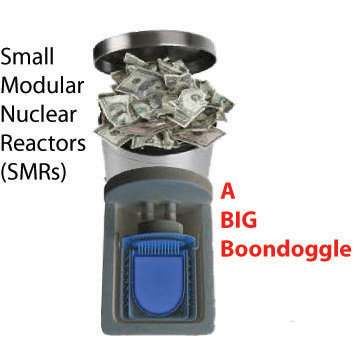
The study, by Salt Lake City-based Energy Strategies, found power produced by the small modular nuclear reactors to be built in Idaho would cost more than $66 per megawatt hour, compared to as low as just over $38 for wind and solar power.
“It does not make economic sense from a market perspective for a group like (the Utah Associated Municipal Power Systems) to be investing in what is essentially a subsidized science project that has not ever been proven,” Shea said…….
Longtime consumer protection watchdog Claire Geddes spoke at the news conference about her confidence in the study and her concerns about the impact of higher costs on the public.
Geddes, who said she has worked on utility issues since 1992, suggested the local governments supervising municipal utilities don’t have the resources to adequately vet the project.
“It’s really not fair to the public,” she said. “I would stress that these cities understand, before they go into it, what the risks are to their citizens and their businesses.”
Both the environmental alliance and Geddes called for further study by the municipal power system before local governments make a final decision next year on what would be a 40-year contract. ……
Besides the cost concerns, Williams said the new type of nuclear plant can’t be presumed to be safe and would still produce at least as much nuclear waste as a traditional plant.
The intent is for the municipal power system to purchase all 12 modular reactors at the plant being built by an Oregon-based company, NuScale Power, system spokesman LaVarr Webb said.
The power generated would be used by the 46 members, mostly municipalities, in Utah and other states, Webb said, and would sold to other users including the federal government for use by the Idaho National Laboratory and the Department of Energy……..https://www.ksl.com/article/46578424/environmental-group-says-new-nuclear-power-plant-too-pricey-for-utahs-municipal-utilities
June 22, 2019
Posted by Christina Macpherson |
business and costs, Small Modular Nuclear Reactors |
Leave a comment
 Investors see huge profits from old nuclear plants, but it could cost taxpayers https://www.lohud.com/story/news/watchdog/2019/06/19/nuclear-plant-decommissioning-holtec-other-firms-see-profit/1456809001/
INVESTORS ARE SCRAMBLING TO BUY OLD NUCLEAR PLANTS. THEY SAY THEY CAN CLEAN THEM FOR PROFIT. IF THEY FAIL, EXPERTS WORRY TAXPAYERS MAY BE ON THE HOOK.
Christopher Maag, North Jersey Record, June 19, 2019 Shutting down nuclear plants is set to become a multi-billion dollar business. If that business fails, critics say, your tax dollars – and possibly your safety – could be on the line. Learn more in our USA TODAY NETWORK Northeast project, The Nuclear Option.
Some of the nation’s richest investors are betting they see profit where no one else does: tearing down America’s aging nuclear reactors.
Among them is one of the most recognized names from the Reagan Administration, former Secretary of the Navy John Lehman.
Lehman’s plans are shrouded in secrecy. The hedge fund that bears his name does not disclose basic information about its finances.
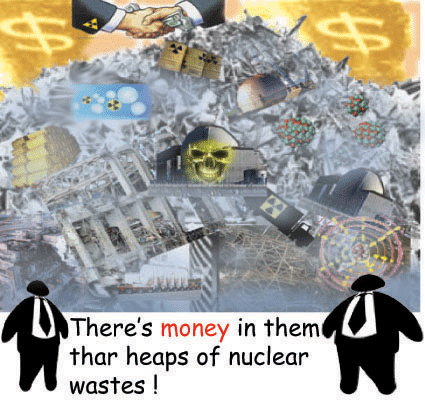
But an examination of deals made by the hedge fund since 2017 to raise money and acquire firms, makes it clear the company sees a pot of gold for the taking — some $60 billion accumulating in trust funds owned by nuclear power plants — all of it bankrolled by ratepayers.
“We believe that the profitability potential remains high,” said Daryl Walcroft, a lead adviser at the accounting firm PwC, which recently released a 20-page report titled “Ready, set…shut down!” to lure new investors.
If they succeed, investors will control a brand-new industry. If they fail, as some independent experts predict, those investors — including public employee pension funds for teachers, police and firefighters — could lose hundreds of millions of dollars.
Past projects blew their budgets by up to half a billion dollars, forcing ratepayers to cover the costs. Current projects may be even riskier, as companies saddle the trust funds with new cleanup costs that federal rules never envisioned, and do not allow.
Such deals may enable big investors like Lehman to take their profit and walk away, leaving “taxpayers to bear the financial burden and responsibility for finishing the work,” Massachusetts Attorney General Maura Healey said in a petition to federal regulators.
For years, power companies supervised reactor cleanup themselves. Nearly every project was a financial failure. In some cases the cost approached $1 billion, double the original estimate.
“I would say all of the early projects went over budget,” said Scott State, CEO of NorthStar Group, a company that deconstructs buildings.
Industry leaders like State believe they can decommission a nuclear plant faster and cheaper, and share the savings with their investors as profit.
“They’re taking on a big risk that they can do a big job,” said Tom LaGuardia, an engineer widely regarded as the world’s top expert on decommissioning costs.
The New Model
TO INVESTORS, EACH REACTOR IS A POT OF GOLD
To some people, a closed nuclear plant is a dangerous place contaminated with radioactive waste.
To investors, each reactor is a pot of gold.
Federal law requires electricity companies to save money in trust funds for the eventual closure and cleanup of nuclear reactors. Fund totals ranged from $286.6 million for Beaver Valley reactor 1 in Pennsylvania to $1.5 billion for Diablo Canyon reactor 2 in California, according to 2016 tallies from the Nuclear Regulatory Commission, the latest available.
Nationwide, trust fund balances topped $60 billion in 2016, the NRC found. They grew to $70 billion by 2018, according to The Callan Institute, which advises fund managers. And the total may soon rise to $90 billion, according to PwC, a major accounting firm formerly known as PriceWaterhouseCoopers.
And unlike virtually every other big construction project, companies decommissioning nuclear plants get paid upfront, before work even starts.
“Having pre-funded work is very good,” said State, of NorthStar.
Powerhouses including the PwC accounting firm also see profit opportunity in teardown deals.
“(T)he growth of this market is accelerating more quickly than predicted,” according to the company’s recent report. “Already, we are seeing qualified decommissioning specialists and institutional investors clamoring through various deals to own” decommissioning companies.
Here’s what that clamor looks like. After serving as President Ronald Reagan’s Secretary of the Navy, John Lehman founded J.F. Lehman & Co., a hedge fund that invested $1.9 billion primarily in defense and aerospace industries, according to the company’s website.
In 2016, J.F. Lehman & Co. sought to raise $700 million. It attracted more than 48 investors, including “leading public and private pension funds” who together invested $883 million, more than 25 percent above Lehman’s original plan, according to a Lehman press release.
Investments included $40 million from the Teachers’ Retirement System of Oklahoma. Another $36.5 million came from three public employee retirement funds in Connecticut. The public employee retirement fund in Montgomery County, Maryland invested $23 million, the Arkansas Teacher Retirement System invested $14.6 million, and the retirement system for municipal police in Louisiana invested $12.5 million, according to the funds’ annual reports, for a total of at least $126.6 million. Together, these funds own $75.9 billion in assets.
Three months after Lehman announced it had beaten its fundraising goal, in June 2017, it gained a foothold in the decommissioning industry by acquiring NorthStar. The following month, it announced a partnership with a company now called Orano, which specializes in nuclear teardowns. In January 2018 Lehman bought Waste Control Specialists, which owns radioactive waste disposal sites in Texas.
The deals allow Lehman’s companies to save money at every step of decommissioning, said State, who is CEO of both NorthStar and Waste Control Specialists.
“We own and control everything we need to do this work,” State said.
Important details about Lehman’s companies remain unknown, including how much cash each keeps for emergencies. Even less is known about Holtec’s decommissioning venture Comprehensive Decommissioning International, which is co-owned with SNC-Lavalin, a large Canadian engineering firm.
The company is secretive about its finances, refusing to disclose basic information about its revenue, assets or ability to handle contingencies. “Both Holtec and SNC-Lavalin supplied the capital for establishing CDI,” Joe Delmar, a Holtec spokesman, said by email.
Potential pitfalls
HOLTEC AND NORTHSTAR HAVE REQUESTED EXEMPTIONS FROM THE NRC’S TRUST FUND FORMULA
The financial success or failure of decommissioning a nuclear reactor hinges on one thing: the size of its trust fund.
“The most unique risk in this market has to do with the health of the trust fund,” said Walcroft, lead adviser on American infrastructure projects for PwC.
In Holtec’s application to buy Pilgrim nuclear power plant in Massachusetts, and in NorthStar’s application to buy the Vermont Yankee plant, both companies said they expect each reactor’s trust fund to pay for the entire project.
“I am telling you they will get it done with the trust fund because they’re really good,” said Rod McCullum, senior director of used fuel and decommissioning at the Nuclear Energy Institute, the industry’s powerful trade group.
Consultants, financial experts and three federal agencies are not so confident. Plant owners must prove their trust funds meet the Nuclear Regulatory Commission’s minimum formula, which the commission estimates will generate enough money to clean up a nuclear plant’s radioactive contamination.
But the commission’s own Office of Inspector General, as well as the Government Accountability Office and Pacific Northwest National Laboratory, together published four reports since 2011 finding the formula — created in the early 1980s — is so old that it consistently underestimates the amount of money needed.
“The NRC estimate is still low,” said LaGuardia, who said he has completed cost estimates on 90 percent of all decommissioning projects in North America.
Moreover, Holtec and NorthStar plan to use trust funds in ways the NRC never envisioned. According to federal rules, trust money may be used only to clean up nuclear contamination. Other jobs, like managing spent reactor fuel and removing asbestos or lead, must use other money.
“It comes from their own money, their own profits,” said Richard Turtil, a senior financial analyst for the NRC.
That’s not what NorthStar and Holtec have in mind. At Pilgrim, Holtec requested an exemption allowing the trust fund to cover $541 million in spent fuel management and site restoration costs. NorthStar requested a similar exemption at Vermont Yankee for $425 million. Both companies stated the funds will have sufficient money to cover the additional work, and provide them with profits.
“This very substantial amount — over a billion dollars — in Pilgrim’s [trust fund] will be sufficient to cover the estimated cost of decommissioning and spent fuel management, as well as site restoration,” Holtec said in a filing to the NRC.
Some current and former regulators disagree. If granted, the exemption “poses a significant risk that insufficient funds will exist” to clean the site, Massachusetts Attorney General Maura Healey told the NRC.
“Certainly, I think the funds are sufficient to cover the cost of the cleanup,” Gregory Jaczko, former chairman of the Nuclear Regulatory Commission, said in May at a Congressional briefing. “But I’m not sure that they’re sufficient to cover the costs of the cleanup and a very nice level of leftover benefit for the company.”
Blowing budgets?
THE BIGGEST DRIVER OF COST INCREASES IS FINDING POCKETS OF PREVIOUSLY UNKNOWN CONTAMINATION
Finally, there’s the question of cost overruns. The cost to decommission Yankee Rowe nuclear plant in Massachusetts was estimated at $370 million in 1994. By the time it was finished in 2003, costs rose by an extra $266 million, according to book co-authored by LaGuardia. At Connecticut Yankee the final bill was $931 million, more than double original estimates.
“Almost invariably in the work I’ve done, the costs were greater than expected,” said Julia Moriarty, senior vice president of The , which advises nuclear fund managers.
Work accidents and changing government rules caused many projects to run over-budget, LaGuardia said, but the biggest driver of cost increases is finding pockets of previously unknown contamination.
Companies learned from these mistakes, State and Delmar said. Teardown experts now perform more intensive site studies; avoid cutting apart reactors with tools like grit sanders that spread contamination around a site; and often control the final disposition of nuclear waste. This means they can simply “rip and pitch” waste into trucks or trains bound for disposal sites, State said, rather than spend valuable workers’ time decontaminating materials on-site.
“They’re getting smarter now, and they’re doing site characterization first,” LaGuardia said. “They know the risks. If they’re not comfortable with their cost estimating method, they’re not going to be in this business.”
Site studies remain imperfect, however.
“Site conditions are never known with absolute precision,” Warren K. Brewer, a decommissioning expert, told the Vermont Public Utilities Commission.
All construction companies build cushions into their plans to cover unexpected costs. At Vermont Yankee, NorthStar set aside 10 percent of the trust fund’s $500 million for contingency and profits, far below standard industry practice, according to Brewer and Gregory Maret, another expert hired by the state.
Even small changes in site conditions or state regulations could increase costs by up to $200 million, Brewer found, enough to overwhelm the contingency fund.
“That’s a very risky business play,” LaGuardia said of NorthStar’s plan.
Eventually NorthStar and its partners committed $200 million in additional financial assurances, said Dan Dane, a financial expert involved in the negotiations.
Holtec’s contingency at Pilgrim is even smaller. The company will set aside 17 percent of Pilgrim’s projected $1.3 billion trust fund for surprises, it told the NRC.
But as Healey found, Holtec plans to spend all but $3.6 million of the $1.3 billion in its trust fund on basic decommissioning work.
“In other words, its contingency allowance covers costs it expects to incur,” Healey wrote in her petition. “Holtec’s attempt to account for contingencies and uncertainty risk is woefully deficient.”
The buck stops where?
IF EVEN A HANDFUL OF PROJECTS GO BROKE, RETIREES IN AT LEAST FIVE STATES STAND TO LOSE $126.6 MILLION
Leaders of decommissioning companies are confident they can avoid the failures of the past.
“Does that mean every project will go perfectly? No,” State said. “But I don’t lose any sleep thinking we aren’t going to be able to do these projects in precisely the way we say we expect we can.”
Consultants think failure is an option, however.
“I think the vast majority will do just fine,” said Moriarty, who has monitored nuclear funds for 20 years. “I think there will be cases where they run into problems.”
If even a handful of decommissioning projects goes broke, current and future public employees in at least five states stand to lose $126.6 million in investments. In its report, PwC advised investors to consider, “Do I have the financial capability to manage the nuclear decommissioning trust fund as required by the NRC — or to make up the difference if it falls short?”
If investors can’t step up, some worry it will fall to “taxpayers to bear the financial burden and responsibility for finishing the work,” Healey told the NRC.
“If they go bankrupt,” Moriarty said, “I assume the taxpayers are on the hook.”
Email: maag@northjersey.com
Data reportreFrank Esposito contributed to this report.
June 20, 2019
Posted by Christina Macpherson |
business and costs, USA, wastes |
Leave a comment

What’s more chilling: watching Chernobyl or cogitating on the cost of going nuclear? Michael West Investigative Journalism Jun 20, 2019, The sudden push by the Murdoch media and Coalition right-wingers to overturn Australia’s nuclear power ban ignores the chilling economic cost — huge public subsidies, storing radioactive waste for thousands of years, the heavy costs of decommissioning and, potentially, radiation-related health costs. Veteran nuclear writer Noel Wauchope reports on the popular TV series, Chernobyl, and the economics of nuclear power.
THE frightening TV miniseries “Chernobyl” could put a few Australians off the idea of nuclear power but nuclear economics might turn out to be the bigger scare.
It is bad news for the Minerals Council of Australia and nuclear lobbyists, that Chernobyl has now arrived on some Australian TV screens, but pro-nuclear advocates are continuing to push their campaign anyway.
The miniseries “Chernobyl” has just finished in Europe and USA, outdoing “Game of Thrones” in popularity. HBO’s Chernobyl topped film and TV database IMDB’s list of the greatest 250 TV shows of all time. The first episode was screened on 12 June, 2019 in Australia, on Foxtel.
The series has had a big impact. It was highly praised by numerous reviewers but criticised by pro-nuclear lobbyists, and infuriated some Russian politicians. ………
The Liberal Coalition’s renewed push for nuclear power……
Prime Minister Scott Morrison said he is open to considering nuclear power if it can stand on its own two feet. Energy Minister Angus Taylor told The Guardianon 12 June 2019 he wouldn’t rule out revising Australia’s nuclear ban “when there is a very clear business case which shows the economics of this can work”. Two days later, Environment Minister Sussan Ley also told TheGuardian she was open to the review considering a removal of the ban.
But — are the economics of nuclear power viable for Australia?
When even Australia’s former top nuclear promoter has doubts, it doesn’t look promising……….
How viable is nuclear power elsewhere?
Nuclear economics in America is really a tale of woe. You hardly know where to start, in trying to assess how much this industry is costing communities and tax-payers. There are the attempts to save the nuclear industry via subsidies. There are the continuing and ever-increasing costs of radioactive wastes. There are the compensation payments to workers with radiation-caused illnesses, $15.5 billion and counting, and the legal battles over where to put the wastes. Needless to say, really, America is not initiating any new nuclear “big build”. The much touted “Small Modular Nuclear Reactors” are turning out to have no market and little prospect of being economically viable……
The UK nuclear industry is in the doldrums with repeated postponement of new projects – Hinkley Point C, Wylfa Newydd, Moorside, Sizewell C, Oldbury B and Bradwell B……The 2018 forecast for future clean-up of Britain’s aging 17 nuclear power stations has blown out to £121 billion which has had to be spread across the next 120 years……
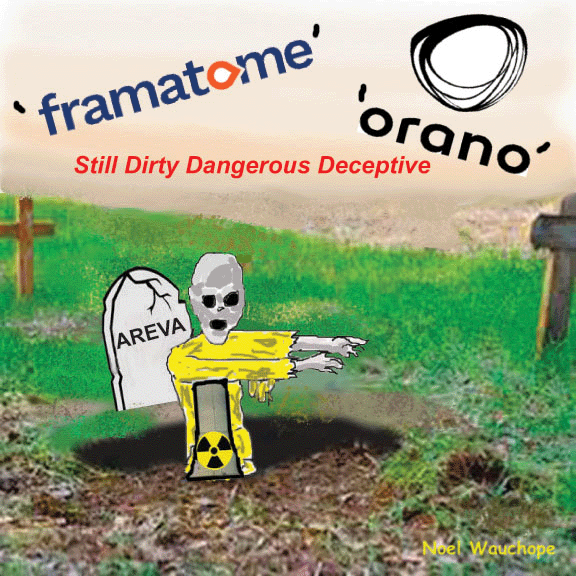
France’s Flamanville nuclear project is taking years, remains bogged down with costly problems. Electricite de France (EDF) has financial woes but hopes to save itself by switching from nuclear to renewables. France’s former nuclear giant AREVA went bankrupt and has changed its name to Orano and Framatome — and French tax-payers are still caught up in Areva/Orano costly legal corruption scandals.
Canada is up for increasing costs for managing its nuclear wastes. Interestingly, Canada abandoned its nuclear project for producing medical radioisotopes and now leads in non nuclear production of these isotopes.
India had grand plans for nuclear power, but has cut these back, and recently cancelled 57 reactors. It continues to have problems and many outages, at its huge Kudankulam nuclear station. ….
Russia keeps offering “generous” funding to the buyer countries. But will those countries end up with big debts? Reuters reports that in China, “No new approvals have been granted for the past three years, amid spiralling costs” ………. https://www.michaelwest.com.au/whats-more-chilling-watching-chernobyl-or-cogitating-the-cost-of-going-nuclear/
June 20, 2019
Posted by Christina Macpherson |
AUSTRALIA, business and costs |
Leave a comment
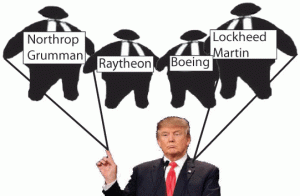
 WASHINGTON ,WATCH: IS TRUMP HELPING THE SAUDIS GO NUCLEAR? https://www.jpost.com/Opinion/Washington-Watch-Is-Trump-helping-the-Saudis-go-nuclear-592310,BY DOUGLAS BLOOMFIELD, JUNE 12, 2019
US President Donald Trump recently took another step toward bringing Saudi Arabia into the nuclear club. While Israeli-Saudi ties have warmed in recent years, helping the desert kingdom go nuclear – with its ongoing support for the most extreme Islamic radicals in the world – can hardly be good for the Jewish state.
Secret negotiations with the US Energy Department over many months have led Washington to “transfer highly sensitive US nuclear technology, a potential violation of federal law,” to Saudi Arabia, according to House Oversight Committee sources cited by The Washington Post.
Sen. Tim Kaine (D-Virginia) revealed last week that at least two transfers were approved since the assassination of Washington Post journalist Jamal Khashoggi.
The Saudis say they want to begin building their own nuclear power plants with their own enriched uranium, even though it could be purchased elsewhere more cheaply. That raises suspicions that their real goal isn’t producing electricity. By enriching their own uranium, they could begin diverting it to highly enriched weapons grade, especially if they bar international inspectors, as they’ve insisted.
Given its record of obeisance to Saudi demands for top technology and weapons, it is unlikely the Trump administration would object, but instead continue helping to conceal the kingdom’s plans. Crown Prince Muhammad bin Salman, the de facto ruler, has said that the kingdom would build nuclear weapons if the Iranians did. He may have taken encouragement from a speech in the UAE last month by Trump’s national security adviser, John Bolton.
The Iranians are threatening to leave the nuclear pact with the major powers – the Joint Comprehensive Plan of Action (JCPOA) – in the wake of the Trump administration’s unilateral exit last year and imposition of sanctions to tighten the economic screws on Tehran.
There’s “no reason” for Iran to walk away from JCPOA, “unless it is to reduce the breakout time to nuclear weapons,” said Bolton, a decades-long advocate of regime change in Iran. Bolton offered no evidence to back his claim.
That should give MBS the rationale he seeks to develop his version of the bomb.
When he turns to Trump for help, he will remind the president that if America won’t sell it to him, there are others who will. Trump is a sucker for that pitch.
North Korea would be a good place to go shopping, since they tried helping Syria build nukes until the Israeli Air Force stopped the plan, something it had done earlier in Iraq. Then there’s Pakistan, which is believed to have built its own nuclear weapons stockpile with Saudi financial help.
THERE MIGHT BE some resistance on Capitol Hill, where Saudi support is low and sinking, but Trump has shown himself more responsive to the wishes of the Saudis than the US Congress.
Republicans like Sen. Lindsey Graham of South Carolina may moan and groan and make threatening sounds toward Riyadh, but he and majority leader Mitch McConnell are Trump’s poodles, and will make sure the president gets what he wants.
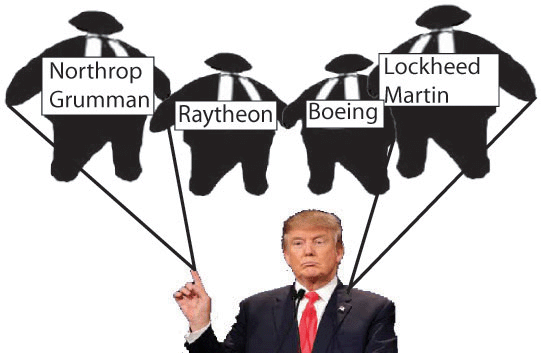
All US administrations – Republican and Democratic – have indulged the Saudi appetite for top technology and weapons. They’ve been driven by pressure from industry and its friends in the Pentagon to sell, sell, sell – and an inexplicable attitude that we need the Saudis far more than they need us. Trump has just raised this to a new level.
Trump’s latest selling spree includes 120,000 conversion kits to produce smart bombs. It is part of an $8.1 billion package that Trump labeled “emergency” to bypass Congressional review.
Most alarming is the Trump administration’s approval for the transfer of highly sensitive weapons technology and equipment to Saudi Arabia so the kingdom can produce electronic guidance systems for Paveway precision-guided bombs, according to congressional sources cited by The New York Times.
The administration assured Congress that it is confident in the Saudi ability to protect the technology, that the need is urgent and that it won’t alter the balance of power in the region – which is exactly what it is intended to do.
Look for Trump to justify massive sales to the Saudis and the UAE as also helping protect Israel from Iran. Historically, all administrations have justified arms sales around the Middle East as harmless to Israel’s qualitative military edge. But they aren’t. Especially when the US is selling the Arabs the same planes, missiles and technology it sells Israel. Trump values his oil-rich customer so much that he has rejected the findings of his own CIA that the crown prince was complicit in Khashoggi’s murder.
Saudi Arabia is the Pentagon’s favorite cash cow. Arms sales are a lucrative business for the US Defense Department, which charges commissions and other fees, and gets economies of scale for its own purchases while selling off old inventory to help pay for replacements. Military attachés around the world are top salesmen for defense contractors as they lay the groundwork for post-uniform careers. Then there are the former – and possibly future – defense industry executives at the highest levels of the Pentagon, starting with the Secretary of Defense.
Sen. Chris Murphy (D-Connecticut) said the administration “has effectively given a blank check to the Saudis – turning a blind eye to the brutal murder of Jamal Khashoggi and allowing their ballistic missile program to expand.”
The United States is not allowed to sell ballistic missiles, so the Saudis have turned to China. CNN reported last week that American intelligence believes Beijing is helping enhance the kingdom’s strategic missile program. In the 1980s, it secretly bought Chinese DF-3 missiles and based them within range of Israel. It bought more advanced missiles in 2007 with the approval of then-president George W. Bush. Unconfirmed published reports suggest they also bought other missiles from Pakistan, which produces a version of the North Korean Nodong missile.
If the Saudis decide to pursue nuclear weapons, they can turn to Trump’s dear friend Kim Jong Un, whose cash-strapped regime has developed its own and the missiles to deliver them.
With Trump looking for business that will create jobs he can claim credit for – and with John Bolton rattling sabers and B-52s, and calling for regime change in Iran – can Saudi Arabia be knocking on an open door to the nuclear club?
June 13, 2019
Posted by Christina Macpherson |
business and costs, politics, politics international, Saudi Arabia, USA |
Leave a comment









 nuclear-news