Flamanville nuclear reactor repairs will cost $13.6 billion

 EDF Cost Overrun at French Plant Piles Pressure on Nuclear Giant, by
- Repairs at Flamanville reactor will lift cost to $13.6 billion
- Plant won’t load nuclear fuel until end of 2022 at earliest
The latest budget hike at the Flamanville-3 reactor is yet another blow to the French state-controlled utility, which raised its cost estimate for two similar reactors it’s building in the U.K. just weeks ago. It also fuels doubts about nuclear’s future in France, where the government has been reluctant to approve new projects before Flamanville-3 is online….. (subscribers only) https://www.bloomberg.com/news/articles/2019-10-09/edf-lifts-cost-of-french-nuclear-reactor-by-14-to-13-6-billion
French nuclear company EDF rules out any interest in UK’s Wylfa nuclear plan
New Civil Engineer 10th Oct 2019, EDF Energy has ruled out taking an interest in the new Wylfa nuclear site in Wales despite claiming it is the ‘best site in the UK’ for nuclear
power. https://www.newcivilengineer.com/latest/edf-rules-out-wylfa-bid-despite-naming-it-best-site-in-uk-10-10-2019/
Ex-generals aim to shift conservative resiliency dialogue away from coal, nuclear subsidies
https://www.utilitydive.com/news/ex-generals-aim-to-shift-conservative-resiliency-dialogue-away-from-coal-n/564815/ The project aims to educate stakeholders on the possibilities of competitive contracts to promote resilience. “There’s an element within the country that says we can’t reveal” engineering improvements for the critical substations and nodes “for causes classified…and so there’s no competition in the pricing of those repairs,” Handy told reporters on Thursday.
“What we’re suggesting, from a national security standpoint is … companies know how to compete in a classified area or a confidential area, and not just about the grid, about anything,” Hagee said. “These competitive forces can in fact be brought to bear even when you have information that is sensitive.”
by Iulia Gheorghiu Oct. 11, 2019
Dive Brief:
- Securing America’s Future Energy (SAFE) launched a project this month to direct conservative discussions on energy and national security toward market-based approaches, leveraging the knowledge and experience of three former U.S. generals.
- The Grid Security Project will focus on federal-level policy, as well as Ohio, Illinois and Pennsylvania, where state subsidy efforts are underway to aid power plants that SAFE has deemed unnecessary for reliability or security, based on a technical analysis from grid operator PJM Interconnection.
-
On Thursday, General Michael Hagee and General John Handy, two leaders of the Grid Security Project, met with energy and defense committees on Capitol Hill to discuss infrastructure legislation, the defense authorization bill and transportation electrification.
Dive Insight:
The new group aims to shift “the narrative in the conservative community away from subsidizing coal and nuclear plants toward one that emphasizes real grid security and resilience,” following proposals from several states and the Trump administration to subsidize power plants with baseload capacity, according to SAFE’s statement.
The Grid Security Project’s fuel-neutral message would target Ohio, Illinois and Pennsylvania, with education efforts extending to legislators, public utility commissioners and other thought leaders.
n Ohio, coal and nuclear subsidy legislation could go into effect in mid-October. The Grid Security Project is publishing information and working to oppose the subsidies because, according to SAFE, state legislators and First Energy Solutions have contradicted PJM’s assessment by maintaining certain coal and nuclear plants were important to reliability and national security.
On a national level, the Federal Energy Regulatory Commission is pursuing a docket on resilience, and the Grid Security Project wants to help steer discussions toward market-based approaches.
“We want a reliable, resilient and affordable grid,” Hagee said. “The best way to get to that… [is] with our ingenuity and our competitiveness.”
The project aims to educate stakeholders on the possibilities of competitive contracts to promote resilience. “There’s an element within the country that says we can’t reveal” engineering improvements for the critical substations and nodes “for causes classified…and so there’s no competition in the pricing of those repairs,” Handy told reporters on Thursday.
“What we’re suggesting, from a national security standpoint is … companies know how to compete in a classified area or a confidential area, and not just about the grid, about anything,” Hagee said. “These competitive forces can in fact be brought to bear even when you have information that is sensitive.”
Russia’s manipulations in supplying Bangladesh with nuclear technology
 Derek Abbott Nuclear Fuel Cycle Watch Australia,7 Oct 19

I’m at an engineering meeting and got to meet an engineer working on the nuclear program in Bangladesh.
I asked him if Bangladesh had renewables. He said they have a lot.
I then made the point that nuclear is therefore not a good investment as his grid is now in greater need of sources that turn on and off quickly. As nuclear can’t do that, nuclear is not cost effective.
He agreed and said for that reason the Bangladeshi govt would actually never pay upfront for a nuclear station on an economic basis.
He said the nuclear program was a result of a political deal with the Russians.
He said that Pakistan and India have nuclear in the region, so the idea of Bangladesh having a nuclear station is a show of “arm flexing.”
The Russians were pushy and made a deal too hard to resist: The Russians will only charge 1% of the cost per annum for the first 30 years of operation and have agreed to remove all waste and ship it back to Russia.
I said that deal does seem too hard to resist.
I then naively asked why on earth the Russians would go to such lengths at an apparent economic loss to them.
His answer was that Bangladesh is seen as an economically strategic region. Labour costs are lower than India, and it has a very capable workforce with a GDP that is over 5 times (per head) higher than India!
I hadn’t realised that and asked how they are making money. He said that India is no longer the power house of the clothing industry. Due to lower wages, clothes are now made in Bangladesh. All your designer labels you might be wearing come from there and have been rebranded.
There are very strong trade deals between China and Bangladesh, and it his belief that Russia’s “bargain basement” nuclear deal is way of getting a foothold in the region themselves. It is a geopolitical maneuver.
What the Russians giveth with one hand, they’ll probably find a way to taketh with another.
Scrutiny on Britain’s nuclear plans: small modular reactors uncompetitive

UK nuclear: a Golden Egg or Poisoned Chalice? UK nuclear power isunder  intense scrutiny as costs balloon on the controversial Hinkley Point C station in southwest England
Nuclear company EDF denounced by France’s economy minister as a “state within a state”
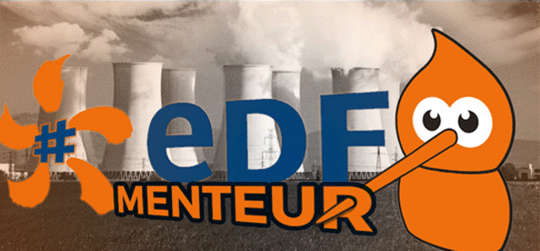 Times, 30 Sept 19 President Macron’s economy minister has accused the French state-owned
company building Britain’s new nuclear plant of “unacceptable” failings as he threatened sweeping change at the group.
denounced cost overruns and delays in the construction of the Hinkley Point C nuclear reactor in Somerset and similar projects in Flamanville in Normandy and Olkiluoto in Finland. “We will not accept this drift month after month, year after year,” Mr Le Maire said.
four-year term as chief executive of EDF by Mr Macron in February. Mr Le Maire said that he had ordered an independent audit into the French nuclear industry, which provides about 75 per cent of nation’s electricity, and into the decision to build a new generation of the increasingly questioned European pressurised reactors in Britain, France, Finland and China.
that Hinkley Point C would cost £3 billion more than expected and may not meet its latest launch date of 2025, which is already eight years late.
https://www.thetimes.co.uk/article/2a8ccefa-e2e8-11e9-bc3e-661ff0438ed9
Australian government warned about taxpayer burden if it chooses nuclear power

Nuclear inquiry hears cost, health risks https://www.9news.com.au/national/environment-groups-front-nuclear-inquiry/79884d6e-f161-4624-9bac-b6f283d96598 By AAP Oct 1, 2019 Taxpayers would be bear the brunt of a potential nuclear energy industry in Australia, a parliamentary committee has been told.
Uranium industry in permanent collapse? And thorium industry probably no better
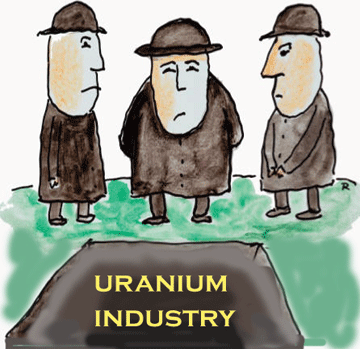 Uranium Sector Won’t Catch A Break, Share Cafe, By Rick Mills September 23, 2019 One week ago Cameco announced it will maintain low output levels until uranium prices recover. The Canadian uranium miner also said it might cut production further, having already closed four mines in Canada and laid off 2,000 of its workers in the uranium mining hub of Saskatchewan.
No end to supply glut“We are not restarting mines until we see a better market and we may close more capacity, although no decision has been taken yet,” Cameco CEO Tim Gitzel told Reuters recently at the World Nuclear Association’s annual conference.
Just over a year ago Cameco made the difficult decision to close its MacArthur River and Key Lake mines, in response to low uranium prices, leaving the company’s flagship Cigar Lake facility as its only operating mine left in northern Saskatchewan, home to the world’s highest grade uranium deposit.
The mine closures by Cameco were preceded by 20% production cuts in Kazakhstan, the number one uranium-producing country. The former Soviet bloc country has said 2020-21 output will not rise above 2019 levels. In Canada, the second largest U producer, 2018 production was cut in half to 7,000 tonnes.
An estimated 35% of uranium supply has been stripped from the market since Kazakhstan’s supply reductions in December 2017…..
Eight years later, only nine of 33 remaining reactors have been re-started, and Japan’s nuclear operators are reportedly starting to sell their uranium fuel, as the chances fade of more reactors coming online, and adding to the six currently operating. Long-term contracts are also being canceled.
In another blow to the industry, Japan’s new environment minister, Shinjiro Koizumi, has said he wants all reactors shuttered to avoid a repeat of the Fukushima catastrophe that leaked radiation and forced 160,000 people to flee the area, many of whom have not returned.
As reactors close in the United States, Germany, Belgium and other countries, “traders and specialists say the market is likely to remain depressed for years,” Reuters reported in August.
Germany has pledged to shut down all its reactors by 2022 and the Belgian government has agreed to a new energy pact that will see nuclear power phased out over the next seven years…….
(makes case for thorium)….As far as disadvantages, thorium takes extremely high temperatures to  produce nuclear fuel (550 degrees higher than uranium dioxide), meaning thorium dioxide is expensive to make. Second, irradiated thorium is dangerously radioactive in the short-term.
Detractors also say the thorium fuel cycle is less advanced than uranium-plutonium and could take decades to perfect; by that time, renewable energies could make the cost of thorium reactors cost-prohibitive. The International Nuclear Agency predicts that the thorium cycle won’t be commercially viable while uranium is still readily available………… https://www.sharecafe.com.au/2019/09/23/uranium-sector-wont-catch-a-break/
Global nuclear industry quietly fizzling out
|
An “undeclared phaseout” of the nuclear industry https://thebulletin.org/2019/09/an-undeclared-phaseout-of-the-nuclear-industry/
By Dawn Stover, September 25, 2019 The number of nuclear reactors operating worldwide has increased significantly over the past year, according to the latest World Nuclear Industry Status Report. Nevertheless, says Mycle Schneider, the project coordinator and publisher of the 323-page report released yesterday at the Central European University in Budapest, nuclear energy is growing too slowly to guarantee its survival. “The world is experiencing an undeclared ‘organic’ nuclear phaseout,” Schneider says. Nine new reactors started up in 2018, and four more came online during the first half of 2019, a modest upturn mostly driven by China. However, the total number of reactors worldwide, 417, falls short of the historic peak of 438 reactors in 2002—and the number of reactors under construction is now declining. The new report calculates that the building rate would have to roughly triple over the coming decade just to maintain the current number of reactors as aging units retire. The average nuclear reactor is now more than 30 years old. The status report, which each year offers an independent assessment of the nuclear industry, has in recent years also analyzed the potential for nuclear power to mitigate climate change. There, too, nuclear power comes up short. Some of the more optimistic scenarios for limiting global warming to 1.5 degrees Celsius rely on a rapid expansion of nuclear power. At a time when the industry is facing major economic challenges, that seems increasingly unlikely. Editor’s note: The Global Nuclear Power Database—an interactive visualization of world nuclear power reactor construction from 1951 to Jan. 1, 2017—can be found here. |
|
Britain’s nuclear power future might be ended, with Hinkley Point C’s escalating costs
EDF Energy says that “challenging ground conditions” mean costs could be £2.9 billion higher, taking the total bill to £22.9 billion. This might seem only of interest to EDF shareholders, given the controversial subsidy deal for the plant means consumers are protected from cost overruns.
But the potential significance of this is much bigger – it could cast a cloud over the UK’s hopes of a new wave of nuclear power plants. Ministers want more nuclear power in the energy mix alongside renewables, to meet carbon targets and provide continuous electricity supply.
Two Japanese companies have already pulled out of plans to build new nuclear plants in the UK, leaving EDF Energy’s designs for a second one at Sizewell in Suffolk as the main option. But the government’s proposed financial model for Sizewell C is very different to the one agreed for Hinkley. Unlike that deal, the “regulated asset base” (RAB) model under consultation for future plants would see consumers paying through energy bills while power stations are still being built.
The main trade-off with the RAB deal was that loading more construction risk onto consumers should make it cheaper to raise funds and therefore cheaper electricity, says Jonathan Marshall at non-profit the Energy and Climate Intelligence Unit.
But the more delays and over-runs there are, it will add to concerns that consumers will be left to pick up an ever-increasing bill, he says. “Consumer groups and others that are against the new framework are going to point to the delays at Hinkley as evidence that billpayers will be liable to pay more than planned to bring new power stations online.”……
What are the alternatives? Some nuclear proponents think small modular reactors could do the job. But the technology for commercial ones is still years off and analysis suggests they could even be more costly than conventional large ones……. https://www.newscientist.com/article/2217725-could-rising-costs-at-hinkley-point-c-end-the-uks-nuclear-ambitions/
Corporate greed, fighting over America’s extravagant $85 billion nuclear missile program

 become the Defense Department’s primary provider of ballistic missiles, Boeing has launched an aggressive lobbying campaign,
There was an $85 billion elephant in the room at this year’s Air Force Association conference, an annual trade show where thousands of uniformed airmen rub shoulders with suit-clad defense contractors hawking the latest advanced weaponry.
Those entering the conference hotel in National Harbor, Md., were welcomed by an enormous blue banner splashed with the Northrop Grumman logo and the words “LEGENDARY DETERRENCE” ― a not-so-subtle reference to the company’s ballistic missile ambitions.
Northrop is poised to take over a massive Air Force nuclear weapons program called Ground Based Strategic Deterrent, or GBSD, which will call on a team of contractors to replace the U.S. military’s aging stock of Minuteman III intercontinental ballistic missiles. But Boeing’s Arlington-based defense business, which has handled the Minuteman program since 1958, has launched an aggressive lobbying campaign in defense of its interests.
Northrop “is on a path to a sole-source opportunity,” Boeing GBSD Program Manager Frank McCall warned in an interview Wednesday on the floor of the trade show.
“There has never been a time in the history of the Minuteman when the Air Force wasn’t supported by both companies,” he said, adding that he thinks the Pentagon is taking “a winner-take-all approach” that is “unprecedented in the history of intercontinental ballistic missiles.”
The ground-based missiles make up one leg of the U.S. nuclear triad, which aims to be ready to deliver warheads at a moment’s notice from air, land or sea. They are meant to deter other countries from launching a nuclear strike by sending a message that any first-mover will be destroyed immediately.
The different components of the triad are extremely expensive to build and keep at the ready. For the new ground-based missiles, the Pentagon faces a difficult dilemma as it tries to get the best solution for the best price.
The Air Force had hoped to evaluate multiple competing options. But Boeing, thought to be the only viable competitor aside from Northrop, says it won’t participate unless the Air Force changes its approach.
With Boeing out, the Northrop-led team appears to be the Pentagon’s only option, something that could make it hard for the government to negotiate a fair price.
It is a common dilemma facing Defense Department weapons buyers, who have the impossible task of running a competitive marketplace when there are, at best, two or three potential suppliers for the most expensive weapons systems. The U.S. defense industry has consolidated to a worrying degree in the decades since the Cold War, officials and analysts say, with a handful of dominant suppliers exerting tremendous influence.
A White House report released last year found 300 cases in which important defense products are produced by just a single company, a “fragile” supplier, or a foreign supplier.
There is big money at stake for Boeing and Northrop: Defense Department estimates for the long-term cost of the program range between $62 billion and $100 billion. Both companies have formidable lobbying operations, spending $7.2 million and $8.3 million, respectively, on Washington lobbyists in 2019.
Boeing’s stewardship of the Minuteman program brought it roughly 600 defense contracts totaling $8 billion in the first 30 years of the programs, according to estimates provided by the company. Northrop has traditionally taken a secondary role handling complex systems integration.
In 2017, Northrop and Boeing were awarded contracts worth $349.2 million and $328.6 million, respectively, to develop their own version of a next-generation replacement for the Minuteman. In July, the Air Force asked each company to submit a proposal, hoping to compare the two missile designs and negotiate a fair price.
Boeing quickly threw a wrench into that plan, announcing July 25 that it would walk away from the competition because the Air Force’s request for proposals allegedly favored Northrop.
Boeing’s concerns stem from Northrop Grumman’s 2017 acquisition of a company called Orbital ATK for $7.8 billion. Orbital ATK ― which operates as a Northrop Grumman business unit called Innovation Systems ― is a dominant producer of rocket motors that power ballistic missiles. Aerojet Rocketdyne, the other U.S. manufacturer of rocket motors, also is working with Northrop.
Boeing has taken its case to the Pentagon, as well as to the Federal Trade Commission, but has failed to block the deal.
“We continue to stand ready to support this important program,” wrote Leanne Caret, president of Boeing’s Arlington-based defense business, in a July 23 letter seen by The Washington Post. “As we have discussed, we believe there are other procurement structures that could provide this capability more rapidly at less cost, and we will look for ways to leverage the work … to help support this critical national security mission.”
Boeing later approached Northrop about the possibility of teaming up but was rejected, a Boeing official said. So it came as little surprise Monday when Northrop released the list of companies it is teaming up with, and Boeing isn’t on it.
Air Force officials stood by their approach but declined to comment on how they will proceed.
“We are very open to a variety of proposals. … We are open to teaming relationships. We just don’t want to dictate,” Will Roper, the Air Force’s assistant secretary for acquisition, technology and logistics, told reporters Monday. “We think it should be decided by industry and what they think is best value.”
Soon afterward, Boeing countered that it is pursuing a multifaceted advocacy and lobbying campaign asking the government to force Northrop to collaborate.
“We believe it is a path to a better weapons system solution that will allow us to field the solution more quickly than either company could handle on its own,” said McCall, the Boeing official.
Analysts expressed concern over the current arrangement, in which Northrop will almost certainly be the only bidder. Whether Boeing’s proposal will resolve the problem is less clear.
“I would much rather see a direct competition between Northrop and Boeing,” said Dan Grazier, a former Marine Corps captain working at the Project on Government Oversight, a watchdog group. “The best practice for any acquisition system would be a solid, honest, competitive prototyping, where the government can weigh competing options and get a competitive price.”
Nuclear Free Local Authorities (NFLA) see Revenue Asset Base (RAB) financial model as a danger to UK’s public purse
NFLA 16th Sept 2019, The Nuclear Free Local Authorities (NFLA) publishes today its response to
the UK Government consultation on the Revenue Asset Base (RAB) financial
model being proposed to assist the funding of new nuclear reactors.
NFLA see this new model as a real risk to the public purse, providing
preferential treatment to new nuclear over renewable energy investment, is
overly complicated to implement at a time when the ‘climate emergency’
calls for more straightforward and realisable schemes like energy
efficiency and decentralised energy solutions instead.
Nuclear lobby’s keen propaganda campaign in Indonesia
 Nuclear tourism experience in Bandung to be launched in October https://www.thejakartapost.com/travel/2019/09/18/nuclear-tourism-experience-in-bandung-to-be-launched-in-october.html, THE JAKARTA POST, Jakarta / Wed, September 18, 2019
The National Nuclear Energy Agency (Batan) is set to launch a nuclear tourism experience on Oct. 30, aiming to introduce nuclear technology to the public.
“We will have an open house to present the results of our research and development team from 2015 to 2019,” said Jupiter Sitorus Pane, head of the Science and Applied Nuclear Technology Center of Batan in Bandung on Wednesday to Antara news agency.
Jupiter said travelers can visit a number of places related to Batan in Bandung, such as reactors, isotopes production lab, the reactor conversion lab and Applied Nuclear Technology Center.
“Our target market is students and those interested in nuclear sciences. As this is a nuclear facility and considered a vital object, visitors must be at least 18 years old,” he said, adding that the tour will be free of charge.
Russia trying to market nuclear power to Uganda (or to anybody, really)
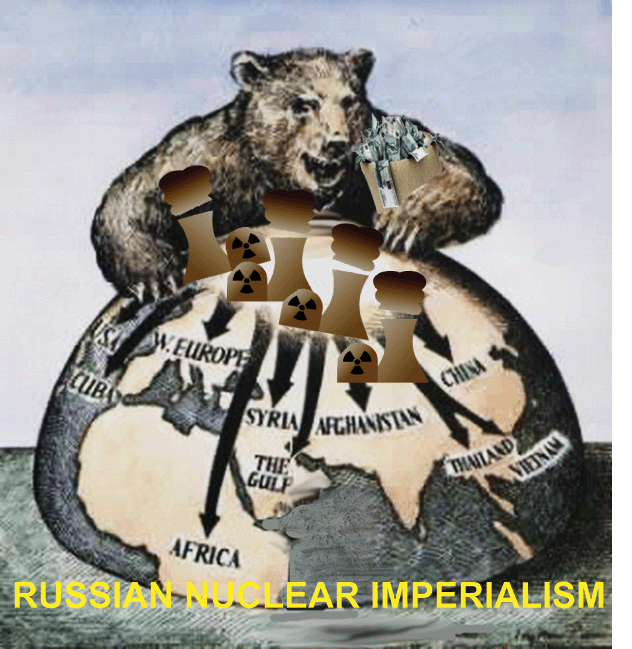 Uganda says Russia to help it develop nuclear energy, KAMPALA (Reuters) 18 Sept 19, – Uganda said on Wednesday it had signed an Inter-Governmental Agreement (IGA) with Russia to help the East African country build capacity to exploit nuclear technology for energy, medical and other peaceful purposes.The government of President Yoweri Museveni has previously said it is eager to use the country’s uranium deposits to boost energy production capacity.
In May last year Uganda also signed a memorandum of understanding with China National Nuclear Corporation (CNNC) to help Uganda build capacity in the use of atomic energy for peaceful purposes.
In an emailed statement, Uganda’s energy ministry said the IGA with Russia was signed in Vienna on Tuesday between Energy Minister Irene Muloni and Nikolai Spasskiy, the deputy director general of Russian state corporation ROSATOM……….
Reporting by Elias Biryabarema in Kampala; Editing by Matthew Lewis https://www.reuters.com/article/us-uganda-russia/uganda-says-russia-to-help-it-develop-nuclear-energy-idUSKBN1W328N
Unacceptable risk to consumers: “regulated asset base” system to fund UK’s new nuclear reactors
How can we pay for new nuclear power stations? https://www.ft.com/content/4b81682e-cf19-11e9-99a4-b5ded7a7fe3f, Funding methods that work in the water industry cannot be applied to the sector, NICK BUTLER 9 Sept 19,
We are coming to a crucial moment of decision on the future of nuclear power in the UK, with implications for the industry across Europe and beyond. The basic issue is whether nuclear power can be provided at a cost that does not damage industrial competitiveness or impose an unacceptable burden on consumers. Without a positive answer to that question, nuclear will not be able to play a role in the transition to a lower-carbon economy.
This method of funding is a serious option for long-term projects with high upfront capital costs and has been used effectively in the water industry and elsewhere. As a mechanism for funding new nuclear, however, it is far from convincing. Water projects, such as reservoirs and pipeline systems, require large-scale capital investment. But the technology is proven and the construction risks are low. In new nuclear, however, the construction risks are high and to place them on the shoulders of consumers is unfair.
Please use the sharing tools found via the share button at the top or side of articles. Copying articles to share with others is a breach of FT.com T&Cs and Copyright Policy. Email licensing@ft.com to buy additional rights. Subscribers may share up to 10 or 20 articles per month using the gift article service. More information can be found here.
https://www.ft.com/content/4b81682e-cf19-11e9-99a4-b5ded7a7fe3f
Under the Rab funding system, consumers would have been paying a surcharge on their bills since 2007 with nothing to show for it. They would have no leverage over the company building the plant and no scope for compensation. They would also of course have to pay in addition the cost of buying the power they need from someone else. Such an allocation of risk is unfair and unacceptable, and it is hard to think that ministers in a UK government, highly attuned to public opinion when it comes to energy prices, will impose such a system.
1 This Month
26 September – International Day for the Total Elimination of Nuclear Weapons





PLEASE OPPOSE HR 8255 AND S.3639 – bills would accelerate satellite deployment, with no environmental review or safeguards – https://ncstd5li.quorum.us/campaign/169331/
To see nuclear-related stories in greater depth and intensity – go to https://nuclearinformation.wordpress.com
-
Archives
- September 2026 (281)
- August 2026 (330)
- July 2026 (355)
- June 2026 (287)
- May 2026 (306)
- April 2026 (356)
- March 2026 (251)
- February 2026 (267)
- January 2026 (308)
- December 2025 (358)
- November 2025 (359)
- October 2025 (375)
-
Categories
- 1
- 1 NUCLEAR ISSUES
- business and costs
- climate change
- culture and arts
- ENERGY
- environment
- health
- history
- indigenous issues
- Legal
- marketing of nuclear
- media
- opposition to nuclear
- PERSONAL STORIES
- politics
- politics international
- Religion and ethics
- safety
- secrets,lies and civil liberties
- spinbuster
- technology
- Uranium
- wastes
- weapons and war
- Women
- 2 WORLD
- ACTION
- AFRICA
- Atrocities
- AUSTRALIA
- Christina's notes
- Christina's themes
- culture and arts
- Events
- Fuk 2022
- Fuk 2023
- Fukushima 2017
- Fukushima 2018
- fukushima 2019
- Fukushima 2020
- Fukushima 2021
- general
- global warming
- Humour (God we need it)
- Nuclear
- RARE EARTHS
- Reference
- resources – print
- Resources -audiovicual
- Weekly Newsletter
- World
- World Nuclear
- YouTube
-
RSS
Entries RSS
Comments RSS

