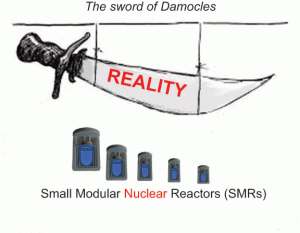
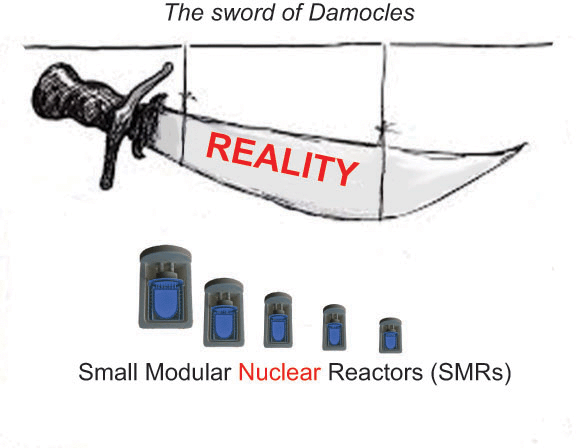
 a reality check is in order. A handful of small reactors is under construction but they have been subject to huge cost overruns and delays. William Von Hoene, senior vice-president of Exelon ‒ the largest operator of nuclear power plants in the US ‒ says that no more large reactors will be built in the US and that the cost of small reactors is “prohibitive”.
Rolls-Royce sharply reduced its small-reactor investment to “a handful of salaries” in 2018 and is threatening to abandon its R&D altogether unless the British government agrees to an outrageous set of demands and subsidies.
|
Supporters of nuclear need a reality check: it’s staggeringly expensive, https://www.smh.com.au/environment/climate-change/supporters-of-nuclear-need-a-reality-check-it-s-staggeringly-expensive-20200308-p547wv.html, By Jim Green
March 10, 2020 The NSW Parliament’s State Development Committee released its report into nuclear power last week. Conservative committee members recommended repeal of state laws banning uranium mining and nuclear power, while Labor members want to retain the legal bans.
What the conservatives and other supporters of nuclear power ignore is that it has priced itself out of the energy debate. Its costs are staggering and the worldwide pattern for the industry is one of stagnation and decline. In the US, the cost of the only two reactors under construction has skyrocketed to between $20.4 billion and $22.6 billion for one reactor. In 2006, Westinghouse said it could build a reactor for 10 times less than that amount.
Another project in the US, a twin-reactor project in South Carolina, was abandoned in 2017 after the expenditure of at least $13.4 billion. Over in New Mexico, the world’s only deep underground nuclear waste repository was closed for three years following a chemical explosion in an underground nuclear waste barrel in 2014.
In Britain, the estimated cost of the only two reactors under construction is $25.9 billion each. In the mid-2000s, the estimated cost was almost seven times lower. The British National Audit Office estimates that taxpayer subsidies for the project will amount to $58 billion.
The cost of the only reactors under construction in France and Finland has nearly quadrupled and now stands at $17.7 billion to $20 billion per reactor. Both projects are 10 years behind schedule.
Tomorrow, Japan will commemorate the ninth anniversary of the meltdowns, fires and explosions at the Fukushima nuclear plant. The Japanese government’s estimate of clean-up and compensation costs is over $300 billion, and rising.
Insiders and lobbyists freely acknowledge that the nuclear power industry is in crisis and that worldwide decline is certain. But its Australian supporters are unfazed. Their only sideways nod to reality is to argue that even if large, conventional reactors are too expensive, the emerging “small modular reactors” would be a good fit for Australia. Continue reading →
|
March 10, 2020
Posted by Christina Macpherson |
AUSTRALIA, business and costs, Small Modular Nuclear Reactors |
Leave a comment
Recent experience supports skepticism. Westinghouse worked on an SMR design for a decade before giving up in 2014. Massachusetts-based Transatomic Power, a nuclear technology firm, walked away from a molten salt SMR in 2018, and despite an $111 million dollar infusion from the US government, a SMR design from Babcock & Wilcox, an advanced energy developer, folded in 2017. While the Russians have managed to get their state-funded SMR floating, its construction costs ran over estimates by four times, and its energy will cost about four times more than current US nuclear costs.
Eventually, every nuclear conversation turns to radioactive waste and safety. SMRs using a pressurized water reactor will continue to generate highly radioactive spent fuel, yet no country has a permanent solution for how to safely store this kind of waste. ……..
small modular reactors suffer from many of the same problems as large reactors, most notably safety issues
“It would be irresponsible for the NRC to reduce safety and security requirements for any reactor of any size.”
The Smaller Is Better Movement in Nuclear Power, Are miniature reactors  really safer? Mother Jones LOIS PARSHLEY, 8 Mar 20,
Huge computer screens line a dark, windowless control room in Corvallis, Oregon, where engineers at the company NuScale Power hope to define the next wave of nuclear energy. Glowing icons fill the screens, representing the power output of 12 miniature nuclear reactors. Together, these small modular reactors would generate about the same amount of power as one of the conventional nuclear plants that currently dot the United States—producing enough electricity to power 540,000 homes. On the glowing screens, a palm tree indicates which of the dozen units is on “island mode,” allowing a single reactor to run disconnected from the grid in case of an emergency.
This control room is just a mock-up, and the reactors depicted on the computer screens do not, in fact, exist. Yet NuScale has invested more than $900 million in the development of small modular reactor (SMR) technology, which the company says represents the next generation of nuclear power plants. NuScale is working on a full-scale prototype and says it is on track to break ground on its first nuclear power plant—a 720-megawatt project for a utility in Idaho—within two years; the US Nuclear Regulatory Commission has just completed the fourth phase of review of NuScale’s design, the first SMR certification the commission has reviewed. The company expect final approval by the end of 2020. The US Department of Energy has already invested
$317 million in the research and development of NuScale’s SMR project.
Continue reading →
March 9, 2020
Posted by Christina Macpherson |
business and costs, Small Modular Nuclear Reactors |
Leave a comment
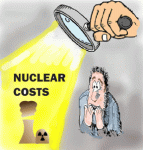
 Times 7th March 2020, Net Zero Report. Plans for nuclear plants in Britain face fresh uncertainty after government advisers warned against backing costly new reactors. The nuclear industry wants the government to commit to a funding system to back the construction of reactors, including EDF’s proposed Sizewell plant in Suffolk.
However, the National Infrastructure Commission, set up in 2015 to provide impartial advice to the government, reiterated concerns in a report about backing more nuclear plants. It noted that there had been cost reductions in renewable power technologies such as wind and solar over the past ten years, but “costs of building and running nuclear power stations have not
fallen consistently, even in countries that have built fleets of similar reactors”. Given the potential for other non-intermittent technologies to complement renewables, it said that this “weakened the case for committing to a new fleet of nuclear power stations”.
https://www.thetimes.co.uk/article/advisers-raise-doubts-over-new-nuclear-plants-8hd85cr6d
March 9, 2020
Posted by Christina Macpherson |
business and costs, politics, UK |
Leave a comment

Dark money dominated Ohio’s nuclear subsidy saga ENERGY NEWS NETWORK, Kathiann M. Kowalski, March 5, 2020
FirstEnergy Solutions paid nearly $2 million to at least one group, but  most other data remains hidden.
After-the-fact filings show that FirstEnergy’s generation subsidiary paid nearly $2 million to Generation Now, one of the special interest groups that orchestrated ads, political donations and other efforts behind Ohio’s nuclear and coal bailout.
But legal loopholes make it harder to find out the total spent and who else was behind xenophobic advertising, dueling voter petitions, alleged intimidation and other claims of foul play. And none of those actions fully disclosed who was behind them.
The scant public filings that are available show additional connections to FirstEnergy Solutions (now Energy Harbor), as well as the law firm of an outspoken legislator who has long fought the state’s clean energy standard, and others with high-level political influence.
House Bill 6 gutted Ohio’s renewable energy and energy efficiency standards while putting ratepayers on the hook for nearly $1 billion in subsidies for nuclear power plants, plus an additional amount for aging coal plants. Multiple groups spent heavily to promote HB 6 and prevent a referendum on the law following its passage.
In some cases, nonprofit and for-profit organizations funded each other or shared the same spokesperson. Groups active in the HB 6 campaign also had links to some of the same lobbyists and consultants who acted for companies that stood to benefit from HB 6, or unions with workers at their plants. But only limited amounts of funding could be traced.
ON ORIGINAL – INTRIGUING INTERACTIVE DIAGRAM HERE _ shows interrelationships of individuals and groups Continue reading →
March 7, 2020
Posted by Christina Macpherson |
business and costs, politics, Reference, secrets,lies and civil liberties, USA |
Leave a comment
Pushing the wrong energy buttons, https://www.thehindu.com/opinion/op-ed/pushing-the-wrong-energy-buttons/article30965454.ece?fbclid=IwAR1ymOL6TLlSxlUKkVVSL6_ukPPeiSzDlI_JM-He3CMG2qBD4HaBU0vezog, M.V. Ramana, Suvrat Raju, MARCH 03, 2020
The idea of India importing nuclear reactors is a zombie one with serious concerns about their cost and safety
For more than a decade, no major meeting between an Indian Prime Minister and a U.S. President has passed without a ritual reference to India’s promise made in 2008 to purchase American nuclear reactors. This was the case in the latest joint statement issued during U.S. President Donald Trump’s first official two-day visit to India (February 24-25), which stated that “Prime Minister Modi and President Trump encouraged the Nuclear Power Corporation of India Limited and Westinghouse Electric Company to finalize the techno-commercial offer for the construction of six nuclear reactors in India at the earliest date”.
Red flags in the U.S. deal
Because of serious concerns about cost and safety, the two organisations should have been told to abandon, not finalise, the proposal.
Indeed, it has been clear for years that electricity from American reactors would be more expensive than competing sources of energy. Moreover, nuclear reactors can undergo serious accidents, as shown by the 2011 Fukushima disaster. Westinghouse has insisted on a prior assurance that India would not hold it responsible for the consequences of a nuclear disaster, which is effectively an admission that it is unable to guarantee the safety of its reactors.
The main beneficiaries from India’s import of reactors would be Westinghouse and India’s atomic energy establishment that is struggling to retain its relevance given the rapid growth of renewables. But Mr. Trump has reasons to press for the sale too. His re-election campaign for the U.S. presidential election in November, centrally involves the revival of U.S. manufacturing and he has been lobbied by several nuclear reactor vendors, including  Westinghouse, reportedly to “highlight the role U.S. nuclear developers can play in providing power to other countries”. Finally, he also has a conflict-of-interest, thanks to his son-in-law and adviser, Jared Kushner, who accompanied him during the India visit.
In 2018, the Kushner family’s real-estate business was bailed out by a Canadian company that invested at least $1.1-billion in a highly unprofitable building in New York. Earlier that year, Brookfield Business Partners, a subsidiary of that Canadian company, acquired Westinghouse Electric Company. It violates all norms of propriety for Mr. Kushner to be anywhere near a multi-billion dollar sale that would profit Brookfield enormously.
What renewables can offer
Analysts estimate that each of the two AP1000 units being constructed in the U.S. state of Georgia may cost about $13.8 billion. At these rates, the six reactors being offered to India by Westinghouse would cost almost ₹6 lakh crore. If India purchases these reactors, the economic burden will fall upon consumers and taxpayers. In 2013, we estimated that even after reducing these prices by 30%, to account for lower construction costs in India, the first year tariff for electricity would be about ₹25 per unit. On the other hand, recent solar energy bids in India are around ₹3 per unit. Lazard, the Wall Street firm, estimates that wind and solar energy costs have declined by around 70% to 90% in just the last 10 years and may decline further in the future.
How safe?
Nuclear power can also impose long-term costs. Large areas continue to be contaminated with radioactive materials from the 1986 Chernobyl accident and thousands of square kilometres remain closed off for human inhabitation. Nearly a decade after the 2011 disaster, the Fukushima prefecture retains radioactive hotspots and the cost of clean-up has been variously estimated to range from $200-billion to over $600-billion.
The Fukushima accident was partly caused by weaknesses in the General Electric company’s Mark I nuclear reactor design. But that company paid nothing towards clean-up costs, or as compensation to the victims, due to an indemnity clause in Japanese law. Westinghouse wants a similar arrangement with India. Although the Indian liability law is heavily skewed towards manufacturers, it still does not completely indemnify them. So nuclear vendors have tried to chip away at the law. Instead of resisting foreign suppliers, the Indian government has tacitly supported this process.
Starting with the Tarapur 1 and 2 reactors, in Maharashtra, India’s experiences with imported reactors have been poor. The Kudankulam 1 and 2 reactors, in Tamil Nadu, the only ones to have been imported and commissioned in the last decade, have been repeatedly shut down. In 2018-19, these reactors produced just 32% and 38%, respectively, of the electricity they were designed to produce. These difficulties are illustrative of the dismal history of India’s nuclear establishment. In spite of its tall claims, the fraction of electricity generated by nuclear power in India has remained stagnant at about 3% for decades.
The idea of importing nuclear reactors is a “zombie idea” that, from a rational viewpoint, should have been dead long ago. In fact an earlier plan to install AP1000s in Mithi Virdi, Gujarat was cancelled because of strong local opposition. In 2018, Gujarat Chief Minister Vijay Rupani declared that the reactors “will never come up” in Gujarat. The Prime Minister should take a cue from his own State and make a similar announcement for the rest of the country.
March 7, 2020
Posted by Christina Macpherson |
business and costs, ENERGY, India, Legal, politics international, safety |
Leave a comment
PLANET PLASTIC, How Big Oil and Big Soda kept a global environmental calamity a secret for decades, Rolling Stone, By TIM DICKINSON, MARCH 3, 2020
|
As the world begins to wean itself off of fossil fuel for transportation, Big Oil giants from Texas to Saudi Arabia are turning to plastic to support future growth. The International Energy Agency predicts that “oil demand related to plastic consumption overtakes that for road-passenger transport by 2050,” and its top executive warns plastics are “one of the key blind spots in the global energy debate.”
The industry is counting on a tidal wave of new demand from emerging economies. A 2018 IEA report underscores that advanced economies use up to 20 times more plastic per capita than consumers do in India or Indonesia. And it warns that increased recycling and single-use bans in places like Europe and Japan “will be far outweighed by developing economies sharply increasing their shares of plastic consumption (as well as its disposal).”
Global plastics production and incineration currently creates the CO2 pollution of 189 coal plants. By 2050, that’s expected to more than triple, to the equivalent of 615 coal plants. At that rate, plastics would hog about 15 percent of the world’s remaining “carbon budget,” or what can be emitted without crossing the 2-degrees Celsius threshold in global temperature rise that scientists warn can trigger calamity.
The plastic industry’s damage to the planet is vast, but not immeasurable. In fact, the industry has published a detailed accounting that reveals its pollution is on pace to cause trillions in environmental harm by midcentury………
“The environmental cost to society of consumer plastic products and packaging was over $139 billion in 2015,” the report reveals. Without a dramatic change in course, Trucost predicts, that annual figure will soar to “$209 billion by 2025.”………
Much of the world is waking up to the plastics crisis. As China has shut its doors to the global plastic-waste trade, the European Union, Canada, and India are stepping up bans on single-use plastics like cutlery, plates, straws, and ear swabs. “How do you explain dead whales washing up on beaches across the world, their stomachs jam packed with plastic bags?” Canadian Prime Minister Justin Trudeau asked, introducing his country’s initiative. “As a dad, it is tough trying to explain this stuff to my kids.”
But under President Trump, the United States is lurching in the opposite direction, promoting the plastic industry’s aggressive expansion. “It’s war,” says Puckett of BAN, “between policies that are totally at odds with each other — of making more plastics and banning plastic.”
American fracking is literally fueling the global surge in plastics. The glut of cheap natural gas here has sparked an explosion in new plastics infrastructure. Since 2010, according to the ACC, U.S. companies have ramped up “334 chemical and plastics projects cumulatively valued at $204 billion.” Europe has built new plastics plants fed by fracked U.S. exports. Environmentalists warn that these facilities will lock in demand for fossil-fuel consumption for a generation.
Trump is an unabashed booster of plastics — in keeping with his service to the fossil-fuel industry. The former CEO of Dow led Trump’s manufacturing council. And last July, the president visited a new Shell plastics complex outside Pittsburgh. “This facility will transform abundant natural gas — and we have a lot of it — fracked from Pennsylvania wells into plastic,” Trump said. That material, he boasted, would be embossed with “that very beautiful phrase: ‘Made in the USA.’”
With the president championing its interests in Washington — and even triggering the libs with Trump 2020 campaign-branded plastic straws — the plastics industry is working to undermine grassroots activism in cities and states across the country.
The Plastics Industry Association, or PLASTICS, is a top trade group headquartered on K Street in Washington, D.C. Hiding its handiwork inside a nesting doll of front groups, PLASTICS has worked to thwart state and municipal bans on single-use plastics. PLASTICS has gotten an assist from the American Legislative Exchange Council, or ALEC, which pushes right-wing state legislatures to pass nearly identical bills. In 2013, the plastic trade group wrote a pitch to ALEC members, arguing a ban on plastic “results in the picking of winners and losers in a ‘not-so-free’ marketplace.” By 2015, ALEC began advocating state laws best known for “banning bans” on plastic bags, but which are often far more sweeping, prohibiting limits on styrofoam and “auxiliary containers” — a catchall term for to-go packaging.
PLASTICS obscures its involvement in these state fights through a “special purpose” front group called the Progressive Bag Alliance, which rebranded in January as the American Recyclable Plastic Bag Alliance. The organization runs public relations through another front group, Bag the Ban, which touts plastic as “the most environmentally friendly option at the checkout.” (The bag alliance claims it is self-funding, but PLASTICS employs its director, per IRS filings, and the groups share offices and overhead.)……
The success of blue states, from Hawaii to New York, in banning plastic bags has been countered by the industry-led push. PLASTICS says it has parted ways with ALEC, but some 15 red states now have laws pre-empting local plastic bans, with Oklahoma, North Dakota, and Tennessee joining the pack in 2019. (ALEC did not respond to questions from Rolling Stone.)
For now, the state bans on bans are holding up in court…….
As the global plastics crisis grows — and photos of albatross chicks decomposing around the indigestible plastic waste that killed them go viral — the industry is quietly agonizing over backlash from the metal-straw and Hydroflask-toting members of Generation Z. “The [plastic] water bottle has, in some way, become the mink coat or the pack of cigarettes,” a senior sustainability manager for Nestlé Waters confessed at a conference last year. “It’s socially not very acceptable to the young folks, and that scares me.”
In contrast to climate change, the plastics crisis has not been met with corporate denial. The companies of Big Plastic are instead seeking to convince consumers and regulators that — despite having unleashed this torrent of pollution on the planet — they can be trusted to pioneer solutions that will make plastic use sustainable. They’re touting a “circular economy,” in which used plastic doesn’t become waste but, instead, a feedstock for new products. A cynic might translate the concept into: Recycling, but for real this time. “There are a lot of different corporate commitments,” says Shilpi Chhotray, a leader of the Break Free From Plastics movement. While some show promise, others “are just greenwashing,” she insists, with the intent of giving the industry cover for its true aim: “growth.”………
The industry’s voluntary actions to curb plastic pollution are driven by two clear motives: One is protecting the environment, the other is protecting profits from regulation……..
In Washington, the plastics industry is asking government, and American taxpayers, to foot the bill to revitalize the moribund recycling industry. The RECOVER Act — backed by both PLASTICS and the ACC — would offer $500 million in federal-matching funds for investment in new infrastructure…….
For Sen. Tom Udall, our involuntary ingestion of plastic waste is proof that the country can’t wait decades for plastic polluters to reform their own practices, or rely on half-measures to bolster the current recycling system. “We are beyond the crisis point on plastic waste,” he says, “and people are starting to wake up.” Udall wants consequences for an industry that has sloughed its environmental harms onto the rest of us for long enough.
Washington is late to the game when it comes to plastics regulation, and Udall’s strategy is to adopt best practices from across the globe. . The Break Free From Plastic Pollution Act would mimic Europe in banning commonly polluted single-use plastics, including plastic bags, styrofoam cups and carry-out containers, and plastic utensils. Plastic straws would be allowed only by request.
The bill would expand the market for recycled plastics by creating a minimum recycled content for beverage containers, while also imposing a 10-cent deposit on each container sold — roughly nationalizing the models of Michigan and Oregon, where residents return nearly nine in 10 containers for recycling.
The bill would create “extended producer responsibility” — making the industry responsible for the waste it creates by requiring that producers “design, manage, and finance programs to collect and process waste that would normally burden state and local governments.” Udall emphasizes that today’s industry is hardly trying, often slapping an unrecyclable label on an otherwise recyclable bottle…..
The companies of the plastics industry, Lowenthal says, are ultimately “going to have to deal with the sticker shock that they are now responsible and they’re going to have to pay” to keep plastics out of the environment. The alternative, he insists, has become untenable: “What we have in plastic is something that has made our lives more convenient and easier. But unless we figure out how to keep this out of the waste stream, it’s just going to kill us.” https://www.rollingstone.com/culture/culture-features/plastic-problem-recycling-myth-big-oil-950957/?fbclid=IwAR2i19CqoMXj7HMbvmzM6uGkEx02ESd69vjlxVVgpUZV-VMbhPQJ_iZ3o3w
|
|
March 7, 2020
Posted by Christina Macpherson |
business and costs, climate change, Reference, secrets,lies and civil liberties |
Leave a comment
 Namaste Nukes? Trump’s Toxic Sales Pitch for the Stalled Westinghouse Nuclear Project in India, The Citizen, KUMAR SUNDARAM | 29 FEBRUARY, 20 Namaste Nukes? Trump’s Toxic Sales Pitch for the Stalled Westinghouse Nuclear Project in India, The Citizen, KUMAR SUNDARAM | 29 FEBRUARY, 20
“………Ahead of Trump’s recent visit to India, officials of the US Department of Energy were quoted as saying that they are strongly encouraging Westinghouse Corporation to ensure further progress on the nuclear projects already in the pipeline. Another addition to the nuclear bucket list this time are the Small Modular Reactors (SMRs), which the industry has been fervently pushing both within and outside the United States. While US-based corporations have individually attempted to introduce their SMR business in India in recent years, this is the first time these reactors have been formally introduced as part of the official US-India nuclear dialogue.
Globally, nuclear lobbies have promoted SMRs as an innovation that will help address the perennial problems of cost, feasibility, environmental impacts, and scalability associated with conventional large reactors.
However, as independent experts in the field suggest, SMRs are an old and discredited idea – a make-believe renaissance after the Fukushima accident thwarted dreams of building massive-sized nuclear power parks across the globe.
SMRs are neither cheap nor innovative nor green, as a number of leading experts in the field have pointed out. In particular, SMRs will be disastrous in densely populated countries like India, which already has an electricity surplus, and whose problems in the power sector owe more to its people’s lack of purchasing power, messy regulatory frameworks that do not allow it to take advantage of renewable energy sources despite their increasing efficiency and competitiveness, and the larger questions surrounding its neoliberal growth model.
India has also been desperately trying to position itself as an exporter of SMRs, and the reaffirmation of US support for India’s accession to the Nuclear Suppliers’ Group (NSG) “without any delay” in the joint statement is expected to boost this ambition.
However, much like the other projections made by the Indian nuclear establishment, the pipedream of India becoming a nuclear exporter reflects its postcolonial aspirations of becoming a big player internationally, rather than being grounded in any realism.
India does not have much to offer beyond the sub-300MWe capacity Pressurized Heavy Water Reactors (PHWRs) that it mastered in the 1970s by reverse engineering the Canada-imported reactors called CANDUs. Invariably these reactors had huge cost and time overruns, and India is now building their larger versions, 700MWe each, at sites such as Gorakhpur, Chutka, and Kaiga.
The smaller designs are evidently unattractive for potential SMR buyers for reasons of cost, safety and reliability. However, simply pitching them in the foreign market will bring to India the tag of a major nuclear player, which is enough international recognition for the chest-thumping present regime.
Despite the hype that Trump’s recent visit generated – of an upgrade of US-India relations to a ‘Comprehensive Global Strategic Partnership’ and so on – there is very little that India stands to gain. In the absence of any new meaningful and people-centric cooperation on trade, environment, education or technology, this nuclear tango will only remain a farcical buildup at the cost of the safety and livelihoods of Indian citizens.
Not long ago, Modi’s own home state of Gujarat had rejected a US-imported nuclear project labeling it unacceptably risk-prone, especially in the wake of the 2011 Fukushima accident. This leaves the Modi government with no moral right to impose the US reactors on people in other parts of the country.
|
|
|
March 2, 2020
Posted by Christina Macpherson |
India, marketing, Small Modular Nuclear Reactors, USA |
Leave a comment
|
 Namaste Nukes? Trump’s Toxic Sales Pitch for the Stalled Westinghouse Nuclear Project in India, The Citizen, KUMAR SUNDARAM | 29 FEBRUARY, 2020 Namaste Nukes? Trump’s Toxic Sales Pitch for the Stalled Westinghouse Nuclear Project in India, The Citizen, KUMAR SUNDARAM | 29 FEBRUARY, 2020
In a rush to please the Americans, no matter the cost The recently concluded US President’s visit to India was marked by the odious displays of pomposity for which both Modi and Trump are known to have a soft spot. Even as Delhi burned, with deadly riots engineered and unleashed by majoritarian mobs backed by the ruling party, Modi and Trump continued their photo-ops around the Taj Mahal and Gandhi Ashram.
What risks being ignored amid this deafening cacophony are crucial issues concerning the US-imported nuclear reactor project in India, to which both the media and civil society have not paid adequate attention, perhaps due to the fact that these nuclear negotiations have been in the pipeline for more than twelve years now and their mention in bilateral summits and statements appears little more than ceremonious.
However, there are additional twists to the India-US nuclear story that deserve our attention.
To recap, in 2008, in exchange for the American heavy-lifting of the decades-long nuclear embargo that India faced internationally for testing atomic weapons, a massive contract for a 6-unit nuclear power park was signed with the US nuclear giant, Westinghouse.
In a reciprocal gesture for this diplomatic favour, India announced the project without any cost-benefit calculation, safety or environmental impact analysis, and in the stark absence of dialogue, negotiations or the consent of the local communities in Kovvada, a site on India’s eastern coast in Andhra Pradesh.
Although the Indian government, in a rush to please its American counterpart, has already pushed through land acquisition in Kovvada, bulldozing grassroots dissent and even resolutions passed by democratically elected local bodies, the project has been stalled by a number of other factors, including the global decline of the nuclear industry post-Fukushima, which led Westinghouse to first sell its stakes to Toshiba and then eventually, declare itself bankrupt.
 Apart from the Fukushima accident, the terminal crisis of the global nuclear industry has also been precipitated by the unprecedented growth in the efficiency and competitiveness of renewable energy sources. Even in India, solar and wind have far outpaced nuclear and are more suitable to the decentralised needs of energy in the country. Apart from the Fukushima accident, the terminal crisis of the global nuclear industry has also been precipitated by the unprecedented growth in the efficiency and competitiveness of renewable energy sources. Even in India, solar and wind have far outpaced nuclear and are more suitable to the decentralised needs of energy in the country.
Additionally, certain other India-specific factors have stalled the nuclear power projects which corporations in the US, France and Russia have been eyeing in order to resurrect themselves.
Nuclear liability tops the list here – foreign vendors have been wary of the 2010 liability law enacted by the Indian parliament, which they view as overly restrictive, even as civil society activists and safety experts consider the legislation extremely weak.
The Indian law provides for a ‘right of recourse’ in Clause 17(b) under which, in case of a future nuclear accident, the nuclear operator can demand liability from the equipment suppliers.
The nuclear industry lobbies have found this provision to be an anathema and the US government has taken the lead in pressuring successive Indian governments to do away with it.
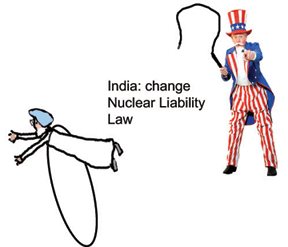 Governments of India under Modi and Manmohan Singh made every possible effort to undermine the country’s domestic law to facilitate the entry of foreign and private players – giving assurances that in case of an accident India’s government-owned operator would not sue the suppliers, setting up a liability insurance pool to channel compensation back to the Indian exchequer, and introducing outlandish rules under the Act that restrict liability to ‘latent and patent defects’ within a limited period. Governments of India under Modi and Manmohan Singh made every possible effort to undermine the country’s domestic law to facilitate the entry of foreign and private players – giving assurances that in case of an accident India’s government-owned operator would not sue the suppliers, setting up a liability insurance pool to channel compensation back to the Indian exchequer, and introducing outlandish rules under the Act that restrict liability to ‘latent and patent defects’ within a limited period.
Despite his party’s vociferous criticism of such moves  by the earlier Singh-led government when in opposition, Modi’s unabashed dalliance with the US has barely remained under wraps – he and Obama jointly declared in 2015 that India would actively take steps to limit liability in the case of a nuclear accident. However, Modi didn’t stop at that. Not only did his government ensure that the liability rules were dubbed ‘ultra vires’ and against the spirit of the law by former Solicitor-General Soli Sorabjee, entered into force in 2016, it also went on to ratify the Convention on Supplementary Compensation (CSC) – an international template promoted by the nuclear lobbies to ensure a liability-free market, thereby deliberately creating a contradiction between India’s domestic law and its international commitments.
Ever since it assumed power, the Modi government has consistently undermined nuclear liability provisions meant to safeguard the interests of the Indian people.
If the recent utterances of senior officials from the US Department of Energy offer any clues, the American nuclear vendors do not want to settle for anything short of amending the original Nuclear Liability Act – “to be clear, there are still open issues around the liability issue,” the US DoE Assistant Secretary is reported to have said in a Reuters report published last week.
As the street protests by indignant survivors of Bhopal’s gas accident during Trump’s recent visit suggest, Indian citizens have had an agonising experience due to the apathy of governments and judicial processes, with the most vulnerable sections having been denied both compensation and justice in the case of the world’s worst industrial disaster.
Successive governments in both the US and India have managed to ensure that concerned corporations remain unscathed and that their owners go unpunished.
Neither the routine exhortations of India-US summits being spaces for a rendezvous between two democracies, nor Modi’s much celebrated cleanliness drive, have translated into an open dialogue with the victims of the Bhopal disaster, or the detoxification of the accident site even three decades after the horrific chemical industrial accident.
 For his part Donald Trump has been pushing for a massive expansion of nuclear power within and outside the US, with his administration fixated on diluting and even scrapping the regulatory and financial restraints put in place after the Three Mile Island accident in 1979, which in effect placed a cap on any nuclear developments for the next three decades. For his part Donald Trump has been pushing for a massive expansion of nuclear power within and outside the US, with his administration fixated on diluting and even scrapping the regulatory and financial restraints put in place after the Three Mile Island accident in 1979, which in effect placed a cap on any nuclear developments for the next three decades.
Trump’s domestic energy policy and budget allocations disproportionately favour the nuclear industry, and exporting American nuclear reactors to developing countries is also a key part of this policy shift. The US under Trump has concluded nuclear deals with the UAE despite massive proliferation concerns……….
Despite the hype that Trump’s recent visit generated – of an upgrade of US-India relations to a ‘Comprehensive Global Strategic Partnership’ and so on – there is very little that India stands to gain. In the absence of any new meaningful and people-centric cooperation on trade, environment, education or technology, this nuclear tango will only remain a farcical buildup at the cost of the safety and livelihoods of Indian citizens.
Not long ago, Modi’s own home state of Gujarat had rejected a US-imported nuclear project labeling it unacceptably risk-prone, especially in the wake of the 2011 Fukushima accident. This leaves the Modi government with no moral right to impose the US reactors on people in other parts of the country.
|
|
March 2, 2020
Posted by Christina Macpherson |
India, marketing, USA |
Leave a comment
Jim Green, Online Opinion, 27 Feb 2020, https://onlineopinion.com.au/view.asp?article=20758&page=0
Nuclear power in Australia is prohibited under the Environmental Protection and Biodiversity Conservation (EPBC) Act 1999. A review of the EPBC Act is underway and there is a strong push from the nuclear industry to remove the bans. However, federal and state laws banning nuclear power have served Australia well and should be retained.
Too cheap to meter or too expensive to matter? Laws banning nuclear power has saved Australia from the huge costs associated with failed and failing reactor projects in Europe and North America, such as the Westinghouse project in South Carolina that was abandoned after the expenditure of at least A$13.4 billion. The Westinghouse / South Carolina fiasco could so easily have been replicated in any of Australia’s states or territories if not for the legal bans.
There are many other examples of shocking nuclear costs and cost overruns, including:
* The cost of the two reactors under construction in the US state of Georgia has doubled and now stands at A$20.4‒22.6 billion per reactor.
* The cost of the only reactor under construction in France has nearly quadrupled and now stands at A$20.0 billion. It is 10 years behind schedule.
* The cost of the only reactor under construction in Finland has nearly quadrupled and now stands at A$17.7 billion. It is 10 years behind schedule.
* The cost of the four reactors under construction in the United Arab Emirates has increased from A$7.5 billion per reactor to A$10‒12 billion per reactor.
* In the UK, the estimated cost of the only two reactors under construction is A$25.9 billion per reactor. A decade ago, the estimated cost was almost seven times lower. The UK National Audit Office estimates that taxpayer subsidies for the project will amount to A$58 billion, despite earlier government promises that no taxpayer subsidies would be made available.
Nuclear power has clearly priced itself out of the market and will certainly decline over the coming decades. Indeed the nuclear industry is in crisis ‒ as industry insiders and lobbyists freely acknowledge. Westinghouse ‒ the most experienced reactor builder in the world ‒ filed for bankruptcy in 2017 as a result of catastrophic cost overruns on reactor projects. A growing number of countries are phasing out nuclear power, including Germany, Switzerland, Spain, Belgium, Taiwan and South Korea.
Rising power bills: Laws banning nuclear power should be retained because nuclear power could not possibly pass any reasonable economic test. Nuclear power clearly fails the two economic tests set by Prime Minister Scott Morrison. Firstly, nuclear power could not possibly be introduced or maintained without huge taxpayer subsidies. Secondly, nuclear power would undoubtedly result in higher electricity prices.
 Nuclear waste streams: Laws banning nuclear power should be retained because no solution exists to for the safe, long-term management of streams of low-, intermediate- and high-level nuclear wastes. No country has an operating repository for high-level nuclear waste. The United States has a deep underground repository for long-lived intermediate-level waste ‒ the only operating deep underground repository worldwide ‒ but it was closed from 2014‒17 following a chemical explosion in an underground waste barrel. Safety standards and regulatory oversight fell away sharply within the first decade of operation of the U.S. repository ‒ a sobering reminder of the challenge of safely managing dangerous nuclear wastes for tens of thousands of years.
 Too dangerous: The Fukushima and Chernobyl disasters results in the evacuation of over half a million people and economic costs in the hundreds of billions of dollars. In addition to the danger of nuclear reactor meltdowns and fires and chemical explosions, there are other dangers. Doubling nuclear output by the middle of the century would require the construction of 800−900 reactors. These reactors not only become military targets but they would produce over one million tonnes of high-level nuclear waste containing enough plutonium to build over one million nuclear weapons.
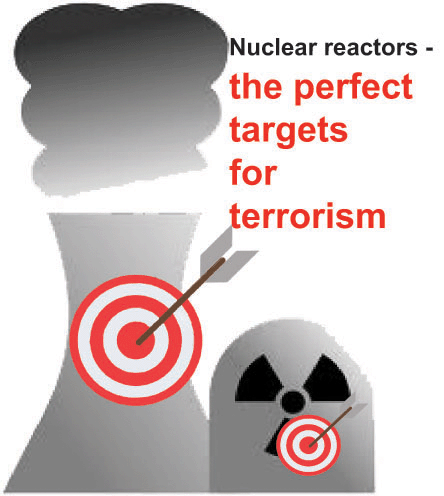
 Pre-deployed terrorist targets: Nuclear power plants have been described as pre-deployed terrorist targets and pose a major security threat. This in turn would likely see an increase in policing and security operations and costs and a commensurate impact on civil liberties and public access to information. Other nations in our region may view Australian nuclear aspirations with suspicion and concern given that many aspects of the technology and knowledge-base are the same as those required for nuclear weapons.
 Former US Vice President Al Gore summarised the proliferation problem: “For eight years in the White House, every weapons-proliferation problem we dealt with was connected to a civilian reactor program. And if we ever got to the point where we wanted to use nuclear reactors to back out a lot of coal … then we’d have to put them in so many places we’d run that proliferation risk right off the reasonability scale.”
Too slow: Expanding nuclear power is impractical as a short-term response to climate change. An analysis by Australian economist Prof. John Quiggin concludes that it would be “virtually impossible” to get a nuclear power reactor operating in Australia before 2040. More time would elapse before nuclear power has generated as much as energy as was expended in the construction of the reactor: a University of Sydney report concluded that the energy payback time for nuclear reactors is 6.5‒7 years. Taking into account planning and approvals, construction, and the energy payback time, it would be a quarter of a century or more before nuclear power could even begin to reduce greenhouse emissions in Australia (and then only assuming that nuclear power displaced fossil fuels).
 Too thirsty: Nuclear power is extraordinarily thirsty. A single nuclear power reactor consumes 35‒65 million litres of water per day for cooling.
Water consumption of different energy sources (litres / kWh):
* Nuclear 2.5
* Coal 1.9
* Combined Cycle Gas 0.95
* Solar PV 0.11
* Wind 0.004
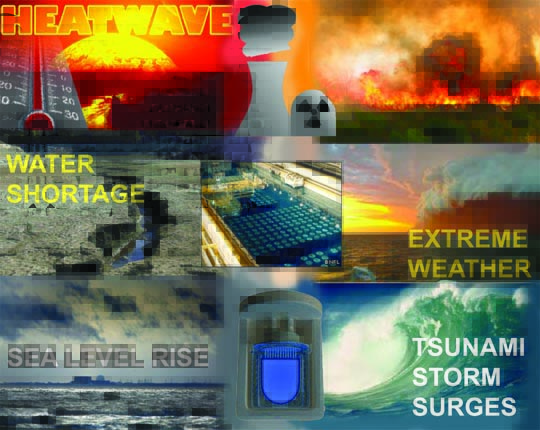
Climate change and nuclear hazards: Nuclear power plants are vulnerable to threats which are being exacerbated by climate change. These include dwindling and warming water sources, sea-level rise, storm damage, drought, and jelly-fish swarms. Nuclear engineer David Lochbaum states. “I’ve heard many nuclear proponents say that nuclear power is part of the solution to global warming. It needs to be reversed: You need to solve global warming for nuclear plants to survive.”
In January 2019, the Climate Council, comprising Australia’s leading climate scientists and other policy experts, issued a policy statement concluding that nuclear power plants “are not appropriate for Australia – and probably never will be”.
By contrast, the REN21 Renewables 2015: Global Status Report states that renewable energy systems “have unique qualities that make them suitable both for reinforcing the resilience of the wider energy infrastructure and for ensuring the provision of energy services under changing climatic conditions.”
 First Nations: Laws banning nuclear power should be retained because the pursuit of a nuclear power industry would almost certainly worsen patterns of disempowerment and dispossession that Australia’s First Nations have experienced ‒ and continue to experience ‒ as a result of nuclear and uranium projects.
To give one example (among many), the National Radioactive Waste Management Act dispossesses and disempowers Traditional Owners in many respects: the nomination of a site for a radioactive waste dump is valid even if Aboriginal owners were not consulted and did not give consent; the Act has sections which nullify State or Territory laws that protect archaeological or heritage values, including those which relate to Indigenous traditions; the Act curtails the application of Commonwealth laws including the Aboriginal and Torres Strait Islander Heritage Protection Act 1984 and the Native Title Act 1993 in the important site-selection stage; and the Native Title Act 1993 is expressly overridden in relation to land acquisition for a radioactive waste dump.
No social license: Laws banning nuclear power should be retained because there is no social license to introduce nuclear power to Australia. Opinion polls find that Australians are overwhelmingly opposed to a nuclear power reactor being built in their local vicinity (10‒28% support, 55‒73% opposition); and opinion polls find that support for renewable energy sources far exceeds support for nuclear power (for example a 2015 IPSOS poll found 72‒87% support for solar and wind power but just 26% support for nuclear power). As the Clean Energy Council noted in its submission to the 2019 federal nuclear inquiry, it would require “a minor miracle” to win community support for nuclear power in Australia.
The pursuit of nuclear power would also require bipartisan political consensus at state and federal levels for several decades. Good luck with that. Currently, there is a bipartisan consensus at the federal level to retain the legal ban. The noisy, ultra-conservative rump of the Coalition is lobbying for nuclear power but their push has been rejected by, amongst others, the federal Liberal Party leadership, the Queensland Liberal-National Party, the SA Liberal government, the Tasmanian Liberal government, the NSW Liberal Premier and environment minister, and even ultra-conservatives such as Nationals Senator Matt Canavan.
 The future is renewable, not radioactive: Laws banning nuclear power should be retained because the introduction of nuclear power would delay and undermine the development of effective, economic energy and climate policies based on renewable energy sources and energy efficiency. A December 2019 report by CSIRO and the Australian Energy Market Operator finds that construction costs for nuclear reactors are 2‒8 times higher than costs for wind or solar. Levelised costs for nuclear are 2‒3 times greater per unit of energy produced compared to wind or solar including either 2 hours of battery storage or 6 hours of pumped hydro energy storage.
Australia can do better than fuel higher carbon emissions and unnecessary radioactive risk. We need to embrace the fastest growing global energy sector and become a driver of clean energy thinking and technology and a world leader in renewable energy technology. We can grow the jobs of the future here today. This will provide a just transition for energy sector workers, their families and communities and the certainty to ensure vibrant regional economies and secure sustainable and skilled jobs into the future. Renewable energy is affordable, low risk, clean and popular. Nuclear is not. Our shared energy future is renewable, not radioactive.
More Information
* Don’t Nuke the Climate Australia, www.dont-nuke-the-climate.org.au
* Climate Council, 2019, ‘Nuclear Power Stations are Not Appropriate for Australia – and Probably Never Will Be’, https://www.climatecouncil.org.au/nuclear-power-stations-are-not-appropriate-for-australia-and-probably-never-will-be/
* WISE Nuclear Monitor, 25 June 2016, ‘Nuclear power: No solution to climate change’, https://www.wiseinternational.org/nuclear-monitor/806/nuclear-power-no-solution-climate-change
Dr. Jim Green is the national nuclear campaigner with Friends of the Earth Australia.
February 27, 2020
Posted by Christina Macpherson |
AUSTRALIA, business and costs, climate change, indigenous issues, water |
Leave a comment
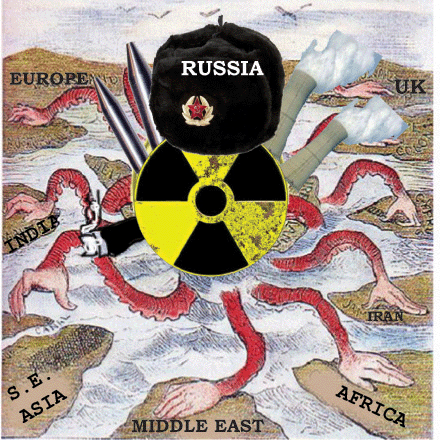
Russia lends Egypt $25 billion for Dabaa nuclear power plant, AL-Monitor, 26 Feb 20, CAIRO — Atomstroyexport, a subsidiary of Russia’s State Atomic Energy Corporation, or Rosatom, announced Feb. 17 that three Egyptian companies were awarded a tender offer for constructing the first phase of Egypt’s Dabaa nuclear power plant.
The three Egyptian companies, competing among 10 others, are Petrojet, Hassan Allam and the Arab Contractors.
The Egyptian government intends to start negotiations within the next few days with the Egyptian Nuclear and Radiological Regulatory Authority to obtain permission to start implementing the Dabaa nuclear plant project. The plant will be constructed in the Dabaa area of Marsa Matrouh governorate in the west of the country.
The Dabaa plant is the first nuclear plant for peaceful uses, with a total capacity of 4.8 gigawatts. The project is financially supported by Rosatom through a Russian loan amounting to $25 billion………….
Yemen al-Hamaki, a professor of economics at Ain Shams University said that under this agreement Egypt will use the loan to finance 85% of the total value of the building, construction, insurance and all other related works. Egypt would bear the remaining 15% in the form of installments. The loan is for 13 years at a 3% annual interest rate. If Egypt fails to repay any of the annual interest within 10 working days, it shall be subject to arrears of 150% of the interest rate calculated on a daily basis
Hamaki also warned that this massive Russian loan of $25 billion could blow up Egypt’s foreign debts. “This loan is a great risk to the future because it burdens the state and should be settled from the wealth and economic assets of the future generations,” she said, adding, “Egypt’s resorting to many loans foretells its inability to attract foreign investments, while tourism revenues continue to decline.” ….. https://www.al-monitor.com/pulse/originals/2020/02/power-plant-nuclear-egypt-russia-loan.html#ixzz6F5iQcolQ
February 27, 2020
Posted by Christina Macpherson |
Egypt, marketing, Russia |
Leave a comment
 The New Republic The New Republic
A report from two economists at JP Morgan Chase pushes back against traditional economic wisdom on climate change. By KATE ARONOFF, February 25, 2020
JP Morgan Chase is the world’s leading financer of fossil fuel projects. And according to a report from within the company, recently leaked to the press, the world is seriously underestimating the adverse effects of climate change. The 22-page report, entitled “Risky Business: the climate and the macroeconomy” and dated January 14, 2020, has been reported by multiple outlets since Friday as containing a gloomy assessment of the risk presented by climate change in the near future. But it also offers a withering takedown of how economists in particular have tended to think about the climate crisis, criticizing findings from several of the field’s experts by name, including a recent winner of the Nobel Prize in economics.
“We cannot rule out catastrophic outcomes where human life as we know it is threatened,” the report concludes. It’s a stunning bit of cognitive dissonance from a bank that is doing so much to fuel the crisis. It also shows a growing push for a more grounded assessment of the crisis than mainstream economics has offered in recent decades….
Essentially an informational document, the report—written by U.K.-based JP Morgan economists David Mackie and Jessica Murray—reviews a battery of academic literature on climate change. It examines several predictions of climate change’s impact on gross domestic product, including economist Richard Tol’s 2018 survey of 26 different climate models—one of the more comprehensive recent works. While Tol has links to organizations that have cast doubt on the scientific consensus around the climate crisis, as his own research has, the findings listed are not especially controversial. But the JP Morgan Chase report authors push back on those and other prominent predictions. “Most likely,” the authors conclude, “these estimates of the income and wealth effects of unmitigated climate change are far too small.”…….. The JP Morgan report doesn’t include clear recommendations for what the company’s own risk analysts should do with the information presented. “Most likely,” it states, “business as usual will be the path that policymakers follow in the years ahead”—something its authors say “opens the earth to a greater likelihood of a catastrophic outcome” than previously estimated. The report does not discuss the bank’s support for polluting industries, which have spent handsomely to block climate action at virtually every level of government.
“It is depressing that JP Morgan are trying to evade responsibility for this thorough and useful report that restates what climate scientists, Greta Thunberg, and Extinction Rebellion alike have been saying for some time now: that our very future as a species is at stake,” Rupert Read, who originally obtained the report, wrote in an email. “It would be so much better if they owned up fully to what is in this report. But then, that would of course require them to completely transform their business model.”
|
|
February 27, 2020
Posted by Christina Macpherson |
2 WORLD, business and costs, climate change |
Leave a comment

|
Pentagon Plan Calls for a $9 Billion Surge in Nuclear Spending by 2025, TIME, BY TONY CAPACCIO / BLOOMBERG, FEBRUARY 26, 2020
The Pentagon’s five-year nuclear weapons plan calls for requesting at least $167 billion through 2025 — building from the $29 billion sought for next year to $38 billion, according to previously undisclosed figures.
The commitment includes research, development, procurement, sustainment and operations. It reflects a major boost to an effort started under President Barack Obama to replace aging nuclear systems, such as Minuteman III missiles and command and control systems.
It doesn’t include funding for the Energy Department’s National Nuclear Security Administration, which is requesting $19.8 billion for fiscal 2021, including $15.6 billion for nuclear weapons activities.
Congressional Democrats have been generally supportive of increased nuclear weapons spending, but Defense Secretary Mark Esper is likely to be questioned about the size and scope of the five-year plan when he testifies Wednesday before the House Armed Services Committee.
Esper is also likely to face bipartisan opposition from the defense-focused committee on President Donald Trump’s plan to shift $3.8 billion from Pentagon programs to his wall on the Mexican border.
The Defense Department’s five-year plan on nuclear programs calls for $29 billion for fiscal 2021, $30 billion in 2022 and $33 billion in 2023, before jumping to $37 billion in 2024 and $38 billion in 2025.
The plan includes $25 billion for research and procurement — but not support and operations for — the new Columbia-class intercontinental ballistic missile submarine that begins construction this year, $24 billion for improved nuclear command and control and $23 billion for the Air Force’s B-21 bomber. ….. https://time.com/5790901/pentagon-nuclear-weapons-spending/
|
|
February 27, 2020
Posted by Christina Macpherson |
business and costs, USA, weapons and war |
Leave a comment
|
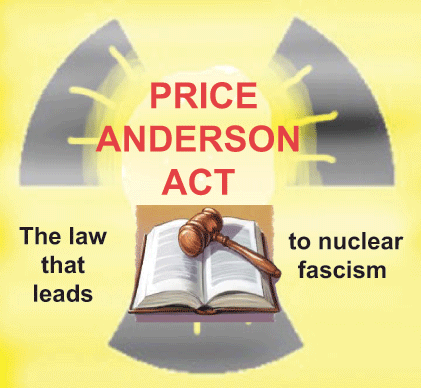
The US government insurance scheme for nuclear power plant accidents no longer makes sense, Bulletin of the Atomic Scientists, By Victor Gilinsky, February 26, 2020 The Japan Center for Economic Research, a source sympathetic to nuclear power, recently put the long-term costs of the 2011 Fukushima accident as about $750 billion. Contrast that with the maximum of $13 billion that could be available after a catastrophic US nuclear accident under the plant owners’ self-insurance scheme defined by the Price-Anderson Act. The Act will have to be renewed before 2025; Congress should seize the opportunity not only to reflect on the lack of insurance in the event of a catastrophic accident, but also to reconsider our approach to nuclear power plant safety altogether.
Price-Anderson frees nuclear plant operators and all firms involved in nuclear construction and maintenance of any liability for offsite accident damage. The only chance for additional compensation lies in the act’s declaration that if accident damages exceed the legal limit “Congress will thoroughly review the particular incident” and will “take whatever action is determined to be necessary” to provide full compensation to the public. In short, a Fukushima-level accident would toss the costs of compensation and cleanup unto the lap of Congress. ……….
The main public risk of nuclear power plants comes from rare but devastating nuclear accidents. Because data on such accidents is sparse, the probability of their occurrence has to be calculated on the basis of a model, rather than obtained from experience. Moreover, the extent of an accident and its monetary consequences are postulated on the basis of models that are limited by analysts’ imagination. Who would have imagined, for example, that the Fukushima accident would involve several reactors? Or that Japan would subsequently shut down all its other nuclear power plants?……….
Curiously, from the chairman on down, the NRC misstates the legal standard for its safety decisions. The NRC and its staff claim their job is to provide “reasonable assurance of adequate protection,” whereas the standard in the Atomic Energy Act is “adequate protection.” Under the law, their job is to provide adequate protection, period. Do the commissioners think the extra cushion of “reasonable assurance” justifies weaker regulation?
To return to the Price-Anderson Act: As we’ve seen, a catastrophic accident would render the US self-insurance scheme for nuclear power plants pretty much irrelevant. But the indemnification of all industry participants would remain highly relevant: The industry would be free of any liability for offsite death or damage, whereas the victims would have to go hat in hand to Congress for restitution. This is an enormous subsidy—consider, again, the $750 billion and counting tab for Fukushima—that the federal government provides the nuclear industry, one without which not a single US nuclear power plant would or could operate. Freedom from liability also has had a perverse effect on nuclear safety. Without the liability protection of Price-Anderson, industry incentives to develop nuclear designs safer than light water reactors would surely have been higher.
Freedom from liability was put into law in the 1950s to get the US commercial nuclear power industry off the ground. It was meant to be temporary, until industry and insurers got some experience with the new technology. But even as time went on, industrial organizations like General Electric and Westinghouse would not participate in the civilian nuclear program if they risked responsibility for offsite damage from a nuclear plant accident………
What is clear is that the nuclear firms—the largest of which possess an understanding of nuclear safety far beyond that of the public—do not believe the NRC safety conclusions that the risk of a catastrophic nuclear accident is infinitesmal. Nor do they accept that probable risk—probability of an accident times the consequences, were one to occur—as the right measure of risk to their companies. They don’t want to risk their companies, period.
If they don’t believe the NRC numbers, why should the rest of us accept them?
Why shouldn’t we have the same protection from physical harm that the nuclear industry has from financial liability? And just as the nuclear vendors will not participate on terms that do not include indemnification from the overwhelming cost of a severe accident, so should the public have the analogous power to only accept future nuclear designs that can demonstrate that they preclude offsite harm. And the designs should demonstrate that level of safety in a clear way, based on physical principles, not on complicated probabilistic calculations put forward by interested parties.
Such new designs would eliminate the current dilemma of a federal nuclear self-insurance scheme that cannot, as a practical matter, cover the financial consequences to the public of catastrophic nuclear power plant accidents. But how to get there? One of the disincentives is the Price-Anderson Act’s limitations on industry liability for offsite accident consequences. That should get phased out. https://thebulletin.org/2020/02/the-us-government-insurance-scheme-for-nuclear-power-plant-accidents-no-longer-makes-sense/#
|
|
February 27, 2020
Posted by Christina Macpherson |
business and costs, Legal, Reference, USA |
Leave a comment
 G20 sounds alarm over climate emergency despite US objections,Group’s first ever reference to global heating signals growing economic concerns over climate change, Guardian, Richard Partington Economics correspondent @RJPartington, Mon 24 Feb 2020 The G20 group of the world’s wealthiest nations have agreed for the first time to collectively sound the alarm over the threat to the financial system posed by the climate emergency.Overcoming objections from Donald Trump’s US administration, G20 finance ministers and central bank governors meeting in Saudi Arabia over the weekend agreed to issue their first ever communique with references to climate change, according to reports from Reuters. G20 sounds alarm over climate emergency despite US objections,Group’s first ever reference to global heating signals growing economic concerns over climate change, Guardian, Richard Partington Economics correspondent @RJPartington, Mon 24 Feb 2020 The G20 group of the world’s wealthiest nations have agreed for the first time to collectively sound the alarm over the threat to the financial system posed by the climate emergency.Overcoming objections from Donald Trump’s US administration, G20 finance ministers and central bank governors meeting in Saudi Arabia over the weekend agreed to issue their first ever communique with references to climate change, according to reports from Reuters.
Sources told the news agency that the statement of priorities included the importance of examining the implications of global heating for financial stability, as part of the work of the G20’s Financial stability Board, the steering group for international banking industry rules.
The language represented a compromise to overcome opposition from US officials at the first major meeting of Saudi Arabia’s year-long presidency of the G20, according to the sources. An attempt to include references to the downside risks for global growth posed by the climate crisis was dropped…….
The International Monetary Fund included climate-related disasters in a list of the risks facing a highly fragile recovery in the global economy this year. However, the increasing focus comes as US officials resist naming global heating as an economic risk, following Trump’s move at the outset of his presidency to withdraw the world’s largest economy from the Paris climate accords. https://www.theguardian.com/world/2020/feb/23/g20-sounds-alarm-over-climate-emergency
|
|
February 25, 2020
Posted by Christina Macpherson |
2 WORLD, business and costs, climate change |
Leave a comment
|
Party leader urges Centre to protect the country’s security
Demanding dropping of nuclear power plant proposed by Nuclear Power Corporation of India Ltd (NPCIL) at Kovvada in Srikakulam district, CPI (M) State Secretariat member Ch. Narsinga Rao on Monday said United States President Donald Trump was on a visit to India to pursue supply of reactor to the plant, among other things.
He told reporters along with Greater Visakha unit president of CPI (M) B.  Ganga Rao that the Government of India should be aware of the fact that Trump’s son-in-law Jared Kushner had ‘vested interest’ in the supply of the reactor to Kovvada plant. Ganga Rao that the Government of India should be aware of the fact that Trump’s son-in-law Jared Kushner had ‘vested interest’ in the supply of the reactor to Kovvada plant.
Mr. Narsinga Rao said Westhouse company, which agreed to supply the reactor to Kovvada, had been acquired by Brookfield Asset Management, an investment company in which Qatar Investment Authority is a major stakeholder.
The CPI (M) leader said Mr. Kushner was an investor in Qatar Investment Authority.
Mr. Trump might be keen on proceeding with the MoU on Kovvada, he alleged and asked the Centre to protect the country’s security by rejecting America’s plea to supply the rector to NPCIL.
He said originally nuclear power plant was proposed at Mithivirdi in Gujarat and due to public protest, it was later decided to set up the plant at Kovvada. He said the Kovvada plant would be expensive and unviable and banks funding it were bound to turn bankrupt.
Mr. Rao said former Union Power secretary E.A.S. Sarma had also strongly opposed the move to sign MoU with the US for supply of six reactors for Kovvada from the erstwhile Westinghouse company.
|
|
February 25, 2020
Posted by Christina Macpherson |
India, marketing, secrets,lies and civil liberties |
Leave a comment