US Navy fires captain who sought help for coronavirus-stricken nuclear aircraft carrier
 US Navy fires captain who sought help for coronavirus-stricken ship, ABC News, 3 Apr 20 The US Navy has fired the captain of an aircraft carrier who faced a growing outbreak of the new coronavirus on his ship, saying he created a panic by sending his memo pleading for help to too many people. US Navy fires captain who sought help for coronavirus-stricken ship, ABC News, 3 Apr 20 The US Navy has fired the captain of an aircraft carrier who faced a growing outbreak of the new coronavirus on his ship, saying he created a panic by sending his memo pleading for help to too many people.
Key points:
In a four-page memo to Navy leaders, the captain of the nuclear-powered warship said the spread of the disease was ongoing and accelerating, and said that removing all but 10 per cent of the crew was a “necessary risk” in order to stop the spread of the virus. Navy Secretary Thomas Modly said the ship’s commander Brett Crozier “demonstrated extremely poor judgment” in the middle of a crisis……. That decision was immediately condemned by members of the House Armed Services Committee, who called it a “destabilising move” that would “likely put our service members at greater risk and jeopardise our fleet’s readiness”. ….. Captain Crozier graduated from the US Naval Academy in 1992 and later attended the Nuclear Power School, a prerequisite to command a nuclear-powered aircraft carrier. The USS Theodore Roosevelt, with a crew of nearly 5,000, is docked in Guam, and the Navy has said as many as 3,000 people will be taken off the ship and quarantined by Friday. More than 100 sailors on the ship have tested positive for the virus, but none have been hospitalised. ….. Democrats in support of Captain CrozierDemocrats on the House committee issued a joint statement in support of Captain Crozier. They said that while the captain went outside his chain of command, the pandemic presented a new set of challenges. “Captain Crozier was justifiably concerned about the health and safety of his crew, but he did not handle the immense pressure appropriately,” the statement said. Captain Crozier, in his memo, raised warnings the ship was facing a growing outbreak of the coronavirus and asked permission to isolate the bulk of his crew members on shore, an extraordinary move to take a carrier out of duty in an effort to save lives. He said that removing all but 10 per cent of the crew would be a “necessary risk” in order to stop the spread of the virus. “We are not at war. Sailors do not need to die. If we do not act now, we are failing to properly take care of our most trusted asset: our sailors,” Captain Crozier wrote. https://www.abc.net.au/news/2020-04-03/navy-fires-captain-who-sought-help-for-coronavirus-stricken-ship/12117534 |
|
|
UK ‘s new nuclear projects further delayed
|
Nuclear project planning hit by delays, Construction News, 02 APR 2020 BY MILES ROWLAND DECISIONS ON FUTURE NUCLEAR BUILDS HAVE BEEN PUSHED BACK AT THREE POTENTIAL NEW SITES DUE TO THE CORONAVIRUS CRISIS.The planning process for Wylfa Newydd, Sizewell C and Bradwell B have all been delayed by periods ranging from weeks to months.
A decision on Horizon Nuclear’s application for a development consent order (DCO) for Wylfa Newydd – the shelved nuclear project in Anglesey, North Wales – has been pushed back by six months by the government, from 31 March to 30 September. This is the second such delay for the decision, the original deadline for which was 23 October last year. While the project was put on hold over funding issues, Horizon, a subsidiary of Hitachi, had been hopeful the project could restart following the decision and the approval of a new funding model. A statement from the Planning Inspectorate said: “The secretary of state has concluded that an additional period of time is required in order to complete his consideration in respect of environmental effects and other issues which were outstanding following the examination.”…… Decisions on future nuclear builds have been pushed back at three potential new sites due to the coronavirus crisis. The planning process for Wylfa Newydd, Sizewell C and Bradwell B have all been delayed by periods ranging from weeks to months. A decision on Horizon Nuclear’s application for a development consent order (DCO) for Wylfa Newydd – the shelved nuclear project in Anglesey, North Wales – has been pushed back by six months by the government, from 31 March to 30 September. This is the second such delay for the decision, the original deadline for which was 23 October last year. While the project was put on hold over funding issues, Horizon, a subsidiary of Hitachi, had been hopeful the project could restart following the decision and the approval of a new funding model. A statement from the Planning Inspectorate said: “The secretary of state has concluded that an additional period of time is required in order to complete his consideration in respect of environmental effects and other issues which were outstanding following the examination.”……. EDF and Horizon Nuclear have also been awaiting a decision from the government on whether the regulated asset base model could be used to fund nuclear projects, following a consultation in October. The model requires developers to spend less upfront and instead raise cash through consumer bills. A spokesman for the Department for Business, Energy and Industrial Strategy said a decision would be made “in due course”. Meanwhile, the public consultation for Bradwell B in Essex, which began last month, is to be extended by five weeks. The project is introducing new ways for the community to participate in the consultation online and on the phone, as well as allowing people to book 20-minute discussions with nuclear experts to answer questions throughout April. Ground-surveying works are continuing on site at Bradwell B, and the project is awaiting a decision from the Office for Nuclear Regulation and the Environment Agency on its design for the UK HPR1000 – a third-generation pressurised water reactor.
Last week EDF announced it was cutting its workforce on Hinkley Point C by more than half, and implemented a range of measures to encourage social distancing after criticism that its actions there had been insufficient. A spokesman declined to state whether this could cause delays to the project. It is due to be completed in either 2025 or 2026. https://www.constructionnews.co.uk/civils/nuclear-project-planning-hit-by-delays-02-04-2020/ |
|
Problems of New England nuclear reactors most are offline
Most NE nuclear power offline due to timing fluke and problem, CT Mirror, CAll but unnoticed as the coronavirus pandemic tears through the Northeast: the New England power grid is without 75% of its nuclear power – with more to go. by JAN ELLEN SPIEGEL, APRIL 3, 2020
Many nuclear power plants schedule refueling operations in spring and fall when electricity demand is lower, and that is the case in New England, where the three remaining nuclear plants typically supply about one-third of the electricity. The Seabrook Nuclear plant in New Hampshire went offline on Tuesday for its refueling – that’s 1,245 megawatts of power. Unit 2 of the Millstone Nuclear Power Station, with about 870 megawatts, is due for refueling this spring as well.
But in the meantime, Millstone Unit 3, which carries about 1,230 megawatts , tripped offline less than a day after the Seabrook shutdown due to a circuit fault between the main generator and the switchyard, according to Kenneth Holt, spokesman for the plant’s owner Dominion Energy. The automatic reactor protection system kicked in as it was supposed to and the plant was shut down.
As of Friday noon, the grid mix showed nuclear at 8% and natural gas at a whopping 68%.
While the situation is abnormal and the timing with the health emergency a fluke, it does not pose any special risks for the region, especially since the demand for power is lower than normal because so much commerce and industry has temporarily shut down. ……
Nuclear plants have some wiggle room, but not a lot, for refueling. In the case of Millstone, each unit is refueled every 18 months in an alternating rotation. Unit 3, the one offline now, is due for refueling in the fall. Refueling takes about one month during which one-third of the plant’s nuclear rods, which are about one foot-by-one foot by 12 to 14 feet long, are replaced. They last about 4.5 years.
……….. https://ctmirror.org/2020/04/03/most-ne-nuclear-power-offline-due-to-timing-fluke-and-problem/
Sweden’s Vattenfall AB’s 44-year-old Ringhals-1 shut down, as energy prices fall
U.S. Nuclear Regulatory Commission (NRC) may exempt some nuclear stations from work-hour controls
NRC to Consider COVID-19 Exemptions for Nuclear Plant Work-Hour Controls https://www.powermag.com/nrc-to-consider-covid-19-exemptions-for-nuclear-plant-work-hour-controls– Sonal Patel , POWER senior associate editor (@sonalcpatel, @POWERmagazine). 30 Mar 20,
The Nuclear Regulatory Commission (NRC) on March 28 told industry that it is prepared to grant requests from individual nuclear generators for exemptions from work-hour controls specified in its rules to help provide more flexibility to the sector as it grapples with workforce issues related to the COVID-19 public health emergency.
The objective of the exemptions from Title 10 of the Code of Federal Regulations (10 CFR 26.205(d)(1)-(7)) is to ensure that the “control of work hours and management of worker fatigue do not unduly limit licensee flexibility in using personnel resources to most effectively manage the impacts of the COVID-19 [public health emergency (PHE)] on maintaining the safe operation of these facilities,” NRC Director of Nuclear Reactor Regulation Ho Nieh wrote in letters sent to the Nuclear Energy Institute (NEI), Entergy Nuclear, and Florida Power and Light over the weekend.
Nieh wrote that the exemptions will apply narrowly—only to nuclear plants whose staffing levels are affected by the pandemic. Licensees must also show they can no longer meet the work-hour controls outlined in the rules, and they can institute site-specific administrative controls for pandemic fatigue-management for personnel as outlined in the rules.
Alternative fatigue-management controls, for example, should ensure employees do not work more than 16 work-hours in any 24-hour period and not more than 86 work-hours in any 7-day period, excluding shift turnover; a minimum 10-hour break is provided between successive work periods; 12 hour shifts are limited to not more than 14 consecutive days; and a minimum of six days off are provided in any 30-day period.
Nuclear licensees that cannot meet the rule’s requirements should notify the NRC in writing, including by email, no less than 24 hours before they would be out of compliance with the rules, Nieh said. The NRC plans to consider requests on a case-by-case basis and, if approved, provide exemptions for a period of 60 days. “If the COVID-19 PHE condition does not improve before expiration of the exemption, then the NRC may consider an additional exemption period,” he added.
(This story is being updated; check back later for more details.)
—
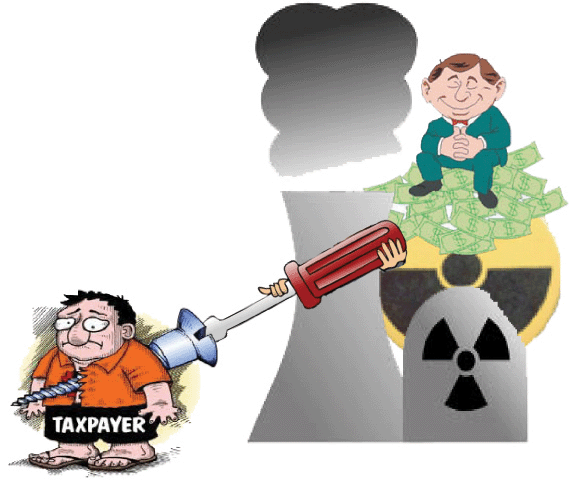
USA nuclear industry uses coronavirus to gouge $billions of tax-payer money
|
Out of control?, While industry looks for handouts, NRC gives nod to reduced safety oversight, https://wordpress.com/read/feeds/72759838/posts/2643325963By Linda Pentz Gunter 29 Mar 20, It was no surprise really, when the first to line up with outstretched palms as Congress debated and formulated its now passed $2 trillion coronavirus-prompted emergency relief bill, were nuclear corporations.The sinking nuclear power industry spotted an economic lifeline and couldn’t wait to make a grab for it. The Nuclear Energy Institute, the lobbying arm of the nuclear power industry, rushed off a letter to congressional leaders asking for a 30% tax credit and waivers for existing regulatory fees. One of NEI’s apparently needy recipients is the financial fiasco known as Vogtle 3 and 4, the new nuclear power plant construction project in Georgia, which is already more than five years behind schedule and is projected to cost $28 billion, double the original predicted price. The two new Georgia reactors aren’t needed, and their continued slow progress is by no means a matter of national security right now — or at all. But the NEI would like to see a nice fat grant go to Georgia Power to continue construction there, even though the company has already received two federal loan guarantees totaling $12 billion. In addition, the company is also gouging ratepayers in advance to cover the costs for the two reactors through the state’s Construction Work in Progress law, with no guarantee that they will ever reach completion. Before long, the nuclear weapons manufacturers got in on the act as well. Wrote the group, Code Pink: “Boeing has the audacity to demand a $60 billion taxpayer bailout for their shareholders and CEO.” Boeing is responsible for the Minuteman Intercontinental Ballistic Missiles, to be replaced this year with the misleadingly named Ground Based Strategic Deterrent. Boeing has also already received a $26.7 million contract from the U.S. Navy for Trident II D5 ballistic missile maintenance, rebuilding and technical services. Astonishingly, it was ultra conservative senator, Ted Cruz, who was one of those who pushed back against the corporate bailouts for the likes of Boeing and GE, manufacturer of the ill-fated Fukushima nuclear power plants and similar boiling water reactors in the US that are meltdowns waiting to happen. Cruz tweeted that “some are pushing for a special carve-out just for Boeing & GE. That would be WRONG. Millions are losing jobs; we don’t need bailouts or corporate welfare — those companies should participate in the same liquidity programs as everyone else.” But Boeing apparently got its wish. A $17 billion federal loan package contained in the stimulus bill passed by both the House and Senate and signed by President Trump on March 27, “was crafted largely for the company’s benefit,” according to reporting in the Washington Post. Boeing may also be able to dip its fingers into the “$58 billion the Senate package is providing in loans for cargo and passenger airlines, as well as the $425 billion in loans it is allocating to help firms, states and cities hurt by the current downturn,” wrote the Washington Post, even though, as Code Pink pointed out, alluding to the two 737 MAX disasters, Boeing is responsible for “defective civilian planes that plummet from the sky in mid-flight.” Boeing shares soared more than 24% on the day the Senate bill passed. The US is already spending $35.1 billion a year on its nuclear weapons arsenal. As the timely graph below [on original] from ICAN points out, this money could be redirected to a wealth of essential needs that would help quell the novel coronavirus in the US. … It’s not yet clear what portion of the stimulus money might go to the nuclear power industry, but the renewable energy sector took a hit. According to the San Diego Union Tribune, “the renewable energy industry had asked for — but did not get — extensions of deadlines related to construction or completion of solar and wind projects, without which they could lose access to time-sensitive tax credits. Industry associations were hopeful they’d be included in any later relief package.” There is also a $400 billion slush fund in the present legislation which can be used for loans and loan guarantees for large companies. Watch for the nuclear power industry to line up for a share of that in addition to its earlier pitch for a $23 billion bailout, which Lukas Ross, senior policy analyst with Friends of the Earth, called “a new low bar,,” and an attempt to use the coronavirus crisis “to try and brazenly grab more cash.” Meanwhile, the US Nuclear Regulatory Commission (NRC), in its usual fashion, has used the opportunity presented by the corona crisis to relax its already somnific safety oversight even more, and will allow nuclear power plant operators to defer safety maintenance, inspections and fitness for duty requirements during the outbreak. “Regulations to ensure safety should be strengthened at a time like this — not weakened,” Kevin Kamps, radioactive waste specialist at Beyond Nuclear, told Power Magazine. “It means operating nuclear plants without basic safety inspections.” One measure would be to allow workers to put in longer shifts than safety regulations allow, a measure that would place unnecessary additional “stress and strain on workers that need to be fully attentive and alert in sensitive jobs,” Kamps told the Carolina Public Press. He recommended powering down reactors instead, particularly given the current reduction in demand. But if the coronavirus pandemic causes higher than usual absenteeism among vital nuclear plant personnel, the NRC has a plan for that. Under normal circumstances, operating with too few control room staff is a safety violation. But under the coronavirus conditions, this would be exempted, or forgiven by the NRC, creating an added safety risk. During a recent NRC and industry telephone meeting on the topic, Beyond Nuclear’s director of reactor oversight, Paul Gunter, asked whether the NRC had supplied its reactor site personnel with sufficient protective equipment, masks, and respirators, as per the Centers for Disease Control guidelines. “They blew it off, Gunter said. “They claimed it was a matter for OSHA.” Industry representatives on the call remained silent on the matter. Gunter added that Kamps’s suggestion to power down reactors in regions where the demand was reduced and excess generating capacity was already high, could allow for resting the remaining workforce and keeping them healthy and ready to replace workers at still operating plants where personnel have been hit hardest by reactor operator shortages and extended security shifts. “We should be planning on how to keep stable and safety-compliant electricity going,” Gunter said. “One way would be to create a protected pool of sequestered nuclear utility workers. But that is not happening. The industry is dictating to the regulator what the agenda will be.” So, business as usual. |
|
EDF, French company building Hinkley Point power station, shifts workers’ costs to UK govt
Coronavirus: EDF to furlough Hinkley Point workers after reducing site numbers, Edward Thicknesse CITY A.M. 29 Mar 20, Hundreds of workers at EDF’s Hinkley Point C nuclear plant are being furloughed after the firm decided to cut the number of workers on site by more than half.
In an attempt to cut costs, the Telegraph reported that many of the site’s workers are being moved onto the government’s employee retention scheme, which guarantees them 80 per cent of their wages.
In an attempt to cut costs, the Telegraph reported that many of the site’s workers are being moved onto the government’s employee retention scheme, which guarantees them 80 per cent of their wages.
Although some of the 2,000 or so workers moved off the nuclear site in Somerset will continue to work in back office roles, the requirement to pay the majority will now shift to the government.
Those initially set to be moved onto the Treasury scheme are contractors working on the site, not EDF employees.
The French firm said: “Hinkley Point C has reduced the number of workers on its site to enable safe working. The project has not asked for any additional Government support and the majority of workers will remain in employment”.
It is understood that contractors are furloughing 500 or so employees, with the intention to bring them back onto payroll as soon as possible.
EDF has not issued a statement on whether it expects the coronavirus pandemic to impact the project’s timeline. …..
EDF’s decision to reduce its workforce came after the government came under pressure to suspend all non-essential construction work over safety concerns.
Politicians of all stripes, from London mayor Sadiq Khan to Tory ex-minister Iain Duncan Smith hit out against the government’s decision not to pause all such work for the duration of the crisis. https://www.cityam.com/coronavirus-edf-to-furlough-hinkley-point-workers-after-reducing-site-numbers/
Vogtle nuclear power plant construction – “Essential workers”, as the company wants to build in a hurry
 Coronavirus could disrupt normal refueling practices for
  nuclear facilities as staffing concerns grow, Utility Dive, By Iulia Gheorghiu , March 26, 2020

“………Nuclear construction
Various states have included construction work in the categories of essential work when issuing directives to keep people at home.
With pandemic plans in place, Southern Company construction is continuing on the Vogtle units in Georgia. Vogtle construction has not encountered major changes from the novel coronavirus, CEO Tom Fanning told Bloomberg.
Southern announced a non-manual worker for the construction of Vogtle units 3 and 4 was being tested for coronavirus two weeks ago.
“I completely understand that [Southern] wants to finish as soon as possible,” Buongiorno said, given the delays and cost overruns of the construction. (Professor Jacopo Buongiorno, director of the Massachusetts Institute of Technology’s Center for Advanced Nuclear Energy Systems.)…https://www.utilitydive.com/news/coronavirus-could-disrupt-normal-refueling-practices-for-nuclear-facilities/574920/
Nuclear stations having difficulties with staffing; one station has workers positive for Covid19

 Coronavirus could disrupt normal refueling practices for nuclear facilities as staffing concerns grow, Utility Dive, By Iulia Gheorghiu March 26, 2020, The nuclear sector has sprung into action to screen employees for signs of the novel coronavirus and prepare for potential disruptions to their typical refueling practices in light of pandemic-related travel restrictions……..
Government under pressure to suspend non-essential construction work (such as building nuclear plants)
“The judgment we have made is that in work, in many instances, the 2m rule can be applied,” he said.
However critics say public health should be prioritised over the economy during the coronavirus outbreak.
Former Tory cabinet minister Iain Duncan Smith joined those calling for a temporary suspension of work. He told the BBC: “I think the balance is where we should delete some of those construction workers from going to work and focus only on the emergency requirements.”
The confusion over who is able to work came after Prime Minister Boris Johnson’s announced a nationwide lockdown in a televised address on Monday night.
The PM said people should only leave their homes to shop for basic goods, fulfil medical needs, to exercise and to travel to work when “absolutely necessary”. However the types of work considered necessary has not yet been made clear….. https://www.cityam.com/government-under-pressure-to-suspend-non-essential-construction-work/
USA nuclear industry exploits coronavirus, seeking tax-payer funds
 Nuclear Industry Effort to Exploit Coronavirus Crisis for Backdoor Bailout Decried as ‘Disaster Capitalism at its Worst’ https://www.commondreams.org/news/2020/03/23/nuclear-industry-effort-exploit-coronavirus-crisis-backdoor-bailout-decried-disaster Nuclear Industry Effort to Exploit Coronavirus Crisis for Backdoor Bailout Decried as ‘Disaster Capitalism at its Worst’ https://www.commondreams.org/news/2020/03/23/nuclear-industry-effort-exploit-coronavirus-crisis-backdoor-bailout-decried-disaster
“The nuclear industry begged for a bailout last fall and is now using coronavirus to try and brazenly grab more cash,” warned Friends of the Earth. by Andrea Germanos, staff writer, Jon Queally, staff writer According to E&E News, which focuses on the energy industry, the request came in a letter sent to congressional leaders and White House officials on Friday by Nuclear Energy Institute president and CEO Maria Korsnick. In addition to other forms of aid—including sick leave for employees and “prioritized access” to testing and masks—the letter requested taxpayer-funded grants in the form of broad tax credits and waivers for existing regulatory fees. “Our member companies are anticipating—or are already experiencing—severe financial strain as product orders are delayed or canceled, as industrial electricity demand falls, and as workforce availability becomes increasingly constrained,” Krosnick wrote to in a letter sent to lawmakers, Treasury Sectary Steven Mnuchin, and Larry Kudlow, director of the National Economic Council. In reaction, Friends of the Earth senior policy analyst Lukas Ross called the request a bald effort to exploit the current outbreak and economic downturn to obtain the same kind of financial bailout it has repeatedly sought from the U.S. government in recent years. “Demanding a $23 billion gift from taxpayers during an unprecedented public health crisis sets a new low bar,” said Lukas Ross, senior policy analyst with Friends of the Earth. “The nuclear industry begged for a bailout last fall and is now using coronavirus to try and brazenly grab more cash.” The industry proposal, added Ross, “would hurt ratepayers and the climate at a time when immediate need for people must be the first priority. The nuclear lobby should be ashamed. This is disaster capitalism at its worst.” |
|
America’s economic plan for Covid19 directs money to big corporations
Democrats are balking at the Senate GOP’s version of the bill because it is far too top-heavy with financial assistance to corporations and lacks sufficient assistance for working families.

The Virus of Capitalism Has Infected the COVID-19 Fight, William Rivers Pitt, Truthout, 23 Mar 20, …….. Under vastly different circumstances, perhaps it would have been possible to argue for a different path of action than dramatic physical-distancing measures, following from the idea that to develop a herd immunity to COVID-19, a certain number of people have to contract it and recover (assuming we are even capable of developing an immunity, which is not yet confirmed). To even countenance this idea, however, we would need a robust and fully functional health care system to aid in the recovery process.
Why? Money.
And then there is the currently stalled $1.8 trillion COVID-19 relief bill, which hit the reef in Congress over the weekend. Democrats are balking at the Senate GOP’s version of the bill because it is far too top-heavy with financial assistance to corporations and lacks sufficient assistance for working families.
Natch. These fellows never, ever, ever miss an opportunity to loot the till.
And therein lies the rub. The priority of the people (for the most part) is to stay safe, to get well if they fall ill, and to do what must be done to eventually return to some semblance of a normal life. The priority of the capitalists is to get the money machine going again, to take full advantage of the crisis in the name of profit, and to defend their well-staked financial turf from any reforms that may be proposed in the aftermath.
U.S.-style capitalism is also a virus, and it has infected every aspect of this situation. Worker safety, insurance coverage and costs, medical preparedness, and vital supplies — even the bill intended to rescue the country from some final financial calamity: All have been perverted and disrupted by the profit motive that never, ever, ever sleeps. https://truthout.org/articles/the-virus-of-capitalism-has-infected-the-covid-19-fight/?eType=EmailBlastContent&eId=e1200502-b139-4a26-8fdd-b7207fc3df68
Canada pushing Small Modular Nuclear Reactors, but the outlook for uranium/nuclear industry is bleak
 Nuclear power, and Canada’s uranium industry, are struggling to find their place in a green energy future, CIM Magazine, 23 Mar , 2020 NuScale Power submitted its small modular nuclear reactor (SMR) design to the Canadian Nuclear Safety Commission for a pre-licensing vendor design review. This came just over a month after the leaders of three Canadian provinces – Ontario premier Doug Ford, New Brunswick premier Blaine Higgs and Saskatchewan premier Scott Moe – signed a memorandum of understanding to develop SMRs in their respective provinces.
UK’s nuclear regulated asset base (RAB) financing passes all financial risks to electricity customers
Times 15th March 2020 David Lowry: I read with incredulity the claims of Horizon nuclear chief Duncan Hawthorne that his company, which is really a Japanese shell company with no products, could build nuclear plants offering power at half the currently projected cost from the Hinkley Point C plant being built.Fukushima Daiichi reactors in Japan on March 11, 2011 — costs $250bn
(£200bn) and rising — suggests Horizon has not learnt the full lessons
of that. The regulated asset base (RAB) financing mechanism Horizon
advocates transfers all financial investment risk to electricity customers
before a single unit is delivered to a home, allowing the foreign nuclear
company to build plants without having to pay attention to keeping costs
under control. This is an extraordinarily one-sided proposal. Surely even
this nuclear-friendly government cannot fall for it.
1 This Month
26 September – International Day for the Total Elimination of Nuclear Weapons





PLEASE OPPOSE HR 8255 AND S.3639 – bills would accelerate satellite deployment, with no environmental review or safeguards – https://ncstd5li.quorum.us/campaign/169331/
To see nuclear-related stories in greater depth and intensity – go to https://nuclearinformation.wordpress.com
-
Archives
- September 2026 (281)
- August 2026 (330)
- July 2026 (355)
- June 2026 (287)
- May 2026 (306)
- April 2026 (356)
- March 2026 (251)
- February 2026 (267)
- January 2026 (308)
- December 2025 (358)
- November 2025 (359)
- October 2025 (375)
-
Categories
- 1
- 1 NUCLEAR ISSUES
- business and costs
- climate change
- culture and arts
- ENERGY
- environment
- health
- history
- indigenous issues
- Legal
- marketing of nuclear
- media
- opposition to nuclear
- PERSONAL STORIES
- politics
- politics international
- Religion and ethics
- safety
- secrets,lies and civil liberties
- spinbuster
- technology
- Uranium
- wastes
- weapons and war
- Women
- 2 WORLD
- ACTION
- AFRICA
- Atrocities
- AUSTRALIA
- Christina's notes
- Christina's themes
- culture and arts
- Events
- Fuk 2022
- Fuk 2023
- Fukushima 2017
- Fukushima 2018
- fukushima 2019
- Fukushima 2020
- Fukushima 2021
- general
- global warming
- Humour (God we need it)
- Nuclear
- RARE EARTHS
- Reference
- resources – print
- Resources -audiovicual
- Weekly Newsletter
- World
- World Nuclear
- YouTube
-
RSS
Entries RSS
Comments RSS

