The emerging potential new nuclear industry political scam
 Does Nuclear Power Slow Or Speed Climate Change? Forbes, Amory B. Lovins 17 Nov 19,
 2. Through generally regulated utility tariffs, customers paid for the plants’ construction and financing, including a just and reasonable return on capital.
3. Customers paid over decades for the plants’ operation, including major repairs, power upratings, and safety upgrades.
4. Many customers reimbursed owners for “stranded-asset costs” totaling upwards of $70 billion to support the owner-demanded transition to competitive wholesale markets.
5. Over the past few years, when reactors generating 2 percent of U.S. electricity proved unable to compete in those wholesale markets (though most of their owners kept their finances secret and kept reporting profits to investors), the owners persuaded state legislators in Illinois, New York, New Jersey, Connecticut, and Ohio to vote billions of dollars a year for new multi-year operating subsidies.
6. Exelon, the nation’s largest nuclear operator and the leading player in the previous two steps, successfully sought Federal regulatory approval for greater capacity payments from power pools whose auctions found nuclear power uncompetitive and whose own rules were thrown off-balance by the new state subsidies. And now, as the annual logrolling season of “tax extenders” rolls around in Congress:
7. For the third year, Exelon is advancing a “Nuclear Powers America Act” to create a new federal investment tax credit on nuclear fuel and maintenance expenses to “help level the playing fuel with other clean energy sources”—whose temporary tax credits are meanwhile being phased down or out. This follows a longstanding pattern of giving different kinds of subsidies to renewables than to nuclear, then “leveling the playing field” by trying to duplicate renewables’ specific forms of subsidies with new ones for nuclear, but never the reverse.
This saga of selling the same hay seven times—and those clever lawyers aren’t done yet—doesn’t include many additional federal and state subsidies. It also doesn’t include an emerging potential scam that could end up with ratepayers’ and federal taxpayers’ getting stuck with vast decommissioning and waste-management liabilities. This emerging pattern has an LLC buy a closed reactor. Absent oversight or rules to stop misbehavior, the LLC could then choose to strip the accumulated customer-funded multi-billion-dollar cash decommissioning fund, not finish the job, and walk away, leaving the parent company whole and electricity customers or taxpayers holding the bag. Watch this space.
Exelon’s proposed “nuclear investment tax credit” has ingenious new features:
– By redefining normal accounting categories so fuel becomes a capital investment, it repays utilities for an “investment” that’s really just a normal operating cost—thus trying to make nuclear operating costs look small by shifting much of them to taxpayers.
The nuclear operating costs it covers have no counterpart for renewables (fuel, nuclear waste management, protection against catastrophic releases of radioactivity), or almost none (operation & maintenance costs), so a tax credit for them would specifically advantage nuclear against renewables.
– Nuclear owners may be able to double-dip, collecting the new federal subsidy and new state subsidies for the same plants and thus turning dead dinosaurs into juicy cash cows.
– There’s virtually no “means test”: the new federal subsidy would apply to about 95% of US operating reactors, including those that the industry claims are currently profitable.
– The proposed legislation, obscurely written in tax-law jargon, appears to be a 30% tax credit (phasing down to 26% in 2024, 22% in 2025, and a permanent 10% in and after 2026), and to cost ~$22–26 billion over the first decade, or ~$33 billion counting the crowding-out of cheaper competitors. Every billion dollars thus bilked from taxpayers is unavailable to provide more electrical services and save more carbon by cheaper means.
– By further distorting the delicate balance between federal, regional, and state regulation, the subsidy seems tailored to weaken or destroy the efficient regional power markets where renewables beat nuclear power. The goal is thus to pay nuclear power for values it doesn’t deliver, while blocking its most potent competitors from continuing to provide the values they do deliver.
– Unlike renewable credits that have helped to mature important new technologies, the nuclear credit would elicit no new production, capacity, or innovation. It would simply transfer tens of billions of dollars to the owners of uncompetitive nuclear assets bought decades ago—if they apply for license extension by 2026, as nearly all have done.
This covert attack on renewables is logical because renewables are now the supply-side competitor nuclear must beat but can’t. The nuclear industry is reluctant to admit that renewables are a legitimate competitor, since this would contradict its claims that renewables can’t supply reliable power. Renewables, unlike nuclear power, are also widely popular. Nuclear advocates therefore tend to blame their woes instead on cheap natural gas. However, new and often even existing combined-cycle gas-fired power plants no longer have a business case: a September 2019 study found that at least 90% of the 88 proposed US gas-fired plants are pre-stranded assets. ………https://www.forbes.com/sites/amorylovins/2019/11/18/does-nuclear-power-slow-or-speed-climate-change/#5b47c988506b
Hinkley Point C nuclear, a super-expensive project for a dubious short term gain
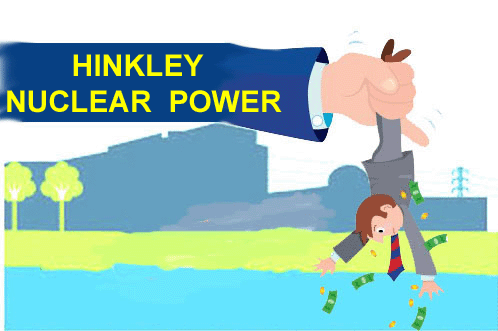 This is the West Country 17th Nov 2019, Stop Hinkley spokesman Roy Pumfrey questions whether the economic boost from Hinkley C is worth the cost I get tired of reading how easily impressed councillors are when they visit the giant incomplete building site that is HPC.
“biggest economic boost” is necessarily a good thing when it is also hugely
problematic and costly for anyone not directly involved? In our case,
economic growth also means a host of problems. There are more traffic jams
all around gridlocked Bridgwater. I’d like to travel from Bridgwater to
Taunton using the Taunton Road, but that simply adds 30 minutes to the
journey time.
schedule.
\ them to the reality of the massive hazard an untried new nuclear power
station running adjacent to her constituency represents.
The plight of Fukushima nuclear workers getting leukaemia
 Fukushima Workers Battle Leukemia – and Bureaucracy Unseen Japan Fukushima Workers Battle Leukemia – and Bureaucracy Unseen Japan
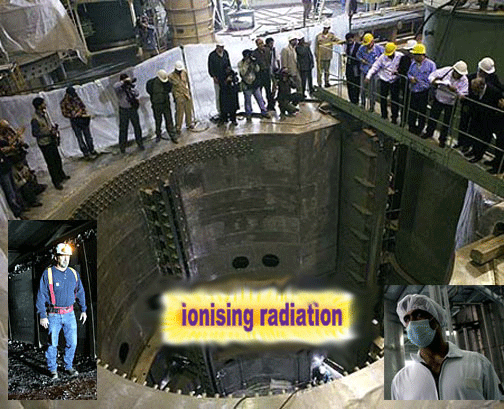
by Hiro Ugaya, November 13, 2019 The March 2011 tsunami, and the subsequent meltdown of three reactors at the Fukushima nuclear power plant, has had a devastating impact on Japan. Eight years later, and most journalists – in Japan and abroad – have forgotten about the story. But for many, the struggle continues.
This is especially true of workers who helped assist in the cleanup effort at Fukushima. Some Fukushima workers have contracted severe diseases – including cancer and leukemia – since their work concluded. The government of Japan has even certified that some cases are a result of recovery work. But workers who are fighting for their lives also find themselves fighting the system. Tokyo Electric (TEPCO), which led the recovery effort, refuses to admit any connection between the cleanup work and subsequent diseases in workers. And many insurance companies are pointing to the fine print in private insurance contracts stating they don’t cover accidents at nuclear facilities. Unseen Japan has been pleased to partner with photojournalist Hiro Ugaya (烏賀陽弘道) to translate his interviews with evacuees and former evacuees, and to document the ongoing struggle of the victims of this tragedy. We previously published Hiro’s interview with a mother in the city of Minamisoma. In this installment, we share the first part of Hiro’s interview with Mr. Ikeda (pseudonym), a Fukushima nuclear reactor cleanup volunteer who now finds himself fighting two uphill battles. Translation from an article originally published on Note.mu. Translation by Jay, Editor/Publisher, Unseen Japan. All photos used with permission of Hiro Ugaya.) Ikeda’s StoryFor this installment of the Fukushima Report, I visited Northern Kyushu City in Fukuoka prefecture. I departed from Tokyo and flew west, in the direction opposite Fukushima. I went to Fukuoka, which is quite far from Fukushima. That’s where the leukemia-stricken Ikeda Kazuya (age 44; pseudonym) has lived since participating in the Daichi Nuclear Reactor reconstruction efforts. I had visited Ikeda once in 2017 to hear his story. Among all my interviews here in the Fukushima Report, it’s the one that’s reverberated the loudest. Mr. Ikeda volunteered to participate in the restoration work at the Fukushima Daiichi nuclear power plant. By trade, he’s an independent welder. In March 2011, when so many people died due to the tsunami, he looked at the report of the death of a small child and thought, “I need to do something useful for Tohoku” [Editor: the region of Japan hit by the tsunami]. He asked permission from his boss and threw himself into the reconstruction effort. The interior of the heavy machinery room of Reactor 4 butts up against the nuclear fuel rod pool. But in 2013, Mr. Ikeda came down with leukemia. Mr. Ikeda is one of the first cancer patients that the country recognizes as a work-related accident connected to the Fukushima Daiichi nuclear power plant. Two Fukushima workers contracted leukemia (bone marrow cancer), and one contracted thyroid cancer. The first case of leukemia was recognized in October 2015. The second was recognized in August 2016. The third person, who had thyroid cancer, was certified in December 2016. As of May 2019, there are six patients in the country whose cases have been recognized as occupational accidents caused by work at the Fukushima Daiichi nuclear power plant. To tell the truth, I was quite surprised that the country recognized them as occupational accidents. Judging from the history of pollution diseases, such as Minamata disease and Itai-itai disease, I predicted the government would probably prevaricate and not admit a causal relationship. But the government admitted it readily (employing a lot of rhetoric, of course, such as “This is not an admission of a scientific, causal relationship”). From a global and historical perspective, the admission is rare. In the Three Mile Island nuclear accident (1979) in the US, more than 2000 lawsuits have been filed, but no relationship between health damage and exposure has been admitted in even a single case. The state government naturally won’t admit it, and the courts don’t either. Due to this admission, the assertion that “the radiation leakage from the Fukushima Daiichi nuclear accident is mild enough not to damage health” fell apart. In the Chernobyl nuclear accident in the former Soviet Union, the first to suffer serious harm were the so-called “Liquidators,” the firefighters and soldiers who were the first responders. Nearly 5,000 people died. Naturally, people who are close to radiation-intensive sites will become seriously ill. The same phenomenon occurred in the Fukushima Daiichi nuclear power plant accident. While the case was recognized as a workplace injury, Mr. Ikeda filed a lawsuit against Tokyo Electric (TEPCO), which ran the restoration project. That’s because TEPCO doesn’t “recognize a causal relationship between Mr. Ikeda’s leukemia and exposure to radiation at the Fukushima Daiichi nuclear power plant.” I’ve long found it mysterious that not a single TV station, weekly newspaper, web media or other news outlet has done an article on those like Mr. Ikeda who contracted deadly diseases from the nuclear reactor recovery work. Since the government’s announcement certifying them as workplace injuries, there’s been dead silence. Those affected can’t be heard in their own voices. ……. Mr. Ikeda pointed out something important. People who work in nuclear facilities such as nuclear power plants are not covered by private insurance, even if they have an accident or get sick. It’s in the so-called “disclaimer.” If People who engaged in the dangerous work of recovering the nuclear power plant post-meltdown have been left naked and defenseless. And few people notice it. Even insurance companies don’t care. I want to fix this abnormality…… (Interview: -) There are six people, including yourself, who have been certified as workplace accidents due to cancer or death from overwork in the recovery work of the Fukushima Daiichi nuclear power plant accident. Any contact from them? No, none. I’ve caught sight of the wife of one of the Fukushima workers who died from overwork (karoshi) at rallies in Tokyo. It seems that TEPCO employees and primary subcontractors who got sick will receive 30 million yen [around USD $274,000]. But in return, they can’t sue. That’s what my lawyer emphasized at trial. But that offer doesn’t extend to us (second-tier subcontractors). The owner who hired me also had business owner insurance. Just in case we have an industrial accident. However, we found out later that it wasn’t valid in nuclear facilities, such as nuclear power plants. The insurance companies say it’s too dangerous a place to cover via employer insurance. And yet TEPCO denies responsibility for my leukemia. That’s what you’re contesting in court. That’s right. They’re denying everything. They say it was too low of a dose to bear any relationship. In the previous trial, TEPCO says I developed leukemia due to smoking, drinking, and a vegetable deficiency. That took me aback (laughs). They talk to us like we’re alcoholics…… What evidence is TEPCO presenting to refute you? Search for the stories of scholars who kowtow to the government, you’ll find it (laughs). Who’s providing testimony, besides you? There are various people I think. TEPCO won’t recognize the causal relationship between your leukemia and radiation exposure, correct? If they did, it’ll become a serious obstacle to future nuclear power policy. I was the first person certified, and there’ve been a number since. So there has to be a causal relationship, right? What total dose did you receive? A total of 19.8 millisieverts. Others received more. TEPCO is terrible. It’d be better if they just copped to it. “Others Will End Up Like Me”Why do you think TEPCO should admit responsibility? When this happens to someone else, this won’t be any guarantee, but it’ll give them peace of mind, you know? I mean, it’s not like you can tell people, “Don’t help with recovery efforts.” Other industries offer insurance – who’s going to guarantee workers who enter a nuclear facility if the employer’s primary insurance won’t? That’s what I want to tell people. Fukushima workers who entered the facility had no idea their employer’s primary insurance wouldn’t cover it……. https://unseenjapan.com/fukushima-workers-leukemia-bureaucracy/ |
|
Before he’s even in the job, USA’s new Energy Secretary Dan Brouillette is busily promoting SMRs for his REAL bosses, the nuclear industryg
 Could tiny nuclear reactors power Alaska villages?
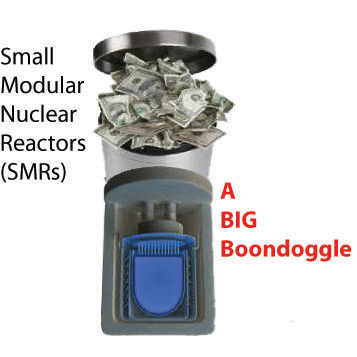
“We want to get to a place where we can develop small micro-reactors, one to five megawatts,” Dan Brouillette said Thursday at his confirmation hearing in the U.S. Senate Energy Committee. …..
Brouillette is now the deputy secretary. He told Murkowski there’s reason to be optimistic about the development of reactors that are a fraction of the size of those in use today. ….. https://www.alaskapublic.org/2019/11/14/energy-secretary-nominee-says-tiny-nuclear-reactors-could-power-alaska-villages/
S and P Global Ratings has made it plain: nuclear power can survive only with massive tax-payer support
 Nuclear power ‘dead and alive’, S&P proclaims, EURACTIV, 13 Nov 19, Growing competition from cheap renewable electricity, safety concerns, and rising costs of new plants are slowly driving nuclear power over the edge – except in Russia and China where the industry continues to enjoy extensive state support, S&P said in a note to investors.It’s probably one of the worst kept secrets in the energy world: nuclear power wouldn’t be able to stand on its own feet without massive government support.
Now, S&P Global Ratings has made it plain and clear to investors.
“The global nuclear industry is facing challenges to do with safety concerns, tightening regulations post-Fukushima, phase-out policies in several countries, aging asset bases, increasingly volatile energy markets, and competition with renewables,” the rating agency wrote in the note, released on Monday (11 November).
“We see little economic rationale for new nuclear builds in the US or Western Europe, owing to massive cost escalations and renewables cost-competitiveness, which should lead to a material decline in nuclear generation by 2040,” S&P said.
But despite those challenges, it would be too soon to pronounce nuclear power dead, S&P adds. China and Russia, for instance, continue to build new nuclear capacities, supported by energy policies and significantly lower construction costs, the rating agency remarked.
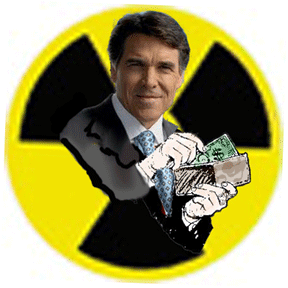 In the US, Energy Secretary Rick Perry has touted small modular reactors (SMRs) as key to the industry’s future, saying small reactors could provide access to electricity in areas of the globe which are currently “shrouded in darkness”. ……..
In Europe, a battle has been raging below the radar on whether to include or reject nuclear power from an upcoming sustainable finance classification scheme aimed at driving private investments into the green economy.
While France supports the inclusion of nuclear in the EU’s draft green finance taxonomy, Germany and Austria argue nuclear isn’t sustainable and shouldn’t be eligible for any kind of EU support. A final decision on the EU’s sustainable finance taxonomy is expected in December. https://www.euractiv.com/section/electricity/news/nuclear-power-dead-and-alive-sp-proclaims/
Messianic Rick Perry preaches nuclear to sceptical Europeans
Messianic Perry preaches nuclear to sceptical Europeans, By Frédéric Simon | EURACTIV.com Oct 26, 2019 Small nuclear reactors can help “vulnerable nations take control of their destinies,” the US energy secretary said in Brussels today (21 October), claiming that small off-grid nuclear plants can bring electricity to poor nations and “disperse the darkness” around the globe…….
Today’s remarks, made in Brussels at the first EU-US high-level forum on small modular reactors, were again chiefly aimed at Eastern European countries, which have repeatedly complained about Russian interference in national politics, using gas as a lever.
Nuclear is a divise topic in Europe. While countries like France opted for it decades ago, others like Germany and Austria are strongly opposed.
“Nuclear energy is neither safe and sustainable nor cost-effective,” said German State Secretary for Energy, Andreas Feicht, during a recent meeting of EU energy ministers, firmly rejecting suggestions that EU money might be used to extend the lifetime of existing nuclear plants.
Today’s remarks, made in Brussels at the first EU-US high-level forum on small modular reactors, were again chiefly aimed at Eastern European countries, which have repeatedly complained about Russian interference in national politics, using gas as a lever.
Nuclear is a divise topic in Europe. While countries like France opted for it decades ago, others like Germany and Austria are strongly opposed.
“Nuclear energy is neither safe and sustainable nor cost-effective,” said German State Secretary for Energy, Andreas Feicht, during a recent meeting of EU energy ministers, firmly rejecting suggestions that EU money might be used to extend the lifetime of existing nuclear plants……
The push for nuclear power in Africa, but what happens to the wastes?

|
What happens to nuclear waste from power plants? DW, 14 Nov 19African countries looking to invest in nuclear energy as a source of clean electricity should consider Europe’s struggles with disposing of radioactive waste. Seventy years after the nuclear age began, no country has built a place to safely store its waste, a report published this week warns, raising concerns for governments mulling nuclear power as an alternative to fossil fuels.More than 60,000 tons of highly radioactive waste in the form of spent nuclear fuel rods are stored in interim sites across Europe, according to the World Nuclear Waste Report, some in old facilities that are running out of capacity and are expected to be used for decades longer than planned. Finland is the only country building a permanent repository underground for nuclear waste that emits large amounts of radiation for tens of thousands of years, according to the report published by the Heinrich Böll Foundation — which is affiliated with the German Green party.
“We are talking about time frames that are beyond the human scale of what we can think of,” said Arne Jungjohann, political scientist and lead editor of the report. “We still don’t know where to put the waste safely in a way that nobody will get harmed, that it is not vulnerable to terrorist attacks, that it is not being stolen to build nuclear bombs.” At the dawn of the nuclear age, radioactive material was diluted and dumped in the environment, before governments moved towards containing it securely underground. But projects from the 1960s onwards only met high safety expectations “to a very limited extent, if at all,” according to the report. That raises difficult questions for developing countries looking to get into nuclear. Nuclear Power in Africa Africa’s urban population is set to double in the next three decades, massively boosting demand for infrastructure and energy. Just half of Africans had access to electricity in 2017, compared to a global average of 88%, World Bank data shows. Eager to connect citizens with electricity grids, but anxious to avoid high-emissions of Western countries, some governments are exploring nuclear as a way to supply cheap and stable energy. South Africa is the only country on the continent that currently operates a nuclear plant, but about a dozen others are considering, planning or building them, according to the World Nuclear Association. Several countries — Algeria, Egypt, Ghana, Kenya, Namibia, Nigeria, Tanzania, Uganda and Zambia — have signed partnership agreements with Russian nuclear energy company Rosatom, a paper published in the journal Issues in Science and Technology found earlier this year, and others have contracts with China…….. attempts to deal with nuclear waste have so far faltered. Excluding Russia and Slovakia due to poor data, the report found that just four countries — France, the UK, Ukraine and Germany — are responsible for more than half of Europe’s nuclear waste, and none have yet found a deep underground store to hold it over centuries. The Heinrich Böll Foundation report found many governments underestimate the cost of storing waste and decommissioning reactors, with inconsistent rules shifting the financial burden from plant operators onto future generations of taxpayers. Unsolved nuclear waste is the “defeating argument against entering into the nuclear age,” said Rebecca Harms, a former Member of the European Parliament who was behind the report. “African countries should consider the nuclear legacies which have been created during the last 50, 60 years and for which we have no solutions.” Demand for energy in Sub-Saharan Africa is set to rise by 60% in the next two decades, but nuclear sources are projected to meet only a small fraction of this, according to the Africa Energy Outlook 2019, a report from the International Energy Agency (IEA) published on Thursday. “What we see in the future economic development of sub-Saharan Africa will be powered by a mix of renewables and natural gas,” said Kieran McNamara, senior energy analyst at the IEA and co-author of the report. “Nuclear just doesn’t feature.” https://www.dw.com/en/what-happens-to-nuclear-waste-from-power-plants/a-51216359 |
|
Georgia Power and the ballooning costs of Nuclear Plant Vogtle
 Plant Vogtle Expansion in the Spotlight: billion$ more at risk
In the 19th VCM, approved last February, the Commission decided to combine the next two reporting periods, which SACE and others opposed, and as predicted, Georgia Power has since spent a lot on the mismanaged nuclear project. The Company is now asking for verification and approval of $1.248 billion in expenditures. And that’s just for Georgia Power’s 45.7% share of the costs incurred during the reporting period from July 2018 to June 2019 for the two new AP1000 reactors under construction at Plant Vogtle near Waynesboro, along the Savannah River.
The continuing saga is like a broken record in each of these VCM proceedings, and it remains mostly the same upon reading Georgia Power’s report and the witnesses’ written testimony, which will be discussed before the Commission on Tuesday.
The project (again) isn’t meeting the productivity goals and appears to be falling further behind schedule, but Georgia Power remains confident (again) that they will somehow have Unit 3 online by November 2021 and Unit 4 by November 2022. Remember, these reactors were supposed to both be operational by April 2017!
And (again) Georgia Power provides itself an out, pointing (again) to a multitude of potential “challenges” in the months ahead that could impact the schedule and most importantly ultimate costs to the utility customers. Because of consistent delays and mismanagement, the currently-projected total cost of this project has more than doubled from the original $14.1 billion estimate to over $28 billion.
Georgia Power customers concerned about their utility bills should let the Commission know that not only are they worried about how the proposed rate hike will affect their bills, but are also very concerned about what happens when the other shoe drops – when Plant Vogtle’s final budget-busting price tag gets rolled into customer’s electricity rates.
Unable to attend the November 12 hearing? Watch online starting at 9am ET via the PSC’s livestream feed and contact the PSC with your concerns.
France considering building 6 new EDF nuclear reactors at a cost of at least 46 billion euros ($51 billion)
 France’s EDF expects six new nuclear reactors to cost 46 billion euros: Le Monde, PARIS (Reuters) 11 Nov 19 – French power utility EDF estimates it would cost at least 46 billion euros ($51 billion) to build six of its latest generation EPR nuclear reactors if the government decides to build them, French newspaper Le Monde reported on Saturday.The estimate was in a confidential document presented to the board of state-controlled EDF at the end of July, it said.
However, the Flamanville EPR reactor under construction in northern France has been plagued by cost overruns and a series of technical problems resulting in years of delays.
EDF, in which the state has an 84% stake, said in October the project which began in 2006 would cost 1.5 billion euros more than previously expected, raising the total cost to 12.4 billion euros.
Reporting by Leigh Thomas; Editing by Edmund Blair full story https://www.reuters.com/article/us-edf-nuclear-epr/frances-edf-expects-six-new-nuclear-reactors-to-cost-46-billion-euros-le-monde-idUSKBN1XJ074
EDF – a nuclear business financial meltdown
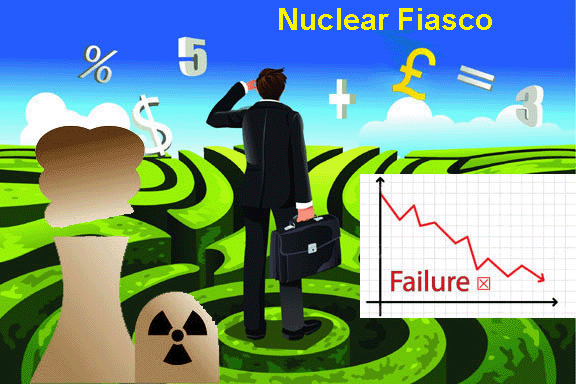
On the shores of the English channel in Normandy, engineers are struggling to fix eight faulty welds at a plant that’s supposed to showcase France’s savoir faire in nuclear power.As they consider sending in robots to access hard-to-get-to areas between two containment walls, for Electricite de France it’s just the latest setback in a project that’s running a decade late and almost four times over budget.
“We hear every year that there’s a new problem,” Finance Minister Bruno Le Maire said on Monday. It is not acceptable that one of the most prestigious and strategic sectors for our country is facing so many difficulties.”
The Flamanville plant is now slated to be completed in 2022 at a price tag of 12.4 billion euros ($13.8 billion), with the latest glitch costing a whopping 1.5 billion euros. Bemoaning the loss of France’s edge in the sector because of a 15-year gap between the start of construction at the plant and that of the previous reactor, Le Maire has given EDF a month to come up with an action plan to restore the industry’s know-how before the country can determine whether it will build any new atomic plants.
For the world’s largest producer of nuclear power producer, Flamanville is just one of many challenges. Across the channel, delays at two U.K. reactors have upped the cost to as much as 22.5 billion pounds ($28.9 billion), 2.9 billion pounds more than previously estimated. EDF also faces mounting costs of maintaining 58 domestic nuclear plants that provide more than 70% of France’s power.
Add to the mix the fact that the former electricity monopoly is losing market share among French corporate and residential clients as rivals buy a part of the electricity it generates at below-market prices, and it’s easy to see why investors are bearish about the company. EDF’s stock has lost 34% this year, making it the second worst-performing utility in the Stoxx 600 Utilities Index of European companies.
A year ago, EDF was Europe’s biggest utility by market value. Now, its market capitalization stands at 28 billion euros, less than half that of Italy’s Enel SpA, which has swelled to 69 billion euros on the success of its renewable business. RWE AG, the German utility planning to shut down its nuclear plants and progressively phase out coal-fired plants, is up 43% this year and Orsted A/S, the Danish champion in offshore wind, whose revenue is about a sixth of EDF’s, has surpassed the French giant.
“Investors are staying away because of current uncertainties following the strongly negative news flow on the reputation of the nuclear industry,” said Auguste Deryckx, an analyst at AlphaValue. “The CEO’s stubbornness in pursuing nuclear, which is limiting potential growth in renewables that are better valued by the market, remains a black spot.”
EDF is struggling to cover the 15 billion euros it needs annually to maintain its aging nuclear reactors, build new atomic and renewable projects, upgrade its electricity network and roll out smart meters, even after cutting 1.1 billion euros in cost cuts in the past four years. Profits have been hit not only by falling power prices, but by safety issues that have forced reactors to be shut for several months in France and the U.K. Other clouds on the horizon—the decommissioning of two of its oldest reactors next year and a dozen more by 2035, and the treatment of nuclear waste.
The one-time monopoly—now about 83% owned by the state—needs some drastic measures, says Chief Executive Officer Jean-Bernard Levy, who’s pushing the state for an increase in the regulated prices at which rivals buy the company’s nuclear power……..https://www.msn.com/en-au/news/world/the-worlds-largest-nuclear-power-producer-is-melting-down/ar-AAJEHRZ?li=AAgfYrC&fbclid=IwAR2c-xzdRQS6grHOpiPYl5e7lEPRCPkPIQCGEWCP3vT5mxgDkH4sfc9alJo
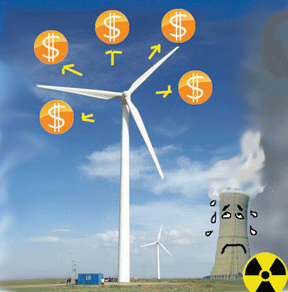
Nuclear costs escalate as wind prices keeps falling,
 WindEconomics: Nuclear escalates as wind prices keeps falling, WindPower monthly, 31 October 2019 by David Milborrow
Nuclear power is too expensive. That is the implicit conclusion of the UK government, which has issued a consultation document on possible ways of reducing the electricity price.
This would be possible if the government — which can borrow money cheaply –shouldered some of the risks and/or provided some finance.
The consultation focuses on “regulated asset base” models. The document describes these models as “typically used for funding UK monopoly infrastructure” and involving “an economic regulator who grants a licence to a company to charge a regulated price to users of the infrastructure”.
One of the advantages for developers is that charges can be levied before the project is completed.
The range of possible prices quoted in the consultation document, shown in the top below, bears out the maxim that “prices are what you want them to be”.
They range from a minimum of -£6/MWh, when the state shoulders all the risks and the rate of return for the government is 2%, to £137/MWh, when the investors demand a 12% rate of return and bear all the risks. In the first case, the cost to the taxpayer would be £18 billion.
The present contract for the under-construction Hinkley Point C power station, which has been widely criticised, is based on a 9% rate of return and an electricity price of £92.5/MWh (2012 prices). That is about £106/MWh (€119/MWh on 1 October) in 2019 prices.
It was announced on 25 September that the estimated cost of the project had risen by nearly 10% — to £21.5-22.5 billion.
The price of electricity to the consumer will not increase, but the profitability for developer EDF will be reduced. This gives a new benchmark price for nuclear of £6,750/kW, as the facility’s output will be 3.26GW.
The effects of moving away from state funding can be illustrated by looking back to the first public inquiry for Hinkley Point….. https://www.windpowermonthly.com/article/1663433/windeconomics-nuclear-escalates-wind-prices-keeps-falling
African countries being conned into nuclear debt, by Russia
 African countries rush to sign nuclear deals with Russia, Daily Maverick By Peter Fabricius• 29 October 2019
But concerns are being raised about whether they can all afford nuclear energy.
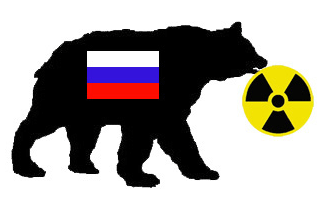
The Russian nuclear power corporation Rosatom has already signed nuclear cooperation agreements with about 18 African counties, as Russia accelerates its drive for nuclear business on the continent.
The growing commitment of African countries to high capital cost nuclear energy has raised some concern about whether they are committing themselves to unaffordable debt.
Rosatom director-general Alexey Likhachev revealed a large number of nuclear agreements with African countries after signing an intergovernmental agreement on cooperation in the peaceful uses of nuclear energy with the Ethiopian Minister of Innovation and Technology, Getahun Mekuria Kuma, during the Russia-Africa Summit in Sochi on the Black Sea last week.
Mekuria later told the Russian official news agency Tass that Ethiopia had plants to build a nuclear power plant.
Rosatom later also signed an agreement with Rwanda at the summit on cooperation for the construction of a centre of nuclear science and technology in Rwanda. Rosatom had a strong presence at the economic forum which paralleled the political summit. The Rosatom stand attracted scores of interested African government officials on the sidelines of the forum. …..
Likhachev told journalists after the discussion that Rosatom had now signed memoranda of understanding or intergovernmental agreements with about one-third of countries on the continent – about 18. He could not say how many of these were about scientific cooperation and how many were about producing nuclear energy “because very often those two tracks go hand in hand”.
But he did say in the discussion that about half of the African countries with which Rosatom had signed nuclear agreements were actively discussing joint projects with the corporation, which had been stipulated in contracts. The most advanced joint project is with Egypt, which has contracted Rosatom to build a 4,800MW nuclear power plant……
“We are ready to propose to Ethiopia cutting-edge solutions of nuclear technology. And our Ethiopian partners are invited to visit nuclear facilities in our country.
“Apart from larger capacity nuclear power plants, we also stand ready to offer smaller capacity, modular reactors.”
……..However, the apparent rush to nuclear energy by African countries has raised some concerns that they may be committing themselves to high capital costs of nuclear power production which they will be unable to afford.
Analysts have noted that even South Africa, one of the top two economies on the continent, backed away from an apparent commitment by former president Jacob Zuma to order 9,600MW of nuclear power plant production from Rosatom – at an estimated cost of about R1-trillion.
President Cyril Ramaphosa said after meeting Putin on the sidelines of the summit that the Russian president had once again asked him if South Africa was still interested in building a nuclear power plant and he had told him once again that it still could not afford to.
An African minister at the summit told Daily Maverick that although power plants could be an important source of economic growth, African countries were sinking further into debt and had to be careful to ensure they could afford the infrastructure they built.
Likhachev defended nuclear energy as an economical source of electricity over the long term. ……….
Olivier Nduhungirehe, Rwandan minister in charge of the East African community would not be drawn on the cost and affordability implications, saying the details of the agreement would be announced in due course. https://www.dailymaverick.co.za/article/2019-10-29-african-countries-rush-to-sign-nuclear-deals-with-russia/
USA negotiating nuclear sales with Saudi Arabia
 US confirms nuclear energy talks with Saudi Arabia, https://www.power-technology.com/comment/us-confirms-nuclear-energy-talks-with-saudi-arabia/ US confirms nuclear energy talks with Saudi Arabia, https://www.power-technology.com/comment/us-confirms-nuclear-energy-talks-with-saudi-arabia/
By MEED
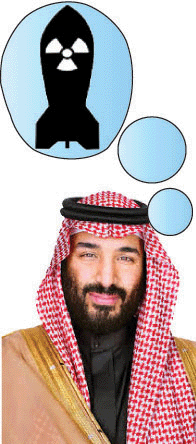
30 Oct 19, Riyadh will have to sign an accord with Washington on the peaceful use of nuclear technology for US firms to participate in the projectA senior US official has confirmed that Washington is in talks with Riyadh about supporting Saudi Arabia’s planned nuclear programme. Speaking in Abu Dhabi on 26 October, US Energy Secretary Rick Perry Perry confirmed that talks were ongoing. Perry told the forum that Saudi Arabia’s leadership in Riyadh wanted to sign a ‘123 Agreement’ with the United States. A 123 Agreement is a section of the US’ Atomic Energy Act of 1954 that sets out rules governing US nuclear cooperation with other nations. Under the terms of a 123 Agreement, Riyadh must sign an accord with Washington committing to the peaceful use of nuclear technology before US companies can compete for its nuclear energy projects in Saudi Arabia.MEED understands the US has an existing 123 agreement with 48 countries to date. Riyadh is reported to have been unwilling to commit to a deal that would rule out the possibility of enriching uranium or reprocessing spent fuel. Saudi Arabia’s nuclear energy programme In November 2018, Saudi Arabia’s King Abdullah City for Atomic & Renewable Energy (KA-Care), the body overseeing the kingdom’s nuclear energy plans, appointed Australia’s WorleyParsons to the project management office consultancy role for the programme.
WorleyParsons will provide consultancy services including project governance, resource management, project services, training and compliance across the full scope of the large nuclear power plant (LNPP), small modular reactors and nuclear fuel cycle. WorleyParsons previously completed the LNPP site selection study for KA-Care. Riyadh is planning to develop nuclear power through a three-pronged strategy. The majority of the nuclear power capacity will be developed through conventional large-scale nuclear facilities, the first of which will be a two-reactor 2.8GW plant.
KA-Care announced in August last year that it had awarded a contract to France’s Assystem to carry out site characterisation studies, including geological surveys and environmental impact studies for the first planned project. The studies will allow Saudi Arabia to choose the most suitable site on which to build, as well as provide important technical details for the design of the project. MEED had reported in early 2018 that the kingdom was assessing two potential locations for the NPP. The two shortlisted are at Umm Huwayd and Khor Duweihin. Both can be found on the coast near the UAE and Qatari borders. The two sites were shortlisted following investigations conducted in 2011 and 2012, in accordance with sitting guidance issued by international regulatory agencies, including the International Atomic Energy Agency (IAEA) and the US Nuclear Regulatory Commission (NRC). Companies are positioning themselves for the contract to build the first nuclear power plant. In July last year, Russian state nuclear company Rosatom said it has been shortlisted to participate in the tender for Saudi Arabia’s first nuclear power plant. According to a report in the Saudi Gazette, Rosatom will be invited to participate in the upcoming tender by KA-Care. Earlier in July, South Korea’s energy ministry revealed that state utility provider Korea Electric Power Corporation (Kepco) had made the shortlist for the first Saudi nuclear power tender. In addition to developing nuclear power capacity through large scale nuclear reactors, the kingdom is also planning to develop atomic energy through a series of smaller system-integrated modular advanced reactor technology (Smart) nuclear power plants in the kingdom in partnership with South Korea. MEED reported in October last year that progress had been made with the Smart programme, and engineering work for two Smart units will be completed in November.
South Korea and Saudi Arabia have already invested more than SR487m ($129.8m) in plans for Smart nuclear reactors across the kingdom. Riyadh signed a memorandum of understanding (MoU) with South Korea in November 2016 to develop the technology. The Smart reactors are expected to have a capacity of about 100MW each. The third pillar of Saudi Arabia’s nuclear energy programme will involve mining uranium resources to fuel the plants, sources close to the kingdom’s nuclear programme have told MEED. Developing the kingdom’s mining sector is a key pillar of the Saudi Vision 2030 that was launched in April 2016.
|
|
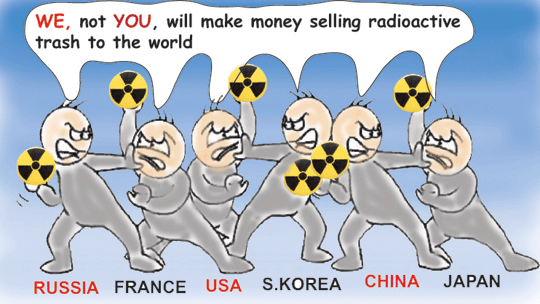
Countries vie to market nuclear reactors to Saudi Arabia
|
Saudi Arabia in talks with 5 vendors to build its first nuclear power reactors, https://www.spglobal.com/platts/en/market-insights/latest-news/electric-power/103019-saudi-arabia-in-talks-with-5-vendors-to-build-its-first-nuclear-power-reactors, Claudia Carpenter , Riyadh — Saudi Arabia is in talks with five vendors, including US-based Westinghouse, to build its first nuclear power plant with two reactors, according to an energy ministry presentation.The other companies in the discussions are France’s EDF, Russia’s Rosatom, South Korea’s KEPCO and China National Nuclear Corp, according to the presentation, shown Wednesday at the Future Investment Initiative conference taking place in Riyadh Saudi Arabia wants to develop a civil nuclear industry and renewable energy to free up oil burned to produce power for export.
Saudi Energy Minister Abdulaziz bin Salman has previously said the kingdom would like to enrich its own uranium resources to produce nuclear energy. However, outgoing US Secretary of Energy Rick Perry cast doubt last week on the kingdom’s ability to process that uranium because of its quality and quantity. Saudi Arabia will be the second Persian Gulf state to build nuclear plants after neighboring UAE, which is building four nuclear reactors that will collectively produce 1,400 MW of electricity. Kepco won the $20 billion contract to construct the UAE reactors, whose start-up has been delayed. |
|
Russia’s Rosatom nuclear firm targets its marketing at African countries
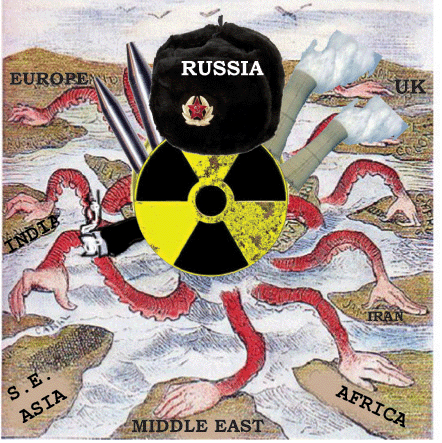
- Russian developer has signed over a dozen agreements in Africa
- Various financing options being considered for the plant build
Rosatom Corp., is eyeing Africa as one of its “priority regions” to build more nuclear reactors and expand its business……(Subscribers only) https://www.bloomberg.com/news/articles/2019-10-30/russia-s-rosatom-focuses-on-africa-for-its-nuclear-expansion
1 This Month
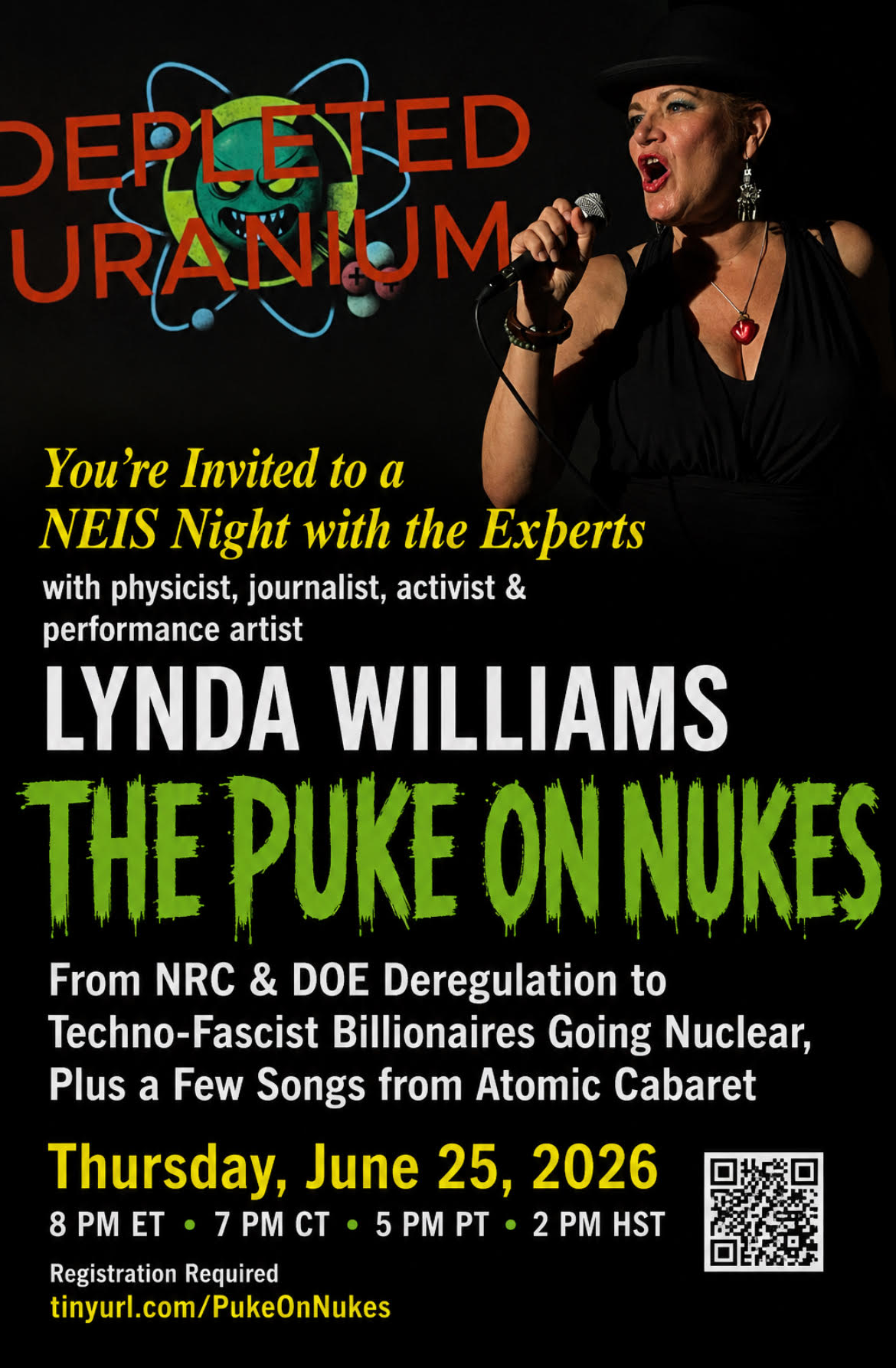
25 June- THE PUKE ON NUKES
Thursday, June 25, 2026
7pm Central Time (8pm ET, 6pm MT, 5pm PT) UTC – 5
From NRC & DOE Deregulation to Techno-Fascist Billionaires Going Nuclear, Plus a Few Songs from Atomic Cabaret REGISTER
26 June – Radiation Trainwreck at the NRC / Join the Protect Better Campaign – https://us02web.zoom.us/meeting/register/4ZlZ5_qLSHGiLSCg8FF6Bg#/registration

1st July – Webinar Waste of Space: The Environmental Harm of Military and Civil Space Activity st July, 7 pm

Report Launch Online: We are seeing an increasing exploitation of space for military and commercial purposes. This must change.

Protect Sazan Island from the Trump family! https://secure.avaaz.org/campaign/en/protect_sazan_island_from_the_trump_family_loc/?bqFCVab&v=174511&cl=22707147157&_checksum=5e9dde668860e8231c33699735e16a1fbf22ab2cb01da50c999fe8732b9775ef&utm_source=email&utm_medium=blast_email&utm_campaign=174511


Cuba Is Not a Failed State – It Is a Besieged State
PETITION: “Global Appeal to Endorse Palestinian Right of Return of Refugees”
To see nuclear-related stories in greater depth and intensity – go to https://nuclearinformation.wordpress.com
-
Archives
- June 2026 (230)
- May 2026 (306)
- April 2026 (356)
- March 2026 (251)
- February 2026 (268)
- January 2026 (308)
- December 2025 (358)
- November 2025 (359)
- October 2025 (376)
- September 2025 (257)
- August 2025 (319)
- July 2025 (230)
-
Categories
- 1
- 1 NUCLEAR ISSUES
- business and costs
- climate change
- culture and arts
- ENERGY
- environment
- health
- history
- indigenous issues
- Legal
- marketing of nuclear
- media
- opposition to nuclear
- PERSONAL STORIES
- politics
- politics international
- Religion and ethics
- safety
- secrets,lies and civil liberties
- spinbuster
- technology
- Uranium
- wastes
- weapons and war
- Women
- 2 WORLD
- ACTION
- AFRICA
- Atrocities
- AUSTRALIA
- Christina's notes
- Christina's themes
- culture and arts
- Events
- Fuk 2022
- Fuk 2023
- Fukushima 2017
- Fukushima 2018
- fukushima 2019
- Fukushima 2020
- Fukushima 2021
- general
- global warming
- Humour (God we need it)
- Nuclear
- RARE EARTHS
- Reference
- resources – print
- Resources -audiovicual
- Weekly Newsletter
- World
- World Nuclear
- YouTube
-
RSS
Entries RSS
Comments RSS
 nuclear-news