NuScam’s (sort of) small nuclear reactors rejected by Utah Taxpayers Association

Critics of planned nuclear power project urge Utah cities to pull out before it’s too late, Utah Taxpayers Association warns it believes proposal is too costly, not transparent DeseretNews, By Amy Joi O’Donoghue@Amyjoi16 Aug 4, 2020 SALT LAKE CITY — The Utah Taxpayers Association and a former member of the U.S. Nuclear Regulatory Commission are urging cities that have signed on to a planned nuclear power plant in Idaho to get out while they can before costs become too great.
NuScale’s Small Modular Reactor is planned for construction at the Idaho National Laboratory near Idaho Falls and would provide 720 megawatts of power, or enough energy for 720,000 homes.
The Carbon Free Power Project is promoted as the next generation design for nuclear power, featuring 12 distinct modules, with the first scheduled to come online in 2029 with the 11 others following the next year.
The project is a collaborative effort involving the U.S. Department of Energy, NuScale and the Utah Associated Municipal Power Systems, a political subdivision of the state of Utah. ……
there are several off-ramps in those phases for cities to exit, one of which is coming up Sept. 14. That deadline prompted the taxpayers association to urge cities to get out now before they get trapped into paying millions for a technology it says is unproven.
“Small modular reactor power is just not cost competitive,” said Rusty Cannon, vice president of the taxpayer group, adding participating cities and districts should hold a public vote to withdraw from the project……..
Peter Bradford, a former member of the U.S. Nuclear Regulatory Commission, said enthusiasm over new developments in nuclear technology that turned out to be flawed have cost ratepayers and taxpayers in multiple states billions of dollars.
He said that of 31 projects pending before the commission in 2009, only two remain — with the rest canceled or indefinitely postponed.
“The stranded costs of nuclear plants paid off by customers in the 1990s exceeded $50 billion nationwide,” he said. “Each period of abject failure is followed by an array of new proposals.”…….
The project is backed heavily by the U.S. Department of Energy, which gave NuScale a competitive award of $226 million in 2013 to develop the technology. Two years later, the federal agency gave NuScale $16.7 million for licensing preparation……..
Cannon and Bradford also criticized the municipal power association for not being transparent enough because its briefing meetings are exempt from the Utah open meetings law and are closed……… https://www.deseret.com/utah/2020/8/4/21354171/critics-nuclear-power-project-urge-utah-cities-pull-out-nuscale-small-modular-reactor-idaho
Bribery scandal haunts Exelon – casts doubt on future of Exelon’s Illinois Nuclear Plants
 ComEd Bribery Scandal Clouds Picture for Exelon’s Illinois Nuclear Plants ComEd Bribery Scandal Clouds Picture for Exelon’s Illinois Nuclear Plants
Exelon wants state legislation to keep its Illinois nuclear plants open. Subsidiary ComEd’s involvement in a bribery scandal is not helping politically. GreenTech Media, JEFF ST. JOHN AUGUST 04, 2020 Exelon may be forced to close its Illinois nuclear plants if state legislation is not passed to bolster their eroding financial prospects. But subsidiary utility Commonwealth Edison’s involvement in a bribery scandal has complicated this and other key policy efforts in its home state.CEO Chris Crane outlined these challenges during the Chicago-based utility’s second-quarter earnings conference call on Tuesday. Last month, ComEd agreed to pay a $200 million fine as part of a deferred prosecution agreement with federal prosecutors to avoid criminal liability in an alleged bribery scheme involving Illinois House Speaker Michael Madigan. ……. Exelon owns the country’s largest nuclear generating fleet and other generation assets; it operates utilities in Illinois, Maryland, Delaware and Washington, D.C. …… Exelon’s nuclear plants hang in the balanceA December decision from the Federal Energy Regulatory Commission is forcing mid-Atlantic grid operator PJM to impose minimum prices on a wide array of state-supported grid resources. That rule is expected to include Exelon’s Clinton and Quad Cities nuclear power plants, which receive hundreds of millions of dollars per year in zero-emissions credits created by Illinois’ Future Energy Jobs Act. Exelon is seeking to extend the zero-emissions credits to its Braidwood, Byron and Dresden nuclear plants, which failed to clear PJM’s last capacity auction in 2018 and could face early retirement without additional financial support. While FERC has not approved PJM’s plan to comply with its order, and PJM has not yet set a date to resume its long-delayed capacity auction, “there’s a strong sense…that some of the nuclear units will not be picked up in that auction” when it occurs, Crane said. “Some are uneconomic right now, and some may become uneconomic.” …….. the bribery scandal has driven a wedge between the utility and state lawmakers, while the COVID-19 pandemic forced the legislature to curtail much of its work this spring and focus on responses to the public health crisis. The Clean Energy Jobs Act failed to move ahead during an emergency session in May, as did an alternative, less ambitious clean energy bill called Path to 100. llinois Governor JB Pritzker suspended the Energy Working Group involved in crafting the Clean Energy Jobs Act after the deferred prosecution agreement was announced, saying through a spokesperson that future legislation “will not be written by utility companies.” …….Absent a legislative solution to Exelon’s nuclear plants’ challenges in Illinois, Crane said, “If we can’t find…a path to profitability, we will have to shut them down.” But Exelon “will not allow the balance sheet to be further deteriorated by operating noneconomic assets,” he said. Exelon has successfully won zero-carbon credits in New York and New Jersey, but it has also laid plans to shut down its Three Mile Island nuclear plant in Pennsylvania if that state does not create similar supports. Formula rate extension and Chicago grid takeover both remain uncertain ComEd also faces an uphill battle in efforts to win an extension of a plan in place since 2011 that allows it to file its capital expansion plans under formula rate updates, rather than through a traditional rate-making process with the Illinois Commerce Commission. A bill that would have extended the formula rate structure past its 2022 expiration failed to pass the legislature this year
………. the utility’s $9.53 billion capital plan for 2020 through 2023, which will take effect under the formula rate structure, will add more than $5 billion to its capital rate base and lead to price hikes for customers in future years. ……. https://www.greentechmedia.com/articles/read/comed-bribery-scandal-affects-exelons-illinois-nuclear-plants-ratemaking-policy
|
|
|
Grim financial news for weapons maker Magnox/Babcock
Times 5th Aug 2020, One of Britain’s main defence contractors has delivered more grim news
for investors after axing its dividend for last year. Babcock said that it
was cancelling the payout for the financial year that ended in March in an
attempt to preserve cash.
In June the company suspended the final dividend
until it had “greater certainty” on the impact of the pandemic.
Yesterday it laid bare the cost of the Covid-19 slump, revealing that
underlying revenues in the three months to the end of June had fallen by 11
per cent.
Underlying operating profit for the first quarter fell by 40 per
cent from last year’s level. Babcock attributed half of the lost profits
to a slide in productivity as the coronavirus outbreak forced it to change
working practices. The remainder was down to the loss of a contract with
Britain’s Nuclear Decommissioning Authority to clean up 12 Magnox reactor
sites and weakness in South Africa and at its land division. Shares in
Babcock fell by 29p, or 10 per cent, to 260p last night.
https://www.thetimes.co.uk/edition/business/dividend-sunk-by-babcocks-profit-woes-dz6qc872f
The continuing and ever more expensive saga of Britain’s Hinkley Point C nuclear project

Times 3rd Aug 2020, The first thing you notice as you approach Hinkley Point C is the sea of
cranes. There are dozens of them, jutting into the Somerset sky from the
site where EDF, of France, and CGN, the Chinese state nuclear group, are
building Britain’s first new nuclear plant in a generation. One stands
out: a 250 metre-tall yellow beast known as “Big Carl”. It is the
world’s largest crane and is central to the companies’ battle to
deliver the project successfully.
£18 billion, the plant was slated to generate its first power before the
end of 2025. Four years on, the budget has risen to between £21.5 billion
and £22.5 billion and EDF says that there is a risk that first power may
be delayed until 2027, adding £700 million in costs; thanks to disruption
from Covid-19, that risk is now “high”.
another big risk, with EDF warning last week that productivity at the site
and in supply chain factories were still being affected. The company said
that it had done what it could to minimise delays, from bringing in extra
buses to transport workers to sending contractors to France to bring back
parts from a factory laid low by the pandemic. EDF believes that it can
catch up on Covid-19 delays by the end of next year, so long as operations
and its supply chain are back to normal by the end of 2020. How confident
was Mr Crooks that the plant would start up in 2025 as planned?
“There’s a long way to go yet. It is a big, complex project.”
https://www.thetimes.co.uk/article/no-let-up-in-heavy-lifting-at-hinkley-point-plant-3s02wmscp
South Carolina’s $9 billion nuclear fiasco – another legal saga develops, criminal investigation coming

3 years later: How the fallout from SC’s $9 billion nuclear fiasco continues Post and Courier, By Avery G. Wilks and Andrew Brown awilks@postandcourier.com abrown@postandcourier.com, Jul 31, 2020
- It has been three years since two of South Carolina’s largest electric utilities abandoned their $9 billion effort to build two nuclear reactors, but the legal, political and financial consequences continue to ripple across the Palmetto State.
The scuttled V.C. Summer expansion in Fairfield County is now widely considered one of the biggest business failures in the state’s history. The announcement of the project’s cancellation on July 31, 2017, shook South Carolina’s power industry, state government and business community.
The two homegrown S.C. utilities that partnered on the project were thrown into disarray. Investigations were initiated by state lawmakers, financial regulators and federal law enforcement officials.
The state and federal court systems were flooded overnight with lawsuits by investors, ratepayers, construction workers and lenders. The state regulatory system that backed the project for nearly a decade was called into question.
And more than 1.7 million utility customers with S.C. Electric & Gas, Santee Cooper and the state’s 19 local electric cooperatives realized they might be forced to pay billions of dollars more for a power plant that will never produce a watt of electricity.
Much has changed since Santee Cooper and SCE&G’s leaders suddenly announced the project’s collapse. But the saga isn’t over quite yet. Here is a breakdown of where things stand. Continue reading
Does UK nuclear energy have any future? The industry has big doubts

 Ministers challenged on future of UK nuclear energy
Industry dogged by doubts about China and rise of renewables calls for clarity, Ft.com, Harry Dempsey in Somerset and David Sheppard in London 31 Jul 20,
Bill in USA Senate to help nuclear workers made ill by radiation exposure
 Bill would expand access to comp for federal nuclear site workers https://www.businessinsurance.com/article/20200731/NEWS08/912335900/Bill-would-expand-access-to-comp-for-federal-nuclear-site-workers#, Angela Childers, July 31, 2020
A bill introduced in the U.S. Senate Wednesday would help workers at federal radioactive sites obtain workers compensation for work-related cancers and other health issues.
S.B. 4363, introduced Wednesday by Sen. Patty Murray (D-Washington), would establish an occupational disease presumption for employees at the U.S. Department of Energy’s Radioactive Waste Management Complex.
The bill is aimed at helping cleanup workers at Washington State’s Hanford Nuclear Site and other nuclear sites more easily claim workers compensation benefits when they suffer from medical conditions as a result of exposure to toxic substances, Sen. Murray’s office said Thursday in a news release.
While the state of Washington created a presumption law for Hanford workers in 2018, the federal legislation would cover workers at other Energy Department nuclear sites. The Hanford site is a 560-square-mile federally operated site known for having manufactured plutonium used in one of the atomic bombs dropped on Japan in 1945.
The U.S. Department of Justice filed a lawsuit in late 2018 over the state’s presumption law, claiming that the law discriminated against the federal government and its Energy Department contractors and aimed to directly regulate the federal government by imposing extra cleanup costs on the decommissioned site. However, a federal judge dismissed the lawsuit in June 2019.
The bill has been referred to the Senate Committee on Health, Education, Labor and Pensions.
Pandemic slows down nuclear construction, increases costs
 Coronavirus company news summary – EDF says construction delays likely – Nuclear plant bill ramps up for Georgia Power, https://www.power-technology.com/uncategorised/coronavirus-company-news-summary-edf-says-construction-delays-likely-nuclear-plant-bill-ramps-up-for-georgia-power/ 31 July 20
The ongoing Covid-19 pandemic has increased Georgia Power’s share of the costs for the Vogtle nuclear plant by nearly $150m. However, the company still intends to complete the construction of Units 3 and 4 as per schedule by November 2021 and November 2022, despite the disruptions caused by the pandemic.
EDF has acknowledged that coronavirus has slowed down construction and maintenance of its nuclear power plant fleet in France and the UK. , A statement by EDF said the risk of delays in commissioning of the UK’s Hinkley Point C plant is “high”. In France, all construction activities at the Flamanville 3 EPR project were suspended between mid-March and early-May, which could result in further delays and additional costs.
Singareni Collieries Company has revealed plans to build 800MW of solar power projects in the southern Indian state of Telangana. The plan encompasses building 500MW of floating solar capacity on large water bodies.
The AES Corporation has made a strategic investment of nearly $8.6m in Australian solar technology innovator 5B to accelerate the adoption of solar energy. It claims 5B’s MAVERICK design allows customers to leverage a higher number of solar resources at three-times the pace, while providing up to two times more energy within the same footprint of traditional solar facilities.
Looks as if 20 municipalities in Utah have been NuScammed for those not so small nuclear reactors

readers may wonder how UAMPS convinced some members to sign an “option” contract, which eventually converts to a “hell-or-high-water” contract, meaning that the buyer has no right, under any circumstances, to abandon the contract once construction, the Achilles heel of nuclear projects, is authorized.
|
|
Over 20 municipalities, primarily located in Utah, have signed a contract with Utah Associated Municipal Power Systems (UAMPS) to purchase entitlement shares for a first-of-a-kind nuclear power plant based on NuScale’s unproven small modular reactor (SMR) design. [and they’re not really small at all]
Ignoring the history of commercial nuclear plant construction, advocates have promoted the SMR project as a cost-effective energy resource without fully addressing the economic, contractual and litigation risks with stakeholders. Between 1953 and 2008, approximately 250 commercial nuclear reactors were ordered in the United States. During this period, ratepayers (and investors) bore the burden for well over $200 billion (in 2009 dollars) in costs for completed and abandoned nuclear plants. For example, one of the largest municipal bond defaults occurred in 1982 when the Washington Public Power Supply System defaulted on $2.25 billion in bonds for two nuclear power plant construction projects. In an effort to reduce their losses, bondholders sued a group of utilities (including several Idaho cities) that entered into contracts to pay for the plants.
Well, what about the UAMPS SMR project, including the $65 dollars per megawatt-hour (price cost of electricity) sales pitch? During a 2018 Los Alamos County Council meeting, held to consider approval of the UAMPS power sales contract, a council member asked a UAMPS lawyer, “There’s been mention of a target of $65 a megawatt-hour. How did we come up with that number?” Another council member, probing into the terms of the contract, expressed additional concern. The councilor stated, “I feel like we’re being sold a bill of goods with $65 a megawatt-hour.” With that said, readers may wonder how UAMPS convinced some members to sign an “option” contract, which eventually converts to a “hell-or-high-water” contract, meaning that the buyer has no right, under any circumstances, to abandon the contract once construction, the Achilles heel of nuclear projects, is authorized. Having a similar concern, especially given the history of nuclear plant construction, a sincere effort was made to address project risks with the UAMPS SMR project chair, including sharing concerns about transparency and proposing possible ways to minimize risks to ratepayers, including contract modifications such as price guarantees and redefining the construction period. Unfortunately, my questions and concerns fell on deaf ears. |
|


UK will fund its nuclear power with the same schemes used by bankrupt US nuclear financing practices!
How bankrupt US nuclear financing schemes are going to be used to fund nuclear power in the UK to fund nuclear power. https://100percentrenewableuk.org/blog by David Toke 24 July, 20 As different types of corrupt pro-nuclear handouts in the USA unravel the British Government is expected to support bringing in a legalised version of bankrupt US nuclear financing practices to fund Sizewell C nuclear power plant.
 The US nuclear power industry is in danger of implosion as corrupt practices used to maintain its old power plant and pay for new plant are the subject of prosecutions. In Ohio the Speaker of the House of Representatives has been arrested on account of charges that he was bribed to ensure that nuclear power and coal plant in Ohio were given bailouts whilst policies supporting renewable energy and energy efficiency were cut back.
Meanwhile in South Carolina the Securities and Exchange Committee has charged executives of the State’s monopoly  utility with fraud after the abandonment of two of the only four nuclear reactors whose construction has been started in the USA this century. According to the Wall Street Journal: ‘The defendants claimed the project was on track even though they knew it was significantly delayed and wouldn’t be completed on time by Jan. 1, 2021, to qualify for $1.4 billion of federal tax credits, the securities regulator alleged’. In the process the electricity consumers were charges billions of dollars for the power plant which were not built through a similar cost recovery process that is proposed for the UK.
Over to Florida, and while nobody has been charged with any offences there is great controversy over the way the 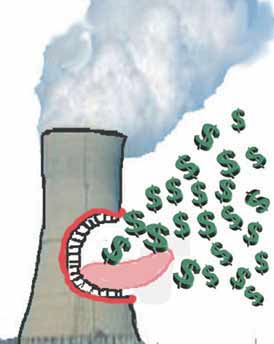 dominant state utility has charged the electricity consumer for a nuclear power plant that was never built. In this case they never even got as far as breaking ground, but the consumers had to pay out $871 million as well as lots more money for other bungled projects relating to nuclear energy. Florida, like other US states has simultaneously erected huge barriers stopping homeowners (in the so-called ‘Sunshine State’) from putting solar panels on their roofs.
According to the New York Times: ‘Florida is one of eight states that prohibit the sale of solar electricity directly to consumers unless the provider is a utility. There is also a state rule, enforced by the utilities, requiring expensive insurance policies for big solar arrays on houses’.
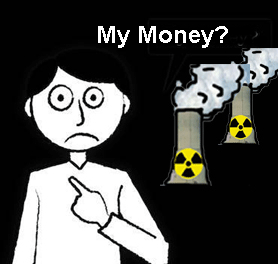 Meanwhile in Georgia, the third state to use the cost recovery method for financing nuclear plant, the only two nuclear power plant being built in the USA (Vogtle III and IV) are hopelessly delayed with massive cost overruns, again, yes you’ve guessed it, with costs paid by electricity consumers.
Of course all of these real or abandoned nuclear plant were financed under the so-called Regulated Asset Base (RAB) model that is being slated to pay for Sizewell C in the UK. This is hailed as a much cheaper way to pay for nuclear power compared with the way that Hinkley C is financed. Cheaper, for the developer (in this case EDF), certainly, but for the electricity consumer it’s a disaster! The consumer, as the US experience clearly illustrates, starts paying and continues paying for a nuclear power plant long before it is generating any energy, and there is no guarantee even that it will ever generate anything! But the consumer still pays, no matter what the constructions cost overruns turn out to be! And invariably, with nuclear power plant, there are very large cost overruns.
Added to this of course the bias in favour of new nuclear as opposed to new renewable energy schemes is also assured. The contracts nuclear power are being given assure them that they will get paid the premium price for energy generated even if wholesale electricity prices are negative whereas windfarms and solar farms will get nothing in such circumstances. See our report on this. Of course there’s nothing illegal in this because mountains of impenetrable contractual and accountancy paperwork make it so. It is just written by the the people who have the energy establishment’s interests at heart.
China’s government-run nuclear institutions are experiencing a brain drain.
 Mass resignations at state-run nuclear institute alarms China https://www.wionews.com/world/mass-resignations-at-state-run-nuclear-institute-alarms-china-315515 Mass resignations at state-run nuclear institute alarms China https://www.wionews.com/world/mass-resignations-at-state-run-nuclear-institute-alarms-china-315515
WION Beijing, China Jul 23, 2020, Edited By: Palki Sharma
STORY HIGHLIGHTSReportedly, ‘China’s best minds’ had access to extremely sensitive information and their sudden resignation has raised many conspiracies and theories regarding the exodus. A crisis has erupted in a major Chinese research institute in the form of mass resignation of 90 nuclear scientists. The Communist Party has launched an investigation after calling it ”brain drain”. However, the incident has become a major concern because of the massive number that have tendered their resignation. ”China’s best minds” reportedly had access to extremely sensitive information and their sudden resignation has raised many conspiracy theories regarding the exodus. The scientists of the Institute of Nuclear Energy Safety Technology(INEST) in China’s eastern city of Hefei are now in the headlines. This institute is part of the Hefei institutes of physical science that’s under the state-run Chinese Academy of Sciences – China’s top research body. INEST specialises in advanced nuclear energy and safety technology which participates in more than 200 national and international projects. It has about 600 members and 80 per cent of the researchers have PhD degrees. Last year, INEST was in the news for developing a virtual nuclear power planet, something that can be used for safety assessment. However, the tables have turned and some serious systemic issues have come to light due to this year’s incident. In June, INEST employees clashed with the staff of their parent institute. Reports say they fought over who gets to control access to their facilities. As per a theory, the institute was unable to get big projects due to lack of funding and the researchers were poached by private companies. China’s Vice Premier Liu He has announced that a team will be sent to investigate the mass resignations. The seriousness of event can also be assessed by the fact that 90 out of the 500 members have left. Last year, the figure had dropped to 200, it is now believed that only 100 researchers work there. The fact is that scientific research in China is largely in the hands of state-run universities and research institutes. While outwardly the premise of research and innovation is the freedom to explore, it is controlled by Beijing and managed by the Communist Party of China. The jobs at state-run institutes promised stability, better benefits but young researchers are now more than willing to give up these jobs and move to the private sector for more money and more freedom. The state run institutions are the like brain trust of China and now they are witnessing a brain drain. |
|
France’s Flamanville new generation nuclear reactor “is a mess” – Energy Minister Barbara Pompili
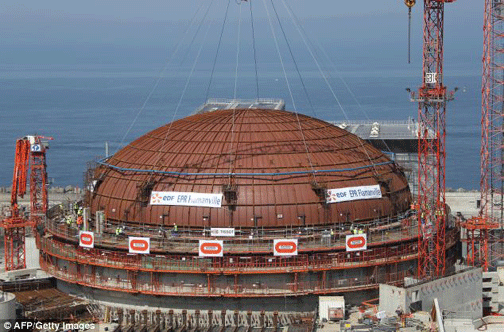 Montel News 23rd July 2020, The new generation EPR reactor EDF is building at Flamanville in France
“is a mess,” France’s new energy minister Barbara Pompili said on Thursday. “I think it’s clear. The Flamanville EPR is a mess. This has been said in a number of reports which cannot be suspected of being anti-nuclear, notably the Court of Auditors report,” she told France Inter radio. “The initial costs (of the EPR) have multiplied by four,” she said, pointing to “problems of competence” that “had to be resolved.”
https://www.montelnews.com/en/story/french-epr-is-a-mess–energy-minister/1133707?s=09
Nuclear power: Still a rip-off after all these years
But Nevada politicians, industries, and people have expended untold jillions of FTE hours fighting Yucca Mountain over more than three decades.
So Nevadans may be interested to know that the industry trying to ram that waste down our throats is at the heart of this week’s FBI arrest of the Speaker of the Ohio House of Representatives on a racketeering charge.
Recap (cribbed from the Current’s sibling, the Ohio Capital Journal): A now-bankrupt utility called FirstEnergy Solutions paid $61 million into a “dark money” PAC controlled by Ohio state Rep. Larry Householder, who then showered the money on fellow Republican legislators, who then selected Householder as House Speaker, and next thing you know Ohio lawmakers passed (and Ohio’s governor signed) a $1.2 billion bailout for FirstEnergy’s economically failing nuclear power plants.
Nevadans may like to take a perverse pride in their state as a very interesting, anything-goes sort of place where a uniquely craven politics is unusually rife with shady shenans and sweetheart deals.
To which Ohio is entitled to say, hold my beer.
I mean, sure, Ohio’s population is about four times bigger than Nevada’s. But $61 million? That’s pretty impressive.
The $1.2 billion public subsidy for a private company, on the other hand, is not particularly outlandish by Nevada standards. Nevada shelled out as much in “incentives” for Tesla, and ladled $750 million to the Raiders.
At least when Nevada elected officials recklessly steered public resources away from public services and to the private sector, it got a battery factory and Mid-Air Engine Failure Field. All Ohio got was a pair of old nuclear power plants that Ohio already had.
Leaving aside for the moment Ohio’s policy decision, ludicrous in design and corrupt in execution, to force electricity customers to rescue a power company, you may be wondering, Why would an electric utility need $1.2 billion to keep some old reactors reacting in the first place?
Glad you asked!
When nuclear power was new on the scene, which is to say about the same time charming mid-mod houses were being built east of the Strip & south of Desert Inn, it came with the promise nuclear energy would be “too cheap to meter.”
A half-dozen decades and countless cost overruns, skyrocketing maintenance expenses and public bailouts later, the financial sector won’t touch nuclear power with a 13-foot spent fuel rod assembly.
The Bush-Cheney administration was hot for nuclear power. Early in Bush’s first term, Cheney stacked a panel with nuclear industry representatives to prepare a plan to build more plants, part of of what people sometimes back then called “a nuclear renaissance.” At the time I was working for Public Citizen, writing about nuclear power (we were against it) and I will never forget one surprisingly candid phrase from the report: “economic viability for a nuclear power plant is difficult to demonstrate.”
Even then, the price per kilowatt was more expensive than coal, let alone gas. It still is, of course. And nearly 20 years later, nuclear can be almost three times as expensive as solar or wind.
Finance is only one industry that wants nothing to do with nuclear power. There’s another: Insurance.
That’s why there is U.S. law called the Price-Anderson Act. If/when a nuclear power plant has, you know, an “incident” that causes economic as well as ecological devastation, taxpayers will foot the bill, even in cases of private sector negligence or misconduct.
As businesses today clamor for protection against covid-related liability, perhaps they’ll point to the no-fault insurance model Congress pioneered in the Price-Anderson Act. If protection from liability is a good idea for nuclear power plants, why wouldn’t it be a good idea for casinos and retailers who put their employees in impossible and risky situations by failing to protect them from the rona?
About the same time Bush and Cheney were firing up their nuclear revival scheme, Nevada Gov. Kenny Guinn was disapproving the Bush administration’s official designation of Yucca Mountain as a nuclear waste dump.
“Nevada is not anti-nuclear and does not oppose nuclear power,” Guinn wrote.
To which you might ask, Why not?
The answer I always got had nothing to do with the desirability, expense or calamitous risk of nuclear power, but the politics of nuclear waste: If Nevada, including and especially its congressional delegation, were against nuclear power, it would make it all the more difficult to win support of congressional colleagues in other states in the effort to keep waste out of Nevada.
It’s a legitimate concern, one on display as recently as last year, when Trump’s plan to fund the dump were supported not only by all the Republicans in the U.S. House (except Mark Amodei), but a whole lot of Democrats, too. But in the end Nancy Pelosi backed Nevada, and Trump’s Yucca wishes fizzled.
Gregory Jazcko was a nuclear policy staffer for Harry Reid, a position where he probably had to draw distinctions between opposing Yucca Mountain, but not nuclear power, on an almost daily basis. In fact, Jazcko would later become chairman of the Nuclear Regulatory Commission, which has never been a habitat for people who oppose nuclear power.
But after leaving that job, Jazcko wrote a book describing nuclear power as “a failed technology” that “is more hazardous than it’s worth,” and “will lead to catastrophe.”
Thankfully earlier this year, Trump proclaimed to Nevada via twitter that the tiny Trump palm had gone to the orange Trump forehead so he no longer wanted to dump nuke waste in Nevada. And if he wins a second term, well, everyone knows how trustworthy and consistent the president is.
In other words, during a second term, maybe Trump will put a revived Yucca project under the direction of former Ohio House Speaker Larry Householder.
Why did over 90 nuclear safety scientists resign en masse from an institute under the Chinese Academy of Sciences (CAS)?

 90 CAS nuclear scientists who resigned were allegedly ‘poached’
Source: Global Times 2020/7 More than 90 nuclear safety scientists with an institute under the Chinese Academy of Sciences (CAS) resigned enmasse according to media reports, with the unusual high number of resignation drawing public attention, considering the essential service the scientists provide.
An employee at the Institute of Nuclear Energy Safety Technology (INEST) under The Hefei Institutes of Physical Science (CASHIPS) of CAS said the more than 90 researchers who voluntarily left their jobs were “poached” and the resignations were part of “normal staff turnover,” the Shanghai-based news website thepaper.cn reported Thursday.
The employee didn’t identify which company or institute may have recruited the researchers.
INEST, located in Hefei, capital of Central China’s Anhui Province, a hub of China’s scientists, has about 600 members and 80 percent of researchers have PhD degrees, according to the institute’s website………Earlier media reports show the resignations were triggered by a conflict with new security staff hired in mid-June at INEST.
According to the official website, INEST was established in September 2011. It is devoted to the design and R&D of advanced nuclear energy and safety technology, and also an independent nuclear safety assessment center with the aim of promoting the sustainable development of nuclear science and technology.
The employee said the 90-plus researchers submitted their resignations in June. https://www.globaltimes.cn/content/1194812.shtml
Purpose of US International Development Finance Corporation perverted in the interests of the nuclear industry
|
Trump’s new foreign investment agency: Itching to build on nuclear quicksand. Bulletin of the Atomic Scientists, By Victor Gilinsky, Henry Sokolski, July 17, 2020 In 2018 a Republican Congress, with strong Democratic support, created the US International Development Finance Corporation to “provide the developing world with financially sound alternatives to unsustainable and irresponsible state-directed initiatives.” That’s government-speak for competing with China’s Belt and Road initiative. It didn’t take very long, however, for the new agency to fall in line with an irresponsible state-directed initiative of its own—the Trump administration’s all-out effort to encourage nuclear exports.
In June, the agency, whose own rules prohibit financing nuclear exports, proposed to fling the doors open to such financing, without limiting its scope to the agency’s mission to help the economies of the lower income countries with modest, environmentally sensible projects. There is no hint on what sorts of conditions would apply on funding nuclear reactors. Would the country have to have a system of safety regulation? Would it have to meet security requirements? Would it have to allow international inspections? It isn’t even clear whether the agency’s support would be limited to US reactor exports, and therefore subject to the requirements of the Atomic Energy Act’s Section 123 or whether they could also cover equipment purchases from other suppliers. Such details determine whether a federal bureaucracy is constrained to act responsibly, or whether it is free to cater to the latest whims of the White House. To justify its proposed action, the agency relies on the administration’s ritual talking points—that nuclear exports will “offer an alternative to the financing of authoritarian regimes while advancing US nonproliferation safeguards and supporting US nuclear competitiveness.” These pearls are straight out of the administration’s April 2020 interagency report “Restoring America’s Competitive Nuclear Energy Advantage.” So are the agency’s assurances that advanced “small modular reactors” and “microreactors” will have significantly lower costs than existing nuclear power plants and “could help deliver a zero-emission, reliable, and secure power source to developing countries, promoting economic growth and affordable energy access in underserved communities.” This is all pie in the sky: None of these plants have been built, and their characteristics and economics are speculative. But if the proposed change is restricted to small reactors or microreactors, the nuclear industry’s influential registered lobby, the Nuclear Energy Institute, hasn’t heard about it. The Institute’s president crowed her unqualified approval: “The US International Development Finance Corporation’s proposed policy change to lift its legacy prohibition on nuclear energy projects supports the development of clean, reliable energy worldwide, helps countries reach their energy development goals, buttresses US national security, and can help level the playing field for US firms.” Nor does her response suggest any awareness that the agency’s financing of nuclear projects will be limited to countries in the lower portion of the economic scale……, This whole affair is the latest expression of the administration’s organizing principle for nuclear energy policy—finding ways to loosen rules and to create subsidies to propel nuclear exports. This is supposed to energize the much-diminished domestic nuclear manufacturing sector. Since the whole policy doesn’t make any economic sense, the ultimate argument is based on the dogma: Come what may, we have to head off sales by our adversaries China and Russia……. The agency does have on its books good environmental, social, and economic criteria for evaluating projects. But will they be applied as intended?,………..https://thebulletin.org/2020/07/trumps-new-foreign-investment-agency-itching-to-build-on-nuclear-quicksand/# |
|
1 This Month



26 September – International Day for the Total Elimination of Nuclear Weapons


PLEASE OPPOSE HR 8255 AND S.3639 – bills would accelerate satellite deployment, with no environmental review or safeguards – https://ncstd5li.quorum.us/campaign/169331/
To see nuclear-related stories in greater depth and intensity – go to https://nuclearinformation.wordpress.com
-
Archives
- September 2026 (281)
- August 2026 (330)
- July 2026 (355)
- June 2026 (287)
- May 2026 (306)
- April 2026 (356)
- March 2026 (251)
- February 2026 (267)
- January 2026 (308)
- December 2025 (358)
- November 2025 (359)
- October 2025 (375)
-
Categories
- 1
- 1 NUCLEAR ISSUES
- business and costs
- climate change
- culture and arts
- ENERGY
- environment
- health
- history
- indigenous issues
- Legal
- marketing of nuclear
- media
- opposition to nuclear
- PERSONAL STORIES
- politics
- politics international
- Religion and ethics
- safety
- secrets,lies and civil liberties
- spinbuster
- technology
- Uranium
- wastes
- weapons and war
- Women
- 2 WORLD
- ACTION
- AFRICA
- Atrocities
- AUSTRALIA
- Christina's notes
- Christina's themes
- culture and arts
- Events
- Fuk 2022
- Fuk 2023
- Fukushima 2017
- Fukushima 2018
- fukushima 2019
- Fukushima 2020
- Fukushima 2021
- general
- global warming
- Humour (God we need it)
- Nuclear
- RARE EARTHS
- Reference
- resources – print
- Resources -audiovicual
- Weekly Newsletter
- World
- World Nuclear
- YouTube
-
RSS
Entries RSS
Comments RSS

