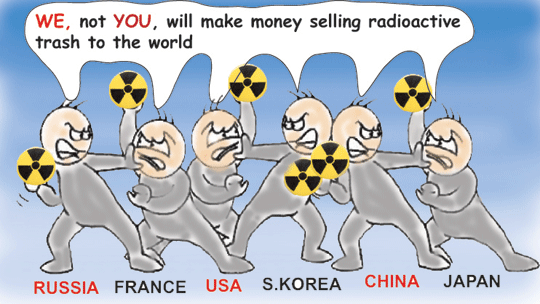
Nuclear powers battle each other to market nuclear reactors to Czech Republic
|
The Czech Republic Is Caught in a Nuclear Tug of War, FP,
Competition among China, Russia, and the West is taking the form of a battle to build reactors in Eastern Europe. BY TIM GOSLING SEPTEMBER 8, 2020”………………… The minority government of Czech Prime Minister Andrej Babis, who founded the ruling ANO 2011 party, has welcomed U.S. President Donald Trump’s embrace. But his stance looks less than certain as the country prepares to face one of its sternest geopolitical tests since the fall of communism 30 years ago: choosing a partner to expand its Soviet-built nuclear power capacity.
……….. Part of Pompeo’s mission to the Czech Republic was to convince Babis that it would pose a similar risk as Huawei should China or Russia win an upcoming tender to build a new 1.2-gigawatt reactor at the Dukovany nuclear power plant, at an estimated cost of over $7 billion. “If you choose one of these countries, it will jeopardize your freedom and sovereignty,” Pompeo reportedly stressed to the Czech leader.
However, Babis’s government is weak, and he faces building pressure at home and abroad to lean east. In turn, he has declined to exclude Chinese and Russian state-owned companies from bidding for the project and, despite welcoming Pompeo enthusiastically, demurred on signing a proffered cooperation agreement on nuclear energy………… Part of Pompeo’s mission to the Czech Republic was to convince Babis that it would pose a similar risk as Huawei should China or Russia win an upcoming tender to build a new 1.2-gigawatt reactor at the Dukovany nuclear power plant, at an estimated cost of over $7 billion. “If you choose one of these countries, it will jeopardize your freedom and sovereignty,” Pompeo reportedly stressed to the Czech leader. However, Babis’s government is weak, and he faces building pressure at home and abroad to lean east. In turn, he has declined to exclude Chinese and Russian state-owned companies from bidding for the project and, despite welcoming Pompeo enthusiastically, demurred on signing a proffered cooperation agreement on nuclear energy. The expansion of the country’s two nuclear power plants—Dukovany and Temelin—are at the center of the Czech Republic’s long-term energy strategy. However, the government has struggled for years to find a financing model agreeable to the minority shareholders at state-controlled energy group CEZ, which is tasked with building and running the nuclear energy infrastructure. The disagreement over funding saw plans to build two new units at Temelin scrapped in 2014. The two finalists in that race—which also brought a U.S. secretary of state to Prague—were the Russian state nuclear agency Rosatom and U.S.-based Westinghouse. They’ve sat in the background in Prague since, awaiting the starting gun for new projects. In the Dukovany showdown, they’re set to be joined by bidders from China, France, and South Korea……….. In the wake of Pompeo’s trip to Prague, lobbying around the nuclear plant will ramp up. “Russia has been extremely active in lobbying for the past couple of years,” Karaskova said. “The U.S., through Mike Pompeo’s comments, also showed a strong interest, probably the first time so openly and publicly.” Petr Trescak, an opposition MP, veteran of the nuclear sector, and member of the government committee for new nuclear plants said that he expects intense lobbying will soon start. Lipavsky said that the tender is already a regular topic with representatives of those countries that will bid, including the French and U.S. ambassadors. Public opinion is also key. Following Pompeo’s visit, Westinghouse launched a search for new senior PR operatives……… https://foreignpolicy.com/2020/09/08/czech-republic-nuclear-tug-of-war-china-russia-united-states/ |
|
EDF made exaggerated and unrealistic claims about local jobs to be provided by Sizewell nuclear power project
Ipswich Star 7th Sept 2020, Independent consultants have challenged the jobs and economic benefits that building a new twin reactor nuclear power station on the Suffolk coast will bring – labelling the claims as “exaggerated” and “unrealistic”.
EDF Energy has said that Sizewell C will give the county’s economy a £125million a year boost and create 25,000 job opportunities during the 10-year construction period and 900 skilled jobs when the power plant is operational. But an independent review of EDF’s Economic Statement, assessing the impacts of Sizewell C on Suffolk’s economy, by research and analysis consultancy Development Economics – commissioned by the Stop Sizewell C campaign – has criticised key aspects of the research and evidence submitted to the Planning Inspectorate.
EDF though insists its project will deliver investment, jobs, skills, education and training for decades to come. And it says its Economic Statement in its planning application is fully compliant with relevant national policy. Development Economics though claimed some aspects were “exaggerated” and “unrealistic”. It questioned EDF’s claim of up to “2,410 jobs for Suffolk residents”, saying this included people travelling from up to 90 minutes away, which covers large population centres in Norfolk and Essex.
It said these local workers will be the overwhelming source of lower skilled roles, expected to fill 90% of jobs in ‘Site Support’ –
cleaners, bus drivers and security guards – compared with only 8% ofroles in professional and management. At peak construction 76% of the workforce will come from further away still and will have to be accommodated in the area.
https://www.ipswichstar.co.uk/news/sizewell-c-independent-economy-report-1-6824930
France’s weekly nuclear power generation drops
|
French nuclear weekly generation falls below 30 GW to 9-week-low, AuthorAndreas Franke , EditorJonathan Dart
HIGHLIGHTS 28.4 GW average some 10 GW below Sept. 2019 Low river levels at Chooz, unplanned outages, delays France turned net importer for week ending Sept. 6 London — French nuclear generation averaged 28.4 GW in the seven days to Sept. 6, the lowest weekly average in nine weeks, according to data from system operator RTE. Nuclear output rose to 29.2 GW on Sept. 7, but that was 12 GW lower than a year earlier as the 3-GW Chooz plant remained offline due to low river levels, with a number of reactor returns delayed……… |
|
EDF’s Economic Statement on impact of Sizewell nuclear project – gives unproven, misleading evidence
 Stop Sizewell C 3rd Sept 2020, An independent review of EDF’s Economic Statement, assessing the impacts of Sizewell C to Suffolk’s local economy, has concluded that the project threatens “profitability and, in some cases, viability” of some local businesses, while others will be “at an immediate disadvantage when bidding for contracts”.
The report, Sizewell Economic Statement – Response, by highly-regarded independent research and analysis consultancy Development Economics, reveals multiple areas where EDF’s claimed benefits are over-optimistic, unproven or misleading, frequently omitting
evidence to support its figures or relying on “erroneous analysis”.
It concludes, critically, that EDF’s Economic Statement “fails to meet the minimum requirements of the legislation”, with no serious attempt to measure the deterrent effect on tourists and their expenditure, traffic congestion or competition for skills and labour.
The National Policy Statement EN-6 requires that applicants for major nuclear energy projects take into account ‘potential pressures on local and regional resources, demographic change and economic benefit’.
More of Britain’s ageing nuclear power stations are likely to close early
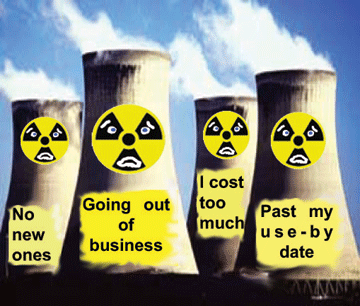 Times 6th Sept 2020, More nuclear power stations could close early as EDF wrestles with problems with patching up its ageing plants. The French power giant owns Britain’s fleet of eight nuclear power stations together with British Gas parent Centrica.
…………. just one new nuclear power station is being built, Hinkley Point C, in Somerset.
B in Somerset and Dungeness B in Kent.
happen sooner. It is currently not generating while its graphite core is inspected. EDF is due to make a decision on its future in November.
publication of a much-delayed energy white paper.
https://www.thetimes.co.uk/edition/business/nuclear-closures-pose-power-puzzle-d6bnnnrcs
Exelon’s threat to Illinois – aiming to get more tax-payer funding
|
Dive Brief:
|
|
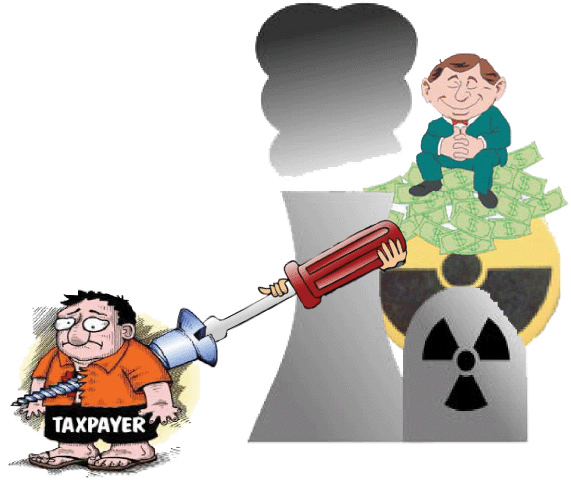
Exelon again bullying Illinois into subsidies for nuclear power stations
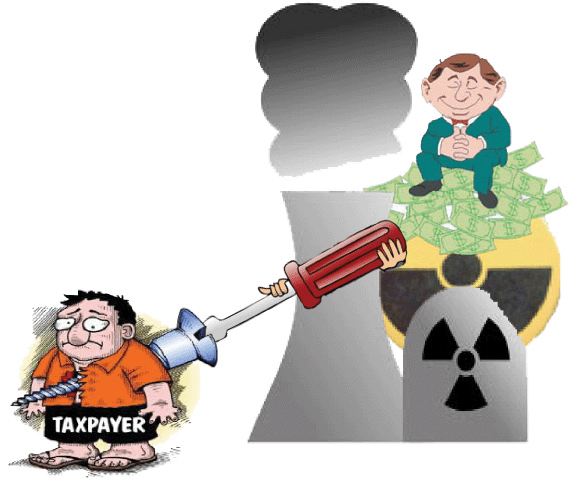 Inside Clean Energy: Illinois Faces (Another) Nuclear Power Standoff. Exelon wants a subsidy to keep two nuclear plants running, reigniting a longstanding—and acrimonious—debate. Inside Climae News, BY DAN GEARINO 4 Sept 20,
If this sounds familiar, it’s because something very similar happened in Illinois about five years ago, leading to a 2016 state law that subsidized two other Exelon nuclear plants in the state—a law now tainted by a still-unfolding bribery scandal.
Despite all the reasons to tell Exelon to take a hike, some consumer and environmental advocates say there is a strong case for keeping the plants open because they are an important source of carbon-free electricity. This ties into the larger, often acrimonious debate about the role of nuclear power in the transition away from fossil fuels.
Exelon owns all six nuclear plants in Illinois. This includes the two that would close in 2021, two (the Braidwood and LaSalle plants) that the company says are at risk of closing for financial reasons but are not yet scheduled to close and two (the Quad Cities and Clinton plants) that are subsidized by the 2016 law.
The six plants produced 54 percent of the electricity generated in the state last year. Coal is a distant second with 27 percent, followed by natural gas with 10 percent.
Renewable energy is growing, thanks in part to programs that also were part of the 2016 nuclear bailout legislation. But wind and solar are still small shares of the energy mix, with 8 percent and less than 1 percent, respectively.
Renewable energy is growing, thanks in part to programs that also were part of the 2016 nuclear bailout legislation. But wind and solar are still small shares of the energy mix, with 8 percent and less than 1 percent, respectively. ……….
Exelon has a lot of baggage these days. Federal prosecutors said in July that Commonwealth Edison, which is owned by Exelon, provided illegal payments and favors to help persuade lawmakers to pass the 2016 nuclear bailout.
ComEd agreed to pay $200 million to resolve the case, and is now cooperating in an ongoing probe that is likely to be focused on the lawmakers who allegedly accepted the favors, including Illinois House Speaker Mike Madigan, a Democrat.
Adding to the complexity of this debate is that environmental advocates are divided on whether nuclear should be part of a clean energy future. The case against nuclear is that it’s unsafe, with risks of devastating accidents and concerns about where to store nuclear waste.
David Kraft, director of the Nuclear Energy Information Service in Chicago, describes this latest push by Exelon as “yet another nuclear hostage crisis.” His group has been campaigning since 1981 for the country to phase out nuclear power.
“A better future for our children would be one that’s both carbon-free and radioactive waste free!” Kraft said in a guest commentary published Monday in The Chicago Tribune.
“To create a truly low-carbon and less-polluting energy future, put those funds gambled on nuclear directly into renewables, efficiency and energy storage upfront instead, eliminating nuclear power’s unpredictable risks and perpetual bailouts,” he said. ………….https://insideclimatenews.org/news/02092020/inside-clean-energy-nuclear-illinois-ohio
Bill Gates and nuclear bigwigs-a conglomerate of propaganda for Small Nuclear Reactors

|
GE Hitachi, TerraPower Team on Nuclear-Storage Hybrid SMR, Power, Sep 3, 2020, by Sonal Patel GE Hitachi Nuclear Energy (GEH) and Bill Gates’ nuclear innovation startup TerraPower are ready to demonstrate a “cost-competitive” advanced nuclear reactor system that will integrate a 345-MWe sodium fast reactor (SFR) with a molten salt energy storage system under a unique energy system architecture. The advanced nuclear technology developed under a joint development agreement is called “Natrium.” It blends the “best of” TerraPower’s Traveling Wave Reactor (TWR) and GEH’s PRISM technology, but it boosts them with “additional innovations and improvements” to ramp up the SFR’s performance and economics and render it competitive in the U.S. and other countries, the companies told POWER on Sept. 2. Because Natrium leverages “the breadth and depth of the team’s expertise and resources”—which takes into account work on multiple reactor designs and efforts across the nuclear lifecycle—the technology has sped “beyond the research and development phase” and is ready for demonstration. “The demonstration plant is designed to be delivered in the next seven years,” TerraPower told POWER on Wednesday. “That means the Natrium technology will be available in the late 2020s,” which would make it one of the world’s first commercial advanced nuclear technologies, it said. …. https://www.powermag.com/ge-hitachi-terrapower-team-on-nuclear-storage-hybrid-smr/ |
|
Over 800 coronavirus cases among workers at Vogtle nuclear project, may increase costs and delays

|
Georgia nuclear project reports more than 800 COVID-19 cases to date, https://www.ajc.com/ajcjobs/georgia-nuclear-project-
 reports-more-than-800-covid-19-cases-to-date/P4BXNDI5ONHX7BSPCPTJYZNWYE/ By Matt Kempner, 20 Sept 20, The Atlanta Journal-Constitution, Georgia Power’s massive nuclear expansion project has had more than 800 workers who have tested positive for COVID-19 since the coronavirus pandemic began. reports-more-than-800-covid-19-cases-to-date/P4BXNDI5ONHX7BSPCPTJYZNWYE/ By Matt Kempner, 20 Sept 20, The Atlanta Journal-Constitution, Georgia Power’s massive nuclear expansion project has had more than 800 workers who have tested positive for COVID-19 since the coronavirus pandemic began.
In a new filing with the state, Georgia’s largest electric provider said it has weathered another wave of cases at the Plant Vogtle project underway south of Augusta, but that the number of new cases is receding again. Georgia Power said more than 700 of the workers who tested positive are now eligible to return to work, and that there were 109 active confirmed cases as of Friday. A spokesman declined to disclose if any workers have been hospitalized or died, citing privacy laws. About 7,000 workers are stationed on site after 2,000 were sent home in April in hopes of reducing the virus’ spread and dealing with growing absenteeism. The virus has been blamed for further slowing the project, which is already years behind schedule and billions of dollars over budget. Independent monitors for the Georgia Public Service Commission warned in June that even without considering the impact of COVID-19, Vogtle’s costs will rise by another $1 billion and the project is “highly unlikely” to have its two new reactors in service by November 2021 and November 2022, respectively. In a filing made public Monday, the company said it continues to plan for the scheduled operation dates. But Georgia Power said it recognizes “that the project may continue to experience challenges and that unanticipated events, or failure to meet the current plan, may require further revision to the site work plan, capital cost forecast, and/or project schedule.” In a July filing, the company said costs for its share of the project are expected to be $149 million over current forecasts and that it later may ask state regulators to charge customers for the increase. After coronavirus cases rose early in the pandemic, the project went several weeks without any new confirmed cases on the site, according to the company’s latest filing. But the confirmed cases grew again. Then, in recent weeks, “the site has followed the general trend in the region with a decline in the number of active cases.” |
|
|
Fluor could improve its finances by abandoning NuScam, as some cities pull out of ”small” nuclear reactor scheme
 Fluor could improve earnings by reducing underperforming assets, including NuScale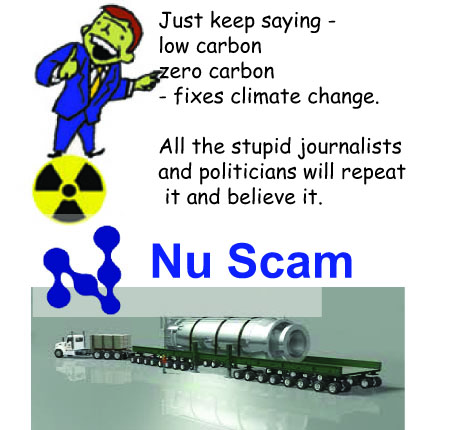
But two cities, Logan and Lehi, Utah have walked away from the project, and a third is now considering dropping its support because of risks and a lack of backers, according to officials.
Allen Johnson, the power department director for Bountiful, Utah, said chances are greater than 50-50 it will withdraw.
“You’ve got to have enough people to support it and some of the players I thought would be interested are not,” he said.
The defections are bad news for U.S. efforts to develop modular nuclear energy …
Combined, cities have so far committed to buying just under 200 megawatts of the plant’s planned 720 megawatts of power.
The U.S. Department of Energy has pumped more the $280 million into the project since 2013, and is expected to commit another $1.4 billion over the next nine years. The department did not respond to requests for comment…….
The consortium earlier this year pushed back the project’s commercial operation date to 2030 from 2026, Webb said, to provide more time for public input and opportunities for cities to reconsider their participation at various phases.
CITIES RETHINK COSTS
NuScale, based in Portland, Oregon, is majority owned by construction and engineering firm Fluor Corp.
The project would include 12 60-megawatt modules at the Energy Department’s Idaho National Laboratory.
The Nuclear Regulatory Commission last week approved NuScale’s design, the first such green light for a modular reactor.
Small modular reactors are meant to be cheaper and quicker to build than traditional reactors because they can be manufactured in factories. But critics say economies of scale are lost with the smaller plants.
The NuScale project’s projected cost of $6.1 billion has risen from $3.6 billion in 2017, Mark Montgomery, head of the municipal utility in Logan told officials there last month ahead of their vote to abandon the project.
Lehi withdrew from the project due to a lack of interest from other entities and increased costs, according to the Aug. 25 resolution approved by its city council.
“These cities should not be acting as venture capital investors,” said Rusty Cannon, vice president of the Utah Taxpayers Association, which has been pushing cities to leave.
Previous cost estimates did not account for financing and decommissioning, as well as higher labor, construction and materials costs over ten years, UAMPS spokesman Webb said, explaining the change.
NuScale said the project delay had been requested by UAMPS. It did not comment specifically on the city defections.
A Wednesday report written by M.V. Ramana a professor of disarmament and human security at the University of British Columbia said Fluor had cut its own investment in the project and excluded NuScale expenses from its financial forecasts because it was expecting additional funding from third party investors.
Financial analyst Jamie Cook of Credit Suisse said last year that Fluor could improve earnings by reducing underperforming assets, including NuScale. ………https://whtc.com/news/articles/2020/sep/02/some-us-cities-turn-against-first-planned-small-scale-nuclear-plant/1054578/
Small nuclear reactors – NuScam looking dodgy as parent company Fluor shares sink?
declined by -15.01% in the 3 months of the year. Over the past six months meanwhile, it has lost -19.89% and lost -47.51% year-on date. DBT News 25 August 20
Small nuclear reactor NuScam’s parent company Fluor – shares tumble afterdisclosure of accounting probe
Fluor Shares Tumble After Disclosure of SEC Accounting Probe, Fluor shares are tumbling after the engineering company disclosed an SEC probe into its past accounting and financial reporting. ROB LENIHAN, FEB 18, 2020
Fluor (FLR) – Get Report shares were tumbling after the engineering and construction company said the Securities and Exchange Commission is looking into the company’s past accounting and financial reporting.
The Irving, Texas, company also said in a statement that the SEC has asked for documents and information related to projects for which the Company recorded charges in the second quarter of 2019……. https://www.thestreet.com/investing/stocks/fluor-shares-tumble-after-engineering-company-discloses-sec-probe
Santee Cooper and Westinghouse Electric to sell of equipment at the failed $9 billion VC Summer nuclear site.
|
SANTEE COOPER, WESTINGHOUSE BURY NUCLEAR HATCHET Agree to sell millions of dollars in nuclear equipment, Lexington Chronicle , By Jerry Bellune, JerryBellune@yahoo.com, 2 Sept 20, Squabbling over millions of dollars in nuclear equipment may be temporarily over. This gives the taxpayer-owned utility full ownership of all non-nuclear equipment at the failed $9 billion nuclear site. Santee Cooper reportedly is in debt more than $8 billion, at least half of it from the nuclear failure. |
France’s President Macron joins the global nuclear lobby’s push to export nuclear reactors
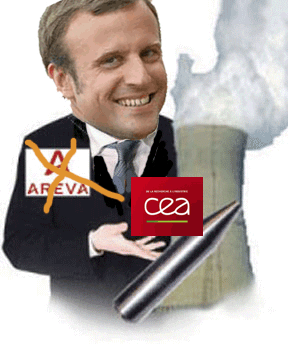 Macron talks nuclear energy and ways to control militias during Iraq visit, The National , Khaled Yacoub Oweis, Sep 2, 2020French PM is the most significant leader to visit Iraq since Prime Minister Mustafa Al Kadhimi came to power in May
During a visit to Baghdad on Wednesday, French President Emmanuel Macron discussed solving Iraq’s massive power shortages with nuclear energy ……. Mr Kadhimi told reporters in Baghdad that he discussed with Mr Macron “a future project” to use nuclear energy to produce electricity and solve decades-long power shortages……..
If realised, the project would place Iraq along with the UAE and Iran as the only Middle East countries with electricity produced by a nuclear reactor. ………. https://www.thenational.ae/world/mena/macron-talks-nuclear-energy-and-ways-to-control-militias-during-iraq-visit-1.1071729
Santee Cooper finalizes settlement over leftover material at failed SC nuclear project
Santee Cooper finalizes settlement over leftover material at failed SC nuclear project, Post and Courier, By Andrew Brown abrown@postandcourier.com, Aug 31, 2020
Santee Cooper may finally be able to recover some of the money it dumped into two unfinished nuclear reactors in South Carolina.
The board of the Moncks Corner power provider finalized a settlement this weekend with Westinghouse Electric that will enable the state-run utility to sell off leftover parts and materials from the failed expansion of the V.C. Summer project.
The settlement, which has been in the works for months, requires Santee Cooper and Westinghouse to split the profits from any remaining equipment that could be used on another site. …….
The V.C. Summer project is widely considered one of the worst business failures in South Carolina history.
Santee Cooper was the minority owner of the project. It partnered on the unfinished reactors with Cayce-based South Carolina Electric & Gas, which was sold to Dominion Energy after construction was halted in mid-2017 after years of delays and cost overruns.
The two South Carolina utilities spent more than $9 billion on construction before the reactors were abandoned in July 2017.
By that time, Westinghouse had filed for bankruptcy and left the struggling project in the laps of SCE&G and Santee Cooper. As a result, electric customers for both utilities are still paying off debt tied to the abandoned project.
The amount of material left over from the two unfinished nuclear reactors is vast, and there’s one big reason for that. By the time SCE&G and Santee Cooper pulled the plug on the project, they had already purchased more than 90 percent of the parts. Yet only a third of the reactors were actually built. ………….https://www.postandcourier.com/business/santee-cooper-reaches-settlement-over-leftover-material-at-failed-sc-nuclear-project/article_8d01c2e4-eba1-11ea-a8d5-5fad5583ac38.html…..
1 This Month



26 September – International Day for the Total Elimination of Nuclear Weapons


PLEASE OPPOSE HR 8255 AND S.3639 – bills would accelerate satellite deployment, with no environmental review or safeguards – https://ncstd5li.quorum.us/campaign/169331/
To see nuclear-related stories in greater depth and intensity – go to https://nuclearinformation.wordpress.com
-
Archives
- September 2026 (269)
- August 2026 (330)
- July 2026 (355)
- June 2026 (287)
- May 2026 (306)
- April 2026 (356)
- March 2026 (251)
- February 2026 (267)
- January 2026 (308)
- December 2025 (358)
- November 2025 (359)
- October 2025 (375)
-
Categories
- 1
- 1 NUCLEAR ISSUES
- business and costs
- climate change
- culture and arts
- ENERGY
- environment
- health
- history
- indigenous issues
- Legal
- marketing of nuclear
- media
- opposition to nuclear
- PERSONAL STORIES
- politics
- politics international
- Religion and ethics
- safety
- secrets,lies and civil liberties
- spinbuster
- technology
- Uranium
- wastes
- weapons and war
- Women
- 2 WORLD
- ACTION
- AFRICA
- Atrocities
- AUSTRALIA
- Christina's notes
- Christina's themes
- culture and arts
- Events
- Fuk 2022
- Fuk 2023
- Fukushima 2017
- Fukushima 2018
- fukushima 2019
- Fukushima 2020
- Fukushima 2021
- general
- global warming
- Humour (God we need it)
- Nuclear
- RARE EARTHS
- Reference
- resources – print
- Resources -audiovicual
- Weekly Newsletter
- World
- World Nuclear
- YouTube
-
RSS
Entries RSS
Comments RSS

