Britain’s nuclear power dreams melting away – with soaring costs, and political problems
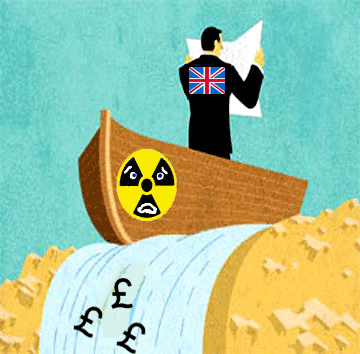 U.K. Nuclear Fleet Plans Evaporating Amid Economic, Political Problems, https://www.enr.com/articles/50109-uk-nuclear-fleet-plans-evaporating-amid-economic-political-problems September 20, 2020, Peter Reina
The U.K.’s hopes for a fleet of new nuclear plants, potentially exceeding 13,000 MW, took another hit when Japan’s Hitachi Ltd. recently pulled out of a major project in Wales. With Chinese investment in two other projects alsolmore doubtful, only the 3,300MW Hinkley Point C project in Somerset, England, has so far progressed to construction
Having suspended development work on the Welsh two-unit plant at Wylfa Newydd in January 2019, Hitachi earlier this month announced that the already difficult investment environment had “become increasingly severe due to the impact of COVID-19.” The company wrote off $2.8 billion of investment in the Welsh plant last year.
Hitachi’s departure followed the Toshiba Corp.’s decision in late 2018 to quit the 3,400-MW Moorside plant, in Cumbria. It had failed to find co-investors for its Westinghouse powered project.
With uncertainty growing, Hinkley Point C is the only U.K. nuclear project o have started work, which is so far largely on schedule, according to Electricité de France (EdF), which controls 66.5% of the deal. China General Nuclear Corp. owns 33.5% of project, which will be powered by two French EPR pressurized water reactors.
Hitachi’s withdrawal from the U.K. market has alarmed supporters of the nuclear industry, since it also casts a cloud over the planned 3,340-MW Sizewell C project in Cumbria.
“For the first time in a generation the U.K has developed a world class nuclear construction and engineering supply chain. Without Sizewell C, we will not sustain it,” says Cameron Gilmour, spokesperson for the Sizewell C Consortium lobby group of key companies in the sector.
The Sizewell C plant would replicate Hinkley Point C and is “shovel ready” according to Gilmour. The U.K. Planning Inspectorate is considering an application for the project submitted this May. The agency’s recommendations will end up on the government’s desk for a final decision at some point.
However, general investment uncertainties and increasingly frosty relations between the U.K and Chinese governments bode ill for the deal, says Stephen Thomas, an energy policy specialist at the University of Greenwich, London.
Set up under a previous conservative administration, the Hinkley Point C deal included CGNC’s participation as a junior partner in Sizewell C. Also, CGNC would have full responsibility for a proposed 2,300 MW Bradwell plant in Essex.
Bradwell would be a global showcase for the technology as it would be the first plant in an industrialized country to use the Chinese Hualong One reactors, Thomas says.
However, the Chinese government was angered over the U.K.’s rejection this July of Huawei technology for the cell phone networks. At the same time, criticism by the country’s lawmakers of China’s participation in critical infrastructure is increasing.
Both developments make the Bradwell deal uncertain. And if Bradwell falls, the Chinese are unlikely to remain merely as passive, junior investors in Sizewell C, potentially scuppering the whole deal, says Thomas.
Investment uncertainties lie at the heart of the U.K.’s fading nuclear hopes. The government offered the Hitachi team a far less generous deal than the one secured by EdF for Hinkley Point C.
While the Hinkley deal protects U.K. electricity consumers from cost escalations, it comes at a high price, according to Thomas. The deal is based on a “contract for differences” which sets an index linked energy price of $120 per MWh at 2012 prices for 35 years. That is hugely more than the $51 per MWh now being bid for offshore wind contracts, he says.
For subsequent deals, the government last year turned to the Regulatory Asset Base (RAB) form of funding used by water and types of utilities. Rather than having a target energy price, electricity tariffs would be controlled by the regulator, which would consider factors such as need for investment and a fair rate of return on capital.
The government completed a review of the system this January but has yet to make a decision, adding to investment uncertainty, says Thomas.
Meanwhile, in the west of England, contractors recently placed the 170-tonne base of the second reactor’s steel containment liner at Hinkley Point on time, despite pandemic working restrictions.
EdF claims to have met critical path goals during the pandemic, but it has yet to reveal the extent of delays on other parts of the job. The site’s workforce is now back to its pre-pandemic level of 4,500 having fallen to 2,000 after February.
Civil and building work is being handled by a joint venture of Paris-based Bouygues Travaux Publics and the U.K.’s Laing O’Rourke Plc. in a contract signed in late 2017, then valued at around $3.6 billion.
However, “challenging ground conditions” and additional design effort have contributed to an overall project cost rise to $29 billion from around $23 billion in 2016, reports EdF. The company still plans to commission the first unit in 2025, but the project has yet to enter its trickier nuclear component phase, officials concede.
Europe’s only two other projects using the same reactor design and involving Bouygues are hugely over schedule. Finland’s Olkiluoto 3 plant and EdF’s flagship French project at Flamanvile are both running about a decade late.
With this track record and future financing doubts, prospects for new projects around the world look bleak, says Thomas.
But nuclear power “has had a history of climbing out of the coffin,” he adds.
UK government to subsidise Sizewell nuclear power station?
 UK government could take stake in Sizewell nuclear power station, BBC, Simon Jack, Business editor@BBCSimonJackon16 September 2020
The collapse of a project to build a new nuclear power station at Wylfa, Wales may accelerate government approval of a new station at Sizewell, government and industry sources say.
The government is disappointed after Japan’s Hitachi pulled out but insists it is committed to new nuclear as way to decarbonise the UK power supply.
It is looking at options to replace China’s CGN as an investor in Sizewell.
That could include the government taking a stake in the plant.
Of six sites originally identified over a decade ago for replacements for the UK’s ageing nuclear fleet, only one is under construction, three have been abandoned and two are waiting approval.
One major sticking point over Sizewell has been the involvement of Chinese state-owned company China General Nuclear Power Group (CGN) in the UK’s new nuclear plans.
CGN already owns a 33% stake in Hinkley Point C in Somerset, currently under construction by French firm EDF, which owns the other two thirds.
The Chinese firm also took a 20% stake in the development phase of Sizewell on the understanding it would participate in the construction phase and then land the ultimate prize of building a reactor of its own design at Bradwell in Essex.
State aid rules
If CGN are excluded the government may choose to take a direct stake in Sizewell, according to people familiar with the matter.
There was a time when a Conservative government would have been very reluctant to take a direct stake in a commercial development. That time has passed.
Industry sources and within the government say Chinese involvement in designing and running its own design nuclear reactor on UK soil “looks dead”, given revived security concerns and deteriorating diplomatic relations after the government’s decision to phase out Chinese firm Huawei’s equipment from a new generation of telecommunication networks.
It’s no secret that Boris Johnson’s powerful adviser Dominic Cummings is a big fan of the idea of small nuclear reactors and EDF are telling him that big nuclear is an important stepping stone to small.
EDF has also been very vocal about the advantages of reproducing the design of Hinkley at Sizewell. Although a similar design of reactor ran into major cost and time overruns in France and Finland, EDF says they UK is poised to benefit from the lessons learned from those mistakes. It also points out that the UK will benefit from transferring high skilled jobs from one site to another.
There was a time, not so long ago, that government ministers talked enthusiastically about “a new nuclear age”. A fleet of brand new reactors producing reliable, low carbon (but expensive) electricity for decades to come.
Hinkley, Moorside, Wylfa, Oldbury, Bradwell and Sizewell were identified as the sites for the most significant national wave of new nuclear power construction anywhere in the world.
Of those six, only one is under construction, three have been abandoned, and two are still waiting for the green light.
The next couple of weeks could tell us which way the wind is really blowing on the government’s appetite for both nuclear energy and new levels of direct state investment.
If a mobile network is considered too sensitive, it’s hard to argue that a nuclear power station is not.
The next couple of weeks could tell us which way the wind is really blowing on the government’s appetite for both nuclear energy and new levels of direct state investment. https://www.bbc.com/news/business-54181748
Why NuScam and other ”small” nuclear proposals just don’t make any sense
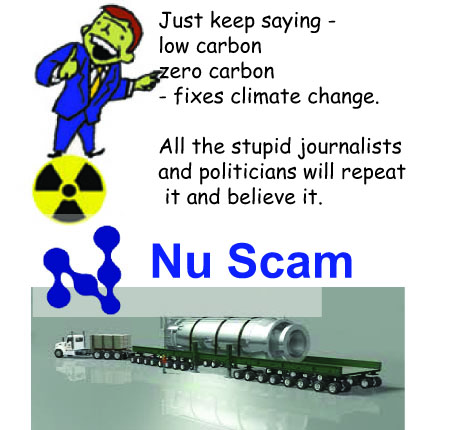
New nuclear projects, like this NuScale proposal, make no sense, Deseret, By Robert Davies, Contributor Sep 18, 2020, The debate over nuclear power has ramped up recently in Utah, with a number of the state’s municipal power agencies wrestling with continued participation in an experimental nuclear project in Idaho, the Utah Associated Municipal Power Systems/NuScale project.
Much has already been written about the project itself. Though proponents tout benefits of cost and reliability, two municipalities so far, Logan and Lehi, have recently opted out of further participation, citing mainly financial concerns over an experimental design with delays and cost overruns mounting rapidly. Still, this extremely expensive energy might be worth it ― if the environmental benefits, particularly for climate change, were significant.
Climate change is regarded within the full scientific community as a bona fide civilizational emergency ― that is, a situation requiring immediate, meaningful response to avoid catastrophic outcomes. For the climate emergency, meaningful response means cutting global carbon emissions at least in half in the next decade, and eliminating them entirely in the next two to three decades.
Electricity generation, as roughly a third of the current carbon emissions, is a large piece of the equation ― and it is on this point that nuclear power has been worth considering. Indeed, the project’s developers, having christened the endeavor the “Carbon Free Power Project,” are emphasizing the climate angle. And if the question were about building new nuclear generation versus new fossil (coal or natural gas) generation, they would have a point; the clear winner with respect to climate would be nuclear.
But this isn’t the question. In rapidly decarbonizing the electrical grid, the name of the game is replacing existing high-carbon (coal and gas) with new low-carbon, as quickly as possible.
……..proposed new nuclear makes no sense ― because it isn’t competing with fossils. Instead, new nuclear is competing with low-carbon renewables, chiefly solar and wind. And it simply can’t compete.
Investing in new nuclear projects to combat climate change is akin to the crew of the Titanic devoting time to building a whole new ocean liner instead of putting all their effort into loading the lifeboats; it steals time and resources from a much better alternative. Any money spent on new nuclear could buy us four to six times more wind and solar energy, available in months instead of a decade. And, remember, the next 10 years are critical.
Faced with this reality, UAMPS/NuScale proponents have said they want a mostly renewable grid, but supplemented by just a bit of nuclear for “baseload” ― and that this is necessary.
The refrain of 20th century-era power managers is that renewables like wind and solar aren’t reliable (“The wind doesn’t always blow, the sun doesn’t always shine … ”) and so constantly humming “baseload” is necessary for reliability. It sounds reasonable, but like most bumper-sticker wisdom, doesn’t hold up. In fact, it is objectively, demonstrably wrong.
The technologies of energy storage (utility-scale battery systems, for example) and demand management (when the energy is used) have transformed the landscape. Traditional “baseload” is no longer a necessary grid attribute. Anyone who says it is simply isn’t keeping up.
In Australia, for example, a 100-megawatt utility-scale battery system (about 1.5 times bigger than one of NuScale’s nuclear modules) is already proving more reliable and 90% cheaper than the “baseload” natural gas system it’s replacing. ………
new nuclear makes no sense whatsoever ― financially, or far more importantly, for addressing climate change.
The UAMPS/NuScale project is a poor choice for the planet, for our nation and for Utah’s independent municipal power companies. A bright future is possible if we’re smart and focused; the nuclear power trap is a distraction we can’t afford.
Robert Davies is an associate professor of professional practice in Utah State University’s department of physics. His work focuses on global change, human sustainability and critical science communication.https://www.deseret.com/opinion/2020/9/18/21400144/guest-opinion-nuscale-uamps-nuclear-project-power-utah-idaho-makes-no-sense
Nuclear energy CHEAP? Nuclear has drained Germany of more than €1trn to date

|
‘No higher cost energy’: nuclear has drained Germany of more than €1trn to date Subsidies tot up to €287bn since 1955, refuting atomic energy’s cheap power myth, says Forum for Ecological-Social Market Economy study https://www.rechargenews.com/transition/no-higher-cost-energy-nuclear-has-drained-germany-of-more-than-1trn-to-date/2-1-877313 17 September 2020 ,By Bernd Radowitz Development of the nuclear energy industry since the mid-1950s has led to more than €1trn ($1.18trn) in costs to the German society, and is wrongly portrayed as an inexpensive power source, according to a study by the Forum for an Ecological-Social Market Economy (FÖS) estimated.
FÖS calculated the support, which includes both state support, power prices and external costs, had been the most draining of all energy sources on the finances of the country, which is Europe’s largest economy. “No other energy source has caused costs as high as those of risky atomic power, which even after 65 years continues highly uneconomical,” said Sönke Tangermann, chairman of independent power provider Greenpeace Energy, which had commissioned the study. Germany by the end of 2022 is phasing out nuclear power. Since a first reactor started operations in 1955, the country had built more than 100 nuclear facilities, including power and research stations, and waste deposits. Other countries, such as Switzerland, have followed Germany’s lead and will also phase out nuclear power, while France at least wants to diminish the share of atomic power in its energy mix. But at the same time a new debate has started to build supposedly cheap mini nuclear reactors for power or hydrogen production. While none of these have been built yet, prices for the construction of conventional new nuclear plants in countries like France or Finland have ballooned into amounts several times the original cost estimate. Direct and indirect German government subsidies alone, including research grants and tax credits, since the mid-1950s have added up to €287bn, FÖS has calculated. Another €9bn were spent on other costs for the state, such as police operations during anti-nuclear protests, or follow-up costs from nuclear operations in former Eastern Germany. “Great part of these costs never had been included in the electricity price, which is why atomic energy wrongly was considered as a cheap power source,” Tangermann said, adding that the study for the overall costs of nuclear energy has included external costs that had been passed on to society for decades, such as the risk of accidents. Even after Germany’s nuclear exit, the country will face high costs, such as at least €7bn for the rehabilitation of the Morsleben nuclear storage facility and the Asse research storage facility as well as the Wismut uranium ore mine, or for the closure of former nuclear power plant sites. Tangermann said he hopes Berlin will resist current demands for an extension of Germany’s nuclear power plants, or investments into new ones, also as those would serve to discredit the expansion of renewables. “Given the enormous costs and aging infrastructure with ever greater risks, nuclear power cannot be a serious alternative to effectively tackling the climate crisis,” he said. |
|
|
Hitachi pulls out – halting two big UK nuclear projects. Renewables would be a fraction of their costs
With the Japanese conglomerate this week walking away from two new nuclear plants in the United Kingdom, project  developer Horizon Nuclear Power has confirmed all activities at both sites will cease. The facilities had struggled to secure funding despite offers from government. Horizon said it will ‘keep lines of communication open’ regarding the future of the sites. PV Magazine, SEPTEMBER 18, 2020 MARK HUTCHINS The former Wylfa nuclear power station was decommissioned in 2015. Plans for a new reactor on an adjacent site have been abandoned with the withdrawal of Hitachi from the project.
Japanese conglomerate Hitachi has pulled out of the construction of two U.K. nuclear projects with a total 5.8 GW of generation capacity, citing ongoing delays and an increasingly tough investment environment due to the Covid-19 pandemic.
The projects, on the Welsh Isle of Anglesey and at Oldbury on Severn, near the English city of Bristol, were taken on by Hitachi in 2012. Construction was suspended in January last year as funding could not be secured for the reactor at Wylfa Newydd, on Anglesey, and Hitachi’s U.K. subsidiary Horizon Nuclear Power has confirmed it will cease development at both sites, though it still hopes to revive the projects.
Hitachi said it would coordinate with government and other stakeholders as holder of the license to build nuclear reactors at the sites. The company posted losses last year from the suspended projects and said it does not expect the decision to further affect its finances……….
Renewables
Critics of nuclear power are likely to view the Hitachi decision as further evidence of the inherent cost and complexity problems associated with the technology, and will repeat arguments the U.K. and other regions would be better served by an energy transition focusing on renewables.
Mycle Schneider, lead author of the World Nuclear Industry Status Report told pv magazine: “Nuclear power plant projects frequently get abandoned even after construction has started. One in eight construction sites have been abandoned at various stages of advancement of construction. Some have been completed and never switched on, and there is absolutely no guarantee that Hinkley Point C will ever generate power,” said Schneider, in reference to a third planned nuclear plant in the southwest of England.
“It has become obvious that renewables, even unsubsidized, come in at a fraction of the cost of new nuclear power. In the U.K., onshore and offshore wind are less than half the cost of nuclear. If the U.K. government keeps planning for nuclear power plants, it’s not because there was no choice, and it has nothing to do with market-economy driven energy policy.”
Solar industry representatives also called on the government to recognize renewables’ potential to fill in gaps left by abandoned and delayed nuclear projects and to implement supportive policies, as well as an auctioning system to boost large-scale projects. “The UK is facing a significant low-carbon energy gap in the 2030s, resulting from the abandonment of new nuclear projects,” said Chris Hewett, Chief Executive of the Solar Trade Association. “Solar PV is well-positioned to help plug a significant portion of this, but the Government must step in to bring down the numerous barriers that are holding growth back, such as punitive business rates and a lack of prioritization of grid capacity for the technology.” https://www.pv-magazine.com/2020/09/18/hitachi-halts-5-8-gw-of-uk-nuclear-plans/
USA taxpayers set up by government in the effort to save uneconomic nuclear power

|
The Nuclear Sector Gets A State-Sponsored Lifeline, Oil Price, By Haley Zaremba – Sep 16, 2020, The United States’ nuclear sector is in trouble. And it has been for years now. While the United States remains the largest producer of nuclear energy in the world, producing about one-third of the world’s total nuclear power supply, the industry has been in a state of decline for quite a while. The nuclear sector has never recovered from the influx of cheap natural gas that came along with the domestic shale revolution, and now the country’s aging nuclear fleet faces even bigger problems coming down the pike. Nuclear, like so many other industries (especially in the energy sector), was hit very hard by the pandemic. As Oilprice reported earlier this summer, climate change will hold particularly difficult challenges in store for the nuclear sector, which has to keep its reactors cooled down at all times to avoid meltdowns. And heat is just one risk factor–there are also extreme weather events and catastrophic floods to consider. In 2019, Bloomberg carried out a review of “correspondence between the commission and owners of 60 plants” and made some particularly worrying discoveries. According to nuclear companies’ own risk assessments, “54 of their [60] facilities weren’t designed to handle the flood risk they now face.”
……..Just two weeks after Oilprice wondered “Can The Nuclear Industry Survive COVID-19?,” however, the U.S. Department of Energy (DOE) offered the nuclear sector a lifeline. On June 18, the DOE announced “it would be awarding more than $65m in nuclear energy research, crosscutting technology development, facility access, and infrastructure awards.” According to reporting by PowerTechnology, “the awards fall under the department’s nuclear energy programs – the Nuclear Energy University Programme, the Nuclear Energy Enabling Technologies, and the Nuclear Science User Facilities.” ………The wide scope of these projects points to the multiplicity and complexity of the challenges faced by the U.S. nuclear industry today. While the money awarded by the DOE this June is a good sign for the sector, this is not the first time the DOE has tried to bail out the U.S.’ ailing nuclear industry. “Since 2009, the Office of Nuclear Energy, part of the US Department of Energy, has allocated more than $800m to research, aiming to boost American leadership in clean energy innovation and train the next generation of nuclear engineers and scientists,” Power Technology writes. https://oilprice.com/Alternative-Energy/Nuclear-Power/The-Nuclear-Sector-Gets-A-State-Sponsored-Lifeline.html
|
|
|
As Hitachi exits the project, UK government to announce funding for Wylfa nuclear project next month
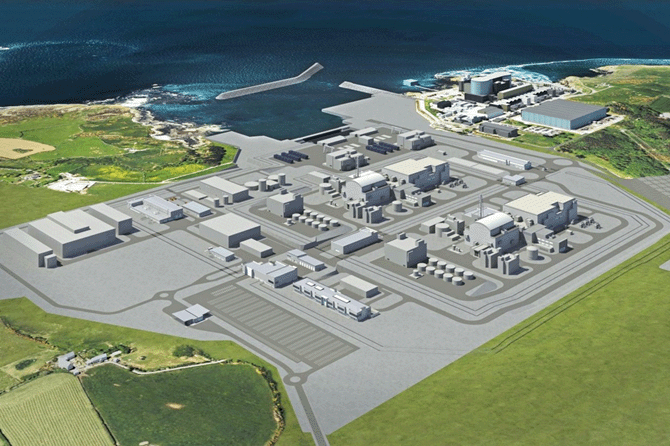 Hitachi Abandons $26 Billion Nuclear Power Project in U.K. Bloomberg Green, By Stephen Stapczynski and Rachel Morison16 September 2020,
-
U.K. due to make statement on financing model next month
- U.K. government says still committed to building new nuclear
Hitachi Ltd. exited a long-planned U.K. nuclear power project despite the most generous support package for an atomic station in Britain, a bad omen for future projects.
The Japanese company announced Wednesday that it decided to withdraw from the Wylfa power project in Wales, citing a worsening investment environment due to the Covid-19 pandemic. Work has been suspended on the 20 billion-pound ($26 billion) venture since January 2019 after the company failed to reach a financing agreement with the U.K. government.
The decision is the latest setback for nuclear’s revival, which supporters promote as the carbon-free solution for reliable power at a time of growing climate change concerns. Cost overruns and cheaper competition is stifling projects and developers in Japan, the U.S. and the U.K.
Britain is one of a handful of developed countries still building nuclear reactors, with the government putting them at the middle of an effort to attract billions of pounds of investment in new low-carbon power plants and create thousands of jobs. However, financing these prohibitively expensive infrastructure projects has become a hurdle, especially in the face of cheaper natural gas and renewables.
A financing package offered to Hitachi in 2019 wasn’t enough to attract additional private investor interest. The U.K. has been considering a funding model that would have seen the state shouldering more of the construction risk. The outcome of that consultation has been delayed.
The U.K. said it had offered a package that “went well beyond what any government has been willing to consider in the past.” Atomic energy still forms a key plank of energy policy including in small and advanced modular reactors.
A financing package offered to Hitachi in 2019 wasn’t enough to attract additional private investor interest. The U.K. has been considering a funding model that would have seen the state shouldering more of the construction risk. The outcome of that consultation has been delayed.
The U.K. said it had offered a package that “went well beyond what any government has been willing to consider in the past.” Atomic energy still forms a key plank of energy policy including in small and advanced modular reactors.
Prospects for the Wylfa plant looked more optimistic last month when Horizon Nuclear Power Ltd., Hitachi’s subsidiary developing the project, said it was engaged with the U.K. government on reviving the project.
The future of how the U.K. finances new nuclear is expected to be announced in the government’s long anticipated energy white paper next month……… https://www.bloomberg.com/news/articles/2020-09-16/hitachi-abandons-u-k-nuclear-power-project-in-blow-to-industry
Huge costs of decommissioning Britain’s ”Magnox” nuclear failities just keep going up
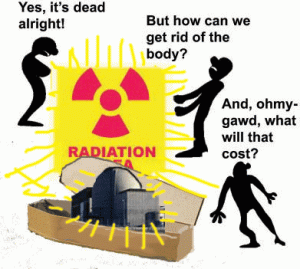 UK spending watchdog warns on costs of cleaning up old nuclear plants
Decommissioning charge has risen by £3bn since 2017 and there remains ‘inherent uncertainty’ over final bill, NAO finds, Nathalie Thomas in Edinburgh, SEPTEMBER 11 2020, Estimates of the cost to clear up 12 of the UK’s earliest nuclear power sites have increased by nearly £3bn since 2017 and there remains “inherent uncertainty” over the final bill, the country’s public spending watchdog has warned.
Hitachi definitely exits UK nuclear power project
Hitachi decides to exit UK nuclear power project – Mainichi newspaper https://www.reuters.com/article/hitachi-nuclear/hitachi-decides-to-exit-uk-nuclear-power-project-mainichi-newspaper-idUKT9N2FQ03Y– Reporting by Makiko Yamazaki; Editing by Chang-Ran Kim , By Reuters Staff, TOKYO (Reuters) –14 Sept 20, Japanese conglomerate Hitachi Ltd 6501.T will completely exit from a stalled British nuclear power project, the Mainichi newspaper reported on Tuesday.
The board of directors could make a formal decision as early as at their planned meeting on Wednesday, the paper said, citing sources.
A Hitachi spokeswoman said the reported decision was not something the company announced.
U.S. seeks to lower Russian uranium imports to boost U.S. nuclear industry
The Commerce Department and Rosatom initialed the draft amendment to the 1992 Russian Suspension Agreement to prevent
Nuclear power is not climate-effective, simply because of comparative costs and delays

 This is a thorough analysis of the costs and time delays of nuclear power, as compared with those of energy efficiency and renewables. It does show that in the fight to stop climate change, the push for nuclear is a wasteful distraction.
My only problem with this argument is that it seems to imply that, apart from its exorbitant costs and delays, nuclear power might be effective. Not so!
Nuclear reactors make climate change worse, September 13, 2020 by beyondnuclearinternational
Being carbon-free does not establish climate-effectiveness, By Amory B. LovinsMost U.S. nuclear power plants cost more to run than they earn. Globally, the World Nuclear Industry Status Report 2019 documents the nuclear enterprise’s slow-motion commercial collapse—dying of an incurable attack of market forces. Yet in America, strong views are held across the political spectrum on whether nuclear power is essential or merely helpful in protecting the Earth’s climate—and both those views are wrong. In fact, building new reactors, or operating most existing ones, makes climate change worse compared with spending the same money on more-climate-effective ways to deliver the same energy services. Those who state as fact that rejecting (more precisely, declining to bail out) nuclear energy would make carbon reduction much harder are in good company, but are mistaken. If you haven’t heard this view before, it’s not because it wasn’t published in reputable venues over several decades, but rather because the nuclear industry, which holds the microphone, is eager that you not hear it. Many otherwise sensible analysts and journalists have not properly reported this issue. Few political leaders understand it either. But by the end of this article, I hope you will. For the details and documentation behind this summary, please see pp. 228–256 of the World Nuclear Industry Status Report 2019. A supporting paper provides simple worked examples of how to compare the “climate-effectiveness” of different ways to decarbonize the electricity system. Nuclear power’s potential role in the global climate challenge If the nuclear one-tenth of global electricity generation displaced an average mix of fossil-fueled generation and nothing else, it would offset 4% of fossil-fuel CO2 emissions. So in an era of urgent climate concern, should nuclear power continue, shrink, or expand? In May 2020, a report by the International Energy Agency claimed that not sustaining and even expanding nuclear power would make climate solutions “drastically harder and more costly.” To check that claim, we must compare nuclear power with other potential climate solutions. Here I’ll use only two criteria—cost and speed—because if nuclear power has no business case or takes too long, we need not address its other merits or drawbacks. How should we compare different ways to provide electrical services in a carbon-constrained world? Our society built coal-fired power plants by counting cost but not carbon. Nuclear advocates defend their preference by counting carbon but not cost. But to protect the climate, we must save the most carbon at the least cost and in the least time, counting all three variables—carbon and cost and time. Costly options save less carbon per dollar than cheaper options. Slow options save less carbon per year than faster options. Thus even a low- or no-carbon option that is too costly or too slow will reduce and retard achievable climate protection. Being carbon-free does not establish climate-effectiveness. Since in reality money and time are both limited, our priorities in providing energy services must be informed by relative cost and speed. Lower cost saves more carbon per dollar. Faster deployment saves more carbon per year. We need both. Buying nuclear power displaces buying some mixture of fossil-fueled generation, renewable generation, and efficient use. Nuclear owners strive to beat coal and gas while their allies often disparage or suppress renewables. Yet most US nuclear plants are uneconomic just to run, so many are closing. To keep milking those old assets instead, their powerful owners seek and often get multi-billion-dollar bailouts from malleable state legislatures for about a tenth of the US nuclear fleet so far. Such replacement of market choices with political logrolling distorts prices, crowds out competitors, slows innovation, reduces transparency, rewards undue influence, introduces bias, picks winners, invites corruption, and even threatens to destroy the competitive regional power markets where renewables and efficiency win. Yet many political leaders think climate’s urgency demands every option, including preserving nuclear power at any cost. So what is that cost, construed in the narrowest economic terms? Costs of new nuclear power vs. competing options Costly options save less carbon per dollar than cheaper options. Slow options save less carbon per year than faster options. Thus even a low- or no-carbon option that is too costly or too slow will reduce and retard achievable climate protection. Being carbon-free does not establish climate-effectiveness. Since in reality money and time are both limited, our priorities in providing energy services must be informed by relative cost and speed. Lower cost saves more carbon per dollar. Faster deployment saves more carbon per year. We need both. Buying nuclear power displaces buying some mixture of fossil-fueled generation, renewable generation, and efficient use. Nuclear owners strive to beat coal and gas while their allies often disparage or suppress renewables. Yet most US nuclear plants are uneconomic just to run, so many are closing. To keep milking those old assets instead, their powerful owners seek and often get multi-billion-dollar bailouts from malleable state legislatures for about a tenth of the US nuclear fleet so far. Such replacement of market choices with political logrolling distorts prices, crowds out competitors, slows innovation, reduces transparency, rewards undue influence, introduces bias, picks winners, invites corruption, and even threatens to destroy the competitive regional power markets where renewables and efficiency win. Yet many political leaders think climate’s urgency demands every option, including preserving nuclear power at any cost. So what is that cost, construed in the narrowest economic terms? Costs of new nuclear power vs. competing options On 7 November 2019, the eminent 170-year-old financial house Lazard published its 13th annual snapshot of relative 2019-$ prices for different ways to generate a megawatt-hour of electricity. The analysis is authoritative though imperfect. ……. Lazard’s comparison between new electricity resources is stark:…… New nuclear plants will save many-fold less carbon per dollar than competing carbon-free resources, in proportion to their relative costs. And new reactors’ expected performance must be tempered by historical experience: of the 259 power reactors ordered in the US, by mid-2017 only 28 units or 11% had been built, were still competitive in their regional markets, and hadn’t suffered at least one outage lasting at least a year. Should existing nuclear plants keep operating? Today’s hot question, though, is not about new US reactors, which investors shun, but about the existing reactors, already averaging about a decade beyond their nominal original design life. Most now cost more to run—including major repairs that trend upward with age—than their output can earn. They also cost more just to run than providing the same services by building and operating new renewables, or by using electricity more efficiently. So let’s go step by step through an eyechart about nuclear operating costs—which exclude original construction and financing costs (all sunk and usually amortized), but include those costs that need not be paid if the plant is closed………….. closing a top-quartile-cost nuclear plant and buying efficiency instead, as utilities could volunteer or regulators require, would save considerably more carbon than continuing to run the nuclear plant. Some modern renewables too can now rival efficiency’s cost and could compete for that opportunity. Thus, while we close coal plants to save carbon directly, we should also close distressed nuclear plants and reinvest their large saved operating cost in cheaper options to save carbon indirectly. These two climate-protecting steps are not alternatives; they are complements. Replacing a closed nuclear plant with efficiency or renewables empirically takes only 1–3 years. If owners don’t give such advance notice—a common tactic to extort subsidies by making closure more disruptive—more natural gas might temporarily be burned, but then more than offset over the following years by the carbon-free substitutes. California’s biggest utility will therefore replace its well-running Diablo Canyon reactors with least-cost carbon-free resources to save money and carbon and to help the grid work better. To get these outcomes, we must track not just carbon but also money and time. Investing judiciously, not indiscriminately, saves the most carbon per dollar. What about per year? Which technologies are faster to deploy?……………. Global carbon-free electricity is now less than one-third nuclear. Counting also carbon-free production of non-electric energy—biofuels and modern renewable heat—nuclear power struggles to sustain less than one-fourth of the world’s carbon-free final energy use. Why pay more to revive it at the expense of faster and cheaper competitors? Sustaining uneconomic reactors would not only divert public funding from more climate-effective competitors but also constrain their sales and degrade the competitive markets where they thrive. Slowing and blocking the fastest and cheapest climate solutions harms climate protection. How high can US nuclear subsidies go? Meanwhile, back in the United States, the climate-effectiveness of continued nuclear operations is not discussed; the conversation focuses solely on carbon, not on cost or time. Indeed, the industry’s immense lobbying power has now hatched a brazen new way to make taxpayers or customers pay for existing nuclear plants and disadvantage their most potent supply-side competitor (modern renewable power), and reduce and retard climate protection while claiming to increase it. Rarely have so many been so deceived so thoroughly, for so long, at such cost.……..https://beyondnuclearinternational.org/2020/09/13/nuclear-reactors-make-climate-change-worse/ |
|
Magnox nuclear clear-up cost soars to £9bn
|
Magnox nuclear clear-up cost soars to £9bn https://www.constructionenquirer.com/2020/09/11/magnox-nuclear-clear-up-cost-soars-to-9bn/ Aaron Morby, 13 Sept 20, The cost of decommissioning the Magnox nuclear reactor estate has continued to soar despite efforts to control the budget. Fresh estimates of the cost of getting all Magnox sites cleared and safely enclosed has increased by £2.7bn to £8.7bn since 2017. An investigation by the National Audit Office warns that while the Nuclear Decommissioning Authority has made major progress sorting out its delivery procedures, costs are likely to continue to rise as it gets to grips with the scope of work. The expected cost is now double the original contract price when the initial clean-up deal was signed in 2014 with Cavendish Fluor Partnership to decommission two nuclear research sites and 10 Magnox sites. Since then the Nuclear Decommissioning Authority terminated the contract more than nine years early following a high court challenge to both the procurement by losing bidder Bechtel and changes in scope of work. The NAO this morning warned that costs are likely to be subject to further change, largely because of the inherent uncertainties involved in cleaning up the UK’s nuclear sites. It recommended that the NDA needs to increase its understanding of the condition of sites and the volume and complexity of remaining decommissioning work. It also said the NDA needed to explore with its subsidiaries how future contracts can better support the timely and effective management of underperformance. Gareth Davies, the head of the NAO, said: “Since the failure of the original Magnox contract in 2017, the NDA has made progress in a number of areas. “It renegotiated the contract, avoided further legal disputes and got on with decommissioning the power plants. “However, the NDA now knows that it will cost significantly more to take the sites to the care and maintenance stage of the decommissioning process, though there remains inherent uncertainty about the final cost. “It still needs to ensure it has a solid understanding of the condition of each Magnox site and the costs of cleaning them up.” |
|
|
A powerful message on the seismic dangers in Hinkley Point C nuclear construction. It would be cheaper to pull out now.
Radiation Free Lakeland 12th Sept 2020, Seismic Warnings – if not now when will the Government Scrap Hinkley C? This week there was yet another earthquake recorded in the Bristol area. It was small but significant, contributing to the well documented seismic activity of the area. If eyewatering costs, long delays, a mental and physical health crisis among the employees building Hinkley Point C are not enough to scrap this hubristic nuclear new build plan then the seismic warnings should be.
This insane project next to operational reactors has seen the geological stresses of the biggest pours of concrete in the UK
alongside three huge tunnels being bored below the seabed. German based multi-national company Herrenknecht built the hugely expensive tunnel boring machines which will be dumped under the Bristol Channel once done.
A total of 38,000 concrete segments are needed to support the tunnels, which would transfer 120,000 litres of water per second for the new nuclear plant when finished. The Bristol area is seismically active so to put increased geological stress deliberately in the vicinity of existing nuclear reactors is the kind of hubris that disaster movies are made of.
Scrapping Hinkley C now and paying off the developers would be far cheaper and far safer than continuing down this route to nuclear disaster.
NuScam’s ”small” nuclear reactor design approved – but cost, safety, public acceptance hurdles loom against them

First U.S. Small Nuclear Reactor Design Is Approved, Concerns about costs and safety remain, however, Scientific American  By Dave Levitan on September 9, 2020
- The U.S. Nuclear Regulatory Commission (NRC) has approved the design of a new kind of reactor, known as a small modular reactor (SMR). The design, from the Portland, Ore.–based company NuScale Power, is intended to speed construction, lower cost and improve safety over traditional nuclear reactors…………
- some experts have expressed concerns over the potential expense and remaining safety issues that the industry would have to address before any such reactors are actually built. ………
- The NRC’s design and related final safety evaluation report (FSER) do not mean that the firm can begin constructing reactors. But utility companies can now apply to the NRC to build and operate NuScale’s design. With almost no new nuclear construction completed in the U.S. over the past three decades, SMRs could help reinvigorate a flagging industry.
NuScale’s SMR, developed with the help of almost $300 million from the U.S. Department of Energy, has a generating capacity of 50 megawatts—substantially smaller than standard nuclear reactors, which can range to well more than 1,000 megawatts (MW). A utility could combine up to 12 SMRs at a single site, producing 600 MW of electricity—enough to power a midsize city. The NRC says it expects an application for a 60-MW version of NuScale’s SMR in 2022……….
In a July 2020 report, NRC nuclear engineer Shanlai Lu discussed a complicated issue known as boron dilution, which could possibly cause “fuel failure and prompt criticality condition”—meaning that even if a reactor is shut down, fission reactions could restart and begin a dangerous power increase. And in another report, the NRC’s Advisory Committee on Reactor Safeguards also noted that “several potentially risk-significant items” are not yet completed, though it did still recommend that the NRC issue the FSER. The agency’s response to the latter report stated that those items will be further assessed when site-specific licensing applications—the step needed to actually begin building and operating a reactor—are submitted. ……..
Lyman says that in general, the NRC’s design certification process should reduce uncertainty for utilities aiming to build nuclear plants because they can reference a completed safety review. But he thinks the NuScale approval undermines that advantage. Whether the gaps in safety will result in further delays to NuScale’s time line remains to be seen. The NRC will undertake another review when the company’s 60-MW design is submitted. https://www.scientificamerican.com/article/first-u-s-small-nuclear-reactor-design-is-approved/
Ohio’s House Bill 60 – bailing out nuclear power, will not save consumers money.
Groups pushing for repeal of the bailout of Ohio’s two nuclear plants are challenging proponents of House Bill 6 who say the law will save consumers money. Instead, consumer and environmental groups say the legislation will add about $7 to a monthly bill.
Ohio environmentalists and consumer groups dispute the math that’s been used to justify the bailout of Ohio’s two nuclear power plants. They say House Bill 6, passed last summer, actually will increase the cost of the average monthly electric bill a family pays by about $7, not decrease it, as backers of the law say.
Efforts to repeal HB 6 have gained momentum since the indictment this summer of former House Speaker Larry Householder, who has been charged with four others in a $61 million federal bribery and racketeering scandal tied to the legislation.
“Supporters of House Bill 6 and those that are now arguing for no repeal or partial repeal are presenting similar cost savings information that is inaccurate and incomplete,” said Trish Demeter, chief of staff of the Ohio Environmental Council Action Fund……..
environmentalists and consumer groups said Wednesday that those numbers don’t tell the whole story.
Take energy efficiency, for example.
Those programs carried an average monthly fee of $3.36. The programs provide homeowners and small businesses with rebates and incentives to switch out aging appliances and upgrade old equipment that wastes energy.
When you account for the lost efficiency savings, consumers are much worse off,″ said Chris Neme, principal of Energy Futures Group, which has worked on energy efficiency programs.
Demeter said the $1.50-per-month fee to shore up the two coal plants is supposed to end in 2030, but utilities are allowed to defer costs to operate the plants, which can be recovered later from consumers.
“Millions upon millions more (will be) coming out of Ohioans’ pockets and going to into the coffers of Ohio utilities,” she said.
The groups are calling on the legislature to consider the true costs of the bill and then repeal it.
Demeter also said repeal of the bill is necessary to begin to restore the public trust in the legislative process that’s been hurt by the scandal.
“Not repealing the bill as soon as humanly possible is sending a message the legislature is not interested in restoring that trust,” she said. https://www.dispatch.com/business/20200909/savings-from-hb-6-nuclear-bailout-donrsquot-add-up-advocacy-groups-say
1 This Month



26 September – International Day for the Total Elimination of Nuclear Weapons


PLEASE OPPOSE HR 8255 AND S.3639 – bills would accelerate satellite deployment, with no environmental review or safeguards – https://ncstd5li.quorum.us/campaign/169331/
To see nuclear-related stories in greater depth and intensity – go to https://nuclearinformation.wordpress.com
-
Archives
- September 2026 (269)
- August 2026 (330)
- July 2026 (355)
- June 2026 (287)
- May 2026 (306)
- April 2026 (356)
- March 2026 (251)
- February 2026 (267)
- January 2026 (308)
- December 2025 (358)
- November 2025 (359)
- October 2025 (375)
-
Categories
- 1
- 1 NUCLEAR ISSUES
- business and costs
- climate change
- culture and arts
- ENERGY
- environment
- health
- history
- indigenous issues
- Legal
- marketing of nuclear
- media
- opposition to nuclear
- PERSONAL STORIES
- politics
- politics international
- Religion and ethics
- safety
- secrets,lies and civil liberties
- spinbuster
- technology
- Uranium
- wastes
- weapons and war
- Women
- 2 WORLD
- ACTION
- AFRICA
- Atrocities
- AUSTRALIA
- Christina's notes
- Christina's themes
- culture and arts
- Events
- Fuk 2022
- Fuk 2023
- Fukushima 2017
- Fukushima 2018
- fukushima 2019
- Fukushima 2020
- Fukushima 2021
- general
- global warming
- Humour (God we need it)
- Nuclear
- RARE EARTHS
- Reference
- resources – print
- Resources -audiovicual
- Weekly Newsletter
- World
- World Nuclear
- YouTube
-
RSS
Entries RSS
Comments RSS

