All logic says that UK’s Hinkley Point C nuclear power project should be abandoned now.

“Anything that passes nuclear’s costs on to the taxpayer — costs like nuclear waste management, nuclear station decommissioning, or delays and cost overruns — will be a total betrayal of taxpayers and cost every household in Britain a small fortune,”
Times 1st Aug 2021, David Cameron could barely hide his glee. In June 2014, the then prime minister welcomed Chinese premier Li Keqiang, who signed a string of trade and investment deals totalling £14 billion. The deal bonanza came a year before the Chinese agreed to pump billions into Hinkley Point C in a move that was meant to revive Britain’s nuclear industry, ushering in a new Sino-British golden era.
That vision is long gone and the future of the UK’s nuclear industry is up in the air after reports that the government is exploring ways to remove state-owned China General Nuclear (CGN) from the proposed £20 billion Sizewell C nuclear plant on the Suffolk coast, amid mounting concerns about Beijing’s influence in critical infrastructure projects.
If the government removes CGN from Sizewell, the Chinese could pull out of all three, leaving a multibillion-pound black hole in Britain’s nuclear plans.
One way in which the government might attract new backers to replace Chinese money would be by introducing a regulated asset base (RAB) funding model. Usually reserved for capital -intensive sectors such as water and energy where monopolies exist, RAB takes the risk away from the developer and piles it on to consumers through higher bills during the construction phase. The RAB model was used
to support the Thames Tideway “super sewer”. Steve Thomas, professor of energy policy at Greenwich University, said: “On Hinkley, intuition says it cannot possibly be abandoned now — but all logic says it should be abandoned now.
You can’t imagine that after 15 years, the government is going to say, ‘Sorry, we made a mistake with this.’ But the reality is that it will be the most expensive power on the system, so from a consumer point of view, it will be awful.” A paper authored by Thomas with Alison Downes of the pressure group Stop Sizewell C estimated that using the RAB model could pile more than £500 on to household bills during the
construction, assuming cost overruns and delays.
Sir Ed Davey, the former energy secretary and now Liberal Democrat leader said “Anything that passes nuclear’s costs on to the taxpayer — costs like nuclear waste management, nuclear station decommissioning, or delays and cost overruns — will be a total betrayal of taxpayers and cost every household in Britain a small fortune,”
Sources told The Sunday Times that EDF was also keen to eject CGN from Sizewell, as its involvement was becoming a block on securing further investment. Thomas at Greenwich University said: “The problem is going to be finding investors who think the project [Sizewell C] is attractive enough, whilst at the same time not dumping huge amounts of risk on to consumers. And I don’t see how you can square that equation.
All the experience in the past 20 years says that costs are going to go horribly over budget and construction times are going to be horribly delayed. Who’s going to take that risk?”
https://www.thetimes.co.uk/article/britains-nuclear-winter-wch7cg2t5
Vogtle nuclear power project’s costs – $27 Billion and rising!

“We’re really so far down the path of absurdity with this project.”
Georgia nuclear plant cost tops $27B as more delays unveiled, By JEFF AMY, July 30, 2021 ATLANTA (AP) — Two new reactors at Georgia’s Plant Vogtle will cost another billion dollars, with shareholders of the parent company of Georgia Power Co. taking a $460 million loss and other owners absorbing the rest.
The news came Thursday as Atlanta-based Southern Co. again admitted what outside experts have been telling regulators for months — its $27 billion-plus project at the complex outside Augusta will take longer and cost more than previously estimated.
Managers project construction will take another three to four months. That pushes the projected start date of Unit 3 into the second quarter of 2022, while Unit 4 is now projected to start in 2023. But independent monitors testified in June that they don’t think Unit 3 will start operation until at least June 2022 and projected total additional spending of up to $2 billion.
“It’s hard to be surprised at this point,” said Kurt Ebersbach, an attorney with the Southern Environmental Law Center, which opposes the project. “We’re really so far down the path of absurdity with this project.”
The company and regulators insist the plant — the first new U.S. reactors in decades — is the best source of clean and reliable energy for Georgia. Opponents have long pointed to what they say would be cheaper, better options, including natural gas or solar generation.
Southern Co. recorded the entire additional cost as a loss to shareholders on its quarterly earnings report, citing “the significant level of uncertainty that exists regarding the future recoverability of these costs” because the Georgia Public Service Commission must approve spending. The company said it could ask ratepayers to pay for the overrun, though.
Customers are already paying for the plant. Rates have gone up 3.4% to pay for earlier costs and Georgia Power projects rates will rise another 6.6 percentage points for a total increase of 10%. Commissioners are scheduled to vote on another rate increase in November……….
Georgia Power’s capital budget for Vogtle is $9.2 billion, with another $3.2 billion in financing costs projected. The total effect on the budget of the Vogtle project isn’t clear because Georgia Power is paying for only 45% of the project. Electric cooperatives and municipal utilities are paying for the remainder and have different financing costs.
Georgia Power also announced Thursday that it agreed with Public Service Commission staff to not seek any amounts above $7.3 billion until commissioners decide whether the company spent prudently during construction.
Georgia Power already agreed to write off about the first $700 million over the $7.3 billion……..
Besides extended testing, Georgia Power said Vogtle has been delayed by poor construction productivity, the necessity to redo substandard work, the slow pace of contractors turning over systems to the company and repairs to a leak in Unit 3′s spent fuel pool.
In June, the U.S. Nuclear Regulatory Commission began a special inspection to determine why so much of the electrical wiring in the plant had to be redone…….
Every month of delay at Vogtle costs roughly $90 million in capital costs, excluding financing costs.
The reactors, approved in 2012, were initially estimated to cost $14 billion, with the first new reactor originally planned to start generation in 2016. Delays and costs spiraled, especially after the main contractor filed for bankruptcy in 2017.
……. The Public Service Commission has reduced the amount that Georgia Power can earn on construction costs because of delays. Southern Co. said those penalties cost it $150 million last year and are projected to cost it another $630 million through 2023.
___ Follow Jeff Amy on Twitter at http://twitter.com/jeffamy. https://apnews.com/article/business-environment-and-nature-georgia-90bbe5cc8e3a1a6077b9e4318e2bbf7e
Vogtle nuclear power project – more costs revealed, and even more likely to come.
Georgia Power discloses more Vogtle nuclear delays, big extra costs, By Matt Kempner, The Atlanta Journal-Constitution 30 July 21, Georgia Power’s parent, Southern Co., announced Thursday yet another delay in its completion of the nuclear expansion of Plant Vogtle and said its share of the costs have increased by nearly half a billion dollars.
Georgia Power customers could see larger increases in monthly electric bills if the company ultimately seeks reimbursement for the higher costs on the massive project south of Augusta. But such a move would require approval from the state’s Public Service Commission.
Southern not only pushed back its timeline for completing the first of two new reactors — something it has done repeatedly this year alone — but also announced a delay for the second reactor. And it cautioned that further delays on both are possible, reeling off a litany of potential challenges to complete a project that was supposed to have been finished years ago and for billions of dollars less.
Another worry: that federal nuclear regulators could continue to increase scrutiny of the project to fix quality problems. The company said in a regulatory filing that “various design and other licensing-based compliance matters” have arisen or may arise that, if not resolved, could lead to additional delays and costs.
As for the latest $460 million in rising costs, the company said it would cover the expense by taking a charge against its profits, a $343 million hit after taxes. The move sparked lower profits for Southern compared to the same quarter a year earlier. The company didn’t say whether it eventually will seek approval from state regulators to recover those costs from its customers. But in a filing it said there is a “significant level of uncertainty” about its ability to get such a full recovery………..
Just a few months ago, Atlanta-based Southern had been sticking by its predictions that the first reactor would be in operation this November, with the second a year later. Now, it projects the second quarter of 2022 for the first, and the first three months of 2023 for the last reactor. In each case that is three or four months later than what it had said in May and reasserted again last month.
The two new reactors were originally slated to be in operation in 2016 and 2017, respectively……….
Kurt Ebersbach, a senior attorney at the Southern Environmental Law Center, which represents some organizations opposed to customers paying for Vogtle’s excesses, said he believes the power company will seek PSC approval to collect billions of dollars in overruns from customers.
The company’s latest predictions for Vogtle’s schedule come closer to what PSC staff and independent advisors to the state have been predicting for the first reactor. Still, a key advisor has projected substantially higher cost increases still to come and a later completion — at least June of 2023 — for the second reactor.
The construction costs of the Vogtle expansion have not yet been rolled into the bills of Georgia Power customers. But for years, customers have paid fees for a portion of both the project’s financing costs and the company’s profits on it.
By the time the project is completed and produces electricity, it’s estimated that the average residential customer will have already paid over $850 toward it. Then bills are expected to rise higher to cover all “prudent” and “reasonable” construction costs and company profits, which rise as allowed costs rise.………..https://www.ajc.com/ajcjobs/georgia-power-discloses-more-vogtle-nuclear-delays-big-extra-costs/EINKHQ3CNJCMRA6GDWQFNJ3VS4/
UK government headed for huge costs, and a major row with China over Hinkley C nuclear power station.
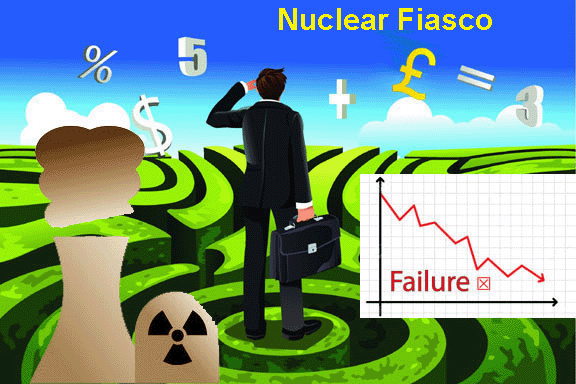
The Government is likely to become responsible for a huge bill for building Hinkley C power station. This is despite an insistence by the UK Government since they signed a deal with EDF to build Hinkley C in 2012
that electricity consumers will not have to pay for cost overruns for the project.
Yet it is now looking increasingly likely that this will end up being the case. When the deal was signed in 2012 the Government agreed to pay a much higher than expected £92.50 per MWh (in 2012 prices), this
price to be paid by consumers in their electricity bills (over twice the price given to recent offshore wind projects).
The Government claimed that there would be no bail-out if the project experienced large cost overruns
since the risk was borne by the holders of the share capital, EDF and also the Chinese state nuclear company, CGN. CGN holds around one third of the equity in Hinkley C.
But now there are mounting pressures on the Government to ensure that, for political and security reasons, China (through CGN) is not allowed to build its own nuclear design at Bradwell in Essex. Yet CNG only agreed to finance Hinkley C (and also in a similar fashion the planned Sizewell C project in Sufflok) on the basis that it was going to get the chance to showcase its own ‘Hualong’ nuclear plant at Bradwell.
If China’s Bradwell ambitions are thwarted then they will certainly pull out of the Sizewell C project and also do as much as is legally possible to forshorten their risks and responsibilities at Hinkley C. The Government is likely to have to take on big liabilities in the case of Hinkley C – that is against a long succession of pronouncements by Government ministers over the past nine years. Some are even urging the Government to take over all of CGN’s shareholdings in Hinkley C.
But even if the Chinese company cannot reclaim the money it will have spent on the project so far, if CGN is denied the opportunity to build at Bradwell they are very likely to refuse to pay for any cost overruns at Hinkley C (as well as pull out of Sizewell C). This means that the UK Government will have to take on the liability of future cost overruns, and maybe end up in a major row with China about financial compensation.
100% Renewables 28thy July 2021
No-one can get finance to build a uranium mine in Australia.

NO-ONE CAN GET FINANCE TO BUILD A URANIUM MINE IN AUSTRALIA https://www.ccwa.org.au/no_finance_toro?utm_campaign=nuclear_news172&utm_medium=email&utm_source=ccwa
BY K-A GARLICK JULY 26, 2021 CCWA nuclear-free campaigner Kerrie-Ann Garlick attended last week’s Toro meeting to raise concerns that the company’s most recent uranium proposal differs from its currently approved plan.
Toro Energy’s general meeting last Friday heard the death toll sounding on WA’s uranium hopefuls.
Toro Chair Richard Homsany told the meeting that no one can get finance to build a uranium mine in Australia. He also acknowledged that Toro’s conditional environmental approval for its stalled Wiluna project expires on January 9, 2022. From this date, Toro will not be able to mine without making project changes that would require further state government scrutiny and approval.
In 2017 the McGowan Labor government introduced a policy ban on uranium mining in WA but inherited four uranium mine proposals with existing approvals granted by the former Barnett government. By the end of January 2022, the current Ministerial approvals for all four of the states proposed uranium mines will expire if they do not commence mining.
Approval for Cameco’s Kintyre expired and was not renewed in March 2020, Vimy Resources Mulga Rock project approval expires in December 2021 and both Yeelirrie (Cameco) and Wiluna (Toro) are set to expire in January 2022. If any of these companies want to mine they will need to seek approval for amendments to Ministerial conditions. This may trigger a new assessment or a suite of other conditions being applied.
CCWA nuclear-free campaigner Kerrie-Ann Garlick attended last week’s Toro meeting to raise concerns that the company’s most recent uranium proposal differs from its currently approved plan. “Toro is now focused on developing a JV uranium project at Lake Maitland. This is completely separate from the existing approval for the Wiluna project and would require a whole new environmental assessment. It is our view that this could not be advanced because of the existing policy ban on uranium mining in WA.”
“The Wiluna uranium mine proposal is uneconomic and they don’t have the funding to develop it. There is almost no scenario in which the Wiluna uranium mine could be developed ahead of the approval expiry in January 2022”
“It is refreshing that the Toro Board are realistic about the current highly negative market conditions for uranium. No one is financing uranium mines and that is unlikely to change by January. It is increasingly likely that we will reach a point in January 2022 where there are no operating mines and no active approvals for uranium mining in WA,” Ms Garlick concluded.
Hinkley Point C and Sizewell nuclear power projects could unravel, leaving France’s nuclear company EDF with huge debt.
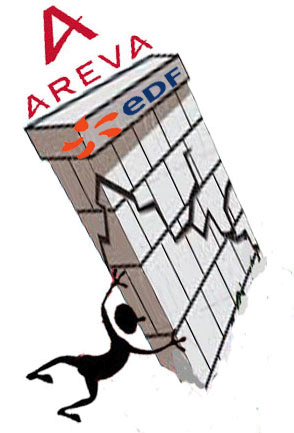
| It was never very likely that the government would allow a Chinese state-owned company to build a nuclear power station in Britain. So news that it is now looking for ways to remove China General Nuclear Power Group (CGN) from future nuclear projects hardly comes as a surprise. Under the terms of a deal struck in 2015 CGN was to take minority stakes in two French-led new nuclear power stations, Hinkley Point C and Sizewell C, while taking a majority stake in a third, Bradwell in Essex, which would use CGN’s own technology. This deal, first agreed by the coalition government, was approved with only minor alterations by Theresa May after a review concluded that Britain’s robust regulatory and technological safeguards were sufficient to protect against any threats to national security. Whether or not that assessment was right, the political context has since changed. The mood in parliament, particularly among Conservative MPs, has turned decisively against China, making it inconceivable that any government could allow China to build such sensitive national infrastructure. CGN was blacklisted from US government contracts in 2019 after being accused by the Trump administration of technology theft. That has made it harder for France’s EDF to attract the infrastructure investors that it needs to make Sizewell C financially viable. The risk is that China does not take its rejection well and the entire three-part deal unravels, with CGN withdrawing from Hinkley Point C in protest. That could leave EDF with a further shortfall of up to £4 billion. Times 26th July 2021 https://www.thetimes.co.uk/article/the-times-view-on-chinas-role-in-nuclear-plants-power-play-v70d2r76k |
Chinese company likely to be glad to abandon UK’s Hinkley and Bradwell nuclear power projects, as costs jump.
| China could quit UK nuclear projects if role threatened, experts warn. Effort to remove state-owned CGN from Sizewell C said to leave Hinkley Point and Bradwell developments exposed. China General Nuclear is likely to walk away from the Hinkley Point C power station being built in Somerset if the Chinese state-owned nuclear company is forced out of other future projects in the UK, industry experts warned on Monday. The company is already a minority investor in the 3.2 gigawatt Hinkley Point nuclear power station, which France’s EDF is building. One nuclear industry executive warned that CGN could now reassess its involvement with Hinkley Point. They pointed out there were four interlinked agreements between CGN, EDF and the government dating to 2015: Hinkley Point, Sizewell, Bradwell and the pursuit of regulatory approval for China’s reactor design. Steve Thomas, emeritus professor of energy policy at University of Greenwich, said CGN’s investment in Hinkley was designed to make a profit and also help secure its plant at Bradwell. With both of those now in jeopardy, the company could quit the UK, he warned. The Chinese company is eager to getUK regulatory approval at Bradwell for its own Hualong One HPR1000 reactor in order to help market it in other countries. The reactor design is currently going through the UK’s rigorous approval process with a decision expected in the second quarter of next year. But Thomas pointed out that with Hinkley’s budget having jumped from £14bn to as much as £22.5bn it was no longer clear whether the consortium would make a profit. “I would have thought that would put it into lossmaking territory,” he said. “They may well be very happy for an excuse to get out of it,” Thomas said. “If Bradwell is off the agenda and Hinkley Point won’t make money, why stick around?” Alison Downes of Stop Sizewell C, a pressure group, said the government’s position threw EDF’s funding problems for the new plant into sharper relief: “The simple fact is that Sizewell C won’t go ahead without new investors,” she said. FT 27th July 2021 https://www.ft.com/content/ada78301-0b2c-4bf5-bcd4-ea0cd55312ae |
The need for integrity in epidemiological research: investigation of uranium miners’health to be carried out by pro nuclear bodies

“They want to show that it doesn’t cause cancer. I think they want to find that result.”
for years, the CNSC has served both as a regulator and promoter of the nuclear industry
“It is concerning that health standards are set by physicists and industries, based on financial and technological convenience, rather than by those educated in and committed to public health and safety.”
Canadian Nuclear Safety Commission to Investigate Lung Cancer Rates Among Uranium Workers, Mother Jones
What’s happened to 80,000 people who have worked in Canada’s mines and processing facilities?CHARLES MANDEL, 25 July 21, The Canadian Nuclear Safety Commission (CNSC) is leading a national study examining incidences of lung cancer in uranium workers from across the country.
The Canadian Uranium Workers Study (CANUWS) will examine health data from 80,000 past and present employees at Canada’s uranium mines, mills and processing and fabrication facilities. The study, which is now underway and set to end in 2023, is the largest examination of lung cancer in Canadian uranium workers to date.
Rachel Lane, one of the lead researchers on the new study, told Canada’s National Observer she believes it will reassure workers they face less risk than before from lung cancer arising from exposure to radon, ……..
The $800-million mining and milling uranium industry employs over 2,000 people—of whom more than half are residents of northern Saskatchewan—at mine sites. The researchers plan to examine causes of death in uranium workers from 1950 on and chart their cancer data from 1970 onwards, using research from previous studies.
The new study will build on the results of two historical studies: the Eldorado study and the Ontario Uranium Mine Workers Study, both of which found elevated risks of lung cancer in uranium workers. During numerous follow-ups ending in 2015, both studies found lung cancer among miners was still more prevalent than in the general population………….
deaths from lung cancer associated with radiation were historically higher for uranium workers than the general male population……….
In 2015, a follow-up to the 2007 Ontario Uranium Miner Cohort study was done. It examined approximately 28,546 male and 413 female uranium miners who had worked at least one week in the Elliot Lake and Bancroft regions or at the Agnew Lake Mine between 1954 and 1996.
The conclusion: “Significant elevations in lung cancer mortality and incidence, as well as silicosis and injury mortality were observed in comparison with the general Canadian population.”……….
Anne Leis, the department head of Community Health and Epidemiology at the University of Saskatchewan, will administer the project and analyze the data. Her colleague, Punam Pahwa, a professor of biostatistics, will lead the statistical analysis of the health data……….
Uranium mining companies Cameco, Orano, and BWXT are co-funding the study, contributing $60,000. The CNSC is providing $125,000, while the Saskatchewan government is kicking in $60,000, and the University of Saskatchewan is contributing $90,000 of in-kind funding.…………
Concerns Over Possible Bias
While former employees and industry watchers applaud efforts to study the health of uranium workers, some are skeptical about the ability of CNSC to produce an unbiased report.
Jamie Kneen, communications and outreach coordinator at Mining Watch Canada, says it’s important to understand the longer-term impacts of radon on the miners. But he cautions that the peer review and oversight of the study must be carefully examined because it is being led by CNSC.Kneen contends that for years, the CNSC has served both as a regulator and promoter of the nuclear industry. “Their tendency has been to extend license periods and to give operators, whether it’s in the uranium industry or the nuclear power industry, more space, more time in terms of licensing and more leeway rather than the kind of tight supervision and oversight that the public probably would expect.”
Therefore, it’s a question of scrutinizing who’s doing the work and reviewing the study to ensure that it really is independent, according to Kneen. He notes that’s a difficult task given that the methodology around radiation is intricate and that not many people can decipher the technical details.
“So there’s a lot of potential for not necessarily deliberate manipulation, but for error to creep in and biases to creep in.”
Rod Gardiner, a former general foreman at the now-defunct Cluff Lake Mine in Saskatchewan, expresses his own concerns about the industry. Gardiner was at the mine for 33 years, working his way up to general foreman and acting mine manager.
He alleges management at Cluff Lake, which was owned by the multinational mining corporation Orano Group, consistently boasted that working in the mine was as safe as working in a supermarket and putting prices on soup cans. “That’s what they used to say, the company.”
He hopes a new study might answer questions about workers’ health. But others aren’t sure whether results will be trustworthy, primarily because the CNSC is partially funding and leading the study.
The CNSC’s work has been subject to just those kinds of complaints in the past.
Writing in the journal Canadian Family Physician in 2013, Dale Dewar and two other authors expressed concern over the CNSC’s ability to act independently of government and industry. The authors noted the former Conservative federal government fired the commission’s CEO when she applied safety guidelines to shut down the Chalk River reactor in Ontario.
The authors observed: “It is concerning that health standards are set by physicists and industries, based on financial and technological convenience, rather than by those educated in and committed to public health and safety.”
Dewar, a longtime general physician in northern Saskatchewan, recently told Canada’s National Observer: “They want to show that it doesn’t cause cancer. I think they want to find that result.”
Dewar expressed surprise that the CNSC has opted for a focused study when northerners have been asking for decades for a baseline health study to determine such things as whether or not there have been increases in autoimmune diseases or cancers that couldn’t be explained by diet, for example.
“I think not only is it virtually a sin that they’ve never done this, but I think it’s a really huge missed opportunity because if they had a study done like this, they would have researchers around the world trying to get information out of it.”…………
Compensation for Uranium Workers
Another, less discussed issue is compensation for uranium miners. In the United States, the Radiation Exposure Compensation Act (RECA) administered by the Department of Justice has awarded over US$2.4 billion in benefits to more than 37,000 claimants since its introduction in 1990. https://www.motherjones.com/environment/2021/07/canadian-nuclear-safety-commission-to-investigate-lung-cancer-rates-among-uranium-workers/
Most Hanford nuclear site workers report exposure to toxic or radioactive chemicals
57% of Hanford nuclear site workers surveyed by WA state report toxic exposures, Tri City Herald
BY ANNETTE CARY, JULY 07, 2021
More than half of Hanford site workers responding to a Washington state survey said they had been involved in an incident at the Hanford nuclear reservation that resulted in exposure to radioactive or toxic chemicals.
Some 57% of about 1,600 past and present workers who took the survey reported being in an exposure incident, which could include the release of radioactive material into the air.
And nearly a third, 32%, reported they had long-term exposure to hazardous materials at the nuclear reservation, rather than exposure during a single incident………
Workers are cleaning up and treating radioactive and hazardous chemical waste left from the past production at Hanford of two-thirds of the nation’s plutonium for its nuclear weapons program……….
For incurable diseases, such as chronic beryllium disease caused by breathing in fine particles of the metal beryllium, information sharing could be key to finding cures, the board said.
SICK HANFORD WORKER ISSUES
It also recommended expanding Tri-Cities access to care that is tailored to Hanford workers’ health needs.
Some workers reported they did not receive a diagnosis until they visited clinics outside the Tri-Cities area and sometimes outside the state.
After an initial assessment or diagnosis related to Hanford exposures there was not long-term coordination of care, said workers in survey comments.
Part of the difficulty was that some health problems, such as cancers, are not diagnosed until years after exposures, the report said……………https://www.tri-cityherald.com/news/local/hanford/article252613523.html
Energy-guzzling Bitcoin must be allied to dangerous costly nuclear power

Bitcoin Miners Embrace Nuclear Power , Yahoo Finance, Editor OilPrice.com, 21 July 21,
”…..The worldwide cryptocurrency production sector is eating up an almost unfathomable amount of energy — as much as entire nations. As of now, Bitcoin mining ranks between Colombia (a country of 50 million people) and Bangladesh (population 163 million) in terms of energy consumption. All told, Bitcoin networks account for an incredible 0.32% of the world’s energy consumption…
The process of “mining” Bitcoin, while virtual, requires an enormous amount of resources because of the considerable computing power necessary to carry out the extremely complex calculations to solve the “proof-of-work” problems that make up the blockchain, the digital ledger that Bitcoin is built upon. Bitcoin is currently being singled out for its massive energy consumption over other cryptocurrencies, not only because it is more than twice the size of the next-most traded cryptocurrency, but because Bitcoin’s especially complex SHA-256 algorithm, which makes Bitcoin one of the most secure cryptocurrencies out there, also makes it one of the most energy-hungry.
Greenpeace Rainbow Warrier aims to help workers to transition to renewable energy work
The Greenpeace Rainbow Warrior III ship is in Aberdeen Harbour as part of its Just Transition Tour. The campaign calls on government to train oil and gas workers for a smooth transition to renewable energy schemes. The 190-ft vessel will moor overnight in Aberdeen before heading for Wick with sights set on the 84-turbine Beatrice offshore windfarm sitting lying nine miles off the Caithness coast. The intrepid crew are keen to assess “the challenges and opportunities” facing the platforms’ workers.
Greenpeace UK’s oil campaign leader Mel Evans, head said offshore workers had their full support. He added: They have powered our economy through difficult times and they have plenty of transferable skills which will be vital to our transition to renewable energy. “Politicians must sit down with offshore workers and take urgent action to make the funds, retraining opportunities and jobs available to make Scotland’s clean energy transition a success.”
Evening Express 18th July 2021
The Green Jobs Taskforce
Just Transition**
The UK is currently not on track to deliver a commitment to host two
million green-collar jobs by 2030. But the economic recovery from Covid-19
presents a window to accelerate investment and build a robust skills
pipeline, according to the Green Jobs Taskforce report published this week.
The Taskforce was set up by the Government late last year, following
pressure from trade bodies, businesses and NGOs. Its purpose is to develop
recommendations for helping unemployed people into skilled jobs that
contribute to the net-zero transition and supporting those currently
working in high-carbon businesses to upskill and reskill.
Under an overarching call to ensure that the Net-Zero Strategy is published to time
ahead of COP26 and includes significant commitments on jobs and skills,
three themes are covered in the report: Scaling up investment in the
net-zero transition, building pathways into good green careers and
supporting a just transition for workers in the high-carbon economy.
Edie 16th July 2021
https://www.edie.net/news/11/Six-UK-green-policy-stories-you-need-to-know-about-this-week/
Green energy suppliers protest at UK government’s funding plan to promote nuclear power, with residents exposed to nuclear cost overruns.
Green energy suppliers oppose bills surcharge for new nuclear plants, Critics warn the UK government’s plans could expose households to cost overruns.
Ft.com Nathalie Thomas in Edinburgh Green energy suppliers are protesting at the prospect of having to add a surcharge to household bills to pay for new nuclear plants in Britain when their customers purposely choose not to support the divisive technology.
UK ministers are aiming to introduce legislation in the autumn that would allow for a large nuclear power plant proposed for Sizewell on England’s east coast to be financed via a “regulated asset base” model. The scheme would see households help fund the construction of the £20bn plant via a surcharge on their energy bills, regardless of their supplier.
Households already pay for a number of policy costs via their energy bills, such as subsidies for wind and solar schemes, yet a nuclear surcharge would prove particularly difficult to stomach for companies that offer their customers “100 per cent renewable energy” deals, which do not include nuclear power.
Dale Vince, the founder of Ecotricity, the first company in Britain to have offered customers green electricity, told the Financial Times: “It’s bonkers we would all have to pay this subsidy for at least a decade of construction and not for power generated.”
“The government is reluctant to fund nuclear projects itself, so allowing Sizewell [C] to access the RAB [regulated asset base] system is simply dumping the cost on consumers — even those who have gone renewable, and that’s just unfair,” added Vince.
Kit Dixon, policy manager at Good Energy, the UK’s first supplier to offer customers 100 per cent renewable electricity, said that “we should be deeply concerned” by the nuclear industry potentially being offered such a deal to build expensive new plants “with little incentive to deliver on time or within budget”.
“We’ve got to stop seeing customers’ bills as a sort of cash machine for folly projects,” said another energy chief executive who asked not to be named.
…………………….Critics of the regulated asset base model warn that it would expose households to cost-overruns, which have proved common in the nuclear industry.
Environment groups oppose nuclear on the grounds that it is more expensive than technologies such as offshore wind and leaves a legacy of highly toxic waste that takes more than 100,000 years to decay.
Bulb, Britain’s seventh biggest supplier by market share, also warned in a response to a consultation on the regulated asset base model that using the financing mechanism for nuclear plants “doesn’t protect customers who choose to be on a renewable tariff but adds costs to their bills for a technology they won’t directly benefit from”……….. https://www.ft.com/content/a12bc937-a91f-4341-ba3e-25d7f7edc6d2
A new problem for France’s nuclear company EDF threatens to further delay its plans for new model European Pressurised Reactor (EPR2)
EPR2**
In a discreetly published notice in March, the Institute for Radiation Protection and Nuclear Safety (IRSN) – the technical office of the Nuclear Safety Authority (ASN) – asks the State-owned company EDF to identify the origin of the vibrations affecting the circuit primary water from EPRs, already built or under construction.
And to find a solution to this problem, so that it does not reproduce on its new model of reactor, called EPR 2.
Passed under the radar, the news is yet another hard blow in a story with twists and turns. Indeed, EDF has to date no idea how to solve it.
Consequently, we can already anticipate new years of additional delay inthe development of a technology, supposedly easier to produce and therefore more competitive, on which the group led by Jean-Bernard Levy plays very heavily.
Blast 17th July 2021
A worrying combination – nuclear + Bitcoin
Nuclear-Powered Bitcoin Mining Is Coming to the States, Nasdaq, Portfolio Insider, JUL 16, 2021 Amid last month’s heated debate over Bitcoin’s environmental impact, two companies are confident they have the answer on how to mitigate some of the negative effects: nuclear energy.
Nuclear-powered Bitcoin mining is part of a new wave of innovation of companies developing smaller reactors that they say would be faster and cheaper to build than conventional nuclear plants. These Bitcoin nuclear reactors can be small and would generate a lot of power without harmful emissions –[this is a lie]
Bitcoin mining is necessary for releasing new Bitcoins into circulation. To help avoid fraud, miners authenticate transactions on Bitcoin’s blockchain. In return, miners are given new Bitcoin. Miners need to solve extremely complex math problems to verify transactions, which require a large amount of computational power.”Right now, millions of Bitcoin mining devices around the world are generating 130 quintillion of such guesses every second of the day non-stop,” Alex de Vries, a financial economist who runs Digiconomist, told CNBC. “Combined, these machines are now consuming as much electrical energy as a country like the Netherlands.”
Bitcoin mining to go nuclear
Along with other clean ? energy sources like wind, solar and hydro, nuclear energy could be the best power source for Bitcoin mining due to its reliability, cheapness [ whaaa at“} and carbon-free nature (carbon free – that’s a lie). ………. https://www.nasdaq.com/articles/nuclear-powered-bitcoin-mining-is-coming-to-the-states-2021-07-16—
1 This Month



26 September – International Day for the Total Elimination of Nuclear Weapons


PLEASE OPPOSE HR 8255 AND S.3639 – bills would accelerate satellite deployment, with no environmental review or safeguards – https://ncstd5li.quorum.us/campaign/169331/
To see nuclear-related stories in greater depth and intensity – go to https://nuclearinformation.wordpress.com
-
Archives
- September 2026 (245)
- August 2026 (330)
- July 2026 (355)
- June 2026 (287)
- May 2026 (306)
- April 2026 (356)
- March 2026 (251)
- February 2026 (267)
- January 2026 (308)
- December 2025 (358)
- November 2025 (359)
- October 2025 (375)
-
Categories
- 1
- 1 NUCLEAR ISSUES
- business and costs
- climate change
- culture and arts
- ENERGY
- environment
- health
- history
- indigenous issues
- Legal
- marketing of nuclear
- media
- opposition to nuclear
- PERSONAL STORIES
- politics
- politics international
- Religion and ethics
- safety
- secrets,lies and civil liberties
- spinbuster
- technology
- Uranium
- wastes
- weapons and war
- Women
- 2 WORLD
- ACTION
- AFRICA
- Atrocities
- AUSTRALIA
- Christina's notes
- Christina's themes
- culture and arts
- Events
- Fuk 2022
- Fuk 2023
- Fukushima 2017
- Fukushima 2018
- fukushima 2019
- Fukushima 2020
- Fukushima 2021
- general
- global warming
- Humour (God we need it)
- Nuclear
- RARE EARTHS
- Reference
- resources – print
- Resources -audiovicual
- Weekly Newsletter
- World
- World Nuclear
- YouTube
-
RSS
Entries RSS
Comments RSS
 nuclear-news