USA keen to market nuclear reactors to Poland (and indeed – to anybody)
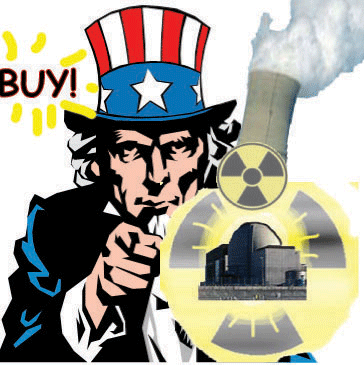
Bechtel, Westinghouse join forces to pursue Polish nuclear power plant project, July 16, 2021, RESTON, Va., July 15, 2021 /PRNewswire/ — Bechtel and Westinghouse Electric Company, two leading U.S. companies in the global nuclear industry, today announced they’ve formed a team to pursue new nuclear power plant projects in Poland…….
“Poland is taking steps to transition to a clean energy economy while retaining its energy independence and security. The Westinghouse-Bechtel team offers proven technology and hands-on experience in nuclear project delivery and is ready to immediately support Poland’s transformative vision.”……
This news follows the U.S. Trade and Development Agency announcement on June 30 providing a grant for a front-end engineering design (FEED) for a plant in Poland using proven Westinghouse AP1000 reactors. The FEED is expected to be delivered in 12 months. https://finance.yahoo.com/news/bechtel-westinghouse-join-forces-pursue-170100809.html
Most Hanford nuclear cleanup workers exposed to hazardous materials: Washington state report
Most Hanford cleanup workers exposed to hazardous materials: Washington state report https://thehill.com/policy/energy-environment/561893-most-hanford-workers-exposed-to-hazardous-materials-state-report
BY CELINE CASTRONUOVO – 07/07/21 More than half of all current and former workers involved in the Hanford Nuclear Reservation cleanup effort have said they were exposed to hazardous materials, according to a new report from the Washington state government.
The report, the last in a series from the Department of Commerce’s Hanford Healthy Energy Workers Board, found that 57 percent “of all current and former workers reported being in an exposure event,” with 32 percent saying they experienced “long-term exposure to hazardous materials.”
The 106-page document cited “deep concerns” among current and former workers about “compensation system processes and the healthcare system’s ability to meet workers’ needs,” and identified “deficiencies in continued engagement with workers after an initial assessment or diagnosis as a common obstacle for the Hanford workforce.”
The findings cap eight months of research by a state-commissioned board tasked with making recommendations on addressing the health needs of workers at the Hanford nuclear site.
The 560-square-mile area in Washington was used by the federal government from 1944 to 1987 to produce plutonium for nuclear weapons and missile warheads.
However, the state board noted that during this time, “many highly radioactive byproducts and waste chemicals were dumped directly into the ground or stored in subterranean multi-million-gallon underground storage areas known as tank farms.”
The Department of Energy’s mission at the site shifted from production to cleanup beginning in the late 1980s.
The site has come under increased scrutiny in recent years for its affect on health and the environment, with the Energy Department warning in April that it believed an underground tank at the facility was leaking waste produced by plutonium production.
The Hanford area is considered the most contaminated site of radioactive waste in the U.S.
The board’s final report on Wednesday offered a look at some of the long-term impacts of nuclear production and waste at the site, including incurable conditions like chronic beryllium disease, which leads to scarring of lung tissue.
The board said that “information sharing could be key to finding cures” to the disease and other chronic conditions developed from exposure to hazardous materials.
Other recommendations included the creation of a Hanford Healthy Energy Workers Center to “serve as a centralized clearinghouse for Hanford-specific health-related information that includes up-to-date scientific knowledge, research on emergent topics, exposure data analysis, medical surveillance data analysis and coordinated intergovernmental efforts for policy and advocacy.”
The board said greater access should be given to specialty and follow-up care, and urged health officials to improve “the quality of care available to Hanford workers both at the Hanford site and in the Tri-Cities area.”
Japan’s government acknowledges that solar power will be cheaper than nuclear
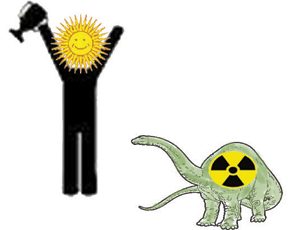
Solar power eclipses nuclear energy in terms of costs, Asahi Shimbun, By SATOSHI SHINDEN/ Staff Writer, July 13, 2021 For businesses looking ahead to reduce costs, solar power would definitely seem to be the way to go. Households could possibly benefit as well.
A new estimate by the industry ministry on future costs of power generation found that solar power will eclipse nuclear energy in terms of costs as of 2030.
The finding, released July 12, is expected to have significant implications for the nation’s energy policy.
This is the first time for the Ministry of Economy, Trade and Industry to acknowledge that the cost to generate solar power will be lower than that for nuclear power.
The estimates were presented at a meeting of a working group of the Advisory Committee for Natural Resources and Energy the same day.
Estimated costs for nuclear power came to close to the 12 yen level or more per kilowatt-hour as of 2030, about 1 yen higher than the previous estimate in 2015.
Costs for solar power ranged from the lower 8 yen level to close to 12 yen for businesses. The rate for homes was estimated at between the last half of the 9 yen level to the first half of the 14 yen level.
The government and electric utilities have continued to champion nuclear power generation even after the 2011 triple meltdown at the Fukushima No. 1 nuclear plant, citing cost efficiency over other energy sources.
However, the latest estimates would seem to call the legitimacy of that argument into question and will likely have an impact on the government’s Basic Energy Plan, for which officials are working to revise.
The Basic Energy Plan is updated almost every three years.
“The industry ministry has finally acknowledged it can no longer maintain the position that nuclear power is the most economical source of energy,” noted Kenichi Oshima, a professor of environmental economics at Ryukoku University who studies the nation’s nuclear policy, referring to the latest findings about costs.
The estimated costs for generating electricity with nuclear energy have risen each time calculations were made.
The ministry was forced to include ballooning costs for decommissioning of nuclear reactors and decontaminating crippled facilities in the aftermath of the Fukushima nuclear disaster…..
solar energy is getting cheaper.
The latest estimate for solar power was down from the previous calculation in 2015 because the costs of installing solar panels are dropping.
Charges for generating electricity are calculated as follows: the total cost of building a new power facility, operating it for decades and finally dismantling it divided by the overall amount of power produced during the period…… https://www.asahi.com/ajw/articles/14394069
The nuclear rort in Georgia. Consumers may end up paying for billions of dollars in cost overruns on the Plant Vogtle nuclear expansion.
Nuclear cost overrun could mean billions in extra Georgia Power profit, By Matt Kempner, The Atlanta Journal-Constitution, 9 July 21, The more utility spends, the more it can earn; consumers pay price.
Consumers may end up paying for billions of dollars in cost overruns on the Plant Vogtle nuclearexpansion.
But for Georgia Power and its parent Southern Co., the extra costs could represent a huge financial windfall: billions of dollars in extra profit.
That’s because the electric utility’s profit from the sprawling project is tied largely to how much it spends, not whether it stays within budget.
The tab for 2.6 million Georgia Power customers — and the profit for Southern and its shareholders — could start becoming clearer this fall, when elected state regulators hold hearings to determine how much of Vogtle’s initial construction expenses can be added to electric bills for the first time.
By state law, Georgia Power can charge its customers for reimbursement of “prudent and reasonable” capital costs, such as from building a new plant, and for profit set as a percentage of those expenses. The higher the allowed costs, the greater the profit.
The Georgia Public Service Commission, which regulates the electric monopoly, could rule that many of Vogtle’s cost overruns weren’t prudent or reasonable, sharply limiting increases in consumer bills and reducing Georgia Power’s total profits.
But so far there are no indications that will happen, at least not in the long term.
Stock analysts, bond-rating agencies and the company’s own executives cite the risk, but they also often praise regulators’ “constructive” relationship with Georgia Power. In late 2019, the PSC agreed to let Georgia Power collect one of the highest rates of return among its peers around the nation.
“Their decisions, for lack of a better term, have been protective of or supported investments of Georgia Power,” saidJeff Cassella, a senior credit officer for bond-rating firm Moody’s Investors Service. He said he’s seen no indication the PSC will deny Vogtle costs.
Vogtle basics
Project: Build two new nuclear reactors near two existing reactors at Plant Vogtle south of Augusta, near the South Carolina line.
Owners: Georgia Power (45.7%), Oglethorpe Power (30%, represents electric membership cooperatives), the Municipal Electric Authority of Georgia (22.7%, represents city utilities), Dalton Utilities (1.6%).
Benefits: Expected to provide a reliable, stable power supply for at least 60 years….
Downsides: Beyond concerns such as toxic nuclear waste, the all-in-cost of the new electricity is projected to be higher than that from competing forms of electricity generation, according to state staffers.
Costs: Georgia Power’s portion of the total project cost was slated to be $6.1 billion. So far, it’s increased to $11.1 billion.
How Georgia Power’s portion of the project will be paid for: The company’s customers are already paying a fee in monthly bills for a portion of Vogtle financing costs and company profits on the project. It’s estimated that average residential Georgia Power customer will have paid over $850 in such fees before the project is completed. Then their bills are expected to rise higher to cover all “prudent” and “reasonable” construction costs and company profits that rise with those costs.
Who decides what costs are prudent and reasonable: The five elected members of the Georgia Public Service Commission, which regulates Georgia Power, a territorial monopoly that is part of Southern Company.
Had Georgia Power met its original budget and schedule, it would have made $7.4 billion in profits on the project, according to testimony of state independent monitors and PSC staff. But because costs have soared by billions of dollars, those profits could rise to $12.6 billion over the decades-long life of the two new reactors under construction, they testified in 2017.
Costs at Vogtle have continued to climb since 2017. As a result, profits could rise higher, too……………..
Vogtle’s expansion, meanwhile, has been riddled with problems and delays since the PSC approved the project in 2009. The company negotiated a contractor deal with Westinghouse to insulate the utility and customers from some of the worst of the possible overruns, but that was negated after Westinghouse filed for bankruptcy protection.
Georgia Power’s share of the initial estimated total project cost, $6.1 billion, has ballooned to $11.1 billion at the latest estimate.
The reactors were supposed to go into operation in 2016 and 2017, but the timetable has been repeatedly extended. Now, Georgia Power predicts the first unit will be finished in the first quarter of next year. A monitor for the state, though, says the earliest would be the summer of 2022, followed by the second reactor a year later, at best. And he cautioned that constructioncosts for Georgia Power and its partners could rise another $2 billion…………
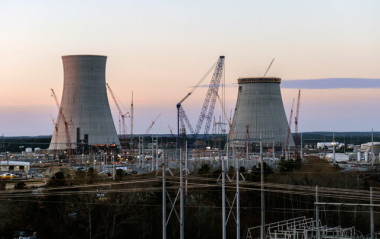
Vogtle was set up for streamlined U.S. regulatory approvals, billions of dollars in federal loan guarantees and dibs on hundreds of millions of dollars in federal tax credits. Georgia’s legislators and then-Gov. Sonny Perdue allowed the company to collect financing costs and some profits years before any electricity was produced.
As a result, the average Georgia Power residential customer will have paid $854toward the project before it goes into operation. That doesn’t include the actual costs of construction, which keep growing.
Echols, the PSC’s vice chairman, said in an email that the enactment of short-term profit reductions shows the regulator is holding the company accountable and “sends a painful and embarrassing message to Georgia Power.”
Those cuts essentially last until the first new reactor goes into operation. Then profit rates can rise back up for what could be decades to come, dwarfing the initial penalties………
Georgia isn’t alone in allowing regulated utilities to potentially profit on project overruns. A number of other states in the Southeast operate under a similar framework, according to the National Association of Regulatory Utility Commissioners………. https://www.ajc.com/news/business/nuclear-cost-overrun-could-mean-billions-in-extra-georgia-power-profit/YIA3T3YHZRHI5A7GCZHREIXCPE/
France’s government helps settle the debts of bankrupt nuclear company AREVA (which is now resuscitated as ORANO)
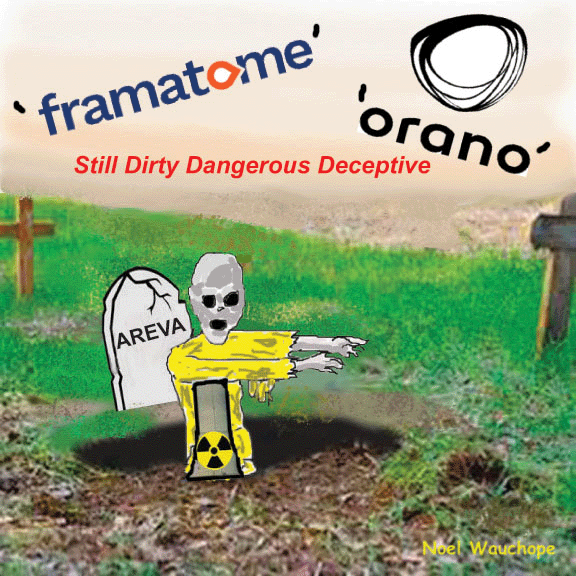
French state helps Areva settle Finnish EPR liabilities. To settle a new additional cost of 600 million euros, the State will buy back from the company, for 994.1 million euros, part of the shares it holds in the capital of Orano, the group responsible for managing the fuel cycle.
Le Monde 8th July 2021
UK residents face higher electricity bills, paying in advance, for the construction of new nuclear reactors
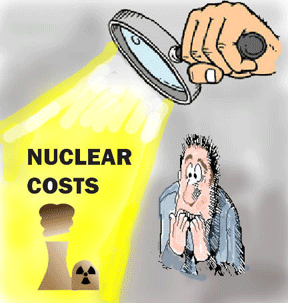
Consumers face higher energy bills to pay for new nuclear power. EDF wants to recoup some of the £20bn cost of the new Sizewell C plant in Suffolk before it starts producing electricity. Households face higher energy bills to help pay for the planned £20bn Sizewell C plant in Suffolk as the Government seeks to replace the UK’s ageing nuclear power stations.
Ministers are preparing to introduce legislation so that nuclear developers can recoup some of their costs through energy bills while a new plant is being built, rather than having to wait until it has been developed, the Financial Times reported. Supporters stress the so-called regulated asset base model can help cut the huge costs of nuclear power because it reduces risk for developers, although critics argue it unfairly heaps risk onto consumers. EDF has been in negotiations with the Government since December over a funding deal for its proposed Sizewell C plant amid public debate about the role nuclear power should play in the energy ecosystem.
It was estimated in 2019 that energy bills could rise by about £6 a year if the regulated asset base model is used for Sizewell. The financing model is used for other infrastructure projects such as the Thames Tideway Tunnel
but not yet for power generation, meaning new legislation is needed. The nuclear industry has been increasingly vocal in recent months about the importance of replacing the UK’s nuclear plants, most of which are due to close by the end of the decade.
Telegraph 7th July 2021
William Perry and Jerry Brown address the unwisdom of spending $2 trillion on new nuclear weapons
Spending $2 trillion on new nuclear weapons is a risk to more than just your wallet, Business Insider, BILL PERRY, JERRY BROWN, JOHN GARAMENDIJUL 7, 2021,
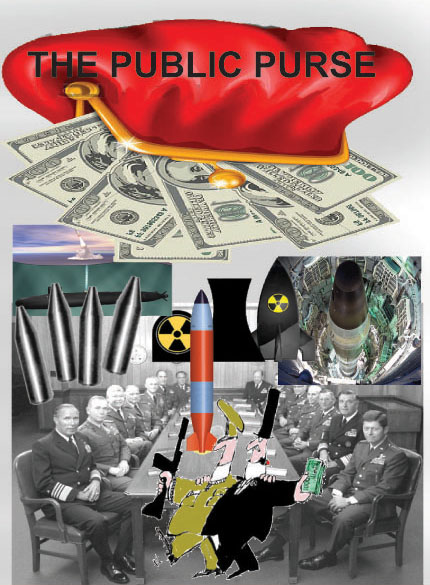
- The US is pursuing the modernization of all three legs of the nuclear triad, at an estimated cost of $1.7 trillion over 30 years.
- Simultaneous modernization exceeds what’s needed for an effective nuclear deterrent and is an unnecessarily costly and risky way to achieve our deterrence requirements.
- Bill Perry is a former US secretary of defense. Jerry Brown is a former governor. John Garamendi is the US Representative for California’s 3rd Congressional District.
The world is witnessing a new, dangerous nuclear arms race. Tensions are rising between the Great Powers. As the US, Russia, and China rush to modernize their nuclear arsenals, the trip wire is becoming more taut by the day.
Observation and communication satellites and systems are increasingly vulnerable to attacks. All three countries are fielding stealth and hypersonic nuclear delivery systems designed to evade detection. The risks of a false alarm or a political miscalculation has always haunted the nuclear landscape, and they do even more today.
Last week, legislation was introduced in the US House of Representatives to address the misguided nuclear modernization strategy the US is currently employing and chart a safer, more cost-effective course for our modernization efforts – one that is predicated on deterrence rather than dominance.
As long as nuclear weapons exist, we must have a safe, secure, and effective nuclear deterrent. However, simultaneous modernization efforts across all three legs of the nuclear triad exceed that scope and are an unnecessarily costly and risky way to achieve our deterrence requirements.
The current US nuclear modernization strategy includes the Ground Based Strategic Deterrent (GBSD), the B-21 bomber, the Columbia-class submarine, the Long-Range Standoff (LRSO) air-launched cruise missile, the sea launched nuclear cruise missile, and new nuclear warheads.
The costs of these projects are extraordinary: a 2017 Congressional Budget Office (CBO) report estimated that the 30-year cost of nuclear weapons spending would be $1.2 trillion ($1.7 trillion adjusted for inflation).
As the Government Accountability Office recently noted, the current plan to modernize every part of the US nuclear arsenal simultaneously is a recipe for schedule delays and cost overruns.
The ICBM leg of the triad deserves special attention. The total price tag to procure the GBSD is projected to be at least $95 billion, and up to $264 billion when accounting for total life-cycle costs. A pause in the GBSD will help defray short-term costs for the Air Force and will also defer a long-term expenditure.
Additionally, the W87-1, the warhead that is being designed for the GBSD, will cost at least $12 billion to build – and is not part of the estimated GBSD procurement cost of $95 billion. To build new warhead cores for the W87-1, the National Nuclear Security Agency (NNSA) is expanding plutonium pit production, which will cost at least another $9 billion through the late 2020s according to the Congressional Budget Office…………..
Maintaining and upgrading the current Minuteman III missile is not only technically possible – it is also cost-effective. According to a 2017 CBO report, it would cost $37 billion less to maintain the MMIII than developing and deploying the GBSD through 2036.
It’s clear that replacing the Minuteman III for the GBSD is a wasteful and costly undertaking that is not in our national security interest. That’s why we are supporting the “Investing in Commonsense Ballistic Missiles (ICBM) Act of 2021,” which was introduced in the US House of Representatives last week by Congressman Garamendi.
This bill will simply pause the development of the GBSD, and the associated W87-1 nuclear warhead, and life extend the Minuteman III until 2040 – something that is both technically feasible and more cost-efficient. This extension provides time for arms control negotiations and additional debate on the utility of a ground-based system, which may make this program unnecessary.
This legislation will help deescalate the modern nuclear arms race and prevent the unnecessary spending of billions of taxpayer dollars. That’s why nine members of Congress joined Garamendi’s “ICBM Act” as original cosponsors, and it’s why 12 policy experts and arms control associations have joined us in endorsing the legislation.
The “ICBM Act” will strengthen our national security and save billions of tax-payer dollars by:
- Prohibiting the use of funds for the GBSD program and W87-1 warhead modification program for fiscal years 2022 through 2031;
- Extending the service life of the Minuteman III missiles until at least 2040, and requiring use of nondestructive testing methods and technologies similar to those used by the Navy for Trident II D5 SLBMs; and
- Transferring back to the Air Force all unobligated funds for the GBSD program, and transferring unobligated funds for the W87-1 warhead modification program from the National Nuclear Security Administration to the Treasury.
As a former US secretary of defense, governor of California, and current chair of the Armed Services Subcommittee on Readiness, we have an intimate understanding of this issue and the urgency with which we must address it.
We have visited the launch sites. We have met the young Air Force captains who sit in the buried bunker ready to turn the launch keys for atomic bombs capable of destroying a city three times the size of Hiroshima. It sobers the mind and underscores the need to chart a new course for our modernization strategy before we cross a line from which we cannot return.
Bill Perry is the former US secretary of defense who served under President Bill Clinton. Jerry Brown is the former governor of California and is currently the executive chair of the Bulletin of the Atomic Scientists. John Garamendi is the US Representative for California’s 3rd Congressional District and chair of the Armed Services Subcommittee on Readiness.https://www.businessinsider.com.au/nuclear-modernization-plans-are-unnecessarily-costly-and-risky-2021-7?r=US&IR=T
UK Treasury’s new green savings bonds says YES to wind energy, NO to nuclear

the nuclear energy aspect had been scrapped in the process of working out suitable investments.
Yes to wind, no to nuclear: the green bonds investment planSavers can be part of £15bn scheme with just £100m
Sunday July 04 2021, The Sunday Times The money raised through the Treasury’s new green savings bonds will not be used to fund any nuclear energy projects, despite the power source being a crucial part of the government’s ten-point plan towards net zero.
The term net zero means achieving a balance between the carbon emitted into the atmosphere and the carbon removed from it.
Investors might be able to help fund the government’s plans to “build back better and greener” as early as September, when it is expected that the first tranche of bonds will be launched.
Farnam Bidgoli, the head of environmental, social and governance (ESG) solutions at HSBC, said that the nuclear energy aspect had been scrapped in the process of working out suitable investments. “When doing our market research,……….. (subscribers only) https://www.thetimes.co.uk/article/yes-to-wind-no-to-nuclear-the-green-bonds-investment-plan-9pcrz6rsw
United Kingdom will not finance any nuclear-energy related expenditures under its Green Financing Framework

Nuclear energy has been excluded from the UK government’s Green Financing Framework, while several EU Member States have written to the European Commission to oppose nuclear’s inclusion in the bloc’s green taxonomy.
The UK’s Green Financing Framework describes how the government plans to finance expenditures through the issuance of green gilts and the retail Green Savings Bonds that it says will be critical in tackling climate change and other environmental challenges. The framework, which was produced and published yesterday by the Treasury, sets out the basis for identification, selection, verification and reporting of the green projects that are eligible for such financing.
Under ‘exclusions’, the document says: “Recognising that many sustainable investors have exclusionary criteria in place around nuclear energy, the UK government will not finance any nuclear energy-related expenditures under the Framework.”
World Nuclear News 2nd July 2021
https://www.world-nuclear-news.org/Articles/UK-excludes-nuclear-from-green-taxonomy
French company EDF’s Plan A – Britain to legislate finance for Sizewell nuclear plant: there is no Plan B.
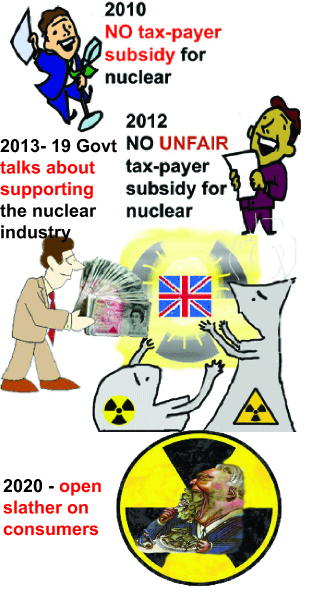
REUTERS EVENTS EDF calls for funding legislation for new UK nuclear power plant, Kate Holton LONDON, June 23 (Reuters) – France’s EDF (EDF.PA) called on the British government to deliver the legislation that would underpin the financing of a new nuclear plant, Sizewell C, saying it was now essential………
Asked if his company had a Plan B in the event the government did not advance with the legislation, Simone Rossi, the UK head of EDF, said: “We do not really. I have to say that would be for the UK government to consider.”………
China General Nuclear Power Corporation (CGN) which holds a 20% share in the pre-construction phase of the Sizewell C project, is on a U.S. government list of companies Washington deems are acting contrary to U.S. interests………….https://www.reuters.com/business/energy/reuters-events-edf-calls-uk-produce-sizewell-funding-legislation-2021-06-23/
House-building plans thrown into doubt as doubts grow about Wylfa nuclear project
Councillor secures debate amid Welsh language fears Sunday, 20 June 2021 – by Gareth Wyn Williams – Local democracy reporter,
An extraordinary meeting of Gwynedd Council has been called regarding the second homes housing crisis and Welsh language fears.
Backbench members have triggered a mechanism to call a full council meeting amid concerns over the existing Joint Local Development Plan (JLDP).
The document proposes why and where up to 7,184 new homes should be built across Anglesey and Gwynedd over the period up to 2026.
The plan was ratified separately by both authorities in 2017, with a scheduled monitoring review set to take place this year.
But after reaching the minimum allowed threshold of five councillors to trigger an extraordinary meeting of all 75 members, one Llyn councillor has called for a debate on the plans.
Even when Gwynedd Council approved the plan, the knife-edge decision was only made thanks to the casting vote by the council’s chair, facing much opposition due to concerns it would lead to a drop in the number of Welsh speakers in both counties.
Cllr Gruffydd Williams, the unaffiliated member for Nefyn, believes there is a need to go further than the scheduled review and asked councillors to also consider 12 recommendations raised by Porthmadog academic, Dr Simon Brooks, in a recent report on second homes and their impact on Welsh speaking communities.
He said: “When you take into account Brexit, Covid-19 and Wylfa Newydd, so many things have changed since the plan was adopted, house prices are shooting up and the plight of Welsh speaking communities looking more perilous than ever.
“I wanted to called this meeting, having already spoken to around 30 councillors, as I feel it’s only right that all members of Gwynedd, and Anglesey councils in fairness, are given a chance to have their say rather than all the burden being placed on the few that sit on the JLDP committee”
Cllr Williams noted: “It would be desirable to give particular priority, going past what is noted as the usual monitoring period within the plan itself and to submit proposals which correspond to Dr Simon Brooks’ report “Second Homes – Developing New Policies in Wales” which was commissioned by the Welsh Government.”
Adding that with any prospect of a major nuclear development on Anglesey looking more uncertain than ever, he argued that this should be taken into consideration as it was a major cornerstone of the plan when first ratified.
While Wylfa Newydd had been earmarked for a site near Cemaes in northern Anglesey, Gwynedd Council had also made arrangements for increased demand on housing in the Arfon area.
Anti-Nuclear group PAWB has long argued that both the JLDP and the North Wales Growth Plan were drawn up on the assumption that Wylfa B “would happen and that it would be a good thing.”……….The extraordinary meeting will be held next Monday, 28 June https://www.cambrian-news.co.uk/article.cfm?id=136455&headline=Councillor%20secures%20debate%20amid%20Welsh%20language%20fears&searchyear=2021
French nuclear company and Chinese government once again have a problem with their much vaunted EPR nuclear reactor design
Nuclear reactor problem a new headache for designer and China. Bangkok Post, 16 June 21, PARIS – The emergence of problems in a new-generation nuclear reactor in China threatens to undermine efforts by its French designer to sell it elsewhere, and could hurt Beijing’s nuclear industry, analysts said.
French energy giant EDF and the Chinese government have sought to ease concerns about a gas build-up at the Taishan Nuclear Power Plant after a CNN report of a potential leak at the site.
The Chinese foreign ministry said Tuesday that radiation levels remained normal at the site in southern Guangdong province and there were no safety concerns.
But it is the latest snag to hit EDF’s much-vaunted EPR reactor.
The Taishan power station became in 2018 the first site worldwide to use the pressurised water design, which has been subject to years of delays in similar projects in Britain, France and Finland.
A second EPR reactor was launched at Taishan a year later. The facility is partly owned by EDF along with state-owned China General Nuclear Power Group, the majority stakeholder and operator of the plant.
EDF said the plant’s number one reactor experienced a build-up of gases in part of the cooling system following the deterioration of the coating on some uranium fuel rods.
The French company was first informed about the problem with the fuel rods in October, but only learned about the gas build-up on Saturday, according to EDF.
The problem and the silence of Chinese authorities triggered criticism of EDF, whose EPR reactor is supposed to be safer, last longer and produce more electricity than previous versions.
– EDF seeks contracts –
It seems that both the Chinese nuclear regulators and the French nuclear corporations may have acted in bad faith,” said Paul Dorfman, a researcher at the University College London’s Energy Institute.
“If so, this new EPR debacle should have important consequences for any further plans for new EPR builds in France, the UK, and internationally,” he added…….
The Taishan incident comes as EDF, which is currently struggling to finish the Flamanville EPR in France after more than a dozen years of work, is hoping to win new contracts.
France, which must eventually decide whether to renew its park of ageing nuclear reactors, is holding off on making a decision until Flamanville comes online, which is now expected in late-2022 at best………. https://www.bangkokpost.com/world/2133307/nuclear-reactor-problem-a-new-headache-for-designer-and-china
The real welfare cheats are weapons makers.
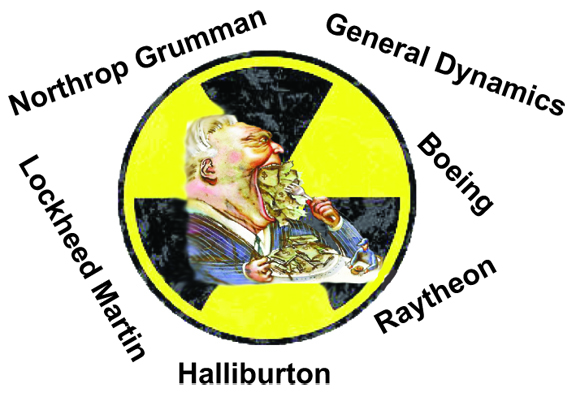
We’re squabbling over Social Security, while the government lavishes infinitely more money on the arms industry. The Nation, By Rebecca Gordon 16 June 21, ”……………………………..President Joe Biden remains super-glued to the same old post–World War II agreement between the two major parties: They can differ vastly on domestic policies, but they remain united when it comes to projecting US military power around the world and to the government spending that sustains it. In other words, the US “national security” budget is still the third rail of politics in this country…………………………….

WELFARE FOR WEAPONS MAKERS
Of course, there’s a second high-voltage, untouchable rail in American politics and that’s funding for the military and weapons manufacturers. It takes a brave politician indeed to suggest even the most minor of reductions in Pentagon spending, which has for years been the single largest item of discretionary spending in the federal budget.
It’s notoriously difficult to identify how much money the government actually spends annually on the military. President Trump’s last Pentagon budget, for the fiscal year ending on September 30, offered about $740 billion to the armed services (not including outlays for veteran services and pensions). Or maybe it was only $705.4 billion. Or perhaps, including Department of Energy outlays involving nuclear weapons, $753.5 billion. (And none of those figures even faintly reflected full national security spending, which is certainly well over a trillion dollars annually.)
Most estimates put President Biden’s 2022 military budget at $753 billion—about the same as Trump’s for the previous year. As former Senator Everett Dirksen is once supposed to have said, “A billion here, a billion there, and pretty soon you’re talking real money.”
Indeed, we’re talking real money and real entitlements here that can’t be touched in Washington without risking political electrocution. Unlike actual citizens, US arms manufacturers seem entitled to ever-increasing government subsidies—welfare for weapons, if you like. Beyond the billions spent to directly fund the development and purchase of various weapons systems, every time the government permits arms sales to other countries, it’s expanding the coffers of companies like Lockheed-Martin, Northrup-Grumman, Boeing, and Raytheon Technologies. The real beneficiaries of Donald Trump’s so-called Abraham Accords between Israel and the majority Muslim states of Morocco, the United Arab Emirates, Bahrain, and Sudan were the US companies that sell the weaponry that sweetened those deals for Israel’s new friends.
When Americans talk about undeserved entitlements, they’re usually thinking about welfare for families, not welfare for arms manufacturers. But military entitlements make the annual federal appropriation of $16.5 billion for Temporary Aid to Needy Families (TANF) look puny by comparison. In fact, during Republican and Democratic administrations alike, the yearly federal outlay for TANF hasn’t changed since it was established through the 1996 Personal Responsibility and Work Opportunity Reconciliation Act, known in the Clinton era as “welfare reform.” Inflation has, however, eroded its value by about 40 percent in the intervening years.
And what do Americans get for those billions no one dares to question? National security, right?
But how is it that the country that spends more on “defense” than the next seven, or possibly 10, countries combined is so insecure that every year’s Pentagon budget must exceed the last one? Why is it that, despite those billions for military entitlements, our critical infrastructure, including hospitals, gas pipelines, and subways (not to mention Cape Cod steamships), lies exposed to hackers?
And if, thanks to that “defense” budget, we’re so secure, why is it that, in my wealthy home city of San Francisco, residents now stand patiently in lines many blocks long to receive boxes of groceries? Why is “national security” more important than food security, or health security, or housing security? Or, to put it another way, which would you rather be entitled to: food, housing, education, and health care, or your personal share of a shiny new hypersonic missile?
But wait! Maybe defense spending contributes to our economic security by creating, as Donald Trump boasted in promoting his arms deals with Saudi Arabia, “jobs, jobs, jobs.” It’s true that spending on weaponry does, in fact, create jobs, just not nearly as many as investing taxpayer dollars in a variety of far less lethal endeavors would. As Brown University’s Costs of War project reports:
And if, thanks to that “defense” budget, we’re so secure, why is it that, in my wealthy home city of San Francisco, residents now stand patiently in lines many blocks long to receive boxes of groceries? Why is “national security” more important than food security, or health security, or housing security? Or, to put it another way, which would you rather be entitled to: food, housing, education, and health care, or your personal share of a shiny new hypersonic missile?
Rebecca GordonRebecca Gordon, a TomDispatch regular, teaches in the philosophy department at the University of San Francisco. She is the author of American Nuremberg: The U.S. Officials Who Should Stand Trial for Post-9/11 War Crimes (Hot Books, April 2016). Her previous books include Mainstreaming Torture: Ethical Approaches in the Post-9/11 United States and Letters from Nicaragua.
https://www.thenation.com/article/economy/the-real-welfare-cheats-are-war-profiteers/
A People’s Guide to the War Industry -5: Portfolio of Conflicts

“They ignored the real threat: The U.S. Armed Forces’ rampant carbon-based military activity contributes to anthropogenic climate change, which melts Arctic ice, which opens up northern sea lanes, into which the Pentagon projects its polluting arsenal, which puts more carbon in the atmosphere.”
A People’s Guide to the War Industry -5: Portfolio of Conflicts — Rise Up Times A PEOPLE’S GUIDE TO THE WAR INDUSTRY -5: PORTFOLIO OF CONFLICTS June 9, 2021 ·
When war is profit, death ensures a healthy bottom line, writes Christian Sorensen in this final installment of his five-part series on the military-industrial-congressional complex.
Read Part 1, Part 2, Part 3 and Part 4 (also available on Rise Up Times)
By Christian Sorensen Special to Consortium News June 2, 2021 Without looking at military adventurism through the lens of the corporation, analysts are bound to produce error-filled studies. For example, one analyst contended in an interview on The Real News Network, “Military force is almost never going to achieve your political aims. The Americans learned this in Vietnam. They’re learning it in Afghanistan. They’re learning it in Syria… So [President Barack] Obama supporting the Saudis and Emiratis in Yemen is a sign really of incoherence on the part of the United States.”
Far from incoherence, the behavior actually is quite rational. A variety of conflicts, disparate and some seemingly futile, is precisely the aim. Conflict itself — producing untold mountains of profit for war corporations and Wall Street — is the goal.

Recall that capital is money used to expand business in order to make more profit. Capital isn’t just building new factories to produce more goods from which to profit.

Capital is also putting money toward cultivating and promoting politicians who advocate for wars and broad military deployments; media and think tanks to propagandize and generate militant narratives; attaining through neoliberal economic policies a U.S. military establishment so rife with corporations that it becomes one bloated, self-sustaining, profitable entity; arranging industry pressure groups and think tanks to encourage and award high-ranking military officers who support and extend conflicts overseas; and marketing, pushing, and operating goods and services that harm populations and destabilize countries around the world, generating more profitable conflict.
The war industry pursues a portfolio of conflicts as any organized, dominant industry views the global marketplace, parses demographics, shapes consumer tastes, and pursues profit maximization at all costs. Afghanistan, Pakistan, Colombia, Iraq, Iran, Korea, Libya, Mexico, Palestine, the Philippines, Somalia, Syria, the Sahel, Ukraine, Yemen — each conflict has advantages and challenges, unique terrain and unique obstacles.
Industry’s products monitor, control and destroy populations. The particular goods and services selected are not the point here. The real rub is that from the eyes of the corporate suite, conflict must endure. Peace is not profitable. A strong portfolio of conflicts, which vary in intensity and scope, is what industry has achieved. Global capitalism demands infinite growth. War corporations’ portfolio approach demands endless, dispersed armed conflicts of varying intensity.
The U.S. war industry sells to capitalist regimes around the world through direct commercial sales and foreign military sales (FMS). FMS tend to deal with big-ticket items or goods and services of a sensitive nature. Through FMS, the U.S. government procures and transfers industry goods and services to allied governments and international organizations.
The U.S. war industry sells to capitalist regimes around the world through direct commercial sales and foreign military sales (FMS). FMS tend to deal with big-ticket items or goods and services of a sensitive nature. Through FMS, the U.S. government procures and transfers industry goods and services to allied governments and international organizations.
The Defense Security Cooperation Agency (DSCA) is the intermediary between the U.S. war industry and the FMS customer overseas. On any given day, DSCA is managing “14,000 open foreign military sales cases with 185 countries,” Lt. Gen. Charles Hooper explained at the Brookings Institution in 2019.
Violent and oppressive regimes are frequent customers, including London, Riyadh, Abu Dhabi and Tel Aviv. The Leahy Law, which is intended to prevent U.S. military assistance from reaching militaries that have committed serious human rights violations, is almost never enforced when it comes to FMS. The Arms Export Control Act requires recipients of U.S. war industry goods and services to use them only in self-defense.
So, customers of the U.S. war industry typically affirm that they’re using the goods and services in self-defense, and the U.S. government doesn’t press them on the matter. After all, there is a lot of cash at stake. In fiscal year 2020 alone, the war industry sold $50.8 billion through FMS and $124.3 billion through direct commercial sales.
The Pentagon often cites industry’s claim that FMS reduces the cost of military systems to the U.S. Armed Forces. The Pentagon supports FMS because foreign militaries dependent on U.S. equipment, knowhow, training, parts, and software are more likely to listen to the U.S. government on military matters, the direction to take in regional conflicts, and international policy.
Without tensions, military provocations, and ongoing hot or cold wars (e.g. Japan v. China, South v. North Korea, Taiwan v. China, absolutist Arab regimes and Apartheid Israel v. Iran, Apartheid Israel v. Arab populations, the global war on drugs) to justify endless transactions, the U.S. war industry would lose billions in annual sales to allied regimes and sales to the U.S. military that is “responding” to such conflict.
Major war corporations place people in charge of selling to each Arab country in the Persian Gulf (e.g. Joe Rank, a career soldier who helped guide Middle East policy for the U.S. Secretary of War, now oversees Lockheed Martin’s business with Saudi Arabia). U.S. flag officers who work on FMS often doff the uniform and then join war corporations to help sell goods and services overseas.
For Profit, Against Democracy
From May 2015 through March 2016, U.S. war corporations sold over $30 billion of goods and services to anti-democratic Arab Gulf allies. Given the U.S. war industry’s long sales history to regimes like Bahrain, Saudi Arabia and the UAE, it stands firmly on the side of profit, and firmly against democracy. Or, as Raytheon’s website puts it,
“With more than 50 years in the Middle East, Raytheon’s steadfast commitment and uninterrupted presence in the region is a testament to the tremendous value we place on being there for our customers.”
The 1945 Quincy Pact between U.S. President Franklin D. Roosevelt and King Abdul Aziz al-Saud started it all: Washington would entrench bases in and around the Persian Gulf and protect the House of Saud, while the latter would keep the oil flowing and give preferential treatment to U.S. corporate interests.
The Saudi regime would later agree to use the dollar in international oil trading. Saudi Arabia purchases a lot of goods and services from U.S. industry, including the war industry. The Washington regime assented when in 2015 the Saudi and Emirati regimes turned U.S. weaponry on Yemen.
The U.S. war industry, in addition to U.S. military and intelligence assistance, has been the cornerstone of the UAE/Saudi destruction of Yemen. Yemenis now suffer from raging famine, disease outbreaks, and crippled infrastructure. The UAE-Saudi coalition has hit civilians (school field trips, funeral processions, weddings, markets) and prevented humanitarian aid from entering Yemen.
In autumn 2018, the head of the U.S. State Department’s legislative affairs team (a former Raytheon lobbyist) certified that Saudi Arabia and the UAE were taking steps to reduce civilian deaths in Yemen. Roughly 233,000 people have died in Yemen as a result of the war, according to the United Nations humanitarian office. Such destruction is evidence of the military-industrial-congressional triangle functioning as designed.
In early February 2021, the Biden administration announced it would halt support for Saudi-UAE “offensive” operations in Yemen. This claim is full of loopholes and is unlikely to substantially alter or end the myriad of ways the U.S. ruling class aids and abets anti-democratic Arab regimes.
Zionism is the ideology that justifies the colonization of Palestine and the maintenance and expansion of that colonization using brutal violence and espionage. Zionists declared independence when they set up a new state, Israel, in Palestine in May 1948, ethnically cleansing hundreds of thousands of Arabs from the land.
Each year, Washington gives roughly $3.8 billion to Israel, which then is supposed to use such monies to purchase from the U.S. war industry. The occupation of Palestine and Zionist aggression against neighboring countries provide the U.S. war industry with a valuable slice of its portfolio: an outsourced proving ground to test, evaluate, use, and improve weaponry.
When war is profit, death ensures a healthy bottom line.
The Advantages of Zionism The aggressive military posture inherent to Zionism is a commercial advantage from an industry perspective. Israel has killed Arabs quite effectively with a variety of aircraft and weaponry purchased from U.S. corporations. The U.S. State Department turns a blind eye, as it is once again doing in the current Israeli operation. Of course, Israel claims self-defense when using U.S. and Israeli weaponry to kill Arabs……….
This is the final installment in the author’s five-part series.
Christian Sorensen is an independent journalist mainly focused on warprofiteering within the military-industrial complex. An Air Forceveteran, he is the author of the recently published book,Understanding the War Industry. He is also a senior fellow at theEisenhower Media Network (EMN), an organization of independent veteranmilitary and national security experts. His work is available atWar Industry Muster. https://riseuptimes.org/2021/06/09/a-peoples-guide-to-the-war-industry-5-portfolio-of-conflicts/
Great powers’competition – the war industry’s best tactic

”……………..Pretexts keep the military budget elevated, sustain the war industry’s profits, and incite a violent foreign policy. Manufactured fear is essential. After pumping the “War on Terror” for trillions of dollars — and with veterans and the U.S. public growing skeptical of such interventions — the war industry has returned to targeting Russia and China through “great power competition.
A PEOPLE’S GUIDE TO THE WAR INDUSTRY -5: PORTFOLIO OF CONFLICTS, By Christian Sorensen by Rise Up Times · Great Power Competition , 9 June 21,
”……………..Pretexts keep the military budget elevated, sustain the war industry’s profits, and incite a violent foreign policy. Manufactured fear is essential. After pumping the “War on Terror” for trillions of dollars — and with veterans and the U.S. public growing skeptical of such interventions — the war industry has returned to targeting Russia and China through “great power competition.
Facing off against Russia and China is more comfortable territory for war corporations. In the calculus of corporate suites, the big-ticket items inherent to competition with another major industrial nation are where the real money can be made. A war on terror was lucrative for a decade or two, and it will continue, but it is not enough to justify excessive spending on cyber, submarines, satellites, hypersonic propulsion, anti-ballistic missiles, nuclear weaponry, artificial intelligence/machine learning, and aircraft carriers.
Competition against Moscow and Beijing also continues the militarization of U.S. society, channeling anger (which might otherwise manifest itself as class awareness and/or physical protest against Washington’s corruption) into outrage against a stereotypical enemy that resides overseas — just as the War on Terror did.
Great power competition is fully entrenched in the Pentagon, as made clear by the 2018 National Defense Strategy, developed in 2017 by military and corporate personnel. It emphasized, “inter-state strategic competition, not terrorism, is now the primary concern in U.S. national security.”
Etching the National Defense Strategy into stone, the then chairman of the Joint Chiefs of Staff, General Joseph Dunford declared in November 2018, that great power competition was here to stay, demanding a shift in Pentagon funding priorities and weapons development. Dunford was speaking at the Halifax International Security Forum, sponsored by corporations (e.g. Boeing, CAE, United Technologies) and NATO, among other powerful groups, including energy and IT firms.
Four months later, the war industry pressure group NDIA presented General Dunford with its most prestigious award. Dunford soon retired and joined the board of Lockheed Martin.
Great power competition has enabled a high volume of war industry goods and services and U.S. military personnel to deploy to Germany, the Czech Republic, Poland and eastern Europe, particularly in the Baltic States and Romania, as well as other clients surrounding China, particularly South Korea, Japan, Taiwan and Guam. Large engineering and project management firms build and sustain the associated infrastructure.
Meanwhile, Beijing’s construction is framed as a threat. “I mean, this is insane. Look at all that crazy construction,” remarked a U.S. naval officer observing Chinese military construction projects in the South China Sea. Though a useful bogeyman, Beijing’s construction in the South China Sea does not hold a candle to what Washington has built up overseas.
Great power competition fills peaceful voids. At the Sea Air Space Forum of 2019 (sponsored by CACI, Lockheed Martin, Northrop Grumman, and shipbuilder Huntington Ingalls), MIC officials cited the “threat” of great power competitors in order to justify expansion of U.S. military power into the Arctic.
They ignored the real threat: The U.S. Armed Forces’ rampant carbon-based military activity contributes to anthropogenic climate change, which melts Arctic ice, which opens up northern sea lanes, into which the Pentagon projects its polluting arsenal, which puts more carbon in the atmosphere.
Great power competition’s consequences are terrifying: increased militarization of an already militarized U.S. economy and public life; greater likelihood of wars big and small; more pollution (notably toxic particulates, carbon emissions, and radiological contamination) in an era of climate catastrophe and mass extinction; nuclear weapons on a hair trigger; narrowing of permissible speech and assembly; and relentless corporatization of the U.S. Armed Forces, the world’s mightiest organization.
The pretext known as great power competition is off to an impressive start, financially, bureaucratically, and industrially. It is incumbent upon the workers of the world to stop it. ”https://riseuptimes.org/2021/06/09/a-peoples-guide-to-the-war-industry-5-portfolio-of-conflicts/
1 This Month



26 September – International Day for the Total Elimination of Nuclear Weapons


PLEASE OPPOSE HR 8255 AND S.3639 – bills would accelerate satellite deployment, with no environmental review or safeguards – https://ncstd5li.quorum.us/campaign/169331/
To see nuclear-related stories in greater depth and intensity – go to https://nuclearinformation.wordpress.com
-
Archives
- September 2026 (245)
- August 2026 (330)
- July 2026 (355)
- June 2026 (287)
- May 2026 (306)
- April 2026 (356)
- March 2026 (251)
- February 2026 (267)
- January 2026 (308)
- December 2025 (358)
- November 2025 (359)
- October 2025 (375)
-
Categories
- 1
- 1 NUCLEAR ISSUES
- business and costs
- climate change
- culture and arts
- ENERGY
- environment
- health
- history
- indigenous issues
- Legal
- marketing of nuclear
- media
- opposition to nuclear
- PERSONAL STORIES
- politics
- politics international
- Religion and ethics
- safety
- secrets,lies and civil liberties
- spinbuster
- technology
- Uranium
- wastes
- weapons and war
- Women
- 2 WORLD
- ACTION
- AFRICA
- Atrocities
- AUSTRALIA
- Christina's notes
- Christina's themes
- culture and arts
- Events
- Fuk 2022
- Fuk 2023
- Fukushima 2017
- Fukushima 2018
- fukushima 2019
- Fukushima 2020
- Fukushima 2021
- general
- global warming
- Humour (God we need it)
- Nuclear
- RARE EARTHS
- Reference
- resources – print
- Resources -audiovicual
- Weekly Newsletter
- World
- World Nuclear
- YouTube
-
RSS
Entries RSS
Comments RSS
 nuclear-news