Since 9/11, US Has Spent $21 Trillion on Militarism at Home and Abroad

Since 9/11, US Has Spent $21 Trillion on Militarism at Home and Abroad https://www.commondreams.org/news/2021/09/01/911-us-has-spent-21-trillion-militarism-home-and-abroad“Our $21 trillion investment in militarism has cost far more than dollars.” JAKE JOHNSONSeptember 1, 2021
In the 20 years since the September 11 attacks, the United States government has spent more than $21 trillion at home and overseas on militaristic policies that led to the creation of a vast surveillance apparatus, worsened mass incarceration, intensified the war on immigrant communities, and caused incalculable human suffering in Afghanistan, Iraq, Yemen, Libya, Somalia, and elsewhere.
According to State of Insecurity: The Cost of Militarization Since 9/11 (pdf), a report released Wednesday by the National Priorities Project, the U.S. government’s so-called “War on Terror” has “remade the U.S. into a more militarized actor both around the world and at home” by pouring vast resources into the Pentagon, federal law enforcement, and the Department of Homeland Security (DHS), an agency established in response to the September 11 attacks.
Released in the wake of the final withdrawal of U.S. troops from Afghanistan after two decades of devastating war and occupation, the new report argues that the Taliban’s rapid takeover of the country “raises deep questions about our military investments to date.”
“Twenty years ago, we were promised a vision of the War on Terror that did not come to pass: that Afghanistan would not become a quagmire, or that the Iraq War would be over in ‘five weeks or five days or five months’ and cost a mere $60 billion,” the report notes. “As the country went to war and refocused domestic security spending on terrorism, few had any inkling of the far-reaching ramifications for the military, veterans, immigration, or domestic law enforcement.”
The National Priorities Project (NPP), an initiative of the Institute for Policy Studies, estimates that of the $21 trillion the U.S. invested in “foreign and domestic militarization” in the aftermath of September 11, 2001, $16 trillion went to the military, $3 trillion to veterans’ programs, $949 billion to DHS, and $732 billion to federal law enforcement.

In addition to fueling death and destruction overseas, the new report stresses that spending on overseas wars heightened domestic militarization, making police crackdowns on dissent at home even more violent.
There is evidence that the War on Terror drove transfers of military equipment to police, as surges ended and the Pentagon looked to divest from surplus equipment,” the analysis notes. “Transfers in 2010, when the military was still deeply engaged in the War on Terror, totaled $30 million. Over the next few years, the U.S. pulled forces out of Iraq, and military equipment transfers skyrocketed, peaking at $386 million in 2014. Today, transfers are still far higher than they were early in the War on Terror, totaling $152 million in 2020 and $101 million in just the first half of 2021.”
Lindsay Koshgarian, program director of NPP and lead author of the new report, said in a statement Wednesday that “our $21 trillion investment in militarism has cost far more than dollars.”
There is evidence that the War on Terror drove transfers of military equipment to police, as surges ended and the Pentagon looked to divest from surplus equipment,” the analysis notes. “Transfers in 2010, when the military was still deeply engaged in the War on Terror, totaled $30 million. Over the next few years, the U.S. pulled forces out of Iraq, and military equipment transfers skyrocketed, peaking at $386 million in 2014. Today, transfers are still far higher than they were early in the War on Terror, totaling $152 million in 2020 and $101 million in just the first half of 2021.”
Lindsay Koshgarian, program director of NPP and lead author of the new report, said in a statement Wednesday that “our $21 trillion investment in militarism has cost far more than dollars.”
- $4.5 trillion could fully decarbonize the U.S. electric grid;
- $2.3 trillion could create five million $15-per-hour jobs with benefits and cost-of-living adjustments for 10 years;
- $1.7 trillion could erase student debt;
- $449 billion could continue the extended Child Tax Credit for another 10 years;
- $200 billion could guarantee free preschool for every 3-and-4-year old for 10 years, and raise teacher pay; and
- $25 billion could provide Covid vaccines for the population of low-income countries.
- The NPP report was published on same day that Brown University’s Costs of War Project released a new analysis estimating that U.S.-led post-9/11 wars in Iraq, Afghanistan, and elsewhere have killed at least 929,000 people—a figure deemed likely to be a “vast undercount”—and cost more than $8 trillion.”The end of the war in Afghanistan represents a chance to reinvest in our real needs,” Koshgarian said Wednesday. “Twenty years from now, we could live in a world made safer by investments in infrastructure, job creation, support for families, public health, and new energy systems, if we are willing to take a hard look at our priorities.”
Uranium prices and the true financial and climate costs of the Megatons to megawatts program
the Russian price the Americans paid for fuel from bombs bears no relationship to the actual costs of producing it, not only in money, but in greenhouse CO2 pumped into the atmosphere.
Megatons to Megawatts’: Prices and true costs of nuclear energy, SEP 1, 2021 KELVIN S. RODOLFO, Rappler.com
Clearly, the uranium market is not a free one in any sense of the word, and never will be’The following is the 13th in a series of excerpts from Kelvin Rodolfo’s ongoing book project “Tilting at the Monster of Morong: Forays Against the Bataan Nuclear Power Plant and Global Nuclear Energy.”
Promoters of nuclear power say it’s “cheap.” If you want to invest in it, however, look at how fickle uranium prices have been. Over time, they have varied by more than eight times!
Clearly, the uranium market is not a free one in any sense of the word, and never will be’The following is the 13th in a series of excerpts from Kelvin Rodolfo’s ongoing book project “Tilting at the Monster of Morong: Forays Against the Bataan Nuclear Power Plant and Global Nuclear Energy.”
Promoters of nuclear power say it’s “cheap.” If you want to invest in it, however, look at how fickle uranium prices have been. Over time, they have varied by more than eight times!
Besides satisfying Russia’s urgent needed for cash, selling this cheap Megatons to Megawatts fuel was a means to two ends. The first is much-extolled: to shrink the huge global stockpiles of nuclear weaponry. But has the project really made us safer?
All the world’s nuclear weapons have declined from as many as 70,300 in 1986 to about 13,890 in early-2019. The reduction happened mostly during the 1990s. But today’s weapons are much more lethal; the nuclear countries, instead of planning to disarm, are retaining large arsenals, making new weapons, and increasing their use in geopolitics.
The second, central role of Megatons to Megawatts was to keep nuclear power financially affordable, so the power industry would continue to use it. Now that the Russian leadership is better-off financially, it is less eager to trade bombs for electricity, and the jittery global realpolitik may well also direct more uranium away from fuel and back to weapons once again.
Finally, and most importantly: what did the reactor uranium made from old Soviet warheads really cost in treasure, and in greenhouse CO2? We know the market price of this new fuel, but what were the true costs of its manufacture, from its mining, milling, enrichment to weapons grade, then its dilution back down into reactor fuel?
During the mad rush to gain nuclear equality with the US, the Russians spared no expense. Their oldest weapons contained uranium that had been enriched with technologies that used about 40 to 60 times more electricity for every kilo of highly-enriched uranium than modern centrifuges do. And more energy, money, and CO2 emissions were used to dilute that warhead uranium back.
Finally, and most importantly: what did the reactor uranium made from old Soviet warheads really cost in treasure, and in greenhouse CO2? We know the market price of this new fuel, but what were the true costs of its manufacture, from its mining, milling, enrichment to weapons grade, then its dilution back down into reactor fuel?
During the mad rush to gain nuclear equality with the US, the Russians spared no expense. Their oldest weapons contained uranium that had been enriched with technologies that used about 40 to 60 times more electricity for every kilo of highly-enriched uranium than modern centrifuges do. And more energy, money, and CO2 emissions were used to dilute that warhead uranium back down to reactor grade, for which work the Russians eventually received $8 billion.In short, the Russian price the Americans paid for fuel from bombs bears no relationship to the actual costs of producing it, not only in money, but in greenhouse CO2 pumped into the atmosphere. A later Foray will evaluate the true costs in greenhouse CO2 for making nuclear fuel. On top of whatever values we arrive at, we must recognize that significant but forever unknowable amounts were generated by Megatons to Megawatts.
Our next Foray is about the intricate entanglement between nuclear weapons and nuclear power. – Rappler.com https://www.rappler.com/voices/thought-leaders/opinion-megatons-megawatts-prices-true-costs-nuclear-energy
Two Billionaires Join Forces in Poland’s Nuclear Energy Push
Two Billionaires Join Forces in Poland’s Nuclear Energy Push, Bloomberg Wealth, By Maciej Martewicz. 31 August 2021, ”’….. Michal Solowow, who controls chemicals producer Synthos SA, and Zygmunt Solorz, the main owner of media and telecommunications giant Cyfrowy Polsat SA, plan to build four to six nuclear reactors, each with a capacity of 300 megawatts. ……. Synthos’ green energy unit, which has exclusive rights in the country for GE Hitachi Nuclear Energy’s small nuclear reactors, will provide the technology, the companies said in a statement, without specifying the project’s timeline or cost.
…….. The companies said that their private project isn’t competing with the state’s plan to build as much as 9 gigawatts of nuclear power using large reactors of more than 1 gigawatt capacity each. https://www.bloomberg.com/news/articles/2021-08-31/two-billionaires-join-forces-in-poland-s-nuclear-energy-push
Cover-up? Unreported event of Hanford nuclear workers’sickness
Unreported event at Hanford nuclear site that sickened workers ‘smells like a cover-up,’ advocates say, Workers reported smelling odors, resulting in symptoms such as dizziness and shortness of breath. The contractor denied a chronic problem, toxic vapors, is to blame. https://www.king5.com/article/news/investigations/hanford-nuclear-site-washington-state-tank-farms-workers-sickened-investigation/281-48a540ea-1fa5-4de9-8ab7-b1dc9db6e5c8 Susannah Frame August 27, 2021
RICHLAND, Wash. — On June 18 of this year, 10 workers at the Hanford nuclear site in eastern Washington digging in what are known as the “tank farms,” were overcome by strange odors. Nine of the workers sought medical treatment, including three who were transported to the hospital for an overnight stay and were given oxygen.
The KING 5 Investigators have found the event went unreported by the contractor involved – Washington River Protection Solutions (WRPS).
According to WRPS documents obtained by KING 5, symptoms reported by workers included dizziness, shortness of breath, chest pain, headache, nausea, a metallic taste in the mouth, stomach issues, light headedness and cough.
Smelling unusual odors, followed by adverse medical conditions are hallmark signs of a chronic problem at the nuclear reservation: exposure to toxic vapors that vent from underground nuclear waste holding tanks.
WRPS is under a legal obligation to report vapor events on a publicly available website.
“I’m still amazed that not one piece of paper has been put out about this exposure, there’s been no announcement,” said Tom Carpenter, executive director of the advocacy group Hanford Challenge. “It’s getting to the point where this silence is very suspicious. It’s like: ‘What are you hiding?’”
The contractor said they did not post the event on their website because they’ve determined the worker’s symptoms were not caused by vapors, but “most likely” by a malfunctioning gas-powered wheelbarrow.
“WRPS collected air samples from the small pieces of fuel-powered equipment used in the soil work. One piece of equipment, a small gasoline-powered wheelbarrow that was difficult to start and used during the June 18 event, was smoking when it started and high levels of volatile organic compound emissions were noted,” a WRPS spokesperson said.
Toxic vapor exposures have been a significant problem at Hanford since the 1980s when the operational mission went from producing plutonium, to clean up only.
Several government reports have identified that poisonous vapors, without warning, will vent from underground tanks. Hanford has 177 underground holding tanks that store the deadliest waste at the site.
Tanks in the tank farm near where the workers got ill in June contain contents including plutonium, the radioactive isotopes of americium and strontium 90, mercury, nickel, lead and cyanide.
In 2014 the KING 5 Investigators revealed a record number of vapor exposures in the tank farms. Approximately 56 workers fell ill with symptoms in the rash of exposures. After each incident, WRPS said their testing didn’t show chemicals of concern over regulatory limits. WRPS officials denied chemical vapors were to blame for the events.
That pattern wasn’t new. Expert reports detailed the same cycle happened at Hanford in the 80s and in the 90s: a slew of exposures, followed by denials by the tank farm contractor, and workers left sick and unable to work.
Many workers said they felt betrayed by the contractors over the years for not being honest about the dangers of vapors.
“Until they are in the field and until they smell what we smell and until they feel like we feel and until they get injured like we get injured, they don’t care,” said Mike Cain, a 47-year current Hanford employee who spent 25 of those years in the tank farms. “Everything that we described 30 years ago, 40 years ago, is still there. Yet they keep doing the same thing over and over and over again.”
After the string of exposures in 2014, Washington State Attorney General Bob Ferguson, Hanford Challenge and Local 598 all filed lawsuits against WRPS and Hanford’s owner, the U.S. Department of Energy. The complaint accused the contractor and federal government of failing to protect workers from vapor exposures, that can cause adverse health effects including lung disease, nervous system damage and cancers of the liver, lung, blood and other organs. The lawsuit also alleged the Department of Energy had been well aware of the dangers for 25 years, yet “Energy did not fix the problem.”
A settlement agreement was reached in September 2018. Hanford officials agreed to improve health and safety conditions, install engineering to keep vapors out of the breathing space of workers. They also agreed to provide respiratory protections including supplied (fresh) air that is worn in tanks on the backs of workers, if needed.
In the June event, workers were not using supplied air. According to workers, the contractor had downgraded respiratory protection to respirators with cartridges. Respirators are lighter and more cost effective than supplied air.
“(That) never should have happened if they were wearing fresh air. Never should have happened,” Cain said.
“They’re not protecting workers. They have a long history of not doing so, of putting money and profits before workers health and safety which is ironic because they’re all about saying they want to protect health and safety. They’re not doing it,” Carpenter said.
A WRPS spokesperson said the company did not skimp on safety protocols in the June event.
“Respiratory controls at the TX Farm during the June 18, 2021 event complied with the tank farms vapors settlement agreement requirements… workers were wearing air-purifying respirators consistent with interim mandatory respiratory protections consistent with cartridge testing results,” the spokesperson said.
What is Hanford?
Hanford is the most contaminated worksite in America. Located near Richland in eastern, Wash., workers at the site produced plutonium for the country’s nuclear weapons program for approximately four decades. Plutonium produced at Hanford fueled the bomb dropped on Nagasaki, Japan, that led to the end of WWII. Since the late 80s, Hanford has been a clean up site only.
The settlement agreement also makes it mandatory for WRPS to report events on its website that fall into the category of an “AOP-15.” On the WRPS website, an AOP 15 is described as an unidentified odor event: “When a worker reports an unexpected and unidentified odor in the tank farms, and reports medical symptoms potentially related to that smell.”
In the June event, WRPS did not characterize it as an AOP-15, therefore, company executives said they had no obligation to report it.
“Smells like a cover-up”
“This lack of information sharing and reporting smells like a cover-up. We do not want to see a return to downgraded worker protections that result in routine vapor exposures. The cycle of exposures must end at Hanford, and meaningful and long-lasting regulations should be enacted to assure that Hanford tank farm workers can conduct a cleanup without risking their own health and safety,” said Carpenter of Hanford Challenge in a press statement sent on Friday.
On Thursday, a WRPS executive told KING 5 that the company’s definition of an AOP-15 had changed in 2020. In an email to employees on Dec. 1, 2020, WRPS Executive Jeremy Hartley said that moving forward, an AOP-15 will occur when personal ammonia monitors worn by workers set off an alarm.
“Ammonia has been verified as a sentinel indicator of changing levels of other chemicals of potential concern. The procedure changes clarify and reinforce a disciplined conduct of operations by recognizing the administrative and engineering controls in place, relying on the ammonia monitors and verifying the conditions when an alarm set point is reached,” Hartley wrote.
Given this change, the WRPS spokesperson said they followed protocol by not reporting the event on the website.
As this event did not involve an ammonia alarm, it is not classified as an AOP-15,” the spokesperson said.
Government scientists have concluded that ammonia does not have to be present for other chemicals of concern to release in concentrations that could harm human health. In 2004 the Department of Energy released a Hanford report concluding the potentially harmful gas, nitrous oxide, can be present without the presence of ammonia.
“Based on…characterization data (the contractor) CH2M HILL has incorrectly assumed that nitrous oxides are present only when ammonia is present,” report authors wrote. “…nitrous oxide vapors in tank headspaces can be present in (dangerous) concentrations, even in the absence of ammonia.”
Stakeholders such as Hanford Challenge and union safety representatives said they were unaware that WRPS had changed its AOP-15 definition.
A WRPS communications specialist said they are committed to the safety of workers.
“The health and safety of the workforce is always paramount,” the company official said.8
Engie nuclear subsidiary Endel in bad shape about to be sold
Nuclear: Engie about to sell its Endel subsidiary to the Altrad group. The
energy company’s industrial and nuclear maintenance subsidiary is in bad
shape. The state has given the green light for the operation.
Le Figaro 26th Aug 2021
Even the right-wing Competitive Enterprise Institute doubts the wisdom of bailing out struggling nuclear power stations
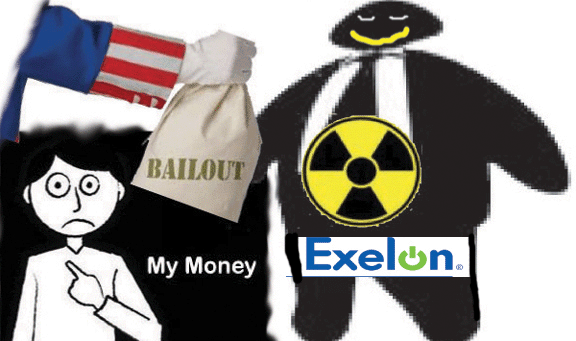
The dubious Senate proposal to bail out nuclear powerplants, https://thehill.com/opinion/energy-environment/569831-the-dubious-senate-proposal-to-bail-out-nuclear-powerplants BY BENJAMIN ZYCHER, — 08/28/21 Costly economic distortions are an inexorable result of government bailouts for specific industries, the justifications for which are almost always deeply dubious.
Consider section 3203 of the proposed Senate Energy Infrastructure Act. It would establish a $6 billion credit program over four years starting in fiscal year 2022 for nuclear electricity plants “projected to cease operations due to economic factors.” The credits, disbursement of which would cease after 2031, would be defined as a certain dollar amount per megawatt-hour (mWh) of generation. And just as the production tax credit for wind electricity has been extended 13 times, it is difficult to believe that once implemented a similar subvention for nuclear power will fail to prove semi-permanent.
And sure enough: The draft legislation directs the comptroller general to submit by Jan. 1, 2024 “any recommendations to renew or expand the credits.”
The bill makes it clear that the ostensible rationale for the credits is “the potential incremental air pollutants that would result if the [given] nuclear reactor were to cease operations. …and be replaced with other types of power generation.”
But the draft legislation asks no one to investigate or even to speculate about whether the hypothetical increase in air pollutants resulting from a shutdown of a nuclear generating plant would yield a violation of the National Ambient Air Quality Standards (NAAQS) in the relevant geographic region for any of the (criteria) pollutants covered by the Clean Air Act.
Because the Clean Air Act requires that the respective NAAQS “protect the public health” with “an adequate margin of safety,” it is difficult to believe that a shutdown of a limited number of reactors and replacement with, say, combined-cycle gas generation, would result in ambient air quality in excess of a given NAAQS. The “public health” would continue to be protected.
Forget air pollution. This proposed subsidy is a bailout — that is, a sizable economic distortion to be added to all of the other distortions inflicted by various policies upon electricity markets. Would it not be better to reduce that aggregate of economic losses rather than to add to them? The actual unpublicized justifications for this proposal are exceedingly weak.
Competitive price pressures from generation fueled with inexpensive natural gas. Competition is the very basis of a market economy, and a failure to foresee the sharp decline in natural gas prices when nuclear investments were made does not justify a federal bailout. Investors and managements contemplating large investments know that there are important risks, both known and unknown, and make their decisions accordingly. The proposed subsidy would shift those risks onto the taxpayers writ large, and there is no reason to believe that such a shift is efficient.
Single-unit vs multi-unit nuclear operating costs. Two of the nuclear generating stations desperate for operating subsidies (Davis Besse and Perry, both in Ohio) are single-unit facilities, which have operating costs per mWh higher than those for multi-unit stations, because their fixed overhead costs are spread over less generation, and because they cannot achieve scale economies similar to those of multi-unit plants when negotiating service and fuel contracts. There is no reason that taxpayers should bear the attendant economic burdens.
Potential mismanagement. It is no secret that business management, like all human endeavors, varies in terms of the efficiency of the decisions made and the conduct of operations. Not only does the proposed legislation not consider the cost effects of possible mismanagement, it also reduces the economic penalty for such inefficiency.
Costly state regulation and the effects of “renewable portfolio” or “clean energy” standards. Regulation at the state level, imposed by legislatures, public utility commissions and other official bureaus, obviously creates costs and distortions, often sizable. Moreover, about 30 states require that some proportion of the electricity produced or consumed in the state be generated by certain technologies (e.g., wind and solar power), and those requirements often exclude nuclear electricity.
Is there a reason that federal taxpayers should be forced to bear the consequences of state laws and regulations? Reforms of state policies yielding adverse outcomes must be implemented at the state level; a federal bailout reduces the incentives for such reforms. The owners of nuclear powerplants should make their case to the state legislatures.
The distortions created by the federal wind production tax credit. The one argument in support of the proposed nuclear subsidy that is not wholly spurious is the effect of the wind production tax credit (PTC), now between $15 and $25 per mWh. The PTC thus allows the wind producers to reduce the prices that they bid for sales into bulk power markets – sometimes to negative levels – while still “earning” positive net prices.
This obviously is unfair competition: The operators of nuclear plants receive no such subventions, and for technical engineering reasons, it is difficult or impossible for nuclear plants to ramp generation up and down in response to short-term price fluctuations.
So, one could argue that the proposed nuclear subsidy corrects the competitive problem created by the PTC, but that is a non sequitur. If the distortions created by given policies are to be addressed by incorporating new distortions, over time the entire economy in effect will become centrally planned, as one set of distortions after another is adopted to deal with the problems created by earlier ones. The proper course is to end the wind PTC and not to bail out nuclear plants with another subsidy program.
Note also that the prospective “profitability” of a given nuclear plant hinges on assumptions about prices, operations costs and other parameters that are subject to important uncertainties. One study by the former chief economist of the PJM Regional Transmission Organization projects net operating profits for 2021 of $30.4 million and $47.5 million for the two plants in Ohio referenced above, respectively. Another study from the PJM itself projects 2021 operating losses for those units of $28.8 million and $33.2 million, respectively.
In short, such calculations are far from straightforward, and no one will be surprised when those applying for the new nuclear credits find ways to increase the magnitude of the operating losses they will claim.
The arguments in favor of this proposed subsidy are exceedingly weak, and the central principle weighing against it is powerful: Let us reduce rather than increase the distortions created by government economic policies. A failure to keep that principle in mind will yield ongoing economic losses for all of us.
Benjamin Zycher is a senior fellow at the American Enterprise Institute.
Nuclear power and nuclear weapons together, in a bonanza for a privatised space industry
Insane U.S. Plan to Spend Billions on Weaponizing Space Makes Defense Contractors Jump for Joy—But Rest of World Cowers in Horror at Prospect of New Arms Race Leading to World War III
CovertAction Magazine By Karl Grossman – August 25, 2021 ”……………….New World Vistas
A 1996 U.S. Air Force report, New World Vistas: Air and Space Power for the 21st Century, speaks of how “new technologies will allow the fielding of space-based weapons of devastating effectiveness to be used to deliver energy and mass as force projection in tactical and strategic conflict. These advances will enable lasers with reasonable mass and cost to effect very many kills.”
However, “power limitations impose restrictions” on such space weaponry making them “relatively unfeasible,” but “a natural technology to enable high power is nuclear power in space.” Says the report: “Setting the emotional issues of nuclear power aside, this technology offers a viable alternative for large amounts of power in space.”
This linkage continues.
A 104-page report issued by the National Academies of Sciences, Engineering and Medicine in 2021 entitled Space Nuclear Propulsion for Human Mars Exploration declared: “Space nuclear propulsion and power systems have the potential to provide the United States with military advantages.”
The report’s central focus is the advocacy of rocket propulsion by nuclear power for U.S. missions to Mars and lays out “synergies” in space nuclear activities between NASA and the U.S. military.

On December 19, 2021, just before he was to leave office, Trump signed Space Policy Directive-6, titled “National Strategy for Space Nuclear Power and Propulsion.”
Its provisions include: “DoD [Department of Defense] and NASA, in cooperation with DOE [Department of Energy], and with other agencies and private-sector partners, as appropriate, should evaluate technology options and associated key technical challenges for an NTP [Nuclear Thermal Propulsion] system, including reactor designs, power conversion, and thermal management. DoD and NASA should work with their partners to evaluate and use opportunities for commonality with other SNPP [Space Nuclear Power and Propulsion] needs, terrestrial power needs, and reactor demonstration projects planned by agencies and the private sector.”
It continues: “DoD, in coordination with DOE and other agencies, and with private sector partners, as appropriate, should develop reactor and propulsion system technologies that will resolve the key technical challenges in areas such as reactor design and production, propulsion system and spacecraft design, and SNPP system integration.”
The members of the committee that put together the report for the National Academies included executives of the aerospace and nuclear industry—a key element in U.S. space policy.
For example, as the report states, there were: Jonathan W. Cirtain, president of Advanced Technologies, “a subsidiary of BWX Technologies which is the sole manufacturer of nuclear reactors for the U.S. Navy”; Roger M. Myers, owner of R. Myers Consulting and who previously at Aerojet Rocketdyne “oversaw programs and strategic planning for next-generation in-space missions [that] included nuclear thermal propulsion and nuclear electric power systems; and Joseph A. Sholtis, Jr., “owner and principal of Sholtis Engineering & Safety Consulting, providing expert nuclear, aerospace, and systems engineering services to government, national laboratories, industry, and academia since 1993.”
And so on.
“Rigged Game in Washington”

The Global Network Against Weapons and Nuclear Power in Space was formed in 1992 at a meeting in Washington, D.C., and has been the leading group internationally challenging the weaponization and nuclearization of space.
Its coordinator, Bruce Gagnon, in a 2021 interview with me, said: “The aerospace industry has long proclaimed that ‘Star Wars’ would be the largest industrial project in human history. Add the nuclear industry’s ambition to use space as its ‘new market,’ and one can imagine the money that would be involved. These two industry giants have put their resources together to ensure their ‘control and domination’ of the U.S. Congress. Both political parties are virtually locked down when it comes to appropriating funds to move the arms race into space and to colonize the heavens for corporate profits. Just one example is the recent approval in Congress of the creation of the ‘Space Force’ as a new service branch in the military.”
During the Trump administration (with the Democrats in control of the House of Representatives) the Space Force was ‘stood up’ as they like to say in the biz,” said Gagnon. “The Democrats could have stopped the creation of this new military branch. During the little congressional debate that did occur, the only thing the Democrats requested was to call it the ‘Space Corps’ (like the Marine Corps). It’s a rigged game in Washington when it comes to handing out money to the aerospace industry.”
Gagnon continued: “In his book, The Pentagon’s New Map: War and Peace in the 2lst Century, former Navy War College Professor Thomas Barnett writes that, under globalization of the world economy, every country will have a different role. We won’t produce shoes, cars, phones, washing machines and the like in the U.S. anymore because it is cheaper for industry to exploit labor in the global south.
Our role in the U.S., Barnett says, will be ‘security export.’ That means we will endlessly fight wars in the parts of the world where nations are not yet ‘fully integrated’ into corporate capitalism. Having a dominant military in space would enable the US to see, hear and target everything on the Earth.”
“In order to put together a global ‘Leviathan’ military capability,” Gagnon continued, “space must be militarized and weaponized. The cost of doing so is enormous and requires cuts in social and environmental spending and larger contributions from NATO member nations.”
“In addition to using space technology to control Earth on behalf of corporate capital, the new Space Force will have another key job. They will be tasked with attempting to control the pathway on and off the planet Earth. In the 1989 Congressional Study entitled Military Space Forces: The Next 50 Years, congressional staffer John Collins writes on pages 24 and 25: “Nature reserves decisive advantage for L4 and L5, two allegedly stable [space] libration points that theoretically could dominate Earth and moon, because they look down both gravity wells. No other location is equally commanding…. Armed forces might lie in wait at that location to hijack rival shipments on return.”
Privatized Gold Rush

“The Pentagon is looking to a future where space would be fully privatized and a new gold rush would ensue. Corporations and rich fat-cats like Jeff Bezos, Elon Musk and Richard Branson, while ignoring the UN’s Outer Space and Moon Treaties that call the heavens the ‘province of all mankind,’ would move to control the shipping lanes from Earth into space. The Space Force would be used by these ‘space entrepreneurs’ as their own private pirate forces to ensure they controlled the extraction of resources mined from planetary bodies. This provocative vision would in the end recreate the global war system, which has been deeply embedded into the culture and consciousness here on Earth. Russia, China and other space-faring nations are not going to allow the US to be the ‘Master of Space.’”
Planting Earth’s Toxic Residue in the Heavens and the Fight to Stop It

Says Gagnon: “I call this the bad seed of greed, war and environmental devastation that we are poised to plant into the heavens.”
“It is my hope that the global public would quickly awaken to a deep understanding and not allow corporate oligarchs or the military to encircle our planet with so much space junk that we would be forever entombed on Earth, or continue to punch a hole in the Earth’s delicate ozone layer from toxic rocket exhaust after each of their tens of thousands of coming launches, or ruin the sacred night sky with blinking satellites for 5G that will in the end be used by the Space Force for expanded ‘space situational awareness’ and targeting capabilities.”
“We have reached the point in human history where we need the immediate intervention by the citizen taxpayers of the planet to ensure that our tiny orbiting satellite called Earth remains livable for the future generations,” Gagnon declared. “We can’t fall for the public relations story-line of the cowboy sailing off into space to discover the new world. We know how that movie turns out in the end—just ask the Native American people.”
U.S. Army Colonel John Fairlamb (Ret.), in 2021 wrote in The Hill, the Washington, D.C., news website: “Let’s be clear: Deploying weapons in space crosses a threshold that cannot be walked back.” Fairlamb’s background includes being International Affairs Specialist for the Army Space and Missile Defense Command and Military Assistant to the U.S. Secretary of State for Political Military Affairs.
“Given the implications for strategic stability, and the likelihood that such a decision [to deploy weapons in space] by any nation would set off an expensive space arms race in which any advantage gained would likely be temporary, engaging now to prevent such a debacle seems warranted,” wrote Fairlamb.
His piece was headed: “The U.S. should negotiate a ban on basing weapons in space.”
“It’s time,” Fairlamb wrote, “for arms control planning to address the issues raised by this drift toward militarization of space. Space is a place where billions of defense dollars can evaporate quickly and result in more threats about which to be concerned. Russia and China have been proposing mechanisms for space arms control at the United Nations for years; it’s time for the U.S. to cooperate in this effort.”
As Alice Slater, a member of the boards of both the Global Network Against Weapons and Nuclear Power in Space and the organization World BEYOND War, says: “The U.S. mission to dominate and control the military use of space has been, historically and at present, a major obstacle to achieving nuclear disarmament and a peaceful path to preserve all life on Earth. Reagan rejected Gorbachev’s offer to give up ‘Star Wars’ as a condition for both countries to eliminate all their nuclear weapons … Bush and Obama blocked any discussion in 2008 and 2014 on Russian and Chinese proposals for a space-weapons ban in the consensus-bound Committee on Disarmament in Geneva.”
At this unique time in history when it is imperative that nations of the world join in cooperation to share resources to end the global plague assaulting its inhabitants and to avoid catastrophic climate destruction or Earth-shattering nuclear devastation,” said Slater, “we are instead squandering our treasure and intellectual capacity on weapons and space warfare.”
And yet far worse is to come—unless there is a return to the vision of the Outer Space Treaty of 1967. The latter needs to be expanded, U.S. Space Force dismantled, and a full global commitment made to keep space for peace.
As we go to press, Breaking Defense published an article: “Pentagon Poised To Unveil, Demonstrate Classified Space Weapon.” This was its headline. Above the headline it stated: “Show Coverage: Space Symposium 2021”
The piece begins: “For months, top officials at the Defense Department have been working toward declassifying the existence of a secret space weapon program and providing a real-world demonstration of its capabilities.” It continues: “The system in question long has been cloaked in the blackest of black secrecy veils—developed as a so-called Special Access Program known only to a very few, very senior government leaders.”
The August 20th article features below its headline a large illustration of—as its caption reads—“Directed energy anti-satellite weapons for the future (Lockheed Martin)”
Space Symposium 2021 was to be held in Colorado Springs, Colorado between August 23 and 26. A main speaker was to be General John W. “Jay” Raymond, chief of space operations of the U.S. Space Force.
Breaking Defense describes itself as “the digital magazine on the strategy, politics and technology of defense,” adding: “It’s a new era in defense, where new technologies, new warfare domains and a rapidly shifting military and political landscape have profound implications for national security.”
Russian nuclear power plants insured for $27 billion
Russian nuclear power plants insured for $27 bln
The insurance case is recognized as loss, damage of insured property as a result of radiation impact, fire, lightning stroke, explosion https://tass.com/economy/1328737MOSCOW, August 22. /TASS/ Rosenergoatom, a member of the electric power division of the Russian state-run nuclear corporation Rosatom, will ensure all domestic nuclear power plants (NPP) against catastrophic risks for 2 trillion rubles ($27 bln). Sogaz became the winning bidder according to minutes of the meeting of the procurement board, posted on the government procurement website.Rosenergoatom will pay the insurance premium of 3 bln rubles ($40.5 mln) to the insurer.
“All the property to be accounted as fixed assets” of Rosenergoatom’s nuclear power plants is registered under the insurance agreement, according to the posted draft agreement.
The insurance case is recognized as loss, damage of insured property as a result of radiation impact, fire, lightning stroke, explosion, crash of piloted aircraft, their parts or cargo, earthquake, volcanic eruption, hurricane, whirlwind, storm, typhoon and other natural disasters, unlawful acts of third parties, terrorism, sabotage, machinery and equipment failures and cyberrisks. The insurance will be valid from September 1, 2021 to August 31, 2023.
South Africa’s Organisation Undoing Tax Abuse (Outa) opposes plan for new nuclear power
Nersa gets green light to approve new nuclear power procurement, but Ts & Cs apply, Fin24, 20 Aug 21, A National Energy Regulator of South Africa (Nersa) committee has recommended that the regulator approve a plan to procure 2 500 MW of new nuclear power.
It will now be up to Nersa’s full board to make a decision on whether it agrees with the plan as set out by Mineral Resources and Energy Minister Gwede Mantashe in August last year.
At a meeting on Friday morning, Nersa’s electricity subcommittee was broadly supportive of Mantashe’s plan. This followed public hearings earlier in the year. Liz McDaid, Parliamentary and energy advisor to the Organisation Undoing Tax Abuse (Outa), said that South Africans would now have to wait see what Nersa’s board decides.
If the board decides to concur with Mantahse’s determination, it will have to publish the reasons behind its decision, including the “suspensive conditions” mentioned in the meeting on Friday.
Outa is opposing the new nuclear build, saying it is “not affordable, not appropriate and should not be approved”. No requests for proposal have yet been issued for the new nuclear build. …….. https://www.news24.com/fin24/companies/industrial/nersa-gets-green-light-to-approve-new-nuclear-power-procurement-but-ts-cs-apply-20210820
Big winners from the Afghan war -the weapons-making corporations.

Progressive Critics Say Investors in US Weapon-Makers Only Clear Winners of Afghan War
“The military-industrial complex got exactly what it wanted out of this war.” https://www.commondreams.org/news/2021/08/17/progressive-critics-say-investors-us-weapon-makers-only-clear-winners-afghan-war
As the hawks who have been lying about the U.S. invasion and occupation of Afghanistan for two decades continue to peddle fantasies in the midst of a Taliban takeover and American evacuation of Kabul, progressive critics on Tuesday reminded the world who has benefited from the “endless war.”
“Entrenching U.S. forces in Afghanistan was the military-industrial complex’s business plan for 20+ years,” declared the Washington, D.C.-based advocacy group Public Citizen.
“Hawks and defense contractors co-opted the needs of the Afghan people in order to line their own pockets,” the group added. “Never has it been more important to end war profiteering.”
In a Tuesday morning tweet, Public Citizen highlighted returns on defense stocks over the past 20 years—as calculated in a “jaw-dropping” analysis by The Intercept—and asserted that “the military-industrial complex got exactly what it wanted out of this war.”

The Intercept‘s Jon Schwarz examined returns on stocks of the five biggest defense contractors: Boeing, Raytheon, Lockheed Martin, Northrop Grumman, and General Dynamics
defense stocks outperformed the stock market overall by 58% during the Afghanistan War.
.
Schwarz found that a $10,000 investment in stock evenly split across those five companies on the day in 2001 that then-President Georg W. Bush signed the authorization preceding the U.S. invasion would be worth $97,295 this week, not adjusted for inflation, taxes, or fees.
According to The Intercept:
This is a far greater return than was available in the overall stock market over the same period. $10,000 invested in an S&P 500 index fund on September 18, 2001, would now be worth $61,613.
That is, defense stocks outperformed the stock market overall by 58% during the Afghanistan War.
“These numbers suggest that it is incorrect to conclude that the Taliban’s immediate takeover of Afghanistan upon the U.S.’s departure means that the Afghanistan War was a failure,” Schwarz added. “On the contrary, from the perspective of some of the most powerful people in the U.S., it may have been an extraordinary success. Notably, the boards of directors of all five defense contractors include retired top-level military officers.”
“War profiteering isn’t new,” journalist Dina Sayedahmed said in response to the reporting, “but seeing the numbers on it is staggering.”
Progressive political commentator and podcast host Krystal Ball used Schwarz’s findings to counter a key argument that’s been widely used to justify nearly 20 years of war.
“This is what it was really all about people,” she tweeted of the defense contractors’ returns. “Anyone who believes we were in Afghanistan to help women and girls is a liar or a fool.”
Jack Mirkinson wrote Monday for Discourse Blog that “it is unquestionably heartbreaking to think about what the Taliban might inflict on women and girls, but let us dispense with this fantasy that the U.S. has been in Afghanistan to support women, or to build democracy, or to strengthen Afghan institutions, or any of the other lines that are deployed whenever someone has the temerity to suggest that endless war and occupation is a harmful thing.”
“We did not go into Afghanistan to support its people, and we did not stay in Afghanistan to support its people,” he added. “It is astonishing, given what we know about the monsters that the U.S. has propped up time and time again around the world, that the myth persists that we do anything out of our love for human rights. We went in and we stayed in for the same reason: the American empire is a force that must remain in perpetual motion.”
As Common Dreams reported Monday, while the Taliban has retaken control, anti-war advocates have argued diplomacy is the only path to long-term peace, with Project South’s Azadeh Shahshahani emphasizing that “the only ones who benefited from the U.S. war on Afghanistan were war-profiteering politicians and corporations while countless lives were destroyed.”
Responding to Shahshahani’s tweet about who has benefited from two decades of bloodshed, Zack Kopplin of the Government Accountability Project wrote, “Adding war-profiteering generals to the mix too.”
As renewable energy powers ahead, the UK government’s prospects for funding nuclear power projects look very risky
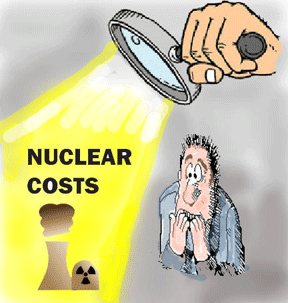
China’s cash for UK nuclear plants is in doubt https://climatenewsnetwork.net/chinas-cash-for-uk-nuclear-plants-is-in-doubt/
August 16th, 2021, by Paul Brown Cooler Sino-British relations mean China’s cash for UK nuclear plants is at risk
LONDON, 16 August, 2021 − A serious stumbling block now threatens the prospect of China’s cash for UK nuclear plants materialising − and also the likelihood of a successful outcome to COP26, the global climate conference which the British government is due to host later this year.
In order to finance the construction of nuclear stations that are supposed to generate up to 20% of the UK’s electricity, the British government needs Chinese money. Without it, the already prohibitively expensive projects may become completely unaffordable.
Neither the deeply indebted French government-owned company EDF, which is building two stations, each with twin reactors, nor the UK government is prepared to underwrite the entire cost of the projects. This is because of the huge sums required − around £45 billion (US$62bn).
However, the UK government faces severe political pressure to end Chinese involvement, because of the perceived threat of ceding control over vital services such as the electricity supply.
Problematic deal
The problem for Boris Johnson, the UK prime minister, is particularly acute as Britain is hosting COP26, this year’s UN climate conference, in Glasgow in November. Relations between the UK and China are already poor, in part because of disputes over democratic freedoms for the people of Hong Kong.
But with China the world’s largest carbon emitter, Johnson needs it onside if he is to have a chance of making COP26 the success it must be to avert catastrophic climate change.
The problem over funding the nuclear programme arises because of a deal struck in 2015 between the then British prime minister, David Cameron, and China’s president Xi Jinping.
That agreed that China would stump up one third of the £23bn ($32bn) cost of the Hinkley C nuclear power station in the West of England, and also pay 20% of the cost of another planned station, Sizewell C, on the east coast. In return the Chinese could then build a nuclear plant of their own design at Bradwell B in Essex, closer to London, and use it as a platform to export their Hualong HPR1000 reactor technology to the rest of the world
To President Xi the cost of helping to fund the French company to build nuclear stations in Britain was outweighed by the advantage of getting Chinese technology validated in the UK as a bridge to future exports.
Six years later, however, with the Hinkley Point project well under way and Sizewell C supposedly close to launch, the British government is now nervous about allowing the Chinese such a strong involvement in the UK’s nuclear secrets and the nation’s power supply.
Its dilemma, though, is that if the UK reneges on its 2015 agreement, then China could abandon both projects, leaving a financial black hole of many billions of pounds. Trades unions are horrified at the potential loss of jobs the possible cancellation of the projects would cause.
One alternative to Chinese funding is a UK nuclear tax which would be paid in advance by electricity users to fund the construction of the power stations. With power bills already due to rise by more than 10% in Britain before the end of 2021, this is unlikely to be an electorally popular solution.
Renewable competition
What will happen is anyone’s guess. Given Johnson’s well-known habit of postponing difficult decisions, and the looming COP26, it is likely that nothing will be announced until the crucial Glasgow talks are over. The French, in anticipation, have already announced that they are postponing the “final investment decision” on Sizewell C until next year.
Meanwhile the renewable energy industry, particularly offshore wind, is powering ahead with a massive construction programme. Its projects will all produce electricity far more cheaply than any of the UK’s proposed new nuclear stations.Last ditch attempts by the nuclear industry to put a green gloss on its proposals by persuading ministers that its spare electricity capacity can be used to make green hydrogen seem unlikely to succeed.Perhaps in time it will become obvious to Johnson that if banning Chinese involvement in British nuclear plants means they end up not being built that will be a bonus, because cheaper renewable energy will soon be available to fill any perceived gap in supply. − Climate News Network
Shareholders of Georgia Power Co now at greater risk for Vogtle nuclear station’s escalating costs?
Shareholders of Georgia Power Co. may be at more risk of shouldering the
utility’s share of cost overruns for the two new nuclear reactors being
built at Plant Vogtle. The Georgia Public Service Commission on Tuesday
approved an agreement between the unit of Atlanta-based Southern Co. and
commission staff that says the commission won’t agree that any expenses
above a $7.3 billion cap imposed in 2017 are “reasonable” until the end
of the project. “Since the company has exceeded the approved revised
capital cost of $7.3 billion, it is no longer appropriate for the
commission to verify and approve the dollars invested in the project,”
states the agreement approved by all five commissioners.
News & Observer 17th Aug 2021
https://www.newsobserver.com/news/business/article253546369.html
What were the USA’s costs for the Afghanistan war ?

The Costs of War, WATSON INSTITUTE FOR INTERNATIONAL AND PUBLIC AFFAIRS
Since invading Afghanistan in 2001, the United States has spent $2.26 trillion on the war, which includes operations in both Afghanistan and Pakistan. Note that this total does not include funds that the United States government is obligated to spend on lifetime care for American veterans of this war, nor does it include future interest payments on money borrowed to fund the war.
| The Costs of War Project also estimates that 241,000 people have died as a direct result of this war. These figures do not include deaths caused by disease, loss of access to food, water, infrastructure, and/or other indirect consequences of the war. |
The figures for Afghanistan are part of the larger costs of the U.S. post-9/11 wars, which extend to Iraq, Syria, Yemen, Somalia and elsewhere. The numbers are approximations based on the reporting of several data sources.
The War On Afghanistan Was A $2 Trillion Scam

Americans will hate whoever they’re told to—Vietnam, Cuba, Iran, Iraq, China. After a while they don’t even remember why they hate them, they just do. Getting the war machine going is easy, just throw the press a few bones about ‘terrorism’ and soon enough there’s bones in the ground. The New York Times will even make terrorism up. CNN will film the bombs raining down. It’s a great, hateful show.
It’s important to understand Afghanistan not as a $2.26 trillion failure of good intentions but a $2.26 trillion success of bad. This is what America does. This is who Americans are. They have reduced war to its most crass objective, a way to profit from misery. Afghanistan was no mistake. It was a very successful scam.–
America just pumped-and-dumped an entire country, https://indi.ca/the-us-military-is-a-deadly-scam/
The American war on Afghanistan was a $2.26 trillion scam. Somebody pocketed all that money, and it certainly wasn’t the people of Afghanistan. That amount is 115 years of Afghan GDP, and it mostly went to arms dealers, the corrupt US military, and corrupt US politicians. Meanwhile the Taliban gets to keep the weapons. This wasn’t just a waste, it was a gigantic fraud.
Afghanistan was not an isolated incident. This is the American war machine, working as intended, grinding bones and printing blood money. America has reduced war to one simple fact: war costs money and somebody’s gonna get paid. This is their galaxy brain idea, starting wars with no objective just to make money for arms dealers. You don’t even have to win. In fact, it’s better if you spend 20 years losing. That’s the beauty of the scam.
Just follow the money. American taxpayers have been defrauded well over $6.4 trillion in their wars ‘of’ terror alone. People keep saying this money was ‘lost’ or ‘wasted’ but it didn’t go nowhere. American people had their pockets picked while saluting the flag. This is what America does. This is who they are. The vaunted American military is a fraud.
A Simple Scam
It’s a simple scam, really.
- Pick some random poor country (and get your people to hate it)
- Attack it
- Profit
The entire war machine is an endless grift. Donors throw a little money at Congressmen, Congressmen throw infinite money at the military, and some poor person ends up crushed under a $25,000 bomb. What does it accomplish? Who cares? We made money on the bomb.
In Afghanistan, the waste was insane(ly profitable). The American military transported fuel via helicopter. They kept every single car, truck, and tank idling 24 hours a day. They spent $1 million dollars per soldier shipping Burger Kings, gyms, and bottled water across the Arabian Sea. Nobody cared. The government just kept giving money and the military kept spending it. War machine go brrrr. It wasn’t their money and it’s wasn’t their lives. It was all a bloody scam.
The original article here posts a 2019 Afghanistan document dump which everyone has forgotten about
America invading Afghanistan was just like the mafia taking over a legitimate business and bleeding it dry. The American military is just a global racket of torturers and thugs, doing bust-outs on an international scale.
Suckers And Losers
Continue readingThe importance of the Radiation Exposure Compensation Act and of coming to terms with USA’s nuclear history.
When Nuclear Fallout Comes Home. Rep. Teresa Leger Fernández (NM03) spoke on the importance of the Radiation Exposure Compensation Act and coming to terms with our nuclear history. https://nationalinterest.org/blog/buzz/when-nuclear-fallout-comes-home-191720by Harry Tarpey Whether in New Mexico, Guam, or the Marshall Islands, the consequences of uranium mining, atmospheric testing, and nuclear weapons manufacturing continue to impact communities around the world, with little awareness from the international community.
I know people who have been impacted by uranium mining, and by the fallout and nuclear testing, so this is not abstract,” said Rep. Teresa Leger Fernández of New Mexico’s 3rd District, who recently sat down for an interview with Press the Button. “These are people I know, these are families I know—you can’t ignore it.”
Leger Fernández is a leading advocate in Congress for the extension and expansion of the Radiation Exposure Compensation Act (RECA), reforms that would establish a more robust and easier to navigate compensation program for the victims of nuclear radiation in the United States and its territories.
RECA is a federal statute established in 1990 as a mechanism to compensate individuals whose health or livelihood was affected by unintended radiation exposure due to our nuclear weapons complex. To date, it has compensated over $2.2 billion to tens of thousands of claimants suffering from health ailments caused by exposure to radiation.
These include atomic veterans, downwinders, and individuals working on atmospheric nuclear tests and in uranium mines.
Though many of these recipients have undoubtedly benefited from the program, Leger Fernández and her colleagues are recommending several improvements to the statute to expand its impact.
One such change she is championing is an increase in the amount of compensation provided per individual grant. “Right now, [RECA payments] are $50,000. That’s not sufficient, so we’re going to raise it to $150,000.” The legislation she will be co-sponsoring, if passed, would expand the limited scope of eligibility that RECA currently maintains to include geographic areas and age groups not currently covered by the statute.
When RECA was first designed, “it had a very limited area where, if you happen to be exposed in these certain counties, you got compensation. But we know that it’s not just a few counties that were impacted,” argues Leger Fernández, “we need to make sure they are all entitled to the compensation.”
Although this expansion would no doubt have a positive impact within her district, Leger Fernández views it as an issue that resonates well beyond her constituency: “I want to take on this fight because this impacts not just New Mexicans, but people elsewhere, who were exposed to radiation from testing, from the development of the weapons, through no fault of their own are
now suffering the consequences. We as a government who inflicted this harm cannot stand back and say ‘too bad’—we must act.”
With RECA set to either expire or be reauthorized in July 2022, Leger Fernández views the year ahead as an important opportunity to reassess and refine RECA to ensure its continued effectiveness. “We need to take this moment and re-authorize the act,” she told guest host Lily Adams, “but also, when we look at it, ask ‘where is [RECA] efficient, and what do we need to do to make it better?”
1 This Month



26 September – International Day for the Total Elimination of Nuclear Weapons


PLEASE OPPOSE HR 8255 AND S.3639 – bills would accelerate satellite deployment, with no environmental review or safeguards – https://ncstd5li.quorum.us/campaign/169331/
To see nuclear-related stories in greater depth and intensity – go to https://nuclearinformation.wordpress.com
-
Archives
- September 2026 (245)
- August 2026 (330)
- July 2026 (355)
- June 2026 (287)
- May 2026 (306)
- April 2026 (356)
- March 2026 (251)
- February 2026 (267)
- January 2026 (308)
- December 2025 (358)
- November 2025 (359)
- October 2025 (375)
-
Categories
- 1
- 1 NUCLEAR ISSUES
- business and costs
- climate change
- culture and arts
- ENERGY
- environment
- health
- history
- indigenous issues
- Legal
- marketing of nuclear
- media
- opposition to nuclear
- PERSONAL STORIES
- politics
- politics international
- Religion and ethics
- safety
- secrets,lies and civil liberties
- spinbuster
- technology
- Uranium
- wastes
- weapons and war
- Women
- 2 WORLD
- ACTION
- AFRICA
- Atrocities
- AUSTRALIA
- Christina's notes
- Christina's themes
- culture and arts
- Events
- Fuk 2022
- Fuk 2023
- Fukushima 2017
- Fukushima 2018
- fukushima 2019
- Fukushima 2020
- Fukushima 2021
- general
- global warming
- Humour (God we need it)
- Nuclear
- RARE EARTHS
- Reference
- resources – print
- Resources -audiovicual
- Weekly Newsletter
- World
- World Nuclear
- YouTube
-
RSS
Entries RSS
Comments RSS
 nuclear-news