World Nuclear Industry Status Report 2021

The World Nuclear Industry Status Report 2021 (WNISR) was released overnight. For nearly 30 years, these reports have provided important factual antidotes to industry promotion and obfuscation. This year’s report is the work of 13 interdisciplinary experts from across the world.
Naoto Kan, Japan’s Prime Minister at the time of the Fukushima disaster, writes in the foreword: “As Prime Minister of Japan at the time of the disaster, I now believe that the time has come for Japan and the world to end its reliance on nuclear power.”
In broad terms, nuclear power has been stagnant for 30 years. WNISR notes that the world’s fleet of 415
power reactors is 23 fewer than the 2002 peak of 438, but nuclear capacity and generation have marginally increased due to uprating and larger reactors being built.
There is one big difference with the situation 30 years ago: the reactor fleet was young then, now it is old. The ageing of the reactor fleet is a huge problem for the industry (as is the ageing of the nuclear workforce ‒the silver tsunami). The average age of the world’s reactor fleet continues to rise, and by mid-2021 reached 30.9 years. The mean age of the 23 reactors shut down between 2016 and 2020 was 42.6 years. The International Atomic Energy Agency anticipates the closure of around 10 reactors or 10 gigawatts (GW) per year over the next three decades.
Reactor construction starts need to match closures just for the industry to maintain its 30-year pattern of stagnation. But construction starts have averaged only 4.8 per year over the past five years, and
there’s no indication of looming growth. Nuclear power’s contribution to global electricity supply has fallen from a peak of 17.5 percent in 1996 to 10.1 percent in 2020 (a 4.3 percent share of global commercial primary energy consumption).
Renewables reached an estimated 29 percent share of global electricity generation in 2020, a record share. Non-hydro renewables(10.7 percent in 2020) overtook nuclear in 2019 and the gap grew in 2020.
Criminality
In addition to a vast amount of energy data, WNISR includes detailed analyses of the Fukushima and Chernobyl disasters; the vulnerabilities of nuclear power to the impacts of climate change (e.g. dwindling and warming water resources, storm impacts, sea-level rise, etc.); and a chapter on nuclear decommissioning.
WNISR details the slow and unsteady progress of small modular reactors. The report notes that “so-called advanced reactors of various designs, including so-called Small Modular Reactors (SMRs), make a lot of noise in the media but their promoters have provided little evidence for any implementation scheme before a decade at the very least.”
WNISR notes that previous reports have covered irregularities, fraud, counterfeiting, corruption, and other criminal activities in the nuclear sector. This year’s report dedicates a chapter to nuclear criminality and includes 14 case studies with serious implications (safety, public governance) that came to trial in the period 2010-2020.
The report states:
“A stunning number of revelations in recent years on irregularities, fraud, counterfeiting, bribery, corruption, sabotage, theft, and other criminal activities in the nuclear industry in various countries suggest that there is a systemic issue of “criminal energy” in the sector. …
“Although not comprehensive, this analysis offers several noteworthy insights:
* Criminal activities in the nuclear sector are not new. Some major scandals date back decades or have been ongoing for decades.
* Organized crime organizations have been supplying workers to nuclear sites — e.g. the Yakuza in Japan — for over a decade.
* Serious insider sabotage has hit major nuclear countries in recent years — like a Belgian nuclear power plant — without ever leading to arrests.
There is no systematic, comprehensive, public database on the issue.
* In 2019, the IAEA released a report on cases of counterfeit or fraudulent items in at least seven countries since at least the 1990s.
* In Transparency International’s 2020 Corruption Perceptions Index about half of the 35 countries operating or constructing nuclear power plants on their territory rate under 50 out of 100.
* In the Bribery Payers Index (BPI, last published in 2011), seven out of the ten worst rated
countries operate or are building nuclear power plants on their territory.”
Author: Dr. Jim Green is the national nuclear campaigner with Friends of the Earth Australia
Renew Economy 29th Sept 2021
Uncertainty on how UK will exclude Chinese involvement in Sizewell and Bradwell nuclear projects
China set to be banned from investing in the UK’s nuclear power stations on security grounds – leaving a huge financial gap which may be plugged by pension funds.
- Exactly how the Chinese will be frozen out of Sizewell on Suffolk coast is unclear
- CGN is also involved at Bradwell, where progress is understood to have stalled
- By ALEX LAWSON and GLEN OWEN FOR THE MAIL ON SUNDAY
Chinese investment in Britain’s next generation of nuclear power stations is set to be banned on security grounds, leaving a multi-billion pound funding hole in the plans……
The Government has committed to making a final investment decision on at least one large nuclear project during this parliament.
Officials are understood to be keen to publish a decision on the future of Sizewell C ahead of next month’s spending review and the UN climate change conference in Glasgow in November.
A senior industry source said: ‘The Chinese will not be involved at Sizewell. This is part of a long journey and is politically much bigger than just one plant.’ Exactly how the Chinese will be frozen out of Sizewell, on the Suffolk coast, is unclear.
They have a 20 per cent stake in development of the project and an option to remain once it is built.
CGN is also involved at Bradwell in Essex, where progress is understood to have stalled, and in the EDF-led Hinkley Point in Somerset, due to be completed in 2026.
Treasury officials have studied several options to replace China’s funds at the plant.
Sources said the favoured option is a regulated asset base (RAB) model, which has been used in other big infrastructure projects such as the Thames Tideway and requires legislation.
Last week, it emerged that Ministers are in talks with the US nuclear reactor manufacturer Westinghouse over a proposal to build a new plant in Anglesey, North Wales.
Separate proposals have been mooted for a series of small modular reactors (SMRs) to complement larger plants, including a programme led by Rolls-Royce.
A Government spokeswoman said: ‘CGN is currently a shareholder in Sizewell C up until the point of the Government’s final investment decision. Negotiations are ongoing and no final decision has been taken.’ https://www.dailymail.co.uk/news/article-10028807/China-set-banned-investing-UKs-nuclear-power-stations-security-grounds.html
UK government close to deal for Regulated Asset Base (RAB) funding for Sizewell nuclear project

Ministers close to deal that could end China’s role in UK nuclear power station. Exclusive: deal in which UK government would take stake in Sizewell C would risk inflaming geopolitical tensions. Ministers are
closing in on a deal that could kick China off a project to build a £20bn nuclear power station on the Suffolk coast and pump in tens of millions of pounds of taxpayer cash instead – a move that would heighten geopolitical tensions.
The government could announce plans to take a stake in Sizewell C power station, alongside the French state-backed power giant EDF, as early as next month, ahead of the Cop26 climate summit. That would be likely to result in China General Nuclear (CGN), which currently has a 20% stake in Sizewell, being removed from the project.
Under plans for Sizewell being discussed by Whitehall officials and EDF, the government could take a stake in a development company that will push it through various stages of planning and bureaucracy, sharing the costs with EDF.
Private sector investors such as the insurance funds L&G and Aviva would then be lured in
at a later stage in return for a government-backed funding model called the regulated asset base (RAB), diluting the taxpayer and EDF. Legislation on RAB funding – the same model used to fund airports such as Heathrow and water companies – is due to progress through parliament next month.
Observer 25th Sept 2021
Democrat politicians, who get big donations from weapons corporations, vote against cuts to Pentagon spending
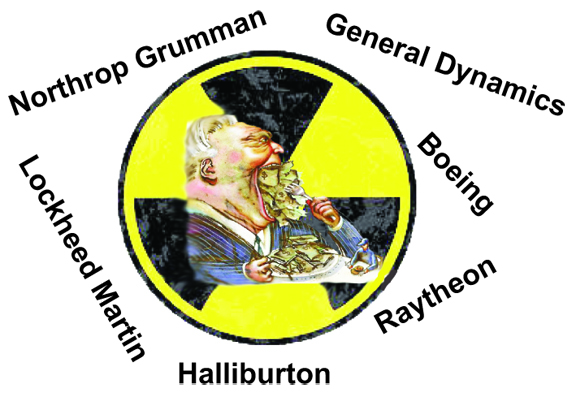
Since fiscal year 2001, military contractors have received over 54% of Pentagon spending, totaling about $8 trillion,” Sludge noted. “Over $2.2 trillion of that went to the five largest weapons firms: Lockheed Martin, Raytheon, General Dynamics, Boeing, and Northrop Grumman. These five firms comprise about 40% of military industry cash given to federal candidates.”
Dems Who Opposed Pentagon Cuts Received Nearly 4x More Donations From Weapons Makers, Common Dreams The latest passage of the NDAA “is particularly strong evidence that Pentagon contractors’ interests easily take precedence over national security and the public interest for too many members of Congress,” said one critic.
Dems Who Opposed Pentagon Cuts Received Nearly 4x More Donations From Weapons Makers, Common Dreams The latest passage of the NDAA “is particularly strong evidence that Pentagon contractors’ interests easily take precedence over national security and the public interest for too many members of Congress,” said one critic.
KENNY STANCIL Common Dreams, September 24, 2021 In a bipartisan 316-113 vote on Thursday night, the U.S. House authorized a $778 billion military budget for fiscal year 2022. Every Republican voted against two amendments to reduce Pentagon spending, but Democrats were split, and a new analysis reveals that lawmakers who rejected the proposed cuts received far more campaign cash from the weapons industry than those who supported the cuts.
One amendment to the National Defense Authorization Act (NDAA), introduced by Rep. Mark Pocan (D-Wis.), would have slashed the overall spending authorization level by 10%, exempting the paychecks and health benefits of military personnel and the Defense Department’s federal civilian workforce.
The measure failed by a tally of 86-332. According to an analysis of OpenSecrets data by the Security Policy Reform Institute (SPRI) and Sludge, the Democrats who voted against the 10% Pentagon budget cut have taken, on average, 3.7 times more campaign money from arms manufacturers since January 2019 than the Democrats who voted for it.
Sludge‘s Donald Shaw and SPRI’s Stephen Semler wrote Friday that “the average amount of defense cash received by Democrats who opposed the amendment was $60,680, while the Democrats who supported it received an average of $16,497” in contributions from the PACs of Defense Department contractors “as well as donations larger than $250 from those companies’ employees.”
“The vote was a step backwards for House progressives,” noted Shaw and Semler, who added that:
Last year, an identical amendment was put forward and it received 93 votes in favor, seven more than it received yesterday. Nine Democrats switched from supporting the 10% reduction last year to opposing it this year: Emanuel Cleaver (Mo.), Dwight Evans (Pa.), Al Green (Texas), Bill Keating (Mass.), Robin Kelly (Ill.), Stephen Lynch (Mass.), Richard Neal (Mass.), Brad Sherman (Calif.), and Bennie Thompson (Miss.).
Earlier this month, the House Armed Services Committee voted in favor of a Republican-sponsored amendment to add $23.9 billion on top of President Joe Biden’s proposed $753 billion military budget for fiscal year 2022—already up from the $740 billion approved for the previous fiscal year under the Trump administration.
A second NDAA amendment, led by Rep. Barbara Lee (D-Calif.), would have restored military spending to the level requested by the president. That proposal for a modest 3% cut to the NDAA’s top-line figure garnered the support of a majority of—but not all—House Democrats and was shot down in a 142-286 vote.
Sludge reported that “the 77 Democrats who opposed the 3% cut have received, on average, $52,211 from the defense sector since January 2019, and the 142 Democrats who supported it have received an average of $35,898.”
Lindsay Koshgarian, program director of the National Priorities Project at the Institute for Policy Studies (IPS), told Common Dreams on Friday that “the passage of the $23.9 billion increase in the House is particularly strong evidence that Pentagon contractors’ interests easily take precedence over national security and the public interest for too many members of Congress.”
As she spoke in support of Pocan’s amendment on Wednesday, Rep. Alexandria Ocasio-Cortez (D-N.Y.) pushed back against the narrative that cutting Pentagon spending would make Americans less safe, emphasizing how easy it would be to find the funds.
“The Pentagon could save almost $58 billion by eliminating obsolete weapons, weapons like Cold War-era bombers and missiles designed and built in the last century that are completely unsuitable for this one,” said Ocasio-Cortez.
“We could find another $18 billion by simply preventing the end-of-year spending sprees that lead to contract money being shoveled out the door every September,” she added, echoing Sen. Bernie Sanders’ (I-Vt.) observation earlier this week that the Pentagon—which has never passed an audit—is “inherently susceptible to fraud.”…………………
The House passage of the NDAA came just over a week after researchers at Brown University’s Costs of War project estimated that as much as half of the $14 trillion that the Pentagon has spent since the U.S. invasion of Afghanistan two decades ago has gone to private military contractors. IPS’ Koshgarian and SPRI’s Semler, meanwhile, have both said that corporations gobbled up more than half.
“Since fiscal year 2001, military contractors have received over 54% of Pentagon spending, totaling about $8 trillion,” Sludge noted. “Over $2.2 trillion of that went to the five largest weapons firms: Lockheed Martin, Raytheon, General Dynamics, Boeing, and Northrop Grumman. These five firms comprise about 40% of military industry cash given to federal candidates.” https://www.commondreams.org/news/2021/09/24/dems-who-opposed-pentagon-cuts-received-nearly-4x-more-donations-weapons-makers
Sizewell C nuclear project no longer viable, with new developments in cheaper wind power- energy expert
Nuclear power has become “outdated by technology” and offshore wind can
produce power more quickly and cheaply, an energy scientist told the BBC.
Professor in energy and climate change Charlie Wilson said there was no
longer a good case for a new £20bn Sizewell C plant on the Suffolk coast.
He said new ways to store wind turbine energy meant supplies could be
maintained even in low winds.
EDF, the firm behind Sizewell C, said nuclearwas key for UK energy needs.
The government said nuclear was vital for the
“UK’s low-carbon energy future”. Prof Wilson, of the the Norwich-based
Tyndall Centre for Climate Change Research at the University of East
Anglia, said nuclear power cost twice as much as wind power. Electricity
generated by wind turbines costs about £40 per megawatt hour, compared to
£92.50 which is the projected cost of the latest nuclear plant being built
at Hinkley Point C in Somerset, he added.
He said in the past nuclear power
was seen as key because in any weather it provides the same baseload power
– baseload refers to the minimum amount of electric power needed to be
supplied to the electrical grid at any given time. “The view in the
1970s-1990s was that you needed this large firm baseload power generation
like nuclear,” he said.
“The game-changing technologies around storage and
flexibility mean intermittent renewables – like large offshore wind farms –
are now viable as a reliable generation source.
BBC 25th Sept 2021
Bitcoin miners strike deals with nuclear industry [on the ”clean energy” lie]
Bitcoin Miners Eye Nuclear Power as Environmental Criticism Mounts
Some cryptocurrency miners are striking deals with operators of struggling nuclear plants, which are carbon-free and have excess power capacity to spare WSJ, By Jennifer Hiller Sept. 26, 2021 Bitcoin miners, under fire for their sizable environmental footprint, are forging partnerships with owners of struggling nuclear-power plants with electricity to spare.
The matchups have the potential to solve key issues facing each industry, executives and analysts say: Electricity-hungry bitcoin miners want stable and carbon-free [ Ed. that’s a lie] power, while nuclear plants facing competition from cheaper power sources need new customers……… (subscribers only) https://www.wsj.com/articles/bitcoin-miners-eye-nuclear-power-as-environmental-criticism-mounts-11632654002
The Record-Breaking Failures and Costs of Nuclear Power
Let’s look at the track record as a whole. According to Wikipedia’s article, List of cancelled nuclear reactors in the United States: “Of the 253 nuclear power reactors originally ordered in the United States from 1953 to 2008, 48 percent were cancelled, 11 percent were prematurely shut down, 14 percent experienced at least a one-year-or-more outage, and 27 percent are operating without having a year-plus outage. Thus, only about one fourth of those ordered, or about half of those completed, are still operating and have proved relatively reliable.”
Wikipedia’s stunning list on the same page details 157 reactors that were either canceled before or during construction.
The Record-Breaking Failures of Nuclear Power, https://www.counterpunch.org/2021/09/24/the-record-breaking-failures-of-nuclear-power/ BY LINDA GUNTER SEPTEMBER 24, 2021The Tennessee Valley Authority could likely rightfully claim a place in the Guinness Book of World Records, but it’s not an achievement for which the federally-owned electric utility corporation would welcome notoriety.
After taking a whopping 42 years to build and finally bring on line its Watts Bar Unit 2 nuclear power reactor in Tennessee, TVA just broke its own record for longest nuclear plant construction time. However, this time, the company failed to deliver a completed nuclear plant.
Watts Bar 2 achieved criticality in May 2016, then promptly came off line due to a transformer fire three months later. It finally achieved full operational status on October 19, 2016, making it the first United States reactor to enter commercial operation since 1996.
Now, almost five years later, TVA has announced it has abandoned its unfinished two-reactor Bellefonte nuclear plant in Alabama, a breathtaking 47 years after construction began.
TVA was apparently happy to get out of the nuclear construction business, because, as the Chattanooga Times Free Press reported, the company “did not see the need for such a large and expensive capacity generation source.” No kidding!
Ironically, this is precisely the argument used to advance renewables, in an energy environment that cannot and will no longer support inflexible, large, thermo-electric generators that are completely impractical under the coming smart grids as well as climate change-induced conditions.
Accordingly, TVA was more than happy to accept overtures from a purchaser for Bellefonte — the Haney real estate company— whose director, Frank Haney, gained his own notoriety by lavishing $1 million on former President Trump and courting Trump’s lawyer, Michael Cohen, possibly, suggested media reports, to curry regulatory favors for his new nuclear toy.
But when TVA announced last month that it had withdrawn its construction permit for Bellefonte, Haney got his down payment back — to the tune of $22.9 million plus interest. TVA had itself spent at least $5.8 billion on Bellefonte over the 47 years, which included long stoppages, before finally pulling the plug.
This kind of colossal waste of time and money on failed nuclear power projects is, of course, the more typical story than the myths spun in the press about the need for “low carbon” nuclear energy, a misleading representation used to argue for nuclear power’s inclusion in climate change mitigation.
In reality, the story of nuclear power development in the US over the last 50 years is beyond pitiful and would not pass muster under any “normal” business plan. How the nuclear industry gets away with it remains baffling.
As Beyond Nuclear’s Paul Gunter told the Chattanooga Times Free Press, “Bellefonte is just the most recent failure for this industry,” noting that “of the 30 reactors the industry planned to build 15 years ago with the so-called nuclear renaissance, only two are still being built. (Those two, at Plant Vogtle in Georgia, are years behind schedule with a budget that has more than doubled to $27 billion.)
As Gunter noted in the same article, “TVA has had major problems meeting projected costs and timetables for new nuclear plants, as the entire industry has had over the past 50 years. The inability to meet any budgets for these plants is what has repeatedly been the demise of nuclear energy.
“Nuclear energy is the most expensive way ever conceived to boil water and Bellefonte just shows once again how unreliable this technology really is in terms of projecting what it will cost and how long it will take to build these power plants,” Gunter told the newspaper.
That was certainly true for Westinghouse Electric Company and SCANA, still embroiled in the ever unraveling scandal around the failure to complete two new reactors at the V.C. Summer nuclear power plant in South Carolina. As executives of the bankrupt Westinghouse and SCANA, who retained them, continue to face criminal charges, Westinghouse has already had to shell out $2.168 billion in settlement payments related to the Summer debacle.
In August, news reports said Westinghouse would also be required to reimburse low-income ratepayers to the tune of $21.25 million. That’s because the new reactors got funded in part through electricity rates, even though they never delivered a single watt of electricity. The cost of the project itself eventually ballooned to more than $9 billion before collapsing.
Let’s look at the track record as a whole. According to Wikipedia’s article, List of cancelled nuclear reactors in the United States: “Of the 253 nuclear power reactors originally ordered in the United States from 1953 to 2008, 48 percent were cancelled, 11 percent were prematurely shut down, 14 percent experienced at least a one-year-or-more outage, and 27 percent are operating without having a year-plus outage. Thus, only about one fourth of those ordered, or about half of those completed, are still operating and have proved relatively reliable.”
Wikipedia’s stunning list on the same page details 157 reactors that were either canceled before or during construction.
The massive costs, of course, send most corporations running scared, the Haney family notwithstanding. Even when meaty subsidies have been dangled — as they were for the Calvert Cliffs 3 EPR project in Maryland — utility companies balk and bail. In the case of Calvert Cliffs, Constellation Energy was the US partner with the French government utility EDF. But even when offered a $7.5 billion loan guarantee by the Obama administration, Constellation viewed those terms as “too expensive and burdensome” and quit.
This left EDF, a foreign company, as sole owner, a violation of the Atomic Energy Act. The project duly collapsed, one of many referred to earlier by Paul Gunter as the fantasy of a nuclear renaissance that first sputtered, then went out.
President Obama, of course, was no friend to the anti-nuclear movement. So eager was he to boost new nuclear construction in the US that he called for the inclusion of $55 billion for nuclear loan guarantees in his $3.8 trillion 2011 budget. In his State of the Union address that year, Obama talked of “building a new generation of safe, clean nuclear power plants in this country.” Kool-Aid thoroughly drunk, then.
All of this should send an obvious message to the deaf ears of Ben Cardin (D-MD), Sheldon Whitehouse (D-RI) and Cory Booker (D-NJ), the leading pro-nuclear evangelists in the U.S. Senate. Cardin’s power production credit bill actually has the gall to describe nuclear power as “zero-emission”, a lie that even Cardin’s own staffer was forced to concede in a recent meeting attended by Paul Gunter who called him out on it.
Not that any of this will stop the bill going forward and almost certainly passing. Like the three not-so-wise monkeys, those Senators and their colleagues will acknowledge no negatives about nuclear power, even as the industry’s appalling litany of financial fiascoes and failures stares them in the face. They will forge right ahead, thus dooming to its own failure the very progress on climate change they claim to champion.
Nuclear lobby stooge Jennifer Granholm wants ”unusual partnerships” in order to save the nuclear industry
Top U.S. Energy Official Sees ‘Unusual Partnerships’ for Nuclear, From reactors at coal plants to hydrogen production and potential cross-border collaboration, Secretary of Energy Jennifer Granholm is seeking new roles for U.S. nuclear power.
Bloomberg Green, By Jonathan Tirone, 21 September 2021, The Biden administration’s top energy official said the nuclear industry should broaden its business case beyond power markets in order to ensure its place in a carbon-free economy.
U.S. nuclear energy has come under relentless pressure in recent years from cheap natural gas, solar and wind power. More reactors are being taken offline permanently than built, risking the long-term future of the country’s biggest clean energy source. resident Joe Biden has pledged financial support to keep aging atomic plants online. Secretary of Energy Jennifer Granholm said “building back better” for nuclear might mean more than just generating electricity as it competes with emerging renewable energy and storage technologies.

“We need to pursue a silver buckshot rather than a silver bullet approach,” Granholm said in an interview with Bloomberg News in Vienna. The former governor of Michigan said some “unusual partnerships” between nations and industries might be needed for U.S. nuclear operators to tap the $23 trillion global clean [nuclear is NOT clean] energy market over the next decade. Granholm urged more cross-border collaboration in developing a new generation of small modular reactors, as well as using nuclear plants for the production of emissions-free hydrogen…….
Granholm spoke at a meeting of senior officials at the International Atomic Energy Agency, where Chinese and Russian envoys called for more research-and-development collaboration to accelerate the deployment of new generations of miniature reactors.
The Department of Energy curtailed some joint projects with China during the Trump administration, including work on a test reactor backed by billionaire Bill Gates. Granholm suggested the urgency of the climate crisis might require re-evaluating prohibitions on some technology transfers and cooperation. She did not signal any new near-term partnerships with Russia or China. The issue could be revisited during two weeks of international climate talks — known as COP26 — beginning Oct. 31 in Glasgow, Scotland…..

Granholm reserved special praise for the Gates-led company, TerraPower LLC, which in June announced it would build its first test plant at a shuttered coal site in Wyoming rather than in China. …. https://www.bloomberg.com/news/articles/2021-09-21/top-u-s-energy-official-sees-unusual-partnerships-for-nuclear
Jennifer Granholm and Westinghouse enthusiastic to sell ”clean” nuclear power to Poland
You really have to wonder just who Jennifer Granholm works for. Is it the American people, or is it the nuclear industry? She’s great at regurgitating nuclear lies about ”clean” nuclear
US lures Eastern Europe with nuclear power, $23t in clean [nuclear is NOT clean]energy market
By Frédéric Simon | EURACTIV.com 24 Sept 21, The climate crisis presents “a market opportunity for carbon-reducing technologies” such as nuclear power, said US energy Secretary Jennifer Granholm, teasing a $23 trillion market to countries in Central and Eastern Europe by 2030.
Low-carbon technologies “will be a 23 trillion-dollar market by the end of this decade,” which offers “an enormous potential to countries on both sides of the Atlantic,” Granholm said on Wednesday (22 September).
Speaking from Poland during an online press briefing, Granholm said the transatlantic market “will give us a chance to launch new business, new industries, to attract billions of dollars of new investment, and certainly to create millions of new jobs”………
In the US, President Biden’s ‘build back better‘ agenda includes an objective to have 100% of US electricity produced from “clean sources” by 2035, [nuclear is NOT clean] she explained, saying this involves reducing CO2 emissions by more than 50% by 2030 and cutting them down to net-zero by 2050……
Nuclear: ‘The reason we’re here.’
And nuclear power features highly among the US objectives.
“The reason we’re here in Poland is because we have been talking about a partnership in the area of nuclear,” Granholm said. “We’re really excited that we may have this partnership here with Poland”.
In October last year, Warsaw and Washington signed a 30-year intergovernmental agreement on future cooperation in the development of the Polish civil nuclear energy programme.
And the US is in pole position to win those contracts.
“Our collaboration to develop Poland’s civil nuclear programme is vital to Poland achieving EU carbon reduction targets and to guarantee its energy security,” Granholm said. “That dispatchable, clean [nuclear is NOT clean] , uninterruptable power is the gold standard of what every nation is looking for” in their quest to reduce CO2, she explained.
In July, US nuclear power firm Westinghouse announced the launch of a front-end engineering and design study – or FEED – under a grant from the US Trade Development Agency to advance Poland’s nuclear energy programme.
“It’s an opportunity to give American technology to help meet Poland’s clean-energy needs, [nuclear is NOT clean] and Westinghouse is going to offer its AP1000 nuclear reactor for the project,” Granholm said. https://www.euractiv.com/section/energy/news/us-lures-eastern-europe-with-nuclear-power-23tln-clean-energy-market/
USA has conned Australia into paying for its super-costly nuclear submarine project

Last week’s AUKUS announcement was nothing more than PR stunt in Australia, with the government merely committing to spend the next 18 months deciding what to buy—which conveniently kicks any actual the decision far enough down the road to avoid the next federal election.
Has PM put Australia on the hook to finance struggling UK, US submarine projects? Michael West Media, By Marcus Reubenstein| September 23, 2021,
“Almost comical”. Experts lambast Scott Morrison’s “crazy” AUKUS deal to buy nuclear submarine tech from parlous UK and US programs. Marcus Reubenstein finds a real prospect Australia will be used to “underwrite” the foundering foreign submarine industry.
Twenty-five years of ongoing maintenance delays for nuclear submarines, chronic shortage of both parts and skilled workers, under capacity at shipyards, and attack class submarines missing from deployments for up to nine months. These sound like potential problems for Australia’s future nuclear submarine fleet but they are actual problems right now confronting the US Navy and its fleet of 70 submarines.
The US is at the cutting edge of nuclear propulsion. It has the largest and most sophisticated submarine fleet in the world, its first nuclear submarine was commissioned 67 years ago, and the US has literally decommissioned twice as many nuclear subs as Australia is planning to buy.
If the US cannot manage to keep its fleet in the water, how can the Morrison government commit up to $100 billion of taxpayer money to secure nuclear submarines and guarantee they will be always operational and ready for deployment?
Professor Hugh White, ANU Professor of Strategic Studies, former Deputy Secretary of Defence and an eminent figure in strategic policy, wrote in The Saturday Paper, “The old plan was to build a conventionally powered version of a nuclear-powered French submarine. It was crazy.”
“The new plan—to buy a nuclear-powered submarine instead—is worse”.
Says White, “There is a reason why only six countries, all of them nuclear-armed, operate nuclear powered subs.”
The sales pitch is underway
Last week’s AUKUS announcement was nothing more than PR stunt in Australia, with the government merely committing to spend the next 18 months deciding what to buy—which conveniently kicks any actual the decision far enough down the road to avoid the next federal election.
The ripples of the announcement, however, reached British shores in double-quick time. Just two days after the AUKUS alliance UK Defence Secretary Ben Wallis announced a $320 million (£170m) grant to be shared between BAE Systems and Rolls Royce to develop technology for Britain’s next generation submarines.
According to Department of Finance figures, In the past twelve months BAE Systems has collected $1.88 billion from Australian taxpayers. The Astute class submarine, touted as one of the two options Australia is considering, is manufactured by BAE Systems.
US Naval analyst, and Forbes Defense columnist, Craig Hooper predicts AUKUS could give the US Navy a big shot in the arm as well. He says a deal with Australia could effectively underwrite major improvements to the US Navy’s outdated submarine maintenance facilities by supporting “America’s decade-long, $US25 billion ($34.6 billion) effort to refit the U.S. Navy’s four aging public shipyards. With yard repair costs already high, America would go to great lengths to welcome any additional bidders for shipyard capability improvements.”
US subs in dry dock In a report published six months ago, the US Congressional Budget Office (CBO) found: “The Navy’s four shipyards have experienced significant delays in completing maintenance on its submarines (all of which are nuclear-powered).” ………. Should Australia go down the nuclear sub path what choice will it have other than to outsource the fleet’s maintenance? …..
Her Majesty’s sub optimal fleet
Britain, touted as the alternative nuclear submarine supplier to Australia, has problems of its own. The Royal Navy operates ten submarines, only four of them were designed and commissioned this century.
Like their American nuclear counterparts there are systemic problems keeping these subs in service……
That report also indicated significant delays to the BAE Systems built Astute hunter-killer submarines, the same class of nuclear submarine being touted for Australian as part of the AUKUS deal………. https://www.michaelwest.com.au/has-pm-put-australia-on-the-hook-to-finance-struggling-uk-us-submarine-projects/
Big questions remain about Australia’s nuclear submarines, but it’s a massive financial gain for nuclear corporations

The possibility of a submarine deal with Australia came at an opportune moment. It provided Biden with a chance to demonstrate support for a close ally and boost its military strength. For Boris Johnson it could show that
relations with the US had not fallen apart because of the chaotic Afghanistan withdrawal, and it validated claims that the UK can play a prominent security role in the Indo-Pacific region.
For Australians it provides reassurance that it is still backed by its oldest allies. Having abandoned a “forever war”, the US and UK have signed up to what the Australian prime minister, Scott Morrison, has described as a “forever
partnership”. The test will lie in this submarine project being more successful than the French-backed one it has replaced. This is not something that can be taken for granted.
The big questions about the boats’ design and manufacture will not be answered until 2023. The value
of the contract will be massive, and we should expect the competing claims of all three partners to be pressed hard when they are deciding their contributions. Instead of building diesel-powered submarines with the French, Australia upgraded its requirement to nuclear-powered submarines. These are quieter, can spend more time at sea and can travel greater distances, but they are fiendishly difficult to construct. Although the UK’s Astute-class programme is now running reasonably smoothly, with each boat costing almost £1.5 billion, the first vessel was almost five years
late and massively over budget.
Times 19th Sept 2021
https://www.thetimes.co.uk/article/the-submarine-deal-is-a-real-downer-for-china-x6t89v022
Protests against nuclear storage plans that could kill the tourist industry
Protesters warn nuclear storage plans could kill tourism as council moves
forward with talks. Protesters are unhappy after county councillors agreed
to talk to the government company behind a potential nuclear waste disposal
site in Lincolnshire. Lincolnshire County Council’s Environment and
Economy Scrutiny Committee on Tuesday morning agreed to join a working
group to look at Radioactive Waste Management’s (RWM) potential plans for
a Geological Disposal Facility in Theddlethorpe. Campaigners against the
plans who gathered outside the council before the meeting, however, are not
happy with the decision and have said moving the plans forward creates
uncertainty for local businesses and residents.
Lincolnite 14th Sept 2021
Protesters warn nuclear storage plans could kill tourism as council moves forward with talks
Push for nuclear power in Pueblo unlikely to succeed: renewables win favour.
Pueblo’s Comanche Coal Plant Is Closing Earlier Than Expected. Is Its Future With Nuclear, Or Renewables? CPR News, By Miguel Otárola, September 13, 2021 ”………………. Faced with a shortened deadline, Pueblo’s leaders are plotting what the city will look like when it loses the largest source of greenhouse gas emissions in Colorado — and a significant source of local tax revenue.
County commissioners are excited about the potential of generating nuclear energy in the community. Other leaders, including Pueblo Mayor Nick Gradisar, are banking on other ways to power the local economy.
“There’s no reason why Pueblo can’t be the renewable energy capital of the world,” Gradisar said.
……… Researchers say Pueblo is already moving in this direction, much of that due to Xcel’s expiration dates for Comanche.
A 2019 study by the Colorado School of Mines suggested the city’s shift to solar and wind could lower electricity costs and bring more private investment and jobs to Pueblo.
One of those projects is currently underway. Workers are installing hundreds of rows of solar panels on a wide expanse of land just south of the Comanche plant.
There have been previous attempts to bring nuclear to Pueblo, but safety was and still is a concern for many…….. Don Banner, a local attorney in 2011 had come to the county with plans to build a nuclear power plant on the outskirts of town. … Banner said his [nuclear] proposal attracted resistance from local residents and out-of-state protestors. The county board voted against the project a month after a nuclear plant was destroyed in an earthquake and tsunami in Fukushima, Japan.
There are other roadblocks — namely, a lack of political support and the cost.
Other Pueblo leaders are cautious of nuclear power.
Gradisar said he is worried the plant wouldn’t provide any electricity to Pueblo, similar to the current arrangement with Xcel at Comanche.
State Rep. Daneya Esgar, who represents the area, called it “an idea of a few” and hoped it wouldn’t gain traction……
Nuclear energy faces another practical hurdle: The cost. Nuclear plants cost billions of dollars to build, with costs rising as safety standards have tightened.
Banner, now 76, said the only way to make nuclear energy a reality in Pueblo is strong political support. It didn’t exist when he pitched his plan 10 years ago, and he questioned whether it exists now…. https://www.cpr.org/2021/09/13/pueblo-comanche-coal-plant-closing-early-nuclear-renewable-energy/
Planned UK-Australia trade deal – a dangerous precedent for climate change policy
Green groups and opposition MPs have responded angrily to news the UK
government has agreed to drop binding climate targets from the planned
UK-Australia trade deal, accusing Ministers of “a massive betrayal of our
country and our planet”.
Greenpeace’s John Sauven offered a withering
assessment of the government’s decision, warning that it set a dangerous
precedent for future trade deals with other carbon intensive nations. “It
will be a race to the bottom, impacting on clean tech sectors and farmers’
livelihoods. There should be a moratorium on trade deals with countries
like Australia until they improve on their weak climate targets and end
deforestation. At the moment the public and parliament are being duped by
the Prime Minister into thinking this deal is great for Britain when in
reality nothing could be further from the truth.”
Business Green 9th Sept 2021
COP26 – the need to scrutinise hidden climate agendas

there may be a need to recognize the short comings of some of the technical fixes being promoted, for example, by some ‘net zero’ enthusiasts. The NGOs can perhaps help here. For example, Oxfam has produced a useful report, ‘Tightening the Net’, which claims that using land-based techniques alone to remove CO2 from the air and help the world reach net zero by 2050 would require at least 1.6 billion hectares of new forests. That is equivalent to 5 times the size of India, or more than all the farmland on the planet.
The charity’s report, says governments and companies are hiding behind a smokescreen of ‘unreliable, unproven & unrealistic carbon removal’ schemes, so as to ‘continue dirty business-as-usual activities’.
COP26 Agendas https://renewextraweekly.blogspot.com/2021/09/with-intergovernmental-panel-on-climate.html?showComment=1630897750625#c4129514770472857573 September 04, 2021 With the Intergovernmental Panel on Climate Change (IPCC) having produced a new very grim report on climate issues, all eyes are now focused on COP 26, the 26th meeting of the Parties to the UN Framework Convention of Climate Change to be held in Glasgow in November. COP 26 has the obvious formal agenda of continuing with the negotiation process over climate policy, developing on the outline COP21 Paris agreement in terms of national and global emission targets and aid funding. There is a lot to do, with many key countries still dragging their feet and the main focus will be trying to improve on that.
However, there are also underlying policy agendas reflecting different views as to how best to cut carbon, and they may shape what goes on and what is seen as important. Most are backed by specific groups or interests. Most familiar, there are the vested fossil fuel interests- global/local oil, coal & gas companies. Some in the past backed climate change denial, but most are now in defensive mode, seeking to limit damage to their profits/portfolios. Carbon Capture & Storage (CCS) is their fall back option as part of a ‘net zero’ carbon offset concession, with 2050 targets presumably being seen as far enough off to be survivable.
At the other end of the spectrum there are the various green NGO’s, all keen on maximum carbon cuts as soon as possible. Most back renewables as the main plank, along with energy saving and a commitment to reduced energy demand- and even perhaps reduced economic growth. Most greens oppose fossil CCS, but some do back biomass CCS as a negative carbon option. Very few however like nuclear, which, as ever, is trying to get in the act despite its generally poor showing compared with renewables. But you’ll find nuclear lobbyist hard at it, always, for good or ill, keeping the nuclear debate alive – even if nuclear PR displays were apparently blocked from access to the Green Zone at COP26!
Hydrogen has meantime become a new area offering angles for all sides. The fossil lobby looks to allegedly low-carbon blue hydrogen (from fossil gas SMR with CCS), an option that seems increasing challenged. The greens look to zero carbon green hydrogen via electrolysis (using power from renewables), and costs do seem to be falling, while the nuclear lobby (both fission and later fusion) hopes it can also get in on the hydrogen act. That seems a long shot. Especially since there is also a strong showing from the electricity lobby, which wants to see heat pumps used, not hydrogen gas – and certainly not fossil gas!
Some underlying issues
Lobby groups certainly do keep it all alive. Although the fossil and nuclear industry lobby groups are familiar enough, there is less of an obvious renewables industry lobby, apart from some trade associations. The International Renewable Energy Agency (IRENA) doesn’t get involved much direct campaigning. So it’s often left to political pressure groups and NGOs, and their interests transcend energy policy and spread across the whole of field of eco-sustainability.
The renewables v nuclear/ CCS issue has already been noted, and the role of hydrogen. However, there are also issues relating to scale and distribution. Most greens would prefer energy to be generated and used locally at the smaller scale. That can be aided by PV solar, but, even with storage, there may still be a need for top-ups and balancing from outside. That means grids, and some actually see grids as a key thing, with low-loss supergrids allowing for power trading long-distance. ……………
Transport is also obviously a key area. The standard green argument is that flying is very bad, but actually, it is only making a small contribution to CO2 at present- about 2% globally. Cars are vastly worse (they use 45% of global energy) and many more people drive than fly. But, longer-term, flying demand will build up vastly, unless blocked. ………….
What can we expect from COP26?
It will be interesting to see how the various technical fixes & social fixes issues are dealt with in Glasgow. It’s only a week, and that may mostly be taken up with haggling on targets and dodging invoices for aid! But some of the wider issues and social fix options may get an airing. The world is changing, and though issues like meat eating are still on the fringe, wider issue are emerging, with Scotland often being a pioneer. More immediately, Scotland is now getting almost all its power from from renewables, so that technical fix may be an inspiration to many people. . Though perhaps a bit peevishly, Greta Thunberg was not that impressed with Scotland’s progress. However, there may be a need to recognize the short comings of some of the technical fixes being promoted, for example, by some ‘net zero’ enthusiasts. The NGOs can perhaps help here. For example, Oxfam has produced a useful report, ‘Tightening the Net’, which claims that using land-based techniques alone to remove CO2 from the air and help the world reach net zero by 2050 would require at least 1.6 billion hectares of new forests. That is equivalent to 5 times the size of India, or more than all the farmland on the planet. The charity’s report, says governments and companies are hiding behind a smokescreen of ‘unreliable, unproven & unrealistic carbon removal’ schemes, so as to ‘continue dirty business-as-usual activities’.
Well, CCS and the like may not be the main reason, but it certainly is worrying that growth in renewable capacity had slowed in the UK. The latest DUKES statistics indicate a year-by-year fall in new capacity added since 2015, with just a 1GW expansion last year, half of that being for offshore wind. The slow down is arguably mainly due the demise of the Feed in Tariff and the block to CfD access for onshore wind and large PV. That may be reversed in the next CfD round, due to be opened up for bids in December. Let’s hope so, otherwise we could have the odd spectacle of the UK promoting renewables hard at COP26 while its own efforts have been diminishing.
1 This Month



26 September – International Day for the Total Elimination of Nuclear Weapons


PLEASE OPPOSE HR 8255 AND S.3639 – bills would accelerate satellite deployment, with no environmental review or safeguards – https://ncstd5li.quorum.us/campaign/169331/
To see nuclear-related stories in greater depth and intensity – go to https://nuclearinformation.wordpress.com
-
Archives
- September 2026 (245)
- August 2026 (330)
- July 2026 (355)
- June 2026 (287)
- May 2026 (306)
- April 2026 (356)
- March 2026 (251)
- February 2026 (267)
- January 2026 (308)
- December 2025 (358)
- November 2025 (359)
- October 2025 (375)
-
Categories
- 1
- 1 NUCLEAR ISSUES
- business and costs
- climate change
- culture and arts
- ENERGY
- environment
- health
- history
- indigenous issues
- Legal
- marketing of nuclear
- media
- opposition to nuclear
- PERSONAL STORIES
- politics
- politics international
- Religion and ethics
- safety
- secrets,lies and civil liberties
- spinbuster
- technology
- Uranium
- wastes
- weapons and war
- Women
- 2 WORLD
- ACTION
- AFRICA
- Atrocities
- AUSTRALIA
- Christina's notes
- Christina's themes
- culture and arts
- Events
- Fuk 2022
- Fuk 2023
- Fukushima 2017
- Fukushima 2018
- fukushima 2019
- Fukushima 2020
- Fukushima 2021
- general
- global warming
- Humour (God we need it)
- Nuclear
- RARE EARTHS
- Reference
- resources – print
- Resources -audiovicual
- Weekly Newsletter
- World
- World Nuclear
- YouTube
-
RSS
Entries RSS
Comments RSS
 nuclear-news