INTERVIEW: Kan Had Not Assumed Nuclear Accident before 2011

Februay 27, 2021 Tokyo, Feb. 27 (Jiji Press)–Looking back at the March 2011 nuclear accident, former Japanese Prime Minister Naoto Kan said he had thought that a nuclear accident would never occur in Japan and admitted that he was wrong in the assumption.
“Before the disaster, I had thought that a nuclear accident would not take place, but I was wrong,” Kan, a lawmaker of the main opposition Constitutional Democratic Party of Japan, told Jiji Press in a recent interview. “(Japan) should scrap all nuclear plants,” he said.
“I feel grave responsibility for the death of many elderly people and people suffering illnesses when they took refuge in the early stages of the accident,” said Kan, who was prime minister at the time of the triple meltdown accident at Tokyo Electric Power Company Holdings Inc.’s <9501> Fukushima No. 1 plant, stricken by the March 2011 earthquake and tsunami.
“The biggest problem” that the government faced in addressing the nuclear accident was that “correct information did not come” from TEPCO, the former Nuclear and Industrial Safety Agency or the former Nuclear Safety Commission.
On his much-criticized visit to the stricken plant in Fukushima Prefecture, northeastern Japan, on the day after the accident, Kan said he made the visit as he thought that he would not be able to capture the situation at the plant. https://jen.jiji.com/jc/eng?g=eco&k=2021022700560
Fukushima disaster: Is TEPCO nuclear plant still a safety risk?
Ten years after the Fukushima nuclear disaster, the Tokyo Electric Power Co. has been criticized for failing to learn safety lessons.

A seismograph at the Fukushima Daiichi plant malfunctioned during a recent earthquake
Februay 26, 2021
Tokyo Electric Power Company (TEPCO), the operator of the Fukushima Dai-ichi nuclear power plant, is facing renewed criticism that it has failed to learn the lessons of the 2011 disaster there.
Next month marks the 10-year anniversary of the massive earthquake and tsunami that caused meltdowns in three nuclear reactors.
Opponents of nuclear power and other civic groups are calling for greater transparency in TEPCO’s operations. They cite a number of issues as evidence that TEPCO is still falling short of its responsibilities, including a significant security breach recently at one of the company’s plants.
It was discovered in early February that an employee at TEPCO’s Kashiwazaki-Kariwa nuclear plant in northern Japan had used a colleague’s identity card to enter the central control room after misplacing his own pass.
The incident, which happened five months earlier, was not reported to the Nuclear Regulation Authority (NRA) until a quarterly meeting in late January on the grounds that it was not considered a major breach of security.
The NRA disagreed and concluded that the unauthorized entry by the worker into the nerve center of the plant “affected security.” TEPCO was ordered to make improvements.
Fukushima’s earthquake problem
The fallout from that incident was worsened after a serious earthquake on February 13 shook northeast Japan, including the Fukushima nuclear plant.
Seismologists said the magnitude 7.3 tremor was the largest to strike Japan since April 2011 and was actually the latest aftershock from the Great East Japan Earthquake nearly a decade ago.
TEPCO admitted a short while later that seismometers installed in two of the reactor buildings broke down last year and had not been repaired.
In addition, a report to the NRA confirmed that the earthquake caused radioactive water to slosh over the edges of containment tanks at the site, while the water level around two of the reactors has fallen.
That could indicate that the tremor enlarged existing fissures in the surrounding concrete or created new ones, enabling the escape of water that is needed to keep the reactors cool and prevent the release of more radioactivity into the atmosphere.
A hard-hitting editorial in the Asahi newspaper after the security breach at the Niigata plant said the incident “raised doubts” about TEPCO’s “fitness to operate nuclear power plants.”
“The utility must thoroughly reexamine every conceivable issue and raise its workers’ safety awareness to prevent missteps, once and for all,” it added.
In a statement issued to DW, TEPCO said it was “addressing” the issue of the malfunctioning seismometers, which may have failed in July due to heavy rain.
“We are now working to restore the system as soon as we can,” the company said.
TEPCO excuses ‘not acceptable’
Hajime Matsukubo, secretary general of the Tokyo-based Citizens’ Nuclear Information Centre, said the excuses of a company charged with decommissioning four damaged reactors that caused the second-worst nuclear disaster in history are “not acceptable.”
“The way that the company is managing things suggests to me that they have not learned their lessons from the March 2011 disaster,” he said.
This 2011 TV image shows the aftermath of an explosion at the plant
“TEPCO says it is ready, for example, to resume operations at the Kashiwazaki-Kariwa plant, but now we have this very serious security breach,” he added.
“I agree that the company has made great strides with the technology that is being developed to contain the situation at the Fukushima plant and to decommission those damaged reactors, but there are too many human errors creeping into their operations,” said Matsukubo.
“They cannot fully manage these sites and, I would say, they do not have the capabilities to manage nuclear facilities.”
Azby Brown, lead researcher for the nuclear monitoring organization Safecast Japan, agrees that the company has made progress in the decommissioning work, but says that errors keep cropping up.
“A lot of things they are doing very well, because this is a hugely challenging operation, so we have to give them credit for that, but there are still some gaping holes that management really needs to plug if they want to begin to rebuild public trust,” he said.
“They have all the appropriate security regulations in place, but then we see things like this happening,” he said. “It’s almost as if there is an institutional allergy to transparency and informing the regulators immediately a problem occurs and then addressing that problem. And that is not helping their reputation at all.”
Increase in radiation
The company’s errors have immediate implications, he says, as monitoring equipment installed at sea off the plant detected a small increase in highly radioactive caesium in the days after the earthquake, indicating that water had indeed escaped from the site and was dispersing into the ocean.
And that coincided with the announcement that a black rockfish caught off the prefecture by a fishermen’s collective had caesium levels five times above the government’s permitted levels.
Local fishermen, whose livelihoods were devastated by the nuclear accident, have been carrying out limited test fishing since June 2012 and had been hoping this year to resume small-scale shipments of fish to market if they were able to prove to inspectors that all the fish being caught were safe to consume.
The revelations surrounding TEPCO’s latest problems is unlikely to reassure the public that produce from much of northeast Japan is safe to buy.
https://www.dw.com/en/fukushima-disaster-is-tepco-nuclear-plant-still-a-safety-risk/a-56713519
Last 6 assemblies Stored in Containers; Nuclear Fuel Removal from Unit 3 Pool at Fukushima Daiichi Nuclear Power Plant to End

Nuclear fuel being lifted by a fuel handling machine. A monitor screen shows a lot of small debris in the pool, at Tokyo Electric Power Co.’s Fukushima Daiichi Nuclear Power Plant in Okuma, Fukushima Prefecture, April 15, 2019.
February 26, 2021
The Tokyo Electric Power Company (TEPCO) stored the last six nuclear fuels in special containers in the spent fuel pool at the Unit 3 reactor of the Fukushima Daiichi Nuclear Power Plant on April 26. Although the work began in April 2019, it will be completed earlier than the target of the end of March 2021. A total of 566 nuclear fuels, 514 spent and 52 unused, were stored in the pool. (Shinichi Ogawa)
This is the second reactor to have nuclear fuel removed from its spent fuel pool, following the Unit 4 reactor (1,535 nuclear fuels) which finished in December 2014. This is the first time for Units 1-3, which suffered a core meltdown (meltdown).
The initial plan was to start removing the nuclear fuel from the Unit 3 reactor by the end of 2002, but the high radiation dose became a barrier to the work. A dome-shaped cover was installed on top of the building to prevent radioactive materials from spreading outside. TEPCO had indicated plans to start removing the radioactive materials in November 2006, but due to a series of problems with cranes and other equipment, the work was postponed for inspection and replacement of parts.
According to the plan presented by the government and TEPCO, the removal of nuclear fuel from the pool is scheduled to start in FY2015-28 for Unit 1 (392 nuclear fuels) and in FY2012-26 for Unit 2 (615 nuclear fuels).
Radiation criteria sow confusion for evacuees

Workers decontaminate a road in a special reconstruction district in the town of Futaba, Fukushima Prefecture, in October. | FUKUSHIMA MINPO
February 26, 2021
Traffic was lighter on the Joban Expressway in the Futaba district in Fukushima Prefecture during the New Year holiday, with people avoiding traveling back to see their relatives due to the novel coronavirus pandemic.
Roadside signs show the radiation levels of areas near the no-go zones put in place after meltdowns in 2011 at the Fukushima No. 1 nuclear plant, reflecting the fact that, even after 10 years, Fukushima residents are unable to return to their homes.
The no-go zones, which are considered uninhabitable for the foreseeable future due to high radiation levels, stretch through six Fukushima towns and villages: Tomioka, Okuma, Futaba, Namie, Katsurao and Iitate. Parts of those zones are now designated as special reconstruction districts, where the government will concentrate its decontamination efforts so that residents can return to their homes in the future.
A decade after the tsunami-triggered nuclear disaster, decontaminating the areas damaged by the fallout is a crucial part of the reconstruction that will pave the way for evacuees to come back to their homes and resume the life they had before the disaster.
But two figures of radiation exposure levels — 20 millisieverts a year and 1 millisievert a year — that the government provides as safety criteria are causing confusion among residents, triggering criticism of what could be called a double standard.
One of the criteria for the government to lift evacuation orders is whether the area’s annual cumulative radiation level has become 20 millisieverts or below, based on a recommendation from the nongovernmental International Commission on Radiological Protection.
When there is a nuclear disaster similar to that at the Fukushima No. 1 nuclear power plant, the ICRP recommends that annual radiation exposure should be limited to between 20 to 100 millisieverts immediately after the disaster. It then recommends the exposure is lowered to between 1 to 20 millisieverts during the reconstruction period.
As the minimum recommended exposure level right after a disaster, the 20 millisieverts mark became the radiation level yardstick for the central government to order the evacuation of a certain area after the nuclear meltdowns.
Meanwhile, the government has set up a long-term decontamination goal of reducing the radiation levels of contaminated areas to an annual 1 millisievert and below. This is to keep a lifetime exposure level below 100 millisievert — the level at which it starts to affect one’s health.
Therefore, the government stipulated the annual 1 millisievert exposure level in its reconstruction policy plan for Fukushima approved by the Cabinet in July 2012. The Environment Ministry aims to keep radiation levels in the special reconstruction district under 1 millisievert as a long-term goal.
However, the no-go zones had been above 50 millisieverts on an annual basis immediately after the nuclear meltdowns. The radiation level is on the decline with natural attenuation of radioactive cesium as well as weathering effects, but there are still patches with high radiation levels.
Even within the no-go zones, there is no easy way to carry out decontamination. Typically it is done by mowing lawns, raking up fallen leaves, washing down roads and other surfaces with a high-pressure water hose, and wiping off the walls and roofs of buildings and housing.
“It’s not easy to bring down radiation levels to 1 millisievert or below just with decontamination,” said an Environment Ministry official in charge.
In Article 1 of the radiation decontamination legislation established after the nuclear disaster, it is stipulated that the purpose of decontamination is to “minimize the health risks of radioactive exposure as much as possible.”
Despite the criteria for easing evacuation orders and the long-term goal on bringing down radiation levels, it is unclear how the government can lower radiation levels to 1 millisievert after evacuation orders are lifted for no-go zones.
The two figures are creating a confusion among local residents, who are torn between the desire to return to their homes and concerns over the radiation level.
“I won’t feel safe until annual radiation levels are below 1 millisievert,” one resident said, while another said, “Can you say for sure that an annual exposure of 20 millisieverts won’t affect our health in the future?”
https://www.japantimes.co.jp/news/2021/02/26/national/fukushima-radiation-criteria/
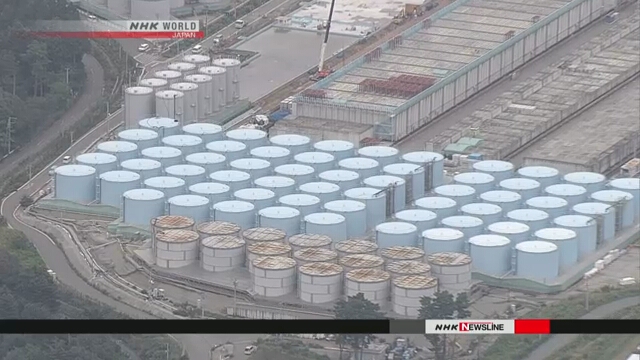
Quake shifts 53 water tanks at Fukushima plant
February 26, 2021
The operator of the crippled Fukushima Daiichi nuclear power plant says it has found that 53 tanks storing radioactive wastewater were shifted from their original locations by a powerful earthquake earlier this month. But it says there have been no leaks from the tanks.
Tokyo Electric Power Company inspected 1,074 tanks after a magnitude-7.3 quake struck off the coast of Fukushima Prefecture on February 13.
TEPCO discovered that 53 tanks had moved from their original locations by 3 to 19 centimeters.
TEPCO treats the water used to cool molten nuclear fuel at the damaged reactors before storing it in tanks. But the water still contains radioactive substances.
The company says it also found that five sections of piping connecting the tanks shifted more than the limit recommended by the manufacturer.
But it says it has so far found no cracks or other abnormalities in the piping. It plans to conduct further examinations.
TEPCO also laid out a plan to repair two seismometers at the No.3 reactor building next month.
It came to light on Monday that the devices went out of order partly because of heavy rain last July. As a result, they were unable to collect data when the quake struck.
Fukushima poll: 74% say nuclear disaster work not promising

A cemetery in a district in Namie, Fukushima Prefecture, on Jan. 20 is surrounded by solar panels installed on former farmland after the evacuation order was lifted.
February 24, 2021
Only 19 percent of residents in Fukushima Prefecture believe the work to decommission the crippled Fukushima No. 1 nuclear plant is showing “promise” nearly 10 years after the triple meltdown, a survey showed.
Seventy-four percent of respondents in the telephone survey said the situation was “not promising” at Tokyo Electric Power Co.’s nuclear plant.
The survey, jointly conducted by The Asahi Shimbun and Fukushima Broadcasting Co. on Feb. 20 and 21, is the 11th since the Great East Japan Earthquake and tsunami caused the nuclear disaster in March 2011.
The first was conducted in September 2011, followed by surveys on February or March every year from 2012.
The central government and TEPCO have set a goal of completing the decommissioning work “in 30 to 40 years,” but their efforts so far have been hit with various problems and delays.
Although evacuation orders have been lifted, many residents who fled the disaster have not returned to their homes near the plant. Still, the government plans to entice people to move into municipalities around the nuclear plant.
According to the survey, 21 percent of respondents viewed the new settlement policy as “promising” for revitalizing the area, compared with 72 percent who said it was “not promising.”
One constant problem in the decommissioning work is the continual stream of contaminated water that must be stored in tanks at the site of the plant.
With space running out, the government’s policy is to treat the water and dump it into the sea, even though the process will not remove all radioactive substances.
Thirty-five percent of respondents approved this policy, up from 31 percent in the 2020 survey, while 53 percent opposed the policy, down from 57 percent.
However, 87 percent of respondents said they were worried about damage caused by rumors over the dumping of the water into the sea, such as overexaggerated claims about the effects. Of them, 48 percent were “greatly” worried while 39 percent were worried “to a certain degree.”
The government continues to hold explanatory briefings about the water-dumping policy at local sites, but the effort has not reduced the people’s concerns.
The respondents were also asked whether the government should be held responsible for failing to prevent the nuclear disaster from occurring. Eighty-four percent agreed, including 33 percent who said the state has “great responsibility” and 51 percent who cited “a certain degree of responsibility.”
Forty-five percent of respondents in their 60s and 44 percent aged 70 or older said the government was “greatly responsible.”
Twenty-eight percent of respondents gave high marks to the government’s response so far to the nuclear disaster, while 50 percent had low evaluations.
As for TEPCO, 39 percent said the utility has acted responsibly over the 10 years since the accident, compared with 43 percent who said, “It hasn’t.”
And only 32 percent of respondents said the country has learned lessons from the nuclear accident, while 57 percent said it has not.
All nuclear reactors in Japan were shut down following the Fukushima disaster. Much tougher safety standards were established, and some reactors have been brought back online.
Sixteen percent of the Fukushima residents approved restarts of nuclear plants while 69 percent said they should remain offline.
Nationwide, 32 percent were in favor of the restarts and 53 percent were against, according to a phone survey conducted on Feb. 13 and 14 that showed opposition is higher in Fukushima Prefecture.

Half of the Fukushima respondents said restoration of the prefecture was on track, including 3 percent who said “greatly” and 47 percent who said “to a certain degree.”
In the 2012 survey, 7 percent said restoration was on track. The ratio jumped to 36 percent in 2016.
In the 2019 survey, conducted a year after most of the decontamination work was completed in the prefecture, the figure increased to 52 percent, but it has since remained at around the same level.
Sixteen percent of respondents said they feel “great” anxiety over the effects of radioactive materials released in the accident on themselves and their families, while 48 percent felt a “certain degree” of anxiety.
The overall ratio of 64 percent was down from 91 percent in September 2011 and 68 percent in 2016. But the latest figure was up from 56 percent in 2020.
By sex, 69 percent of female respondents and 59 percent of males felt anxious about the radioactive fallout.
In addition, 79 percent of all respondents were worried that the public will lose interest in the plight of the victims of the nuclear accident. Of them, 34 percent were “greatly” worried and 45 percent were worried “to a certain degree.” Nineteen percent were not worried very much or not at all.
Fifty percent think the image of Fukushima Prefecture has been restored to the pre-disaster level, but only 4 percent “largely” believe this is the case.
The overall figure has improved from 30 percent in the 2016 survey.
But the nationwide survey on Feb. 13 and 14 showed that only 40 percent believe that Fukushima Prefecture’s image has been restored.
The survey used home phone numbers for voters in Fukushima Prefecture, excluding some areas, selected at random by computer. It received valid responses from 1,049, or 54 percent, of the 1,955 voters contacted.
Fish contaminated with radiation caught off northeastern Fukushima Prefecture

This 2007 file photo shows black rockfish.
February 24, 2021
FUKUSHIMA — Radioactive cesium five times above permitted levels in Japan has been detected in black rockfish caught in northeastern Fukushima Prefecture, according to a Feb. 22 announcement by a local fishing association.
Some 500 becquerels per kilogram of cesium was found in black rockfish caught at a depth of 24 meters about 8.8 kilometers off the town of Shinchi, exceeding the national standard level of 100 becquerels per kilogram.
The Fukushima Prefectural Federation of Fisheries Co-operative Associations has since halted distribution of the fish until it can confirm their safety. The voluntary suspension of seafood shipments by the fishing body marks the first time since October 2019, when 53 becquerels per kilogram of radioactive cesium was detected in a white sea perch, exceeding the standard level set by the group at 50 becquerels per kilogram.
The fishing association has been conducting test fishing since June 2012 on a limited scale. After shipping restrictions on common skate were lifted in February 2020, shipment of all fish was permitted. The fishing body aims to resume full fishing operations in April. https://mainichi.jp/english/articles/20210224/p2a/00m/0na/014000c
Broken devices at Fukushima plant fail to record vital quake data
Either not replaced by negligence or claimed to be broken so as to not have to share disturbing data outside of Tepco….

Prime Minister Yoshihide Suga visits the Fukushima No. 1 nuclear power plant in September. The No. 3 reactor building is seen in the background.
February 23, 2021
Two broken seismometers at the crippled Fukushima No. 1 nuclear plant failed to record data from a powerful earthquake that struck off the coast of the prefecture on Feb. 13, according to the plant operator.
Tokyo Electric Power Co. became aware last year that the seismometers installed at the No. 3 reactor building were on the blink but didn’t repair them, company officials told a meeting of the Nuclear Regulation Authority on Feb. 22.
The company installed the seismometers in March last year after the NRA said they would be useful in evaluating the degree of deterioration of the structure. One was placed on the top floor, and the other was set on the ground floor.
But one was broken in July and the other in October due to heavy rain and other reasons.
The seismometers at the No. 3 reactor building were not required under laws or regulations.
The NRA plans to call on TEPCO to report on how it will deal with the issue. It will also consider requiring the company to properly manage and maintain seismometers.
The magnitude-7.3 earthquake on Feb. 13 registered an upper 6 on the Japanese seismic scale of 7 in Fukushima and Miyagi prefectures.
TEPCO said the following day that cooling water had overflowed from pools storing spent nuclear fuel at the Fukushima No. 1 and No. 2 nuclear power plants due to the temblor.
The overflow, totaling three liters, was wiped off and did not escape the plant compounds. No changes in radioactivity were detected in nearby areas.
TEPCO also said Feb. 19 that contaminated water had leaked from the containment vessels of the No. 1 and No. 3 reactors of the Fukushima No. 1 plant apparently because the parts damaged by the 2011 earthquake and tsunami were subjected to strong shaking from the temblor.
The company said the leakage has remained within the plant premises, and nuclear fuel debris has continued to be cooled in the containment vessels.http://www.asahi.com/ajw/articles/14213851
Fukushima Daiichi Nuclear Power Plant Containment Vessel Water Level Continues to Drop Due to Earthquake

February 23, 2021, 5:05 PM
Tokyo Electric Power Company (TEPCO) summarized the impact of the February 13 earthquake on the Fukushima Daiichi Nuclear Power Plant on February 22, and said that the water level in the containment vessel that houses the reactor continues to drop. The Nuclear Regulation Authority (NRA) has said that water injection is continuing and that there are no safety issues at present, but has called for tighter monitoring.
At the Fukushima Daiichi Nuclear Power Plant, water is being injected to cool the melted down nuclear fuel, but the water level in the containment vessels of the Unit 1 and Unit 3 reactors has dropped by several dozen centimeters and has been on a downward trend ever since.
In addition, nitrogen has been injected into the containment vessel to prevent hydrogen explosions and increase the pressure, but in the Unit 1 reactor, the pressure gauge that measures the difference from atmospheric pressure has dropped from 1.2 kilopascals to 0.1 kilopascals and is now almost at atmospheric pressure.
The Tokyo Electric Power Company (TEPCO) says it will continue to monitor the water level and pressure, as it is possible that the earthquake may have caused damage that was created 10 years ago to spread, causing the water level and pressure to drop.
In addition to the above, it was also found that six tanks used to store water after treating contaminated water were displaced by up to 5 cm due to the earthquake.
The displacement was within the design assumptions, and no water leakage has occurred.
There was no change in the values of the monitoring posts after the quake, and there was no leakage of radioactive materials to the outside.
The Nuclear Regulation Authority (NRA), which received the report, said that cooling of the nuclear fuel and nitrogen injection are continuing and that there are no safety issues at present, and asked TEPCO to strengthen its monitoring.
https://www3.nhk.or.jp/news/html/20210223/k10012881251000.html?fbclid=IwAR0KDxC1FABC_SeNe3Sda6M55_WOvJxDE_UwBaODJls6oHlTgudC0-CHPhQ
6.0 Plus Magnitude Earthquake Damages Radioactive Waste Incineration Facilities at 3 Sites in Fukushima

February 23, 2021
The Fukushima Regional Environment Office announced on Tuesday that three temporary incineration facilities for radioactive waste from the accident at the Tokyo Electric Power Company’s Fukushima No. 1 Nuclear Power Plant were damaged in an earthquake that registered a seismic intensity of 6.0 on the Japanese scale late on February 13. None of the facilities have leaked radioactive waste, but it is expected to take about a month to recover.
According to the Environment Office, as a result of post-earthquake inspections at the Adachi temporary incineration facility (Nihonmatsu City) and the Futaba temporary treatment facilities No. 1 and No. 2 (Futaba Town), damage was found in the piping and ceiling. There was no change in the air dose rate at the site boundary. There was no damage caused by the earthquake at the other five facilities operating in Fukushima Prefecture.
Fukushima nuclear plant operator: Seismometers were broken

February 22, 2021
The operator of the wrecked Fukushima nuclear power plant says two seismometers at one of its three melted reactors have been out of order since last year and did not collect data when a powerful earthquake struck the area earlier this month
TOKYO — The operator of the wrecked Fukushima nuclear power plant said Monday that two seismometers at one of its three melted reactors have been out of order since last year and did not collect data when a powerful earthquake struck the area earlier this month.
The acknowledgement raised new questions about whether the company’s risk management has improved since a massive earthquake and tsunami in 2011 destroyed much of the plant.
The malfunctioning seismometers surfaced during a Nuclear Regulation Authority meeting on Monday to discuss new damage at the plant resulting from a magnitude 7.3 quake that struck the region on Feb. 13. Cooling water and pressure levels fell in the Unit 1 and 3 reactors, indicating additional damage to their primary containment chambers.
The operator, Tokyo Electric Power Co., has repeatedly been criticized for coverups and delayed disclosures of problems at the plant.
Regulatory officials asked TEPCO at the meeting why it did not have seismological data from the Unit 3 reactor for Saturday’s quake, and utility officials acknowledged that both of its seismometers had failed — one in July and the other in October — and had never been repaired.
TEPCO also said that seismometers at all but two of the reactor buildings that survived the 2011 disaster were submerged by water from the tsunami and have never been replaced.
During Monday’s meeting, regulatory officials said they were concerned about the declining water levels and pressure in the Unit 1 and 3 primary containment chambers because of the possibility that the quake had expanded the existing damage or opened new leakage paths, and urged the utility to closely check for any increased radiation levels in the ground water surrounding the reactor buildings.
TEPCO said no abnormality has been detected in water samples so far.
New damage could further complicate the plant’s already difficult decommissioning process and add to the large amounts of contaminated water being stored at the plant.
Since the 2011 disaster, cooling water has been escaping constantly from the damaged primary containment vessels into the basements of reactor and turbine buildings, where the volume increases as groundwater seeps in. The water is pumped up and treated, then part of it is reused as cooling water, while the rest is stored in about 1,000 tanks.
TEPCO initially reported there was no abnormality at the plant from Saturday’s earthquake. But on Monday, it said about 20 of the tanks had slid slightly due to the quake, a storage container carrying radioactive waste had tilted, and asphalt pavement at the plant was cracked.
Fukushima struggling to get people back, 10 years after disaster

An elementary school building in Namie, Fukushima Prefecture, is seen deserted in January. Municipalities near the crippled nuclear power plant in Fukushima have been struggling to bring residents back. February 22, 2021
February 22, 2021
Fukushima – Municipalities near the crippled nuclear power plant in Fukushima Prefecture have been stepping up efforts to bring residents back, a decade after the March 2011 triple reactor meltdown.
In areas in 10 Fukushima municipalities that were once off-limits due to radiation from the nuclear disaster, the ratio of actual to registered residents is as low as 31.8%.
Years of evacuation orders following the disaster at Tokyo Electric Power Company Holdings Inc.’s Fukushima No. 1 nuclear plant have left many registered residents unwilling to return, leaving officials concerned about the survival of their municipalities.
Taki Shoji, an 87-year-old former evacuee, returned from the city of Aizuwakamatsu further inland in the prefecture to the town of Okuma in April 2019 after an evacuation order was lifted.
In Aizuwakamatsu, Shoji struggled with snow-removing work during wintertime that he was not accustomed to.
“Living in a large house makes me feel calm,” he said, referring to his life in his warmer, coastal hometown.
Shoji needs to go to a neighboring town by bus to shop because local stores offer only a limited supply of goods. He is looking forward to the opening in spring of a commercial facility in Okuma that houses convenience and grocery stores. It “will allow me to go shopping by foot,” he said.
The ratio of actual to registered residents is especially low, at less than 20%, in the towns of Namie and Tomioka, where it took about six years for people to return after the nuclear accident.
A survey of Namie and Tomioka residents last summer by the Reconstruction Agency and others showed that greater access to shopping and medical and welfare services is needed for evacuees to return to their hometowns.
These municipalities are taking steps to encourage people to relocate to them.
The village of Iitate, where the ratio of actual to registered residents stands at about 30%, offers support measures for those willing to relocate, including up to ¥5 million in subsidies for the construction of a new house. As a result, the number of people who have relocated to Iitate topped 100 in summer last year.
Namie plans to create new jobs mainly in the renewable energy industry to bring more people to the town. “The current population is not enough to maintain infrastructure and administrative services and it’s difficult to keep the town afloat,” Namie Mayor Kazuhiro Yoshida said.
The government will start a new program in fiscal 2021, which begins in April, to provide up to ¥2 million per household to people relocating to Fukushima areas affected by the nuclear accident.
Fukushima Prefecture plans to promote support for both evacuees’ return to hometowns and relocation by making use of the aid from the government. “Unless there are people, there will be no reconstruction,” a prefectural official said.https://www.japantimes.co.jp/news/2021/02/22/national/fukushima-residents-struggle/
Pressure drops inside vessel at Fukushima plant
February 13 earthquake could have exposed damaged part

February 22, 2021
Tokyo Electric Power Company has found that the pressure inside one of the reactor containment vessels at the Fukushima Daiichi nuclear plant has dropped.
The utility said the earthquake that hit the area on February 13 may have been to blame. TEPCO said no radioactive material has leaked.
The nuclear plant in Fukushima Prefecture in northeastern Japan is now undergoing decommissioning.
TEPCO said it confirmed at around 6 p.m. on Sunday that pressure inside the vessel of the No.1 reactor dropped to 0.9 kilopascals from the usual 1.2 kilopascals. Nitrogen is being added to the vessel to raise the pressure and reduce the risk of a hydrogen explosion.
TEPCO found that after the quake the level of water in the containment vessel had dropped.
It said the part damaged in the 2011 nuclear accident may have been exposed after the water level dropped, possibly causing an air leakage and the drop in pressure.
TEPCO said it is continuing to pump water into the vessel and there should be no safety problem.
It said there have been no abnormality in the measurements at radioactivity monitoring posts in the compound.
The utility said it will keep watching the data at the vessel and other facilitieshttps://www3.nhk.or.jp/nhkworld/en/news/20210222_02/
Radioactive Materials in Black Rockfish Off Fukushima Coast: Shipment Suspended

February 22, 2021, 7:09 pm
The Fukushima Prefectural Federation of Fishermen’s Associations (FISHMA) has suspended shipments of a fish called “Kurosoy” that was landed on February 22 in an experimental fishery off the coast of Fukushima Prefecture. This is the first time in about two years that radioactive materials exceeding the standard have been detected in the fishery off the coast of Fukushima Prefecture, and in February of last year, the shipping restrictions were lifted for all fish species.
According to the Fukushima Prefectural Federation of Fishermen’s Associations, on the 22nd, radioactive materials were detected in a fish called “Kurosoy,” which was caught in a fishing ground 8.8 kilometers off the coast of Shinchi Town at a depth of 24 meters.
As a result of detailed measurements at a prefectural laboratory, the concentration of radioactive cesium was 500 becquerels per kilogram, exceeding the national food standard of 100 becquerels per kilogram.
The prefectural fishermen’s federation has also decided to suspend the shipment of black rockfish until the safety of the fish is confirmed, as it exceeded the voluntary standard of 50 becquerels per kilogram set by the federation.
The national government’s nuclear emergency response headquarters is expected to order restrictions on the shipment of black rockfish.
The amount of blue rockfish landed in the past year was 3 tons, which is less than 1% of the total landings of the experimental fishery being conducted off the coast of Fukushima Prefecture.
This is the first time that radioactive materials exceeding the national standard have been detected since February of two years ago in the common kasube, a species of ray-finned fish, and in February of last year, the shipping restrictions were lifted for all fish species off the coast of Fukushima Prefecture.
Prefectural Fisheries and Oceanic Research Center: “There is a possibility of fish entering and leaving the nuclear power plant port
According to the Fukushima Prefectural Fisheries and Oceanic Research Center, which has been continuously measuring the concentration of radioactive materials in fish and shellfish off the coast of Fukushima Prefecture, the detected levels have dropped significantly compared to immediately after the nuclear accident.
According to the Fukushima Prefectural Fisheries and Oceanic Research Center, which has been continuously measuring the levels of radioactive materials, the levels detected have decreased significantly compared to the levels immediately after the nuclear accident.
We also examined 50 samples of black carp, and all of them were below the detection limit.
On the other hand, the Tokyo Electric Power Company (TEPCO) once detected a radioactive substance of about 900 becquerels per kilogram in a sample of black rockfish taken for investigation in the harbor of the Fukushima Daiichi Nuclear Power Plant.
Tokyo Electric Power Company (TEPCO) has installed nets at the entrance and exit of the harbor to prevent fish from entering and leaving the harbor, but the prefectural Fisheries and Oceanic Research Center is investigating the possibility that the black rockfish got out for some reason, and is investigating the cause of the detection of radioactive materials exceeding the standard.
Kyoichi Kamiyama, director of the Radioactivity Research Department at the Fukushima Prefectural Fisheries and Oceanic Research Center, said, “Considering the low concentration of radioactive materials in the seawater and seabed off Shinchi Town, we really don’t know why such high levels of radioactive cesium were detected. We would like to investigate the cause, taking into consideration the possibility that fish are coming in and out of the harbor of the Fukushima Daiichi Nuclear Power Plant.https://www3.nhk.or.jp/news/html/20210222/k10012880681000.html?fbclid=IwAR3fsx6QfmBWHfSgpjkrUvc_gDf6q0qUWBf50YGXkWR0KLgwWAM_1GdBwBI
TEPCO neglected seismograph failure for more than six months, failed to record the earthquake of March 13 at Fukushima Daiichi Unit 3

February 22, 2021
The Tokyo Electric Power Company (TEPCO) announced on Wednesday that two seismographs installed in the reactor building of the Unit 3 reactor at the Fukushima Daiichi Nuclear Power Plant had failed but had been left unrepaired for more than half a year, so they were unable to record data from a seismic intensity 6-weak earthquake that occurred late at night on the 13th of this month.
The water level in the reactor containment vessel dropped by more than 30 centimeters at the Fukushima Daiichi Nuclear Power Plant Units 1 and 3, possibly due to the magnitude 6-weak earthquake.
The explanation was given by TEPCO when it reported on the effects of the earthquake at a Nuclear Regulation Authority meeting. TEPCO made no mention of the seismograph failure in its press conference after the quake or in its public documents, and had not announced it before that.
Akira Ono, chief executive officer of the Fukushima Daiichi Nuclear Decommissioning Promotion Company, apologized at the review meeting, saying, “We missed a chance to get valuable data and we regret it.
According to TEPCO, seismographs were installed in March 2020, one on the operation floor and one on the first floor, both on the top five floors of the Unit 3 reactor building, and the one on the first floor broke down in July, four months after it was installed, when it was submerged in water due to rain, and the other broke down in October of the same year due to another cause.
At a press conference on the evening of the 22nd, a TEPCO spokesperson said, “We had planned to install seismographs with countermeasures. The seismograph in the Unit 3 reactor was “installed on a trial basis” to study the earthquake resistance of the building where a hydrogen explosion occurred during the accident, he explained.
At the Fukushima Daiichi Nuclear Power Plant, seismographs were installed on the basement floor of the reactor buildings of Units 1-6, but the equipment in Units 1-4, which were flooded by the tsunami, is not working. (Kenta Onozawa) https://www.tokyo-np.co.jp/article/87498?fbclid=IwAR10pYQZCCKlLhFL8juxyOLZMvOCVTaiP7kQt1C0B46KSxj91KtREIEezP8
1 This Month

of the week – Shut Down Drone Warfare!


Tell the Ukrainian Government to Drop Prosecution of Peace Activist Yurii Sheliazhenko

Petition to revoke the licensing of the Near Surface Nuclear Disposal Facility (NSDF) at Chalk River. https://www.ourcommons.ca/petitions/en/Petition/Details?Petition=e-7247
To see nuclear-related stories in greater depth and intensity – go to https://nuclearinformation.wordpress.com
-
Archives
- April 2026 (34)
- March 2026 (251)
- February 2026 (268)
- January 2026 (308)
- December 2025 (358)
- November 2025 (359)
- October 2025 (376)
- September 2025 (257)
- August 2025 (319)
- July 2025 (230)
- June 2025 (348)
- May 2025 (261)
-
Categories
- 1
- 1 NUCLEAR ISSUES
- business and costs
- climate change
- culture and arts
- ENERGY
- environment
- health
- history
- indigenous issues
- Legal
- marketing of nuclear
- media
- opposition to nuclear
- PERSONAL STORIES
- politics
- politics international
- Religion and ethics
- safety
- secrets,lies and civil liberties
- spinbuster
- technology
- Uranium
- wastes
- weapons and war
- Women
- 2 WORLD
- ACTION
- AFRICA
- Atrocities
- AUSTRALIA
- Christina's notes
- Christina's themes
- culture and arts
- Events
- Fuk 2022
- Fuk 2023
- Fukushima 2017
- Fukushima 2018
- fukushima 2019
- Fukushima 2020
- Fukushima 2021
- general
- global warming
- Humour (God we need it)
- Nuclear
- RARE EARTHS
- Reference
- resources – print
- Resources -audiovicual
- Weekly Newsletter
- World
- World Nuclear
- YouTube
-
RSS
Entries RSS
Comments RSS
 nuclear-news