At 8:00 — Already, 85 children have had surgeries for thyroid cancer, there are 112-113 children who are suspected of having cancer. When children get cancers it progresses very quickly. The former person in charge of health, Yamashita Shunichi, said it would be only a 1 in a million chance of children getting any kind of cancer because of radiation. But he was lying. Right now, it’s like 1 in 3,000 — it’s an epidemic… The head of the National Cancer Research Center estimated right now in Fukushima the rate of cancer has gone up 61 times. And yet the gov’t and also the hospitals related to the gov’t are saying this is not because of radiation… How long does the gov’t think that we’ll be silent about this? In light of this epidemic, my anger will never die down. And then to think about the parents of the small children – how worried they must be.
At 12:00 — It’s not only children. There are many things happening to adults as well. Increased rates of thyroid cancer, heart attacks, leukemia, cataracts – many, many health problems, where they are wondering… there’s something definitely wrong.
At 16:00 — I can’t forgive the gov’t, they’re murderers. This is definitely a holocaust.
At 20:00 — Media won’t report on it. Everything’s just being swept under the rug.
At 26:00 — A TV program called ‘Hodo Station’… they went to Fukushima City to interview people and they also came to my clinic… The director that made this program also made a follow up show and contacted one of the interviewees telling her, ‘We’ll be airing it soon.’ But before it was aired, it was taken off the program. This director died. This director apparently told one of the interviewees, ‘If you do hear that I died, please believe that it was not a suicide, no matter what you might hear.’ There is no truth in the media in Japan today. There are all sorts of these mysterious events happening that are still unexplained and uninvestigated.
At 43:00 — Even today the gov’t is insisting the rise in pediatric thyroid cancer rates are not due to the accident…Why are they being so insistent? It’s because the moment they admit the reality of what’s going on, then they obviously can’t restart any of the nuclear plants and must change their entire nuclear policy.
Carole Hisasue, translator (at 1:15:00): It’s disappeared from the media, it’s disappeared from people’s consciousness. There’s this big culture of denial going on outside of Fukushima. They want to pretend like it never happened. I can’t talk to my own family about radiation contamination… They don’t want to hear it. They go, ‘You don’t understand because you don’t have to live here, we have to live here.’… It’s like ‘see no evil, hear no evil, speak no evil’… just trying to ignore it and pretend life is the way it was before 3/11. It’s frightening, it’s very very frightening… [My sister-in-law] is completely brainwashed by the gov’t who says, ‘Oh no, it’s fine, fine, fine’… she believes it, even though her son suffers from a lot of nosebleeds — and I think that’s a serious problem. If I mention it to her, or even to my own mother, they get very offended. They go, ‘Oh no, no. He’s always been like that. It’s nothing to do with radiation.’ Talk about denial, it just hurts my heart.
Sources:
Youtube: Report From Fukushima And The Abe Government Expansion And Export Of Nuclear Plants
Enenews: Cancer epidemic underway in Fukushima — Rates up 6,000% says head of cancer research center — “This is definitely a holocaust… everything’s being swept under the rug” — “Very, very frightening… my family members are brainwashed”
Tohoku Electric Power Company says it has found more than 4,000 improper entries in its inspection records about one of the reactors at its Onagawa nuclear power plant.
The initial inspection was held to check a wide range of facilities at the plant’s No. 2 reactor after the great earthquake that hit northeastern Japan. The operator is hoping to restart the reactor about 100 kilometers north of the crippled Fukushima Daiichi plant.
But Japan’s Nuclear Regulation Authority pointed out last year that Tohoku Electric’s inspection was lax and the firm was re-examining the inspection records on the No. 2 reactor.
Company officials said at a news conference on Wednesday that the utility has scrutinized all the inspection records for the reactor since August 2011.
They said in some cases workers entered “no problem” for parts that didn’t exist, citing the example of monitoring equipment for a valve which was not there.
In other cases, incorrect product types and serial numbers were left untouched. They say there were 4,188 errors in total.
Managing Director Takao Watanabe apologized to people in the region for causing concern, although he asserted the improper entries will not lead to any safety problems.
The company says it will also check the inspection records for the No.1 and No. 3 reactors.
Pressure exerted by tectonic plate movement off Tohoku that triggered the 2011 earthquake and tsunami has returned to pre-disaster levels, seismologists say.
“Large earthquakes might occur more randomly distributed in time than conventionally expected,” said Bogdan Enescu, an associate professor at the University of Tsukuba.
Researchers from the university and Switzerland-based Eidgenoessische Technische Hochschule analyzed seismic data collected by the Japan Meteorological Agency since 1998.
As part of the study, the team calculated b-values, a ratio comparing the occurrence of small earthquakes in a specific area with larger ones.
Because the b-values decline to under 1 when the frequency of large quakes increases, they assumed values of less than 1 are indicative of high plate stress in the areas being studied.
Although readings in the region at the center of the 2011 earthquake hovered around 0.8 to 0.9 from 1998 until 2005, the b-values dropped to around 0.6 to 0.7 in mid-2005. Those figures then surged to 1 or higher after the Great East Japan Earthquake of March 11, 2011.
But the b-values started to decline again around 2013, and returned to around 0.8 by the fall of 2014–almost the same level registered prior to the magnitude-9.0 quake.
“Observing b-values could be useful in improving the accuracy of massive earthquake forecasting,” said Enescu.
The findings were published in the British scientific journal Nature Geoscience on Feb. 3.
Preparatory work to build an interim storage site for radioactive waste is under way at the Okuma east industrial park (front) in Okuma, Fukushima Prefecture, on Feb. 3. The crippled Fukushima No. 1 nuclear power plant stands in the background.
February 04, 2015
The government has begun prep work on a parcel of land near the crippled Fukushima No. 1 nuclear power plant to receive its first delivery of radioactive debris from decontamination work in the area.
The Environment Ministry began the work for the interim storage site on Feb. 3, following its announcement last month that it had secured 60,000 square meters of land in industrial parks in the towns of Okuma and Futaba as a first step.
The move comes as companies owning large lots of land in the industrial parks are ready to sell their plots for the storage project.
While the plots owned by the companies account for just 2 percent of the total land needed to build storage site in Okuma and Futaba, which co-host the plant, the move will allow the government to begin shipping tainted debris by its target of March 11, the fourth anniversary of the nuclear disaster triggered by the Great East Japan Earthquake and tsunami.
The ministry plans to transfer 43,000 cubic meters of radioactive soil and other debris stored at 43 localities in the prefecture over a year on a trial basis.
The secured plots take up about 70 percent of the Futaba industrial park and Okuma east industrial park’s combined 440,000 square meters of land.
The Asahi Shimbun found that eight of the 13 companies that own property in the parks are willing to sell their land to the government and have already notified the appropriate officials of their decision.
Most of the companies are in the pharmaceutical and machinery industries and based in Tokyo.
“We doubt products we make here will sell anyway, even if we can someday resume operations,” said an official with a company that owns a factory in the Okuma park, referring to its decision to sell off the land. “We are afraid that (radiation-related) fears about products and produce from this area will linger.”
An official with a company in the Futaba park that also agreed to sell its land said: “We set up the factory about 20 years ago and hired many residents. We are more than happy to offer our land to help rebuild the local area.”
Residents of the two towns, where radiation levels remain high, continue to live outside the area after it was evacuated following the outbreak nuclear crisis.
Plots in the industrial parks were among the ministry’s first targets for the interim storage site. It is expected to be easier to start building the site on these plots because they house fewer buildings compared with other land.
Still, the ministry expects a prolonged battle to secure the 16 square kilometers needed for the storage site. “It will take a very long time,” said a senior ministry official.
The storage facility to be built in the towns will be designed to hold radioactive waste for up to 30 years.
Tokyo Electric Power Co. (TEPCO), the operator of the crippled Fukushima No. 1 nuclear plant, has agreed to pay some 420 million yen in compensation for property damage to residents who live in a radiation “hotspot” area, the Mainichi Shimbun has learned.
Fifty-two residents of 10 households living in parts of Minamisoma, Fukushima Prefecture, which is designated as a recommended special evacuation zone due to radiation hotspots, and another nine people of one household in a neighboring district sought compensation from TEPCO over property damage via an alternative dispute resolution process.
Attorneys representing the residents told the Mainichi Shimbun on Feb. 2 that TEPCO has agreed to pay some 420 million yen, a large portion of the compensation payment recommended by the government-backed dispute resolution center.
However, as the utility refused to pay compensation to the one household which is located outside the recommended evacuation zone, the plaintiffs will not accept the payment until TEPCO agrees to pay everyone who filed the claim.
The dispute resolution center presented a settlement proposal over property damage in the recommended evacuation zones to TEPCO in December last year. It was the first case for the center to accept such a claim filed by a group of residents in those areas.
TEPCO rejected the damage claim filed by the one household (about 10 million yen in compensation), saying that the utility will not handle dispute resolution requests from residents outside the radiation hotspot areas in the same manner as those filed by people living in the recommended evacuation zones.
Tokyo Electric Power Co, operator of the wrecked Fukushima Daiichi nuclear power plant, on Tuesday recommenced clean-up work after a two-week break due to two fatal accidents at the Daiichi and Daini plants.
All work was halted following the accidents, in order for safety regulation checks to be conducted.
However, TEPCO said it expects delays to continue for up to a month on a project to build an ice wall intended to contain the leaking of contaminated water from reactors at the Daiichi plant, TV Asahi reported.
TEPCO has been fighting a daily battle against contaminated water since Fukushima was wrecked by an earthquake and tsunami in March 2011 and three reactors underwent meltdowns.
Water flushed over the wrecked reactors to keep them cool enough to prevent further radioactive releases is leaking into basements after contact with the melted uranium fuel.
The water mixes with groundwater that seeps into the basements, requiring more pumping, treatment and storage.
Missteps and leaks have dogged the efforts to contain the water, slowing down the overall decommissioning process, which is expected to take decades.
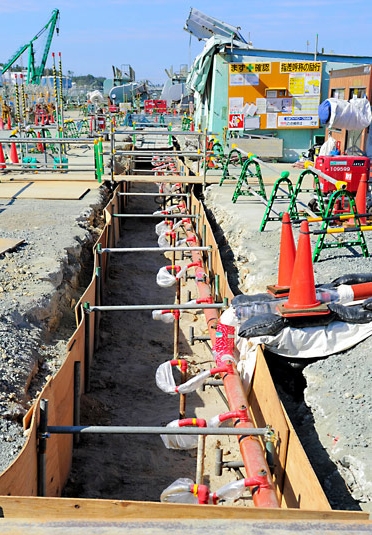
Tokyo Electric Power Co. will probably not meet its target of completing by the end of March the first section of frozen soil shields to curb the buildup of radioactive water at the Fukushima No. 1 nuclear plant.
Construction is being delayed by two weeks to one month after two deadly accidents at Fukushima No. 1 and No. 2 nuclear plants last month forced the company to suspend work for safety checks, Tepco officials said Monday.
The shields are intended to block groundwater from the nearby mountains from flowing into the reactor building basements and mixing with water that has become highly radioactive after being used to cool the overheating reactors.
Tepco began the construction work last June.
The volume of contaminated water has been increasing by several hundred tons a day due partly to the inflow of groundwater.
Even after the construction is completed, Tepco will need approval from the Nuclear Regulation Authority to start circulating refrigerant to freeze the surrounding soil. The NRA is concerned that the shields may change the flow of groundwater and cause the ground to sink, which could allow contaminated water to flow out of the reactor buildings.
Tetsu Kariya, author of the gourmet manga “Oishinbo,” says in the series’ latest edition that radiation is so high in Fukushima Prefecture it is causing nosebleeds among local residents.
The theme echoes one in a previous story that critics panned when Kariya had the main character suffer a nosebleed after visiting the Fukushima No. 1 nuclear power plant.
The controversial episodes ran in Shogakukan Inc.’s Big Comic Spirits magazine last May. But when the manga was compiled into book form, critical passages, including one linking nosebleeds and radiation exposure, were watered down.
In his latest book, published by Yugensha, Kariya questions the Environment Ministry’s assertion that radiation is unlikely to be causing nosebleeds locally. He cites surveys that found that “many people” have been suffering nosebleeds in the prefecture.
Kariya has written extensively about the plight of Fukushima farmers and fishermen, whose troubles he has studied at first hand. He has visited places around the nuclear power station.
He said he altered some controversial episodes in the new book to prevent misunderstanding and to protect real people who were identifiable in previous episodes and who others criticized.
In the final chapter, Kariya emphasizes that the reconstruction of the lives of the people is far more important than the recovery of the land of Fukushima.
“It is only you who can protect yourselves,” he said, addressing them in general. “Please have the courage to flee from Fukushima.”
Japan’s environment ministry plans to soon start building initial facilities for storing radioactive waste stemming from decontamination work in Fukushima Prefecture, northern Japan.They are part of the intermediate storage complex to be built in a 16-square-kilometer area straddling the towns of Futaba and Okuma.The government earlier planned to start moving the waste to the site by the end of this month. But it canceled the plan due to delays in purchasing land and building facilities.The government now plans to start the transport by March 11th, the 4th anniversary of the earthquake and tsunami that led to the nuclear accident in 2011.
The ministry says construction of 2 initial storage facilities, each 10,000 square kilometers, will start next Tuesday at industrial parks in the intermediate site.The waste is to be kept there until intermediate storage facilities are completed. It remains unclear when their construction will begin, due to lack of progress in purchasing land.Huge amounts of radioactive soil and other waste stemming from decontamination work have been kept in each municipality of the prefecture.
Municipalities are asking the government to provide a concrete schedule for transporting the waste.
Study: Global consequences from Fukushima-like nuclear disaster; Many nations at risk of ‘great exposure’ — Transport of hot particles to US was especially effective during worst releases after reactor explosions — Radioactivity confined ‘close to surface’ due to seasonal factors
We estimate the contamination risks from the atmospheric dispersion of radionuclides released by severe nuclear power plant accidents… We present an overview of global risks… [These] risks exhibit seasonal variability, with the highest surface level concentrations of gaseous radionuclides in the Northern Hemisphere during winter [Fukushima crisis began with 10 days left in winter].
The model setup was evaluated… using emission estimates from… Fukushima
The risk posed from nuclear power plant accidents is not limited to the national or even regional level, but can assume global dimensions. Many nations may be subjected to great exposure after severe accidents.
Our model shows increased surface-level concentrations throughout the Northern Hemisphere during the boreal winter months compared to the summer… Not only the expected risk magnitude is higher, but the geographical extent of the high concentrations of transported radionuclides is more pronounced towards the north… Horizontal advection [i.e. transfer] is more efficient in winter due to relatively stronger winds, and the concentrations are highest near the surface [and] surface level concentrations in the summer tend to be more localized in the emission region.
Our results illustrate that accidents… could have significant trans-boundary consequences. The risk estimate [shows] increased surface level concentrations of gaseous radionuclides in the Northern Hemisphere during winter and a larger geographical extent towards the north and the east… This is related to the relatively shallow boundary layer in winter that confines the emitted radioactivity to the lowest part of the atmosphere close to the surface…It is the view of the authors that it is imperative to assess the risks from the atmospheric dispersion of radioactivity from potential NPP accidents [for] emergency response planning on national and international levels.
JAMSTEC, Univ. of Tokyo, etc.: We show a numerical simulation for the long-range transport from the [Fukushima] plant to the US… Large-scale updraft [over] Japan from March 14 to 15 was found effective in lifting the particles[to the]jet stream that could carry the particles across the Pacific within 3 to 4 days [See study: On Mar. 15, Fukushima reactors emitted 100 quadrillion Bq of cesium into air — This one day was equal to total lifetime release from Chernobyl]… Some of the particles [had a] long-range atmospheric transport over — 10,000 km within 3 to 4 days… [R]adioactive materials were detected in that period over the east and west coasts of the U.S… In order for the particles to be transported with the jet stream, they must be lifted up from the surface boundary layer to the mid- or upper troposphere. Large-scale updraft was indeed observed… on March 14 through 15… [T]he westerlies in mid-March were thus particularly effective in the trans-Pacific transport of the radioactive materials…
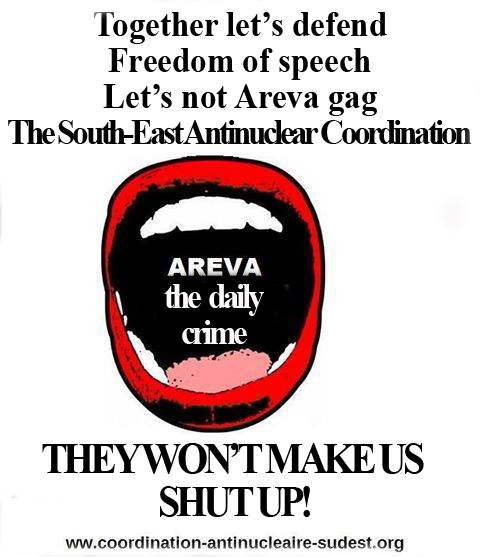
AREVA filed a complaint against the South-East Antinuclear Coordination.
We will not allow ourselves to be gagged !
The South-East Antinuclear Coordination has just been informed last Tuesday January 6, 2015 that a defamation suit has been filed by Areva against them for a report that they published on their website, denouncing the nuclear lobby’s penetration to the elected officials.
This attack on freedom of speech is taking place while the nuclear health crime continues here in the Rhône Valley of France, and in Fukushima, Japan.
By such attempt to gag opposition, the nuclear giant intends to silence dissent at a time when the Areva group is in financial and industrial decay (having lost 52% of its stock market value, failure of its EPR in Finland, risky investments, its Mox sales declining, especially in Japan, in question regarding its foreign budget financing etc), at a time when incidents are increasing at its ageing nuclear facilities in France and that thousands of Japanese children and adults will die slowly in Fukushima, Japan, and elsewhere as in Niger.
The South-East Antinuclear Coordination, apart from any political party, bringing together concerned citizens acting for the immediate and unconditional cessation of the nuclear crime for public health reasons, denounces :
The fanatical ideological war that proponents of atomic destruction are waging against free thought and against the people, the arrogance and the imperialism of the nuclear lobby and of its ruling caste,
The populations health and life damages and the contamination of areas by radioactive releases in the air and in the water from each of the 125 civil nuclear facilities plus the military nuclear facilities on secret military bases located throughout the french territory. Damages deliberatedly done, and repeated daily, such as the manufacturing of the radioactive «depleted uranium» by Areva, used in weapons of war,
Neo-colonialist exploitation of Niger’s workers and resources, as well as the radioactive contamination of the territories and of the Tuareg people and other people life in this country,
The infiltation of the State institutions, and of the elected assemblies by a private interests group and their ideological relay to impose a dominant order and a state of nuclear terror on the country and the plane.
The South-East Antinuclear Coordination calls to mind that there is no harmless dose of artificial radiation.
The South-East Antinuclear Coordination calls for solidarity :
All the persons freedom-loving, attached to the right of speech and criticism,
All the collectives, groups and organizations,
To oppose this attack on freedom of speech,
To send support emails to the South-East Antinuclear Coordination : sudest.antinucleaire@free.fr
To express their indignation to the authorities and to Areva by any way each person will define:
Japan’s nuclear watchdog gave the green light to the operator of the wrecked Fukushima nuclear power plant to discharge pumped up groundwater into the sea if radioactive substances in the water are within safety standards.
The Jan. 21 decision by the Nuclear Regulation Authority concerns groundwater from 41 wells, called subdrains, close to the No. 1 to No. 4 reactor buildings at the Fukushima No. 1 plant.
Operator Tokyo Electric Power Co. will be obliged to remove radioactive substances in the groundwater at its decontamination facilities.
The water must meet certain criteria before it is released into the sea.
The conditions per liter of water are: that radioactive cesium is less than 1 becquerel; radioactive substances that emit beta rays are less than 3 becquerels; and the level of tritium is less than 1,500 becquerels.
Although TEPCO does not have the means to remove tritium at its decontamination facilities, the levels of contamination must be within safety limits.
The NRA said the volume of groundwater that flows into the reactor buildings will be reduced by one-half.
However, it remains unclear if the plan will be implemented as TEPCO is keen to get the approval of local residents, many of whom depend on fishing for their livelihoods.
The utility has been holding meetings with local fishery cooperatives since the summer to explain what it involved. Some members of the cooperatives seemed receptive to the plan, but others were not.
Tokyo Electric Power Co. on Thursday said it will suspend the decommissioning of the Fukushima No. 1 power plant until it completes safety checks related to two fatal accidents at its facilities in the prefecture earlier this week.
“The most important thing is to thoroughly conduct safety checks,” Tepco spokesman Shinichi Kawamura told a news conference in Fukushima.
Decommissioning the wrecked plant involves many processes, but “we can’t tell when we will finish the checks for all work at this point,” Kawamura said, adding that it won’t take weeks.
On Monday, a 55-year-old subcontractor hired to work at the Fukushima No. 1 plant fell into a 10-meter-deep water tank during an inspection Monday. He was taken to a hospital but died the following day. Although the man was wearing a safety belt, he did not appear to be using it at the time.
On Tuesday, a subcontractor in his 40s died at the nearby Fukushima No. 2 plant after his head got crushed by an object during a concentrator inspection. The object was supposed to be held in place by a crane.
Kawamura said Tepco wants to pinpoint potentially unsafe places at the site, improve employee safety habits and ensure the procedures they are performing are safe.
For instance, Tepco will check whether adequate safety steps are being taken when handling heavy objects.
Since decommissioning work often requires the use of special industrial tools, workers must follow the required procedures to ensure their safety, Kawamura added.
The suspension will not affect the fuel-cooling and water-filtering operations, the utility said.