Crowdfunding and recuperation programs for Fukushima children
 Fukushima c’est eux Fukushima c’est nous
A group of parents who has been hosting children from Fukushima since summer 2012 are now organizing another round of crowd funding for summer 2015.
Details on their crown funding site.
http://fr.ulule.com/fukushima-nous/
Here is the information about the previous year’s achievement.
http://fr.ulule.com/fukushima/
JCSシドニーレインボープロジェクト JCS Sydney Rainbow Project
2015年夏、東北の震災孤児・遺児を10人、シドニーに保養に呼ぶ計画です
Summer camp 2015 for children who lost parents/family members
詳細はこちら For donation details https://readyfor.jp/projects/sydney
FUKUSHIMA KIDS DOLPHIN CAMP 2015 フクシマドルフィンキャンプ2015 御蔵島
“Dear eARThist family,
Oak to all relations Tokyo would like to present 2015 Fukushima Kids Dolphin Camp in Mikura Island this summer for children to release their stress from radiation fear caused by 2011 Tohoku earthquake and tsunami and give them an opportunity to play in the mother nature. And WE ARE COLLECTING DONATIONS!
See more at http://www.oak-to-all-relations.org/fukushima-kids-dolphin-camp2015/
Source: Save Children From Radiation
http://www.save-children-from-radiation.org/events/

Ma: Japanese food ban only for short term
Taiwanese President Ma Ying-jeou says Taiwan’s tightened controls on food imports from Japan will only be temporary.
Taiwanese health authorities had banned food imports from Fukushima and 4 nearby prefectures in the wake of the March 2011 nuclear accident.
But it was revealed in March that some food from the prefectures was being imported to Taiwan. This prompted calls by consumer groups for stricter regulations.
The authorities further tightened their rules on food imports from Japan last Friday. The measures include requiring that all Japanese food products bound for Taiwan carry certificates proving the prefecture of origin.
President Ma stressed to reporters on Monday that priority lies on dispelling consumer fears over the labeling of food products in Japan. He described the measure as being temporary, and added that health authorities are eager to resolve the issue.
Ma expressed his readiness to ease the restrictions after authorities determine how the banned products reached Taiwanese consumers and steps are taken to prevent similar reoccurrences.
The Japanese side has been urging Taiwan to lift the tougher regulations, calling the steps scientifically groundless. Japanese food exporters have expressed the fear that the revised regulations may increase export costs and make them less competitive in Taiwan.
Taiwanese supermarkets have also voiced concern over a possible decline in the volume of Japanese food they sell.
Source: NHK
http://www3.nhk.or.jp/nhkworld/english/news/20150518_29.html
‘Kantei Santa’ makes himself heard over the din of the election vans Is crime justified in the service of good?

It’s an ancient question. “Thou shalt not kill,” says the Bible — war in God’s service being an implicit exception. Then there’s Don Quixote, lover of justice, upholder of virtue, who founders on the impossibility of doing good without committing outrages. His name became an adjective — quixotic — for a certain kind of activism that fails to allow for the practical limits life imposes on ideals.
“Quixotic” is a word Shukan Bunshun magazine applies to the self-described “Kantei Santa” — kantei meaning the prime minister’s official residence, Santa needing no introduction, surprising though it is to see him at work so far from Christmas. “Kantei Santa” was the signature on a warning note attached to a miniature drone found in late April on the roof of the prime minister’s residence. “Radioactive,” said the note. The stunt, it explained, was a protest against the government’s drive to restart nuclear power stations idled in the wake of the meltdown catastrophe in Fukushima in March 2011. A quantity of earth in a container attached to the drone was in fact found to be mildly radioactive. “Santa” reportedly told police he dug it up in Fukushima.
The “Santa” police have in custody is 40-year-old Yasuo Yamamoto of Obama, Fukui Prefecture. In Shukan Bunshun’s profile, Yamamoto comes across as sufficiently idiosyncratic to beg the question: Is the crime attributed to him explicable simply as the work of one emotionally unstable individual, or is there a broader significance?
Many people are against the nuclear restarts; Yamamoto is not alone there. Japan is a democracy. Democracy means the government is responsive to the popular will, as freely expressed via the media, demonstrations, elections. In undemocratic societies, citizens must resort to crime to make themselves heard. Insisting on being heard is itself a crime.
Japan is a democracy but, as many observers have been noting lately, a flawed one. It comes perilously close, for one thing, to being a one-party state, the Liberal Democratic Party having held power for all but three of the past 60 years. Gerrymandered electoral districts are unrepresentative to the point that the Supreme Court last November, following numerous lower courts, cast doubt on their constitutionality.
Seemingly undemocratic government initiatives lately are growing increasingly bold, conspicuous among them a new state secrets Law that potentially criminalizes a key aspect of a journalist’s job — namely, the pursuit of public information.
Proposed revisions to the 68-year-old Constitution seem to weaken its protection of democratic rights while strengthening the national military. Some at least among those old enough to remember Japan’s undemocratic and militarist past, and some younger people attentive enough to listen to them, are not reassured by the benign official phrase “proactive pacifism.” Should they be?
Elections are the lifeblood of democracy, and Japan has just been through two of them — one national, the other a nationwide series of local ones. The first, in December 2014, gave Prime Minister Shinzo Abe a resounding victory in spite of widespread unease, consistently surfacing in opinion polls, over the course he is charting. The second, in April, was marred by a curious fact unworthy of a vigorous and healthy democracy — 22 percent of incumbents ran unopposed. No wonder voter turnout sank to record lows — less than half on average. Turnout for the national election in December was little better — 52.66 percent, also a record low.
Can democracy survive public apathy? Japan is not the only developed nation facing that question. Democracy prolonged is democracy taken for granted. Infant democracies do better in that regard. Voters take courage from situations that demand courage, streaming en masse to the polls in defiance of army thugs, terrorist threats, even terrorist bombs.
“Sato! Sato! Sato!” Anyone who has lived through a Japanese election campaign will know what that refers to — the incessant screeching of candidates’ names into loudspeakers mounted on campaign vans that roll through your neighborhood and mine, turning daily life into a nightmare of cacophony. Again: No wonder people don’t vote; they feel belittled and insulted. In 70 years of democracy, can campaigning have failed to mature beyond this?
Don’t blame the candidates, said the Asahi Shimbun in a pre-election report. The rules that bind them are strict, minute and seemingly meaningless. “No other country has campaign rules as strict as Japan’s,” Waseda University professor Minoru Tsubogo tells the newspaper. No door-to-door campaigning. No ad balloons. No candidates’ speeches from moving vehicles. No posters larger than 40×30 cm. Each individual poster must bear a certifying seal. Internet campaigning was finally permitted in 2013 but seems not to have caught on. So it’s “Sato-Sato-Sato,” rookie candidates being the worst offenders because the incumbents are already known. The system doesn’t change because the incumbents who can change it are its beneficiaries — which may have something to do with Japan’s virtual one-party statehood.
A society so rigid in some respects can be curiously lax in others. If drones were regulated half as closely as election campaigning, Kantei Santa would never have got off the ground. Granted, technological progress this rapid is bound to outpace legislation; still, Japan, having received a sharp lesson in vulnerability from the Islamic State terrorist group last winter, appears curiously inattentive to the security risks involved.
A former Air Self-Defense Forces enlistee with special skills in electronics, Yamamoto had ample opportunity to ponder the implications of nuclear power — his native Fukui hosts more reactors than any other prefecture. On his blog he named Ernesto “Che” Guevara — not Don Quixote — as his inspiration. Che’s personality and revolutionary zeal were magnetically charismatic. They still are, nearly 50 years after his death. Did pretending to be Che fill a void in Yamamoto’s apparently humdrum, lonely life? Or was he, in his own mind, offering himself, Che-like, as a sacrificial victim to a nation he saw going astray?
Democracy. The Asahi, apropos the April “Sato-Sato” elections, offered its own reflections on the subject. Its exemplar of living democracy was the county council of Cornwall, England, where citizen participation is frequent and impassioned. When local libraries were being closed last year due to budget deficits, the council heard an earful — with respectful attention — from a 10-year-old boy defending his right to read. An Internet campaign was launched to save the libraries.
Imagine that happening in Japan! And yet why shouldn’t it? They’re closing libraries here too.
Source: Japan Times
Video shot by robot inside damaged reactor May 16, 2015
The operator of the Fukushima Daiichi nuclear power plant on Friday released hundreds of hours of video footage showing the inside of the containment vessel of one reactor.
The footage was shot in April by 2 remote-controlled robots sent inside the No. 1 reactor’s vessel where radiation levels are very high.
Footage first captured shows fallen rubble in front of the robot.
The probe’s camera also captured what might be lead sheets that fell when meltdown occurred. Rubble can be seen piling up around them. All this testifies to the severity of the accident.
Meanwhile, no major damage was found in areas near the route leading to the bottom of the containment vessel.
Tokyo Electric Power Company plans to carry out further searches by sending robots to the lower levels of the vessel to look for nuclear fuel that melted down.
It also plans to send them into the containment vessel of the No. 2 reactor as early as August.
A survey using robots at the No. 3 reactor is expected to start as early as autumn this year.
The operator’s effort using robots to look into the reactor vessels will go into full swing in preparation for removing nuclear fuel. That should be the most difficult part of the work in the reactors’ decommissioning.
Source: NHK
Nuclear Watch: Robot Gives Glimpse
http://www3.nhk.or.jp/nhkworld/english/news/features/201504152112.html
LDP wants Fukushima evac orders lifted early in some areas by end of fiscal 2016
A task force in the ruling Liberal Democratic Party plans to ask the government to lift evacuation orders for areas with “relatively low” radiation around the meltdown-hit Fukushima No. 1 nuclear plant by the end of fiscal 2016.
The politicians want to speed up residents’ return to radiation-tainted areas and discussed measures, including lifting the evacuation orders, at a general meeting Thursday.
The Tokyo Electric Power Co. plant was heavily damaged by a triple meltdown after losing all power following submersion by tsunami spawned by the March 2011 Great East Japan Earthquake. The resulting radiation contamination tainted wide swaths of Fukushima and other parts of east Japan.
The group now hopes the government will give evacuated residents the option of returning to risk doses as high as 50 millisieverts a year, by the end of March 2017.
Lifting the orders would give about 55,000 residents the option of recovering their homes.
According to the outline, the orders would be lifted no later than six years after the nuclear crisis began.
By setting a deadline, the LDP wants raise evacuees’ hopes of returning.
The LDP plans to discuss the idea with its coalition ally, Komeito, and submit it to Prime Minister Shinzo Abe as a joint proposal by the end of this month.
The outline also calls for accelerating infrastructure recovery and decontamination in the areas. It says the government should instruct Tepco to duly consider providing financial compensation for psychological pain even if the evacuation orders are lifted earlier than the March 2017 deadline.
Source: Japan Times
http://www.japantimes.co.jp/news/2015/05/15/national/fukushima-evacuation-orders-lifted-low-radiation-areas-end-fiscal-2016-ldp/#.VVZNgZNZNBQ
Opponents of nuclear waste site hold symposium to counter gov’t forum on same day
Residents attend a symposium on opposition to a plan to build a radioactive waste site in Shioya, Tochigi Prefecture, on May 14, 2015. (Mainichi)
UTSUNOMIYA — While the Environment Ministry held a forum here on the night of May 14 on building disposal sites for radioactive waste and other debris caused by the Fukushima nuclear disaster, opponents of one candidate site held a large-scale symposium in Shioya.
The ministry held the forum in the prefectural capital in connection with plans to build disposal sites in Tochigi and four other prefectures. Meanwhile, the opponents held the symposium in Shioya, about 22 kilometers away from Utsunomiya, under the theme of local natural riches.
About 180 people attended the Environment Ministry’s forum, the second in a series that began in April in Sendai. Officials in charge of designated radioactive waste briefed the participants on the disposal scheme and sought their understanding for constructing a disposal site in the prefecture. Some of the participants made remarks such as, “If it’s so safe, build it in Tokyo,” and, “We can’t trust the central government because it covers up bad data.”
The Environment Ministry told the Mainichi Shimbun that it held the forum — designed to win understanding from Tochigi prefectural residents — in Utsunomiya rather than Shioya because transportation in the prefectural capital was more convenient, allowing more people to attend.
The symposium in Shioya, organized by a coalition of groups opposed to the proposed disposal site, drew about 1,100 people. Its venue, a high school gym, was packed with local residents and about 200 people watched the event on an outdoor screen. The participants confirmed their resolve to protect the local environment. A 72-year-old man said, “The Environment Ministry’s forum is an event only for convenient explanations. If we participate, we will be counted as supporters.”
Source: Mainichi
http://mainichi.jp/english/english/newsselect/news/20150515p2a00m0na006000c.html
TEPCO starts prep work to take cover off damaged Fukushima reactor
The operator of the Fukushima Daiichi nuclear plant began work on Friday morning to dismantle the cover of the No.1 reactor building.
The cover was installed after the March 2011 nuclear accident to prevent radioactive dust from dispersing. The reactor experienced a hydrogen explosion at the time of accident.
Tokyo Electric Power Company plans to remove the cover in order to clear away radioactive debris on the upper part of the building and remove spent nuclear fuel still stored inside. It is part of an effort to decommission the reactor.
For about one week, workers will spray chemicals over the debris inside the cover by using a remote-controlled crane to prevent radioactive dust from spreading.
They will proceed with the work to remove the cover over the period of about one year. Company officials say they will enhance monitoring of radiation levels during the procedure.
TEPCO says a preliminary test last year showed no scattering of radioactive materials when dismantling the cover.
The utility initially planned to start dismantling the cover on the No.1 reactor building in July of last year. But the work was delayed after the removal of debris from the No. 3 reactor in 2013 caused radioactive dust to spread, sparking fear among local residents. The death of workers at the plant also affected the plan.
Source: NHK
http://www3.nhk.or.jp/nhkworld/english/news/20150515_08.html
Tokyo Electric Power Co. began preparations on May 15 to remove the cover around a damaged reactor building at the crippled Fukushima No. 1 nuclear power plant, the first step in a lengthy process to extracting nuclear fuel inside it.
The work is part of a preparatory process that could take several years for the eventual removal of nuclear fuel from the spent fuel pool in the No. 1 reactor building.
On the first day of the work, TEPCO, the plant operator, sprayed a chemical agent in the reactor building to prevent radioactive dust in the building from being released into the air when the cover is removed.
On May 15, a large crane lifted a spraying machine to insert a thin, long nozzle into the building through holes created on the top cover to spray a glue-like chemical to contain dust and other materials generated by a hydrogen explosion triggered by the March 2011 Great East Japan Earthquake and tsunami.
The agent will be sprayed through the nozzle at 48 points. After it completes the spraying, TEPCO plans to begin retracting the roof cover on May 25 at the earliest to remove debris from the upper part of the building.
When the utility was removing debris from the No. 3 reactor building in the summer of 2013, a large amount of radioactive substances was released into the environment, fostering the public’s distrust in the process.
Subsequently, TEPCO has cautiously been proceeding with preparations for removing the cover around the No. 1 reactor building, such as testing anti-scattering agents in advance last October.
Because it is currently rice planting season around the Fukushima plant, TEPCO has pledged to suspend its work and inform surrounding local governments within 30 minutes when amounts of released dust and radiation exceed certain levels.
Source: Asahi Shimbun
http://ajw.asahi.com/article/0311disaster/fukushima/AJ201505150060
Filmmakers Ash and Kamanaka discuss radiation, secrets and lives
Ian Thomas Ash and Hitomi Kamanaka are perhaps the two most widely viewed filmmakers who have produced documentaries about the effects of radioactivity in Fukushima since the March 11, 2011, disaster. Ash’s commitment to the subject arose after the multiple nuclear meltdown. Kamanaka, on the other hand, has been Japan’s designated nuclear documentarian for nearly two decades.
In a number of ways, they are each the other’s mirror image. Ash is a foreign filmmaker who produces films in Japanese. Kamanaka also made her first widely distributed film about radiation exposure by traveling abroad: She went to the Hanford Nuclear Reservation in Washington state and to Iraq, where she documented the effects of depleted uranium on Iraqi citizens after the first Gulf War. She has continued to travel since, making films in Sweden and, most recently, Belarus.
Kamanaka has considered herself an activist filmmaker from nearly the beginning, and her films are consciously critical of the nuclear energy industry. Ash’s films, however, are narrative in nature. His camera stays firmly planted in the lives of his individual subjects.
In this way, as well, the two filmmakers’ careers have converged: Kamanaka’s new film, “Little Voices from Fukushima,” eschews a commentary structure in favor of a larger cast of subjects and a similarly narrative style. The film’s subject matter — the effects of radiation on the thyroid glands of children following nuclear meltdowns — also brings Kamanaka into alignment with Ash, whose two post-Fukushima documentaries address this issue exclusively.
Neither filmmaker is unfamiliar with the polarized nature of public discussion about nuclear energy: Kamanaka has lost government-administered funding for her films as a result of their content, and during a period of particularly heated media debate surrounding Ash’s films, his distributor was dissolved by its parent company in an attempt to avoid involvement in any potential controversies.
We asked the two filmmakers — American and Japanese, storyteller and activist — to discuss their work and their films, and to consider the notion of “being a ‘foreign’ filmmaker.” Below is an edited version of their discussion at the Foreign Correspondents’ Club of Japan. (Dreux Richard)
Ian Thomas Ash: Let’s talk about that now: being a “foreign filmmaker” and how much that affects the work.
I have a few questions about language. I am also a foreign filmmaker. I make films in Japanese in Japan. And you make films in Japan, but you go abroad to make films and you do that in English. You said maybe people feel disarmed by the fact that you are foreign, that it’s a little bit easier for you.
Hitomi Kamanaka: They’re not protective. They become relaxed.
ITA: Your English is not perfect, nor is my Japanese perfect. So I think on some level people sense that they have to speak more straight. They can’t bull—-t, because it won’t work.
HK: In Japanese society, in our culture, we have a sophisticated, indirect way of communicating.
ITA: One of the things in my film “A2-B-C” is “Tadachi ni eikyō wa arimasen to omowaremasu.” It means—
HK: Nothing.
ITA: Yeah: “I believe that at this point in time there will probably be no health effects.” That doesn’t mean anything. You’re just playing with words.
HK: It’s bull—-t.
ITA: Exactly. It’s bull—-t. In 10 years, 20 years, we don’t know. So it’s using language as a weapon — to try to cover things up. But when you are speaking with a foreign person, you can’t do that so much.
HK: (miming confusion) “What? What?”
ITA: I often pretend I don’t understand. People ask me about being a foreign filmmaker, and to be honest, I am not always conscious of the fact that I am foreign. I don’t think all the time, “I’m foreign. I’m foreign.” And how do you feel? When you go abroad, do you always feel like a foreigner? I don’t. Until someone says to me, “Ah, you are a foreigner.”
HK: I think since I was small, I see everyone — American people, Iraqi people or people from any other country — as the same. It’s just a problem of language.
ITA: To prepare for this discussion, I watched “Hibakusha: At the End of the World.” You went to Iraq, and you have been to America. What was that like? Because when you go to Iraq, not only are you foreign, but you are a woman.
HK: I think images about Iraq have been exaggerated and distorted by the mass media, especially the United States mass media — that Iraqis are stubborn people, or narrow-minded. But when I met them, they were warm and kind and full of love for their families. And they were open-minded toward foreign people. Everyone was, from normal citizens to bureaucrats.
ITA: In the movie, there’s a farmer [in Washington state] named Tom, who is leading this group of downwinders who are—
HK: Plaintiffs. In a trial.
ITA: There is a scene in the film where he is making a joke about the fact the government is saying, “It’s all right, it’s all right.” He says, “I’m just a farmer.” He says, “I’m not supposed to say anything. The government says it’s all right, so it must be all right.” You’re in the back of the car, laughing. It’s a really funny moment. He’s saying, “The government says the radiation stops at the barbed wire fence.”
HK: It’s a kind of black joke. He knows everything. But what he’s saying is the reality, how he sees the reality going on around the Hanford area. The farmers are pretending.
ITA: Then Dr. Shuntaro Hida, who is a hibakusha from Hiroshima, at that time he is 85. He talks about compensation only being for people within a 2 km radius. That is true for Fukushima as well, where they had zones. Initially it was 10 km and then it was 20 km, 30 km. If you live outside of 20 km, no compensation.
HK: Society has a different way of facing the truth, I think. Physics says it is impossible to stop radiation, and that anywhere you draw a line, there will be no difference between the two sides. But you must draw the line somewhere. In between, people are trapped.
ITA: In your film “Rokkasho Rhapsody,” there is a woman, Kikukawa-san. Her friend is growing organic foods. I want to read you her quote, because I think it’s important. She says, “There’s no proof that it is OK. But if you don’t like something, you shouldn’t do it. I can’t offer an explanation. It’s only the way I feel. The decision comes down to me, not some university professor.” She, as a farmer, just has this sense.
HK: When I had a press conference and screening for that film, maybe 30 journalists came. I was waiting outside the door [during the screening]. And they came out, and I expected somebody — anybody —to talk about the contents of the film. Everybody was silent. And then they just left. Nobody stopped to talk to me. Nobody.
ITA: I had the same experience with both of my films. I made “In the Grey Zone” in 2012, and it came out one year after the nuclear meltdown. Looking back, I think maybe it was too early. Then I did “A2-B-C,” and again I had a lot of trouble finding a distributor. I decided, “OK, I’m going to show it around the world and then bring it back to Japan,” which is what I did. Now “A2-B-C” is better-known and people say, “Can we see ‘In the Grey Zone?’ Can we see the other film?”
HK: In “A2-B-C” you begin with Yamashita-san. I wondered how you could do that shooting. That is very difficult, to access Yamashita-san. He was so protected.
ITA: Dr. Shunichi Yamashita was an adviser to the government who helped after the nuclear meltdown to create policy. He is from Nagasaki and his parents were hibakusha in Nagasaki. He had been doing research in Chernobyl.
HK: He is a very famous researcher of Chernobyl. Internationally.
ITA: So he came here to the [Foreign Correspondents’ Club of Japan] press club about 12 days after the nuclear meltdown and he gave a press conference. He gave the press conference in English, which I think is very important, because his English is not very good. I have to tell you that Dr. Yamashita’s English is not very good. This is important.
HK: Why did he not have a translator?
ITA: It’s part of his act. He gives this speech, and of course none of the Japanese journalists understand what he is saying. So all of the foreign journalists leave the room and they go write their articles. Only the Japanese reporters remain in the room. He was still at the table. All the Japanese reporters stayed and he gave an off-record press conference in Japanese. But it’s all off-record. I was there. He looks at me and I am the only white person in the room. He thinks I don’t speak Japanese, and I am sitting there recording the whole thing.
HK: That’s how you could do it.
ITA: This goes back to the thing about being a foreign filmmaker. I want to make a connection between Dr. Yamashita, and Dr. [Michael] Fox, who you interviewed, who works at the Hanford nuclear facility. And one of the things he says is—
HK: “Evidence. Scientific evidence.”
ITA: Exactly. “I’m a scientist. I sort things out based on data. Data should decide these issues. Not propaganda. Not fear.” It really reminded me of Dr. Yamashita. This way of thinking: that it is only about numbers, it’s only about data. When you talk about any of these issues — when you talk about Hiroshima, Nagasaki, Iraq, Fukushima — if we only talk about numbers, we forget that each number represents a person. People say things like, “Only one person will become sick.” But to that one person, it’s 100 percent.
HK: That kind of sensitivity is always missing in those kind of scientists. But with Dr. Fox, I made a mistake. I had read the history of Hanford. A whistleblower had said they were doing bad things there. They are polluting the area and people. But [Hanford employees] had pride. They were working for a national purpose, protecting the United States from communism, or something. So they had pride, and then their pride had been broken. They became so protective, and that is why I pushed a kind of button when I—
ITA: I don’t think you made a mistake.
HK: But I made him angry about it.
ITA: I made Dr. Yamashita angry. You have to break through that sometimes. That’s why you’re a good filmmaker. I mean, if you don’t break through that, then we have no film.
HK: When I want to ask something, I ask.
ITA: I think of so many things. One is my own struggle when people refer to me as an activist filmmaker. I have not been able to embrace the word ‘activist’ yet. What I am doing, I hope that it can help people. But I feel like if I am only an activist filmmaker, then only other activists will watch the films.
HK: That’s the problem.
ITA: There are people in America who need to see “Hibakusha: At the End of the World,” but the people who need to see this film are not going to seek it out. The people who do seek it out already know there is a problem. I feel this is true for my films as well.
HK: I’ve been thinking about the same thing for a long time. If people think, “Oh, this is my story” or “He is like me,” it will make people interested in seeing this kind of film. The people who are in my new film are very, very ordinary people. They are not activists. The only thing in their mind is “We need to protect children.”
ITA: In your films, you often go to different places and you make connections. When you edit, you don’t give the audience any chance to adjust: We’re in Iraq and now we’re in Hanford, and in Hanford you’ve brought someone with you from Hiroshima. In your new film, is it only filmed in Fukushima or did you go to other places?
HK: The film [“Little Voices from Fukushima”] is about mothers who want to protect their children from radiation exposure, which has occurred in Fukushima. And the other place is Belarus. So I combined two places in one film. I expect a kind of chemical reaction.
ITA: Among the audience?
HK: Yes. After you watch the film. This is a 25-year delay — 1986 and 2011. Twenty-five years separate Fukushima and Belarus.
ITA: I remember now what I was going to ask you. In this world of documentary film in Japan, and especially films that deal with nuclear issues, you are quite well-known.
HK: Because nobody was making these films.
ITA: How does that affect your ability to make another film? When I went somewhere while I was making “A2-B-C,” for example, people didn’t know who I was. It was easy. Now if I go back to make another film: “Ah, you’re the guy that made ‘A2-B-C’. ” You made “Hibakusha,” you made “Rokkasho Rhapsody.”
HK: For “Rokkasho Rhapsody,” Madarame-san [Haruki Madarame] is in it.
ITA: He’s the geneticist, or the University of Tokyo professor.
HK: And also the head of the [now-defunct] Nuclear [Safety] Committee in Japan. So he doesn’t know me. He just thought I was a small woman bringing a small camera. He could speak freely. But now the [trade ministry]—
ITA: Know who you are.
HK: They hate me.
ITA: Because you got some cultural funding from the Japanese government to make your films.
HK: That’s why they were angry. Later, when my film got famous, then they thought, “This film got a grant from the government? Who gave it?” I guess they were angry with the ministry of culture. Since then, I can’t get this kind of grant. People develop an image about you. It’s difficult.
ITA: Interesting. We were just talking about professor Madarame. He says something like—
HK: “It’s money.”
ITA: Exactly. He says, “Regardless of whether the path we are on is the right one, this is the path that we have chosen. And it all comes down to money.”
HK: Documentary film production in Japan is not easy. Mass media is taking over whole fields and people believe what mass media says, even after March 11. So we are making a smaller type of media. But this media only can tell the things that mass media doesn’t talk about. That’s why I think it’s important.
Ian Thomas Ash is currently touring in Japan and abroad to support his latest film “-1287,” about a late friend’s terminal cancer. He is also in production for two feature documentary films: The first is about a rarely explored niche in Japan’s sex industry; the other is the third installment in his series about Fukushima. More information on his films can be found at www.documentingian.com.
Hitomi Kamanaka’s most recent documentary “Little Voices from Fukushima” is now showing in theaters (www.kamanaka.com/canon). A screening with English subtitles will be at 10:45 a.m. on 20 May at Uplink in Shibuya, Tokyo (www.uplink.co.jp).
Special thanks to Dreux Richard. Your comments and story ideas: community@japantimes.co.jp
Source: Japan Times
http://www.japantimes.co.jp/community/2015/05/13/issues/filmmakers-ash-kamanaka-discuss-radiation-secrets-lives/#.VVTCXJNZNBT
Video on Youtube:
Filmmakers Ash and Kamanaka discuss radiation, secrets and lives
https://www.youtube.com/watch?v=_-MNhsQ8708
Food items from five Japanese prefectures from which imports are banned had made their way into Taiwan with the help of false labels
 Minister of Health and Welfare Chiang Been-huang yesterday said that Taiwan is within its rights to tighten regulations on imported Japanese foodstuffs.
Japan’s WTO case a bad recipe: officials
Amid reports that Japan could challenge Taiwan’s decision to tighten regulations on imported Japanese foodstuffs at the WTO, Minister of Health and Welfare Chiang Been-huang (蔣丙煌) yesterday said that Taiwan is within its rights to take such an action.
“The new measure will be enforced as scheduled [tomorrow]. Even if Japan plans to file a case with the WTO, our action will stand up to scrutiny,” Chiang said.
“The ministry will continue to communicate with Japan and help it understand why it was necessary to tighten regulations,” he said, adding that the measures “will benefit both sides.”
The new measures were adopted after it was discovered in March that food items from five Japanese prefectures from which imports are banned had made their way into Taiwan with the help of false labels, Chiang said.
Food products from Fukushima, Ibaraki, Tochigi, Gunma and Chiba prefectures have been banned in Taiwan since those areas were suspected of radiation contamination the Fukushima Dai-ichi nuclear power plant disaster in March 2011.
Under the new laws, importers of Japanese food products would be required to present certificates of origin to prove that the items did not originate in the five prefectures.
For imports such as tea, baby food, and dairy and aquatic products, radiation inspection certificates are also to be required.
How measures are enforced remains to be seen, as the Food and Drug Administration (FDA) had not received any certificates of origin issued by official Japanese agencies or authorized bodies as of yesterday, Chiang said.
Japan has also not supplied a list of its inspection organizations, he said.
The FDA has inspected more than 8,000 shipments of Japanese food so far this year, agency statistics showed.
If related documents are not presented before tomorrow, items such as tea from Shizuoka and some aquatic and dairy products would not be allowed into Taiwan, officials said.
Japanese Minister of Agriculture, Forestry and Fisheries Yoshimasa Hayashi on Tuesday said that Japan has demanded that Taiwan retract its decision, but has yet to see any tangible progress, and that Japan has not ruled out taking the case to the WTO.
Association of East Asian Relations chairman Lee Chia-chin (李嘉進) said that he would advise Japan not to threaten to take the case to the WTO.
With such friendly bilateral relations between the two sides, he said: “We can talk about everything, but taking the case to the WTO could sour bilateral ties.”
Lee added that Taiwan is a major consumer of Japanese agricultural products and can certainly ask Japan to heed its food safety concerns.
“Once Japan has fully investigated the false labeling, Taiwan will certainly feel less pressure to impose stricter regulations,” Lee said.
Meanwhile, the Ministry of Foreign Affairs yesterday confirmed that Takeo Hiranuma, a senior Japanese lawmaker and head of the Japan-Republic of China Diet Members’ Consultative Council, recently canceled a scheduled visit to Taiwan, but said that the move was not related to conflict over the planned regulations.
Ministry spokesperson Anna Kao (高安) said that Hiranuma postponed his planned visit because he was concerned that Typhoon Noul might cause travel disruptions on his way home.
Kao made the remarks in response to a report by the Chinese-language Liberty Times (the Taipei Times’ sister newspaper) yesterday saying that Hiranuma was scheduled to arrive on Tuesday, but that he canceled the trip after he was told by the ministry that his visit would not change the government’s decision to implement the rules this week.(Additional reporting by Shih Hsiu-chuan)
Source: Taipei Times
http://news.ltn.com.tw/news/focus/breakingnews/1316706
Taiwan suspends entire food import from Japan as of May 15, 2015.
【台湾、日本からの食品輸入すべて停止 協議物別れで15日から実施】
FOOD FIGHT? With Taipei’s new regulations on Japanese food imports set to go into effect tomorrow, questions regarding the enforcement of such rules remain unanswered
Taiwan suspends entire food import from Japan as of May 15, 2015.
Taiwan has banned food import from 5 prefectures since the accident in 2011.(Fukushima, Ibaraki, Tochigi, Gunma, Chiba)
Both countries could not reach an agreement on Taiwan’s tightened restriction over Japanese imported food –
1, origin of product to be labeled on all imported food products
2. radiation test result to be attached to 800 food products in 3 categories (baby foods, seafood, tea) from specified area (like Tokyo or Shizuoka) due to the “HIGH RISK” of contamination – and Taiwan decided to stop importing any food from Japan.
台湾当局が東京電力福島第1原発事故後に導入した日本の食品に対する輸入規制を強化する問題で、日台双方の窓口機関による協議が13日、台北市内で行われた。関係者によると協議は物別れに終わり、15日から日本からの食品輸入が全て停止することが確実になった。
協 議には、日本側から農林水産省や経済産業省の課長級も出席した。台湾は震災以降、福島など5県の食品の輸入を禁じており、(1)日本から出荷される全ての 食品に都道府県別の産地証明(2)東京都や静岡県など特定地域の水産品、茶類、乳幼児食品など3分類800品目超の「高リスク産品」に放射線検査証明-の 添付をそれぞれ求めている。
http://www.sankei.com/world/news/150514/wor1505140010-n1.html
Taiwan FDA test resutls 2011-2014
http://www.fda.gov.tw/upload/133/Content/2013111914051840175.pdf
Revised US FDA alert
http://www.accessdata.fda.gov/cms_ia/importalert_621.html
New rules on Japanese food imports to be enforced as planned in Taiwan

Taipei, May 12 (CNA) A new measure that will tighten regulations on Japanese food imports will be enforced from May 15 as scheduled, a Cabinet spokesman said Tuesday.
Sun Lih-chyun (孫立群) reaffirmed the government’s stance after Japan again criticized the new measure.
Media reports said that Yoshimasa Hayashi, Japan’s minister of agriculture forestry and fisheries, said after a Cabinet meeting in Tokyo that Taiwan has not submitted scientific data and has ignored Japan’s “repeated explanations” on its food safety.
Japan will continue to request that Taiwan retract the measure and if no progress is made, “Japan will not rule out the possibility of filing the case with the World Trade Organization,” reports cited Hayashi as saying.
Sun noted that according to information from the Ministry of Health and Welfare, the new measure has been formulated based on more than 60,000 pieces of inspection information data.
“The government will make reviews and adjustments at a later date,” he said.
He said that Taiwan has taken stock of the practices of other countries, noting that China and South Korea have taken the same approach, but Japan has not threatened to take their cases to the WTO.
Sun said that Japan should more aggressively check the labeling of place of origin of its exported goods and provide Taiwan with any false reporting information resulting from the checks.
Food products from the Japanese prefectures of Fukushima, Ibaraki, Tochigi, Gunma and Chiba have been banned in Taiwan since those areas were suspected to have suffered radiation contamination as a result of a meltdown at the Fukushima Daiichi Nuclear Power Plant in March 2011.
Under the new regulations that will take effect May 15, importers of Japanese food products will be required to present certificates of origin to prove that the imports are not from any of the five prefectures. For some imports such as tea, baby food, and dairy and aquatic products, radiation inspection certificates will also be required.
The government came up with the measures after it was discovered in March that food items from the five prefectures had made their way illegally into Taiwan.
A delegation of Japanese lawmakers visited Taiwan recently to urge the government not to implement the new regulations.
Source: Focus Taiwan
http://focustaiwan.tw/news/aipl/201505120024.aspx
Related:
Official urges Japan to check food labeling before involving WTO
Fukushima No. 1 workers exposed to high radiation surged 1.5-fold in 2014

The number of workers exposed to high radiation at the crippled Fukushima No. 1 power plant in fiscal 2014 has grown 1.5-fold from the year before, data from Tokyo Electric said Saturday.
A total of 992 workers, mostly those employed by subcontractors, saw their doses top 20 millisieverts in the year ended in March. The previous year, the number of workers with such high exposure levels stood at 660, according to the data.
Since the five-year radiation limit for Fukushima No. 1 workers is 100 millisieverts per person, many could be barred from working at the plant.
The yearly limit for decontamination workers stands at 50 millisieverts, according to the Health, Labor and Welfare Ministry.
Of those who topped the 20-millisievert level in 2014, only 11 are from Tepco, with 981 from subcontractors. The highest doses logged were 29.5 millisieverts among Tepco’s staff and 39.85 millisieverts among the subcontractors.
The data also showed that 20,695 plant workers were exposed in fiscal 2014, with doses averaging 4.99 millisieverts. That’s higher than the 14,746 exposed in the previous year, but lower in terms of dosage, which averaged 5.25 millisieverts in 2013.
The jump in exposures was partly attributable to an overall increase in workers at the plant since the previous year.
A public relations official at Tokyo Electric Power Co., which runs the meltdown-hit plant, said the amount of decontamination and debris-removal work in high-radiation zones there is also rising.
US follows Hong-Kong and Taiwan to restrict food imports from Japan over radionuclide contamination concern
US restricts food import from Japan over radionuclide contamination concern
The United States has recently tightened restriction of food import from Japan. According to Import Alert 99-33 issued by US FDA, a list of Japanese food will be banned unless they pass physical examination, which includes milk, butter, milk-based infant formula, and other milk products; vegetables and vegetable products; rice and whole grain; fish; meat and poultry; venus clam; sea urchin; yuzu fruit; Kiwi fruit. FAD indicates that revision to this import alert is due to radionuclide contamination.
FDA says it will continue consultation with Japanese government to ensure products from the affected prefectures do not pose a health risk to US consumers. FDA will continue monitoring the public health risks due to radionuclide contamination, and when appropriate will remove the Import Alert and resume routine coverage of entries.
http://en.people.cn/n/2015/0509/c98649-8889831.html
My comments
What is interesting, and what should be also interesting to the American people is that it is China which publishes this article about the US import Alert 99-33 issued by US FDA last April 2015 whereas up to now I have not seen it published/posted by any US media nor website.
What is also interesting, is it took the Japanese contaminated food repeatedly found in Taiwan and Hong-Kong in last March and April , and well published in the chinese media and websites, for finally the US FDA to wake up after 4 years of lethargy to take some action.
If things are getting too hot with exports from Tohoku and Kanto contaminated regions to the US, Japan will change the origin adress of their products as being from Kansai, Chubu, Chugoku, Shikoku and Kyushu regions…With adequate paperwork, good credible certificates of origin, it will not pass under contamination control, and business will continue as usual.
Or they will mix a highly contaminated product from one area with a lesser contaminated product from another area, so as to lower the contamination level to become acceptable to the level of acceptable threshold of the US, as they are already doing inside Japan with rice.
Regarding imports the US FDA mostly relies on the certificates of origin, not questioning the veracity of the data provided on those certificates, and very seldom monitor the contamination level of all incoming food stocks, only once in a blue moon at random.
Like the canary in a coalmine, birds tell real story of Fukushima
Like a canary in a coalmine, birds are a good indicator of the quality of an environment. A study has found that Fukushima prefecture has not been friendly to our feathered friends since that fateful day four years ago, and things are not getting better.

Using animals as environmental indicators is not a new idea, particularly when it involves studying the after effects of radiation. The flora and fauna in and around the site of the 1986 Chernobyl disaster have been studied for years.
Now it is Fukushima’s turn to be studied. Starting a few months after March 11, 2011, when the Fukushima Daiichi Nuclear Power plant disaster occurred, University of South Carolina biologist Tim Mousseau and his colleagues have been monitoring the avian population in and around the Fukushima plant.
Lasting three years, and studying the populations of bird species at over 400 sites around Fukushima, Dr. Mousseau’s team found that half the populations of 57 species of birds had suffered declines. But what they discovered is very interesting. The populations have continued to decline, even though the radiation threat has dropped.
“There are dramatic reductions in the number of birds that should be there based on the overall patterns,” Mousseau told CBS News. “In terms of barn swallows in Fukushima, there had been hundreds if not thousands in many of these towns where we were working. Now we are seeing a few dozen of them left. It’s just an enormous decline.”
Not only have barn swallows been hit hard, but so have the great reed warbler, Japanese bush warbler, and the meadow bunting. Researchers are working to pinpoint the exact cause of the continuing decline.
Earlier field work by Dr. Mousseau showed the nuclear disaster had severe effects on a wide range of species, causing genetic damage to butterflies, monkeys, and other creatures.
Disputing the results of Mousseau study
In 2000, Robert Baker and Ron Chesser of Texas Tech University published a paper saying the Chernobyl nuclear disaster site had turned into a marvelous “game preserve,” thanks to the absence of humans.
Both men assert that in the long term, biodiversity and the abundance of species at Chernobyl and Fukushima are not being affected by radiation. “Despite our best efforts, post-accident field studies aren’t sufficient to give us a clear picture,” says Chesser. “They offer no good controls because we aren’t working with data from before the accident.”
Mousseau found patches of bleached-white feathers on many of the birds he captured at Fukushima, and this told an important story. “The first time I went to Chernobyl in 2000 to collect birds, 20 percent of the birds [we captured] at one particularly contaminated farm had little patches of white feathers here and there—some large, some small, sometimes in a pattern and other times just irregular,” said Mousseau.
The white patches are believed to be due to radiation-induced oxidative stress. This stress depletes the bird’s reserves of the antioxidants that control the color of feathers and other body parts. It was also found and documented that birds suffered other abnormalities from radiation exposure, including cataracts, tumors, asymmetries, developmental abnormalities, reduced fertility and smaller brain size.
Mousseau thinks the studies at both Chernobyl and Fukushima are evidence of the cumulative effects of prolonged radiation exposure on wildlife at different stages after a nuclear disaster. Jim Smith, the editor and lead author of Chernobyl: Catastrophe and Consequences, says he doesn’t believe the white patches have anything to do with radiation because the levels are considered “low-dose.” He remarks, ” This would mean the white feather patches—and perhaps the overall bird declines—are being caused by something other than radiation.”
But Mousseau is sticking to his belief that something is, indeed going on. He says, “The relationship between radiation and numbers started off negative the first summer, but the strength of the relationship has actually increased each year. So now we see this really striking drop-off in numbers of birds as well as numbers of species of birds. So both the biodiversity and the abundance are showing dramatic impacts in these areas with higher radiation levels, even as the levels are declining.”
The question on many people’s minds is this: If radiation isn’t causing the decline in the bird populations at Fukushima, then what is causing the decline?
Dr. Tim Mousseau’s paper was published in the Journal of Ornithology, March 17, 2015, under the title: Cumulative effects of radioactivity from Fukushima on the abundance and biodiversity of birds
1 This Month

Protect Sazan Island from the Trump family! https://secure.avaaz.org/campaign/en/protect_sazan_island_from_the_trump_family_loc/?bqFCVab&v=174511&cl=22707147157&_checksum=5e9dde668860e8231c33699735e16a1fbf22ab2cb01da50c999fe8732b9775ef&utm_source=email&utm_medium=blast_email&utm_campaign=174511
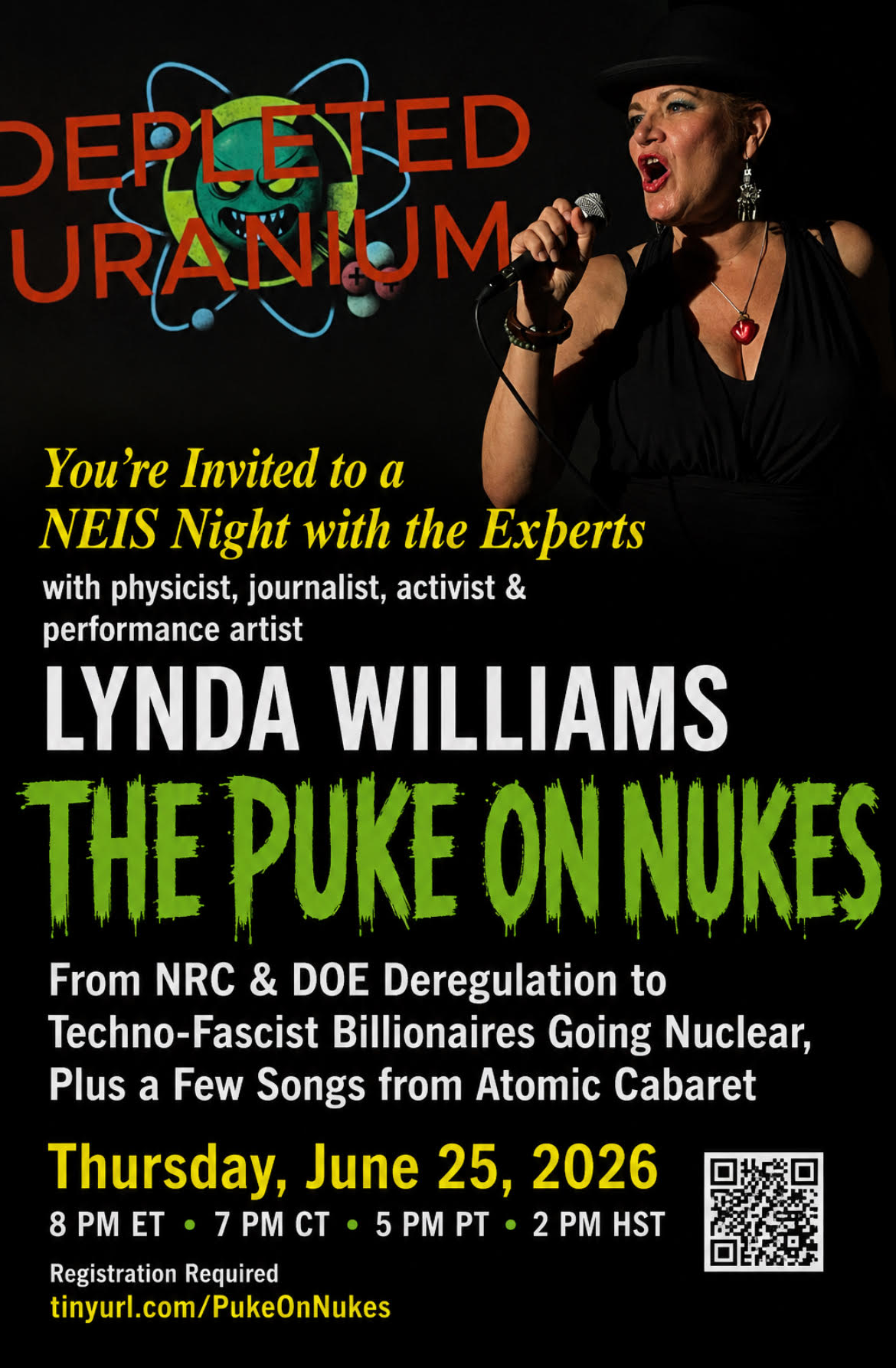
25 June- THE PUKE ON NUKES
Thursday, June 25, 2026
7pm Central Time (8pm ET, 6pm MT, 5pm PT) UTC – 5
From NRC & DOE Deregulation to Techno-Fascist Billionaires Going Nuclear, Plus a Few Songs from Atomic Cabaret REGISTER
26 June – Radiation Trainwreck at the NRC / Join the Protect Better Campaign – https://us02web.zoom.us/meeting/register/4ZlZ5_qLSHGiLSCg8FF6Bg#/registration


Cuba Is Not a Failed State – It Is a Besieged State
PETITION: “Global Appeal to Endorse Palestinian Right of Return of Refugees”
To see nuclear-related stories in greater depth and intensity – go to https://nuclearinformation.wordpress.com
-
Archives
- June 2026 (129)
- May 2026 (306)
- April 2026 (356)
- March 2026 (251)
- February 2026 (268)
- January 2026 (308)
- December 2025 (358)
- November 2025 (359)
- October 2025 (376)
- September 2025 (257)
- August 2025 (319)
- July 2025 (230)
-
Categories
- 1
- 1 NUCLEAR ISSUES
- business and costs
- climate change
- culture and arts
- ENERGY
- environment
- health
- history
- indigenous issues
- Legal
- marketing of nuclear
- media
- opposition to nuclear
- PERSONAL STORIES
- politics
- politics international
- Religion and ethics
- safety
- secrets,lies and civil liberties
- spinbuster
- technology
- Uranium
- wastes
- weapons and war
- Women
- 2 WORLD
- ACTION
- AFRICA
- Atrocities
- AUSTRALIA
- Christina's notes
- Christina's themes
- culture and arts
- Events
- Fuk 2022
- Fuk 2023
- Fukushima 2017
- Fukushima 2018
- fukushima 2019
- Fukushima 2020
- Fukushima 2021
- general
- global warming
- Humour (God we need it)
- Nuclear
- RARE EARTHS
- Reference
- resources – print
- Resources -audiovicual
- Weekly Newsletter
- World
- World Nuclear
- YouTube
-
RSS
Entries RSS
Comments RSS
 nuclear-news