Concrete melted off ‘pedestal’ for damaged reactor in Fukushima
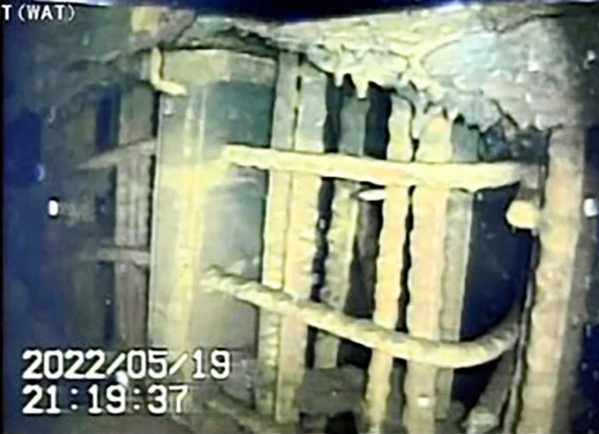
Rebars in the pedestal, which are normally covered with concrete, are seen exposed inside the No. 1 reactor at the Fukushima No. 1 nuclear power plant. (Provided by the International Research Institute for Nuclear Decommissioning and Hitachi-GE Nuclear Energy Ltd.)
November 30, 2022
The concrete support foundation for a reactor whose core melted down at the Fukushima No. 1 nuclear power plant has deteriorated so much that reinforcing bars (rebars) are now exposed.
Masao Uchibori, governor of Fukushima Prefecture, has expressed concerns about the earthquake resistance of the “pedestal” for the No. 1 reactor at the crippled plant operated by Tokyo Electric Power Co. (TEPCO).
Strong quakes struck off the coast of the prefecture in 2021 and 2022.
“There have been events that caused anxieties among residents of our prefecture, including damage to the foundation supporting the No. 1 reactor’s pressure vessel,” Uchibori told a prefectural assembly session in September. “We will check up on TEPCO’s efforts so the decommissioning work will proceed safely and steadily.”
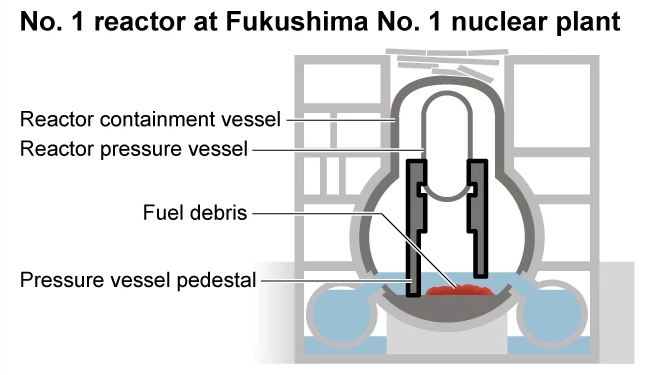
The cylindrical pedestal, whose wall is 1.2 meters thick, is 6 meters in diameter. It supports the reactor’s 440-ton pressure vessel.
The interior of the No. 1 reactor’s containment vessel was inspected in May for TEPCO’s eventual plans to retrieve the melted nuclear fuel that dropped to the bottom of the vessel during the 2011 nuclear disaster.
The study found that the normally concrete-encased rebars were bare and the upper parts were covered in sediment that could be nuclear fuel debris.
The concrete likely melted off under the high temperature of the debris.
The International Research Institute for Nuclear Decommissioning (IRID), an entity set up by power utilities and nuclear reactor manufacturers, conducted a simulation in fiscal 2016.
IRID said seismic resistance would remain uncompromised even if about one-quarter of the pedestal was damaged.
However, only a part of the pedestal was inspected during the May study, and only from the outside.
The pedestal’s inside remains a mystery.
“The pedestal’s soundness is of foremost concern,” said Kiyoshi Takasaka, a former engineer with Toshiba Corp. who is now an adviser to the Fukushima prefectural government on nuclear safety issues. “It is important to first inspect the pedestal from the inside.”
TEPCO has prepared six types of robots to detect the fuel debris and perform other tasks in a series of inspections at the No. 1 reactor.
An internal study of the pedestal is planned toward the March end of the fiscal year as the final mission during the inspections. The task carries the risk of the robot hitting the sediment or other obstacles and being unable to return.
“We understand people’s concerns very well,” Akira Ono, president of TEPCO’s Fukushima Daiichi Decontamination & Decommissioning Engineering Co., told a news conference in October. “We hope to finish studies inside the pedestal by the end of this fiscal year.”
He said his company will scrutinize whether the previous assessment of seismic resistance is still applicable.

Haruo Morishige, who has been studying the Fukushima nuclear disaster, called for immediate emergency safety measures, such infusing concrete to reinforce the pedestal.
“There is a critical defect in terms of quake resistance,” said Morishige, based on a photo showing the interior of the No. 1 reactor.
Morishige studied aseismic structural design for nuclear reactors when he worked for Mitsubishi Heavy Industries Ltd.
He also served as an on-site manager for the No. 3 reactor at the Ikata nuclear plant operated by Shikoku Electric Power Co., including when the reactor was being built.
The photo, released following the May inspection, shows how concrete covering the cylindrical “inner skirt” of the pedestal had melted off, laying bare part of the steel frame and rebars from the bottom to the top.
The inner skirt’s functions connect the reactor pressure vessel with the containment vessel. But the melting of the concrete has separated the pressure vessel from the containment vessel, and weakened the structure’s quake resistance, Morishige said.
The loss of concrete has also decoupled the pedetal’s walls from the floor, making it more prone to sway during seismic events, he added.
Morishige said that all concrete around the rebars inside the pedestal has likely melted away.
He also said fuel debris that flowed out from an aperture likely melted concrete around rebars over about a quarter of the outside circumference of the pedestal.
His simulation has shown that the support capability of the pedestal is now about three-eighths of the original level.
“In such a state, the reactor could topple over in an earthquake of upper 6 on the Japanese seismic intensity scale (of 7),” Morishige said.
He added that repeated exposure to seismic shocks could cause cracks in the remaining concrete, further undermining quake resistance.
“The very fact there are chances of the reactor toppling is unacceptable,” he said. “Officials should proceed with safety measures and inspections at the same time.”
(This article was written by Keitaro Fukuchi and Tetsuya Kasai.)
Ministry’s action plan drops nuclear policies set after 3/11
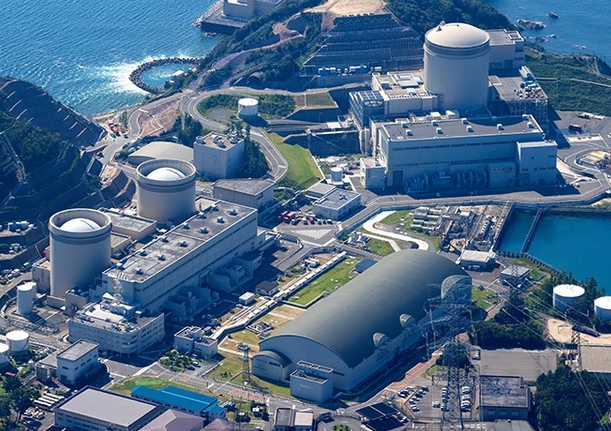
Local officials want new reactors to replace the two retired units at the front of Kansai Electric Power Co.’s Mihama nuclear plant in Fukui Prefecture.
November 29, 2022
The industry ministry proposed building new nuclear reactors to replace retired ones and effectively extending their operating lives beyond 60 years, a reversal of policies set after the 2011 Fukushima nuclear disaster.
The proposals were presented to the ministry’s advisory council, the Nuclear Energy Subcommittee, at a meeting on Nov. 28 as a draft action plan for the Kishida administration’s slogan to “make maximum use of nuclear energy.”
Although many subcommittee members endorsed the proposals, some members said not enough time was spent on discussing such a major change in energy policy.
Prime Minister Fumio Kishida in August issued a directive to a special government panel tasked with decarbonizing Japan to review the current nuclear energy policy.
The government has maintained that “for now,” it does not expect construction of new nuclear plants or a replacement of any reactor.
Because of opposition expected from local governments, the plan also did not propose building nuclear plants in areas that have never hosted such facilities or adding new reactors to existing plants.
But under the action plan, the Ministry of Economy, Trade and Industry states that construction of new reactors “will begin with those replacing retired ones,” giving utilities the green light to build reactors to take the place of those being decommissioned.
The ministry is also seeking “advanced light water reactors” as replacement units, expecting them to start operating in the 2030s. They will each come with an estimated price tag of at least 500 billion yen ($3.57 billion).
Such reactors have enhanced safety features and are an extension of current nuclear technologies, the ministry said.
The action plan also pushes for a system that will effectively extend the life cycle of reactors beyond the maximum of 60 years set under rules adopted after the 2011 triple meltdown.
It suggests that often lengthy periods when reactors are offline for examinations by the Nuclear Regulation Authority on whether they meet standards for restarts be excluded from the 60-year limit.
In addition, the time frame should not include periods when reactor operations are suspended because of lawsuits, the ministry said.
Under those proposals, a reactor that has been idle for 10 years for those reasons could operate for up to 70 years since it first went into service.
The proposed exclusions from the 60-year limit have been criticized as “taking the teeth from” the rigorous reactor regulations set in 2013.
One subcommittee member said the exclusions are “akin to ditching the lessons learned from the Fukushima accident.”
The action plan also called for a new system to provide grants to local governments that promote the use of recycled nuclear fuel at facilities in their jurisdictions.
This is meant to give some leverage to the nation’s trouble-plagued nuclear fuel cycle policy.
Although the action plan represents a sweeping policy change, it does not directly deal with a slew of challenges that have remained unsolved for decades.
For example, it is unclear when the nuclear fuel reprocessing plant under construction in Rokkasho, Aomori Prefecture, a key component in the nuclear fuel cycle program, will go into operations.
Under the program, plutonium retrieved from spent nuclear fuel from across Japan will be recycled as fuel for use at nuclear plants.
The completion date of the reprocessing plant has been pushed back 26 times so far. Around 14 trillion yen has been invested in the project.
Another big headache for the central government is securing a final disposal site for highly radioactive nuclear waste from nuclear power plants across the country.
Two small municipalities in Hokkaido have shown an interest in hosting such a storage facility in exchange for generous grants.
But the Hokkaido governor is opposed to the plan. And no other local governments in Japan have come forward as potential final disposal sites.
The ministry’s action plan did not list any specific proposals to resolve these issues. It merely said: “The state should bolster efforts to gain the understanding” of the public to the nuclear policy.
Plaintiffs claim that the wide-area evacuation plan is ineffective.

November 28, 2022
On November 28, a lawsuit filed by residents of the Onagawa Nuclear Power Plant seeking an injunction against the restart of the No. 2 reactor at Tohoku Electric Power Company’s Onagawa Nuclear Power Plant was concluded. The verdict will be handed down in May next year.
On the 28th, the plaintiffs made their final statements in oral arguments at the Sendai District Court. The plaintiffs again argued that the “wide-area evacuation plan” formulated by the prefectural government and others is ineffective because it does not include specific details about the inspection sites that would be set up along evacuation routes in the event of an accident to check residents’ radiation exposure, including the securing of personnel and materials and equipment.
Mr. Nobuo Hara, leader of the plaintiffs: “How ineffective is the wide-area evacuation plan?
Mr. Nobuo Hara, leader of the plaintiffs’ group: “We have shown how ineffective the wide-area evacuation plan is. The most realistic way to stop the restart of nuclear power plants is to obtain a ruling that nuclear power plants must not be restarted under the evacuation plan. It is the firm belief of the plaintiffs that such a ruling will be reached.”

The trial will conclude on May 28, and the verdict will be handed down on May 24 next year. Tohoku Electric Power aims to restart the Onagawa Unit 2 reactor in February 2024.

Japan studies plan to extend life of 60-year-old nuclear plants

Nov 28, 2022
Japan will consider keeping some nuclear reactors operating beyond a current 60-year limit as the country focuses increasingly on atomic power as a solution to an ongoing squeeze on energy supply.
Officials are studying a plan to exclude periods when reactors were offline from an existing limit on their lifespan, which would allow some facilities to operate for longer, according to a document released Monday by a trade ministry panel. Reactors are often halted for years to allow the nation’s nuclear watchdog to perform inspections, or as a result of legal challenges.
Following the 2011 Fukushima nuclear disaster, which was triggered by a massive earthquake and tsunami, Japan introduced stricter safety standards limiting the operation of nuclear reactors to 40 years in principle.
But operation for an additional 20 years is possible if safety upgrades are made and a reactor passes screening by regulators.
The proposal to allow operations beyond the 60-year limit comes as Japan’s public and government shift back in favor of nuclear power, despite experiencing one of the worst atomic meltdown disasters. The import-dependent country has this year grappled with more expensive fossil fuel prices as a result of Russia’s war in Ukraine, along with a weak yen, and seen its stretched power grid put under severe pressure.
The government has repeatedly asked people to take steps to limit their electricity consumption, by using fewer appliances or cutting back on heating.
In August, Prime Minister Fumio Kishida said the government will explore developing and constructing new reactors, and that it will also aim to restart seven more idled reactors from next summer.
The trade ministry proposals also call for new, next-generation nuclear reactors to be built at sites where existing units will be decommissioned.
Japanese manufacturers have announced plans to develop next-generation reactors this year. Mitsubishi Heavy Industries is jointly developing an advanced light water reactor with four other Japanese power producers, while a venture between Hitachi and General Electric is also reported to be developing a new reactor model.
https://www.japantimes.co.jp/news/2022/11/28/national/nuclear-plant-extension/
Evacuation of Iitate Village’s Nagadori District, Fukushima Prefecture, to be lifted in May.

November 21, 2022
Iitate Village, Fukushima Prefecture, has begun coordinating with the national government to lift the evacuation order for a specific restoration base area (restoration base) in the Nagadori administrative district, a hard-to-return zone following the TEPCO’s Fukushima Daiichi nuclear power plant accident, by the major holidays in May of next year. The government plans to lift the evacuation order for a part of the area outside the restoration center as a park area to check the reduction of radiation levels in the air at the same time as the area inside the restoration center. This is the first time that the government has announced the lifting of evacuation orders for areas outside of the restoration centers in the difficult-to-return zones established by the nuclear accident.
On March 20, after a briefing session for residents of the Nagadori area in Fukushima City, Village Mayor Makoto Sugioka made the announcement to the press. The village has been saying that it aims to lift the restrictions next spring. The village is expected to decide on a specific date after the final report by the village’s decontamination verification committee scheduled for January next year and after the end of March.
The difficult-to-return zone in the village covers approximately 1080 hectares, of which about 186 hectares are restoration sites. The village plans to construct a meeting place for short-term stays and exchanges, a multipurpose ground, and public restrooms.
According to the village, the park area covers about 0.64 hectares of land in the Kyakuta district. No playground equipment is planned. The village will continue to measure radiation levels to see how they decrease.
https://www.minpo.jp/news/moredetail/20221121102625?fbclid=IwAR39qL5sRkcgxB2AM316-9b4dN7hSEF3mMYfdlmfKMLHG4_5njXQagUlsAQ
Expert panel full of proponents of nuclear power plants to discuss direction on March 28th, extending operation period and developing next-generation models, rushing to conclusion on “Prime Minister’s directive.

Basic policy subcommittee discusses extending the operational period of nuclear power plants in Kasumigaseki, Tokyo.
November 27, 2022
The Ministry of Economy, Trade, and Industry (METI) will present its direction on measures to utilize nuclear power plants, including the extension of the operating period of nuclear power plants, which is stipulated as “40 years in principle, with a maximum of 60 years,” and the development and construction of next-generation nuclear power plants, at the “Nuclear Energy Subcommittee,” a meeting of experts on November 28. Discussions will reach their final stage about three months after Prime Minister Fumio Kishida ordered the committee to study the issue in August. However, the committee did not solicit opinions from the public before reaching a conclusion, and its deliberations were noticeably more hasty than past energy policy debates. (The discussion has been held in a very slow pace compared to past energy policy debates.)
◆Draft government policy at several subcommittee meetings
Of the 21 members of the Atomic Energy Subcommittee, which discusses nuclear energy policy, only two, including Hajime Matsukubo, executive director of the NPO Nuclear Data and Information Office, have made negative statements about nuclear power at recent meetings. In the discussion on extending the operating period, many committee members called for removing the maximum 60-year limit, and at the meeting on March 28, METI is expected to push for a proposal to exclude from the number of years of operation the period during which a nuclear power plant is shut down to undergo a review before it can be restarted, without removing the limit in consideration of public outcry.
The contents of the Nuclear Energy Subcommittee’s deliberations will be discussed by the Basic Policy Subcommittee, which brings together expert panels on energy policy, and the conclusions of the subcommittee will serve as a draft of the government policy.
At the meeting on March 15, Ms. Chisato Murakami, an advisor on consumer affairs, commented, “The use of nuclear power plants will not directly lead to an end to the tight power supply and demand situation. I would like to propose that we take time to deepen the national debate.” She objected to the way the discussion was proceeding, but no other opinions were expressed calling for a reconsideration.
The subcommittee has met twice so far. The committee is expected to hold one or two more meetings before the end of the year to reach a conclusion, after which public comments will be sought.
◆Energy Basic Plan to be discussed 17 times and opinions solicited via the Internet
The previous energy policy discussions were different.
In the discussion of the “Sixth Basic Energy Plan,” a medium- to long-term guideline for energy policy formulated last October, subcommittee meetings were held 17 times over a period of 10 months. In addition, an opinion box was set up on the website during the discussions in order to listen to the opinions of the public at large. The opinions received were submitted as materials to each of the subcommittee meetings for consideration. In total, about 640 opinions were collected, with about 300 calling for a nuclear power phase-out, while about 80 supported the promotion of nuclear power.
At that time, members of the subcommittee expressed the opinion that extending the operational period of nuclear power plants and building new plants were necessary to realize a decarbonized society by 2050, but this was not explicitly stated in the basic plan. The policy of “reducing dependence on nuclear power plants as much as possible,” which came to be stated after the Fukushima accident, was also maintained.
◆Ministry of Economy, Trade, and Industry (METI) official: “The directive to reach a conclusion by the end of the year cannot take too much time.
The government has been stressing the use of nuclear power plants against the backdrop of the recent tight power supply and demand and soaring fuel prices. However, the development of next-generation nuclear power plants, for example, will take a long time and will not be a quick fix, so there is no need to reach a hasty conclusion. Even after Murakami pointed out this contradiction at the subcommittee meeting, a METI official told the interviewer, “We cannot take too much time because [Prime Minister Kishida] has instructed us to reach a conclusion by the end of the year. We will come up with a direction as soon as possible.
Mr. Matsukubo commented, “This is a heavy-handed way of proceeding, not listening to the public and having the Council of Eminent Persons decide what the government wants to do. The government’s policy of making nuclear power a given may narrow the scope for the introduction of renewable energies in the future.
https://www.tokyo-np.co.jp/article/216285?fbclid=IwAR1q4FkmUf5IMHwP2VfT5TG3LA6wvwN1V1CU7vRueWSFSkMq6upQHAuxkG4
Tohoku Electric Applies for 32.94% Increase in Electricity Rates for Households, Effective Next April

President Higuchi announces application to raise electricity rates for households.
November 24, 2022
On November 24, Tohoku Electric Power applied to the government for a 32.94% average increase in regulated electricity rates for households. This is the first time since February 2013 that the company has applied for a price increase to revise basic rates and electricity unit prices. The increase is the third largest in history. The free electricity rates for households, which do not require government approval, will also be raised by an average of 7.69%, both of which are scheduled to go into effect on April 1 next year. This is the first time that a major electric power company has applied for a price hike due to soaring fuel costs caused by Russia’s invasion of Ukraine and other factors.
At a press conference held in Sendai City on April 24, President Kojiro Higuchi said, “The current electricity revenues will not be sufficient to cover fixed costs, and if this situation continues, we will not be able to procure fuel stably or invest sufficiently in power facilities. We are deeply sorry that we are applying for a large price increase, but we hope you will understand.
The regulated rates will increase both the basic rate and the unit price of electricity. The amount of electricity used is divided into three levels, and the more electricity is used, the larger the increase. In the case of the model case (contract type: “metered electric light B,” contract current: 30 amperes, electricity consumption: 260 kWh), the monthly fee will increase by 2,717 yen to 11,282 yen.
The total cost of fuel, labor, and other costs calculated for the application averaged 2.1636 trillion yen over the 23-25 year period, an increase of 1.4 times the 1.5067 trillion yen from 13-15, the basis for the current rate setting. Rising fuel costs and the cost of procuring electricity through markets and other means account for most of this increase.
The restart of Onagawa Nuclear Power Plant Unit 2 (Onagawa Town, Miyagi Prefecture, and Ishinomaki City), scheduled for February 2012, was also factored into the cost calculation. The plant will be able to reduce the amount of fuel it buys, which will lead to an annual cost reduction of about 100 billion yen, and Higuchi said that the price increase will be curbed by about 5%.
In order to compress the price increase, the plan also included 115.9 billion yen in management efficiency improvements. In addition to the initiatives already undertaken, such as more efficient fuel procurement, the company will reduce the number of employees by curtailing new hiring and extend the periodic inspection cycle of thermal power plants.
The METI’s expert panel will review the application. In Tohoku Electric’s previous application, the actual price increase was reduced after discussions on whether the calculation of the total cost was appropriate.
The average increase in free rates for households is smaller than the regulated rates because the system was changed in December to reflect fuel price fluctuations without a cap, based on the fuel cost adjustment system.
President Higuchi’s Painful Decision to Ensure a Stable Supply
The following is a question-and-answer session with Tohoku Electric Power President Kojiro Higuchi, who announced the application for an increase in electricity rates for households.
-The increase will place a heavy burden on households.
With not only electricity rates but also prices rising, it is distressing to see the increase. I hope you understand that this is a difficult decision to make in order to ensure a stable supply of electricity.
-How do you plan to improve management efficiency?
We will reduce repair costs by extending the inspection cycle for thermal power plants and reduce fuel costs by reducing spot procurement as much as possible. In terms of personnel reduction, we will consider consolidating our sales offices.
We have already reduced executive compensation by up to 20% linked to performance and voluntarily returned up to 10% of corporate rates.
-Other major electric power companies are also planning to apply for price increases.
The biggest difference between us and other companies is the two earthquakes that occurred off the coast of Fukushima Prefecture last year and this year. (The biggest difference between us and other companies is the two earthquakes off the coast of Fukushima Prefecture last year and this year, which knocked out power (from several thermal power plants) and increased the cost of restoration.
-The deregulation of the electric power industry was supposed to lower electricity prices through competition.
However, the unexpected rise in fuel costs, such as this one, cannot be absorbed through friendly competition among power providers. Tohoku Electric is expensive, but new power companies are not cheap, and we believe that we are now in a state of emergency.
https://kahoku.news/articles/20221124khn000028.html?fbclid=IwAR2eR9Xvf8z8dHCRnRuz1G-1YCLcMlSnk2HTMs6rZzN8vy5eRV-ATnDwbOE
Environmentalists devoted to reveal nuclear contamination in Fukushima
A team of elderly Japanese environmentalists has been devoted to revealing the real environmental conditions of Fukushima after the nuclear incident in 2011. The team, with all members over 60 years old, volunteered to have a routine check for nuclear radiation in Fukushima. Masami Aoki, 77 and a former media worker, is one of the persons in charge of the team founded in 2012. Over the past 10 years, Aoki has worked with his team to examine nuclear radiation levels near the Fukushima Daiichi Nuclear Power Plant, including Futaba Machi and Minamisoma.
A group of journalists from HT investigates the impact of Fukushima’s controversial plan to dump water into the ocean

24 Nov, 2022
MADRID, Nov. 25, 2022 /PRNewswire/ — While the Japanese Primer Minister has described the measure as “totally safe and unavoidable”, member countries of the Indian Ocean Rim Association (ORA), official institutions, non-governmental organizations, environmental associations such as Greenpece, experts and professors in atomic energy, as well as doctors and researchers specialized in diseases related to uncontrolled exposure to atomic substances, denounce this measure as irresponsible, and do not understand the silence of the IAEA (International Atomic Energy Agency) in this situation.
A group of international journalists led by Global Think Agency investigates and analyzes the impact of the controversial plan to discharge water from Fukushima into the sea. The Key findings are:
- The decision announced by the Japanese government in April 2021, announcing it as a “safe” project, the measure does not convince the scientific community, nor the experts in atomic energy, for all is “the cheapest option“.
- It is currently unknown how the long-lived radioactive isotopes contained in the contaminated water will interact with marine biology, this situation is “unprecedented”.
- An independent analysis of the report published by Japan’s Ministry of Economy, Trade and Industry (METI) Subcommittee shows that the company responsible for the Fukushima plant understood that additional storage of contaminated water beyond 2022 was possible, but it was ruled out because it would require “a substantial amount of coordination, time and financial resources.“
- Last October 30, and in view of the IAEA’s silence, a group of experts and professors in atomic energy, as well as doctors and researchers specialized in diseases related to uncontrolled exposure to atomic substances, submitted a letter to the Director General Mr. Rafael Mariano Grossi, requesting him to urge the Japanese authorities to halt this measure, without receiving any reply to date.
Shaun Burnie, senior nuclear specialist with Greenpeace, confirms “the lack of clarity and scientific inconsistencies” in the Fukushima nuclear power plant decommissioning project, considering it “fantasy” and that the discharge of contaminated and treated water into the ocean “does not solve the crisis and will generate an unpredictable environmental situation”.
Eleven years after the earthquake and tsunami that led to one of the worst nuclear accidents in history, Greenpeace is issuing a new wake-up call after reviewing multiple documents from different government agencies and industry.
Satoshi Sato, leader of the nuclear fusion and quantum energy neutron source design group in Rokkasho (Japan), says “decommissioning is not possible in 40 years”. There are many shadows and doubts and the Japanese government should clarify the progress that has been made so far.
It will have to “live with treated water for decades while a safe solution is found”, said the expert in relation to the discharge of treated water into the Pacific Ocean, a plan foreseen for 2023 and which the International Atomic Energy Agency (IAEA) recently evaluated during a mission to the country.
Shaun Burine and Satoshi Sato, agreed, telling us that the IAEA’s position in supporting the plans of the Japanese government and TEPCO (Tokyo Electric Power Company Holdings, Inc.) “does not make sense”. They went on to say that “the mission of this organization is to develop safety standards and maintain high levels of safety for the protection of human health and the environment against ionizing radiation. As well as to verify that States comply with their commitments.”
“TEPCO has no intention of decommissioning the Fukushima nuclear power plant in the next 20 to 30 years. It is a fantasy and a much longer process than we have been told“, said Burnie, who stressed the need to inform affected communities and the public in detail.
“The long-term consequences cannot be dismissed, because this transcends generations and this fact should be crucial in addressing the problem, not the official agenda of the actors involved“, Burnie criticized the roadmap approved by the Japanese government.
Tokyo Electric Power Co. is the world’s fourth-largest utility and the bastion of the nation’s nuclear power, from which Japan draws 30% of its electricity. Tepco serves a third of the population. The company that operates the nuclear power plant has contributed to the disaster with its management before and after the accident It falsified reviews, concealed information and delayed urgent measures
The company is contributing to the scandal, acknowledging that it has falsified safety reports, elevating fleeting inspections to exhaustive examinations. Tepco is also accused of irresponsibly delaying the cooling of the reactors with salt water because it was going to ruin them beyond repair.
The legacy of scandals in the sector in half a century has punished its credibility.
The Greenpeace organization recalls that the company’s negligence brought the former IAEA management to task on numerous occasions, its spokesman Hidehiko Nishiyama denounced on numerous occasions as “extremely regrettable” the errors in the measurements of radioactive water, apparently due to failures in the software used to carry out the measurements. “Tepco is facing a very serious situation and is failing to meet people’s expectations“, Nishiyama insisted, in the harshest criticism the company has ever received.
About HT
HT is a global agency specializing in developing documentary, research and entertainment content. The company boasts a team of experts from different fields such as production, creativity, and journalism, some have over 25 years of experience in major production companies in Spain.
Fukushima Daiichi Nuclear Power Plant Accident Survivors Urge Diet Members to Provide Adequate Relief in Light of Policy to Revise Compensation Standards

Plaintiffs appealed their plight as evacuees at a meeting held at the House of Councillors building in Nagata-cho, Tokyo, on March 24.
November 24, 2022
On November 24, the National Liaison Group of Plaintiffs in Lawsuits Against Nuclear Power Plants, consisting of victims of the TEPCO’s Fukushima Daiichi Nuclear Power Plant accident, held a meeting at the Diet to demand that the interim compensation standards established by the government’s Nuclear Damage Dispute Review Board be revised to provide adequate relief to the victims of the accident.
The plaintiffs, who are engaged in class-action lawsuits against the national government and TEPCO in various parts of Japan, submitted their requests to the offices of members of the Diet at both the House of Representatives and the House of Councillors.
The CALI decided to review the guidelines on the 10th of this month in response to a series of court decisions ordering TEPCO to pay more compensation than the interim guidelines. In addition to the review of the guidelines to match the actual damage, the request also called for the government to consider building new nuclear power plants and extending their operating periods, and to oppose the discharge into the ocean of water treated to purify contaminated water generated at the Fukushima Daiichi Nuclear Power Plant.
At the rally following the request, lawyer Guntaro Managi, who serves as the secretary general of the legal team for the Fukushima lawsuit, criticized the government’s response, saying, “The review of the guidelines is too little too late. Hiroshi Murata, 79, an evacuee from Minamisoma City, Fukushima Prefecture, who has been living in Yokohama, said, “The guidelines were created immediately after the accident, and it was not assumed that the evacuation would last this long. The guidelines were created immediately after the accident and were not based on the assumption that evacuees would have to live for such a long time. They should be revised in their entirety, not just partially. (Kenta Onozawa)
https://www.tokyo-np.co.jp/article/215953?fbclid=IwAR3Ur_jQqDli869rwXoAJspCvxE1W7BFpeTaI_VE4RRqMiOqcN-ZCZFAq60
Safety first must be priority for Fukushima water: China Daily editorial

2022-11-23
Since the Japanese government announced its highly controversial plan to release massive amounts of radioactive water from the wrecked Fukushima nuclear plant into the Pacific Ocean in April last year, it has met with opposition and condemnation, not only from Japan’s neighbors, China and the Republic of Korea, but also from Japanese society, residents in Fukushima and the country’s fishery industry in particular.
Although the Japanese government says that apart from tritium, which cannot be removed from the water, all other radionuclides will have been reduced to safe amounts after treatment, it is not known what the environmental consequences will be after it is discharged into the sea.
Marine experts have raised concerns over traces of ruthenium, cobalt, strontium and plutonium isotopes in the wastewater.
The Pacific Ocean does not belong to Japan. It is an ocean shared by dozens of countries and regions. By discharging the water into the ocean, the Japanese government shows little regard for the health and well-being of its own people and those in neighboring countries. As such, the International Atomic Energy Agency, as the world’s nuclear watchdog, should put public health first and do its utmost to see to it that Japan fully complies with all the relevant nuclear safety standards.
The IAEA set up a task force last year to review the safety of Japan’s discharge plan, comprising a group of IAEA specialists and external experts from 11 countries. The task force conducted a field trip to the Fukushima Daiichi Nuclear Power Station last week, and reviewed the updated technical plans for the water discharge by Tokyo Electric Power Company and the equipment and facilities to be used for the discharge. The IAEA said a report of the mission will be made available within three months, and a comprehensive assessment on the safety of the discharge will be issued prior to the planned release in 2023.
Both China and the ROK have urged the agency to strictly adhere to all safety standards in its assessment of the plan.
Chinese Foreign Ministry spokeswoman Mao Ning said on Monday that China hopes the task force will ensure the “absolute safety” of the treatment.
And the Foreign Ministry of the ROK also struck the same tune on Tuesday, stressing that the discharge of the contaminated water should meet objective scientific standards.
Needless to say, Japan should coordinate closely and transparently with the task force so as to ensure the IAEA clearly grasps the whole picture.
China’s support of the IAEA task force’s work should not be interpreted as an approval of Japan’s decision to discharge the contaminated water. It needs to be pointed out that the task force has not evaluated the alternatives to ocean discharge, leaving the IAEA unable to conduct a comprehensive evaluation and find the best way to dispose of nuclear-contaminated water. China still maintains that instead of pushing forward with its discharge plan, Japan should find a safer way to treat the contaminated water.
https://www.chinadaily.com.cn/a/202211/23/WS637e2ecaa31049175432b7ec.html
China supports IAEA review of Fukushima treatment
“Just because China supports the task force’s work does not mean it approves of Japan’s decision to discharge the contaminated water, Mao also said, urging Japan to find an appropriate way to treat the contaminated water, instead of pushing forward with its discharge plan.”

2022-11-21
China supports the International Atomic Energy Agency and its task force in reviewing Japan’s treatment of nuclear contaminated water, and hopes the task force will strictly implement the IAEA’s nuclear safety standards and ensure the “absolute safety” of the treatment, Foreign Ministry spokeswoman Mao Ning said.
Mao made the remarks at a daily news conference on Monday after the task force carried out a new mission last week to review Japan’s plan to discharge treated nuclear-contaminated water from the Fukushima Daiichi Nuclear Power Station.
The IAEA said a report of the mission will be made available within three months.
In response, Mao said a time limit should be avoided to ensure the quality and credibility of the report, and Japan should coordinate closely with the task force.
The IAEA didn’t review other plans of treating contaminated water than discharging it to sea, thus failing to make a full assessment and find the best treatment plan, Mao pointed out.
Just because China supports the task force’s work does not mean it approves of Japan’s decision to discharge the contaminated water, Mao also said, urging Japan to find an appropriate way to treat the contaminated water, instead of pushing forward with its discharge plan.
https://global.chinadaily.com.cn/a/202211/21/WS637b7603a31049175432b07c.html
JNFL’s application for examination of a nuclear fuel reprocessing plant was criticized by the Regulatory Commission for “lacking a sense of urgency”

JNFL Senior Managing Executive Officer Rei Sudo (left) and others explain at the Nuclear Regulation Authority’s review meeting in Minato-ku, Tokyo.
November 22, 2022
JNFL found multiple errors in the seismic calculation results of the application it submitted to the Nuclear Regulation Authority during the examination required for the operation of its reprocessing plant for spent nuclear fuel from nuclear power plants in Rokkasho Village, Aomori Prefecture. The errors were discovered when the Nuclear Regulation Commission pointed them out to JNFL. Even two years after the application was submitted, NNFL continues to reveal its inadequacies, and there is no prospect that the review will be completed.
The errors were in the results of seismic calculations for the cooling tower fire detectors, which NNFL submitted on November 8 in the form of an amendment to its application. According to NNFL, when the results of the seismic calculations were transcribed into the application, incorrect values were entered in several places. Although the documents were checked before submission, the mistake was not noticed. The cause of the error has not been disclosed, saying that it is under investigation. The correction will be corrected and resubmitted in the future.
According to the secretariat of the regulatory commission, the error in the calculation results was so simple that a person with expert knowledge would be able to recognize it at a glance.
At the review meeting held on March 15, the person in charge at the secretariat of the regulatory commission commented, “In the review of facility design, making a mistake in numerical values is a definite and serious problem,” and “It is the most rudimentary of rudiments. Why don’t they notice it? Why don’t they realize this? They have no sense of crisis at all. Rei Sudo, executive vice president of Nenryo, who is in charge of handling the review, simply stated, “This is something that really shouldn’t happen. We take this very seriously.
The reprocessing plant, a core facility under the government’s nuclear fuel cycle policy, met the new regulatory standards for basic accident countermeasures in July 2020, and in December of the same year, JNFL applied for a review of detailed facility designs and construction plans. However, there has been no significant progress since the application stage due to inadequate explanations from NNFL.
In September of this year, NNFL announced for the 26th time that it was postponing the completion of the plant due to the difficulties encountered in the review process. The company plans to announce the next target date for completion by the end of this year, but the examination process will inevitably become even more difficult due to the discovery of numerical errors. (Kenta Onozawa)
https://www.tokyo-np.co.jp/article/215291?fbclid=IwAR3axQXraZ9FR1wgBWFW97VsXYaz7LEtnmRwhAa8f6fSsxczwS8WNBpIdY4
Iitate will be 1st to lift evacuation order without decontamination

Akihiko Morota, deputy director-general of the government’s Nuclear Emergency Response Headquarters, explains the status of the difficult-to-return zone to Iitate village residents at a briefing in Fukushima city on Nov. 20.
November 21, 2022
FUKUSHIMA–Iitate village near the Fukushima No. 1 nuclear power plant plans to lift an evacuation order next spring for a small portion of the “difficult-to-return zone” so it can reclaim space for a park.
This marks the first time an evacuation order will be lifted without first carrying out decontamination work since the government made it easier to lift evacuation orders in 2020.
The order was originally issued due to high levels of radiation detected following the triple meltdown at the plant triggered by the 2011 earthquake and tsunami.
Iitate Mayor Makoto Sugioka and the central government’s Nuclear Emergency Response Headquarters made the announcement at a news conference following a briefing for residents in Fukushima city on Nov. 20.
Residents of Iitate in eastern Fukushima Prefecture had initially opposed lifting the evacuation order without first decontaminating the area, but the mayor said they were persuaded.
“We were able to obtain their consent at the briefing,” Sugioka said.
The area where the order will be lifted without any decontamination work is small. It spans just 0.64 hectares and includes only one household.
Workers will set up shields on the ground there to prevent exposure to radiation.
But the government has confirmed that even without the shielding, the radiation level is below the standard for issuing an evacuation order, at 20 millisieverts per year. The village plans to use this area as a park.
The government designated areas with readings of more than 50 millisieverts a year as difficult-to-return zones.
Iitate has a difficult-to-return zone measuring 1,080 hectares in total, according to the village and the central government.
Within this area, officials have designated a 186-hectare special zone for reconstruction and revitalization, which covers 63 households. That land will be decontaminated by removing topsoil contaminated with radioactive materials.
But there is no prospect for lifting the order for the remaining land outside the special zone, which covers 10 households.
In December 2020, the government created new criteria for lifting an evacuation order for land outside the special zone, where radiation levels are below the standard due to natural attenuation. Those conditions include a request from the local government and confirmation that no one will live there.
Among eight municipalities that have such special zones, this will be the first time that an evacuation order will be lifted outside the zone. No municipalities other than Iitate are seeking a lifting of the evacuation order under the new criteria.
Fukushima Iitate Village Lifting of Evacuation Order for “Out of Base Area” First indication of timing

November 20, 2022
The national government and Iitate Village in Fukushima Prefecture have announced that they will lift the evacuation order for a part of the Nagadori area, which has been designated as a “difficult-to-return zone” due to the accident at the TEPCO’s Fukushima Daiichi Nuclear Power Plant, around the major holidays in spring next year under the so-called “lifting of evacuation order without decontamination.
This is the first time that a specific date for lifting the evacuation order for areas outside of the “base area” has been announced.
In the Nagadori area of Iitate Village, which is a hard-to-return zone where entry is severely restricted, 17% of the area has been designated as a “specific restoration and rehabilitation base zone” where decontamination and other measures will be carried out first, with the aim of lifting the evacuation order in the spring of next year.
On April 20, the central government and Iitate Village held a press conference after holding a briefing session for local residents in Fukushima City to discuss the possibility of lifting the evacuation order in the spring of next year under the framework of “lifting the evacuation order without decontamination,” which allows the lifting of the evacuation order even if the government has not decontaminated the land, provided that the local government has strong intentions to use the land and the radiation level is lowered and the residents do not return. The government has announced that it plans to lift the evacuation order for a part of the area outside the “base area” around the major holidays in the spring of next year.
The area to be removed is a 6,400-square-meter plot of land where a government demonstration experiment to block radiation by pouring concrete on the ground was being conducted, and it represents 0.07% of the area outside the “base area” in the village.
Since it has been confirmed that radiation levels have been sufficiently reduced, the government will allow people to freely enter the area to see the results of this demonstration project.
This is the first time that a specific date for the lifting of the evacuation order for “outside the base area” has been announced.
In conjunction with this, the policy of lifting all evacuation orders for the base area in the village was also announced.
Iitate Village Mayor Makoto Sugioka said, “We would like to consider using the site as a place where we can confirm the effects of the radiation dose reduction demonstration project and a place where we can pass on to future generations what has been done in the difficult-to-return zone and Nagadori area.
https://www3.nhk.or.jp/news/html/20221120/k10013897961000.html?fbclid=IwAR3mZj8YTUnBARRCJV-KqrxSGzF9OP-jVrRRRv2GY1kcSpDWnrIF0boiiNg
1 This Month

Petition to revoke the licensing of the Near Surface Nuclear Disposal Facility (NSDF) at Chalk River. https://www.ourcommons.ca/petitions/en/Petition/Details?Petition=e-7247


of the week – STOP SMALL MODULAR REACTORS IN CANADA
To see nuclear-related stories in greater depth and intensity – go to https://nuclearinformation.wordpress.com
-
Archives
- March 2026 (153)
- February 2026 (268)
- January 2026 (308)
- December 2025 (358)
- November 2025 (359)
- October 2025 (376)
- September 2025 (258)
- August 2025 (319)
- July 2025 (230)
- June 2025 (348)
- May 2025 (261)
- April 2025 (305)
-
Categories
- 1
- 1 NUCLEAR ISSUES
- business and costs
- climate change
- culture and arts
- ENERGY
- environment
- health
- history
- indigenous issues
- Legal
- marketing of nuclear
- media
- opposition to nuclear
- PERSONAL STORIES
- politics
- politics international
- Religion and ethics
- safety
- secrets,lies and civil liberties
- spinbuster
- technology
- Uranium
- wastes
- weapons and war
- Women
- 2 WORLD
- ACTION
- AFRICA
- Atrocities
- AUSTRALIA
- Christina's notes
- Christina's themes
- culture and arts
- Events
- Fuk 2022
- Fuk 2023
- Fukushima 2017
- Fukushima 2018
- fukushima 2019
- Fukushima 2020
- Fukushima 2021
- general
- global warming
- Humour (God we need it)
- Nuclear
- RARE EARTHS
- Reference
- resources – print
- Resources -audiovicual
- Weekly Newsletter
- World
- World Nuclear
- YouTube
-
RSS
Entries RSS
Comments RSS
 nuclear-news