Documentary – “Atomic Secrets”

Dmitry Kalmykov is a Ukrainian scientist who has dedicated his life to eliminating environmental disasters, first at Chornobyl and now in Semipalatinsk, in Kazakhstan – formerly the Soviet Union’s primary nuclear weapons testing site. He teaches schoolchildren about how bombs were tested, and how – more than 30 years after the site was decommissioned – the community is only really beginning to understand radiation’s powerfully harmful effects. Against the backdrop of war in Ukraine and the long shadow of a nuclear conflict across the region, Dmitry debates Kazakhstan’s nuclear future with its next generation
UPENN REPORT: TARIFFS LIKELY NAIL IN COFFIN OF U.S. SMALL NUCLEAR REACTORS.

Small Modular Reactors (SMRs) are a “false promise” for powering
proposed artificial intelligence (AI) data centers nationwide, according to
a new report published today by the University of Pennsylvania’s (UPenn), Dr. Joseph Romm, a former Acting Assistant Secretary of Energy.
The research report, “Smaller nuclear reactors (SMRs) are a costly dead end,
especially for AI, and Trump’s tariffs and other policies make them even
more of a losing bet,” is an expanded version of a chapter in Dr.
Romm’s new book, “The Hype About Hydrogen: False Promises and Real
Solutions in the Race to Save the Climate” (Island Press, April 22).
The report examines recent economic developments, including the over-budget $35
billion completion of Georgia’s Vogtle plant, current and canceled SMR
proposals, and how Trump’s tariffs (and other policies) threaten the
nuclear industry. The study concludes that these factors will ultimately
doom the likelihood of new American commercial nuclear reactors playing
much of a role in meeting U.S. electricity demand needs for the foreseeable
future.
“It would be unprecedented in the history of energy for smaller
nuclear reactors to overcome not only the high cost per megawatt of large
nuclear plants but also the diseconomies of shrinking them down—and then
to somehow keep dropping in price so sharply that SMRs become such clear
marketplace winners as to make a major contribution to cutting greenhouse
gas emissions by 2050. This is especially true since SMRs show every sign
of the kind of cost escalation that has plagued larger nuclear reactors for
decades,” according to the report.
Hastings Group 15th April 2025,
https://hastingsgroupmedia.com/SMF/041525-Romm-SMR-Dead-End-Report-news-release.pdf
Germany: One exit and back? The role of nuclear power in the Merz coalition.
April 14, 2025, by Joachim Wille Note, abbreviation, background, and translation – Dieter Kaufmann, Working Group Against Nuclear Facilities, Frankfurt am Main, Germany
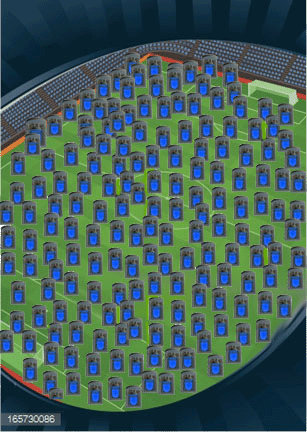
“SMRs will hardly be able to produce electricity more cheaply than conventional new nuclear power plants, unless thousands of them are mass-produced, which is not at all foreseeable.”
Although desired by some members of the Merz coalition, there will be no comeback for nuclear power plants. Joachim Wille philosophizes about the reasons.
Berlin – For a while, it looked as if the future Merz coalition would reverse the shutdown of the most recently shut-down nuclear power plants. The CDU/CSU, by far the largest partner, pushed for reversing the phase-out. The paper from the grand coalition’s “Energy and Climate” exploratory group stated – colored in the CDU/CSU blue – the CDU/CSU’s wish: “Nuclear energy can play a significant role, particularly with regard to climate goals and security of supply.”
Union backtracks on nuclear power: Coalition agreement seals Germany’s nuclear phase-out
But the coalition agreement recently presented by Merz and his colleagues no longer mentions any of this. This is an unmistakable signal: Germany is sticking to its nuclear phase-out, which was initiated in 2011 by CDU Chancellor Angela Merkel after the Fukushima disaster.
And this despite the fact that the public image of nuclear power has turned positive. The last three nuclear power plants in Germany were shut down two years ago. Today, however, according to a survey, a narrow majority of Germans (55 percent) support a return to nuclear energy, while 36 percent oppose it.
In politics, the CDU/CSU could have seen its pro-nuclear stance vindicated. It wanted to investigate whether the recently shut-down reactors could still be reactivated, and possibly even build new mini-reactors, as well as invest more money in the promising future of nuclear fusion. In the current representative Verivox survey, almost a third of respondents (32 percent) favor building new nuclear power plants, while another 22 percent would like to see only the most recently decommissioned plants brought back online.
After the Fukushima disaster: The Bundestag in Berlin voted in 2011 to shut down nuclear power plants
The phase-out of nuclear power, which at its peak provided around a third of the electricity consumed in Germany, was finally sealed by the Fukushima nuclear power plant disaster. In 2011, the Bundestag passed a cross-party resolution to gradually shut down the 17 nuclear power plants still in operation at the time.
After the reactor meltdowns in Japan, which rendered an entire region uninhabitable, there was a consensus: the “residual risk” of even Western nuclear technology is too great, and a phase-out is necessary. Ultimately, safety calculations showed that even with nuclear power plants made in Germany, serious accidents with radioactive contamination of large areas in the surrounding area, including entire cities, could not be ruled out.
Polls at the time showed high levels of support for the decision pushed forward by Merkel. The physicist’s legendary utterance when she saw the explosions at the Fukushima nuclear power plants on TV was legendary: “That’s it.”
Note: In 2011 polls, over 80 percent of the German population wanted to shut down all nuclear power plants after Fukushima
After the end of the Merkel era: The Union included plans for a return to nuclear power in coalition negotiations
After the end of the Merkel era, the remaining nuclear fans in the Union felt they had the upper hand again. It also looked as if they had a good chance of prevailing in the negotiations with the SPD. In particular, their demand for an “assessment of whether … a resumption of operation of the most recently shut-down nuclear power plants is still possible at a reasonable technical and financial cost,” as stated in the energy policymakers’ paper, seemed to have a good chance of success.
But there is no mention of this in the coalition agreement. Only fusion research plays a role here. “Our goal is: The world’s first fusion reactor should be located in Germany,” it states. However, the time perspective here is two or more decades. So, have Klingbeil’s Social Democrats, who have been pushing for a phase-out since the Chernobyl disaster in 1986, prevailed with their course against the CDU/CSU’s nuclear fans?
The energy industry doubts the CDU/CSU’s plan to reactivate nuclear power plants.
The most recent election platform clearly stated: “Nuclear power has been shut down in Germany, and that’s a good thing.” The anti-nuclear NGO “ausgestrahlt” sees it this way, accusing the SPD of having “burst the Union’s nuclear soap bubbles.” In fact, it’s at least as likely that the Union leaders realistically assessed the problems of the nuclear power renaissance. The dismantling of the nuclear power plants is already well advanced, and restarting them would be extremely expensive and very time-consuming due to the need for new permits.
A return to nuclear power is hardly possible: Nuclear power plant operators have closed their chapter.
In addition, the three current nuclear power plant operators, EnBW, PreussenElektra, and RWE, have practically closed the chapter on nuclear power. None of them would voluntarily take the entrepreneurial risk of reversing the decommissioning process. Before the start of the grand coalition negotiations, the line was clear. EnBW’s nuclear power chief Jörg Michels said: “The decommissioning status of our five nuclear power plants is, in practical terms, irreversible.”
PreussenElektra stated that it was not “engaged in such thought experiments.” RWE CEO Markus Krebber stated: “We are past the point in this country where we should bring decommissioned nuclear power plants back online.”
Estimates by the nuclear power plant service provider Nukem show how expensive the restart would have been. He estimates the cost of repairing the six reactors shut down between 2021 and 2023 at one to three billion euros per nuclear power plant, depending on how far the decommissioning has progressed. This would therefore involve a sum of ten billion euros or more, which would likely have had to come from the federal budget in Berlin.
Nukem CEO Thomas Seipolt told bild.de that he sees “a realistic possibility of a comeback for nuclear power” by 2030 and is therefore making a corresponding offer to the future German government. For his company, which specializes in the decommissioning of nuclear power plants and the management of nuclear waste, such a renaissance of nuclear power would have been extremely lucrative. But the fact remains: Despite the federal government’s €500 billion special fund for infrastructure and climate protection, such a massive cash injection for the nuclear power plant operators would have been virtually impossible to implement.
Further arguments against nuclear power: Green electricity now dominates the electricity market
But other arguments may have slowed the nuclear renaissance. “A return to nuclear power doesn’t fit in a market increasingly dominated by green electricity,” said Christoph Pistner, nuclear power expert at the Öko-Institut, to the Frankfurter Rundschau newspaper. The share of renewables in the grid is growing rapidly; currently, it’s already 60 percent, and according to current plans, it’s expected to reach around 80 percent by 2030 and even 100 percent by 2035.
The same applies, by the way, to the mini-nuclear power plants (Small Nuclear Reactors) proposed by the CDU/CSU, which, according to Pistner’s estimates, could not be ready for series production and built until the mid-2030s at the earliest. And: “As things stand today, SMRs will hardly be able to produce electricity more cheaply than conventional new nuclear power plants, unless thousands of them are mass-produced, which is not at all foreseeable.”
And then Pistner recalled a politically critical aspect: “A return to nuclear energy has the potential to jeopardize the search for a final storage site in Germany.” The search for a final storage site was restarted after the Fukushima nuclear phase-out, which eliminated the previously hotly contested Gorleben site, which proved to be geologically unsuitable. A Gorleben 2.0 would probably be the last thing the Merz grand coalition needs – https://www.fr.de/politik/warum-sich-die-neue-koalition-gegen-eine-atom-rueckkehr-entschied-93684231.html Groko (Grand Coalition) is an abbreviation for grand coalition.
Background: Nuclear phase-out in Germany
The first phase-out of nuclear energy in Germany took place in 2000. As early as 2006, it was clear that the conservative parties (CDU/CSU), also known as the Union, wanted to return to nuclear energy with a new government change in 2009. This happened in 2010. But then Fukushima happened in 2011, and Chancellor Merkel withdrew from nuclear energy after just a few months. The resolution was supported by all parties in the federal parliament in Berlin that the last nuclear power plants would be shut down on December 31, 2022. We would have preferred to phase out nuclear power sooner.
All social groups have prepared for the nuclear phase-out. Then Russia, Putin’s country, invaded Ukraine in February 2022 for the second time since 2014. Natural gas and oil became very expensive. Electricity prices also rose. In addition, half of all nuclear power plants in France were shut down in the winter of 2022/2023 for various reasons. The Union then wanted to re-enter nuclear energy. But it was too late. Nuclear power plant operators in Germany were annoyed. Planning security looks different. Nuclear power plants are not kettles that can be switched on and off.
An agreement was reached with the nuclear power plant operators, and the remaining three nuclear power plants were extended until April 15, 2023, as long as the nuclear fuel still allowed. Certain fuel elements were converted once again in the core area of the three nuclear power plants. Then it was over.
Peace camp protestors hand in letter to US airbase commanders at Lakenheath

14th April 2025, https://www.nuclearpolicy.info/news/peace-camp-protestors-hand-in-letter-to-us-airbase-commanders-at-lakenheath/
On this the first day of a two-week Peace Camp hosted by the Lakenheath Alliance for Peace, a delegation from LAP will hand in a letter to commanders of the US airbase at Lakenheath.
The Peace Camp will comprise various themed days, including Democracy Day on 22 April, for which the NFLA Secretary has produced a bespoke briefing paper for peace activists wishing to engage with Councillors on the issue of nuclear disarmament. As a partner in LAP, the UK/Ireland NFLAs have endorsed the letter.
The letter reads:
14th April 2025
Peace camp protestors hand in letter to US airbase commanders at Lakenheath
On this the first day of a two-week Peace Camp hosted by the Lakenheath Alliance for Peace, a delegation from LAP will hand in a letter to commanders of the US airbase at Lakenheath.
The Peace Camp will comprise various themed days, including Democracy Day on 22 April, for which the NFLA Secretary has produced a bespoke briefing paper for peace activists wishing to engage with Councillors on the issue of nuclear disarmament. As a partner in LAP, the UK/Ireland NFLAs have endorsed the letter.
The letter reads:
Dear Base Commanders and all personnel of ‘RAF’/USAF Lakenheath,
Lakenheath Alliance for Peace (now consisting of around 60 Alliance Organisations) are writing to you once more. This is our 5th letter[1] to you and we politely ask that you please reply to us.
As you will know from our previous communications and protests over the last year, we are concerned at the blatant disregard of international humanitarian law by the preparation to use US guided nuclear bombs. Just one could kill hundreds of thousands of people and cause lasting devastation to our environment. We are also horrified and ashamed that you have been training Israeli pilots who are engaged in a genocide in Gaza and have also, along with USAF Mildenhall, been aiding and abetting that genocide.
We are engaged in a 2-week nonviolent presence at your base in order to show that your war mongering is not being done in our name.
Many people living close to US military bases in Europe, Japan and South Korea (to mention just a few) are extremely concerned that you operate outside the rule of law and in the interests of controlling scarce resources for yourselves, not for purely self-defensive reasons and certainly not in the interests of the general public in our countries.
The informed public understand that the existential threats facing us are escalating climate change, biodiversity loss and nuclear annihilation. Your activities at Lakenheath are exacerbating all these threats and putting us all in danger. They are a breach of our peace and are in breach of national and international laws.
Yours in peace,
Lakenheath Alliance for Peace, info@lakenheathallianceforpeace.org.uk
CND Cymru has highlighted the continued lack of investment in communities and people, while billions is to be spent subsidising the nuclear industry.
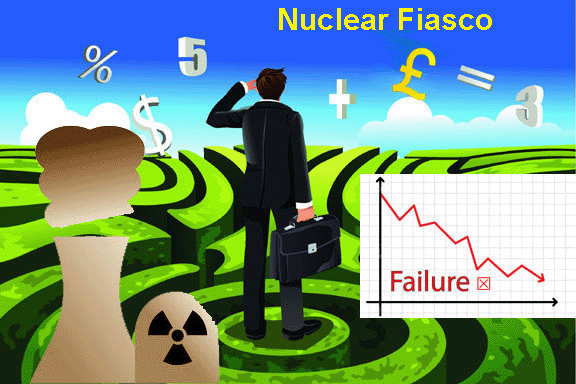
Following reports that the Westminster government is doubling down on
Nuclear Power, including a potential further investment in Sizewell C and a
raft of new Small Modular Reactors (SMRs), CND Cymru has highlighted the
continued lack of investment in communities and people, while billions is
to be spent subsidising the nuclear industry.
Keir Starmer seems poised to announce renewed public subsidy in Hinkley Point C, not set to open till 2031, and support for a further reactor at Sizewell C, costing billions in
taxpayer money. Coupled with a renewed focus on pushing through SMR
proposals, also likely subsidised by the taxpayer, Starmer may be set to
hand over £10 billion to the nuclear industry at a time when austerity is
looming over everyone.
Citing the potential for growth, Starmer is banking
on moderate gains by corporations in order to save a stagnating economy
that would benefit more from investment in community and green projects.
A CND Cymru spokesperson said “The willingness of the government to fund
the nuclear industry to the tune of billions while preaching austerity to
everyone else is absolutely farcical. We have seen the winter fuel payment
means tested, an attack on disability and other welfare systems, and a
refocus away from people towards profit. This government is functionally
taking money from the pockets of working class people and handing it to
corporations in the nuclear and warfare industry in order to chase a
mythical idea of growth – all while suppressing the true wealth creators in
this country.
A different, greener, fairer, future is possible which
doesn’t leave future generations with nuclear waste – and the government
has time to refocus and adjust their plans in order to build that future.
We must not accept the subsidy of the nuclear industry – all meant to prop
up a failing industry in order to preserve our nuclear attack capabilities
– while working people are facing impossible choices or sometimes not even
having the luxury of choice – starving and freezing – while the CEOs and
shareholders rake in the cash. Something has to change – and it is in the
government’s power to change it if they wish; because austerity, the death
of thousands, and the attack on millions, is a political choice, not
economic necessity.”
CND Cymru 14th April 2025
Lawsuit on Nuclear Regulation
Nuclear Start-up Valar Atomics is suing the US Nuclear Regulatory
Commission (NRC), claiming in essence that the NRC doesn’t have the right
to regulate small reactors, and instead the states should have oversight.
Let’s skip over for a moment what a nightmare it would be to have 50
different regulators to deal with just for one country. Their claim —
that small reactors are not capable of accidents posing public health and
safety concerns — is dangerous baloney. It seems after decades of
fighting rampant radiophobia from anti-nuclear activists and scared
normies, the pro-nuclear community must now also contend with a new
problem: nukebros who have become too cavalier about radiation.
Elemental 15th April 2025
A picture paints a thousand words: Shocking aerial images of Sizewell C devastation

14th April 2025
Stop Sizewell C has published shocking aerial photographs of the environmental devastation meted out by developers at the Sizewell C site despite the still-uncertain provenance of the project. These photographs were taken by an anonymous source. We are grateful to the photographer who has kindly made them free of license for open use.
Links to these images can be found at:
X – https://x.com/StopSizewellC/status/1909602544680153277
LinkedIn – https://www.linkedin.com/feed/update/urn:li:activity:7315368916342497280
BlueSky – https://bsky.app/profile/stopsizewellc.bsky.social/post/3lmcmbwflj22r
Instagram – https://www.instagram.com/p/DIMBBwiMNEh/?utm_source=ig_web_copy_link
CND Cymru condemns billions for nuclear industry
Morning Star 15th April 2025
https://morningstaronline.co.uk/article/cnd-cymru-condemns-billions-nuclear-industry
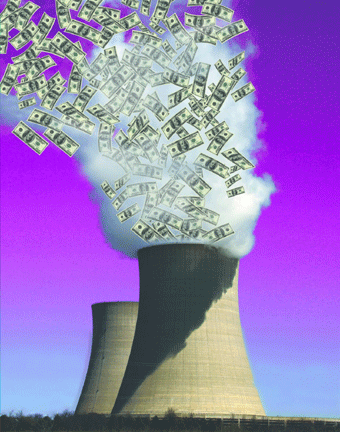
CAMPAIGNERS have condemned the billions being poured into nuclear energy while the Westminster government “preaches austerity” for everybody else.
CND Cymru attacked Sir Keir Starmer today, claiming he was poised to announce more public subsidy for the Hinkley Point C nuclear power plant in Somerset, not due to open until 2031.
A CND Cymru spokesperson said: “The willingness of the government to fund the nuclear industry to the tune of billions while preaching austerity to everyone else is absolutely farcical.
The anti-nuclear campaigners said Hinkley Point is likely to cost over £40 billion, £14bn over the initial estimate, with CND pointing out the project was managed by French company EDF.
“We must not accept the subsidy of a failing industry in order to preserve our nuclear attack capabilities while working people are facing impossible choices,” the CND spokesperson said.
“A different, greener, fairer, future is possible which doesn’t leave future generations with nuclear waste.”
U.S. advances microreactor program for military sites
Nuclear Newswire, Apr 15, 2025,
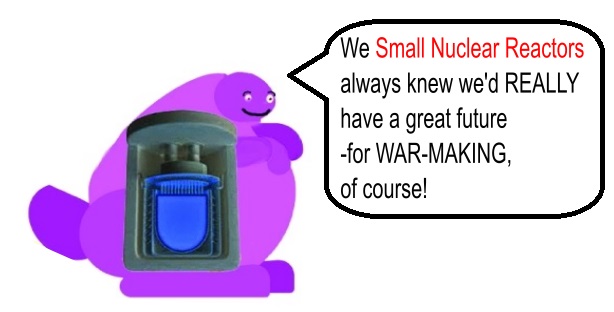
The Defense Innovation Unit announced April 10 next steps in the Advanced Nuclear Power for Installations (ANPI) program, launched in 2024 to deploy microreactor nuclear systems for increased power reliability at select military locations.
The ANPI program is a collaboration between DIU, which is under the Department of Defense, and the Departments of the Army and the Air Force, with the goals of working to design, license, build, and operate one or more microreactor nuclear power plants for the armed forces………………..
The DIU released the names of eight companies eligible to receive Other Transaction awards to provide commercially available dual use microreactor technology at various DOD installations:
- Antares Nuclear
- BWXT Advanced Technologies
- General Atomics Electromagnetic Systems
- Kairos Power
- Oklo
- Radiant Industries Incorporated
- Westinghouse Government Services
- X-energy
“Projecting power abroad demands ensuring power at home and this program aims to deliver that, ensuring that our defense leaders can remain focused on lethality,” ………………………………………………………………… https://www.ans.org/news/2025-04-14/article-6931/us-advances-microreactor-program-for-military-sites/
Donald Trump flounders about on the Ukraine situation
17 Apr 25 https://theaimn.net/donald-trump-flounders-about-on-the-ukraine-situation/
Trump’s previous presidency resulted in huge job losses, a massive increase in the national debt, and global uncertainty about economics. Still, the stock market went up, and the very wealthy got wealthier. His purpose then was perhaps to enrich himself and his rich mates. Apart from that, it all looked like incompetence. If the job of President is to preserve the security and well-being of the nation, his administration was floundering about.
So – no real surprise that this is now happening again.
And what better example of the flounder is there than Trump’s dithering about over the Ukraine war?
As far as the Ukraine war goes, Trump’s big advantage over his predecessor Joe Biden, is that he is willing to negotiate at all. But Donald Trump’s concept of “negotiation”really needs to be examined. He is inordinately and mistakenly proud of his “art of the deal”. But when we observe his actual behaviour, it’s more like a form of childish bullying, than any real method of negotiation.
Major tenets of negotiation, as explained by Herb Chen, to achieve a win-win situation, are to prepare well with information on the situation, seek out and understand the other side’s needs, respect the other side and establish trust.
To start with. Donald Trump aims to win, i.e to defeat the other side. Is Donald Trump even capable of going for a win-win situation? He is quoted as saying “My whole life is about winning” – though I could not find the source. https://www.youtube.com/shorts/YPg9sBtuMJw
So already it appears that Trump’s goal in negotiating is to get what he wants, in a bulldozing manner. And what he wants now is for USA business interests to win in Ukraine, rather than an acceptable peace agreement between Ukraine and Russia.
As to “preparing well with information on the situation”, Trump seems to have understood some of the critical facts – for example, that Putin will not tolerate Ukraine becoming a member of NATO, that Zelensky depends on USA military backing. But the more complex picture concerning the national borders, and the industries in the region seems to be beyond him. And this starts to matter when questions arise about the ownership of rare earths resources. This is a complicated story, but industry experts and economists warn that for the USA to gain control of Ukraine’s mineral resources is not likely to be a success, either commercially or geopolitically.
But Trump’s focus in the negotiations is on American business taking over Ukraine’s minerals. https://www.youtube.com/watch?v=Ya9WKaveRXU
The “deal” that Trump is pursuing also involves that very thorny question – which nation will own and control the Zaporizhzhia nuclear station. I have previously written about this. But suffice to say that the ownership of this particular NPP is a very fraught matter. All three nations, Ukraine, Russia, and USA, seem to want to take on this huge responsibility – massive out-of-action nuclear reactors, all very dangerous and lacking a dependable supply of cooling water.
So, squabbles over industrial resources, and nuclear facilities would be predictable to anyone who bothered to prepare for negotiations on ending the war in Ukraine.
Seeking out and understanding the other side’s needs? Has Donald Trump any concept of this? He might appreciate strongman Putin’s need to look tough and insistent on tough conditions – but Trump does not take account of Russia’s need for to have sanctions on it ended, nor to have Ukrainian troops gone from Russia’s Kursk region, nor to prrevent a pause that enables Ukraine to build up weapons. Trump doesn’t take any interest in the complex needs of the Ukrainian side either, – with many in the Donbass area especially desperate for the war to end.
Respecting the other side and establishing trust? Trump’s manner shows that he doesn’t even respect his own side – as evidenced by his recent rudeness to Ukraine’s President Zelensky. About the other side – he’s said that he’s “pissed off” with Putin, and has threatened to impose secondary tariffs on countries that buy from Russia. He has broadcast his anger with Putin, – but added that “the anger dissipates quickly … if [Putin] does the right thing”.
So much for Trump’s promise about quickly ending the carnage in Ukraine. Almost three months after he took office, Trump has achieved nothing. Thousands of soldiers and civilians continue to be injured or die each month.
Without going into the nightmare of the Trump tariffs situation, the economic effect of the current Trump administration is starting to look very like the economic effect of his previous one. Unless the purpose of it is solely the enrichment of Trump and billionaires, the whole operation looks like being massively incompetent. And, sadly, the Ukrainian people are prime victims of this incompetence.
On Ukraine war and Israeli Gaza genocide, Trump playing Dr. Jekyll Mr. Hyde.

Walt Zlotow, West Suburban Peace Coalition, Glen Ellyn IL, 16April 25
We in the peace community welcome any leader who seeks peaceful resolution to ongoing wars. That is why we welcomed Trump’s break with predecessor Biden’s senseless war with Russia in Ukraine.
Trump wisely campaigned to end the war and swiftly started negotiations to do that upon returning to power. Astonishing as Biden not only prosecuted the war endlessly for his last 29 months, he refused to even recognize the existence of Russian leaders much less communicate with them.
Trump quickly sidelined Biden’s war puppet Zelensky who stupidly believed the BS Biden fed him that Ukraine could prevail with endless US weapons but not one drop of US blood.
Negotiating peace will be daunting since Trump has no cards to play in achieving any semblance of Biden’s unrealistic war objectives. But he can shift the onslaught of blame that will erupt from the US war party where it rightly belongs…on Joe Biden.
Concerning Ukraine, Trump is channeling the wise and kindly Dr. Jekyll. But when it comes to Israel’s genocidal ethnic cleansing of Palestinians in Gaza, Trump’s ingesting some bad medicine which turns him into the murderous Mr. Hyde.
He’s ecstatic over the prospect of a colossal Trump real estate development to expand Greater Israel into Gaza after 2,300,000 Palestinians (less the hundred thousand already expired) are dead and gone. To that end he’s keeping the genocide weapons train rolling along, winking ‘A OK’ to Israel’s cutting off of all food, water, medicine, and electricity prodding Palestinians to leave ‘voluntarily’.
Then, instead of arresting indicted war criminal Netanyahu when he visited the Oval Office, Trump bragged about how they’re working furiously in tandem to find nearby countries to absorb the displaced Palestinians so the Trump Gaza project can commence.
All things considered, we in the peace community prefer Trump’s Ukraine Dr. Jekyll to his Israeli genocide Mr. Hyde.
Zelensky started the war then begged for missiles – Trump

Ed COMMENT. Unsurprisingly, Donald Trump again plays fast and loose with the truth. In fact Zelensky did not start Russia’s wholescale invasion of Ukraine. Putin did.
However, there’s more than a grain of truth in Trump’s claim. Zelensky deceived the Ukrainian public by pledging to support the autonomy of the Donbass regions, and end the Ukraine government’s 8 year war against them. Once elected, he reneged on this .
14 Apr, 2025 , https://www.rt.com/news/615756-zelensky-started-war-trump/
The Ukrainian leader has recently renewed his call for Washington to supply air defense systems
Ukraine’s Vladimir Zelensky should never have started a war with Russia, US President Donald Trump has said.
In a press conference alongside El Salvador’s President Nayib Bukele in the Oval Office on Monday, Trump commented on Zelensky’s recent offer to finance $15 billion worth of Patriot air defense batteries with the aid of Kiev’s European backers.
“He’s always looking to purchase missiles,” the US presided noted.
“When you start a war, you got to know that you can win the war,” he said of Zelensky. “You don’t start a war against somebody that’s 20 times your size and then hope that people give you some missiles.”
Trump added that he gave Kiev American-made Javelin man-portable anti-tank missiles during his first presidency.
In an interview with CBS News on Sunday, Zelensky called on the US to supply Ukraine with more air defenses. Kiev is ready to buy or lease up to ten Patriot air defense systems, and some European backers have offered to help with the money, he claimed.
During the interview, the network suggested that Trump tried to cut Kiev out of peace talks with Russia, and that he lied in his statements about the conflict. Trump allegedly “rewrote history, saying, falsely, that Ukraine had started the war and calling… Zelensky ‘a dictator without elections’,” according to CBS.
The US president lashed out at the news network on Truth Social on Monday, calling the interview inaccurate and fraudulent.
Trump has repeatedly claimed that the Ukraine conflict would never have escalated had he been in the White House, rather than his predecessor Joe Biden.
According to the US president, the previous administration invested more than $300 billion into supporting Kiev. Trump has promised to “get back” the money, entering talks with Ukraine about jointly exploiting its mineral resources. He also suggested taking over Ukrainian nuclear power plants.
The Kremlin has hailed the Trump administration’s peace efforts, but cautioned that resolving long-standing issues will take time and “painstaking work.”
Nuclear Energy Means Climate Action Delay: O’Donnell and Winfield

Susan O’Donnell and Mark Winfield, https://www.theenergymix.com/nuclear-energy-means-climate-action-delay-odonnell-and-winfield/ 16 Apr 25
What is the best way for utilities to delay the transition from fossil fuels? Propose to build nuclear reactors.
Electricity utilities wanting to “decarbonize” have several options for replacing the fossil fuel (coal, oil and gas) plants on their grids: aim to increase energy efficiency and productivity; add new renewable energy and storage resources; consider adding carbon capture and storage (CCS); or propose to build new nuclear reactors.
By objective measures, building new nuclear power plants will cost more, take longer to deploy, and introduce catastrophic accident risks—relative to improving energy productivity, expanding renewables with energy storage, and developing distributed energy resources. CCS suffers from limits of appropriate geology, reduced plant efficiency, and high costs.
However, if the goal is to keep fossil fuel-fired plants operating as long as possible, promising to build more nuclear energy has definite appeal.
Reactor design, planning, and build times are notoriously long—usually measured in decades—with well-established patterns of significant “unexpected” delays. Delaying while waiting for the promised new nuclear builds or reactor refurbishments maintains the status quo, effectively kicking actual climate action well down the road.
The two Canadian provinces with operating nuclear power reactors, Ontario and New Brunswick, provide case studies in this strategy. Both provinces are investing in significant new fossil gas generating infrastructure while waiting for new reactor designs to be developed and then built.
In Ontario, greenhouse gas emissions from the electricity sector have already risen dramatically as fossil gas plants are run to replace out-of-service nuclear reactors, and the province proposes to add more gas-fired generating capacity to its system. After a nearly decade-long hiatus, it only recently proposed a feeble reengagement with renewable energy. New nuclear reactor builds at Darlington, Bruce, and now Wesleyville, with timelines stretching well into the 2030s and 40s, remain the centrepiece of its energy (and supposed) climate strategy.
New Brunswick’s NB Power plans to add 600 MW of new nuclear power at its Point Lepreau nuclear site on the Bay of Fundy. Calls to build renewables instead have been rebuffed. In 2018, the province invited two nuclear start-up companies to set up in Saint John and apply for federal funding. Despite generous support from federal and provincial taxpayers, the companies have been unable to attract matching private funds. The NB Power CEO recently said she is “unsure” if the ARC-100, the reactor design promoted in 2018 as the closest to commercialization, will be ready by “the late 2030s.”
Meanwhile, the government recently announced support for building a large fossil gas plant, the biggest power project in the province in more than a decade.
The reality is that the new nuclear reactors being pushed by proponents are largely “PowerPoint reactors”—unproven and unbuilt designs. The BWRX-300 reactor that Ontario Power Generation (OPG) is proposing for its Darlington site, for example, lacks a fully-developed design, including key elements like safety systems. The Canadian Nuclear Safety Commission (CNSC) still gave OPG a licence to build it, while the U.S. Nuclear Regulatory Commission is still reviewing the design and asking for more information.
Recent analyses from the U.S. Tennessee Valley Authority also suggest the cost of the reactors will be far higher than OPG has claimed, and the timeline to construction and completion by 2030 seems less and less likely.
The new Monark design for a CANDU reactor that AtkinsRéalis (formerly SNC Lavalin) is proposing for the Bruce Power nuclear site is even further behind the BWRX-300 in development. According to the CNSC, the Monark is at a “familiarization and planning” stage, with no date set for even the first, preliminary stage of the design review.
The Monark’s main competitor is the AP-1000 reactor by Westinghouse. In 2002, the company submitted the AP-1000 design for formal review by the U.S. Nuclear Regulatory Commission. Two reactors came online in 2023 and 2024 at the Vogtle plant in Georgia, more than two decades later and twice the original timeline. Prior to the Vogtle project, the last reactor to come online in the U.S. took more than five decades from the start of construction to supplying power to the grid.
The final cost of the recent Vogtle project, at US$36.8 billion, was more than twice the original budget. If the same cost profile is applied to Ontario’s nuclear expansion projects, the total bill to Ontario electricity ratepayers and taxpayers could exceed $350 billion.
Promising to build more nuclear power is a political path to climate action delay and a distraction from a sustainable and decarbonized energy system transition. There is a reason why the International Energy Agency predicts that despite new nuclear reactor builds, nuclear energy will provide only eight percent of electricity supplies globally by 2050. In the meantime, while renewables development continues to accelerate globally, Canadian utilities, detoured by nuclear and CCS ambitions, double down on fossil gas and drift further and further behind in the global energy revolution.
Dr. Susan O’Donnell is adjunct research professor and lead investigator of the CEDAR project at St. Thomas University in Fredericton. Dr. Mark Winfield is a professor at the Faculty of Environmental and Urban Change at York University in Toronto, and co-chair of the faculty’s Sustainable Energy Initiative.
.
Flood warnings as Europe named as the fastest-warming continent in the world

Europe has been named the fastest-warming continent in the world in a
UN-led annual report. The UN-led European State of the Climate 2024, which
included contributions from about 100 scientists and experts, found that
last year was the warmest on record for the continent as countries were hit
by clear climate change impacts, extreme weather and record temperatures.
Released on Tuesday by the UN World Meteorological Organisation (WMO) and
the Copernicus Climate Change Service (C3S), the report details a year of
extremes.
Independent 15th April 2025, https://www.independent.co.uk/climate-change/flooding-spain-global-warming-un-report-b2733121.html
The climate crisis has tripled the length of ocean heatwaves, study finds.

The climate crisis has tripled the length of ocean heatwaves, a study has
found, supercharging deadly storms and destroying critical ecosystems such
as kelp forests and coral reefs. Half of the marine heatwaves since 2000
would not have happened without global heating, which is caused by burning
fossil fuels.
The heatwaves have not only become more frequent but also
more intense: 1C warmer on average, but much hotter in some places, the
scientists said. The research is the first comprehensive assessment of the
impact of the climate crisis on heatwaves in the world’s oceans, and it
reveals profound changes.
Hotter oceans also soak up fewer of the carbon
dioxide emissions that are driving temperatures up. “Here in the
Mediterranean, we have some marine heatwaves that are 5C hotter,” said Dr
Marta Marcos at the Mediterranean Institute for Advanced Studies in
Mallorca, Spain, who led the study. “It’s horrible when you go
swimming. It looks like soup.”
Guardian 14th April 2025, https://www.theguardian.com/environment/2025/apr/14/climate-crisis-has-tripled-length-of-deadly-ocean-heatwaves-study-finds
-
Archives
- October 2026 (104)
- September 2026 (339)
- August 2026 (330)
- July 2026 (355)
- June 2026 (287)
- May 2026 (306)
- April 2026 (356)
- March 2026 (251)
- February 2026 (267)
- January 2026 (308)
- December 2025 (358)
- November 2025 (359)
-
Categories
- 1
- 1 NUCLEAR ISSUES
- business and costs
- climate change
- culture and arts
- ENERGY
- environment
- health
- history
- indigenous issues
- Legal
- marketing of nuclear
- media
- opposition to nuclear
- PERSONAL STORIES
- politics
- politics international
- Religion and ethics
- safety
- secrets,lies and civil liberties
- spinbuster
- technology
- Uranium
- wastes
- weapons and war
- Women
- 2 WORLD
- ACTION
- AFRICA
- Atrocities
- AUSTRALIA
- Christina's notes
- Christina's themes
- culture and arts
- Events
- Fuk 2022
- Fuk 2023
- Fukushima 2017
- Fukushima 2018
- fukushima 2019
- Fukushima 2020
- Fukushima 2021
- general
- global warming
- Humour (God we need it)
- Nuclear
- RARE EARTHS
- Reference
- resources – print
- Resources -audiovicual
- Weekly Newsletter
- World
- World Nuclear
- YouTube
-
RSS
Entries RSS
Comments RSS

