Ukrainian-born US lawmaker says Ukraine should cede land to Russia, demand Zelensky’s resignation
by The Kyiv Independent news desk April 7, 2025
Ukrainian-born U.S. lawmaker Victoria Spartz has said Ukraine should cede land to Russia, and its people should demand the resignation of President Volodymyr Zelensky.
In an interview with the Telegraph published on April 7, Spartz said Ukraine is not in a position to demand the return of all occupied territories. “If they were winning the war, that would be very different,” she added.
Spartz was born in Chernihiv Oblast and moved to the U.S. in 2000. She was elected to Congress three times, in 2020, 2022, and 2024, and represents Indiana’s 5th District.
Spartz initially supported U.S. aid for Ukraine and has often spoken about the war in personal terms.
However, she has also criticized the Ukrainian government, particularly Zelensky and his chief of staff, Andriy Yermak.
Spartz, who has been a critic of both the Biden administration and the Ukrainian government, supported U.S. President Donald Trump’s call to negotiate with Russian President Vladimir Putin.
“There are no easy solutions,” she said, placing blame on former President Joe Biden for what she sees as failed support.
“President Trump inherited it, so now he has to deal with it.”………………..
On April 4, 2024, The Wall Street Journal reported that Spartz would not support a new $60 billion Ukraine aid bill. She articulated “a lack of clear strategy” and the need for better oversight.
Spartz also said she has “largely moved on from focusing heavily on Ukraine.” In October 2023, Spartz also backed fellow Republican Jim Jordan’s calls for more accountability in Ukraine funding………………..
“To win wars, you need to have leaders who know how to win, not to try not to lose and become oligarchs themselves,” she said. Spartz also claimed Zelensky “took control of all Ukrainian media, prosecuted churches, businesses and volunteers.”https://kyivindependent.com/uss-only-ukrainian-born-lawmaker-says-ukraine-should-cede-land-to-russia-demand-zelenskys-resignation/
Israel still eyeing a limited attack on Iran’s nuclear facilities.
AFR, Erin Banco, Apr 19, 2025
New York | Israel has not ruled out an attack on Iran’s nuclear facilities in the coming months despite President Donald Trump telling Israeli Prime Minister Benjamin Netanyahu that the US was, for now, unwilling to support such a move, according to an Israeli official and two other people familiar with the matter.
Israeli officials have vowed to prevent Tehran from acquiring a nuclear weapon and Netanyahu has insisted that any negotiation with Iran must lead to the complete dismantling of its nuclear program.
US and Iranian negotiators are set for a second round of preliminary nuclear talks in Rome on Saturday.
Over the past months, Israel has proposed to the Trump administration a series of options to attack Iran’s facilities, including some with late spring and summer timelines, the sources said. The plans include a mix of airstrikes and commando operations that vary in severity and could set back Tehran’s ability to weaponise its nuclear program by just months or a year or more, the sources said.
The New York Times reported on Wednesday that Trump told Netanyahu in a White House meeting earlier this month that Washington wanted to prioritise diplomatic talks with Tehran and that he was unwilling to support a strike on the country’s nuclear facilities in the short term.
But Israeli officials now believe that their military could instead launch a limited strike on Iran that would require less US support. Such an attack would be significantly smaller than those Israel initially proposed.
It is unclear if or when Israel would move forward with such a strike, especially with talks on a nuclear deal getting started. Such a move would likely alienate Trump and could risk broader US support for Israel.
Parts of the plans were previously presented last year to the Biden administration, two former senior Biden administration officials told Reuters. Almost all required significant US support via direct military intervention or intelligence sharing. Israel has also requested that Washington help Israel defend itself should Iran retaliate.
In response to a request for comment, the US National Security Council referred Reuters to comments Trump made on Thursday, when he told reporters he has not waved Israel off an attack but that he was not “in a rush” to support military action against Tehran…………………………………………..
While the more limited military strike Israel is considering would require less direct assistance – particularly in the form of US bombers dropping bunker-busting munitions that can reach deeply buried facilities – Israel would still need a promise from Washington that it would help Israel defend itself if attacked by Tehran in the aftermath, the sources said.
Any attack would carry risks. Military and nuclear experts say that even with massive firepower, a strike would probably only temporarily set back a program the West says aims to eventually produce a nuclear bomb, although Iran denies it.
Israeli officials have told Washington in recent weeks that they do not believe US talks with Iran should move forward to the deal-making stage without a guarantee that Tehran will not have the ability to create a nuclear weapon.
“This can be done by agreement, but only if this agreement is Libyan style: They go in, blow up the installations, dismantle all of the equipment, under American supervision,” Netanyahu said following his talks with Trump. “The second possibility is … that they [Iran] drag out the talks and then there is the military option.”
From Israel’s perspective, this may be a good moment for a strike against Iran’s nuclear facilities.
Iran allies Hamas in Gaza and Hezbollah in Lebanon have been hammered by Israel since the Gaza war began, while the Houthi movement in Yemen has been targeted by US airstrikes. Israel also severely damaged Iran’s air defence systems in an exchange of fire in October 2024.
A top Israeli official, speaking with reporters earlier this month, recognised there was some urgency if the goal was to launch a strike before Iran rebuilds its air defences. But the senior official refused to state any timeline for possible Israeli action and said discussing this would be “pointless”. https://www.afr.com/world/middle-east/israel-still-eyeing-a-limited-attack-on-iran-s-nuclear-facilities-20250419-p5lswv
DOE report: Cost to finish cleaning up Hanford site could exceed $589 billion
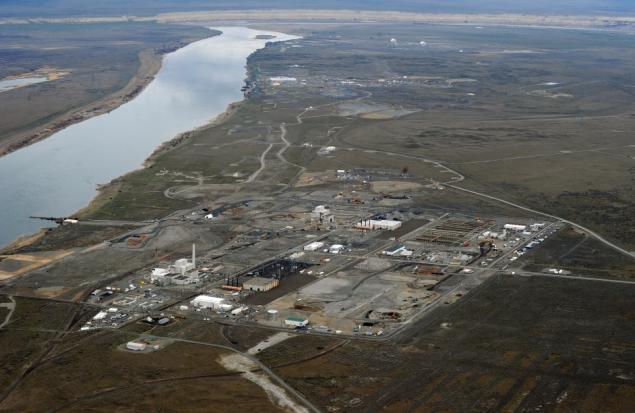
The cost to complete the cleanup of the Department of Energy’s Hanford Site in Washington state could cost as much as $589.4 billion, according to the 2025 Hanford Lifecycle Scope, Schedule, and Cost Report, which was released by the DOE on April 15. While that estimate is $44.2 billion lower than the DOE’s 2022 estimate of $640.6 billion, a separate, low-end estimate has since grown by more than 21 percent, to $364 billion.
The life cycle report, which the DOE is legally required to issue every three years under agreement with the U.S. Environmental Protection Agency and Washington State Department of Ecology (Ecology), summarizes the remaining work scope, schedule, and cost estimates for the nuclear site. For more than 40 years, Hanford’s reactors produced plutonium for America’s defense program.
The DOE’s cost estimates assume an active site cleanup schedule lasting until 2086, with long-term site stewardship until 2100. The DOE, however, said the federal government plans to have a presence at Hanford well beyond 2100.
The details: The report provides both a baseline (low-range) and a high-range cost estimate for completing the Hanford cleanup work. For this latest report, the DOE estimates a baseline cost of approximately $364 billion and a high-range cost estimate of approximately $589.4 billion. In 2022, the DOE reported an estimated cost range of $300.2 billion to $640.6 billion. The estimates include active cleanup, decommissioning, and remediation work, along with the final disposition of Hanford’s remaining reactors and long-term stewardship of the site.
According to the DOE, the cost range reflects the high degree of technical complexity and uncertainty associated with the large volume of work to be completed at the site, which includes the treatment and disposal of Hanford’s radioactive and chemical tank waste, Hanford’s largest liability. The estimates also include risk reduction work along with mission and site infrastructure costs.
According to the DOE, the high-range estimate reflects an 80 percent confidence level and is intended to ensure transparency among Hanford stakeholders of the inherent risks in achieving the agreed-upon cleanup goals.
While the Hanford life cycle report is not a decision-making document on the actions the DOE will take to meet its cleanup obligations, it does act as a foundation for preparing budget requests and for informational briefings with stakeholders. It also supports the DOE’s discussions with the EPA and Ecology on the progress it is making in cleaning up the site.
Feedback: The DOE is collecting public feedback on the report in writing until June 16. Received feedback will be considered when the department drafts its 2028 life cycle report.
Comments can be emailed to lifecyclereport@rl.gov (preferred) or mailed to:
Dana Gribble, Hanford Mission Integration Solutions
U.S. Department of Energy
P.O. Box 450, H5-20
Richland, WA 99354
Unprecedented number of B-2 bombers amassed for Iran strike
Ken Klippenstein, Apr 08, 2025
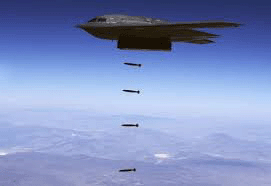
In the largest single deployment of stealth bombers in U.S. history, the Pentagon has sent six B-2 “Spirit” aircraft to Diego Garcia in the Indian Ocean.
The long-range bombers, which are uniquely suited to evade Iranian air defenses and can carry America’s most potent bunker busting weapons, flew in from Missouri last week in a little noticed operation.
The B-2s carry not just bombs, but a message for Iran: “do you see our sword?,” as one retired general told Newsmax this week.
President Donald Trump hasn’t been shy in threatening Iran, saying that if Tehran doesn’t close the door on a nuclear capability they will experience “bombing the likes of which they haven’t seen.”
“Hell” will “rain down” on the country, Trump has also said. Just today, amidst the stock market meltdown Trump again reiterated his threat, saying that “doing a deal would be preferable to doing the obvious” — which to the president is undertaking a massive strike.
Blatant as the threat is, the U.S. government has not otherwise publicly acknowledged the bomber buildup. Though B-2 bombers were used to carry out strikes on underground Houthi facilities in Yemen (both under the Biden and Trump administration), the forward deployment of the bombers to the island of Diego Garcia was only reported when commercial satellite images of the airbase there revealed the six on the runway.
“To my knowledge, this is the largest B-2 deployment to a forward location,” Hans Kristensen, director of the Nuclear Information Project at the Federation of American Scientists told me. Kristensen is the world’s leading tracker of nuclear comings and goings.
“All the bombers, they’re not in hangers, they’re underneath satellites where they can be photographed and seen; and the idea is, do you see our sword?” retired Air Force Brig. Gen. Blaine Holt, who served as Deputy U.S. Military Representative to NATO, said in an interview with Newsmax last week. Holt also said that the B-2 deployment “gives the president a military option that he can actually use these weapons against Iran if needed.”
This is a highly visible threat to Tehran, but at least one party isn’t supposed to notice: the American people.
The Pentagon refuses to acknowledge that the deployment is even happening. Trump’s new Pentagon Press Secretary Sean Parnell has only vaguely alluded to “other air assets” being deployed it has announced that two aircraft carriers will stay in the region, the result of a delay in sending one home after its current deployment.
According to Google Trends, searches for terms like “B-2” and “war with Iran” have only modestly increased, indicating that public curiosity has been suppressed despite Donald Trump’s many threats to attack his enemies.
Why B-2s?
The B-2 was first designed during the Cold War to penetrate deep into Russian territory for a nuclear attack. The aircraft’s stealth features (making it all but “invisible” to conventional radar) allow it to evade even the most sophisticated air defenses. Subsequent to its deployment, the bomber was modified so that it could take on unique conventional roles as well, especially in attacking underground facilities.
Though the U.S. has a variety of long-range fighters in the region — F-16s, F/A-18s, F-15Es, and F-35s — deployed on aircraft carriers and based in countries like Jordan and the UAE, the B-2s also allow the Trump administration to carry out unilateral strikes. That is, without the permission or involvement of any other Middle East countries. (Diego Garcia continues to be militarily controlled by the U.K.)……………………………………………………………………………………………https://www.kenklippenstein.com/p/pentagon-prepares-for-trump-to-go?utm_source=post-email-title&publication_id=7677&post_id=160827397&utm_campaign=email-post-title&isFreemail=true&r=191n6&triedRedirect=true&utm_medium=email
During Canada’s leaders’ debate, Carney praised a nuclear firm he bought while at Brookfield
Investment fund co-headed by Liberal leader acquired 51% of Westinghouse in 2023
Daniel Leblanc · CBC News ·Apr 17, 2025
During the first leaders’ debate on Wednesday, Liberal Leader Mark Carney praised nuclear energy and named two companies in the sector with which he did business during his tenure at Brookfield Asset Management.
In 2023, Brookfield formed a partnership with uranium mining firm Cameco to purchase the Westinghouse Electric Company. Brookfield Asset Management acquired 51 per cent of Westinghouse while Cameco got the rest, according to a news release.
The purchase was made within the Brookfield Global Transition Fund, an investment fund that was co-headed by Carney at the time. He was an executive at Brookfield Asset Management from 2020 until early 2025, when he entered politics and became leader of the Liberal Party and prime minister of Canada.
During Wednesday’s French-language leaders’ debate, Carney praised nuclear energy in response to a question from host Patrice Roy. In Canada, nuclear energy falls within the jurisdiction of the federal government, which invested hundreds of millions of dollars in the sector earlier this year.
“It’s a great opportunity,” responded Carney, adding it’s up to the provinces to decide whether or not to invest in nuclear power.
“We have a great advantage here in Canada. We have uranium, that’s one of the advantages. We have major nuclear companies including CANDU, Westinghouse and Cameco,” he said.
Carney then began talking about “small” modular reactor technology in which several firms including Westinghouse are active, but he was interrupted.
According to documents made public by Brookfield Asset Management, as of Dec. 31, Carney had stock options in the firm worth $6.8 million US.
Carney has repeatedly explained that he co-operated with the ethics commissioner when he entered politics to establish a blind trust to hold all of his assets except cash and his personal real estate holdings. In addition, Carney established anti-conflict of interest screens as prime minister to avoid intervening in matters affecting Brookfield.
Carney facing calls for more transparency
Political scientist Geneviève Tellier said she wonders whether some of Carney’s assets are still linked to his time at Brookfield, adding a clear answer should be provided before the federal election on April 28.
“To directly mention companies in a leaders’ debate, when he perhaps has interests in these companies or has benefited from these companies, I think that raises major ethical questions,” the University of Ottawa professor said.
“I understand the law does not require it, but morally and for the sake of transparency, we should have more information.”…………………………………
In a written statement issued Thursday, Conservative MP Michael Barrett criticized the Liberal leader’s failure to disclose whether or not he has an ongoing financial interest in Brookfield.
According to the Conservatives, Carney’s response during the debate was designed to “promote” nuclear energy and Westinghouse.
“If Westinghouse was to rake in billions of Canadian tax dollars, Mark Carney would almost certainly benefit financially,” Barrett said.
“[He] should come clean now and disclose all his assets and conflicts of interest before Canadians go to vote. If Carney has done nothing wrong and has nothing to hide, he should have no problem doing so.” https://www.cbc.ca/news/politics/during-leaders-debate-carney-praised-a-nuclear-firm-he-bought-while-at-brookfield-1.7513169
DOGE’s staff firing fiasco at the nuclear weapon agency means everything but efficiency
Bulletin, By Stephen Young | April 16, 2025
According to a recent press report, the Energy Department has identified 8,500 employees who are “nonessential” and therefore vulnerable to being laid off by Elon Musk’s chainsaw-welding wrecking crew known as the Department of Government Efficiency (DOGE). Of those 8,500 employees, 500 work in the National Nuclear Security Administration (NNSA), the agency responsible for maintaining the US nuclear weapons stockpile. This follows on from a chaotic period in February, when 177 NNSA employees were summarily fired by DOGE. Following a bipartisan uproar, DOGE reversed course, rehiring all but about 27 of the staff who had been laid off.
The media coverage of those forced-then-reversed departures was extensive, with the Washington Post and the New York Times each reporting later the details of the Trump administration operation. But all the coverage, including the latest news, misses two important aspects of this debacle.
Creating chaos in an agency responsible for the safety and security of nuclear weapons is already concerning; the early DOGE firing plan and any new layoffs are very inefficient ways to save taxpayers’ money. According to DOGE, the average salary of the Energy Department’s staff, including the NNSA, is $116,739. If the 500 “nonessential” employees are laid off and all those initially let go were not rehired, it would save approximately $79 million—or about one-third of a percent of the NNSA’s $25 billion budget.
More important, the United States could save tens to hundreds of billions of dollars if it had a sensible and sustainable nuclear modernization plan rather than one that seeks to replace every single weapon in the arsenal—and even create new ones. Such a plan would also have the benefit of removing fuel from the nuclear arms race that President Donald Trump himself has decried.
New security environment. Right now, the NNSA is in the middle of an unnecessary multi-billion-dollar effort to build new and expanded facilities that will produce plutonium pits for new nuclear weapons—the first being made since the end of the Cold War.
The push for new pits usually relies on two arguments—neither of which makes much sense even as they ignore the very high economic, environmental, and geopolitical risks of the path the United States is taking.
First, supporters of new nuclear weapons argue that, as plutonium pits age, they will stop working as expected. In the early 2000s, pit lifetime was estimated at 45 to 60 years. Given that pit production stopped in 1989, that estimate could be a cause for concern, if true. Fortunately, pit lifetime estimates were significantly updated in 2007, when JASON, the federal government’s independent science advisory committee, concluded that most plutonium pits “have credible minimum lifetimes in excess of 100 years as regards aging of plutonium” and that “those with assessed minimum lifetimes of 100 years or less have clear mitigation paths.”
In 2014, Congress passed legislation mandating pit production “driven by the requirement to hedge against technical and geopolitical risk and not solely by the needs of life extension programs.” The law called for demonstrating the capacity to make 80 pits per year by 2027. The “technical” risk highlighted appears tied to pit lifetime—an argument thoroughly refuted by JASON’s reassuring conclusions.
The geopolitical risk perception is more complicated………………………………………………………………………………………………….
DOGE’s arbitrary cuts in NNSA staffing were an ill-informed and very poor choice. The US government could save vastly more money by reconsidering the bloated defense programs that the NNSA is responsible for executing compared to the relatively insignificant savings from the haphazard elimination of staff critical for national security.
The NNSA firing debacle questions whether DOGE is serious about reducing wasteful government programs and promoting efficiency. But if Congress and the Trump administration are, they could easily find tens of billions of dollars to save from the NNSA budget so no more taxpayer is used for a new nuclear arms race that the president has said he does not want. https://thebulletin.org/2025/04/doges-staff-firing-fiasco-at-the-nuclear-weapon-agency-means-everything-but-efficiency/?utm_source=ActiveCampaign&utm_medium=email&utm_content=Behind%20the%20US-Iran%20talks&utm_campaign=20250417%20Thursday%20Newsletter
US envoy calls for Iran to ‘eliminate’ nuclear programme
US envoy Steve Witkoff said on Tuesday that Iran “must stop and
eliminate” its nuclear enrichment programme to secure a deal with Donald
Trump after previously hinting that Washington might be willing to soften
its stance. “A deal with Iran will only be completed if it is a Trump
deal,” Witkoff said on social media platform X as he appeared to
backtrack on his previous comments. “It is imperative for the world that
we create a tough, fair deal that will endure.”
FT 15th April 2025, https://www.ft.com/content/5fa3707d-7952-464f-a67c-37ddfc061ed5
‘Risk of insolvency’ at parent company of N.B. nuclear developer
Moltex Canada CEO says money problems in U.K. ‘slowed us down’ on small modular reactor development
Jacques Poitras · CBC News ·Apr 17, 2025
Saint John-based Moltex Energy Canada Inc. is hoping potential new owners for its overseas parent company will breathe new life into its development of small modular nuclear reactor technology in the province.
But the company acknowledges that cash flow problems at its U.K.-based parent company have slowed down those efforts.
There is “a risk of insolvency” at the parent company, Moltex Canada CEO Rory O’Sullivan acknowledged in an interview.
An administrator is now looking for buyers for the U.K. company’s assets, which include Moltex Energy Canada.
“As a technology development company we need to almost continuously be fundraising to keep progressing technical milestones,” O’Sullivan told CBC News. “And, because we need parent company authorization to raise new capital, we have not got that authorization.
“That has slowed us down. And so that’s why we’re looking forward to new owners as soon as possible.”
The U.K. administrator overseeing the sale, Azets Holdings Ltd., said in a statement that the holding company had been unable to get majority shareholder consent for new investments or a sale of assets.
That led directors to decide on March 17 to put the company under Azets administration…………………………………………………………………………………………………………………..
“They are looking for investors now. … We also have to have a Plan B in the event ARC isn’t ready.”
That could include buying small reactors from companies not operating in New Brunswick.
Ontario Power Generation was recently granted a licence by the Canadian Nuclear Safety Commission to build its first SMR, a competing model by GE-Hitachi, at its Darlington power station.
ARC spokesperson Sandra Donnelly said in a statement Wednesday that the company aims to complete design work by 2027 so it can apply to the commission for a licence to build its first reactor. https://www.cbc.ca/news/canada/new-brunswick/moltex-canada-parent-potential-sale-1.7512014
Second Annual WIPP Plutonium Trail Caravan on Saturday, April 26th
April 17th, 2025, nuclearactive,org
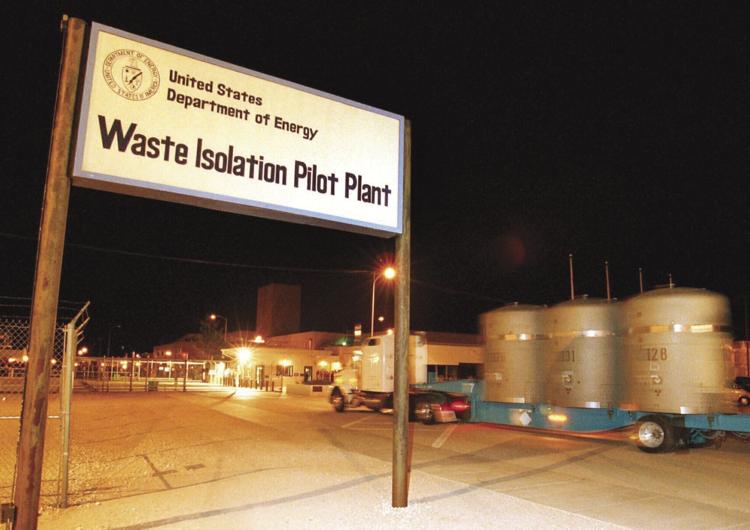
The U.S. Department of Energy (DOE) promised the People of New Mexico that it would cleanup and dispose of its plutonium-contaminated nuclear bomb waste by depositing it into the Waste Isolation Pilot Plant (WIPP) over 25 years and close. DOE broke its promise when that deadline passed on March 26th, But DOE has a new plan to keep the deep geologic nuclear waste disposal facility at WIPP open for 60 more years for legacy bomb waste and for newly-generated bomb waste from fabricating new weapons. https://wipp.energy.gov/
To alert the public about DOE’s plans, the Stop Forever WIPP Coalition will host the Second Annual WIPP Plutonium Caravan on Saturday, April 26th beginning at 9 am at the DeVargas Mall in Santa Fe. The Caravan will travel south on St. Francis Drive to Interstate 25 and towards Las Vegas, New Mexico with stops along the way. You are invited to be part of the Caravan. For more information, please visit https://stopforeverwipp.org/……………………………………………………………………………………………….. https://nuclearactive.org/
Canada’s Liberal energy plan: more corporate, less climate?
Winnipeg Free Press, By: Anne Lindsey, Apr. 16, 2025
In this “flag-waving” moment, where the U.S. government is threatening our sovereignty and economic well-being, it now appears the federal election is the Liberals’ to lose.
Amid the hype and adulation for Liberal Leader Mark Carney, however, the Liberals are promoting ideas that merit a closer look. Not least their plan to “make Canada the world’s leading energy superpower” announced in Calgary on April 9.
On the surface, it looks like the perfect recipe for self-reliance in energy and building a stronger Canada. It’s an industrial development strategy meant to exploit our natural mineral resources, build needed infrastructure and create jobs.
But what kind of energy and infrastructure? The plan includes many welcome and essential commitments to reducing emissions: investment in zero-emission vehicles, developing battery and smart grid technologies, reducing methane, and references to our “clean energy advantage.”…………..
The “clean energy advantage” is not well defined…………………..
Why? Nuclear is a controversial energy technology, for good reason. It seems inevitable that nuclear power will play a starring role in Canada’s energy future but not one the Liberals want to highlight.
Nuclear’s proponents might be winning the semantic battle branding it as “clean,” despite its routine operations releasing a cocktail of radioactive substances, its waste products containing among the most dangerous elements on the planet, and its inextricable link to the manufacture and proliferation of nuclear weapons.
Federal Liberals (and for that matter, Conservatives) have always been pro-nuclear, even though no nuclear plants have been built in Canada for decades. The annual federal expenditure on Crown corporation Atomic Energy of Canada Limited is more than $1 billion, due in no small part to the massive liabilities of managing nuclear waste. Tax credits for nuclear companies already abound.
Just this year, in the month of March alone, the current Liberal government committed another nearly half a billion dollars to a variety of nuclear projects across the country. The plan may not talk, but money does.
Mark Carney himself, a former UN special envoy on climate change and finance, has said there is “no path to net zero without nuclear.” In 2022, he joined Brookfield Asset Management, a firm holding both renewable energy and nuclear portfolios that, together with uranium giant Cameco, purchased bankrupt reactor company Westinghouse, under his watch. No question that Carney has a strong pro-nuclear bent.
More nuclear energy is an inappropriate climate action response, for at least two reasons. First, reactors take decades to be licensed, constructed and connected to the grid. And that’s a luxury we can’t afford.
Business as usual while waiting for nuclear power to get online means we surpass the tipping points of global warming, a scenario we must avoid.
Second, nuclear is the costliest way to generate electricity. Studies by organizations from the Ontario Clean Air Alliance to Lazard show that nuclear is not competitive with renewable alternatives which continue to drop in price. As governments fund nuclear, there is a massive lost opportunity cost for developing cheaper and readily available renewable energy.
Nuclear is too slow and too expensive to address climate change. The IPCC shows nuclear to be inefficient in reducing emissions. This is not an ideological perspective. It is fact.
Besides, “new generation” reactors being touted in Canada (such as GE Hitachi’s BWRX-300) carry a massive political liability, given current world events: most are American designs and all require enriched uranium fuel fabricated outside Canada.
Hardly a prescription for self-sufficiency. It’s a bit mysterious why “nuclear” does not appear in Liberal election plans while getting so much government (Liberal and Conservative) attention and money — unless we recognize the essential role of civilian nuclear infrastructure in maintaining weapons of mass destruction. Canada was instrumental in building the first atomic bombs and remains central to today’s U.S. defence/weapons supply chains for critical minerals, including uranium. Let’s keep that in mind as leaders negotiate trade and tariffs.
Canada should define itself not by becoming an “energy superpower” in the conventional and nuclear sense, but by disengaging from the defence industrial complex. We should use our critical minerals, ingenuity and workforce to pursue a decentralized, affordable, locally based renewable energy infrastructure leaning heavily into building and transportation efficiencies. We need to work together with Indigenous and remote communities, fully understand environmental and social impacts of developments and create smart grid interconnections that allow for maximum flexibility in energy sharing within Canada.
Anne Lindsey volunteers with the No Nukes MB campaign of the Manitoba Energy Justice Coalition and has been monitoring nuclear waste since the 1980s. https://www.winnipegfreepress.com/opinion/analysis/2025/04/16/the-liberal-energy-plan-more-corporate-less-climate
TIDES, NUKES AND BIRDS
Over the years, I’ve been hugely critical of what I call the ‘all of
the above’ brigade – made-up largely of nuclear enthusiasts who don’t
want to be seen trashing renewables in public but are desperate to keep new
nuclear (both big and small) in the mix to meet future electricity demand
here in the UK – even though it’s abundantly clear that nuclear cannot
compete with renewables on cost, construction time or even reliability. We
now have a wonderful opportunity to do a properly rigorous analysis of
‘nuclear vs renewables’ – this time, with the focus on tidal energy
rather than wind or solar as is usually the case. The biggest threat to the
potential for tidal energy on the Severn is the Government’s obsessive
support for nuclear power – including the prospect of a massive new power
station at Sizewell C on the Suffolk coast (with a Final Investment
Decision said to be “imminent”), as well as ‘in principle’ support
for so-called ‘ Small Modular Reactors.’
Jonathon Porritt 16th April 2025 https://jonathonporritt.com/tidal-energy-severn-estuary-nuclear-vs-nature/
Protester for life
Activist Angie Zelter has been arrested more than a hundred times. She’s not stopping now, writes LINDA PENTZ GUNTER
ANGIE ZELTER doesn’t know if there are already US nuclear weapons at the RAF Lakenheath base in Suffolk. In fact we may never know, says the 73-year-old grandmother and veteran of countless protests, who began her activism at the Greenham Common women’s occupation in 1981 that saw US cruise missiles removed from the base there 10 years later.
RAF Lakenheath is a misnomer. It is actually a US Air Force base where, it is suspected,
preparations are underway for a return of US nuclear weapons to the base,
if they are not there already. This week and next, hundreds of peace and
disarmament activists will be travelling there to attend a peace camp that
includes rallies, a conference and culminates in a blockade on April 26.
The camp is hosted by the Lakenheath Alliance for Peace, a network of
groups and individuals from Britain and around the world. Protesters are
expected to include activists from other countries where US military bases
are located.
Morning Star 16th April 2025
https://morningstaronline.co.uk/article/protester-life
Westinghouse and McMaster University deepen eVinci microreactor collaboration

WNN, 17 Apr 25
A memorandum of understanding and a master services agreement signed by Westinghouse Electric Company and McMaster University aim to move the eVinci microreactor towards commercialisation.
Under the agreements Westinghouse and McMaster University, which is based in Hamilton, Ontario, Canada, will collaborate on the research and development of the eVinci microreactor, including material irradiation and examination studies.
They build on existing collaboration since 2022 which has included McMaster “completing a material properties literature review along with corresponding material handbooks to inform engineering design and determine future testing needs”………………………………………….. https://www.world-nuclear-news.org/articles/westinghouse-and-mcmaster-university-mou-on-evinci-microreactor
The Conservative Argument Against Nuclear Power in Japan

It has been said that nuclear power stations are like nuclear weapons directed at your own country. I couldn’t agree more.
Getting rid of these “nuclear weapons directed at our own country” will not require huge defense spending or difficult diplomatic negotiations. All that is required is the ability to look square at the facts, and a conservative mindset determined to protect our rich and productive land and pass it on to the next generation.
Higuchi Hideak, Apr 15, 2025, https://www.nippon.com/en/in-depth/d01111/
A Devastating Loss of Territory
“Conservatism is essentially realism. A conservatism that refuses to confront reality is as worthless as a progressivism without ideals.”
This is how I opened my Hoshu no tame no genpatsu nyūmon (Nuclear Power: An Introduction for Conservatives), which came out last summer. In the book, I tried to bring attention to the contradictions inherent in the policies of the Liberal Democratic Party: a party that claims to support conservative values and uphold the ideals of patriotism but nevertheless advocates that Japan should continue or increase its reliance on nuclear power, even in the aftermath of the Fukushima disaster.
In the book, I made three main points. First, nuclear power is fundamentally incompatible with conservatism and patriotism. Second, nuclear power stations are inherently vulnerable to earthquakes, for structural reasons. And third, nuclear power stations are also vulnerable from a national security perspective.
The disaster at the Tokyo Electric Power Company’s Fukushima Daiichi Nuclear Power Station in March 2011 led to the evacuation of more than 150,000 people. More than 20,000 are still not able to return to their homes even today. And the state of emergency declared shortly after the disaster has still not been lifted, 14 years later.
In Fukushima Prefecture, evacuation orders are still in effect across more than 300 square kilometers, in what the government has designated as “closed to inhabitation indefinitely.” This is in spite of the fact that the annual safety limits for radiation exposure among the general population were lifted from 1 millisievert to 20 millisieverts. An area of more than 300 square kilometers—equivalent to the size of Nagoya, one of Japan’s key economic centers—is still effectively under evacuation orders. The country has effectively lost territory 50 times larger than the Senkaku Islands in Okinawa Prefecture, controversially claimed by China and the frequent focus of national security anxiety. As if this weren’t bad enough, more than 300 young people have been diagnosed with childhood thyroid cancer, a condition that would normally be expected to affect only around one in a million. Many of these have been serious cases requiring invasive surgery.
When I sat as presiding judge in the case brought before the Fukui District Court to stop the planned reactivation of the Ōi Nuclear Power Station, operated by the Kansai Electric Power Company, the argument put forward by the Liberal Democratic Party (then newly returned to power) and the business lobby was that shutting down nuclear plants would force Japan to import vast amounts of oil and natural gas to fuel thermal power stations. This would result in a massive outflow of the nation’s wealth and lead to national impoverishment.
On May 21, 2014, the court handed down its verdict. Even if shutting down the plant did lead to a trade deficit, the court rejected the idea that this would represent a loss of national wealth. True national wealth, the court held, consists of rich and productive land—a place where people can put down roots and make a living. The risk of losing this, and being unable to recover it, would represent a more serious loss of national wealth. Compare the arguments of the LDP and economic business lobby with the decision of the Fukui District Court. Which represents true conservatism, unafraid to look squarely at the facts about nuclear disasters? Which best represents the true spirit of patriotism?
Disaster Caused by a Power Failure
Let’s consider a few of the characteristics of nuclear power stations. First, they must be continuously monitored and supplied with a constant flow of water to cool the reactor. Second, if the supply of electricity or water is interrupted, there is the risk of an immediate meltdown. A serious accident could potentially mean the end of Japan as a nation.
The accident at Fukushima Daiichi came perilously close to rendering much of the eastern part of Japan uninhabitable. Yoshida Masao, the director in charge at the time, feared that radioactive fallout would contaminate all of eastern Japan when it looked as though the containment building at the Unit 2 reactor would rupture after venting became impossible. The chair of the Japan Atomic Energy Commission also expected it would be necessary to evacuate the population from a 250-kilometer radius of the plant, including Tokyo.
The accident at Fukushima did not happen because the reactor was damaged directly by the earthquake or tsunami. The initial earthquake interrupted the external supply of electricity, and the tsunami that followed cut off the emergency supply as well. Essentially, a power failure made it impossible to cool the reactor, and this was enough to trigger a catastrophe.
These characteristics mean that the resilience of nuclear power stations depends not on how physically robust the reactors and containment buildings are, but on the dependability of the electricity supplied to them. Nuclear power plants in Japan are designed to be able to withstand seismic activity between 600 to 1,000 gals (a gal being a unit of acceleration used in gravimetry to measure the local impact of an earthquake). But earthquakes over 1,000 gals are not unusual in Japan, and some have exceeded 4,000 gals. For this reason, some construction companies build housing that is designed to withstand seismic shocks up to 5,000 gals.
There are only 17 fully constructed nuclear power stations across the country. Six earthquakes exceeding the safety standards have already occurred at four of these: Onagawa, Shika, Kashiwazaki-Kariwa, and Fukushima Daiichi (twice each at Onagawa and Shika). Japan experiences more earthquakes than any other country on earth. Although the country accounts for just 0.3% of the world’s landmass, more than 10% of all the world’s earthquakes happen here. Despite the inherent dangers, there are 54 nuclear reactors along the coasts, around 10% of the world’s total.
Since it is impossible to forecast what scale of earthquake might hit a given site in an earthquake-prone country like Japan, construction companies operate on the principle that houses should be able to withstand seismic events equivalent to the strongest earthquake on record in the past.
The government ratified the Seventh Strategic Energy Plan at a cabinet meeting in February this year. This latest iteration of the plan removed references to an ambition to reduce the country’s dependence on nuclear power as much as possible, and signaled a clear intention to restore nuclear power to a more prominent position in the country’s energy strategy. Despite this, the seismic planning standards for nuclear power stations still assume that it is possible to accurately predict the maximum size of any earthquake that will hit in the future by analyzing past seismic data and running a site assessment of local geotechnical conditions. Whose position demonstrates better scientific judgement and a more realistic assessment of the facts—the government’s or the construction companies’?
Why Europe’s Biggest Nuclear Power Plant Fell into the Hands of the Enemy
TEPCO was a huge company, with annual revenue of around ¥5 trillion and a profit margin of 5%, meaning the company was making ¥250 billion every year. But the economic damages from the Fukushima accident came to at least ¥25 trillion, equivalent to 100 years in revenue for the company. What can we say about an approach to electricity generation in which a single accident can wipe out a century’s worth of revenue and essentially bankrupt a huge company like TEPCO? It is an energy source that is not just cost-ineffective but unsustainable.
For example, it is estimated that if an accident on a similar scale happened at the Tōkai Daini Nuclear Power Station in Ibaraki Prefecture, it would cause damage worth ¥660 trillion (compared to the national government budget of ¥110 trillion). As head of the Fukushima plant, Yoshida was resigned to losing the containment building of the unit 2 reactor to an explosion. He was saved by a “miracle” when a weakness somewhere in the structure of the building allowed pressure to escape and a rupture was avoided. Without this lucky intervention, it is estimated that the economic damages might have reached ¥2.4 quadrillion.
These figures make clear that the problem of nuclear power is not merely an energy issue. It has profound implications for national survival, and should be regarded as a national security priority. Russia’s war in Ukraine has provided a stark reminder of the seriousness of this threat. The Zaporizhzhia station on the Dnieper River is the largest nuclear power plant in Europe. A threat from Russia to attack it was enough to persuade Ukraine to hand over the plant to Russian control. If the plant really had been attacked, it might have caused a crisis with the potential to lay waste to large parts of Eastern Europe.
It has been said that nuclear power stations are like nuclear weapons directed at your own country. I couldn’t agree more. And in Japan we have 54 of these reactors bristling our shores, all but unprotected against earthquakes, potential enemies, and terrorist attacks. The LDP government mocks those who oppose Japan’s holding the offensive capability to attack enemy bases and argue for an exclusively defense-oriented posture as indulging in “flower garden” thinking. At the same time, the party is blind to the fact that nuclear power stations represent this country’s biggest national defense vulnerability.
Getting rid of these “nuclear weapons directed at our own country” will not require huge defense spending or difficult diplomatic negotiations. All that is required is the ability to look square at the facts, and a conservative mindset determined to protect our rich and productive land and pass it on to the next generation.
In my previous books and articles, I addressed the legal issues involved in nuclear power. In my Nuclear Power: An Introduction for Conservatives, I made clear that my own political stance is conservative. I was prepared for a backlash from progressives, who make up the bulk of the antinuclear movement, but in fact I received no pushback from that quarter all. In fact, I was taken aback by the resounding support I received.
Most of the criticism came from supposed conservatives who were apparently determined to discredit my sincere intentions and grumbled that it was unseemly for a former judge to be sticking his nose into politics. On Amazon, my reviews were flooded with apparently coordinated personal attacks and slander. But I am still convinced that true and fair-minded conservatives will understand my true intentions.
Geologists acknowledge that it is simply not possible to accurately predict earthquakes with today’s science. A huge earthquake could strike tomorrow, causing a catastrophe at one of the nation’s nuclear power stations that could wipe out or render inhabitable large parts of the country. My aim is simply to make as many people as possible aware of this terrifying fact.
(Originally written in Japanese. )
Saying It’s Antisemitic To Oppose Genocide Is Like Saying It’s Anti-Catholic To Oppose Pedophilia
Caitlin Johnstone, Apr 15, 2025, https://www.caitlinjohnst.one/p/saying-its-antisemitic-to-oppose?utm_source=post-email-title&publication_id=82124&post_id=161378744&utm_campaign=email-post-title&isFreemail=true&r=1ise1&triedRedirect=true&utm_medium=email
On Sunday Israel bombed the al-Ahli Arab Baptist Hospital, which readers may remember as the hospital that Israel ferociously insisted it didn’t bomb in October 2023 and accused anyone who said otherwise of antisemitic blood libel. According to a statement from the Episcopal Church’s Diocese of Jerusalem, this is now the fifth time this hospital has been bombed since the beginning of the Gaza onslaught.
The IDF is predictably claiming there was a Hamas base in the hospital, because that’s what they always do. The hospitals are Hamas, the ambulances are Hamas, the journalists are Hamas, the UN is Hamas, the schools are Hamas, the children are Hamas, every building in Gaza is Hamas, and anyone who disputes this is also Hamas.
God this gets old.
❖
Israel, October 2023: How dare you say we bombed Al-Ahli Baptist Hospital? We would never bomb a hospital!
Israel, 2023–2025: *bombs all hospitals in Gaza*
Israel, April 2025: We just bombed Al-Ahli Baptist Hospital again.
❖
Saying that opposing genocide is hateful toward Jews is like saying that opposing child molestation is hateful toward Catholics.
Western Zionists will be like, “All this hate for Israel makes me feel anxious and unsafe!”
Really? Are you sure that’s what you’re feeling? Are you sure it’s not guilt? Gut-wrenching guilt about all those dead kids in the genocide you support? Or cognitive dissonance, because your entire worldview is wrong?
❖
People often say I hate Israel, but what’s weird is they say it like it’s a bad thing.
So far the “President of Peace” has started a relentless bombing campaign in Yemen, reignited the Gaza holocaust, and shifted more US war machinery to west Asia in preparation for war with Iran, all while getting ready to announce the first ever trillion-dollar Pentagon budget.
Trump is just as awful a warmonger as Biden. If there’s a war with Iran he’ll be far worse. He hasn’t even gotten a Ukraine ceasefire.
❖
The western political faction that’s doing the most to help murder children in Gaza are not the “Yeehaw kill them Arabs” fanatics of the far right, but the “Gosh it’s so complicated, both sides hate each other and they’ve been at war for millennia” fence-sitting of the so-called moderate.
So far the “President of Peace” has started a relentless bombing campaign in Yemen, reignited the Gaza holocaust, and shifted more US war machinery to west Asia in preparation for war with Iran, all while getting ready to announce the first ever trillion-dollar Pentagon budget.
Trump is just as awful a warmonger as Biden. If there’s a war with Iran he’ll be far worse. He hasn’t even gotten a Ukraine ceasefire.
❖
The western political faction that’s doing the most to help murder children in Gaza are not the “Yeehaw kill them Arabs” fanatics of the far right, but the “Gosh it’s so complicated, both sides hate each other and they’ve been at war for millennia” fence-sitting of the so-called moderate.
And this isn’t an ancient conflict, it’s the culmination of abuses which were initiated by western powers dropping a brand new settler-colonialist ethnostate on top of a pre-existing civilization after the second world war. There was no reason to believe the middle east would not have joined the rest of the world in settling into a more peaceful status quo after WWII without western imperialists forcefully inserting an artificial apartheid state into the region like a shard of glass into a foot and then keeping it there by any amount of violence necessary.
Sure the middle east had plenty of violence prior to the world wars, but if you’ve ever read American and European history you’ll know this wasn’t anything unique to the middle east; it was the norm around the world. It wasn’t until after WWII that things settled down a bit and westerners grew accustomed to a more peaceful status quo; the only reason the middle east wasn’t allowed to join in that movement was because of aggressive western intervention.
By just shrugging saying “Yeah the Israelis hate the Palestinians and the Palestinians hate the Israelis, who’s to say who’s right,” this mainstream line tacitly promotes the notion that we should just let things play out as they are rather than doing everything we can to stop an active genocide that’s being backed by our own leaders. And this is the position put forward by most of the people with prominent voices in our society. They’re not just not helping, they’re discouraging everyone else from helping too.
-
Archives
- October 2026 (104)
- September 2026 (339)
- August 2026 (330)
- July 2026 (355)
- June 2026 (287)
- May 2026 (306)
- April 2026 (356)
- March 2026 (251)
- February 2026 (267)
- January 2026 (308)
- December 2025 (358)
- November 2025 (359)
-
Categories
- 1
- 1 NUCLEAR ISSUES
- business and costs
- climate change
- culture and arts
- ENERGY
- environment
- health
- history
- indigenous issues
- Legal
- marketing of nuclear
- media
- opposition to nuclear
- PERSONAL STORIES
- politics
- politics international
- Religion and ethics
- safety
- secrets,lies and civil liberties
- spinbuster
- technology
- Uranium
- wastes
- weapons and war
- Women
- 2 WORLD
- ACTION
- AFRICA
- Atrocities
- AUSTRALIA
- Christina's notes
- Christina's themes
- culture and arts
- Events
- Fuk 2022
- Fuk 2023
- Fukushima 2017
- Fukushima 2018
- fukushima 2019
- Fukushima 2020
- Fukushima 2021
- general
- global warming
- Humour (God we need it)
- Nuclear
- RARE EARTHS
- Reference
- resources – print
- Resources -audiovicual
- Weekly Newsletter
- World
- World Nuclear
- YouTube
-
RSS
Entries RSS
Comments RSS

