Author and Pediatrician Helen Caldicott takes time out of her busy schedule to join me to discuss the unfolding events at the Fukushima Daiichi nuclear power station in Japan. Fukushima was devastated by a massive earthquake on March 11, 2011 which led directly to a massive failure causing hydrogen explosions which blew the roof off of at least two of the reactor buildings. Tepco and the Japanese government have understated the radiation dangers and the dire reality of the situation from day one.
Helen says, at this point there is no “best case scenario” for Fukushima, just worsening degrees of horror because it’s scientifically impossible to clean up what has already occurred. And with thousands of spent fuel rods and thousands more active rods still in the fuel pools of the damaged reactor buildings, the worst case scenario – if another major earthquake hits the area – is an ecological nightmare of biblical proportions for everyone living in the Northern hemisphere.
GREG & MICHEAL GIVEN OVER, 5 MORE YEARS PLOWSHARES 3 , FOR WHAT, attempting to safe your life, your kids life, your kids kids kids kids kids lifes.
AS Y 12 OAK RIDGE, IS BREAKING THE LAW. THE QUEENS COURT CONT. THE TORUTURE AND REPRISSION OF JUSTICE, LONGSHANKS LIVES,
TOKYO, Japan (February 19, 2014) U.S. Ambassador to Japan Caroline Kennedy delivers opening remarks at the Japan-U.S. Decommissioning and Remediation Fukushima Recovery Forum.
Green Drinks NYC invites you to a lively evening at its SPARK SPEAKER SERIES with a focus on Japan’s Fukushima Reactor disaster and New York’s Indian Point Nuclear Reactor and how to manifest a green energy future. Riverkeeper Hudson River Program Director Phillip Musegaas will take part in a panel discussion at The Moderns titled “Three Years After Fukushima: Lessons Learned from the Disaster and The Future of Indian Point.”
The nuclear disaster at Fukushima continues to unfold nearly three years after that fateful day, March 11, 2011. The lives and livelihoods of tens of thousands of Japanese have been irreparably harmed with devastating human, economic and environmental consequences. Here in the United States, what lessons have we heeded from this disaster? What are U.S. regulators doing to better protect the hundreds of millions of Americans who live near one of the nation’s 100 operating nuclear reactors, including the Indian Point nuclear plant, 38 miles north of New York City? What are some of the known risks at the Indian Point plant and what is being done to address them?
Riverkeeper has a long history of work on Indian Point safety and environmental issues, including its current active legal challenge to Indian Point’s re-licensing by the Nuclear Regulatory Commission. Appearing with him is and journalist Susan Q. Stranahan and Edwin Lyman, a nationally recognized nuclear power safety expert from the Union of Concerned Scientists and the author (with Dave Lochbaum and Susan Q. Stranahan) of the Feb, 2014 book, Fukushima: The Story of a Nuclear Disaster.” Hosting the event is Paul E. McGinniss.
A grim “Of Special Importance”[highest classification level] report prepared by the State Atomic Energy Corporation (ROSATOM) circulating in the Kremlin today is warning that the “potentially catastrophic nuclear event” currently unfolding at the United States atomic Waste Isolation Pilot Plant (WIPP) near Carlsbad, New Mexico has prompted the Obama regime to begin pre-staging government forces and equipment in the event a large-scale evacuation is needed.
According to this report, the United States Department of Energy WIPP is the world’s third deep geological repository (after closure of Germany’s Repository for radioactive waste Morsleben and the Schacht Asse II Salt Mine) licensed to permanently dispose of transuranic radioactive waste for 10,000 years that is left from the research and production of nuclear weapons.
Critical to note, however, this report says, is that the United States Enrichment Corporation (USEC), the private American corporation serving as executive agent for the HEU Purchase Agreement, was “deliberately targeted” for elimination by the Obama regime in early 2009 leading to its 16 December 2013 announcement that it had reached an agreement with a majority of its debt holders to file a prearranged and voluntary Chapter 11 bankruptcy restructuring in the first quarter of 2014.
As to why the Obama regime wanted to eliminate USEC, Federal Security Service (FSB) intelligence experts contributing to this report say, was for the diverting HEU Purchase Agreement uranium for the purpose of reconstituting it to its highly dangerous U-235 level to conduct experiments at the WIPP on what is called nuclear salt-water rockets (NSWR), which is a proposed type of nuclear thermal rocket designed by Robert Zubrin that would be fueled by water bearing dissolved salts of plutonium or U-235.
Under tight strictures put upon it by US law, this report says, the Obama regime needed Russia’s HEU Purchase Agreement uranium for these NSWR experiments and which is not reportable.
On 5 February, however, this report continues, these NSWR experiments at the WIPP went “horrifically wrong” leading to an explosion and fire at the underground facility, followed by the 14 February “radiological event” that prompted its full evacuation.
Sister Megan Rice vandalized a weapons facility for almost an hour before she was apprehended
Sister Megan Rice, an 84-year-old radical nun who broke into a nuclear weapons facility in Oak Ridge, Tenn., in protest against the nation’s nuclear arsenal, was sentenced Tuesday afternoon to 35 months in federal prison.
“Please have no leniency with me,” Rice told the judge. “To remain in prison for the rest of my life would be the greatest gift you could give me.”
The judge said he considered her age and her decades of good works and just could not give her what could amount to a life sentence. He asked that Rice use her “brilliant mind” to lead to change in Washington, D.C., and not use it to break laws in Tennessee.
Her co-defendants, Michael Walli, 65, and Gregory Boertje-Obed, 58, were sentenced to 62 months on charges of interfering with national security and damaging property at the Y-12 National Security Complex in July 2012 — the facility that once provided the enriched uranium for the Hiroshima bomb.
The activists put up banners, splashed blood and beat hammers against the walls of the storage facility in a biblical reference to Isaiah 2:4, “They shall beat swords into plowshares and their spears into pruning hooks.”
The defense argued the trio acted in accordance with their religious beliefs and did not mean to cause any harm with their action, which follows a series of anti-nuclear protests organized by “Transform Now Plowshares,” a collective of pacifist activists looking to draw attention to the nation’s nuclear weapons arsenal.
Sister Megan Rice and two other defendants jailed for entering Oak Ridge plant and daubing it with Biblical messages
…..But the US government argued at the January hearing that they did not accept that they had committed crimes, took no responsibility for them, showed no contrition and then, during the trial, proceeded to argue against the laws they had broken. It has described the three, who have previous convictions related to their protest activities, as “recidivists and habitual offenders”……
An 84-year-old nun was handed a 35-month jail term on Tuesday for breaking into a US nuclear weapons plant and daubing it with biblical references and human blood. Sister Megan Rice was sentenced alongside two co-defendants, Greg Boertje-Obed, 58, and Michael Walli, 64, who both received 62-month terms.
At an earlier hearing in January, a judge ordered the three Catholic anti-nuclear protesters to pay $53,000 for what the government estimated was damage done to the Y-12 nuclear weapons plant at Oak Ridge, Tennessee, regarded as one of the most secure in the world.
All three defendants were convicted of sabotage after the 2012 break-in, on charges that carried a maximum sentence of up to 30 years. The government had asked for the trio to be given prison sentences of between five and nine years.
In a recent interview with the Guardian from prison, Rice said she hoped US district judge Amul Thapar would seize the opportunity to “take his place in history” and sentence them in a way that would reflect their symbolic, non-violent actions – actions she said were intended to highlight the US stockpile of nuclear weapons they believe is immoral and illegal.
Rice and her co-defendants have been in prison, mostly in Ocilla, Georgia, for nine months, a period of time her lawyers had argued was sufficient punishment for the break-in.
On 28 July 2012, the three activists cut through three fences before reaching a $548m storage bunker. They hung banners, strung up crime-scene tape and hammered off a small chunk of the fortress-like storage facility for uranium material, inside the most secure part of complex. They painted messages such as “The fruit of justice is peace” and splashed small bottles of human blood on the bunker wall.
“There is no consistent signal of change in either storms or blocking near the UK in either ensemble of Met Office models or the ensemble of alternative models. Such changes as are seen are relatively modest, and the potential for substantial changes appears to be small.“
Posted to nuclear-news.net
Posted by Arclight2011
18 February 2014
A new report out today gives justification for a new generation ABWR reactor to be built in the UK. It comes with pretty pictures and a biased view of radiological damage.
The report states that there are no issues with this plan and that even in the event of a major incident that there would be no insignificant health effects on humans. The effects on birds and animals are presumed to be negligable if there are no effects on humans.
The basis for this feel good factor is the WHO health report on the fukushima showing no significant health effects and Dr weightmans report and findings after his visit to the Fukushima Daichi nuclear accident site.
Looking at the report I noticed some slight differences of opinion shown in the choice of words
Commission of the National Diet of Japan in 2012 concluded that:
“Although triggered by these cataclysmic events, the subsequent accident at the Fukushima Dai-ichi Nuclear Power Plant cannot be regarded as a natural disaster. It was a profoundly “manmade disaster” – “
Dr Weightman concluded that:
“The Fukushima accident highlighted the potential for multi-unit nuclear power stations to be affected by severe “natural disasters””
As to why the report plays down the health effects and therefore is able to say on the economics section;
“Based on the Government’s own analysis, adoption of the Proposed Practice is highly likely to be beneficial for the UK economy when security of supply and carbon reduction benefits are taken into account.
The risks of significant detriment to the UK economy from the Proposed Practice are very low”
“We remain satisfied that stringent regulation here and overseas (where uranium is mined) provides adequate environmental safeguards to assess and mitigate the impacts.”
“Any additional radiological health detriment arising from uranium mining and extraction in support of the UK’s implementation of the Proposed Practice will thus be very small.”
On atmospheric an liquid releases from the new reactor type:
It is also reasonable to conclude that average individual doses to the UK population as a whole would be at levels so small they would
be insignificant in terms of any radiological health detriment”
Needless to say that the report plays down the actual health effects on the ground that range from confirmed dozens of cases of thyroid cancers in 14 year old children (average age), nosebleeds, diarrhea, polydactyl, leukemia, sudden heart attacks etc.
The thyroid cancers are not certainly not contested but they are ignored in the statistics as the nuclear industry does not want to admit such early effects.
In the report it states that Chernobyl was an order of magnitude of six larger that Fukushima but a recent study puts that figure at 5 times what is given by the nuclear corporations and their supportive international agencies like the IAEA.
In fact the report actually is incorrect concerning the actual dose received by the children and families of Fukushima.
Kazakhstan is in the final stages of talks with the International Atomic Energy Agency (IAEA) on plans to host an international nuclear fuel bank.
As the range of countries investing into nuclear power plants grows, the bank will make it possible for them to buy fuel rather than setting up their own enrichment plants. The launch of the international bank then is designed to help prevent the proliferation of nuclear weapons.
“Kazakhstan is to host the international bank for low-enriched uranium and the IAEA is currently finalizing negotiations on an agreement,” says a statement from the Kazakh ministry of foreign affairs. “We believe that the development of multilateral approaches to the nuclear fuel , including the creation of guaranteed nuclear fuel reserves will promote the peaceful use of nuclear energy.”
A final decision on the bank was expected in 2013, but talks are still ongoing, the statement added. Kazakhstan is the world’s leading uranium producer, and turned out 38% of global production last year. Seventeen uranium mining projects run in the country, 12 of them joint ventures with foreign partners.
Astana has offered the Soviet-built Ulba Metallurgical Plant in Ust-Kamenogorsk, at the very eastern end of the country, as the site for the fuel bank, which will store and distribute low-enriched uranium internationally. In 2012, the head of state nuclear agency Kazatomprom claimed the plant is one of the safest places in the world for uranium storage.
The problem is that high-level wastes remain extremely dangerous for centuries and must not enter ground water. Also, they must be protected from terrorists who can use the materials in it to make “dirty” radiological weapons.
Karachi, Feb. 16 — Mohammad Shehzad: What is wrong with nuclear energy? Some experts say it is the cheapest form of energy available to Pakistan.
Pervez Hoodbhoy: The cost of nuclear power depends hugely on what items one includes or excludes. For Pakistan, there is little chance of unbiased, honest accounting of costs especially because all nuclear matters are hidden under multiple shrouds of secrecy. One should therefore look at the international context. The United States has the world’s largest nuclear industry and generates about 30 per cent of the world’s nuclear electricity. But, partly because of stringent safety requirements, it has difficulty in competing with other means.
A 2009 Massachusetts Institute of Technology study, which strongly advocates increasing the role of nuclear power globally out of climate concerns, estimated the cost of nuclear electricity in 2010 to be 8.4 cents/kWh and compares it against coal and gas – 6.2 and 6.5 cents/kWh respectively. These costs were arrived at by using standard economic arguments and input costs. When fossil fuel eventually depletes, the nuclear-fossil price ratio will turn around in favour of nuclear. But this has not happened as yet and the discovery of oil shale is pushing against nuclear development. It is important to note that no new nuclear plant has been commissioned in the US over the last twenty years.
MS: Then why is Pakistan going for a 2200MW nuclear power plant if the risks are so high?
PH: The risk may be medium or even low, but the consequences of an accident are extremely high because of the plant’s location. Nevertheless, our government has been successfully enticed into the deal because the Chinese are dangling a $6.5 billion soft loan – which is greater than the annual budget of the Pakistan Army. This means that we will not seriously consider alternative means of energy production, such as wind power, which exist aplenty in Pakistan but need capital.
China, according to a recent BBC report, has the fastest growing production with a current installed wind capacity of 75,000MW – which is four times larger than the sum total of all electricity generating means in Pakistan. Germany’s current installed wind capacity is 25,000MW but Pakistan’s is only 50MW.
In India, wind power generates twice as much power as their nuclear. Will this disgraceful situation change? With the powerful Pakistan Atomic Energy Commission (PAEC) backing nuclear power in its institutional interest, and with China willing to give only a nuclear loan, one cannot be too hopeful of a rational energy policy.PH: They will have to be courageous. Even though the two have nothing to do with each other, nuclear power plants are somehow mixed up with nuclear bomb production in the public mind. As we all know, there are millions of bomb worshippers in Pakistan who would be only too happy to take up cudgels for a sacred cause. They need to be disabused first with facts and information.
MS: Why is the PML-N government so keen?
PH: Although these reactors are expensive and will take 6-8 years or more to come on line, the powerful institutional interests of the PAEC have prevailed upon the government. They have convinced it that nuclear power is a good option and that China is the only country that will offer to sell to Pakistan. The $6.5 billion loan promised by China for the reactor purchase took care of any possible hesitation.
MS: And what are ‘the powerful institutional interests of the PAEC’?
PH: Over a period of five decades the PAEC has created a vast infrastructure that comprises of hundreds of buildings, fuel processing facilities, computers, electronic and electrical machinery, chemical plants and chemicals, lathes and workshop machinery. Add to all this local and foreign training, salaries and benefits, security arrangements, etc. Like every large institution, the PAEC has powerful lobbyists placed in the state system who fight for enhancing PAEC’s interests even if those interests are not identical to those of Pakistan.
MS: You said the reactors will take 6-8 years to come online. Are you saying they will be able to generate energy after 6-8 years? Will they really generate 2200 MW electricity? And what will the price per unit be?
….Lyman said the extent of the cleanup operation necessary to get the repository back in operation depended on the intensity and range of contamination in the underground tunnels.
“It could be a mess,” Lyman said. “If there is airborne contamination and it involves plutonium, they are going to need to decontaminate surfaces. If it is in the ventilation system, it could have spread to other areas.”….
Normal operations at the Waste Isolation Pilot Plant have been suspended for four days as the leak is investigated.
The Energy Department suspended normal operations for a fourth day at its New Mexico burial site for defense nuclear waste after a radiation leak inside salt tunnels where the material is buried.
Officials at the site, known as the Waste Isolation Pilot Plant, or WIPP, activated air filters as a precaution and barred personnel from entering the 2,150-foot-deep repository as they investigate what caused the leak. Radiation sensors sounded alarms at 11:30 p.m. Friday, when no workers were in the underground portions of the plant.
Officials at the site discounted any effect on human health, saying no radiation escaped to the surface. But they said little about the extent of the problem or how it could be cleaned up.
“Officials at WIPP continue to monitor the situation,” spokeswoman Deb Gill said. “We are emphasizing there is no threat to human health and the environment.”
How long the repository would be closed and the effects on the defense nuclear cleanup program were unclear.
The Advanced Mixed Waste Treatment Project, a federal operation in eastern Idaho that is the biggest user of WIPP, said Monday that it had suspended waste shipments.
Gill said the repository shutdown occurred earlier this month after another incident in which a truck caught fire in an underground tunnel. That matter is still under investigation.
Any prolonged shutdown could cause a backup of waste at a dozen nuclear-weapons-related sites across the nation, including Lawrence Livermore National Laboratory in the Bay Area. In 2012, those dozen sites made 846 shipments to the dump, more than two per day. A spokesman at the Idaho operation said it was continuing normal business and storing the waste on site.
WIPP officials have said little about what could have triggered the radiation leak.
Shutting down Germany’s nuclear power plants is going to be atrociously expensive. Experts also doubt the funds set aside will be enough to cover the costs of scrapping the plants and their radioactive waste.
The decision to move away from nuclear energy is a done deal in Germany, where all nuclear power plants are intended to be offline by 2022. It’s a political decision that will cost billions of euros, while the expansion of renewable energy is already pushing up electricity rates.
It also remains unclear exactly how much it will cost to dismantle the power plants after they’ve been mothballed. Experts are certain that the 34 billion euros set aside by plant operators for this purpose will not be enough to do the job.
The government officially lists nine nuclear plants as providing electricity for Germany’s power grid. Eight additional reactors were already switched off in the wake of the Fukushima disaster in Japan. There are also 16 power stations currently undergoing the long shut-down process.
In total, there are at least 33 facilities that will need to be dismantled and whose contaminated scrap will have to be disposed of.
Aside from the costs involved, there is also the question of where to store the spent nuclear fuel. The federal government calculated in April 2013 that the selection of a site for this purpose over the next 15 years would cost two billion euros.
Irretrievable reserves
Even before Fukushima, Germany’s nuclear operators were building reserves to finance the dismantling of their reactors. However, they were planning for the reactors to remain in operation for longer, leaving more time for the entire process.
The German Atomic Forum (DAtF) estimates that the reserves total around 34 billion euros. Reports indicate that 18 billion lie with the provider Eon, 10 billion with RWE and 3.6 billion with Vattenfall.
Since the dismantling process is now set to begin earlier and be carried out faster, it’s questionable whether these reserves will be sufficient.
Energy experts say the true figure needs to be much higher. RWE calculates that closing a single nuclear plant in Mülheim-Kärlich in the state of Rhineland-Palatinate will cost 750 million euros. Even the anti-nuclear Green party in Germany’s parliament has acknowledged that a much higher sum will be needed to decommission the plants.
Problems also emerge when it comes to the availability of the 34 billion euros that have accumulated. This capital is not sitting in a bank, ready to be accessed. The plant operators have mostly invested it. In RWE’s case, for example, the money has largely been put toward plants in the Netherlands and in Great Britain.
The 196th Carnival of Nuclear Energy Bloggers and Authors has been posted at The Energy Reality Project. You can click here to read this latest installment of a long running tradition among the top English language pro-nuclear bloggers and authors.
Each week, a new edition of the Carnival is hosted at one of the top English-language nuclear blogs. This rotating feature of nuclear “posts of the week” represents the dedication of those who are working toward a future of energy abundance, improved health, and broadened security through nuclear science and technology.
Past editions of the carnival have been hosted at Yes Vermont Yankee, Atomic Power Review, ANS Nuclear Cafe, NEI Nuclear Notes, Next Big Future, Atomic Insights, Hiroshima Syndrome, Things Worse Than Nuclear Power, EntrepreNuke, and Deregulate the Atom.
This is a great collaborative effort that deserves your support. If you have a pro-nuclear energy blog and would like to host an edition of the carnival, please contact Brain Wang at Next Big Future to get on the rotation.
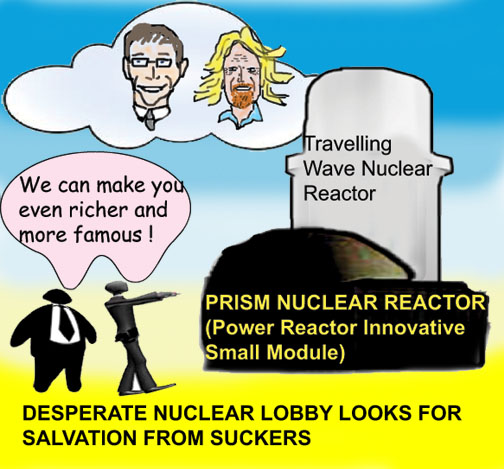
….TerraPower’s TWR is a larger reactor based on Generation IV technology and designed to use depleted uranium as fuel…
…. “This MOU with B&W makes it possible for us to tap the nuclear industry’s excellence and keep American companies active in the international supply chain for advanced nuclear energy technologies.”….
The Babcock & Wilcox Company (B&W) (NYSE:BWC) and TerraPower® have signed a Memorandum of Understanding (MOU) to support the development of TerraPower’s Generation IV traveling wave reactor (TWR), a safe, economic and sustainable nuclear energy system that utilizes advanced materials for more durable metallic fuels and supercomputing for advanced comprehensive modeling.
The TWR commercial reactor plant design is a 1,150 megawatt liquid sodium-cooled fast reactor that uses depleted uranium as fuel. This innovative design allows for the use of depleted uranium generated by the enrichment process used for existing light water reactors fueled with enriched uranium. With the conceptual design phase under way, B&W will provide support to TerraPower as the project enters the preliminary design phase.






 nuclear-news