Sizewell: New book imagines terror attack on Suffolk’s nuclear plant
David Green Sunday, April 13, 2014
12:10 PM
A former nuclear industry safety official has written a novel based on his fears that it would become easier for terrorists to cripple the UK if the Government gives the go-ahead to big infrastructure projects such as Sizewell C.

Barrie Skelcher was head of the health physics department at Sizewell A during the 1960s and 70s and went on to become technical officer at Sizewell B.
His novel, The Day England Died, is due to be published by the Book Guild on April 24.
It tells the story of a group of terrorists planning an attack on a nuclear power complex – by blowing up the pylons connecting it to the grid and disabling emergency generators which could be used to help cool the reactors and prevent a Fukushima-scale disaster..
Although the name Sizewell is not mentioned in the novel, the terrorists base themselves in Suffolk 20 miles from a former fishing village where there is a nuclear site.
In the novel it is called Deephole and is close to a town of 7,000 inhabitants called Munchington.
Mr Skelcher, who lives in Leiston and is a sailing enthusiast, started his nuclear industry career working for the UK Atomic Energy Authority at Dounreay in Scotland in 1954 and took early retirement from Sizewell B in 1987.
Mr Skelcher, who has three children and four grandchildren, said he was opposing the construction of Sizewell C because he believed the power should be generated where it is needed – in London and the Thames Valley – and that concentrating so much generating capacity on one site would make it easier for terrorists to cripple the UK
“As power is being imported at Sizewell from offshore wind farms another power station there would be putting too much power in one place,” Mr Skelcher said.
“My guess is that terrorists will try to better the Twin Towers attack but deploy different methods.
“In this context, the power stations, whatever type they may be, could be targets.”
An EDF Energy spokeswoman said the company could not discuss security but acted on all recommendations and instructions from the Office for Nuclear Regulation.
“The Civil Nuclear Constabulary is deployed at all EDF Energy nuclear sites to further enhance the already robust security arrangements. These officers work alongside existing security teams at each station,” she added.
Kiev crisis halts Chernobyl charity’s €3m surgery plan – Children at risk!
Alyson Henry – Published 14 April 2014 02:30 AM
AN IRISH humanitarian aid agency has been forced to cut its €3m heart surgery programme for the children in Chernobyl due to increasing riots and violent demonstrations in Ukraine.

Adi Roche (right), pictured with Ali Hewson, said it broke her heart to put her charity’s heart surgery programme on hold due to violence in the Ukraine
CEO of Chernobyl Children International (CCI), Adi Roche, said the decision to put the programme on hold was “deeply distressing”, and that the impact of this may mean even longer waiting lists for vital-life saving operations.
Ahead of today’s EU Foreign Affairs Council meeting in Luxemburg, Ms Roche, has spoken with EU officials to see whether or not humanitarian funding can be made available to the programme at this time of crisis.
The €3m spent so far on establishing and maintaining the programme has been raised entirely in Ireland by CCI donors and volunteer fundraising activities.
All operations that had been scheduled for the next month at the “open heart” surgery programme in the Regional Hospital in Kharkiv have been suspended until the situation stabilises.
RACE
Ms Roche said the reality is that one in every four children diagnosed with the ‘Chernobyl heart’ will die before they reach the age of six. She said this means the “programmes we organise and fund each year are really a race against time”.
She stressed that the situation between Russia and Ukraine was so serious the surgery programme had no choice but to temporarily suspend all procedures, but that “teams of surgeons” are standing by in the US and Canada “waiting to travel”.
For the past 10 years, the programme has been treating a significant portion of the 6,000 Ukrainian children born with genetic heart diseases every year. Many of these conditions, known as the ‘Chernobyl heart’, have been linked to the radiation leaks from the Chernobyl nuclear plant accident in 1986.
Dr Novick, whose pioneering surgery featured in the 2003 Academy Award-winning film ‘Chernobyl Heart’, said: “It is a shame that politics is once again negatively impacting on the medical care of children to the point where lives may be lost not because of bullets but simply because nationalistic ego’s prevent these children from receiving adequate care.”
Irish Independent
Ambiguities of Japan’s Nuclear Policy
…At the same time, the government is finding it increasingly difficult to explain why Japan should maintain its fuel-cycle policy. In the wake of the Fukushima disaster in 2011, none of Japan’s 48 commercial nuclear reactors is currently in operation, and popular opinion is mounting against the idea of developing more special fast-breeder reactors…
http://www.worlddaily.co/contributing-op-ed-writer-ambiguities-of-japans-nuclear-policy/
13 April 2014
TOKYO — When Yasunari Kawabata became the first Japanese to receive the Nobel Prize for Literature in 1968, he gave a speech called “Japan, the Beautiful, and Myself” that presented a benignly aesthetic portrait of the so-called Japanese spirit larded with references to classical poetry, the tea ceremony and ikebana. When Kenzaburo Oe received the prize in 1994, he titled his lecture, “Japan, the Ambiguous, and Myself,” and offered a critical take on the country’s ambiguities, starting its being part of Asia and simultaneously aligned with the West.
I was reminded of the contrast between Japan the Beautiful and Japan the Ambiguous late last month when, during the third Nuclear Security Summit in the Hague, the Japanese government announced that it would hand over to the United States more than 700 pounds of weapons-grade plutonium and a vast supply of highly enriched uranium. It struck me then that the ambiguities of Japan’s policy on nuclear weapons might be coming up against the nationalist agenda of Prime Minister Shinzo Abe, also the author of “Towards a Beautiful Country: My Vision for Japan.”
Although Japan does not have nuclear weapons, it has a nuclear weapons policy. The strategy was set out by the Ministry of Foreign Affairs in 1969 in an internal document whose existence was kept secret until the daily Mainichi Shimbun published it in 1994. That paper states that “for the time being we will maintain the policy of not possessing nuclear weapons” but also “keep the economic and technical potential for the production of nuclear weapons, while seeing to it that Japan will not be interfered with in this regard.” Known as “technological deterrence,” this posture is inherently ambiguous, and has been made more so still by the ministry’s insistence that the document was a research paper rather than a statement of policy.
In a 2000 essay about the future of the Nuclear Nonproliferation Treaty, the disarmament advocate Jonathan Schell drew a distinction between capacity and intention in describing the range of positions states may adopt on nuclear weapons. At the time, Sweden had the capacity to produce such weapons but not the intention; Libya had the intention but not the capacity. Japan, by contrast, stands out as the only nation that has both the capacity and the intention to produce nuclear weapons but does not act on its intention. It has pioneered a type of nuclear deterrence that relies not on any overt threat, but on the mere suggestion of a latent possibility.
The radlab on wheels: a mobile radiochemistry laboratory
[ Arclight note ; This could be used in Fukushima and Myagi prefectures ]
http://www.neimagazine.com/features/featurethe-radlab-on-wheels-a-mobile-radiochemistry-lab-4203717/
14 April 2014
UK National Physical Laboratory (NPL) and Loughborough University are setting up a demonstration mobile radiochemistry laboratory that can be driven onto a nuclear site. Field tests are expected later this year.

Work to decommission plant, buildings and contaminated land on legacy nuclear sites relies on accurately determining the activity concentrations of specific radioisotopes in the materials, so that demolition and waste disposal can be carried out safely and in compliance with site licence conditions.
Equipment and expertise for the complex measurements needed for decommissioning samples are the province of a small number of specialist analytical laboratories. As a result, these laboratories can be over-burdened with work, leading to long turnaround times of up to several months. The laboratories are also off-site, so radioactive samples often have to negotiate a time-consuming permitting and administrative process before they can be sent off for analysis.

As measurement results lie on the critical path for decommissioning projects this can lead to long delays, with the project team waiting for the results from the analysis before work can start on demolition or disposal.
The UK National Physical Laboratory (NPL) at Teddington has joined forces with Loughborough University’s radiochemistry section to develop a solution to this problem. Thanks to support from the Department for Business, Innovation and Skills and the EC, NPL and Loughborough are setting up a demonstration mobile radiochemistry laboratory that can be driven onto a nuclear site. Samples can be taken directly to the laboratory and the results from the analysis will be in the hands of the project manager within hours rather than weeks. If the results show that further samples are needed, they can be arranged immediately, which is far preferable to repeating a long cycle. A mobile laboratory also has the advantage that it can carry out essential measurements of routine discharges in the event that a site’s own laboratory is out of action.
Design of the mobile radiochemical laboratory
The vehicle was designed by the British Geological Society and is the property of Loughborough University. The vehicle itself is reconfigurable and has its own independent power supply and utilities. Equipment needed for a particular analysis campaign can be rapidly installed, and removed or replaced as required. Two technicians are needed to operate the installed analysis and measurement systems, with wireless data transfer to the NPL-Loughborough support team for further analysis and reporting.
The mobile laboratory has two distinct areas: one for sample preparation and the other for analysis and measurement equipment. The latter may include a high-resolution gamma spectrometer, a bench-top scintillation detector, portable radon gas detectors and non-nuclear measuring equipment such as balances and x-ray fluorescence (XRF), x-ray diffraction (XRD), SEM or GC-MS.
Automated radiochemistry
The mobile laboratory has become a realistic proposition only in the last five to ten years, due to technological developments such as automated radiochemistry.
Sellafield’s Radioactive Pollution from The Irish Sea to The Arctic – Omnicide knows no bounds between wildlife and humans.
By on April 9, 2014
Yesterday at Cumbria Wildlife Trust’s Irish Sea Conference, Radiation Free Lakeland handed out over 100 leaflets to delegates. The venue was the beautiful Netherwood Hotel in Grange over Sands. The front door looks out on to Morecambe Bay and Heysham Nuclear plant ( see photo above ). From Heysham spent fuel trundles across the train viaduct to Sellafield to be reprocessed making it even more dangerous.
The leaflets handed out yesterday by volunteers and supporters of a Radiation Free Lakeland describe just a few of the impacts of existing and proposed nuclear developments on the Irish Sea. This is to counter the non engagement of Cumbria Wildlife Trust in nuclear impacts ( happy to engage in the impact of wind turbines!)
The ever charming Sir Martin Holdgate Trustee of CWT came over to speak to us and interestingly told us that he favours above ground storage and monitoring of nuclear waste.
We agreed and suggested that the first step to looking after existing nuclear waste must be to STOP PRODUCING ANY MORE.
He replied “there is something to be said for that point of view.”
Rather worrying the equally charming Director of Cumbria Wildlife Trust Peter Bullard appears to assume that damage from nuclear ‘only’ affects humans and that the Trust “is not about people but is concerned with wildlife.”
Humans are at the top of the food chain and as studies, including studies by Lancaster University, have shown even chronic low level radiation is damaging to all wildlife including the game changing 100% sterility of fish “Severe effect on reproduction hatching and abnormal larvae (100%).”
These test studies are backed up by findings in the real world. Many universities worldwide have been studying evidence from nuclear accidents:
“Low-dose radiation has been known to have negative consequences for (all) living beings for almost 100 years. Indeed, background radiation causes the death of tens of thousands of humans annually. These ‘natural’ effects may be exacerbated by the 23 nuclear accidents recorded during the last century”.
Radiation Free Lakeland know Sellafield to be the equivalent of an ongoing accident with routine releases of radiation to sea, air and groundwaters. On May 13th Cumbria Wildlife Trust are inviting families to spend hours on beautiful St Bees beach making sand sculptures. This is the same beach where increasing numbers of radioactive particles from Sellafield’s insane reprocessing programme are being found. Not really surprising as the headland of St Bees acts as a catchment area for Sellafield discharges. The same particles take just 4 years to reach the Arctic and bioaccumulate in all life there. As a result of these finds there are no warning signs on the beaches, rather the monitoring and retrieval of radioactive particles has been stepped down dramatically. If you don’t look you don’t find? If you don’t mention the ‘N’ word people will be blind to the diabolic plan for ever more radioactive and chemical pollution from nuclear?
Leaflet handed out to delegates:
CUMBRIA WILDLIFE TRUST : IRISH SEA CONFERENCE 2014
Do Not Mention the ‘N’ word?
Gov’t model shows airborne radioactive plume covering entire west coast of US & Canada on Mar 22, 2011… 10 times more radioactive than plume coming from Fukushima plant on same day — Radiation levels in some plumes had no discernible decrease after crossing Pacific (VIDEO)
Published: April 8th, 2014 at 8:16 am ET
By ENENews
Fukushima Radioactive Aerosol Dispersion, NOAA: The [HYSPLIT] model was developed by NOAA to follow the transport and dispersion of pollutants in the atmosphere. In HYSPLIT, the computation is composed of four components: transport by the mean wind, turbulent dispersion, scavenging and decay. A large number of pollutant particles, which by convention are called “particles” but are just computational “points” (particles or gases), are released at the source location and passively follow the wind. […] March 11th […] by 16:36 a nuclear emergency was reported. By the early morning hours of March 12th, radioactive emissions were occurring […] the simulation from NOAA’s HYSPLIT model shows a continuous release of tracer
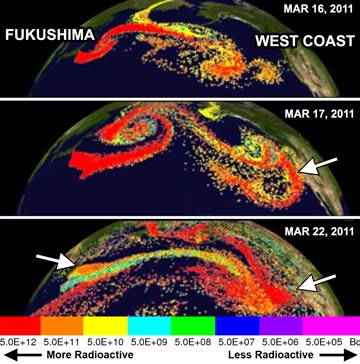
particles from 12-31 March at a rate of 100 per hour representing the Cesium-137 emitted from Fukushima Daiichi. Each change in particle color represents a decrease in radioactivity by a factor of 10.
Notable Features
- Particles with the highest radioactivity were released around March 15th [See also: UN: Fukushima Unit 2 reactor “burst” on March 15th after fuel melted — Radiation doses soon hit highest levels of crisis for many places across region]
- Particles caught in clockwise circulations are embedded in fair weather high pressure systems and their radioactivity will persist for longer periods
- In general, radioactivity reaching the United States showed air concentrations over 1000 times smaller than areas near Japan
The March 22, 2011 NOAA model (above right) shows the West Coast of US and Canada covered in red particles, while the Fukushima site — and all of Japan — are under orange particles. According to the NOAA above a “change in particle color represents a decrease in radioactivity by a factor of 10”
Evidence of Prime Minister Abe getting a sweet deal at expense of Japanese tax payers –
http://www.japan-press.co.jp/modules/news/index.php?id=7043
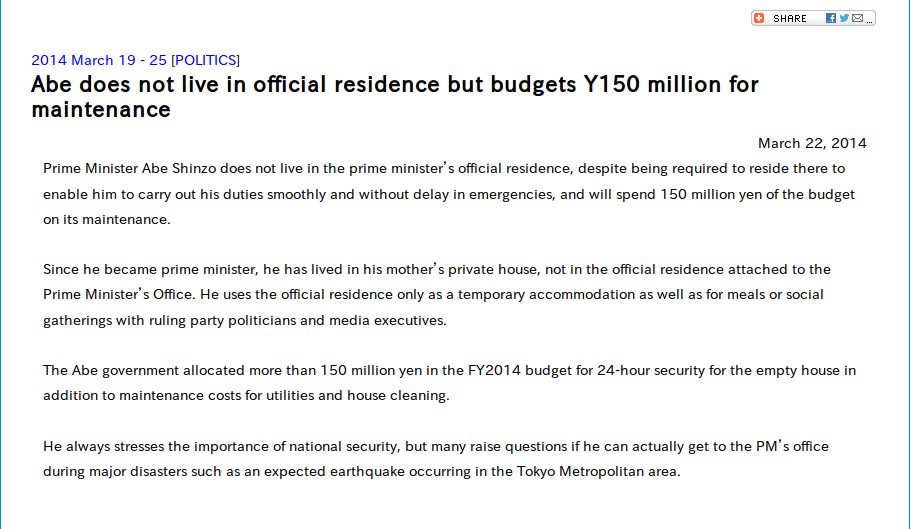
Nice Pad!!

Fukushima, nuclear censorship and attacks on activists
 13 April 2014
Op Ed by arclight 2011part2
Posted to nuclear-news.net
Times certainly have changed. I believe that our fight for human rights and justice has never been so threatened as it is today. Recent attacks are to support Japanese Prime minister Abes attempts to start ALL the reactors in Japan.
I am a UK citizen who has been shocked to find out of the lengths that the military industrial complex and associated corporations have been doing in stopping important human rights information getting to you, the public. There has been the targeting of human rights activists on a global scale using new technologies that effect the Internet and mobile communications that we take for granted as part of our everyday lives.
What happened to investigative journalism?
In recent months, if you may have been searching the Internet for information concerning human rights abuses you will have been slowly becoming aware of murmurings of state hacking and other attacks on the people who are trying to bring you information from many locations around the world on a variety of important topical situations.
The issues brought up are being clearly stated in the situation regarding Wikileaks and the Edward Snowden affair. Unfortunately, though, our brothers and sisters in the main stream medias around the world are largely unable to bring you this information because of personal and corporate threats of litigation and because of the governments and security services using various terror laws and state censorship rules to block any, what they consider, to be “dangerous information” .
In the course of my research I have been stunned to see that government departments within the UK, USA, Japan (To name but a few) being manipulated by what i believe to be the military industrial complex and connected industries and corporations. Also in the frame is large insurance investment and banking corporations.
This manipulation is far reaching and includes attacks on independent journalists, scientists, bloggers and politicians and is far reaching and pervasive.
The question of truth in Fukushima, Japan?
In 2011, I was stunned to see a large mushroom cloud appearing from Unit 3 Fukushima Daichi nuclear plant as well as the claimed “hydrogen” explosions from Units 1 and 2. The video evidence from a local Fukushima news outlet was quickly pulled from the web but not before bloggers had copied it and made it go viral. There was at least a fire in Unit 4 reactor building that was claimed to be the spent fuel pool but no video evidence supporting that has been released. Denials of any “meltdowns” of the reactor cores went on for some months in the face of obvious evidence.
My concerns for the people living in the region (some 20 million plus) caused me to investigate the cover up of the true situation. This situation has been well documented on the Internet and discussed with many posits being brought forward to describe the accident and its effects and I will not go into them fully here. The annals of blogs like www.enenews.com www.nuclear-news.net www.fukuleaks.org as well as a Japanese speaking bloggers such as tokyobrowntabby, exskf, and Fukushima Diaries to name but a few, show us a cover up of historic proportions.
Many of the Japanese translators have been shut down in many different ways and I have at least some anecdotal evidence of intimidation, violence and even murders associated with these campaigners and truth tellers.
A vicious circle.
At the end of the cold war with Russia, countries have expanded their security operations and investment instead of reigning them back. Blaming so called Muslim terrorists that they are presently supporting to attack regimes they deem as terrorist.
So whats the big deal?
I maintain that I and others have been targeted for at least a few of the posits that I have put forward and some of these are;
1) The support of Nuclear Test Veterans claims of health and genetic effects due to nuclear testing during the cold war
2) Supporting Japanese bloggers in their translations into English of the situation on the ground in Fukushima and Myiagi prefectures in Japan.
3) For uncovering military and security operations in stemming the flow of nuclear related information.
4) The censorship of media organisations by the use of litigation and terror legislation.
5) The attacks on scientists and researchers who claim health effects caused by various nuclear processes such as pollution from nuclear fuel processing and decommissioning of nuclear sites in the UK and beyond.
6) For highlighting the problems with nuclear fuel rods and high burn up techniques causing damage to the nuclear fuel rods and nuclear reactor vessels which could cause another Fukushima like disaster.
7) For supporting Professor Yablakovs and colleagues claims of high mortality and other undiscussed health effects as a result of the Chernobyl nuclear disaster.
8) For uncovering UK complicity in stifling the well proven genetic effects of the victims of the Russian nuclear tests in Semipalantisk in Kazakhstan.
9) In challenging the way in which contaminated food is being spread around the globe by corporations processing methods and the cover up/manipulation of some United Nations organisations.
10) For my findings of other nuclear related pollutions including NO2 and Lead (Pb) causing miscarriage, death and injury to UK citizens and wildlife.
11) For the suppression of genetic blood tests in Japan to hide the damage from radiation and the sidelining of geneticists in the UK and USA, by limiting funding to relevant radiation studies and research.
12) For supporting the efforts of Dr Chris Busby in bringing his years of research to the forefront of the battle against the lies being promoted by the nuclear industry.
We have fight on our hands!
I have been aided by a plethora of bloggers with a wide range interests and points of view and even encouraged by main stream media journalists and media outlets who have found that their public viewpoints have been limited by editorial concerns of litigation and personal threats and harassment of individual journalists.
Owing to the recent increase in attacks on certain key scientists, bloggers and researchers etc, I have wondered how we independent thinkers can overcome such attacks via the Internet, as have had been happening recently. How do we protect anonymity and our rights of discourse in the face of recent developments that highly encrypted services have been co-opted by various security organisations?
It was during the UK select committee investigation into the release of material stemming from the Edward Snowden affair that I caught a glimpse of one such way we could fight back against such a formidable hidden enemy.
The Editor of the Guardian was questioned by various MP`s and committee members as to the safety of the security services in light of the information that was publicly being revealed. The editor seemed to satisfy the committee as to the thoroughness of the checking procedure being used by the Guardian team assigned to extracting information that was relevant to the public good. However, one committee member, representing the UK security services threatened the editor with the new anti terrorist laws and his questioning was stopped by Timothy Yeo MP (the head of the committee). The Guardian editor responded to this threat by claiming that he was defending freedom of speech in the UK. The security services representative also seemed very distressed at the mention of TORBROWSER by the Guardian editor, a software program used by global activists and journalists to hide their IP addresses (location) and maintain their anonymity and safety. So maybe this is something that should be used?
There is also the co-operation of the USA and UK nuclear and military industries and their encouragement for Japan to militarise in line with these countries. this co-operation includes the denial of the human rights petition to the UNHCR by Anand Grover and and their support for the new Japanese “Secrets Law” that gives journalists the threat of 10 years imprisonment and bloggers the threat of 5 years in prison (if the normal litigation threats do not work) for talking about anything nuclear. The UK recently also quietly made more amendments to the UK official Secrets policy apparently to bring it in line with the Japanese and USA tact on secrecy of nuclear and health matters.
Japanese Bloggers, scientists, health proffesionals and journalists speak out!
Scientists, health professionals, media and bloggers in Japan and elsewhere have been highlighting issues with the effects of radioactive contamination in Japan and have brought to light the homeless and disabled workers of the Daichi nuclear site employed with lucrative contracts administered by the criminal Yakusa groups employed by TEPCO, the UK USA and French decommissioning specialists.
They have been also reporting on a plethora of health issues concerning people, animals and the environment that they claim are connected to the contamination in a wide area around the triple meltdown nuclear plant. And there is some peer reviewed evidence for this starting to come out.
Japanese translators are heroes.
This group I have the most admiration for. They are brave and conscientious individuals that seem to be driven by their natural compassion for life and their fellow countrymen. I have to also to include here those translators who are not of Japanese origin also. They are all the most harassed and targeted individuals, in my experience because of there on going on the ground, real time documentation of events and situations.
I need to preserve the anonymity of some of these wonderful, brave people who are so special because they are normal citizens who have taken up the job of the much beleaguered journalists and editors that would normally bring you this evidence. They are people who have been targeted by “unknown” and known forces and have done their best in the face of extreme adversity. So, my documenting of these affairs will be necessarily vague in places.
Topics covered by these translators include;
The dissemination of secretive technical issues to do with a very secretive nuclear industry, the health effects on the citizens of Fukushima and Myagi (reportedly as far away as Tokyo), the corruption within the Japanese government and Energy companies, the scandals of the Fukushima Medical Hospital and support of associated University professors throughout Japan, Corruption of voting procedures during the Japanese elections since the disaster to protect the Japanese nuclear industry from popular anti nuclear opposition and also the manipulation of any provable victims of the nuclear disaster are compensated with the addition of legal gagging orders to stop the information getting out. Indded this type of tactic was reported after the Deep water Horizon Gulf oil spill disaster (In fact Sir Martin Sorrel, CEO of Ogilvey and Maher – who are owned by WPP, are the actual company that “managed” both these disasters on behalf of BP and TEPCO, using very similar approaches to both disasters to mitigate damages to the corporations concerned)
Needless to say that many of these translators have fallen by the wayside as the forces that promote the nuclear lobby set there attentions on them.
International bloggers and You tube uploaders
This group has largely dug into the connections between military and corporate interference in how the news is managed and here the UK has excelled in promoting a little known charity called the UK Science Media Centre. This so called charity vastly increased its revenue in 2011 in the UK and also got funding to set up similar groups in Australia, Canada, Japan ( The Japan SMC web-site is not updated but is still manipulating the news behind the scenes) and the USA to manage the news coming from Japan to the world at large (as well as other topics). And these bloggers have countered this disinformation.
Fionna Fox, one of the founders of the UK Science Media Centre (who was a witness at the Leveson inquiry in the UK) wants only the “right science” to be given to the worlds public. She is strongly supported by a myriad of corporations who want their version of the “right science” to be promoted.
The topics covered by the Science media Centres worldwide also include fracking, GMO, Climate science and weather modification and she uses mainly cherry picked industry connected scientists and specialists largely ignoring the dissenting voices. And specifically this has had a profound effect on the situation in Japan and how the perception of the nuclear disaster and its aftermath is delivered to the public at large in many countries.
Of course the media also has the pressure from the likes of the WPP, the vast global PR corporation to pressure media outlets with the threat of the withdrawal of advertising revenue from any dissenting media corporation outlets.
These bloggers and you tube activists have also disseminated the information from our brothers and sisters in Japan and tried to get it out to the citizens of the world to give them warning of what might happen if a nuclear disaster should happen in another country.
The corporation that said enough is enough! A fresh start?
Considering that Yahoo has recently relocated its servers to Ireland in an attempt to protect peoples data and because they are aware of a global manipulation of the internet to stop embarrassing and possibly costly information (for politicians and corporations) reaching the eyes and ears of the public at large, it would give some credence to – at least – some of the so called conspiracy claims that can be found on the Internet. The evidence to support Yahoo`s position can also be seen in the way that the establishment are acting in relation to both Julian Assange (Wikileaks) and the Edward Snowden release of data to the Guardian, New York Times and associated blogs (ie. The interceptor – Glen Greenwald).
Finally, I would like to explain that some of these conspiracy claims are being promulgated to hide and create confusion to the real conspiracies that are happening and this is backed up by the release of intelligence training manuals showing how JTRIG manipulates discourse on the Internet.
I believe that the time has come to save the Internet or face the results of ignoring this threat to freedom of expression and thought. It is may also be our last chance to save the people of Fukushima and Myagi from a long future of experimentation, ill health and even death.
I hope that whoever receives this article will share and discuss the issues that I have outlined. I am only touching the tip of the iceberg in this article and therefore only touching on some of the issues raised by my findings and posits.
Will you stand back and allow the powerful interests to destroy centuries of social, judicial and human rights development? I hope not, for the children of Japan and other radioactively contaminated regions and for your children. if we do not make a stand concerning the environmental catastrophes that loom before us, what sort of fate awaits will us all?
Arclight
Thank you to all those that have informed my findings and have challenged my posits and have allowed me to put together all the above (you know who you are).
Lets hope for a better future and a kinder world, if not……….?
Sources for some relevant information
Japan risks public outcry as it brings back nuclear power – 48 NPP`s to restart!
Plant operators have already paid out hundreds of millions of pounds on replacement fossil fuels, with media reports estimating that more than £9 billion will need to be spent on facility upgrades to meet required safety standards.
“I think it is unavoidable that the Japanese utilities will write off most of their nuclear ‘assets’ and move on,” said Mycle Schneider, an independent energy consultant based in Paris.
12:15PM BST 11 Apr 2014
The Japanese government approved a new energy policy backing nuclear power on Friday despite widespread public wariness in the aftermath of the Fukushima disaster.
The new policy highlighted nuclear energy as an “important baseload power source”, marking a clear U-turn from the previous government’s plans to phase out atomic energy.
The new plans are expected to pave the way for the government to restart the nation’s 48 viable nuclear reactors, all of which are currently off-line as a result of safety checks prompted by the 2011 disaster in Fukushima.
The new plan is also believed to include a strong focus on renewable energy generation, such as solar, wind and hydropower, with a ministerial level group established in order to boost such energy sources.
“We aim to opt for an energy supply system which is realistic, pragmatic and well balanced,” Toshimitsu Motegi, Japan’s trade and industry minister, told reporters.
The decision is likely to be unpopular among the Japanese public, which has been unusually vociferous in its widespread opposition to the use of nuclear energy as a result of the Fukushima incident.
The nuclear disaster, the world’s worst since the 1986 Chernobyl accident, triggered a widespread anti-nuclear backlash among the public and a surge in renewable energy projects.
The government’s new policy was approved just days after the first evacuees from Fukushima were permitted to return to their homes inside the exclusion zone more than three years after the disaster.
Canada narrows list of possible locations for nuclear waste facility
Some were also drawn by the fact that for taking part in the selection process, they’ll get $400,000 even if they’re not chosen, providing they advance far enough in the process and a DGR is ultimately approved.

7 of 22 municipalities dropped from list of potential sites
By Rick MacInnes-Rae, CBC News Posted: Apr 09, 2014
(Interactive map showing locations of possible nuclear dump sites on link)
Canada is a step closer to picking a place to store spent nuclear fuel underground for the next 100,000 years, a project that’s backfired on some of the world’s other nuclear economies.
Despite the stigma of radioactivity, 22 Canadian municipalities expressed interest in hosting such a facility. Four have now been moved up the list for further evaluation, while seven have been rejected as not suitable. The other 11 are still in the initial assessment phase.
Final approval could take another couple of decades, but if a site is found and approval given to build a Deep Geologic Repository (DGR), the project will generate thousands of jobs, some lasting generations.
Billions would be spent constructing a vast warehouse over 500 metres underground to contain some of the most radioactive waste in the world.
Deadly byproduct
Nuclear energy has helped meet Canada’s electricity needs for more than 40 years, but a deadly byproduct has been steadily building up as a result.
There’s a growing inventory of spent uranium pellets. The radioactive pellets are stored inside long silver tubes bundled together like 24-kilogram logs.

Spent uranium pellets from nuclear reactors are stored inside long silver tubes that are bundled together like 24-kilogram logs.
Heading the search for a secure place to store those tubes is the Nuclear Waste Management Organisation (NWMO), funded by Canada’s four nuclear agencies, which describes the situation this way: “If Canada’s entire current inventory of just over two million used fuel bundles could be stacked end-to-end, like cordwood, it would fit into six NHL-sized hockey rinks from the ice surface to the top of the boards.”
At present, spent fuel is stored at seven different sites across Canada, including at the reactors it once powered. But that’s not a long-term solution, because in time those reactors will be decommissioned and dismantled.
In its quest for a site, the NWMO took the novel step of asking Canadian communities if they’d think about hosting the highly-radioactive payload.
“Well, we didn’t know what to expect” said Jo-Ann Facella, director of social research and dialogue at the NWMO.
“We put out the plan that Canadians had come forward with and the government had selected as Canada’s plan. And an important part of that plan, it emerged from Canadians, is that these facilities only be implemented in a willing host.”
What also came back were expressions of interest from 22 different municipalities, tempted in part by the promise of employment if they’re chosen. Some were also drawn by the fact that for taking part in the selection process, they’ll get $400,000 even if they’re not chosen, providing they advance far enough in the process and a DGR is ultimately approved.
Tepco NOT to analyze Plutonium or Uranium in bypass water before discharging to the Pacific
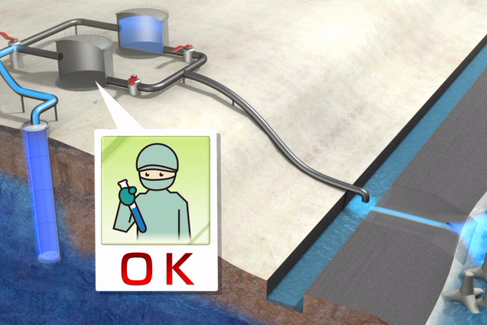
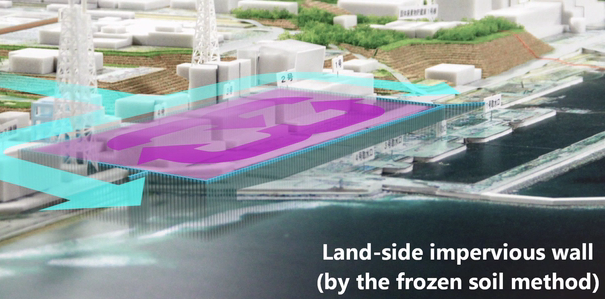
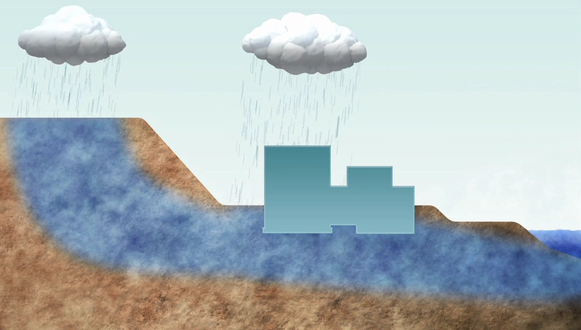
The program is expected to reduce the amount of water flowing into the building basements by a maximum of 100 tons from the current amount of around 400 tons a day to 300 tons a day, TEPCO said.


Image and quote source ; http://peakoil.com/enviroment/japan-starts-cleaning-radioactive-groundwater-at-fukushima-before-dumping-into-ocean/comment-page-1
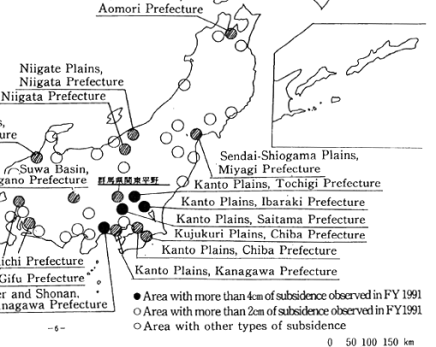
Other information ; Fig. 1-1-27 Land Subsidence Across the Nation in FY 1991

Posted by Mochizuki on April 9th, 2014
Tepco is not going to analyze / put the safety limit on α nuclides including Plutonium-238/239/240 and Uranium-235/238 in bypassed groundwater to discharge.
They are planning to discharge the pumped groundwater to the Pacific from this coming June. They are supposed to analyze the contamination though they won’t filter the pumped water.
However from their answer to the local fishery cooperative, α nuclides will be excluded from the checking list. No matter how contaminated by Plutonium, Uranium, or / and Americium the water is, the pumped water will be discharged limitlessly.
α nuclides, which are the highest risk for the health and environment, are hardly checked in fishery products either. Potential Plutonium or Uranium of Fukushima plant will be discharged to the Pacific without any checking, and it can be transferred to the body of the fishery products consumers with no control.
http://www.tepco.co.jp/news/2014/images/140404a.pdf
Iori MochizukiDownplay it in the beginning, and quietly add more information so nobody notices it. All for not letting the cattle escape. This is their strategy.
3/30から5/5まで、おれ氏はキプロスを調査しておりもす。
(キプロス調査の詳しいところ)
オ ラソダ調査の時に何度も弁護士の口から出てきた国、キプロスで起業→オラソダで支店開設をすれば同じ要領で世界中の国でビザが(σ・∀・)σゲッツ!! 出来るのか。理論上では可能ですが、実際に出来るのかは誰か暇な奴が確かめてみないといけません。ということで、世界で幼稚園児の次に暇な男、おれ氏が やってきます。
調査費は自腹で、見積もりを出す以前にキプロスに飛び込んでしまいましたが、未開の地を開拓するサソタ・オレオ号にみなさんのオレオを投資して頂けると嬉 しいです。費用は全部で切りのいいところで222.5オレオになる見込みですたい。1オレオ(10$、オレオ数はQuantityで変更可能)〜から、顔 本、たそぶらーの専用ページへアクセス出来もふ!
現在の総オレオ/目標オレオ:64/222.5
_____
Français :
Tepco n’analysera PAS le Plutonium ou l’Uranium des eaux de la dérivation avant leur décharge dans le Pacifique
Even low-level radioactivity is damaging, scientists conclude
“And the truth is, if we see effects at these low levels, then we have to be thinking differently about how we develop regulations for exposures, and especially intentional exposures to populations, like the emissions from nuclear power plants, medical procedures, and even some x-ray machines at airports.”
“With the levels of contamination that we have seen as a result of nuclear power plants, especially in the past, and even as a result of Chernobyl and Fukushima and related accidents, there’s an attempt in the industry to downplay the doses that the populations are getting, because maybe it’s only one or two times beyond what is thought to be the natural background level,”
Date November 13, 2012
Source:University of South Carolina
Summary:Even the very lowest levels of radiation are harmful to life, scientists have concluded, reporting the results of a wide-ranging analysis of 46 peer-reviewed studies published over the past 40 years. Variation in low-level, natural background radiation was found to have small, but highly statistically significant, negative effects on DNA as well as several measures of health.
http://www.sciencedaily.com/releases/2012/11/121113134224.htm
Even the very lowest levels of radiation are harmful to life, scientists have concluded in the Cambridge Philosophical Society’s journal Biological Reviews. Reporting the results of a wide-ranging analysis of 46 peer-reviewed studies published over the past 40 years, researchers from the University of South Carolina and the University of Paris-Sud found that variation in low-level, natural background radiation was found to have small, but highly statistically significant, negative effects on DNA as well as several measures of health.
The review is a meta-analysis of studies of locations around the globe that have very high natural background radiation as a result of the minerals in the ground there, including Ramsar, Iran, Mombasa, Kenya, Lodeve, France, and Yangjiang, China. These, and a few other geographic locations with natural background radiation that greatly exceeds normal amounts, have long drawn scientists intent on understanding the effects of radiation on life. Individual studies by themselves, however, have often only shown small effects on small populations from which conclusive statistical conclusions were difficult to draw.
“When you’re looking at such small effect sizes, the size of the population you need to study is huge,” said co-author Timothy Mousseau, a biologist in the College of Arts and Sciences at the University of South Carolina. “Pooling across multiple studies, in multiple areas, and in a rigorous statistical manner provides a tool to really get at these questions about low-level radiation.”
Continue reading
long-term cardiac effects of low doses of ionizing radiation – Report 2013

Abstract from http://www.ncbi.nlm.nih.gov/pmc/articles/PMC3579799/
Aim
Investigating long-term cardiac effects of low doses of ionizing radiation is highly relevant in the context of interventional cardiology and radiotherapy. Epidemiological data report that low doses of irradiation to the heart can result in significant increase in the cardiovascular mortality by yet unknown mechanisms. In addition co-morbidity factor such as hypertension or/and atherosclerosis can enhance cardiac complications. Therefore, we explored the mechanisms that lead to long-term cardiac remodelling and investigated the interaction of radiation-induced damage to heart and cardiovascular systems with atherosclerosis, using wild-type and ApoE-deficient mice.
Methods and Results
ApoE−/− and wild-type mice were locally irradiated to the heart at 0, 0.2 and 2 Gy (RX). Twenty, 40 and 60 weeks post-irradiation, echocardiography were performed and hearts were collected for cardiomyocyte isolation, histopathological analysis, study of inflammatory infiltration and fibrosis deposition. Common and strain-specific pathogenic pathways were found. Significant alteration of left ventricular function (eccentric hypertrophy) occurred in both strains of mice. Low dose irradiation (0.2 Gy) induced premature death in ApoE−/− mice (47% died at 20 weeks). Acute inflammatory infiltrate was observed in scarring areas with accumulation of M1-macrophages and secretion of IL-6. Increased expression of the fibrogenic factors (TGF-β1 and PAI-1) was measured earlier in cardiomyocytes isolated from ApoE−/− than in wt animals.
Conclusion
The present study shows that cardiac exposure to low dose of ionizing radiation induce significant physiological, histopathological, cellular and molecular alterations in irradiated heart with mild functional impairment. Atherosclerotic predisposition precipitated cardiac damage induced by low doses with an early pro-inflammatory polarization of macrophages.
Introduction
Epidemiological reports clearly show that cardiac exposure to high doses of ionizing radiation after radiotherapy increase the risk of cardiovascular disease in cancer patients (for instance, in left sided breast cancer patients the heart dose can range from 3 to 17 Gy with an increased risk of cardiovascular death equal to 44%) [1]; [2]; [3]; [4]. Alteration of cardiac function with a decrease in ejection fraction (EF) suggestive of heart failure was also reported in patients who developed long-term radiation-induced cardiac toxicity either after exposure to intermediate dose of ionizing radiation to the heart (<3 Gy) [3] and/or chemo-induced heart toxicity after exposure to anthracyclines [5]. Although the potential risk of late cardiac disease after exposure to low radiation doses was raised a long time ago by the analysis of mortality from cancer and non-malignant diseases among Japanese A-bomb survivors [6]; [7], controversies are still ongoing and biological evidence remains scarce. Mortality from myocardial infarction more than 40 years after radiation exposure was significantly increased in victims who had received an acute total body dose of 1 to 2 Gy. Other data are accruing that both environmental and occupational low-dose exposure may lead to increased risk of cardiac disorders [8]. However, studies conducted in Canadian, British and German nuclear workers showed no evidence of enhanced cardiovascular disease (CVD) [9]; [10]; [11]. The dose threshold and latency time for CVD development after low dose exposure is unknown as well as the pathogenic features and mechanisms of the disease. The enormous latency time (≥15 years) required before occurrence of any measurable symptoms [3];[12] makes the disease difficult to study in humans and co-morbidity factors inevitably influence final outcome.
The establishment of an experimental model dedicated to study heart response to low dose of ionizing radiation constituted the first part of the present study. As cardiovascular co-morbidity such as atherosclerosis is present in >20% of cancer patients [13], we investigated cardiac response in pro-atherogenic ApoE-deficient mice [14]. Finally, several questions were addressed: i) the impact of low doses of ionizing radiation on cardiac function, ii) the time course of the pathogenic development if any, iii) and potential structural and cellular alterations associated. Functional studies along with structural, cellular and molecular characterization allowed us to document for the first time that low doses of irradiation induce cardiac lesions and remodelling that are amplified in a pro-atherogenic genetic background with mild but measurable functional impact. The development of post-irradiation cardiac pathology is largely amplified by aging factors and structural alterations consistent with ongoing scarring and fibrogenic processes. The pathological picture was enhanced and more precocious in ApoE−/− as compared with wild-type (wt). However, in both strains, cardiac fibrosis was associated with inflammatory infiltration that was further characterized.
Today the role of macrophages in cardiac remodelling is well recognized and M1 versus M2-polarization is thought to drive the balance between exacerbation of tissue damage (M1) or protection/recovery but possibly fibrogenesis (M2) [15]; [16]; [17]; [18]. Interestingly, a role for macrophages after total body exposure to low dose irradiation has been suggested [19] but macrophage polarization has never been characterized. These long-term changes in the micro-environment and persistent inflammation might alter the tissue and contribute to long-term defects and to chronic release of fibrogenic growth factors [17]. Amongst them a key role for TGF-β1 signalling has been shown, by us and others, in the constitution of radiation-induced fibrotic tissue [20]; [21]; [22]; [23]; [24]. TGF-β1 is also an important mediator of cardiac remodelling and cardiomyocyte hypertrophy [25], its contribution after exposure to low dose of ionizing radiation has been shown in mammary epithelium [26], but has not been previously investigated in the heart. Given the cellular features observed in irradiated hearts at low dose, we hypothesized that both precocious macrophage polarization and earlier TGF- β1 activation could provide the molecular basis for ApoE−/− enhanced sensitivity to low dose of ionizing radiation.
Materials and Methods
Animals and irradiation procedures
Temporary URL links to Libbe Halevy of Nuclear hotseat issue number #146

Nuclear Hotseat #146; download directly from:
http://lhalevy.audioacrobat.com/download/1a1ba8c9-5529-9e3b-4a42-98a476bb2688.mp3 OR – get it from iTunes under Podcasts.
A message from Libbe Halevy
Nuclear Hotseat website still down, but that doesn’t stop the program! Latest details on WIPP site radiation release in Carlsbad, NM w/Don Hancock; new anti-nuclear “holiday” on April 10: Bequerels Awareness Day (BAD – because Radiation is BAD to eat!) to contact your Senators and Congressional Reps to demand a reduction in “allowable” radiation levels in US food; and;
NUMNUTZ of the WEEK is an EVIL NUMNUTZ – UNSCEAR’s lying, manipulative 300-page “report” that tries to convince the world that there will be no increase in cancer rates because of Fukushima radiation. How stupid do they think we are? Oh, wait… we aren’t, are we?
Nuclear hotseat hacked again! Its just that good! Plus some advise from the Dalai Lamai
Posted by Arclight2011part2
posted to nuclear-news.net
PLEASE SHARE
I will keep this brief and to the point.
Nuclear Hotseat has been taken down for the third time in a week. This happened after Libbe Lahavey organised an expansion of her marketing to cover the ENTIRE GLOBE. To do this she dispatched a couple of mischievous bloggers and sending them forth into the cyber world to post last weeks show as her engineers had corrected the Nuclear Hotseat website.
Then As Libbe was preparing to post this weeks show and reap the rewards of her marketing bonanza, she found her website blocked to her, and indeed everyone, apart from the all powerful NSA.
The message on the site was “Access denied”
To say show was miffed is an understatement.. libbe was blooming furious and asked me to let all out there know that a delay in this weeks show is on the cards.
However, as always Libbe is slaving away to bring you her excellent show and has solutions that she is working on. So;
DONT PANIC

“The practice of patience guards us against losing our presence of mind. It enables us to remain undisturbed, even when the situation is really difficult. It gives us a certain amount of inner peace, which allows us some self-control, so that we can choose to respond to situations in an appropriate and compassionate manner, rather than being driven by our disturbing emotions.”
UPDATE:
Libbe Lahavrey says:
Nuclear Hotseat website still down, but that doesn’t stop the program! Latest details on WIPP site radiation release in Carlsbad, NM w/Don Hancock; new anti-nuclear “holiday” on April 10: Bequerels Awareness Day (BAD – because Radiation is BAD to eat!) to contact your Senators and Congressional Reps to demand a reduction in “allowable” radiation levels in US food; and NUMNUTZ of the WEEK is an EVIL NUMNUTZ – UNSCEAR’s lying, manipulative 300-page “report” that tries to convince the world that there will be no increase in cancer rates because of Fukushima radiation. How stupid do they think we are? Oh, wait… we aren’t, are we? Nuclear Hotseat #146;
download directly from:
http://lhalevy.audioacrobat.com/download/1a1ba8c9-5529-9e3b-4a42-98a476bb2688.mp3
OR – get it from iTunes under Podcasts.
lhalevy.audioacrobat.com
Edward Snowden is ready to testify on the US wiretapping of Angela Merkel’s phone if Germany will grant him political asylum — and Merkel may just take him up on the offer.
“My government continues to treat dissent as defection, and seeks to criminalize political speech with felony charges that provide no defense,” Snowden wrote German officials. “Speaking the truth is not a crime.”
Edward Snowden will never be safe if he returns to the US, and temporary asylum in a country notorious for its own civil liberties abuses won’t work in the long run. But if Merkel lets him stay on German soil, Snowden could have a life again — which is the least we can do for the whistleblower who exposed the NSA.
Berlin has a growing reputation for standing up against civil liberties abuses. But if Merkel turns Snowden down, it will look as though she supports the Obama administration’s disregard for privacy and mockery of international law — now let’s make sure she knows that before she makes her decision.
PETITION TO ANGELA MERKEL’S GOVERNMENT: Stand up to the NSA’s encroachment and protect the man whose whistleblowing exposes the US’ betrayal of Germany — grant Edward Snowden asylum in exchange for his testimony now.
Click here to sign — it just takes a second.
Thanks,
— The folks at Watchdog.net
1 This Month

of the week – Shut Down Drone Warfare!


Tell the Ukrainian Government to Drop Prosecution of Peace Activist Yurii Sheliazhenko

Petition to revoke the licensing of the Near Surface Nuclear Disposal Facility (NSDF) at Chalk River. https://www.ourcommons.ca/petitions/en/Petition/Details?Petition=e-7247
To see nuclear-related stories in greater depth and intensity – go to https://nuclearinformation.wordpress.com
-
Archives
- April 2026 (91)
- March 2026 (251)
- February 2026 (268)
- January 2026 (308)
- December 2025 (358)
- November 2025 (359)
- October 2025 (376)
- September 2025 (257)
- August 2025 (319)
- July 2025 (230)
- June 2025 (348)
- May 2025 (261)
-
Categories
- 1
- 1 NUCLEAR ISSUES
- business and costs
- climate change
- culture and arts
- ENERGY
- environment
- health
- history
- indigenous issues
- Legal
- marketing of nuclear
- media
- opposition to nuclear
- PERSONAL STORIES
- politics
- politics international
- Religion and ethics
- safety
- secrets,lies and civil liberties
- spinbuster
- technology
- Uranium
- wastes
- weapons and war
- Women
- 2 WORLD
- ACTION
- AFRICA
- Atrocities
- AUSTRALIA
- Christina's notes
- Christina's themes
- culture and arts
- Events
- Fuk 2022
- Fuk 2023
- Fukushima 2017
- Fukushima 2018
- fukushima 2019
- Fukushima 2020
- Fukushima 2021
- general
- global warming
- Humour (God we need it)
- Nuclear
- RARE EARTHS
- Reference
- resources – print
- Resources -audiovicual
- Weekly Newsletter
- World
- World Nuclear
- YouTube
-
RSS
Entries RSS
Comments RSS
 nuclear-news