By Kentaro Hamada
ICHIKIKUSHIKINO Japan Mon Jun 30, 2014
http://in.reuters.com/article/2014/06/30/us-japan-nuclear-evacuation-idINKBN0F513N20140630
(Reuters) – Japanese authorities, keen to restart nuclear power plants three years after the Fukushima disaster, may face an additional hurdle in securing approval – coming up with a cogent evacuation plan in the event of new accidents.
The problem has come into focus as procedures for the first proposed restart enter the home stretch in Ichikikushikino, a town five km (three miles) from Kyushu Electric Power Co’s Sendai plant.
The government, facing the first summer in 40 years without nuclear power, is fielding complaints from residents who say key points have been missed in planning for any mass evacuation.
Local authorities approve restarts, but Ichikikushikino, as only a neighboring town, does not get any final say in the matter. That didn’t stop more than half its 30,000 residents from signing a petition opposing it.
“The (evacuation) plan itself is very sloppy, just slotting bits and pieces into a manual without giving any consideration to the special features of the area,” said Zenyu Niga, a Buddhist monk whose mountain-side temple overlooks the Sendai plant.
Residents say a narrow road designated as an evacuation route regularly floods at high tide. A day care center has no evacuation plan at all. One evacuation center is a run-down building with limited space.
Niga, who was attending a public meeting where officials explained evacuation plans, said he feared the region, served by three congested highways, could face panic in an evacuation.
“I feel very worried after seeing what happened in Fukushima,” he said.
Continue reading →
July 1, 2014
Posted by arclight2011part2 |
Uncategorized |
Leave a comment
The entire construction project was originally supposed to cost roughly $14 billion, though that figure is likely to climb. Southern Co. subsidiary Georgia Power, which owns a 46 percent stake in Plant Vogtle, estimates its construction spending is tracking $646 million above its $6.1 billion budget. Since Georgia Power is a regulated monopoly, its customers will pay for the construction costs unless elected regulators intervene.
Original company had trouble getting parts to construction site on time
By Ray Henry Tue, Jul 1, 2014 @ 5:13 pm
ATLANTA | New suppliers will be making parts for a nuclear power plant under construction in Georgia, a development that comes after a factory struggled to deliver parts on time, a monitor for state utility regulators said Tuesday.
Nuclear engineer William Jacobs Jr. said he learned this spring that two new vendors, Oregon Iron Works and SMCI, will construct large parts needed for brand-new nuclear reactors at Plant Vogtle. That facility and an identical plant under construction in South Carolina are the first new nuclear plants built in the United States in a generation.
A factory owned by CB&I in Lake Charles, Louisiana, was producing large structural modules, some weighting tens of tons, that could be picked up by a crane and hoisted into place. The technique was supposed to be faster and cheaper than building a plant part-by-part at the construction site.
However, the CB&I facility has struggled to produce the modules while meeting the detailed quality control rules required for the nuclear industry. Jacobs wrote in a recent report that the factory was “not prepared for the rigor of nuclear construction.”
“Certainly there have been problems at Lake Charles getting the modules, so I guess it’s not totally surprising that the consortium would go ahead and look around,” Jacobs said during a hearing at Georgia’s Public Service Commission. CB&I spokeswoman Gentry Brann declined to comment, referring questions back to Georgia Power.
Jacobs said Georgia Power has increased its oversight over suppliers to address quality issues.
While the factory in Lake Charles will continue producing smaller parts, Westinghouse Electric Co. and CB&I are steering larger work to other firms. For example, it earlier contracted with Newport News Industrial Corp. in Virginia to construct pieces that will form a protective wall around the heart of the reactors.
The entire construction project was originally supposed to cost roughly $14 billion, though that figure is likely to climb. Southern Co. subsidiary Georgia Power, which owns a 46 percent stake in Plant Vogtle, estimates its construction spending is tracking $646 million above its $6.1 billion budget. Since Georgia Power is a regulated monopoly, its customers will pay for the construction costs unless elected regulators intervene.
Financial analysts for the state still calculate that finishing the nuclear plant is a better economic deal than building gas-fired power plants instead.
The other project owners include Oglethorpe Power Corp., the Municipal Electric Authority of Georgia and the city of Dalton.
July 1, 2014
Posted by arclight2011part2 |
Uncategorized |
Leave a comment
Naoto is making sure the donated fodder is fed to the rescued cattle.

2014年07月02日
http://blog.livedoor.jp/liablog/archives/1789128.html
Thank you for your loyal support for the LIA.
Your material support makes the LIA’s environmental activities possible.
The LIA has been supporting Naoto Matsumura of Ganbaru Fukushima since 2012.
Naoto remains at home in the area designated as a no-go zone after the Fukushima Daiichi Power Plant accident to take care of the rescued cattle destined for slaughter.

The current fodder for the rescued cattle will run out within a month.
Unless more fodder is delivered, the cattle won’t be able to survive this summer.
Your donation of cattle fodder is much needed.
------------------------------
[Rakuten] Ganbaru Fukushima Wish List
↑ Click to see details.
Shipping address: ↓
NPO Ganbaru Fukushima
Hirono Center/Yamato Transport
29-38 Aza-Iwasawa, O-aza Kami-kitasako,
Hirono-machi, Futaba-gun, Fukushima 979-0401
The delivery service to the area is available only at Yamato Transport. No other parcel delivery service can be used.
Your donation will be very much appreciated.
------------------------------
Naoto is making sure the donated fodder is fed to the rescued cattle.
Thank you very much for your past donation!
“Timothy hay”
Apples, Irish potatoes and sweet potatoes have also been sent by some of the supporters.
The cattle rush to Naoto when he approaches the fence with a basket full of apples and potatoes.
In the enclosure, the cattle follow Naoto around. The animals are so attached to him.
Cows, pigs, chickens, and all those animals called “livestock” are no different from dogs and cats. The more you love and take care of them, the more they will be attached to you.
I wish the days of livestock raising, of killing animals to eat, to be over soon.
I wish a day when humans don’t eat animals to come soon.
In this picture Naoto is feeding the cattle with “formula feed”.
Cows, ostriches and hogs all love it.
Formula feed is the richest in nutrients, but it is not available on the Internet shopping sites.
Please help the animals in the no-go zone stay alive.
*The LIA will not receive and keep aid deliveries for Naoto Matsumura or for the animals he takes care of, or donations for Ganbaru Fukushima, an organization Naoto represents. We appreciate your understanding.
July 1, 2014
Posted by arclight2011part2 |
Uncategorized |
1 Comment
http://www.nukewatch.org/watchblog/
June 27, 2014
Santa Fe, NM – Today the New Mexico Environment Department (NMED) denied extension requests by Los Alamos National Laboratory (LANL) to delay cleanup milestones under a legally enforceable 2005 Consent Order. These denials by NMED counter a trend since January 2012 when NMED and LANL entered into a nonbinding “Framework Agreement” to ship 3706 cubic meters of above-ground transuranic waste from the Lab to the Waste Isolation Pilot Plant (WIPP) for permanent disposal. LANL radioactive wastes are now the main suspect in the February 14 contamination and subsequent shutdown of the multi-billion dollar WIPP.
NMED denied 14 extensions, now available in LANL’s Electronic Public Reading Room. These denials include construction of monitoring wells, and investigation reports for cleanup of contaminated areas. All of them included language that LANL requested an extension based on the Lab’s need to divert resources to remove transuranic waste in accordance with the Framework Agreement. The denials repeatedly state, “Based on the Permittees’ [LANL’s] statement that they will not be able to meet the deadlines that they committed to in the Framework Agreement [to ship TRU wastes to WIPP], the request is hereby denied.”
NMED had previously agreed to over 100 of these extension requests in favor of the so-called 3706 Campaign. The campaign was part of a non-binding agreement with the NM Environment Department so there are no penalties associated with lack of performance. The problem is that much other cleanup at the Lab was delayed while the 3706 Campaign was prioritized.
The Lab will miss the June 30 deadline of shipping 3,706 cubic meters of transuranic waste while the cleanup of over 1,000,000 cubic meters of all types of radioactive waste, hazardous waste, and contaminated backfill buried across the Lab were put on the back burner. These vast amounts of buried wastes, dating back to the Lab’s early days, are covered under the 2005 Consent Order for the “fence-to-fence” cleanup of legacy wastes. The Consent Order is enforceable with financial penalties for missed deliverables.
The Lab has claimed that there is not enough money to address all the Consent Order deliverables, but the original intent behind the Consent Order was that fines or the threat of fines would shake federal cleanup funding from DOE headquarters in Washington, DC. Cleanup without the big stick of possible fines just takes us back to the time when the small budget received annually just gets sprinkled around to where the cleanup “priorities” are perceived to be.
Jay Coghlan, Nuclear Watch New Mexico Executive Director, commented, “After granting more than one hundred extension requests to delay cleanup, we salute the New Mexico Environment Department for denying further requests. We encourage NMED to enforce what it already has, and make LANL comply with its legally mandated cleanup order. This in turn will drive increased federal funding for genuine cleanup at the Lab, creating hundreds of jobs while permanently protecting our precious water and environment.”
Scott Kovac, Nuclear Watch New Mexico Program Director, commented, “We look forward to continuing enforcement of the 2005 Consent Order and the necessary removal of Cold War legacy waste buried in unlined trenches above our aquifer.”
January 2012 Framework Agreement
LANL’s Electronic Public Reading Room
Sample of denial
July 1, 2014
Posted by arclight2011part2 |
Uncategorized |
Leave a comment

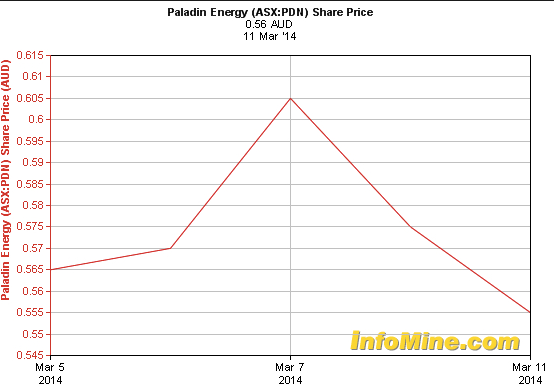
Since the Fukushima meltdown in 2011, uranium prices have also melted falling around 30% in the last 12 months. The price of Silex stock has fallen 48% over the same period (and come down from 2007 highs above $12 to $1.16), affected by sentiment weighing upon Paladin Energy Ltd (ASX: PDN) and Energy Resources of Australia Limited (ASX: ERA), which is majority owned by Rio Tinto Limited (ASX: RIO)
[..]
recent news that Japan intends to restart at least two nuclear reactors, potentially unwinding some of the recent negative market sentiment (Or maybe not – Arclight) http://in.reuters.com/article/2014/06/30/us-japan-nuclear-evacuation-Even supporters of restarts have doubts about the plans.
http://hotcopper.com.au/threads/a-good-analysis.2310128/?post_id=13597957#.U7M0fYYpLFA
Why this bargain growth stock could power you to an early retirement By Mark Woodruff – July 1, 2014 | More on: SLX 0 inShare Here is an opportunity to buy a growth stock at a significantly discounted price. I have been following the fortunes of Silex Systems Ltd Australia (ASX: SLX) for well over a decade. The one-time subsidiary of Sonic Healthcare Limited (ASX: SHL) became a separate entity in 1996 and went about establishing the commercial viability of Silex technology. Silex stands for Separation of Isotopes by Laser Excitation, to enrich uranium. This technology is the only privately held information that is classified by the U.S. government.
This is the opportunity, as while the company has to keep the market fully informed, such a classification leads to secrecy. This was illustrated on an ABC 4 Corners program, when the reporter was restricted in pursuing his story by security guards and endless barbed wire fences. In my opinion, the company has enormous upside potential via its licensing agreement with Global Laser Enrichment (GLE). This is a business venture majority owned by General Electric Company (NYSE: GE), a global industrial colossus.
Because the technology of Silex is classified, the normal 20-year patent protection becomes a perpetual royalty of between 7% and 12% of GLE’s revenues. GLE has invested hundreds of millions of dollars to date and continues to fund the program towards potential construction of the first commercial production plant. Yesterday’s Announcement: “Stick to your knitting” means that one should concentrate (especially in business) on what one does best. This perfectly summarises yesterday’s results of a major strategic review by the Board of Silex Systems. It resulted in a 5.5% rise in the share price to $1.16 on a day when the benchmark S&P/ASX 200 Index (Index: ^AXJO) (ASX: XJO) lost 0.91%. The strategic review aims to refocus efforts on this technology, the primary economic asset. So the company is pursuing strategic partnerships or transactions to effectively divest three subsidiary businesses it has become involved in, subsequent to the foundation technology.
Continue reading →
July 1, 2014
Posted by arclight2011part2 |
Uncategorized |
Leave a comment
http://www.gofundme.com/9yubhk
UPDATE This GO FUND ME account has been closed qithout warning or any notification ..
Hello nuclear-news.net viewers. Sorry I haven’t been posting as regularly as I usually have been.
I have managed to finally get some accommodation and at least some work. I have been living from hand to mouth and sleeping on the smallest two seater sofa known to mankind this past month or so. I now have a bed that is big enough to sleep on, without my feet dangling over the edge.
I haven supported by some wonderful people that have got me this far and I have regained my lost weight and sorted out my erratic sleeping pattern. I wish to thank those that helped me from the bottom of my heart. You know who you are but i understand your wish to remain anonymous.
The move to Ireland has been successful for me and I am tentatively getting back on my feet after the terrible situation I found myself dealing with in the UK, as described in my earlier posts and you tube videos. My heart goes out to those many activists left in the UK who are or will be, dealing with similar harassment from the police and security services for their beliefs and concerns. And to those activists I have had close contact with and have developed a close and warm relationships with over these past few years, I miss you all very much and hope to carry on the fight from a stronger position here in Ireland ( a much more free, democratic and caring society than the UK has turned out to be).
I have opened up a go fund me account (linked above) that will allow people to send me small donations easily. I have set a limit of 2,000 Euros to cover the expenses for some computer hardware and various items for my new accommodation. I have set this limit as I have steady work on the horizon and hope to return to the self funding of my activism that I had up until the beginning of this year.
This donation request is designed to bridge the gap until my earnings from the day job start coming in and to set up the tools for my Internet research and article posting and OpEds. Also, I am developing some exciting anti nuclear projects with some other bloggers and I hope to inform you of these projects in the very near future. 2014 will be the beginning of the development of and consolidation of the new media platforms I hope.
Please feel free to send in any amount that you can reasonably afford. The smallest donation will be received with deep gratitude in these times of austerity.
Finally, from tomorrow I will be returning to my regular daily posting of the news and occasional personal OpEds here on Nuclear-news.net ..
I thank you for your attentions and patience over these past weeks.
Peace Light and Love
S. McGee
Aka arclight 2011
June 30, 2014
Posted by arclight2011part2 |
Uncategorized |
3 Comments
“…..so that is why the Audubon article made a comment from 3 anonymous sources and did not point out that Christelle Adam-Guillermin et al are actually in a competitive adversarial position to Moller et al. ….”

Posted to nuclear-news.net
posted on 27th June 2014
posted by Shaun Mc Gee
aka arclight
A new article that discusses Mollers et al findings on the effects of radioactive contamination on bird wildlife in the Fukushima area was recently posted on line.
Within the article 2 scientists were commented as saying that these findings were important and that the study was efficient.
http://mag.audubon.org/articles/birds/chernobyl-s-radiation-seems-be-robbing-birds-their-sperm
However, one scientist was quoted;
“Christelle Adam-Guillermin points out that the researchers based their statistics on ambient radiation levels in the environment rather than on each bird’s absorbed dose, or the amount of radiation it’s exposed to both internally and externally. “
Christelle Adam-Guillermin thought that this study was flawed and with a little bit of digging I found that she also was doing a similar bird study in Fukushima in 2013 supported by Japanese scientists and the French IRSN (with whom she works).
The link to that study is here ..
https://wiki.ceh.ac.uk/download/attachments/196083904/Effects%20on%20birds%20and%20frogs.pdf?version=1&modificationDate=1369323874000&api=v2
Also in this article 3 scientists (who preferred to remain anonymous), said that Moller had made a mistake and although he did admit this mistake, they thought that he had done it fraudulently an should never be forgiven . Even though this mistake was made many years ago (11 years ago, concerning a 1998 mistake ), these 3 anonymous scientists were still quoted.
This is not the first time that Mousseau, Galvan and Moller have had the results of their work in Fukushima twisted to suit the views of the big energy companies connected to the nuclear industry.
In a recent article by the Sciencedaily.com magazine, findings showing that some birds eventually developed an immunity to the radiation, were twisted to make the reader think that there was very little problems with wildlife in the nuclear contaminated areas of Japan. The true extent of the damage was not discussed though if one looked at the actual report, one would see that many species had died out and the surviving species had suffered catastrophic loss in order to get the result of “radioactive proof birds”. The link to a breakdown of that article is here;
https://nuclear-news.net/2014/04/28/how-to-spin-a-radioative-bird-during-chernobyl-remberance-day-using-google-and-sciencedaily-com/
You might ask why the IRSN, nuclear lobby an the Audubon organisation might want to challenge Moller et als findings in such a nasty way? In the field of epidemiology there has been little study on the effects of radiation on humans. However, funding for some butterfly and bird species has been made available (though limited). The small amount of funding ( in the case of Moller et al) was made up by the fact that the team including Galvan worked very hard at gleaning as much evidence in their short time in Japan whilst the IRSN team seemed to have a good party (It does look like they may have some work also ). The evidence to the IRSN having a party can be found here (along with their inconclusive findings) ; 
https://wiki.ceh.ac.uk/download/attachments/196083904/Effects%20on%20birds%20and%20frogs.pdf?version=1&modificationDate=1369323874000&api=v2
Obviously, the IRSN and anonymous scientists themselves would not be able to give the impression that they were the only real, informed and superior scientists on bird epidemiology without the connivance of the media outlets and authors that present articles on these topics.
You might ask why such a media outlet as Audubon might want to do this?
“….. What do a car company and a conservation organization have in common? Plenty. Innovation. Leadership. Commitment to community. Dedication to diversity. And a focus on meeting the needs of the present while investing in the future. When Audubon and Toyota joined forces to create Toyota TogetherGreen, we knew we wanted to create a conservation program that modeled those qualities. http://www.togethergreen.org/about ….”
Toyota are hoping to make it big in the “renewable”car field.. they dont want efficient and clean chemical batteries created and maintained by small local industries but want to use old style energy systems that require global sized large energy infrastructure to operate. Of course Toyota have decided to go for the hydrogen fuel cell as batteries may be replace with this chemical battery; https://nuclear-news.net/2013/05/03/an-aluminium-fuel-cell-why-is-uk-government-blocking-it/
Media outlets are reliant on advertising revenue to survive and the big PR companies that supply this essential revenue work directly with the large energy corporations that support the nuclear industry. A recent Manga story that showed possible health effects from radiation in Fukushima prefecture had to be pulled as the publisher was refused advertising spots from a large amount of media organisations.
Added to the fact that fictional Manga articles (based on real people and situations), real discussion on health effects from the nuclear disaster have been banned and health professionals and journalists are under threat from imprisonment if they release any information that shows any health effects.
https://nuclear-news.net/2014/06/25/the-manga-oishinbo-controversy-radiation-and-nose-bleeding-in-the-wake-of-3-11/
So, summarising as to why Moller et als study is being attacked. Because the findings seem to point at a number of health effects (some shocking) in the wildlife in the contaminated areas, it would make sense that other scientists with a financial and academic interest would want to attack any study that might stop the nuclear industry and increase costs in compensation from the nuclear accident.
Their very jobs and funding are at risk. It is the same for the media companies that have to place strategic comments on their articles that detract from the honesty and accuracy of such findings. The media companies would also face litigation from corporate legal teams representing nuclear connected industry interests as well as losing advertising spaces and reduced business from their corporate customers, so that is why the Audubon article made a comment from 3 anonymous sources and did not point out that Christelle Adam-Guillermin et al are actually in a competitive adversarial position to Moller et al.
Here is some info on the PR campaign connections with WPP and Ogilvy and Mather (who covered up the Fukushima daichi nuclear disaster effects for the Japanese government) ;
“….Toyota is the most valuable car brand in the world. This is according to the annual BrandZ Top 100 study conducted by marketing research firm Millward Brown Optimor.
The BrandZ Top 100 Most Valuable Global Brands ranking assesses brand value with the help of financial data and feedback from potential and current buyers. ……… It was started by Millward Brown Optimor, which is a unit of Kantar. Kantar is the data investment management arm of advertising firm WPP.
The Toyota brand took the top spot in the 2014 study with value of $29.6 billion, a 21 percent jump over last year’s figure. In the nine years the study has been conducted, it has been named the number one global automotive brand seven times. Toyota is in the 26th spot in the list of the top global 100 brands. 22 may 2014 ….”
Toyota have recently decided to use the hydrogen fuel cell in their cars and are soon bringing working vehicles on line. They hope to use nuclear reactors to create the hydrogen needed for the fuel…
Nuclear power is relevant to road transport and motor vehicles in three respects: (1) hybrid vehicles potentially use off-peak power from the grid for recharging; (2) Nuclear heat can be used for production of liquid hydrocarbon fuels from coal; and (3) hydrogen for oil refining and for fuel cell vehicles may be made electrolytically, and, in the future, thermochemically using high-temperature nuclear reactors. December 2009
June 27, 2014
Posted by arclight2011part2 |
Uncategorized |
2 Comments
http://www.japanfocus.org/-Eiichiro-Ochiai/4138
The Asia-Pacific Journal, Vol. 11, Issue 25, No. 4, June 23, 2014
Eiichiro OCHIAI
“Oishinbo” is the title of a series of manga (comic), meaning “Gourmet Craze”, created and written by Kariya Tetsu. It has been continuously published since 1983 in a comic magazine “Big Comic Spirits” published by Shogakukan (Tokyo), and enjoyed great popularity in Japan. The series, mainly centered on gourmet food, has been re-published in more than 100 books, and in the past caused controversies regarding its criticisms of food and food regulations.

Oishinbo volume 102 |
An episode titled “The Truth about Fukushima (series 604)”, with episode 22/23 published on May 12, 2014. It depicted a conversation about “Nose Bleeding” among the comic’s protagonist Yamaoka Shiro, a scientist and the former mayor of Futaba-machi a town adjacent to the Fukushima Dai-ichi Nuclear Power Plant, which had severe accidents on the occasion of the Great East Japan Disaster when a powerful earthquake (magnitude 9) combined with the huge Tsunami on March 11 of 2011 (the 3.11 incident). A portion of a key scene of the comic is shown below. The controversy, centered on the issue of the main character suffering nose bleed after a visit to the plant, and another character modeled on the former Futaba Mayor, warning people against living in the prefecture. After the Fukushima prefectural government issued a protest against the manga for inflaming fears about the safety of the prefecture’s fish, the publisher announced that the popular series would take a break following a final issue on “The Truth about Fukushima” on May 19.
This episode in the comic, centered on nose bleeding in the wake of 3.11, provoked an unusual controversy immediately upon publication, and all printed copies of the comic were rumored to have sold out quickly. Essentially there are two views. One is “denial of the fact” that many people have experienced nose bleeding after the Fukushima incident, with the assertion that nose bleeding cannot be caused by the radiation emitted from Fukushima Dai-ichi. The other view is that it is reasonable that the nose bleeding observed among the people of Fukushima prefecture and surrounding areas including Tokyo could be caused by radiation, as suggested in the comic.

Courtesy of Shogakukan (Tokyo)
(The conversation goes like this (top to bottom, right to left): “I think the reason that so many people in Fukushima are suffering from nose bleeding and serious fatigue…” “It is due to exposure to radiation.” “Concerned mothers in Osaka investigated 1000 persons living near the incinerating facility dealing with the debris brought from the affected areas.” “They found problems with the eyes and respiratory system, though I would not say that all are due to radiation.”) |
The fact is that no scientifically definitive proof has been found for the cause-effect relationship in the case of nose bleeding. No serious studies have been conducted on this issue. The question is then whether the scientific arguments “against” causality are more reasonable than the arguments “for” causality or the reverse. If the former (against) is reasonable, and is very likely based on the best human knowledge available, it would suggest that it is not necessary to worry about the entire issue of radiation effects on living organisms at current levels. On the hand, if the latter (for) is more reasonable and conforms to the best human knowledge, there would be need to worry about radiation effects, and action would be required to reduce such danger to the minimum.
The Political Aspect
The denial has two aspects: one is political, the other scientific. The political powers, including the current mayor of Futaba-machi, the minister of the environment and even the prime minister, strongly criticized the episode, saying that the contents do not hold up to scrutiny. They deny categorically the facts depicted in the comic. The intention seems to be to suppress any suggestion of a causal relationship between nose bleeding and the radiation emitted as a result of the disaster and any criticism of the government and the nuclear industry. People, including locals, have been keenly aware of government intentions in strongly reacting to this trivial incident. After all, it was simply a description of certain incidents observed by the author and associates and presented in a comic. Why did the government go to such lengths to suppress mention of nose bleeding? The incident suggests the desperation of the government and the industry to suppress the facts concerning the danger of radiation.
The local governments of Fukushima prefecture and local communities expressed concern, coining the term “damage caused by rumors”. This suggests that to express something that cannot be verified may adversely affect those for which the concern is expressed. In this case, the idea was to suggest that people (Japanese citizens) may receive a false impression that radiation is still significant in Fukushima, and might become afraid of approaching the area, buying products made in the area, etc., despite the fact that the radiation level has already been reduced significantly, as the local governments and the Japanese government insist. However, it is to be recognized that the damages caused by radiation are indeed more serious than rumors such as these. But what is the true situation concerning radiation? Unfortunately, precise, accurate and detailed data are non-existent or have been hidden from public scrutiny. Besides, a more significant issue is the question of how low a level of radiation should cause us to worry. Is there a threshold? This is a scientific issue, so we now turn to the scientific aspects of the controversy, which are the main focus of this article.
The Facts about Nose Bleeding and Other Symptoms
There have been a number of reports of unusual nose bleeding after the Fukushima Dai-ichi accident. These have been made mostly by individuals who have had nose bleeding themselves or have observed their children’s experience of unusual nose bleeding. Some prominent persons, such as a medical doctor who appeared in the comic, have reported observations of nose bleeding. Nose bleeding has also been reported in connection with the Chernobyl incident (1986). Dr. Hida Shuntaro, a medical doctor and a survivor of Hiroshima Atomic Bomb, has witnessed many examples of radiation-related illnesses, including nose bleeding and unusual fatigue syndrome after the Hiroshima bombing. Fatigue is another symptom discussed in the comic. One of the more recent reports can be seen here,1 in which several citizens from Fukushima prefecture describe in detail their experiences of ill-health including nose bleeding.
It is true that there are many causes for nose bleeding. This fact may have influenced some people to belittle the possible causality between nose bleeding and radiation. Whether this is the case or not, no official detailed data on nose bleeding has been collected in any of these situations (Hiroshima/Nagasaki, Chernobyl and others), let alone the Fukushima case. This is a fact, and the deniers use this fact as a ground for their claim that no widespread nose bleeding incidence has been observed, and that such a description even in a comic is demagogic.
A few relatively large data sets have, however, been collected. One on the Chernobyl incident was collected by a group led by Hirokawa Ryuichi.2 Over the years 1993-96 he collected data from 25,564 persons who were evacuated from the immediate vicinity of Chernobyl. The following results were obtained from 2127 persons who evacuated from Chernobyl city 8-9 days after the accident.
(a) Ill-health effects experienced one week after the accident:
headache: 64.5 %; nausea: 41.5 %; sore throat: 42.5 %; pain on the skin: 7.1 %; nose bleeding: 21.6 %; fainting: 9.7 %; unusually strong fatigue: 61.7 %; state like being drunk 22.1 %; other ill effects: 13.4 %
(b) Current health conditions:
healthy: 2.7 %; headache: 74.6 %; sore throat 35.6 %; anemia: 14.2 %; dizziness: 50.2 %; nose bleeding: 19.6 %; fatigue: 74.9 %; susceptible to cold: 59.0 %; pain in limbs and bones: 64.0 %; eye sight problem (cataract): 30.5 %; abnormalities in thyroid glands: 37.8 %; tumors: 3.8 %; leukemia: 0.7 %; congenital abnormalities: 0.1 %; others 20.0 %.
A team from Kumamoto Gakuen University led by Nakachi Shigeharu3 in Nov. 2012 investigated nose bleeding and other illness among the people living in Futaba-machi adjacent to Fukushima dai-ichi and Marumori-machi 60 km north west north of Fukushima dai-ichi, and compared the data to those for people living in Kinomoto-cho in Shiga prefecture 600 km west of Fukushima dai-ichi. The odds ratio of nose bleeding among the people living in Futaba- and Marumori-machi were 3.5 and 3.8, respectively. This indicates that nose bleeding incidence was significantly higher (by 3 to 4 times) in towns close to Fukushima Dai-ichi compared to that in a place far from it. Other symptoms including headache, dizziness, nausea and fatigue were also high among people living in Futaba-machi.
Continue reading →
June 25, 2014
Posted by arclight2011part2 |
Uncategorized |
Leave a comment
http://www.katu.com/news/local/Working-climate-at-Hanford-nuclear-site-is-strained-264505811.html
By Nicholas K. Geranios, Associated Press Published: Jun 24, 2014
SPOKANE, Wash. — Few of the U.S. Department of Energy workers who are helping build a plant to treat the most dangerous radioactive wastes at a nuclear site in Washington state feel they can openly challenge management decisions, according to a report obtained Tuesday by The Associated Press.
The survey conducted by the Energy Department shows only 30 percent of the agency’s employees at the Hanford Nuclear Reservation feel they can question their bosses.
The results were somewhat better for the plant’s managers who responded, with 65 percent saying they could openly challenge decisions by higher-level managers.
Democratic Sen. Ron Wyden of Oregon said the study shows recent allegations of retaliation against Hanford workers who raised safety concerns made other employees less likely to come forward.
The Energy Department, in a news release, said it “remains committed to developing and sustaining a strong nuclear safety culture.”
The agency said it has taken many steps in the past year to improve the safety at Hanford and other nuclear weapons production sites around the nation.
“We have more work to do,” the agency said.
Continue reading →
June 25, 2014
Posted by arclight2011part2 |
Uncategorized |
Leave a comment
25 June 2014
http://www.businesskorea.co.kr/article/5166/nuclear-export-korea%E2%80%99s-nuclear-reactor-technology-succeeds-first-european-export
South Korea’s nuclear R&D technology marks its first success in export to Europe.
The Ministry of Science, ICT and Future Planning revealed on June 24 that the Korea Atomic Energy Research Institute (KAERI) consortium wins a bid as a partner to upgrade Delft University of Technology’s experimental reactor, also known as the OYSTER Project.
The KAERI-run Consortium consists of KAERI, Hyundai Construction, and Hyundai Engineering.
The objective of this project is to complete the upgrade of the reactor’s capacity from the current two megawatts to three megawatts by the end of 2017. This deal costs 19 million euros (about US$26 million).
This bidding holds significant meaning as it won a brutally relentless competition against international consortia from nuclear-power dominant nations such as France, Germany, and Russia.
South Korea’s nuclear technology projects so far were limited to Asia, such as the UAE’s commercial atomic power plant contract in 2009, Jordan’s research system contract in 2009, Thailand’s nuclear research facility upgrade
project in 2009, and Malaysia’s nuclear digital system upgrade in 2012.
In contrast, this is acclaimed to be a significant move, as South Korea’s nuclear energy proves to be world class to win a deal in the nuclear-technology dominant Europe.
Above all, this winning bid proves that President Park Geun-gye’s diplomacy played a major role in the 3rd Nuclear Security Summit in Prague March this year.
President Park had actively engaged in promoting the highly-skilled domestic nuclear technology along with research-related projects including OYSTER.
This upgrade is based on a cold neutron source, a US$39.6 million model developed by KOAERI for seven years since July 2003.
The science minister, Choi Moon-gi, stated that “The winning OSTER bid is a success marking the bright future for nuclear technology export in Europe. It will also serve as a great advantage in the future bid for Netherland’s construction of reactor known as the PALLAS project.”
S. Korea says nuclear programs won’t guarantee N. Korea’s future
SEOUL, June 25 (Yonhap) — Prime Minister Chung Hong-won called on North Korea on Wednesday to cooperate with South Korea and choose the path of co-prosperity on the divided Korean Peninsula.
“North Korea should clearly recognize that what can guarantee its future is cooperation with us, not its nuclear programs,” Chung said in a ceremony marking the 64th anniversary of the outbreak of the 1950-53 Korean War……….
http://english.yonhapnews.co.kr/national/2014/06/25/0301000000AEN20140625004100315.html
June 25, 2014
Posted by arclight2011part2 |
Uncategorized |
Leave a comment
http://www.chicagotribune.com/news/politics/sns-rt-us-usa-military-industry-20140624,0,1291365.story
By Andrea Shalal Reuters
6:20 p.m. CDT, June 24, 2014
WASHINGTON (Reuters) – U.S. weapons makers must focus on affordability and be more upfront about the cost of new, cutting-edge technologies given a large “bow wave” of increased spending facing the Pentagon in the 2020s, Comptroller Robert Hale told Reuters on Tuesday.
Hale, who will leave office soon after five years as the Pentagon’s top financial officer, said he worried that constant increases in military requirements would undermine a range of efforts under way to drive down the cost of weapons systems.
He said efforts to develop a new long-range bomber would be the “canary in the coal mine” that showed whether budget caps would be effective in curbing runaway weapons costs. The department has said it plans to spend no more than $550 million apiece for 80 to 100 new bombers.
“That would be an enormous achievement,” Hale said in an interview, saying it would be a “struggle” for the Air Force to stay under the cost cap since it developed a new bomber only once every 30 years. Boeing Co and Lockheed Martin Corp have joined forces to compete against Northrop Grumman Corp for the multibillion-dollar order.
Typically, new weapons wound up costing two to three times as much as the ones they replaced, Hale said.
He said the Pentagon faced a “bow wave” or large increase in weapons spending in the 2020s when it hopes to buy the new bomber, large numbers of new ground vehicles for the Army, and hundreds of Lockheed Martin Corp F-35 fighter jets.
The Navy is also working on a new submarine to replace the nuclear-armed Ohio-class submarines, and the Air Force needs to replace the Minuteman nuclear ballistic missiles, he said.
Given those pressure to fund those new systems, he said it was critical for firms to find ways to cut costs, and to ensure that military leaders understood the true cost of new technologies.
“I hope more of them will have to courage to say, ‘Look this is going to be very expensive, maybe you ought to consider (something else),'” he said.
Companies could help government by “sounding an alarm” about the cost of new technologies. That would help firms in the long run, he said, because otherwise the military would simply buy fewer numbers of ships, planes and ground vehicles.
Hale said he hoped the Pentagon could still avoid breaking a multiyear procurement deal with Sikorsky Aircraft, a unit of United Technologies Corp, and Lockheed for new MH-60 helicopters, a Navy plan that has worried industry.
“But ultimately if we have to choose between readiness and multiyears, it would be a tough call,” he said.
Hale said companies needed to “sharpen their pencils” and cut costs, but the Pentagon understood that industry needed to make profits to keep shareholders happy. “They’ve got to make money or they can’t stay in business,” he said.
(Reporting by Andrea Shalal; editing by Gunna Dickson)
June 25, 2014
Posted by arclight2011part2 |
Uncategorized |
Leave a comment
http://www.zawya.com/story/Emiratis_leaving_nuclear_regulator_jobs_raised_at_UAE_FNC-GN_24062014_250616/
Tuesday, Jun 24, 2014Abu Dhabi: A member of the Federal National Council on Tuesday put a question to Dr Anwar Mohammad Gargash, Minister of State for FNC Affairs, on the reasons behind many Emiratis quitting jobs in a certain department of the federal nuclear authority.
Thirteen employees resigned from the nuclear regulator last year due to dissatisfaction with their jobs, it was revealed at a previous meeting of the council.
Hamad Al Rahoumi, a member from Dubai, said the Federal Authority for Nuclear Regulation (FANR) has to investigate the reasons behind these citizens’ resignations and why they were mostly from a specific department.
A letter was sent to the House about the bonus details and a timetable with the names, job details and reasons why the 13 quit.
It said that bonuses were mostly granted to specialised staff in technical fields and all of the employees’ reasons for leaving included job dissatisfaction. Some got better job opportunities, while others spoke of unhappiness over job security, work environment and teamwork.
Rules to make the use of the Emirates ID card mandatory for Emiratis and expatriates across the board were also debated by the Federal National Council on Tuesday.
The use of the Emirates ID card is mandatory for Emiratis and expatriates in pursuance of federal law No 9 of 2006 on the Demographic Registry and Identity Card and Cabinet Resolution No 25 of 2011.
Members of the House approved changes in the law, giving more powers to the board of directors of the Emirates Identity Authority to set up a system of implementation, deadlines and exemptions from Demographic Registry rules.
Under the rules, it is mandatory for all Emiratis to produce the ID card along with the passport and the family book to finalise all transactions and dealings at work places, schools and to enjoy the benefits.
All expatriates and their family members, who work in government, semi-government and private sectors, have to produce the ID card and the passport which contains the residence visa to have their transactions finalised and completed at the work place.
The rules state all entities, departments and establishments across the country must abide by the provisions of federal law No 9 of 2006 on Demographic Registry and ID card. Anyone in his/her capacity as employee, official, worker or student or having any other status, must obtain the ID card to use any service.
By Samir Salama, Associate Editor
Gulf News 2014. All rights reserved.
June 25, 2014
Posted by arclight2011part2 |
Uncategorized |
Leave a comment
By Kyle Stucker
June 24, 2014 – 9:56 PM
HAMPTON — Seacoast residents again questioned Tuesday during an annual meeting about Seabrook Station’s safety why owners of the degraded nuclear power plant can apply for a new license 20 years before their current license expires.
“I just don’t understand how you could be considering relicensing this far ahead with all the problems down there,” said Don Tilbury, an area resident, to Nuclear Regulatory Commission officials running the meeting. “You’re in the midst of something you don’t know the results of. … You don’t really know that they’re safe.”
Roughly 40 people, including elected officials and Seabrook Station employees, attended Tuesday’s annual open house and safety meeting for Seabrook Station at the Best Western in Hampton.
The purpose of the meeting was to inform the public that NRC officials have deemed the plant operated safely in 2013 despite increasing degradation and cracking caused by an alkali-silica reaction within the plant’s concrete, according to the NRC.
NextEra Energy is seeking to extend its license from 2030 to 2050. A determination about Seabrook Station’s license application won’t be made until specialized ASR tests are completed and various action plans are implemented, according NRC Division of Reactor Safety Deputy Director Jim Trapp.
Those tests, being conducted at the University of Texas at NextEra’s expense, are expected to take roughly a few years or longer to complete.
University of Massachusetts Lowell nuclear engineering professor Gil Brown raised several questions and concerns about the plant’s safety and the relicensing process during the question and answer period of Tuesday’s meeting, although he said the seemingly “arbitrary” and “early” 20-year relicensing application period is a good thing.
He said the plant “has to be safe” and that it’s not wise to wait until “five years” or “one year” before a plant’s license expires to conduct time-consuming tests to evaluate safety and structural integrity.
“I would say 20 years gives time to resolve things that have shown up, like ASR,” Brown said.
NRC staff say recent visual inspections indicate there are 171 locations of cracking throughout Seabrook Station’s various concrete structures due to the gel that slowly forms when the alkali and silica within the concrete react.
NRC Public Affairs Officer Neil Sheehan said tests last year indicate there were 131 locations of cracking due to ASR, which is a common problem with concrete. The number of locations is expected to grow over time, and the University of Texas tests are being conducted to determine how the cracking will affect the plant’s concrete and operability decades down the line.
The NRC claims the plant’s concrete is still able to handle its required loads despite the cracking, though, because the plant was constructed to structural specifications that far exceeded the design loads. NRC staff say Seabrook Station’s ASR is not “infringing” on those margins.
Detailed information about ASR findings at Seabrook Station, recent safety inspections and evaluations, and updates and findings from the University of Texas tests can be found online at www.nrc.gov.
June 25, 2014
Posted by arclight2011part2 |
Uncategorized |
Leave a comment
http://news.yahoo.com/nrc-raises-risk-significance-2013-arkansas-nuclear-plant-181841548–finance.html
23 June 2014
(Reuters) – The U.S. Nuclear Regulatory Commission (NRC) said on Tuesday that after a series of investigations, it has declared a 2013 incident at an Arkansas nuclear power plant to be of substantial safety significance, the penultimate of four emergency classifications.
An industrial accident at Entergy Corp’s Arkansas Nuclear One plant in Russellville killed one worker and injured eight others on March 31 last year, when a generator fell as it was being moved out of the turbine building.
The accident was initially classified as an unusual event, the lowest of four emergency classifications, because the incident caused a small explosion inside electrical cabinets.
The incident caused unit 2 of the plant to automatically shut down when a reactor coolant pump tripped due to vibrations caused by the heavy component hitting the turbine building floor, damaging electrical cables and equipment, leading to a loss of off-site power.
Unit 1 at the plant was in a refueling outage at the time, with all of the fuel still in the reactor vessel, safely cooled.
Emergency diesel generators were relied upon for six days to supply power to cooling systems.
If the diesel generators would have failed, there was no alternate means of providing electrical power to key safety-related systems at the plant at that time, due to the damaged electrical cables and equipment.
“The NRC determined that the lifting assembly collapse resulted from the plant’s failure to adequately review the assembly design and ensure an appropriate load test in accordance with its procedures or approved standards,” the NRC statement said.
NRC held a regulatory conference with Entergy officials on May 1 and after considering information provided by Entergy, determined that ‘substantial safety significance’ was appropriate to characterize the risk significance of the event for both Unit 1 and 2.
“The NRC will determine the appropriate level of agency oversight and notify Entergy officials of the decision in a separate letter,” the statement said.
(Reporting by Anupam Chatterjee in Bangalore; Editing by Marguerita Choy)
June 25, 2014
Posted by arclight2011part2 |
Uncategorized |
Leave a comment
http://timesofindia.indiatimes.com/City/Chandigarh/Fatehabad-DC-recommends-shifting-of-nuclear-plants-residential-colony-site/articleshow/37157089.cms
Bhaskar Mukherjee,TNN | Jun 25, 2014
Fatehabad: The proposed residential colony of the nuclear power plant at Badopal village of Fatehabad district is likely to be shifted to another site, as the area is inhabited by endangered species like blackbucks and neel gai (blue bull). Project developer Nuclear Power Corporation of India Ltd (NPCIL) had acquired 125 acres of land to build a residential colony for plant workers.
Fatehabad deputy commissioner Dusmanta Kumar Bahera has sent a letter to the state government asking it to shift the proposed residential colony site. Animal rights activists and members of Bishnoi community have been protesting against the proposed colony since last year, demanding its shifting to another site.
Bahera told mediapersons that the administration’s proposal was being considered by the state government and a final decision was likely to be taken soon.
NPCIL is coming up with a 2,800 MW nuclear power plant on 1,313 acres of land acquired at Gorakhpur village in Fatehabad. NPCIL had acquired about 125 acres more at Badopal, about 8 kms from the plant site, to build houses for its employees and personnel of Central Industrial Security Force (CISF).
In September 2013, several blackbucks were trapped and killed in the fencing put up by NPCIL around the colony site which trigged anger among the Bishnoi community. Later, a team of scientists from Wildlife Institute of India (WII), Dehradun, conducted a survey of the spot and submitted a report that Badopal was a key habitat for wildlife and the residential colony should be shifted to some other place.
June 25, 2014
Posted by arclight2011part2 |
Uncategorized |
Leave a comment







 nuclear-news