Niseko Accommodation Announced The Support For Project Fukushima Kids For Charity
“We strongly believe in the efforts of this project and hope to protect the residents from the risk of developing cancer,” said Chris Pickering, Operations Manager of HT Holidays. “We are proud to be able to provide places for the kids and parents to stay in Niseko.”
Niseko, Japan (PRWEB) July 17, 2014
The most established Niseko accommodation provider and market leader, HT Holidays, is proud to announce that they will be providing summer accommodation in late July to support the efforts of the Protect Fukushima Kids.
In order to provide a radiation free summer to the kids and parents affected by the Great East Japan Earthquake in the Tohoku region in 2011, HT Holidays has decided to offer services for their six-day long stay in Niseko during late July. HT Holidays is proud to support this charitable cause, as it will help lower the visitors’ exposure to high radiation levels and also the risk of cancer amongst residents.
“We strongly believe in the efforts of this project and hope to protect the residents from the risk of developing cancer,” said Chris Pickering, Operations Manager of HT Holidays. “We are proud to be able to provide places for the kids and parents to stay in Niseko.”
The Great East Japan Earthquake on March 11th in 2011 caused the high radiation levels of exposure and higher risk of developing cancer to the residents around the Tohoku region. More than 300,000 people were evacuated and many deaths were related to poor evacuation conditions.
“The beautiful summer here makes it the perfect place for people to escape from the tragic and unfortunate incident,” continued Pickering. “This long break in Niseko is a great chance for them to feel relaxed, unconstrained and to participate in hands-on activities. The kids are able to play outside, study and go on a trip to a neighboring area.”
HT Holidays is dedicated to provide what they can to help the kids learn and grow in a healthy environment. To learn more, please visit HT Holidays’ website: http://htholidays.com.
About HT Holidays
HT Holidays is the most established Niseko accommodation provider with over 10 years of experience. They are the market leaders in relation to services and service delivery and look forward to welcoming guests to Niseko.
For the original version on PRWeb visit: http://www.prweb.com/releases/2014/07/prweb12016922.htm
Lake Huron Is No Place for a Nuclear Waste Dump – David Suzuki
According to Stop the Great Lakes Nuclear Dump, burying such highly toxic wastes in limestone next to 21 per cent of the world’s fresh water “defies common sense.” The group’s website notes, “There are no precedents anywhere in the world for burying radioactive nuclear waste in limestone. The repository must function to safely contain the nuclear wastes for over 100,000 years. No scientist or geologist can provide a 100,000 year guarantee.” The Great Lakes are only 12,000 years old

Posted: 07/16/2014
http://newsbritishcolumbia.ca/2014/07/16/lake-huron-is-no-place-for-a-nuclear-waste-dump/
Is dilution really the solution to pollution — especially when it’s nuclear waste that can stay radioactive for 100,000 years? A four-member expert group told a federal joint review panel it is.
The panel is examining an Ontario Power Generation proposal to bury low- and intermediate-level nuclear waste from the Darlington, Pickering and Bruce nuclear plants in limestone at the Bruce site in Kincardine, beside Lake Huron. According to the Toronto Star, the experts reported that 1,000 cubic metres of contaminated water could leak from the site, although it’s “highly improbable.” But even if it did leak, they argued, the amount is small compared to Lake Huron’s water volume and the quantity of rain that falls into it.
If the materials were instead buried in Canadian Shield granite, any leaking waste would be diluted by active streams and marshes, the experts claimed: “Hence, the volumes of the bodies of water available for dilution at the surface are either immense (Great Lakes) or actively flowing…so the dilution capacity is significant.”
Others aren’t convinced. The Stop the Great Lakes Nuclear Dump group has more than 62,000 signatures on a petition opposing the dump. Many communities around the Great Lakes, home to 40-million people, have passed resolutions against the project, including Canadian cities Toronto, Mississauga, Hamilton, Niagara Falls, Kingston, Thunder Bay, Sault Ste. Marie, Windsor and more, and local governments in the states of Michigan, Illinois, Pennsylvania, Indiana, Minnesota, Wisconsin, New York and Ohio. The United Tribes of Michigan, representing 12 First Nations, is also opposed.
Michigan’s Senate recently adopted resolutions to urge President Barack Obama, Secretary of State John Kerry and U.S. Congress to intervene, and for the International Joint Commission, the Great Lakes Commission and all Great Lakes States and Ontario and Quebec to get involved.
According to Stop the Great Lakes Nuclear Dump, burying such highly toxic wastes in limestone next to 21 per cent of the world’s fresh water “defies common sense.” The group’s website notes, “There are no precedents anywhere in the world for burying radioactive nuclear waste in limestone. The repository must function to safely contain the nuclear wastes for over 100,000 years. No scientist or geologist can provide a 100,000 year guarantee.” The Great Lakes are only 12,000 years old!
On top of that, retired Ontario Power Generation research scientist and chemist Frank R. Greening wrote to the review panel stating that OPG has “seriously underestimated, sometimes by factors of more than 100” the radioactivity of material to be buried.
Greening says the company acknowledged his criticism but downplayed its seriousness, which he believes raises doubts about the credibility of OPG’s research justifying the project. “Their response has been, ‘Oops we made a mistake but it isn’t a problem’ and that really bothers me as a scientist,” he told Kincardine News. “It is rationalizing after the fact.”
According to the newspaper, “a radiation leak at a nuclear waste site in New Mexico — cited by OPG as an example of a successful facility — is further fuelling criticism of the project.” In February, radiation was detected in vaults and in the air a kilometre from the U.S. Department of Energy’s Waste Isolation Pilot Plant near Carlsbad, where radioactive materials from the nuclear weapons program are stored. The facility, the world’s only deep geologic repository, had only been in use for 15 years and is closed for now. The cause of the leak isn’t yet known.
Those and other factors led the joint review panel to re-open hearings beginning September 9. They initially ended October 30, 2013. A federal cabinet decision is expected sometime next year.
This “out of sight, out of mind” mentality must end. We can’t continue to dump garbage into the oceans, waterways and air or bury it in the ground and hope it will disappear. If we can’t find better ways to use or at least reduce waste products, we must stop producing them.
In the meantime, this project must be halted. The Great Lakes are already threatened by pollution, agricultural runoff, invasive species, climate change and more. We can’t afford to add the risk of radioactive contamination to one of the world’s largest sources of fresh water.
Written with Contributions from David Suzuki Foundation Senior Editor Ian Hanington. Learn more at www.davidsuzuki.org.
CWS to map radiation hot spots in 50 nurseries and schools within Fukushima city
The disaster has surely affected the lifestyle of children in Fukushima. According to Kuniaki Sato, the principal of the nursery, in the first two years after the nuclear power plant accident, the children were playing only indoors with curtains shut all the time, which has caused decreases in their physical strength. Until today, they cannot play in fields to pick wild flowers and catch insects. The nursery teachers told us how they have made efforts to nurse children in such a difficult environment.
July 15, 2014
http://www.cwsglobal.org/newsroom/news-features/cws-committed-to-fukushima.html

Three years after the Fukushima nuclear disaster in Japan, CWS continues to support local partners working to help survivors. Yukiko Maki-Murakami, project officer for CWS Japan, visited Fukushima with one of our generous donors in May 2014 to see firsthand some results of CWS’s recovery work with survivors of the disaster. Following are some of her impressions:
I regretted that due to my overseas assignment during the period it took me over three years to make my first visit to Fukushima after the nuclear power plant disaster. When I heard the stories of actual victims, I felt ashamed of the superficial knowledge I had gained from secondhand reports.
I accompanied Eiichiro Kuwana of the Japanese American Association of New York. The association was one of the donors to the Great Eastern Japan Earthquake and Tsunami project, which ended after three years. Kuwana was very much interested in seeing and knowing the current situation and issues toward the recovery of Fukushima.
Our host, Hiroyuki Yoshino of Shalom, one of our implementing partners, took us to Sayuri Nursery School to show us how children in Fukushima were surviving under difficult circumstances. Sayuri Nursery currently accommodates 97 local pre-school children including infants and evacuated children from other areas. The municipality decontaminated their playground and re-opened it to the children one year ago.
The disaster has surely affected the lifestyle of children in Fukushima. According to Kuniaki Sato, the principal of the nursery, in the first two years after the nuclear power plant accident, the children were playing only indoors with curtains shut all the time, which has caused decreases in their physical strength. Until today, they cannot play in fields to pick wild flowers and catch insects. The nursery teachers told us how they have made efforts to nurse children in such a difficult environment.
As the mother of a teenager, I felt pity for those children for whom access to the natural environment was restricted because of high radiation.
One of the nursery teachers told us of her experiences during the critical period of radioactive contamination. She wished she could have evacuated if she had not been a nursery teacher. She expressed her worries about a high staff turnover rate in the nursery.
Furthermore, while evacuated people are beginning to return, the psychological distances between evacuees and the survivors who remained in contaminated areas is now becoming a divisive issue. An income difference between compensated ones and others is another issue dividing the community. Although this may not be a well-known issue outside Fukushima, it could lead to serious problems in the local communities in the future.
Taking into account the lessons learned from the last three years’ experiences, Yoshino now is starting a new psycho-social program and a mapping project to monitor radiation around 50 nurseries and schools within Fukushima City.
CWS Japan also is committed to supporting the implementing partners continuously in this development phase in order to hasten the rehabilitation of Fukushima.
There seems to be no end in sight for the struggles of people in Fukushima. It is my sincere hope that our support can continue to be of some help to relieve the tensions in Fukushima.
Taiwan – Decision on nuclear waste disposal site years away: official – Or its war!
Lawmaker Tien, an Yilan native, threatened on behalf of the county to launch a war against the government if the greater Nan’ao area is chosen as the permanent disposal site.
“We will fight until the end!” she declared.[…]
Image source ; http://news.asiaone.com/news/asia/anti-nuclear-protest-taiwan-attracts-nearly-13000

2014/07/14 21:35:04
http://focustaiwan.tw/news/aeco/201407140030.aspx
aipei, July 14 (CNA) No decision has been made on the location of a permanent nuclear waste disposal site, an official said Monday, after residents of Nan’ao Township in Yilan County reacted angrily to speculation that their town was being considered for the site.
The search remains in its initial stage, which is focused on evaluating the quality of potential “host rock” for nuclear waste repositories, said Lee Hsiao-tung, the head of the Ministry of Economic Affairs office responsible for nuclear waste storage.
Lee explained that the high-level radioactive waste disposal plan proposed by state-run utility and nuclear power plant operator Taiwan Power Co. (Taipower) is divided into five stages, with the project’s completion set for 2055.
In the current stage that concludes in 2017, the goal is to study and evaluate underground rock strata that would be suitable for hosting and storing nuclear waste, Lee said.
The second stage, aimed at choosing candidate sites and determining the most suitable one, will not begin until 2018.
“No one can say now that Nan’ao is the ultimate place” for the nuclear waste disposal site, Lee said in a presentation of the nuclear waste disposal site selection plan held at Yilan County Hall.
The presentation was attended by opposition Democratic Progressive Party lawmakers Tien Chiu-chin, Hsiao Bi-khim and Chen Ou-po, government officials, Taipower executives, Yilan County officials and representatives of Yilan residents.
According to the Atomic Energy Council, the country’s top nuclear power regulator, several potential host rock areas are being evaluated, including the granite strata of the Taiwan-controlled island groups of Kinmen and Matsu and rock formations in the greater Nan’ao area in southern Yilan County.
Chen Teng-chin, the head of Yilan County’s Environmental Protection Bureau, contended, however, that none of the sites being studied in Kinmen and Matsu are suitable for a permanent waste disposal site because of the small scale of their rock beds.
Given that Taipower has conducted drilling tests in Hualien County’s Xiulin Township near Nan’ao, all signs point to the greater Nan’ao area, which covers a river valley plain south of Suao Township, as the final choice, Chen said.
“Don’t even think” of that possibility, Nan’ao Township chief Chiang Ming-shun said at the presentation, arguing that all Nan’ao residents are strongly opposed to the idea.
Lawmaker Tien, an Yilan native, threatened on behalf of the county to launch a war against the government if the greater Nan’ao area is chosen as the permanent disposal site.
“We will fight until the end!” she declared.
(By Worthy Shen and Elizabeth Hsu)
ENDITEM/ls
Ukraine & Singapore may cooperate on nuclear safety – Buisness is buisness!

Ambassador of Ukraine to Singapore Pavlo Sultansky met with Professor Lim Hock, Director, Division of Research Governance and Enablement, NUS and PhD Chung Keng Yeow, Deputy Head, Department of Physics, NUS.
Ukraine-Singapore possibilities of cooperation in nuclear safety were discussed.
Turkey’s nuclear projects to exceed $70 billion – But what about Turkeys poor?
 Image source ; http://revolution-news.com/greenpeace-turkey-confronts-nuclear-power-plants-summit-in-istanbul/
Turkey aims to build three nuclear power plants in its bid to diversify its energy sources.
World Bulletin / News Desk
http://www.worldbulletin.net/news/140733/turkeys-nuclear-projects-to-exceed-70-billion
Total cost of Turkey’s nuclear power plant projects will exceed $70 billion by 2023, Turkish parliament’s energy sub-commission head Halil Mazicioglu said on Tuesday.
“Our goal is to have both Akkuyu and Sinop nuclear power plants to be operational and a third one to be under construction by 2023,” Mazicioglu told Anadolu Agency. “With the additional third project, the sum of Turkey’s nuclear program will exceed $70 billion.”
Several new legislations need to be introduced in order to restructure Turkey’s nuclear field, including the creation of a “Nuclear Energy General Directorate” for coordinating the nuclear projects and preparing necessary infrastructure and programming.
These legislations are expected to be ratified by the parliament during the upcoming legislative term.
The Russian energy company Rosatom signed an agreement to build and operate a four reactor nuclear power plant in the Mersin province on Turkey’s Mediterranean coast.
Turkey also has plans to build a second four reactor nuclear plant in the port city of Sinop on the Black Sea coast with a Franco-Japanese consortium.
A third nuclear project is expected to be constructed with Turkey’s own domestic resources.
Turkey currently relies heavily on foreign energy resources like natural gas and oil, which drives almost half of its electricity production and costs up to 60 billion dollars a year.
Athabasca Nuclear and Strike Graphite Announce Intent to Merge – Bull or bust?
“….The parties caution that no assurance can be given at this time that the Transaction will be completed, that the conditions to closing will be satisfied, or that the terms of the Transaction will not change materially from those described in this news release….”
Image source ; http://www.stockhouse.com/companies/quote/ywrlf/athabasca-nuclear-corp
Image source ; http://www.4-traders.com/STRIKE-GRAPHITE-CORP-7641147/technical_analysis-full/
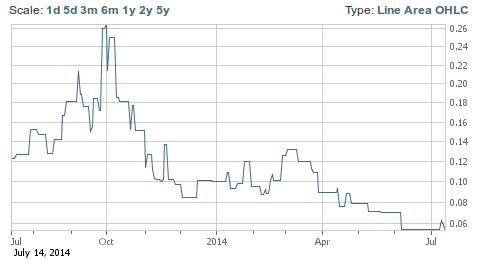
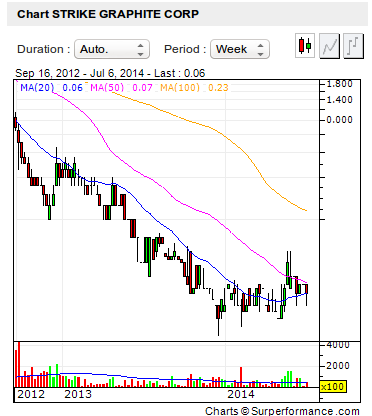
http://online.wsj.com/article/PR-CO-20140715-904725.html
Athabasca Nuclear and Strike Graphite Announce Intent to Merge
VANCOUVER, BRITISH COLUMBIA–(Marketwired – July 15, 2014) –
NOT FOR DISTRIBUTION TO U.S. NEWS WIRE SERVICES OR DISSEMINATION IN THE UNITED STATES
🙂
Athabasca Nuclear Corporation (TSX VENTURE:ASC) (“Athabasca Nuclear”) and Strike Graphite Corporation (TSX VENTURE:SRK) (“Strike”) are pleased to jointly announce that they intend to merge and form a combined Saskatchewan-centered exploration and development company with a multi-faceted project portfolio being focused on the Preston Lake uranium and the Sask Craton diamond projects.
The transaction (the “Transaction”) will be completed by way of a plan of arrangement, or other business combination, in which Athabasca Nuclear will acquire all of the issued and outstanding common shares of Strike. Each Strike shareholder will receive one common share of Athabasca Nuclear for each common share of Strike held. All outstanding Strike options and warrants will be exchanged for options and warrants of Athabasca Nuclear in an amount and at exercise prices adjusted in accordance with the same exchange ratio.
Merged Entity Highlights:
   -- Athabasca Nuclear is the Operator of and a working interest partner in
      the Western Athabasca Syndicate, which is advancing the Preston Uranium
      Project, a large-scale uranium exploration project that is regionally
      proximate to the high-grade uranium discovery made by Fission Uranium
      Corp. in the SW Athabasca Basin. Approximately $3,500,000 dollars in
      exploration has been carried out since July 2013 by the Western Athabasca
      Syndicate in advancing the Preston Uranium Project within a broader
      tenure base consisting of approximately 709,513 acres.

   -- Strike's principal asset is the early-stage Sask Craton and Sask Craton
      North diamond exploration properties ("Sask Craton Properties"), for
      which Strike has received conditional TSX Venture Exchange approval. The
      Sask Craton Properties, in which Strike will hold an 80% undivided
      interest, are contiguous and proximate to the recent Pikoo diamond
      discovery made by North Arrow Minerals Inc. and consists of a mineral
      tenure base of approximately 1,300,000 acres.

   -- The combined entity stands to benefit from reduced operating costs
      associated with the elimination of certain duplicative administrative and
      staffing costs affiliated with running a publicly-traded company. The
      elimination of such duplicative costs may result in incremental capital
      being available to be allocated to exploration of the combined entity's
      project base rather than to administrative expenses.

   -- The aggregation of multiple large-scale project interests within the same
      jurisdiction (Saskatchewan) offers the prospective benefit of being able
      to coordinate regional service companies on a multi-project basis with
      potential economic advantages resulting from volume-based work.

   -- The combined entity stands to benefit from a stronger working capital
      position and balance sheet. Leveraging the fiscal strength of Athabasca
      Nuclear, Strike shareholders will gain access to funding to advance their
      project and address a working capital deficiency which previously would
      have required significant dilution.

   -- The combined entity stands to benefit from a diversified project base
      attracting capital market interest in multiple commodity areas.

   -- The combined entity will offer shareholders of both companies greater
      liquidity by way of a larger combined capitalization and the benefit of
      trading volumes for both equities being concentrated into a single
      vehicle.
“This proposed transaction offers valuable benefits to the current shareholders of both Athabasca Nuclear and Strike. Not only will a combined entity present a superior fiscal situation, but it will also uniquely capture and focus the interest of the capital markets in two of Canada’s emerging resource plays, the SW Athabasca Basin and the Sask Craton, into a single listed vehicle,” stated Ryan Kalt, Chairman & Chief Executive Officer of Athabasca Nuclear.
“Strike is in a fortunate position to have successfully negotiated for its Sask Craton and Sask Craton North properties which recently received conditional approval by the TSX Venture Exchange. By combining with a larger exploration company, Strike will be in an improved position to better access exploration capital for its projects, fund current liabilities, and benefit from a diversified project base,” noted Geoff Balderson, President of Strike.
Athabasca Nuclear currently has 48,593,954 common shares outstanding, and Strike currently has 4,490,649 shares outstanding with a further 12,691,453 shares expected to be issued as a result of its previously announced property acquisitions and debt settlement.
Terms of Transaction
Kyushu’s nuclear restart is not enough – A perfect storm? – Moodys Japan K.K.
“The current tariff, implemented in May last year, is based on four of the company’s nuclear power plants being operational – so even if two reactors are restarted Kyushu will still not be able to return to profitability,” Kazusada Hirose, vice president of Moody’s Japan K.K., told Interfax.
[…]
“On the expenditure side, ordinary expenses increased by 2.5% to ¥1,938.1 billion, affected by […] performances in [the] electricity business as thermal fuel costs increased due to the influence of a weaker yen and costs for power purchases from renewable energy sources increased,” Kyushu said in its FY 2014 results.
[…]

Image source ; http://online.wsj.com/articles/safety-clearance-for-japan-reactors-wont-guarantee-restarts-1405340244
http://interfaxenergy.com/gasdaily/article/11395/kyushus-nuclear-restart-is-not-enough
Restarts at two shuttered nuclear reactors will not be enough to return Japan’s Kyushu Electric to profitability, Moody’s Japan warned on Tuesday in a stark reminder of the difficulties still facing the country’s beleaguered power providers more than three years after the Fukushima crisis.
“The current tariff, implemented in May last year, is based on four of the company’s nuclear power plants being operational – so even if two reactors are restarted Kyushu will still not be able to return to profitability,” Kazusada Hirose, vice president of Moody’s Japan K.K., told Interfax.
“The company’s financial situation is not sustainable on two reactors, and it will have to raise electricity rates again, which the government may be unwilling to do,” said Hirose.
Moody’s warning came one day before the Nuclear Regulation Authority (NRA) was expected to release a draft report on whether the company’s two reactors at Sendai are safe to restart.
The NRA said on Monday it would issue a draft assessment on whether the Sendai reactors had passed updated safety regulations, which were revised in the wake of the Fukushima disaster. The assessment would then be open for public comment for a month before further on-site NRA checks.
“Kyushu Electric’s two Sendai reactors are at the front of the line in terms of inspections. However, since this is the first time reactors would be brought back online, the restart procedure is still uncertain and it remains unclear where the ultimate authority to clear shuttered plants lies,” said Hirose.
Even with central government support, however, Japan’s power providers must secure approval from local communities, many of which have remained staunchly opposed to restarts because of safety concerns.
Earlier in the summer, protestors surrounded government offices in Kagoshima prefecture, the home of the Sendai plant, calling for the reactors to be permanently shut down. During the protest, prefectural officials were handed a petition opposing the restarts signed by around 120,000 people, according to local media. Meanwhile, a March poll by national broadcaster NHK showed 44% of people still believe the country’s nuclear fleet should be permanently shut down.
Deteriorating finances
Peadophile victims attacked by UK government – Bloggers fight back!
Op Ed by Arclight
Posted to nuclear-news.net
Posted on 14 July 2014
A stunning expose of government corruption and attacks on sex victims and supporters in the UK using the “Law”
link source
http://www.dailymotion.com/video/x21g7en_uk-column-news-july-14-2014_news
In a follow up to the attacks on bloggers in the UK, I am posting another video on behalf of, and in support of UK Column and the anti Fracking activist Ian Crane, who are being targetted by the UK`s security services and Home office via “independent organisations”. Having been at the brunt of this sort of operation myself, I feel an obligation to support my fellow citizens in having their right to free speech and discourse not being impeded. So my you tube channel will be used in this support for the near future as I now live outside the UK national borders.
In my earlier ATVOD video, A commenter appeared and left a link to another video that insulted UK Column in true JTRIG style. I looked into the video source and left my findings in the comments. Briefly, the source was from another “Charity” style organisation that is in support of big business. I left links and commentary underneath that video .
In this video from UK Column you will see victims and supporters being persecuted by being sent to jail to destroy there credibility and sex offenders being supported. This is not the way the Law in the Uk is supposed to work but in the new paradaigm UK citizens find themselves in, this is becoming the norm.
Here is a link to other great research in this area and you can get all the UK column videos a few hours after they have been shown live. The video stream is not very good and I wonder if it is not being messed with .. I have personal experience of bandwidths being slowed in the UK and know of other bloggers having the same problem.
All the most recent investigations can be found at this source (to be updated if it gets blocked )
http://www.dailymotion.com/f100004576424298
Please share and distribute widely
Creative commons is enabled for easy download and reupload to another video site please use it and get the word out
here is Chunky mark making an impassioned commentary on the sex offenders cover up
https://www.youtube.com/watch?v=RIlhj_tB_SE
and here is a shocked German citizen asking the European parliament to look into the terrible issue of enforced adoptions at a time that pedophiles in the UK government and their security services supporters are running wild with the ultimate digital control mechanism. These Pedophiles also have the “Law” in their pocket.
Sabine Kurjo McNeill (German), on behalf of Association of McKenzie Friends, on Abolition of Adoptions without Parental Confirm (forced adoption)
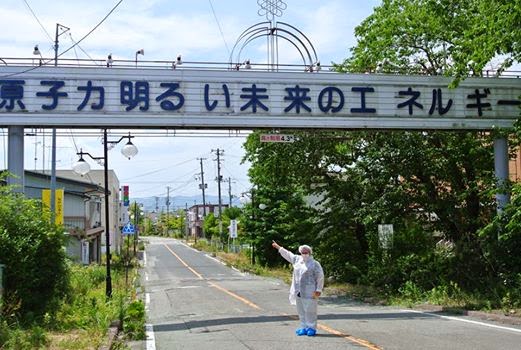
INTO THE FUKUSHIMA FORBIDDEN ZONE – JULY 12, 2014
The radioactivity in the Futaba city, at its most radioactive spot , according to my friends, former residents of Futaba City, with who I was (beside the plant site and outside the forest) :
24.12 mSv / h (microsieverts / hour) on this photo, but in reality it even went up to 25. 25μSv / h.
It is 219 millisieverts / year,
or 219 times the dose considered acceptable for the civilian population
(1 mSv / year, 1 millisievert / year).
I did not find any change in the ambient radioaction from my previous radiation measure in November 2013, through the once inhabited area.

Janick Magne is a French citizen residing 35 years in Japan, she has been entering repeatedly the forbidden zone thanks to the help of a Japanese family who are going there regularly to visit their evacuated house.
Janick Magne’s purpose in going there is to take continuous radiation measures and pictures in order to testify about the real gravity of the situation. Gravity which the Japanese Goverment and the world mainstream media are mimimizing if not totally omitting to report, covering it up with their well-oiled propaganda and their plain outright lies..
Thank you Janick Magne for your outstanding dedication and your unwavering courage to expose the truth.
View original post 763 more words
John Large – Nuclear analyst concerned over Fukushima ‘ice wall’
Published on 12 Jul 2014
Nuclear analyst John Large, July 9, 2014: The cores remain active for hundreds, if not thousands, of years, so there’s a commitment to keep either the ice wall technology in place or to replace it with an alternate technology by some future generation. […] Water is coming off the escarpment above the three reactors, it’s then percolating through the ground — there’s hydrostatic pressures pushing the water up toward the sea level — it’s then collecting the fission products and radioactive products from the melted-down cores and taken out to sea. […] What I think they should now have a plan to tackle the root cause… How do you control, manage and eventually remove the reactor cores? […] If the reactor cores remain in there, it’s going to be a constant leachate (water that percolates through a solid and leaches out some of the constituents) of radioactivity.
Fukushima Three Years Later – The Children (Original site blocked)

It’s hard to believe that three years have gone by since the devastating earthquake, tsunami and subsequent destruction and meltdown of the Fukushima Daiichi Nuclear Power Plant. As we have come to learn, most of what was told of this catastrophe was not true and people are now beginning to suffer the consequences, especially the children.
I read this heartbreaking story about the daily lives of the children of Koriyama, not very far from the now destroyed nuclear plant. At the onset of trouble these families should have been evacuated from the area and told the truth about the radiation releases. Instead, the “Exclusion Zone” was limited to 20 Kilometers and those just outside of that were asked to stay inside for an undetermined amount of time. A few weeks later that zone was expanded to 50 Kilometers, how would you feel? In fact, they should have left the that entire side of the island, if not the country itself.
 Now the Japanese government is telling Fukushima families, three years later, that it’s O.K. to move back in to their homes and restart their lives. There was even a report several months ago of offers made to pregnant women and young mothers, by the local Fukushima government, for free housing if they moved in to “newer” homes previously evacuated.

Over the past week, two more revelations were made about Fukushima radiation and it’s effects. First, Arnie Gunderson, former nuclear engineer and co-founder of Fairewinds Energy Education, came out with another article about the devastating effects of radiation upon children and how quickly they can occur. Secondly, In a public meeting at the UK House of Commons on the 10th of this month, Fukushima evacuee Gavin Allwright, testified to the disasters and their effects on his family. Included in his statement, was the fact that there was a very fine black dust in Miyagi, the prefecture just north of Fukushima, and that it had not been analyzed for a very long time. It has since been disclosed that it is highly radioactive and that the paper masks worn by the children will not protect them from these deadly particles.
As we continue to learn of the deception people of Fukushima, one has to wonder how far that deception reaches.
Link to original site
http://radiationrain.com/2014/03/24/fukushima-three-years-later-the-children/
Your access to this site has been limited
Your access to this service has been temporarily limited. Please try again in a few minutes. (HTTP response code 503)
Reason: Access from your area has been temporarily limited for security reasons
Open a Nuclear Fuel Bank please! says the IAEA – Ignoring the earthquakes again?
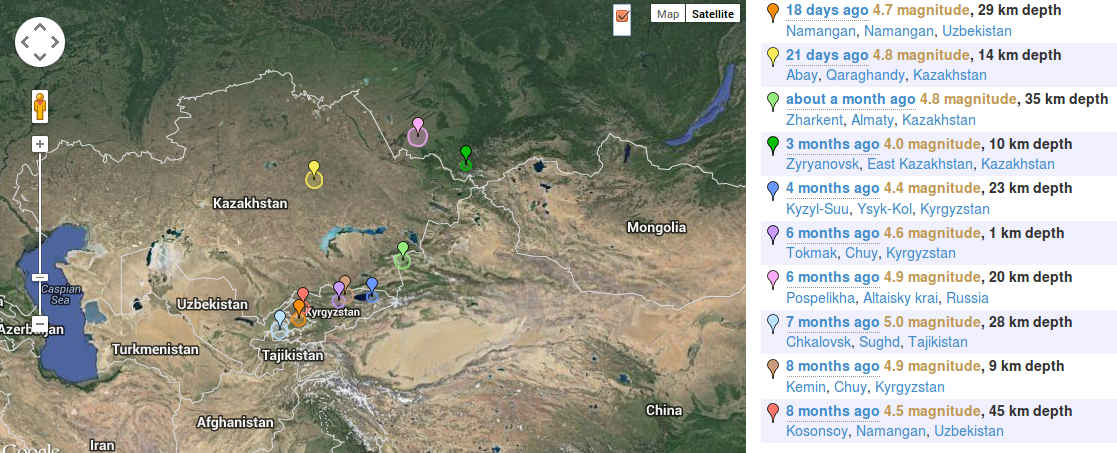
…..But in the three years since, the agency and Kazakhstan have not been able to finalize plans. The I.A.E.A. and Kazakhstan should work together to quickly resolve the remaining issues, including determining the seismic stability of the Ulba facility. Given the investment made by both sides in the viability of the site, implementing any required precautions to manage seismic risks should be the highest priority and demands good-faith cooperation.
Image source ; http://earthquaketrack.com/p/kazakhstan/recent
If this site does not meet safety requirements, the parties must find another site in Kazakhstan or the I.A.E.A. must identify another national host to fulfill the 2010 mandate of its board of governors……

WASHINGTON — As the United States and its negotiating partners continue nuclear talks with Iran in Vienna, the pressure is rising. The deadline for a final accord is July 20, and success hinges on Iran agreeing to verifiable commitments to prove to the world that its nuclear program is exclusively peaceful.
http://www.nytimes.com/2014/07/12/opinion/open-a-nuclear-fuel-bank.html?_r=0
11 July 2014
Unfortunately, at this critical point in the talks, a separate development that could support and reinforce an agreement with Iran has stalled. This development — the creation of an international fuel bank, to be owned and managed by the International Atomic Energy Agency — would allow countries full assurance that they could access nuclear fuel in the unusual case of an interruption of their supply.
A key element of any agreement with Tehran is the number and type of centrifuges Iran will have. Centrifuges can be used to enrich uranium from the level that is found in nature to a level that can fuel a nuclear power plant or to a level that could be used in a nuclear bomb. If a country has the capacity to make low-enriched uranium for a nuclear power plant, it also has the technical capability to make highly enriched uranium for a nuclear weapon. This is the key source of concern over uranium enrichment in Iran, given the country’s repeated violations of international nonproliferation obligations and the work the Iranians have already done that could lead to the development of a nuclear bomb.
Iran is not the only potential problem. Uranium enrichment is also a concern globally: A world where more and more countries make their own nuclear fuel — and thus can also produce nuclear weapons materials — is a far more dangerous world, as we have seen from North Korea.
According to the International Atomic Energy Agency, or I.A.E.A., over 30 countries are exploring whether to build their first nuclear power plant. Either these countries will import their fuel or make it themselves.
Despite Russia’s commitment to supply the necessary fuel for Iran’s only operating nuclear power reactor at Bushehr, Iran has claimed it needs national enrichment capability to protect against an interruption in its nuclear fuel supply. So, in principle, if Iran’s concerns about security of supply are addressed, it should have no need for a large domestic enrichment program that would raise fears regionally and globally.
To address this issue, the Nuclear Threat Initiative pledged $50 million in 2006 to help create a low-enriched uranium stockpile. The pledge — made possible with financial support from Warren Buffett — was later matched by more than $100 million in contributions from the United States, the European Union, the United Arab Emirates, Norway and Kuwait.
The ability to acquire low-enriched uranium on a nonpolitical basis in case of interrupted supply could be a significant factor in the negotiations with Iran. After the international fuel market and national fuel resources, the fuel bank would provide a final layer of assurance. The I.A.E.A. bank is a last-resort source if the first two backups could not fill the gap.
In addition to its relevance for Iran, the fuel bank could be important for Ukraine, should its nuclear fuel supply from Russia be cut off. This would be an aggressive move, but not unthinkable. President Vladimir Putin of Russia was reported to have announced a nuclear fuel embargo in March, though it has not been carried out.
Unfortunately, at a time when the fuel bank could be a valuable asset for countries making decisions about their nuclear programs, the bank’s completion is stalled.
Top scientist backs Scottish independence to get rid of immoral and expensive Trident nuclear nuclear missiles
“I intend to vote ‘yes’ to independence,” he said. “My principal reason for doing so is because it would finally sever us from a reliance on nuclear weapons, carried by Trident submarines and based in Faslane.
“They are the most conspicuous, useless, immoral and expensive symbols of Westminster’s hankering for imperial grandeur since Winston Churchill first pronounced his determination to defend the empire in November 1942.”
by JANE BRADLEY
11 July 2014
Distinguished mathematician, Sir Michael Atiyah, has added his support to the Yes campaign, claiming that he backs independence mainly due to a separate Scotland’s anti-nuclear weapon stance.
Sir Michael, one of the only scientists to have been resident of both the Royal Society of Edinburgh and the Royal Society in London, believes the anti-nuclear policy is more important than the issues surrounding academia, which have been cited by many of his contemporaries as reasons for remaining in the union.
Song lyrics from the song in the video above;
In the town where I was born
Live some weapons beside the sea
I was told about their lives
In our yellow nuclear powered ballistic missile submarines
We all live in a yellow nuclear powered ballistic missile submarine
Yellow nuclear powered ballistic missile submarine
Yellow nuclear powered ballistic missile submarine
Yellow nuclear powered ballistic missile submarine
It’s gonnae cost a bob or two
To buy new missles for me and you
You can’t afford to feed the weans
But their priority is in Faslane
We all live in a yellow nuclear powered ballistic missile submarine
Yellow nuclear powered ballistic missile submarine
Yellow nuclear powered ballistic missile submarine
Yellow nuclear powered ballistic missile submarine
A hundred billion of our pounds
Ignore the misery that’s all around
Let’s buy some nukes! Prepare for war.
While child poverty is one in four.
We all live in a yellow nuclear powered ballistic missile submarine
Yellow nuclear powered ballistic missile submarine
Yellow nuclear powered ballistic missile submarine
Yellow nuclear powered ballistic missile submarine
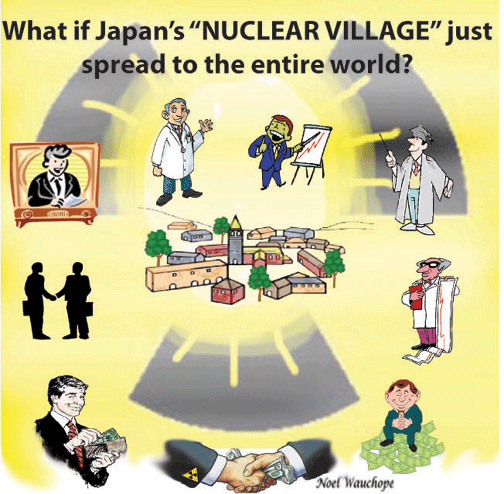
Japanese honour for Sir John Beddington for covering up the effects of the Fukushima nuclear disaster!
“The advice that he gave during the disaster was very important to reassure not only the British citizens in Japan but also the Japanese people and rest of the world, and also helped the Japanese Government gain public confidence regarding its response to and basic policy on the Fukushima Daiichi accidents.
Image source ; https://nuclear-news.net/2014/03/13/like-japan-uk-seems-to-be-developing-an-academic-nuclear-village/
http://www.oxfordmartin.ox.ac.uk/news/201407_Beddington_Honour
11 Jul 2014
Sir John Beddington, Senior Adviser to the Oxford Martin School, has been recognised by the Government of Japan for his contributions to strengthening the co-operation between Japan and the UK in the areas of science and technology.
At a ceremony at the Japanese Embassy in London on 26 June, Sir John, former Chief Scientific Adviser to the UK Government, was presented with the Order of the Rising Sun, Gold Rays with Neck Ribbon.
Announcing the honour, an embassy spokesman said: “Sir John played a significant role in advising the UK Government not to evacuate the British Embassy in Tokyo or UK nationals in Japan, after the tragic earthquake and tsunami and its subsequent effect on TEPCO’s Fukushima Daiichi Nuclear Power Station.
“The advice that he gave during the disaster was very important to reassure not only the British citizens in Japan but also the Japanese people and rest of the world, and also helped the Japanese Government gain public confidence regarding its response to and basic policy on the Fukushima Daiichi accidents. We, the Japanese government and the Japanese people, recognise and sincerely appreciate his support when we were dealing with the crisis.
“He has made significant contributions to strengthen the co-operation between Japan and the UK in the area of science and technology for many years, and his contributions to Japan in the area of science and technology have improved the overall bilateral relations between our countries.”
The embassy also cited Sir John’s joint leadership of the UK-Japan Joint Committee on Cooperation in Science and Technology, his participation in the Japanese Science and Technology in Society forum and his involvement with Japanese research institutions, and thanked him for the advice he had given to Japanese researchers and government delegations visiting the UK.
The spokesman added: “The Government of Japan highly appreciates the significant contribution Sir John has made throughout his career. He greatly deserves to be honoured for his outstanding contribution to Japan-UK relations.”
To find out about the full extent of the cover up please check these links;
https://nuclear-news.net/?s=science+media+centre
“….In 2011, as their share value continued to plummet[Because of fukushima Arclight2011], EDF formed a stakeholder advisory panel, employing Chris Patten, chair of the BBC Trust, as chair of the panel and Diane Coyle, vice chair of the BBC Trust, as a member the panel. She is married to BBC News Technology Correspondent, Rory Cellan-Jones. Other members of the panel include Will Hutton, former editor of the Observer and a leading commentator on social and political affairs, and Sir Richard Lambert, former director of the CBI and former editor of the Financial Times. Chris Patten is linked to David Cameron through Patten’s former chief of staff, who is now chief of staff to Cameron….[Also, The UK SMC and the USA senseaboutscience began its promotion of the “right” science. Arclight2011]“ https://nuclear-news.net/2013/09/24/the-bbc-and-edf-corrupts-nuclear-science-with-the-help-of-the-usa/
“…An article at nuclear-news.net provides a number of references revealing how experts from SMCs have downplayed the seriousness of the nuclear disaster. I note that the “experts” writing about ionising radiation and health were nuclear engineers — not radiation biologists……
how do general journalists scrutinise and distinguish between what is an independent science story and what is a pro business story? How easy might it be for general journalists to be discouraged from covering certain topics?….If the subject is complex – the health effects of Fukushima radiation – it is all too easy to go to the science media centre and get a comforting article from a nuclear engineer….” https://nuclear-news.net/2013/07/26/sloppy-science-writing-in-australias-media/
“….7 March 2014
In 2012 Francis Maude, Minister for the Cabinet Office, announced the intention to fundamentally overhaul and replace the existing information classification and marking scheme as part of the government’s Civil Service Reform programme.
Sellafield Ltd’s security regulator, ONR (Office for Nuclear Regulation), have instructed Sellafield Ltd and the wider civil nuclear industry to adopt the new GSC protective marking scheme known as Government Security Classifications (GSC).
Government Security Classifications
The new three tier system has three classifications: OFFICIAL, SECRET and TOP-SECRET.
Additionally ONR have mandated the use of an additional classification: OFFICIAL-SENSITIVE for Sensitive Nuclear Information which is classified below SECRET.
Implementing GSC
In line with the rest of UK government, the new GSC scheme is coming into operation on April 2nd 2014. All documents (including commercial correspondence, drawings, specifications, data sheets etc) created by Sellafield Ltd after this date for issue to suppliers will carry the new markings. Documents created prior to this date will continue to carry their existing markings until such time as they are amended in the normal course of work when the new markings will be applied at the same time.…..” https://nuclear-news.net/2014/03/09/the-uk-follows-japan-in-determining-extent-of-nuclear-transparency-by-extending-secrecy-and-protecting-corruption/
1 This Month

of the week – Shut Down Drone Warfare!


Tell the Ukrainian Government to Drop Prosecution of Peace Activist Yurii Sheliazhenko

Petition to revoke the licensing of the Near Surface Nuclear Disposal Facility (NSDF) at Chalk River. https://www.ourcommons.ca/petitions/en/Petition/Details?Petition=e-7247
To see nuclear-related stories in greater depth and intensity – go to https://nuclearinformation.wordpress.com
-
Archives
- April 2026 (7)
- March 2026 (251)
- February 2026 (268)
- January 2026 (308)
- December 2025 (358)
- November 2025 (359)
- October 2025 (376)
- September 2025 (257)
- August 2025 (319)
- July 2025 (230)
- June 2025 (348)
- May 2025 (261)
-
Categories
- 1
- 1 NUCLEAR ISSUES
- business and costs
- climate change
- culture and arts
- ENERGY
- environment
- health
- history
- indigenous issues
- Legal
- marketing of nuclear
- media
- opposition to nuclear
- PERSONAL STORIES
- politics
- politics international
- Religion and ethics
- safety
- secrets,lies and civil liberties
- spinbuster
- technology
- Uranium
- wastes
- weapons and war
- Women
- 2 WORLD
- ACTION
- AFRICA
- Atrocities
- AUSTRALIA
- Christina's notes
- Christina's themes
- culture and arts
- Events
- Fuk 2022
- Fuk 2023
- Fukushima 2017
- Fukushima 2018
- fukushima 2019
- Fukushima 2020
- Fukushima 2021
- general
- global warming
- Humour (God we need it)
- Nuclear
- RARE EARTHS
- Reference
- resources – print
- Resources -audiovicual
- Weekly Newsletter
- World
- World Nuclear
- YouTube
-
RSS
Entries RSS
Comments RSS
 nuclear-news