Abby Martin issued the following response to the Jan. 7 New York Times article falsely representing her work at RT America.
The long-awaited report by the Director of National Intelligence (DNI), allegedly proving Russian “interference” in the US election, includes a section solely dedicated to bashing RT, and specifically calls out my former show Breaking the Set, which ended two years ago, as a propaganda vector marking the beginning of the Kremlin attempt to subvert American democracy.
Desperate to push this US intelligence narrative, The New York Times called the report “damning and surprisingly detailed,” while adding that it includes no actual evidence.
The very next day, on Jan. 7, the Times published another piece titled “Russia’s RT, The Network Implicated in U.S. Election Meddling.”
In the article, NYT journalist Russell Goldman used two blatantly false statements about my work at RT to support the argument that the network is simply a Putin-dictated propaganda outlet.
First, he stated “…two anchors who quit during live broadcasts say the network is a propaganda outlet.”
I did not quit during a live broadcast, nor did I say that the network is a propaganda outlet.
He goes on to say “…Abby Martin, who said before quitting, ‘What Russia did was wrong.’”
Any cursory research into the referenced quote—when I spoke out against Russia’s military entrance into Crimea and the network’s glorification of it—will find that not only did I not quit on air, but that I continued my show for an entire year afterward.
I was interviewed about my on-air statement on many major news stations, from BBC to CNN, where I defended my editorial freedom and also called-out the double standards and hypocrisies in their coverage.
RT issued an official statement in support of my freedom to state my opinion on the network. Over the course of the next year, I continued to voice my concerns and opinions about Russia, from MH-17 to the Ukraine crisis, unfiltered.
I quit the network on my own terms in February 2015 because I wanted to do more in-depth investigative reporting, not because I believed it to be a propaganda outlet.
The Times issued a correction after these false accounts were featured prominently on their website for over 19 hours. But their correction still misrepresents the facts to push their narrative.
The correction reads “this article misstated when the RT anchor Abby Martin left the network. She quit sometime after denouncing on air Russia’s war in Ukraine, not during the live broadcast.”
The error in their article was not simply about when I quit, but the reason and circumstances for leaving the network. The article still implies that I left over this political disagreement.
Additionally, they removed from the article the line “two anchors who quit during live broadcasts say the network is a propaganda outlet,” but they do not note that change in their correction addendum, as is standard.
The article now includes a modified sentence: “Abby Martin quit some time after denouncing Russia’s incursion on air. ‘What Russia did was wrong,’ Ms. Martin said.”
This new line twists the truth, omits the facts, and ironically contradicts their entire argument.
The glaring fact is that I spoke out about the actions of Putin, Russia and RT’s coverage of it on air, and not only was I not fired, but I still had the prime time opinion show on the network for another year.
That begs the question to the NY Times: if RT is simply a Kremlin mouthpiece, how was I allowed to do this and still be featured prominently on the network?
It appears that the Times is, once again, working to push a false perspective being promoted by US government officials and agencies. To paint RT in such a cartoonish, totalitarian fashion—and to promote the idea that it is subverting US democracy—is the dangerous state propaganda that we should be worrying about.
US Navy C-40 photographed at Shannon Airport on Jan 8th (2017)
Analysis of Shannonwatch data shows that over 730 US military flights landed at Shannon in 2016. That’s more than 2 a day over the entire year. Of these, 413 were operated by the US Air Force, Navy or military, and the remainder were contracted troop carriers like Omni Air International.
Since August 2008 at total of at least 7,988 US military planes carrying armed troops or cargo have landed at the airport. This does not include suspect rendition planes and planes not identifying themselves as attached to the CIA or US military which have undountedly also landed there.
As the first peace vigil of the year took place today at Shannon, a US Navy C40 sat inside the airport, away from the terminal building. There was an Irish Defence Forces patrol stationed about 50 meters from it. The large force of Gardai (Irish Police) that stood blocking the entrance to the airport during the peace vigil were asked to inspect it (since it could well be carrying weapons illegally, or even war criminals), but a sergeant in charge said that would not be happening.
The full breakdown of US Air Force, Navy and military operated aircraft recorded at Shannon in 2016 is as follows:
C130
C17/C5
K* Refueling
C9
Executive Jets
Other (B737, B752 etc)
Monthly total
January
8
0
0
3
5
11
27
February
3
0
2
0
2
15
22
March
13
2
1
0
8
21
45
April
8
1
1
0
11
22
43
May
13
1
1
4
3
16
38
June
7
1
9
1
8
17
43
July
13
3
0
0
6
18
40
August
8
1
0
1
3
12
25
September
8
0
0
2
16
21
47
October
9
3
2
2
3
17
36
November
6
1
0
3
3
5
18
December
4
2
1
0
3
19
29
TOTALS
100
15
17
16
71
194
413
The monthly breakdown of troop carriers is as follows:
MONTH
COUNT
January
22
February
30
March
28
April
39
May
31
June
22
July
32
August
18
September
17
October
45
November
15
December
20
If the first peace vigil of the year is anything to go by, the number of people who are prepared to express their opposition to this ongoing US military use of Shannon is growing. We had peace activists from Clifden, Galway city, Dublin and Waterford, as well as more local activists from Ennis, Limerick and Shannon. The Shannon Airport authority may have planned for 2017 to be another year of complicity in warmongering, death and suffering. But they may not have it all their way.
Though the young leader’s birthday is well-known throughout the country, it has yet to be celebrated with the kind of adulatory festivities that accompany the birthdays of his late grandfather and father. Pyongyang residents did what they do every second Sunday of the new year – joined in sports events.
Kim Jong Un, who is believed to be 33 or 34 and the world’s youngest head of state, assumed power after the death of his father, Kim Jong Il, in late 2011.
Big bash last May
With the official period of mourning his father’s death over and his own powerbase apparently solid, Kim presided over a once-in-a-generation party congress last May that was seen by many as something of a coronation and the beginning of the Kim Jong Un era.
But he has continued to keep a step or two behind his predecessors in the country’s intense cult of personality. Kim’s grandfather, “eternal president” Kim Il Sung, and Kim Jong Il statues and portraits are found in virtually every public space or home. Their pins are worn over the hearts of every adult man and woman.
Rumors were rife that a new pin featuring Kim Jong Un would be issued during the May party congress, but they proved to be unfounded. Calendars for this year don’t denote January 8 as anything other than a normal Sunday, and there was no mention of the birthday in Rodong Sinmun, the ruling party newspaper.
The only time Kim has been honored in public on his birthday was in 2014, when former NBA star Dennis Rodman sang “Happy Birthday” to him before an exhibition basketball game in Pyongyang.
North Korean officials say the low-key approach – and the very little information made public about his wife and family – reflects Kim’s humble nature and respect for his forbearers. Kim seemed to amplify that image in his annual New Year’s address, when he closed with remarks about his desire to be a better leader.
Lavish parties for father, grandfather
Even so, 2017 could turn out to be a bigger than normal year in North Korea for Kim-related events.
State media have suggested Kim Jong Il’s birthday in February and especially Kim Il Sung’s birthday in April will be celebrated in a more lavish than usual manner, though exactly what’s in store is not known. And Kim Jong Un has had something of a big New Year’s event – days after his address, tens of thousands of North Koreans rallied in Pyongyang in the customary show of support for their leader.
And a little reported statement from North Korea here 2017;
“…PYONGYANG – Top leader of the Democratic People’s Republic of Korea (DPRK) Kim Jong Un said Sunday in a televised New Year address that the DPRK would continue to strengthen national defense including nuclear capabilities as long as nuclear threat from the United States exists.
“Unless the United States and its vassal forces stop nuclear threat and blackmail and unless they stop the war exercises which they stage right at our noses under the pretext of annual exercises, the DPRK would keep increasing the military capabilities for self-defense and preemptive striking capacity with nuclear force as a pivot,” he said.
Kim emphasized the need to foil challenges posed by anti-reunification forces at home and abroad who are against the national desire for reunification.
Kim also called for taking active measures to improve north-south relations and defuse military conflict and the danger of a war between the two Koreans, appealing to the whole nation that a wide avenue should be paved toward independent reunification through joint efforts.
“All the Koreans in the north and the south and abroad should solidarize and get united on the principle of subordinating everything to national reunification, the cause common to the nation and activate the reunification movement on a nationwide scale,” Kim added……”
“…But critics note that while France struggles to sell nuclear reactors abroad, Denmark’s Vestas (VWS.CO) and Germany’s Siemens (SIEGn.DE) are winning export deals for wind turbines.
Former environment minister Corinne Lepage blames an old boy’s network of graduates from France’s elite engineering schools for defending nuclear at any cost.
She opposes EDF extending the life of its oldest reactors, saying it should instead start decommissioning them. EDF could build this into a business in dismantling reactors while gradually switching to renewable energy, she told Reuters.
“We need a massive reconversion plan for EDF staff. These are engineers. If they can handle nuclear reactors, they can also handle wind turbines and solar panels,” she said…..”
To see how much of UK EDf bill payers revenue and French Tax Payer money will be used to bail out the French nuclear industry see this link;
The B-52 “Stratofortress” lost one of its eight turbofan engines when it was around 28 miles from the Minot Air Force base in North Dakota, a spokesman said.
The aircraft, which is designed to hold up to 70,000 pounds (32,000 kg) of nuclear warheads, was not carrying any weapons.
It landed safely using the remaining seven engines.
The eighth engine landed in an unpopulated area and no injuries were caused, the spokesman said.
He added that the crew “declared an in-flight emergency when the pilot discovered that an engine departed the aircraft.”
He said: “There were no weapons on board and it was a local training mission. The aircraft landed safely with no injuries to the five personnel on board.”
The last fatal crash involving the “Stratofortress” occurred in 2008 when the aircraft crashed into the Pacific Ocean during a training flight.
Six crew members were killed and investigators said the probable cause was a system malfunction.
The freak show that is American politics got even freakier last week. Mercury was definitely in retrograde, as Sean Hannity got up close and personal with Julian Assange, Sarah Palin hailed him as a national hero (and urged people to see Oliver Stone’s “Snowden”) and Donald Trump, who once called for the “death penalty or something” for Assange, suddenly embraced the WikiLeaks founder as a trusted source.
On Friday, Trump had a sit-down with top intelligence chiefs at Trump Tower, which he proclaimed as “constructive” — the same way a president describes a meeting with an enemy power. But he made it clear he still wasn’t buying the spooks’ story about foreign interference in an election that he won fair and square, not counting those 3 million or so votes.
The source of all this madness, of course, was the alleged Russian hacking of the U.S. presidential election. On Thursday, James Clapper, the director of national “intelligence” — as President-“elect” Trump air-quotes it — appeared before a Senate committee to confirm his belief in Moscow’s nefarious interference. Yes, this is the same Clapper who once lied bald-faced to Congress about NSA surveillance of the public. But the Senate, in rare bipartisan frenzy, declared the intelligence chief totally credible this time.
The U.S. intelligence report finally released Friday was dismissed by skeptics as underwhelming in its evidence of Russian hacking but was embraced by political partisans like House Democratic leader Nancy Pelosi, who found it “stunning” in its persuasiveness. Computer security experts I contacted have been convinced of Putin’s guilt for some time.
“Healthy skepticism is a good thing, but at this point it’s no longer healthy and bordering on ‘jet fuel can’t melt steel,” Nicholas Weaver, a UC Berkeley computer science lecturer, emailed me. “There is simply a ton of evidence showing that Russia hacked the Democrats and released that information. And those ‘serious’ (people) who state otherwise are simply defending the special snowflake of a president-elect whose ego is so fragile that to admit that Putin helped him out is untenable to him.”
But even if the Russian government was responsible for handing the Democratic National Committee’s emails to WikiLeaks — possibly through other parties — is this really an “act of war,” as ever-belligerent Sen. John McCain has called it? And should we be throwing “rocks,” as Sen. Lindsey Graham demanded, even though the stones on both sides are nuclear-tipped? Pulitzer Prize-winning journalist Glenn Greenwald is not the only one who finds the media’s Putin fever to be “reckless.”
For some much-needed perspective, I consulted with Daniel Ellsberg, the Pentagon Papers whistle-blower and a former nuclear war planner. Ellsberg, who was a Pentagon consultant under Presidents Dwight Eisenhower, John F. Kennedy and Lyndon Johnson, is completing a book based on his experiences titled “The Doomsday Machines: Confessions of a Nuclear War Planner.”
At 85, Ellsberg is still active on the political front and has visited Assange, who has been under house arrest for six years at the Ecuadoran Embassy in London. He refuses to take a position on the Russian hacking question, which he finds “too fraught and complex.” But he was outspoken about the increasingly tense relationship between Washington and Moscow.
Ellsberg, who lives in Kensington, did not vote for Trump, whom he regards as a “disaster” in every way but one. “I’m against conflict with Russia, so on this one issue, I’m on Trump’s side. Even if the Russians are guilty of hacking, I don’t think we should risk war with them. Even if the Russians intervened in our election, as we ourselves have done in many countries on an even bigger scale.”
“Look,” Ellsberg continued, “I think we’re about to see a fascist regime take office in Washington. And I’d rather see these two authoritarian regimes — led by Trump and Putin — not fighting. At this point, I don’t see either regime as expansionist in the Hitler mode. Trump seems less interventionist than the Washington establishment, although his rhetoric about China and Iran is alarming. But on Russia, he looks like a deal maker.”
This is a good thing, Ellsberg observed, particularly given rising tensions in Europe, which could become a nuclear battlefield. NATO, which is committed to defending frontline countries like Poland and the Baltic states against any incursion, maintains a dangerous first-use nuclear policy. Despite Putin’s strong protests, a destabilizing antiballistic-missile system was installed in Romania and another is planned for Poland.
If Trump is serious about reducing tensions with Moscow, Ellsberg said, he should begin by removing those ABM systems and by negotiating reductions in the two countries’ nuclear arsenals to the level where a nuclear exchange would not result in the end of human life on the planet.
“A nuclear exchange involving even a fraction of the weapons that the U.S. and Russia now have on alert status alone would result in nuclear winter, with the smoke from burning cities widely dispersing and blocking sunlight for over a decade. That means years without harvests on Earth. Just one year pretty much does the job of eliminating the human race. So maintaining nuclear arsenals this size is insane and immoral and unjustifiable.”
The old, terrifying Cold War scenarios still loom over the planet as the voices of hysteria clamor for a new Cold War. Ellsberg said that he and his fellow nuclear planners used to regard the mad doomsday satire “Dr. Strangelove” as “a documentary.” In his opinion, Hillary Clinton would have done little to restore sanity in the nuclear relationship with Russia. And Trump is “a cipher. We don’t know what we’ll get from him. And his off-the-cuff remarks are disturbing.”
For this reason, Ellsberg hopes that Trump and the intelligence agencies can establish a healthy working relationship. “He shouldn’t be getting into a war with the intelligence community — it’s bad for him and for the country. There’s no question that he could be putting himself at risk by doing this. Nixon didn’t trust the CIA either. And look what happened to him.”
I didn’t bring up JFK, who threatened to “splinter the CIA into thousand pieces and scatter it to the winds” after the agency’s Bay of Pigs disaster, but of course, the bitter split between that president and his national security team still shadows American history.
In any case, we can only pray that sanity, in extremely short supply these days, can somehow be restored in Washington.
San Francisco Chronicle columnist David Talbot appears Sundays, Tuesdays and Thursdays. Email: dtalbot@sfchronicle.com
At the beginning of December 2016 the Swiss Federal Nuclear Safety Inspectorate (ENSI) requested the inspection of the steam generators at the Gösgen and Beznau nuclear power plants. Georg Schwarz, ENSI Deputy Director and head of the NPPs Division, explains the background and context in the following interview.
The article was removed within 12 minutes but a cached copy remained;
Last summer, the operators of Swiss nuclear power plants were obliged to examine the production documents of forged steel components within their plants in respect of possible falsifications. Now, ENSI has requested that the Beznau and Gösgen nuclear power plants inspect the components in their steam generators for elevated carbon values and possible effects on material toughness. For this purpose, the production documents must first be examined again. Is there a connection between these two issues?
In parallel, but independent of the falsification issue, information became available from France about potential material problems in the steam generators of pressurised water reactors. In a series of reactors, the forged steel components of the steam generators showed elevated carbon content. On 18 October 2016, the French nuclear supervisory authority ASN therefore instructed the operator of the French nuclear power plants, EDF, to subject the steam generators of twelve nuclear power plants to more detailed investigation and to demonstrate that they have the necessary material toughness in spite of the elevated carbon content. This, in turn, prompted ENSI to call for the inspection of the steam generators of the Swiss nuclear power plants Beznau and Gösgen.
And what about the other two nuclear power plants in Switzerland?
Leibstadt and Mühleberg are boiling water reactors. They do not have steam generators and are therefore unaffected of this issue.
What does examination of the documents involve?
The examination of the production documents is a first step and serves as basis for the inspections of the steam generators themselves. In this case, however, it is not a search for potential falsifications, but rather for basic information on the material quality of the steam generators.
Is it still possible to trust these documents?
Yes. The investigations in summer revealed no indication of any falsifications.
In the inspections of the steam generators at Beznau and Gösgen requested by ENSI, the results of the corresponding investigations in France will probably also be considered. What is the current status in France?
In France, the investigations are largely completed and it has been demonstrated that the steam generators with an elevated carbon content are strong enough and do not pose a risk. The reactors which were disconnected from the grid for the investigations have either been reconnected to the grid by now, or will again be delivering power from January 2017. (For details see the chronology below).
In France, the plants had to be disconnected from the grid for the investigations. Why is this not necessary for Beznau and Gösgen?
In France, the nuclear power plants were not shut down immediately, either. In Switzerland we do not see any reason, from a safety point of view, to temporarily disconnect the plants concerned from the grid. The inspections on the steam generators can be performed during a routine maintenance outage.
Can you explain why in more detail?
The first checks in France in the past summer revealed that steam generators in 18 of the 58 French reactors require more detailed investigations. For 6 reactors these investigations could be completed fairly quickly so that by autumn 2016 only 12 reactors remained. ASN set a deadline of three months for the French NPP operator EDF to carry out the required measurements and calculations on the steam generators in the remaining reactors. To be able to perform this work, a reactor must be in shut-down mode. Seven of the reactors concerned were already in routine maintenance outage and they therefore decided to postpone their restart, five reactors initially continued operations. In the course of 2016, three were disconnected from the grid in order to perform the required measurements. The last two will be disconnected in January 2017.
In light of the developments in France, why is there any point in Beznau and Gösgen actually performing the investigations?
The steam generator is an important component of the primary circuit. From a safety point of view, it is appropriate to assess both the situation in the Swiss reactors and to what extent the results in France agree with the corresponding findings in the steam generators in the Swiss plants.
What precisely do the Beznau and Gösgen nuclear power plants have to check?
As stated, a first step will involve examining the production documents. This will result in information on affected components, manufacturer, manufacturing period, material, applied design specification and regulations, deviations during manufacture, details of the forging process, acceptance tests carried out, and test requirements. Based on these documents, a second step involves the derivation of a concept for the further safety assessment.
What result do you expect from the first step, the examination of the documents?
The aim of the in-depth examination of the production documents is to obtain fairly quickly a first overview of the manufacturing of the steam generators. This will result in first insights, based on which further steps can be decided upon.
When will the second step containing the non-destructive testing be performed?
This depends on the concepts. Potential inspections on the steam generators themselves will be performed during the regular maintenance outages of the nuclear power plants.
Is this inspection of the steam generators in any way related to the findings in the reactor pressure vessels, which were uncovered in the Belgian plants Doel 2 and Tihange 3 in 2013 and during 2015 in Beznau 1?
No. The findings in the reactor pressure vessels have nothing to do with the inspections of the steam generators. As already stated above, the trigger for the inspection of the steam generators was information from France stating that the steel of the steam generators potentially contains an elevated carbon content in certain areas.
Reactor pressure vessels and steam generators are different components.
The fuel rods are contained in the reactor pressure vessel. The heat generated by the chain reaction is used to heat up the coolant.
In pressurised water reactors, steam production takes place in the steam generator, where the hot water of the primary circuit transfers heat energy to the secondary circuit.
Does this mean that the investigations concerning the steam generator will have no influence on the decision of whether Beznau 1, upon completion of the investigations into the reactor pressure vessel findings, can start up again?
Precisely, they have no influence at all.
On the basis of findings in the French Flamanville nuclear power plant, various investigations have been triggered in France and Switzerland. These concern falsifications in the production documents from the Le Creusot forge, on one hand, and the material properties of the steam generators on the other hand.
Topic ‘Findings in the Flamanville reactor pressure vessel’
On 7 April 2015, the French nuclear supervisory authority ASN informed the public that zones of elevated carbon content had been identified in the reactor vessel closure head and reactor vessel bottom of the French Flamanville 3 nuclear power plant, which is currently under construction.
Topic ‘Falsifications in the Le Creusot forge’
Topic ‘Carbon content in steam generator components’
2015
On 4 August 2015, ASN President Pierre-Franck Chevet wrote in an open letter that AREVA had decided to arrange an investigation into the production practices at the Le Creusot forge over the past few years by an independent body. These investigations were started in April 2015 at the instigation of the ASN.
2016
On 19 January 2016, the ASN made it known that within the context of a hearing on 8 December 2015 it had informed AREVA of the requirements for the investigation. According to these, the investigation had not only to extend back until 2010, but until at least 2004 because it was in this year that the first parts were forged for the Flamanville EPR.The ASN first informed the public of the results of the investigation on 3 May 2016. It was established that there were irregularities in the production documents for 400 components manufactured at Le Creusot since 1965. These included both inconsistencies between the documents and production or inspection data as well as falsifications (changing of measurement and acceptance reports). Of the relevant 400 components, around 50 are in use in French nuclear power plants.
On 6 June 2016, ENSI required the Swiss nuclear power plants to gather information about whether components originating from the Le Creusot forge with potentially incorrect production documents were or are currently in use.
On 16 June 2016, the ASN could for the first time list those nuclear power plants in France where components of the primary circuit are affected by irregularities in the material properties. To perform additional examinations, the operator EDF took the reactor Fessenheim 2 offline in the middle of June 2016.
On 19 July 2016, the ASN informed the public that the authorisation for a steam generator of the Fessenheim 2 NPP had been suspended. It cited falsifications in the production documents as the reason. The steam generator vessel bottom produced in 2008 does not conform to the dossier that had been submitted to the ASN and was not forged in accordance with the applicable rules.
On 17 August 2016, ENSI informed the public that all plants in Switzerland which had or have components in use originating from the Le Creusot forge, could confirm that these components are not affected by any falsifications in production documents.
On 23 September 2016, the ASN for the first time published a list of the irregularities and falsifications uncovered in the production documents. At the same time, the French supervisory authority made it known that in 21 of the 23 cases uncovered, safety was not affected. Further investigations were announced in two cases, namely Gravelines 5 and Fessenheim 2 which are currently shut down.
On 23 June 2016, the ASN informed the public for the first time that the vessel bottoms of steam generators could have zones with elevated carbon content. Under consideration were 18 reactors, 16 reactors with 900 MWe output and 2 with 1450 MWe output. Amongst the unaffected reactors were 18 reactors of 900 MWe, 2 reactors of 1450 MWe and all 20 reactors with a 1300 MWe output. The supervisory authority required the operator EDF to examine the steam generators from the Le Creusot forge and the Japanese JCFC forge using both non-destructive testing in respect of carbon concentration and using ultrasonic crack testing.On 18 October 2016, the ASN ordered more detailed inspections of the steam generators in respect of the material carbon content in 12 reactors. Seven of the affected reactors were at that time already shut down for routine maintenance outage. Five other nuclear power plants received a deadline of three months.
On 26 October 2016, the ASN announced that within the context of a parliamentary hearing it had provided information that in the steam generators of 12 reactors, which had been manufactured by JCFC, the carbon content elevated.
On 5 December 2016, ASN announced that the documents requested from the operator EDF had been accepted in general. Furthermore, it requested reports for compensatory measures and other medium-term tests. It requested additional calculations for four plants. As soon as these are assessed by ASN, the ten 900 MWe nuclear power plants can start up again. According to ASN, EDF announced that the documents for the two 1450 MWe plants will be submitted soon.
On 9 December 2016, ENSI required that the pressurised water reactors in Switzerland, Beznau and Gösgen, examine their steam generators in a two-stage process.
According to Réseau de Transport d’Electricité RTE (dated 3 January 2017), 4 of 12 reactors subject to more in-depth investigation have been restarted until the end of 2016. 8 further reactors are planning to start up in January 2017.
The Emirates Nuclear Energy Corporation (ENEC) has achieved major milestones as it moves towards a new phase in the construction of Units 3 and 4 at the Barakah Nuclear Energy Plant which is now more than 50 per cent completed.
The recent progress significantly advances Enec’s goal of delivering safe, clean, efficient and reliable nuclear energy to the UAE through its Peaceful Nuclear Energy Program, said a statement from the corporation.
The construction achievements include the successful setting in place of Unit 3’s Reactor Containment Building (RCB) Liner Dome section, effectively installing the roof of the structure which now houses the Reactor Vessel (RV), said the statement.
Further, the completion of Unit 4’s Turbine Generator Operating Deck and the setting of the last Reactor Containment Liner Plate Rings mark important progress for the units, it added.
These milestones are a result of Enec’s extensive collaboration with its prime contractor and joint venture partner, the Korean Electric Power Corporation (Kepco), said its top official.
“All construction milestones for the Barakah Nuclear Energy Plant project have been achieved in accordance with the highest standards of quality and safety,” remarked Enec CEO Mohamed Al Hammadi.
“The latest successful achievement of these milestones for Units 3 and 4, is a result of many months of hard work by all those involved. I am proud of our teams whose commitment and dedication is a key factor in the continued successful construction of the world’s largest nuclear plant, with four identical units being built simultaneously,” said Al Hammadi.
According to him, peaceful nuclear energy will bring many benefits, from the creation of high-value job opportunities to the emergence of a new sophisticated industrial sector to support operations in Barakah.
With the successful setting of Unit 3’s RCB Liner Dome section, it is now more than 62 per cent complete and work to pour the concrete and complete the RCB is progressing steadily.
The RCB is expected to be completed in the first quarter of 2017, roughly a year after similar work was concluded on Unit 2, in line with ENEC’s construction schedule, stated the top official.
Enec’s deputy CEO Ahmed Al Rumaithi said the completion of the Turbine Generator Operating Deck and the setting of the final Reactor Containment Liner Plate Rings on Unit 4 has allowed work to begin on erecting the Turbine Building and the interior and exterior concrete for the Unit’s RCB is now being poured.
“Once completed, we will be ready for the installation of Unit 4’s Reactor Pressure Vessel in mid-2017,” he noted.
Al Rumaithi revealed that 35 per cent of the construction work at Unit 4 had been completed and was ahead of schedule, with the completion of the deck and rings having occurred roughly 10 months after similar work was concluded on Unit 3.
“The Barakah Nuclear Energy Plant is scheduled for completion in 2020, with construction having started in 2012. With four reactors online, the facility will deliver up to a quarter of the UAE’s electricity needs and save up to 12 million tons in carbon emissions every year,” he noted.
Al Rumaithi pointed out that the project at Barakah was progressing steadily and overall, around 75 per cent of the construction work had been completed at Units 1 to 4.
All four units will deliver safe, clean, reliable and efficient nuclear energy to the UAE grid, pending regulatory reviews and licensing, he added.-TradeArabia News Service
Other article describing ways to make mini nuclear weapons for terrorists, dictatorships etc here;
STOCKHOLM (AP) — A spokesman for one of Sweden’s three nuclear power plants says they will have armed guards outside the facilities starting next month in a decision made by the country’s nuclear watchdog.
Anders Osterberg of the Oskarshamn power station says “the elevated level” was based on a general security assessment, not a specific threat.
Osterberg said Thursday in an email to The Associated Press that the Swedish Radiation Safety Authority decided last year that guards should carry firearms as of Feb. 1. There was no immediate word from the authority.
Sweden has a total of 10 reactors in Oskarshamn, Ringhals and Forsmark, providing about half of the country’s electricity production. Sitting some 200 kilometers (124 miles) south of Stockholm on the Baltic Sea coast, Oskarshamn has three reactors.
Florida is basically one gigantic hunk of porous limestone with pythons, buildings, and Medicare frauds sunning themselves on top. Underneath is South Florida’s main source of drinking water, the Biscayne Aquifer, a pristine pool of underground liquid that’s become increasingly susceptible to pollution and saltwater intrusion.
Just below that sits another, deeper store of H2O called the Floridan Aquifer. Thanks to that porous limestone, water sometimes mixes between the two.
And that’s why it’s more than a bit alarming that Florida Power & Light (FPL) is pushing ahead with plans to inject radioactive waste into the Floridan Aquifer’s lowest zone over the next few decades, after building two new nuclear reactors in South Florida. Environmentalists contend the plan could leak carcinogens such as cesium, strontium 90, and tritium right into South Florida’s largest drinking water source.
Last week, a nonprofit environmentalist group that has frequently sparred with FPL, the Citizens Allied for Safe Energy (CASE), filed a formal petition to hold a hearing to stop the utility company’s plan. The group filed November 28 — FPL now has 25 days to respond to the complaint.
“Everything will be put into a supposedly ‘hermetically sealed’ boulder zone,” CASE’s president, Barry J. White, says, “but anybody who lives in South Florida knows nothing below us is hermetically sealed.”
An FPL spokesperson, Peter Robbins, provided the following statement to New Times:
After an exhaustive and comprehensive review of the proposed Turkey Point Units 6 & 7 project, including the plans to safely use reclaimed water for cooling, the independent Nuclear Regulatory Commission’s staff concluded “…there are no environmental impacts to preclude issuing Combined Licenses to build and operate two reactors next to the existing Turkey Point nuclear power plant.”
We will be reviewing the allegations made by CASE in this document, which was filed after the Environmental Impact Statement was issued, and will respond at the appropriate time. It’s important to note that the system will be closely monitored and is designed to ensure that upward flow from the Floridan Aquifer is not taking place.
The new radioactive-waste fight stems from FPL’s long-standing plan to expand the much-ballyhooed nuclear plant at Turkey Point. The power company — a “legalized monopoly” within Florida that’s long been accused of buying off the state Legislature with campaign cash — wants to build two new reactors, numbers 6 and 7, at the plant over the next decade or two.
Earlier this year, Miami-Dade County officials said Turkey Point is almost certainly leaking radioactive waste into Biscayne Bay, though at levels that most scientists agree is safe for humans. After that news broke, FPL decided to postpone building the new reactors for four more years. That means the new towers won’t be operational until roughly 2030.
But the extended timeframe doesn’t mean Miamians can stop paying attention to the project. FPL is applying for licenses to build the new towers, as well as crafting a host of plans to get the new wing operational. This includes a review from the U.S. Nuclear Regulatory Commission (NRC), which issued an environmental impact statement in May.
As part of that plan, FPL says it plans to stash chemicals used to clean the reactors, as well as “radwaste” — waste that contains radioactive material — inside the so-called boulder zone. The zone, which sits about 3,000 feet below ground, is mostly rocky but does contain saltwater. Miami-Dade County has used the zone before to stash both treated and untreated sewage — but activists say that’s no excuse for placing radioactive waste there.
“Two wrongs don’t make a right,” White says. “I’ve always opposed dumping anything there.”
The feds must approve FPL’s plan under a law called the National Environmental Policy Act, which stipulates that governmental agencies must take a “hard look” at any possible risks a plan like FPL’s would pose. (The “hard look” provision is legally vague and sparks frequent fights among environmentalists, energy companies, and the government.) FPL initially applied to build the new reactors in 2009, but the government issued its final Environmental Impact Statement only this past October. The NRC allowed the project to move forward.
But CASE says the government ignored a number of small but frightening details when it comes to storing radioactive waste underground: For one, government documents themselves say the Floridan’s boulder zone could possibly leak into the ocean.
According to CASE’s complaint, the United States Ground Water Atlas, a government document, warns that the boulder zone “is thought to be connected to the Atlantic Ocean, possibly about 25 miles east of Miami, where the sea floor is almost 2,800 feet deep along the Straits of Florida.” CASE’s petition says the NRC failed to address this issue.
“Liquid Radwaste? Into the Boulder Zone?” the petition says. “Our members probably have not even heard of that and, when they do, it will scare the daylight out of them. Even small, diluted amounts of radioactive waste will accumulate and concentrate radiation which is not confined like water and can be absorbed by plant life.”
More frightening, in January 2016, in a hearing related to Turkey Point Reactors 3 and 4, FPL’s own engineer testified that the boulder zone could leak upward into the Biscayne aquifer — AKA, Miami-Dade’s drinking water.
MR. ANDERSEN: Yes. I agree with everything Bill is saying. In addition, too, that there is an upward hydraulic gradient from the Floridan [Aquifer] to the Biscayne [Aquifer]. The Floridan is under pressure. Therefore, you have flow from the Floridan into the Biscayne and not vice versa.
Likewise, CASE cited a 2000 University of Miami study that also warned that material injected into the boulder zone can float to the surface.
“Effluent injected from Turkey Point will flow up the surface’s gradient to the northwest and then probably north, where it will have many opportunities to encounter breaks in the permeability barrier in this lateral travel,” the petition says.
CASE says the NRC failed to investigate either of these issues as well.
“Thus, as these two studies show, there is no guarantee that the discharges of harsh chemicals into the boulder zone will stay put,” CASE warns. “It is more likely that they will migrate in all directions and, over time, pose a threat to the entire Biscayne Aquifer, which covers some 4,000 square miles in South Florida.”
White, who wrote the petition, faults FPL for clinging to a 20th-century business model too reliant on fossil fuels and nuclear energy.
“They have ignored the potential of a different business model,” White says. In his petition, he claims that the state could add $200 million in GDP from renewable energy sources — and that FPL could rake in a huge cut of that money if it commits to building clean energy sources.
CASE also raised three other major issues with the new reactors, including that the two towers might suck far too much freshwater from the state’s aquifers.
“Our organization’s whole objective is to return Turkey Point to being a wetland,” White says. “We don’t need it to be totally clear. They can put solar array down there. I wouldn’t even mind if they used gas. But they need to do it without impinging on the needs of the land.”
If the NRC doesn’t listen, he says, his next step will be to try to get the attention of the Florida Legislature.
“People have injected this waste into the land before, but not into a flowing body of water like this,” he says. “How anybody who has an iota of conscience can put radioactive waste into a body of water that humans and animals use, it’s like, ‘Are you crazy? What are you doing?'”
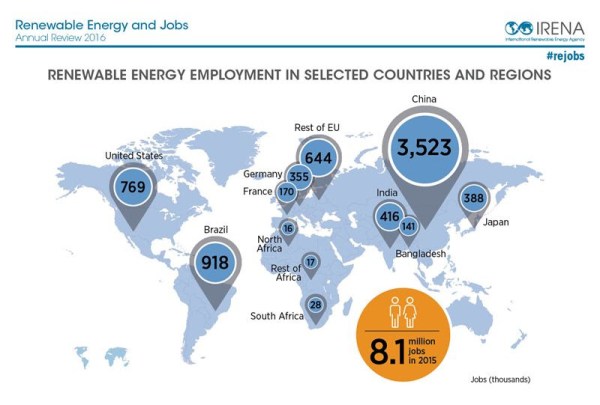
Solar energy is now cheaper than traditional fossil fuels.
Solar and wind is now either the same price or cheaper than new fossil fuel capacity in more than 30 countries, according to a new report from the World Economic Forum. The influential foundaton has described the change as a “tipping point” that could make fighting climate change into a profitable form of business for energy companies.
But investors and energy firms are still failing to put money into such green solutions despite the fact that they are cheaper than more traditional forms of electricity generation, according to the same report.
Solar power ‘becoming world’s cheapest form of electricity’
“Renewable energy has reached a tipping point – it now constitutes the best chance to reverse global warming,” said Michael Drexler, Head of Long Term Investing, Infrastructure and Development at the World Economic Forum. “Solar and wind have just become very competitive, and costs continue to fall. It is not only a commercially viable option, but an outright compelling investment opportunity with long-term, stable, inflation-protected returns.”
Just ten years ago, generating electricity through solar cost about $600 per MWh, and it cost only $100 to generate the same amount of power through coal and natural gas. But the price of renewable sources of power plunged quickly – today it only costs around $100 the generate the same amount of electricity through solar and $50 through wind.
The cheap price of solar and wind energy is already encouraging companies to build more plants to harvest it. The US is adding about 125 solar panels every minute, according to the Solar Energy Industry Association and investment in renewables in 2015 rose to $286 billion, up 5 per cent from the year before.
Even despite that cheap price, the investment isn’t enough to counteract the catastrophic effects of global warming. The worldwide investment is only 25 per cent of the $1 trillion goal set in the landmark Paris climate change accord, and because of political problems with investments it can’t be hard to convince companies to put their cash into green power.
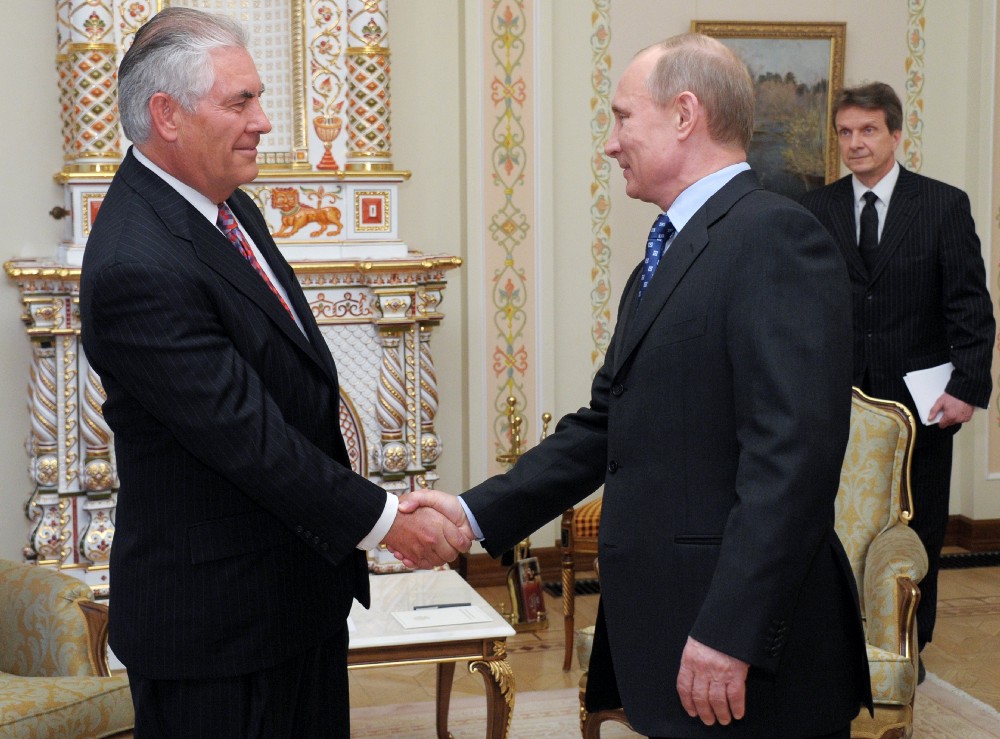
Exxon CEO Rex Tillerson (left) and Vladimir Putin meet in 2012. (Photo: Kremlin Press Service)
As unholy alliances between US president-elect Donald Trump and the Kremlin go, none are more potentially disastrous for the environment, or critical to Vladimir Putin’s future, than his tapping of ExxonMobil CEO Rex Tillerson for Secretary of State.
The windfall Putin’s wretched economy would reap as a result of the appointment doesn’t take any dusting for digital fingerprints to detect, but Some have suggested Kremlin hacking could have been aimed at ensuring precisely an oil bonanza.
And that’s exactly what Putin wants. In 2011, Tillerson negotiated a breathtaking $500 billion deal with Russia’s state oil company Rosneft, run by Putin’s KGB crony Igor Sechin.
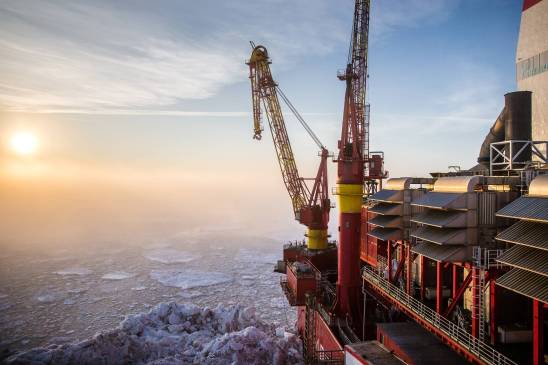
The deal opened 63.7 million acres of Russian land for ExxonMobil to produce on, most of it in on the Arctic shelf, which is thought to contain 22 percent of the world’s undiscovered oil and gas reserves. ExxonMobil also gets land in Western Siberia for shale as well as a chance to explore the Black Sea. The total haul over time could be worth as much as $8.2 trillion. In exchange, Rosneft’s shaky, outdated technology would get a needed upgrade to drill, frack and produce. Sold.
But the EU and the US put the brakes on the whole thing in 2014 when they sanctioned Russia for annexing Ukraine’s Crimean Peninsula and fomenting a proxy war in the country’s east.
The ExxonMobil deal was remarkable at a time when Putin had harried Royal Dutch Shell out of the Sakhalin III joint venture over an arcane environmental violation and pelted Rosneft partner BP with “sustained harassment.”
The misanthropic, byzantine landscape for oil speculation in Russia hasn’t gone entirely unnoticed by Tillerson. He went briefly on record in St Petersburg in 2008 to carp, with other big foreign CEOs, about respect for the rule of law in Russia and the functioning of the judiciary.
But by 2012, when Putin handed Tillerson the Kremlin’s Order of Friendship, the ExxonMobil chief had dropped his academic legal concerns and was enjoying, as the Wall Street Journal put it, the “closest ties to Russian President Vladimir Putin,” of any of the revolving door pageant contestants Trump considered for Secretary of State.
Trump’s antic anxieties over Russian hacks that might have propelled him to the presidency are incidental in the face of what’s so obvious: Russia and Exxon need each other and can enrich each other considerably, and Trump is in the middle, ready to make one of his “just tremendous” deals. Both have the world to gain.
As Vox pointed out, Exxon famously missed out on the fracking boom of the early 2000s and lifting the sanctions against Russia would let it make up for lost time and profit.
The Eiffel Tower lighted during the Paris climate summit. (Photo: http://www.arc2020.eu)
For Putin, a repeal of the sanctions means nothing less than saving his economy. Nearly half the Kremlin budget comes from oil revenue, and that’s expected to dip in 2020, according to the Wilson Center.
Falling oil revenue and adhering to Paris could gut the Russian economy all over again and mean unrest for Putin leading up to a reelection in 2018.
He was coy in an interview with 60 Minutes in September about whether he would run for the Kremlin again, saying it would depend on “the specific situation in the country, in the world and my own feelings about it.”
There’s a method to his theatrical caution. Could it have been to wait and see what happened in the US election and whether a hacking campaign directed against Trump’s opponent would have any effect? Were a Trump victory and a right wing swerve in Europe the situation in the world he was waiting on to announce his candidacy? Are his feelings now, post-Brexit, more positive with a malleable, posturing egotist in the White House and right wing confederates well placed to seize power in Germany, France, Greece and the Netherlands?
The circumstances hardly seem accidental. And, on Thursday, US intelligence officials will take to Capitol Hill in an effort to convince a Trump-cossetting Senate that they’re not. Bizarrely, much of that argument will involve discrediting backstairs Internet troll and fugitive Julian Assange.
Trump and Putin might not be able to wreck the Paris agreement individually. But, together, the stage they have set for reckless populism and plutocracy will cast a hopeless shadow on the agreement in its infancy. At an ExxonMobil shareholders meeting in 2013, Tillerson posed his view on climate change mitigation in the form of a rhetorical question: “What good is it to save the planet if humanity suffers?” Not so rhetorically, he and Putin seem willing to show us.
…with thanks to Shaun for the “Scrooged” reference in the headline.
Numnutz of the Week (for Nuclear Boneheadedness):
Mmmmm mmmmm! Japan’s newly discovered HotRad Potato Chips, straight from Fukushima-adjacent prefectures to your internal organs. Bet you can’t eat just one… Bequerel!
In this video Ian Goddard looks at the story where an AP reporter was taken to court for reporting on contaminated milk. He breaks down the scientific evidence available and is not happy with what he finds..
@ 2:46 Belarusian Association of Journalists: “The outcome of the trial dramatically narrows free expression in the country, as it casts doubts on the very possibility to hold journalistic investigations in Belarus.” https://baj.by/en/content/court-decla…
@ 8:40 fallout-dose overlay from: https://pubmed.gov/21906781 (the location in Russia from which shown doses were estimated received less fallout than the most affected parts of Belarus)
@ 10:30 Graph shows cattle receiving Prussian Blue in Belarus. http://www-pub.iaea.org/MTCD/publicat… PB binds to Cs137 and prevents its absorption, but has no effect on Sr90. So PB-fed cattle should have a skewed Cs/Sr ratio.
 Desperate to push this US intelligence narrative, The New York Times called the report “damning and surprisingly detailed,” while adding that it includes no actual evidence.








 nuclear-news