Above: National Route 114 runs through the current exclusion zone in Namie. The area remains evacuated but the road was recently reopened for public use.
National Route 114 in Namie was reopened to public access on Sept 20th of this year. The route, also known as the Tomioka Highway, is a primary thoroughfare which runs east-west in Fukushima, primarily through the mountainous sections of Namie. Prior to the accident it was the major lifeline connecting Fukushima City in the west with the center of Namie and other coastal towns in the east. Since April 2011 the road has been officially closed to public access, as the entire town of Namie was placed under evacuation orders. However, Joe and Kalin shot this video on Rte 114 in Namie in May, 2012, so it was still at least partly accessible then, and to the best of our recollection remained so until Spring of 2013. In March this year, the previously more populated eastern portion of Namie was reopened for residence. But the rest of the town, through which Rte 114 runs, remains part of the “Difficult to return zone” (kikan konnan kuiki), usually marked in red on evacuation maps. It’s been difficult for us to get access to this area in the past, but longtime volunteer KM Aizu recently Safecasted the reopened road. He measured dose rates at 1 meter of up to 5.91 µSv/hr along one stretch. This is somewhat higher than the 5.53 µSv/hr shown by an official survey in August, as reported recently in the Asahi Shimbun. It is also significantly lower than the 19.6 µSv/hr we measured there in Oct-Nov 2011.
KM Aizu commented that while driving on the road, which took about 45 minutes end-to-end, he thought, “It’s been a long time since I’ve been anywhere with dose rates this high.” The portion of Route 6 in front of Fukushima Daiichi is still up to about 5 µSv/hr, he noted, “But this is now the highest dose rate anywhere that is publicly accessible in Fukushima.”As with Rte. 6 and the Joban Expressway, both of which cut through the “Difficult to return zone,” the government advises people not to stop along the way but to enter and leave the area quickly so as to minimize their radiation exposure. Barriers blocking access to side roads have been placed at over 80 locations along Rte 114, and according to our volunteer, the road is regularly patrolled by police cars. (KM Aizu noted that as with other law enforcement teams patrolling and manning roadbocks, the ones he saw were from other prefectures). He also noted that while Rte 6 is lined with houses and businesses to which somewhat efficient decontamination could be done before and after reopening it, Rte 114 runs almost entirely through forested hillsides.The hillsides immediately flanking the road have been remediated to a distance of about 10 meters, but the remainder is essentially untouched. “If people went even a fairly short distance into the mountains,” he observed, “I’m sure the doses would be much higher.”
The reopening of Rte 114 will definitely make travel between Fukushima City and the coast easier for people and goods, and in that sense it will bring benefits and is probably justified. There have been increasing discussions about reopening Rte 399, which runs north-south between Iitate and Katsurao, intersecting Rte 114 in Namie, as well. This would essentially restore the basic road network through the area. Locals generally seem to acknowledge and accept the risks the potential exposures present, but nevertheless we urge people intending to travel in the region to be aware of the situation and to exercise adequate caution.
About the Author
Azby Brown
Azby Brown is Safecast’s lead researcher and primary author of the Safecast Report. A widely published authority in the fields of design, architecture, and the environment, he has lived in Japan for over 30 years, and founded the KIT Future Design Institute in 2003. He joined Safecast in mid-2011, and frequently represents the group at international expert conferences.
I live in Ireland and we have signed the UN nuclear weapons ban. If there was another good reason for banning these awful things it would also be because of the governments that stifle freedom of speech and use the official secrets act to terrorise and discriminate against their citizenry .. God willing that this poor man will be released to live with his wife and family. Norway is a wonderful place and he will be welcomed. Time for Israel to show some compassion and forgiveness. It is time! [Arclight2011]
Israeli nuclear whistleblower Mordechai Vanunu has been granted permission to immigrate to Norway so he can be united with his Norwegian wife.
Vanunu’s wife, Kristin Joachimsen, told Norway’s TV2 channel Friday the couple requested family reunification after they wed in May 2015. It wasn’t clear when he would relocate.
Joachimsen says: “Family values have prevailed.”
Vanunu served 18 years in prison for leaking details and pictures of an alleged Israeli nuclear weapons program to a British newspaper. He sought asylum in Norway after his 2004 release.
Israel then banned him from speaking with foreigners and leaving the country, among other restrictions.
Israel neither confirms nor denies its nuclear weapons capability.
THURS 28th Sept 2017 – LIVE UPDATE from THIRD ENERGY’s FRACK Pad in Kirby Misperton, North Yorks
Arrested on Monday for filming at Kirby Misperton, Ian was later released without Charge, Ian is now back at the Kirby Misperton Protection Camp, and live streaming an important video which raises the very real spectre of a dangerous ulterior agenda lurking behind the unconventional gas play. He had previously alluded to this possibility three years ago on an episode of FRACKING NIGHTMARE, where he asked whether or not the UK fracking agenda is really a red herring, whereby the real agenda here is to create a network of ‘Deep Borehole Repositories’ for the disposal of toxic nuclear waste? The evidence just keeps on mounting!!!
Shutdown of the nuclear power plant! – Greenpeace reaction 28 September 2017
“this decision by l’ to edf shows once again that the operator is irresponsible by ignoring the risks that are clearly identified”, explains Yannick Rousselet, a nuclear campaign officer for Greenpeace France.
The Centrale plant is built in a seismic risk zone and below the water level of the-Mondragon Canal.
” in the event of breakage of the dam, the water of the canal would flood the plant, which could cause a major nuclear accident as confirmed by the ASN in its decision, continues Yannick Rousselet. It must be remembered that the Centrale and bogey plants are in the same situation. The same decision must therefore be imposed on EDF, in order to protect people and the environment. ‘
Greenpeace has been denouncing the dangers of the Centrale plant for more than five years, and it has also taken action in front of the plant to denounce this problem in November 2012.
EU member states risk undermining the diminishing confidence Europeans have in the Union by playing a two-faced game on climate change, warns Wendel Trio.
Wendel Trio is Director of the Climate Action Network (CAN) Europe.
Governments are trying to pull the wool over our eyes by claiming climate leadership and talking up their commitment to the Paris Agreement. However, ongoing negotiations on new climate targets for Member States reveal the reality of their dangerous stance on tackling the climate crisis.
President Trump’s decision to withdraw the US from the Paris Agreement in June created a groundswell of support for climate action among EU politicians.
Directly after his announcement, during the European Council, all EU heads of state and government confirmed their commitment to swiftly and fully implementing the Paris Agreement.
“I think that the Paris Agreement is so important that there should not be compromises,” German Chancellor Angela Merkel said. And French President Emmanuel Macron called on the world to “Make Our Planet Great Again”.
Now comes the first test of these commitments: the negotiations on one of the EU’s cornerstone measures for implementing the Paris Agreement, the Effort Sharing Regulation, which sets targets for member states to reduce emissions from transport, waste, agriculture, buildings and small industry.
On 13 October, EU Environment Ministers will meet to decide on the revision of this policy for 2021-2030. The text which lays out the conditions for their position, discussed and to a large extent endorsed on Wednesday (27 September) by countries’ ambassadors in Brussels, reveals national priorities in the negotiations so far.
Rather than discussing how to correct for the flaws of the original proposal from the Commission, governments are favouring loopholes which would allow them to use accounting tricks and avoid real action.
So far none of the governments has advocated for raising the level of ambition of emission reductions, despite the fact that the current ESR target of -30% by 2030 is too low to match the Paris Agreement’s long-term objective to keep global average temperature rise well below 2 degrees Celsius.
None of the governments has proposed provisions stringent enough to align the starting point for emission reductions with real emission levels in 2021. This is despite the fact that an inflated starting point would allow countries to use surplus allowances to make it look like they are on track to achieve their target, instead of really reducing emissions.
This problem was recognised by the European Parliament which corrected the starting point in its position on the file.
As if that was not enough, most governments have not argued against loopholes which would allow them to reduce their efforts instead of taking real action.
Instead, countries have introduced a new loophole that would allow some of them to carry over unused pollution permits from the past. These loopholes, together with an inflated starting point, would lower an already weak -30% target to a mere -23%.
Sweden for example would only have to undertake 29% real emission cuts, instead of its 40% target as proposed by the Commission. For France, the engineer of the Paris Agreement, the target would stand at -28% instead of -37%.
Ireland would receive the most staggering concessions. The country has a target of -30% but under the current rules it would have to cut as little as 1% of its emissions in the transport, agriculture and buildings sectors.
EU member states may talk a good game on climate action, but behind closed doors government representatives are doing as much as they can to ensure their country avoids taking real action.
A serious response to the threat of climate change could help EU leaders address feelings of alienation and mistrust between citizens and the EU. Europeans want stronger action from the EU on tackling the climate crisis. They understand that effective climate action is key to improving and safeguarding the lives of millions of people.
Right now, they seem to be getting the opposite. This two-faced stance on the climate crisis is not going to restore public confidence in politics or limit Euroscepticism. Nor will it stem the rise of populists who benefit from public distrust in mainstream politics’ ability to address their most pressing problems.
There are more than two weeks before the Environment Council, so Ministers still have the opportunity to step up and improve the proposals on the table. They must commit to a deal that at the very least, aligns the starting point with real emissions levels. This two-faced game on climate action must end because it has no winners.
The European Commission is set to relax import restrictions on rice from Fukushima Prefecture that were imposed after the 2011 nuclear disaster, sources said.
The import curbs could be eased as early as this year and prompt other countries, including major markets like China, to follow suit, the sources added.
In addition to rice from Fukushima Prefecture, the EU is expected to remove restrictions on some seafood products from Iwate, Miyagi and other prefectures.
All restrictions on products from Akita Prefecture will likely also be lifted, thereby abolishing all curbs on rice grown in Japan.
The United States on Sept. 22 decided to allow imports of milk and dairy products from Fukushima, Iwate, Miyagi, Tochigi and Gunma prefectures without inspection certificates stating they are free of radioactive materials.
The EU move follows a general agreement on an economic partnership in July, during which EU officials informed Japan of plans to relax import restrictions on agricultural products. The two sides have been discussing the issue since then.
(This article was written by Naoki Tsuzaka in Brussels and Tetsushi Yamamura in Tokyo.)
The network, according to police, would have received at least 10 million yen ($ 88,500) for recruiting people to work in Fukushima. It is investigating if the money went to the coffers of the yakuza
Between February 2015 and April 2016, three men, including a yakuza, received at least 160,000 yen ($ 1,400) commission for sending two people to companies performing decontamination work in Fukushima.
The three men, who were acting without authorization from the Ministry of Labor, were arrested by Tokyo police, Tokyo Reporter reported.
The mafioso, Hidenobu Maruta (48), is head of a band affiliated with Yamaguchi-gumi, Japan’s largest criminal organization.
The two workers who sent the prefecture struck by the nuclear disaster were not the only ones.
The network, according to police, would have received at least 10 million yen ($ 88,500) for recruiting people to work in Fukushima. It is investigating if the money went to the coffers of the yakuza band. (International Press)
Radioactive Visualiser is a device to visualise radioactivity. It was developed by Nobumichi Asai. This device detects the radioactivity in space with a Geiger counter and projects the same number of light particles as its radioactivity. Radioactivity penetrates the skin and cuts off the DNA strand within the cell. It then makes the cells cancer and kills. This device visualises the invisible radiation with sharp rays and makes the danger feel sensible.
Hatis Noit is a Japanese singer and voice performer based in London. She created a majestic song that reminds us of a chant by the method of overdubing her own voice. She participated in a ceremony for memorial and appreciation tailored to the withdrawal of the evacuation area in Fukushima on March 31, 2017, and she produced this song based on the inspiration she felt there.
We can hear the sound of the waves heard in the second half of this movie was recorded on the coast of several kilometres from the nuclear power plant. The scenery of the sound of waves that should not change anything before “it” happens to that place, the birds singing, the sounds that many people have had fun memories. However, if you listen, you will hear the sound of the reconstruction work that still continues from afar. The town is still changing every moment as time goes by now. Their sounds are also memories of sorrow, as well as the people who live there to keep on looking into the future at the same time. Just once there were people there and people still love it. There is always a personal person even if it’s in the middle of a big problem that can not be controlled. In this song, a memorial to the deceased people, a feeling for the people who she met in the place and a self-indulgence of self refusal are expressed in as a prayer.
Nobumichi Asai said,
“The issue of radioactive contamination from the Fukushima Daiichi Nuclear Power Plant still hasn’t been solved.
Nuclear power plants continue to be restarted here, and there are still many being operated overseas.
Even if you see information from the media about “how many thousands becquerels are being discharged” for some reason it doesn’t home in a way that appeals to our emotions as a reality. So people gradually become unconcerned, and their thoughts towards it are numbed. The danger does exist, however, and is drawing closer to us. Can you not sense more of this intuitively? Can you not feel the pain and suffering of the people who are behind the facts?”
This work begins with the image of atomic bombings of Hiroshima / Nagasaki.
Japan is the only atomic bombed country in the world and has learned the lesson of nuclear fear.
Why in Japan that a tragedy in Fukushima has taken place?
And why is that problem still going on still?
We will deeply think about their causes and pray that the same mistakes will not occur.
We pray all nukes will eternally disappear from the world.
(SYSTEM)
The radioactive visualizer converts one ray detected by the Geiger counter as one particle of light and draws it.If used in a radioactively contaminated area, we can visualize the radioactivity present in that space.In this installation radioactive material for research are contained in lead shielding containers containing GM tubes for detecting radioactivity.
The calculation formula for calculating the number of radiation passing through 1㎥ of space from CPM is as follows.(Supervised by Mr. Yasushi Noguchi below)
(Number of counts per cubic meter per minute) = (volume of GM tube) / (CPM) * 1,000,000,000
This work was dropped on the internet at the same date and time when the Hiroshima atomic bomb was dropped at 8:15 am on August 6, 2017.
Radioactive Visualiser is a device to visualise radioactivity. It was developed by Nobumichi Asai. This device detects the radioactivity in space with a Geiger counter and projects the same number of light particles as its radioactivity. Radioactivity penetrates the skin and cuts off the DNA strand within the cell. It then makes the cells cancer and kills. This device visualises the invisible radiation with sharp rays and makes the danger feel sensible.
Hatis Noit is a Japanese singer and voice performer based in London. She created a majestic song that reminds us of a chant by the method of overdubing her own voice. She participated in a ceremony for memorial and appreciation tailored to the withdrawal of the evacuation area in Fukushima on…
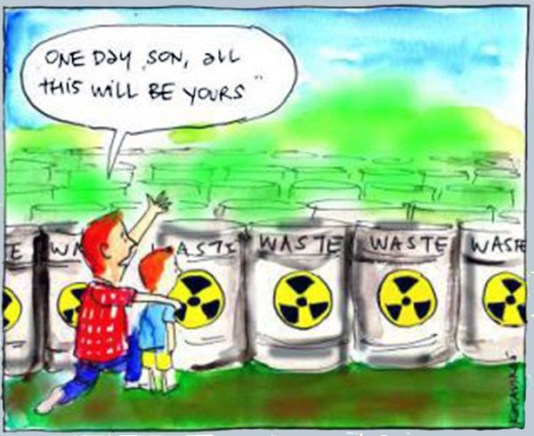
Highly radioactive waste, dangerous for as long as 200,000 years, has to be isolated and guarded in every country that has dabbled in nuclear energy. Cartoon credit: www.sanonofresafety.org/nuclear-waste/
Japan is a place where not two, not three, but four plates meet with no geographical stability. Volcanoes are erupting all the time, new islands pop up in the sea and there are daily earthquakes. Forty thousand years ago, the coast line was totally different and nuclear waste storage is supposed to be safe there?
The issue of Transparency
there seems to be a lack of information on the Japanese plans to bury their nuclear High Level waste. Very little has been discussed on this latest OECD report from May, However, on the JAIF website it has been given a brief mention in a very recent report from JAIF (10 August, 2016)
“When completing its report, the group also took into consideration…
STARKVILLE, Miss.— Officials and engineers tasked with preventing the release of radioactive material during debris removal from the Fukushima nuclear site in Japan are visiting Mississippi State University this week to learn about the university’s expertise in evaluating components of radioactive containment systems.
MSU’s Institute for Clean Energy Technology is the international leader in evaluating the performance of high-efficiency particulate air (HEPA) filtration systems used in nuclear power plants. ICET Director Charles Waggoner said HEPA filters, which are used in nuclear power plants’ containment ventilation systems, prevent the release of air with radioactive material into the atmosphere.
The Fukushima Daiichi Nuclear Power Plant was damaged in March 2011 by a tsunami that followed an earthquake. The team of engineers visiting ICET is responsible for designing the containment ventilation systems for the damaged reactors before the containment vessels can be breached to begin debris removal.
“Much of the world’s population is aware of what happened at Fukushima. Of the four reactors, three suffered a core meltdown,” Waggoner said. “They are at the point of trying to determine how to breach the containment vessel in order to start to retrieve the radioactive debris from the core melting down. That material will be highly radioactive and the process that will be used will also produce aerosols. The way you remove radioactive aerosols from an airstream is to, among other things, use HEPA filters at the end of the treatment train. They’re here because of our ability to evaluate the performance capabilities of HEPA filters under very adverse conditions.”
The six visitors from Japan each represent one of the organizations collaborating on the design of processes and infrastructure to remove materials from the damaged reactors. The group is led by Osamu Seki of the International Research Institute for Nuclear Decommissioning.
“It is indispensable to use the HEPA filters because from now on they will help get rid of the debris from the failed nuclear plant,” Seki said. “It is very important to ventilate the air, which is why the HEPA filters are indispensable to this whole process. We want to learn more about the knowledge and expertise the MSU researchers have accumulated. We also want to build a continuous relationship so we can learn more and help solve our problems.”
ICET, a unit of MSU’s Bagley College of Engineering and a part of MSU’s Energy Institute, has been working with the U.S. Department of Energy for almost 20 years to develop the capability of testing filters under worst-case scenario conditions. Jaime Rickert, ICET’s research program manager and quality assurance manager, implemented a nuclear quality assurance program at ICET that meets Department of Energy standards. Data gathered by ICET researchers is used by the Department of Energy to determine what, if any, changes need to be made to filters at nuclear facilities.
“We provide testing data to the Department of Energy that meets their most stringent quality assurance standards, so they can then go to nuclear facilities using these filters and say, ‘yes, these filters are good for your facility,’ or, ‘we may need to adjust the conditions they’re being used in,’” Rickert said. “ICET’s nuclear quality assurance program, which has been audited and approved by the Department of Energy, ensures that they have the data to support any changes that need to be made.”
The visiting officials from Japan also will visit the Hanford Site in Washington State to discuss design considerations and the use of HEPA filters in the Waste Treatment and Immobilization Plant.
For more on MSU’s Institute for Clean Energy Technology, visit http://www.icet.msstate.edu.
Information provided by Mississippi State University.
Heres an interesting find RE geiger measurements. After clean up and laying of Ashfelt, look between the joins for hotspots (5+ mcSv/h Ouch! Near a used public space) Measurement day July 29, 2017 Sukagawa City, Fukushima Prefecture ①
Enrichment by asphalt joint
measurement details (Think small child) 1 m above ground 0.6 μSv / h Ground 50 cm 1.2 μSv / h 5 cm above the ground 4.1 μSv / h Earth surface 5.6 μSv / h
PS the same could be found in otherwise damaged or broken asphalt as well (broken by heavy vehicle, rain or badly laid asphalt surface which is all too common)
A multi-billion-dollar contract cancellation also weighed on Cameco’s second-quarter financial results. Tokyo Electric Power (Tepco), the operator of Japan’s wrecked Fukushima nuclear plant, terminated a supply contract in January alleging force majeure, which affects about 9.3-million pounds of uranium deliveries through 2028, worth about C$1.3-billion in revenue to Cameco, including about C$126-million in 2017. Cameco disputes the withdrawal,
“saying it sees no basis for terminating the agreement.”








 nuclear-news