US CDC Public Health Response to a Nuclear Detonation meeting
Set for January 16, 2018 at 1:00 p.m. (ET)
https://www.cdc.gov/cdcgrandrounds/archives/2018/January2018.htm
While a nuclear detonation is unlikely, it would have devastating results and there would be limited time to take critical protection steps. Despite the fear surrounding such an event, planning and preparation can lessen deaths and illness. For instance, most people don’t realize that sheltering in place for at least 24 hours is crucial to saving lives and reducing exposure to radiation. While federal, state, and local agencies will lead the immediate response efforts, public health will play a key role in responding.
Join us for this session of Grand Rounds to learn what public health programs have done on a federal, state, and local level to prepare for a nuclear detonation. Learn how planning and preparation efforts for a nuclear detonation are similar and different from other emergency response planning efforts.
Presented By:
Dan Sosin, MD, MPH
Deputy Director and Chief Medical Officer
Office of Public Health Preparedness and Response
Centers for Disease Control and Prevention
“Preparing for the Unthinkable”
CAPT Michael Noska, MS
Radiation Safety Officer and Senior Advisor for Health Physics
Chair, Advisory Team for Environment, Food and Health (A Team)
Office of the Commissioner
U.S. Food and Drug Administration
“Using Data and Decision Aids to Drive Response Efforts”
Robert Whitcomb, PhD
Chief, Radiation Studies Branch
Division of Environmental Hazards and Health Effects
National Center for Environmental Health
Centers for Disease Control and Prevention
“Public Health Resources to Meet Critical Components of Preparedness”
Betsy Kagey, PhD
Academic and Special Projects Liaison
Office of Emergency Preparedness and Response
Division of Health Protection
Georgia Department of Health
“Roadmap to Radiation Preparedness”
Facilitated By:
John Iskander, MD, MPH, Scientific Director, Public Health Grand Rounds
Phoebe Thorpe, MD, MPH, Deputy Scientific Director, Public Health Grand Rounds
Susan Laird, MSN, RN, Communications Director, Public Health Grand Rounds
For non-CDC staff who want to attend in person:
Non-CDC staff must have prior security clearance. US citizens must submit a request to the Grand Rounds Team. A US state-issued photo ID (e.g., driver’s license, US passport) is required.
Non-US citizens must submit their requests 20 days prior to the session to the Grand Rounds Team, and additional information will be required.
For individuals requiring reasonable accommodations:
It is the policy of CDC to provide reasonable accommodations (RA) for qualified individuals with disabilities to ensure their full inclusion in CDC-sponsored events. Employees are asked to submit RA requests at least 5 business days prior to the event. Please e-mail the request to grandrounds@cdc.gov.
For questions about this Grand Rounds topic:
Feel free to e-mail your questions before or during the session.
Grand Rounds is available for continuing education.
All continuing education credit for Public Health Grand Rounds (PHGR) is issued online through the CDC/ATSDR Training and Continuing Education Online system. If you have questions, you can email Learner Support or call them at 1-800-41-TRAIN (1-800-418-7246). Those who view PHGR and wish to receive continuing education must complete the online seminar evaluation. Continuing education will be available for up to 2 years and 1 month after the initial offering. The course code for all PHGR sessions is PHGR10.
Pilgrim nuclear plant manually shut down
4th Jan 2018
PLYMOUTH — Operators manually shut down Pilgrim Nuclear Power Station shortly at 2 p.m. after one of the two main 345-volt lines that provide off site power to the plant “became unavailable,” according to Nuclear Regulatory Commission spokesman Neil Sheehan.
“There have been no complications with the shutdown thus far,” Sheehan wrote in an email to the Times.
The emergency generators were fired up to power cooling and other emergency systems functioning, even though the second 345-volt line, along with a smaller line, from offsite have remained in service.
Patrick O’Brien, a spokesman for Entergy Corp., Pilgrim’s owner and operator, said plant managers decided to use the diesel generators for safety systems because of their reliability.
Plant watchdogs had been calling on federal regulators to order Pilgrim’s reactor shut down since yesterday, when strong winds and flooding were forecast.
The NRC left it to Pilgrim’s management, along with three federal inspectors onsite at the plant, to make the call. O’Brien had said late yesterday there were no plans to power down the reactor in anticipation of storm-related problems.
O’Brien issued the following written statement from Entergy shortly before 4 p.m today:
“We are working to determine the cause of the line loss. Pilgrim had been safely operating for 227 consecutive days following the completion of our most recent refueling outage in May 2017. We will take this opportunity to conduct preventive maintenance that we could not otherwise perform with the plant operating at full power. When Pilgrim will return to 100 percent power is considered business sensitive, and we do not disclose that information.”
Mary Lampert, president of Pilgrim Watch, said her group had asked federal regulators to order the reactor shut down as a pre-emptive measure.
“My concern was flooding, the high winds, the water, everything,” Lampert said shortly after the reactor was manually powered down.
“So much for (Energy Secretary Rick) Perry’s and Trump’s faith in nuclear as providing reliable power,” Lampert said. “It’s only Jan. 4. We’re off to a good start.”
A January blizzard in 2015 resulted in an emergency shutdown that was accompanied by a number of system problems. Those storm-related difficulties pushed Pilgrim into Column 4, as one of the country’s worst performing reactors.
http://www.capecodtimes.com/news/20180104/pilgrim-nuclear-plant-manually-shut-down
Westinghouse, Toshiba’s troubled nuclear unit, is acquired
THE ASSOCIATED PRESS January 5, 2018 at 08:35 JST
CRANBERRY TOWNSHIP, Pa.–Westinghouse Electric, the U.S. nuclear unit of embattled Japanese electronics giant Toshiba, has been acquired in a deal valued at about out $4.6 billion.
Westinghouse Electric Co. declared bankruptcy protection early last year, leaving a number of nuclear projects in limbo.
The acquisition by Brookfield Business Partners LP on Thursday comes one day after an agreement tying up loose ends from two failed nuclear reactors in South Carolina.
South Carolina Electric & Gas Co. abandoned construction reactors at the V.C. Summer Nuclear Station. Thousands were left jobless in the wake of the $9 billion failure, which was blamed by owners on the plight of Westinghouse, the lead contractor. A deal proposed Wednesday could mean $1.3 billion in refunds for utility customers affected by the failed project.
The nuclear industry has struggled both because of the tremendous cost of building massive reactors and the accelerating shift to other forms of energy like natural gas and alternative energy, like solar. The industry, and Toshiba in particular, has been subjected tighter regulatory control following the 2011 Fukushima nuclear disaster in northeastern Japan.
Toshiba has been dumping assets to cover for its disastrous immersion into nuclear power, a play it saw once as a safe infrastructure investment, free of the seasonal fluctuations of the power generation industry.
Technology in both fracking, a form of drilling, and alternative energy, has upended the power sector.
Westinghouse said Thursday that the deal with Brookfield doesn’t involve cash, but includes the assumption of a number of pension, environmental and operating obligations.
The agreement, pending the approval of bankruptcy court, is expected to close in the third quarter.
Political Scientists to Speak on Nuclear Weapons and International Relations
Former IOP Executive Director Steve Edwards will moderateThe threat of nuclear war is once again in the news. Fears about the potential use of nuclear weapons have reanimated public debate in ways not seen since the Cold War.
To further understand how decisions about nuclear weapons are made by world leaders and institutions, the Division of the Social Sciences, the Chicago Project on Security and Threats (CPOST), and the Institute of Politics (IOP) are cosponsoring a January 29 panel titled “A Safer or a More Dangerous World? Nuclear Weapons in Today’s Global Community.” The event, to be held in Regenstein Library Room 122 from 5:30-7:00 PM, is an extension of the University-wide Nuclear Reactions series commemorating the 75th anniversary of the first controlled atomic chain reaction.
Organized by political scientist Paul Poast, Assistant Professor of Political Science,
the event joins UChicago international relations scholars to offer different viewpoints on military decisions, the role of nuclear arms in the formation of alliances, and aids and obstacles to non-proliferation efforts. “It’s important to think systematically about the international system, about how countries interact with each other, and what would lead them to think that nuclear weapons are a useful thing to have,” Poast says.
In addition to Poast, panelists will include Austin Carson, Assistant Professor of Political Science; Paige P. Cone, CPOST’s Nuclear Proliferation Fellow; Robert Pape, Professor of Political Science and Director of CPOST; and Paul Staniland, Associate Professor of Political Science and Chair of the Committee on International Relations (CIR). Steve Edwards, Chief Content Officer of WBEZ and former executive director of the Institute of Politics (IOP), will moderate.
Panelists will address various long-standing questions about nuclear politics and policy, from the effectiveness of dropping the first atomic bombs over Japan during World War Two to the latest battles over nuclear programs in Iran and North Korea. “All of us have something to say on this topic about the international politics of nuclear weapons,” says Poast. “This session will help to not only give a little historical perspective, but also contextualize the uncertain future of nuclear weapons in the world.”
Poast stresses that despite the daunting scale of the nuclear weapons threat and the global problems it presents, the work of researchers like those on the panel can help people better understand the implications for society today and in the future. “The goal is to give people a new way to think about things,” he says.
Looking at nuclear weapons from the viewpoint of political science helps reinforce the idea that technology is always political and social, Carson says. “But we have a lot of ways of managing that technology and we better damn well understand what makes it work and what doesn’t,” he says. “Because it’s the seventy-fifth anniversary of an innovation that still vexes us in terms of how to handle it. And I think probably should for a long time.”
Panelists will offer varied perspectives, scholarship
In a paper published early in his career, Robert Pape challenged the conventional wisdom that dropping the atomic bombs on Hiroshima and Nagasaki was the key to the Japanese surrender that ended World War II. He suggested instead that Japan’s ability to continue fighting was most threatened by the Soviet Union’s declaration of war (on August 9, the same day as the bombing of Nagasaki), and by the United States’ sea blockade and capture of Okinawa. Pape argued further that while the nuclear bombs’ devastation was massive, the Japanese had already suffered intense conventional bombing and had not surrendered.
“[Pape’s argument] raises all sorts of ethical questions about the whole justification to use it to end the war quickly,” Poast says. “Could we have ended the war quickly just by having the Soviets invade without the dropping of the atomic bombs? That’s a big question and I think that’s going to be something that will be really valuable for the audience to hear.”
In another influential article titled “Why Economic Sanctions Do Not Work“, Pape questioned the effectiveness of punishing sanctions to achieve international political goals, like efforts to end specific states’ nuclear weapons programs. Cone says sanctions can appear reasonable to leaders faced with emergent crises. “They think, we don’t want to reward you for your bad behavior, so we’re going to punish you. That might make sense morally, but does it actually work?”
Cone’s research extends beyond sanctions to include other forms of economic or military coercion as well. A recent item she published in the Bulletin of the Atomic Scientists explained her finding that previous uses of so-called “negative inducements” have not produced good results. “If the definition of insanity is doing the same thing over and over while expecting different results, insanity is an apt description of US sanctions policy against North Korea,” Cone wrote.
According to Cone, 39 states have pursued nuclear weapons. Of those, Cone determined that offering positive inducements was a more reliable method of intervening to prevent a country from becoming a nuclear power, and was successful in reversing at least 11 countries’ nuclear ambitions. Today, nine countries are considered nuclear states, including North Korea.
“It’s really easy to think everything is terrible right now,” Cone says. “But if you take everything else away and look at the numbers, far more states have tried to begin nuclear weapons programs and failed, than those that have tried and not failed. And a big part of why they start and then reverse is a consequence of the inducements that are being given to them.”
Part of Poast’s research centers around one of those inducements — membership in international security alliances like the North Atlantic Treaty Organization (NATO). Although a key function of NATO was to limit the Soviet Union’s influence in Europe during the Cold War, Poast’s research suggests that the alliance also thrived as a way for the United States to enforce nuclear non-proliferation.
“You can’t avoid the fact that nuclear politics provide the rationale for NATO,” Poast says. “Once you view NATO’s role in the context of nuclear weapons, you realize that the end of the Cold War did not in any way make NATO obsolete.” In fact, Poast believes NATO became even more important as a tool of non-proliferation in the 1990s, when the Iron Curtain fell and Eastern European states might have pursued nuclear weapons.
Austin Carson also examines the influence of international organizations in nuclear politics. The 1968 Nuclear Nonproliferation Treaty and its enforcement arm, the International Atomic Energy Agency (IAEA), have played an increasingly important role in combatting nuclear programs, particularly since the first Gulf war in Iraq.
Carson’s work looks at secrecy and transparency between states and international organizations. He has previously studied covert military and intelligence operations as a kind of face-saving communication among states. His current project examines why decisions are made not to communicate secret information, particularly when countries have intelligence that could cause an acceleration of nuclear programs.
“We’ve known that…if you tell everyone about [a state’s attempts to develop nuclear weapons], you marshal international pressure that’s going to make that proliferating country or that violator more likely to come come back from the brink and reverse what they’re doing,” Carson says. But examining newly declassified documents from US intelligence archives, he found that there are often situations in which government and military officials did not think publicity would produce a positive outcome.
“Part of what sustains norms and conventions is a lack of awareness about who breaks those norms and conventions and how commonly they do it,” Carson says. “Publicizing information that isn’t widely held about a particular violation could make it more likely that other countries violate and then ultimately that norm or convention or law would sort of fall away.”
Poast says Paul Staniland’s perspective will help the panel address the regional impacts of nuclear weapons programs. Staniland, whose work has been on insurgencies and violence in South and Southeast Asia, has recently shed light on broader South Asian foreign policy questions, including the way nuclear weapons factor into smaller-scale conflicts between Pakistan and India like the resurgent violence in Kashmir last year. Staniland recently coauthored a paper that considers the domestic political implications of India’s nuclear policy and the role played by other regional nuclear powers like Pakistan and China.
Poast says the various questions raised in his and the other panelists’ research reflect the fact that nuclear politics are inextricable from the development of other kinds of international politics and governance, and that their influence may be surprising. “If anything,” he says, “nukes have had this perverse effect of making everyone more conscious of trying to create peaceful relations”
N.J. stops fast-track pursuit of nuclear subsidy bill, for now
Jan 4 (Reuters) – * A bill to subsidize New Jersey’s nuclear power plants that could have cost ratepayers about $300 million a year was abandoned in the state legislature late Wednesday, according to organizations interested in the plan.
* Assembly Speaker Vincent Prieto, a Democrat, decided not to advance the bill, which was designed to stop the reactors from retiring early in the current low power and natural gas price environment.
* The reactors in question include Public Service Enterprise Group Inc’s Salem and Hope Creek plants in New Jersey, which PSEG said it might be forced to close in a couple of years if it does not receive some kind of assistance
* After a joint legislative committee voted unanimously to support the bill on Dec. 20, which was introduced earlier in the month, some energy analysts thought the state legislature would pass it during the ongoing lame duck session and New Jersey Governor Chris Christie, a Republican, would sign it into law before he leaves office on Jan. 16.
* The Natural Resources Defense Council, an environmental group and opponent of the bill, said in a statement on Thursday that Prieto’s move provides Governor-elect Phil Murphy, a Democrat, the opportunity to develop an energy plan that will increase investment in energy efficiency and renewables, while keeping the state’s nuclear plants running.
* PSEG said in a statement on Thursday that it “will continue to educate New Jersey’s legislators and policymakers on the economic threat facing the nuclear plants that serve our state.”
* New Jersey is one of several states exploring ways to keep reactors in service to preserve carbon-free energy, jobs and taxes as cheap and abundant gas from shale fields keep power prices low, making it less profitable or even unprofitable for generators to keep the units operating.
* Ohio, Pennsylvania and Connecticut have also considered proposals to protect reactors. In 2016, New York and Illinois adopted rules to subsidize some reactors in danger of closing
* PSEG has said economic studies show the loss of its plants would result in $400 million a year in higher electricity rates, 14 million tons a year of additional air pollution and the loss of 5,800 or more jobs (Reporting by Scott DiSavino; editing by Jonathan Oatis)
Dr. Norma Field on Fukushima solidarity and Japanese society
| Summary: Interview following NEIS’ “The End of the Nuclear Age: Where are the People?” event with Arnie Gundersen and Norma Field at DePaul University. Dr. Field speaks of her solidarity work with Japanese effected by the Fukushima disaster. When the government failed to prosecute anyone in its aftermath, a peoples campaign formed to demand accountability. She speaks of that and the tradition of protest against government and nuclear power specifically. She refers to some largely unknown but shared experiences in American and Japanese society. |
|
| Credits: DePaul University NEIS |
|
| Notes: “Sea of Miracles” Case in point about history of protest. Link above to a short documentary about a Japanese fishing village that has for 30 years been protesting the building of a nuclear power plant that would destroy the Bay it depends on for its livelihood and culture. Having stopped the nuclear power plant twice the community was recently notified that local authorities have approved the power company’s permit to begin construction. |

Podcast for Program: Dr. Norma Field on Fukushima solidarity and Japanese society In series: Version: Interview following NEIS’ “The End of the Nuclear Age: Where are the People?” event with Arnie Gundersen and Norma Field at DePaul University. Dr. Field speaks of her solidarity work with Japanese effected by the Fukushima disaster. When the government failed to prosecute anyone in its aftermath, a peoples campaign formed to demand accountability. She speaks of that and the tradition of protest against government and nuclear power specifically. She refers to some largely unknown but shared experiences in American and Japanese society.
Dr. Norma Field on Fukushima solidarity and Japanese society Segment: 1
January 3, 2018, 5:20 AM
Media files
2838-1-Norma_Field_on_Resistance.mp3 (audio/mpeg, 19.0 MB)
UN officials welcome reopening of comm b/w two Koreas
Thursday, Jan 4 2018 IST
United Nations Secretary-General Antnio Guterres has welcomed the reopening of the communication channel between the Democratic People’s Republic of Korea (DPRK) and the Republic of Korea, his deputy spokesman has said.”It is always good to have a dialogue between the Democratic People’s Republic of Korea and the Republic of Korea,” F
arhan Haq told reporters on Wednesday in response to a question during the daily news briefing at UN Headquarters in New York.He went on to say that the UN remains committed to ensuring the implementation of Security Council resolutions on the denuclearisation of the Korean peninsula. “We hope that enhanced diplomatic initiatives will help achieve this goal,” he added.
According to media reports, DPRK announced Wednesday the reopening of a channel of communication, the day after the offer of dialogue made by the Government of the Republic of Korea.This communication channel, established in August 1972, was cut in February 2016 by Pyongyang after Seoul decided to close the inter-Korean industrial zone of Kaesong,
in the wake of a nuclear test by the DPRK.Meanwhile, the President of the 72nd session of the UN General Assembly, Miroslav Lajk, met today with Ja Song Nam, the Permanent Representative of the Democratic People’s Republic of Korea (DPRK) to the United Nations, at the request of the Permanent Representative.According to a note issued by the Assembly President’s Office, Mr Lajk said he was pleased with the readiness of DPRK to constructively engage in a dialogue with the Republic of Korea, including a possible participation of a delegation from DPRK in the Winter Olympic Games in PyeongChang, Republic of Korea, as well as with the reopening of the communication channels.UNi XC-SNU 0758
https://news.webindia123.com/news/Articles/World/20180104/3244425.html
Scana To Be Bought By Dominion Energy, Assume Failed Nuclear Project Costs
Dominion Energy Inc said on Wednesday it would buy Scana Corp in an all-stock deal worth about $7.9 billion, offering the utility a…..
This content is restricted to site members. If you are an existing user, please log in. New users please check out our subscription options.
Bill to help New Jersey’s nuclear power plants to get vote today

TRENTON, N.J. (AP) – New Jersey lawmakers are set to vote on a roughly $300 million bill that would raise utility ratepayers’ costs to rescue the state’s nuclear power industry from what some say is impending financial ruin.
The Democrat-led state Senate is set to vote on the bill Thursday. A vote in the Democrat-controlled Assembly is pending. Estimates state the legislation could mean ratepayers would pay from $31 to $41 more annually.
PSE&G;, the state’s biggest utility, says its two nuclear plants, which account for about 40 percent of the state’s electricity production, are in danger of going broke within two years and would shut down.
The legislation has drawn significant opposition, including from the AARP, environmental groups and industrial utility ratepayers who argue that PSE&G; is opportunistically pursuing a bailout.
https://www.washingtontimes.com/news/2018/jan/4/bill-to-help-new-jerseys-nuclear-power-plants-to-g/
Exclusive and rare interview with Christina Mac Phearson owner of nuclear-news.net

One of Christina’s many memes 🙂
For all our followers here on nuclear-news.net, I would like to present you with two interviews from our authors.
Firstly, here is a recent and rare audio podcast with Christina MacPhearson (AKA Noel Wauchomp), our blog founder. In the podcast she mentions how she started her activism and progressed onto blogging nuclear information. She also discusses the situation in her home Australia, Fukushima as well as a range of other topics.
Lonnie Clark interiew with Christina Mac Phearson 2 Jan 2017
While I am doing this post i thought to add an interview with 2 co authors of the blog for any new subs. Herve Courtois who has been covering much of the Fukushima news here on nuclear-news.net. I (Shaun McGee aka arclight2011) will add an information packed podcast interview that I did with Herve here;
Published on 2 Aug 2015
In the second part of the show we discuss with Herve Courtois (French activist, blogger and researcher) the issues with Fukushima evacuees, The PR companies methods to smooth over the bad news, The connection between health studies done after Hiroshima and Nagasaki and how health studies are being equaly fudged by the nuclear corporations and Health physicists, How the Japanese government is forcing evacuees back into contaminated areas against their will, How the Japanese blocked the UN petition to evacuate at least the children from more contaminated areas, We discuss also how the nuclear industry world wide is going into overdrive to promote the safety of nuclear energy around the anniversary of Hiroshima and Nagasaki and the timing of the first Japanese nuclear reactor to be brought back online. This is a fascinating interview packed with information that the main stream media can not report on. We discuss Wikileaks and the report concerning the spying on Japan by the NSA in recent years and the connection to the Okinawa protest.
If you wish to make a small donation to either myself or Herve towards our running costs for the year, please feel free to send a paypal payment via these emails
To make a donation to Herve Courtois (aka Dun Renard) send your payment here; herve.courtois@yahoo.com
To make a donation to Shaun McGee )aka arclight2011) send you payment here;
arclight2011@riseup.net
Many thanks! And we all wish you a productive and peaceful new year! Namaste!
GE and its 2017 annus horribilis.

GE sued for $700M over 401(k) management
https://dailygazette.com/article/2017/09/29/ge-sued-for-700m-over-401-k-management
Shareholder sues GE after ‘unacceptable’ results hurt stock
https://www.reuters.com/article/us-ge-lawsuit/shareholder-sues-ge-after-unacceptable-results-hurt-stock-idUSKBN1D22CK
General Electric plans to lay off 12,000 people from its GE Power business unit as part of a broad effort to cut $3.5 billion in costs by the end of 2018
http://fortune.com/2017/12/07/ge-layoff-power-business/
GE faces $500M federal lawsuit over Fukushima nuclear disaster –
https://www.bizjournals.com/boston/news/2017/11/17/ge-faces-federal-lawsuit-over-fukushima-nuclear.html
The Brexit effect UK and Euratom. Some good nuclear PR

Mark Payne Published: 06:00 Wednesday 03 January 2018
The boss of Hartlepool Power Station says he is confident a replacement to Europe’s nuclear regulator will be secured after Brexit.
The UK is currently part of the European Atomic Energy Community, also known as Euratom, which allows the free movement of nuclear workers and materials between European Union member states.
Minister at the Department for Exiting the European Union, Steve Baker (left) with Craig Dohring station director at Hartlepool Power Station, during the minister’s visit in September Minister at the Department for Exiting the European Union, Steve Baker with Craig Dohring station director at Hartlepool Power Station, during the minister’s visit in September Britain is due to leave Euratom as part of the Brexit process as it comes under the jurisdiction of the European Court of Justice which Prime Minister Theresa May has committed to removing the United Kingdom from.
Last May, the Commons Energy Committee urged the UK to delay leaving Europe’s nuclear regulator warning power supplies could be threatened if a new regulator was not in place. But Craig Dohring, station manager of Hartlepool’s EDF nuclear power station, is more optimistic. He told the Mail:
“It is clear there is a few things we need to have a replacement for including Euratom. “We need something to essentially cover us to a similar level of our Euratom agreement which allows us access into Europe and third part countries to support the power station around some nuclear specific equipment and fuel. “
I’m confident we will get that. There is a positive feeling around the Government trying to cover that.
“I think our role is to help the Government and provide information and advice, and the Government have certainly been open to that.”
The power station spoke about the issue with MP Steve Baker, one of four Brexit ministers, when he visited Hartlepool in September then said the Government had “some work to do” and its job was to get new legislation through to ensure the success of nuclear power stations across the country.
For more recent resources on Euratom and Brexit;
Blunders, catastrophic, delays, even bankruptcy… ANOTHER nuclear power plant is going into financial meltdown
The company behind one of Britain’s biggest nuclear power projects has plunged to a £266 million loss citing ‘uncertainties’ over its future and the viability of crucial technology.
Japanese firm Toshiba said the huge loss incurred by one of its UK subsidiaries was due to writing off hundreds of millions of pounds of investment in the proposed Moorside plant, in west Cumbria.
It is the latest sign of financial strain at the Tokyo-based firm amid wider concerns over the spiralling costs and catastrophic delays that have beset the UK’s nuclear industry.
The plan: How the plant at Moorside was planned to look. Now the project has an uncertain future
Britons were last week supposed to be cooking their turkeys with power from EDF’s nuclear plant at Hinkley Point in Somerset, which is now not expected to be in use for another decade.
‘EDF will turn on its first nuclear plant in Britain before Christmas 2017,’ said Vincent de Rivaz in 2007, who stepped down as group chief executive in November. ‘It is the moment of the power crunch. Without it, the lights will go out.’
It was envisaged that new nuclear plants at Moorside, Hinkley Point and Wylfa in Anglesey would between them generate a fifth of the UK’s electricity.
This may still happen. But right now, nuclear firms are struggling with the expense, stringent regulatory hurdles and costly project delays – just as the cost of other forms of electricity fall.
Toshiba won the contract to build the nuclear power plant at Moorside, on land next to the Sellafield nuclear fuel reprocessing site.
But it was forced in March to place its US nuclear division Westinghouse into bankruptcy protection. Last month, it said it would sell Westinghouse for £4 billion. Troubled Toshiba is now in talks to sell its interests in the Moorside project to Kepco, majority-owned by the South Korean government.
Heat is on: We had been told that by 2017 we would be cooking the turkey with power from Hinkley (due to be ready in 2025)
Toshiba has two UK subsidiaries: Advance Energy UK, which incurred the £266 million loss; and NuGeneration, which is directly responsible for running Moorside.
With a cloud of uncertainty over the project, the Japanese firm has admitted in reports issued by its UK subsidiaries: ‘The directors do not know whether a sale of the shares of [NuGeneration] will be completed nor how any successful bidder will frame the deal.’
Kepco said it hoped to complete a deal to take over the running of the project early next year.
Uncertainties are understood to include the use of Westinghouse’s AP1000 reactor. Approval for use at Moorside was first sought from UK regulators in 2011. It was granted approval by the Office for Nuclear Regulation in March – just days after Westinghouse entered bankruptcy protection.
Should Kepco decide to ditch the design and use its own, the project would likely be delayed for years until a new design is approved. Some estimates say that could put any launch back from 2025 to the late 2020s at the very earliest. ‘The whole thing is a mess,’ said Martin Forwood of campaign group Core, which opposes the Moorside development.
‘Kepco would almost certainly push to use its own reactors so the big question is whether they would have to start afresh on consultation.
‘A lot of people around Moorside believe it will never take off.’
Forwood said the costs of other forms of renewable energy are falling and energy storage systems are being developed. ‘The longer these plans get delayed the less nuclear is needed,’ he added.
And, according to Forwood, the firms involved in the projects at Moorside and Wylfa ‘are not going to get anywhere near what the Government signed up for at Hinkley’.
The House of Commons Public Accounts Select Committee last month said there had been ‘grave strategic errors’ awarding French government-backed EDF the Hinkley Point contract.
It said ‘the economics of nuclear power in the UK have deteriorated’ and a ‘blinkered determination’ to agree the 35-year Hinkley deal, ‘regardless of changing circumstances’ had lumbered consumers with £30 billion payments over market rates for electricity.
Hinkley is officially due to switch on by 2025 at the earliest, although 2027 appears more likely.
Read more: http://www.thisismoney.co.uk/money/article-5223475/ANOTHER-nuclear-power-plant-enerting-financial-meltdown.html#ixzz534A9A0c8
Should the public be allowed to see a radioactive contamination map?
“Normally, both the dose rate of radioactivity in the air and the density of soil contamination are needed to define the evacuation zones. Indeed, in TEPCO Fukushima Daiichi nuclear accident plant, the radiation protection of workers is organized according to the combination of the radiation dose, the surface contamination density and the concentration of radioactive substances in the air.”
We published the most recent map of soil contamination made by the “Environmental Radioactivity Measurement Project around Fukuichi (Fukushima Daiichi)”.
Nous publions la carte la plus récente de la contamination du sol faite par le “Projet de mesure de la radioactivité environnementale autour de Fukuichi (Fukushima Daiichi)”.
「ふくいち周辺環境放射線モニタリングプロジェクト」作成の最新の土壌汚染マップをアップいたします。


We have published several soil contamination maps of the “Environmental Radioactivity Measurement Project around Fukuichi” in this blog (see maps of Namie, Minamisoma). Normally, the government should take the measurements, but the government relies on measures of the dose rate of radioactivity in the air at the expense of radio-contamination measurements at the surface and in the air (in terms of volume radioactive substances). In response to the lack of this vital information for the radiation protection of the population, civil groups carry out soil measurements.
Nous avons publié plusieurs cartes de contamination du sol du “Projet de mesure de la radioactivité environnementale autour de Fukuichi” dans ce blog (voir les cartes de Namie, Minamisoma). Normalement, le gouvernement devrait effectuer les mesures, mais le gouvernement s’appuie sur les mesures du débit de dose de la radioactivité dans l’air au détriment des mesures de radio-contamination à la surface et dans l’air (en termes de volume de substances radioactives). Pour répondre à l’absence de cette information essentielle pour la radioprotection de la population, les groupes civils effectuent des mesures du sol.
このブログで紹介してきた「ふくいち周辺環境放射線モニタリングプロジェクト」の土壌汚染マップですが(浪江町、南相馬市)、もともと国や地方自治体が実施すべき測定です。しかし、政府は空間線量率の測定のみを優先し、表面(土壌を含む)や空間の汚染密度をニグレクトしています。そのため住民の放射線防護に不可欠の情報が欠如しています。この情報不備を補完するため、市民団体が測定を 実行しているのが現状です。
Normally, both the dose rate of radioactivity in the air and the density of soil contamination are needed to define the evacuation zones. Indeed, in TEPCO Fukushima Daiichi nuclear accident plant, the radiation protection of workers is organized according to the combination of the radiation dose, the surface contamination density and the concentration of radioactive substances in the air. (See Control of radioactivity dose rate is not a satisfactory radiological protection measure.)
Normalement, le taux de débit de dose de la radioactivité dans l’air et la densité de contamination du sol sont nécessaires tous les deux pour définir les zones d’évacuation. En effet, dans TEPCO Fukushima Daiichi centrale nucléaire accidentée, la radioprotection des travailleurs est organisée en fonction de la combinaison de la dose de radiation, la densité de contamination de surface, et la concentration de substances radioactives dans l’air. (Voir Le contrôle du débit de dose de radioactivité n’est pas une mesure de radioprotection satisfaisante.)
避難指示区域の設定には空間線量率とともに土壌汚染密度が必須のはずです。実際、福島第1原発内では作業者の放射線防護対策には空間線量率(Sv/時間の単位)、表面汚染密度(Bq/m2)、空気中放射性物質の密度(Bq/m3)の三者の組み合わせを考慮しています。
Yet, for ordinary people, under the current Japanese government, only the rate of dose rate of radioactivity in the air is taken into account, neglecting the risk of internal exposure to radioactivity (note 1). Evacuation orders are lifted, and residents without a manual or occupational radiation protection training are encouraged to return, including infants and pregnant women, to be exposed to the highly radio-contaminated environment (see maps and instructions). read the article, No human rights in Namie to Fukushima?).
In this situation, what will be the use of soil contamination maps created by civil groups? How will local administrations deal with it? Will they benefit?
Pourtant, pour les gens ordinaires, sous l’actuel gouvernement japonais, seul le taux de débit de dose de la radioactivité dans l’air est pris en compte, en négligeant le risque d’exposition interne à la radioactivité (note 1). Les ordres d’évacuation sont levés, et les habitants sans manuel, ni formation professionnelle de radioprotection sont encouragés à retourner, y compris les bébés et les femmes enceintes, pour être exposés dans l’environnement très fortement radio-contaminé (voir les cartes et lire l’article, Pas de droits de l’homme dans Namie à Fukushima?).
Dans cette situation, quelle sera l’utilisation des cartes de contamination du sol créées par les groupes civils? Comment les administrations locales s’en occuperont-elles? Vont-ils en tirer profit?
それなのに、現在の日本政府の元では、住民の場合は空間線量率のみが考慮され、内部被ばく(注1)のリスクは無視され、避難指示は解除され、住民は女性、子供も含めて放射線防護の装備もなく、高い放射線の環境にさらされているのが現実です(浪江町の汚染状況に関する記事 )。
このような状況の中で、市民団体が作成する土壌汚染マップ はどのように役立っているのでしょうか?地方行政による扱いはどのようなものでしょうか?行政は市民団体作成の地図を役立てることがあるのでしょうか?
Mr. Yoichi Ozawa, from the “Environmental Radioactivity Measurement Project around Fukuichi”, commented on this.
M. Yoichi Ozawa, du “Projet de mesure de la radioactivité environnementale autour de Fukuichi”, a donné des commentaires à ce sujet.
「ふくいち周辺環境放射線モニタリングプロジェクト」の小澤洋一さんにコメントをいただきました。
Citation
引用
Article and image source; http://nosvoisins311.wixsite.com/voisins311-france/single-post/2018/01/01/Le-public-devrait-il-%C3%AAtre-autoris%C3%A9-%C3%A0-voir-la-carte-de-la-radio-contamination
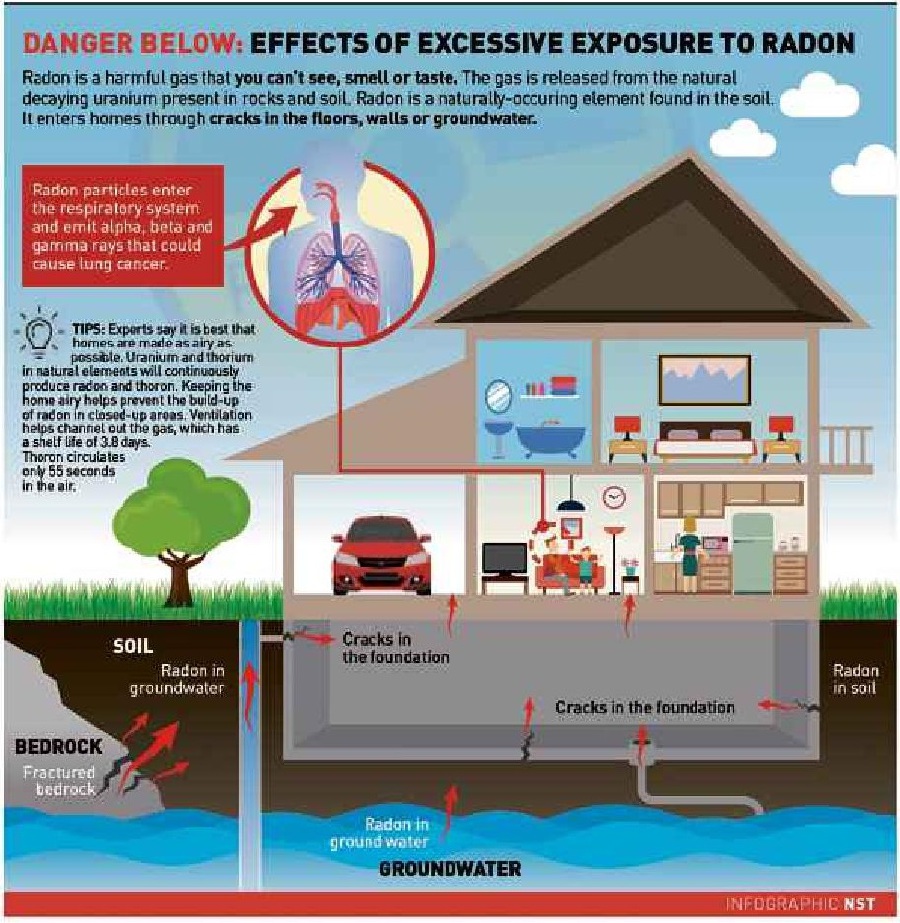
Radiation risk in home construction materials
NUCLEAR and radiation experts are cautioning the public over potential hazards posed by naturally-occurring radioactive elements in construction materials.
Commonly found in materials naturally sourced from earth, uranium and thorium are Naturally Occurring Radioactive Materials (NORM) often found in bricks, cement blocks, granite, marble or glazed tiles used in the construction of homes.
The two elements (uranium and thorium) undergo a natural decaying process to form other harmful elements and emit several types of radiation, particularly alpha, beta or gamma rays.
Atomic Energy Licensing Board (AELB) director-general Hamrah Mohd Ali, in an exclusive interview with the New Straits Times, cautioned that excessive exposure to these rays could damage human tissue and cells, and cause health issues or death.
The degree of health risks for those exposed to these types of radiation, he said, depended on the levels and duration of exposure.
He said the risk of excessive exposure could be reduced by minimising direct contact with NORM, including wallpaper, plastic or wooden flooring for protection and in the case of gamma, lead.
“Materials traced to natural materials like brick, mosaic, granite or cement blocks… even toilet bowls, contain radioactive materials… There is no way for us to run away from them.
“The levels of radiation vary depending on the origin of the materials.
“For example, mosaic from Kerala, India, may have higher radiation levels than those from the domestic market because the earth in Kerala has higher natural background radiation.
“Exposure to radiation can have long-term, short-term or acute effects…
“We must be careful with the long-term effects because it can slowly kill us even though we may not realise it.”
Hamrah said the types of radiation emitted from radionuclides would also determine the severity of the health effects on those exposed to it.
“Different rays affect us differently. For example, although alpha rays can be blocked using things like a piece of paper, it could cause a lot more damage on a surface, compared with beta, which has smaller particles.
“Since alpha’s particles are bigger, they will affect a wider area when it enters the human body, including through wounds, inhalation or contaminated food.
“For example, if you knead dough directly on top of a chipped granite table top, you will not notice particles containing NORM attaching to it.
“When you consume it, these radioactive materials will enter your body… some might exit through the excretion process, but the rest will continuously emit rays that will kill your cells.”
He said the International Atomic Energy Agency had set 10 microsievert as the “acceptable” yearly “dose limit” to radiation absorption.
The “legal effective dosage” limit or level of radiation reading among the public should be no more than one milisievert a year.
Hamrah, however, cautioned about possible “unknown” effects, even with the most minimal exposure.
“Although the ‘acceptable’ dose has been set at one milisievert per year, those working in the radioactive and nuclear industry are ‘allowed’ to be exposed to up to 20 milisievert per year… This is on top of the background reading.
“But, there is no study that can say for sure that if you receive below one milisievert, you will not be affected,” he said, adding that children would be more sensitive to radiation as their immune systems were not fully developed.
He said apart from the dangers of being exposed to lethal radiation, uranium and thorium also produced radon and thoron, which are also lethal gases.
Radon, a colourless and odourless radioactive gas, is known as the second leading cause of lung cancer in the United States, with an estimated 20,000 deaths a year.
Hamrah cautioned that having more sources containing radioactive materials in a confined area would increase the level of these naturally-produced radioactive gases.
“Uranium and thorium in consumer products will continue to decay, releasing radon and thoron that will accumulate in confined areas.
“Radon in the air will break down into tiny radioactive elements (radon progeny) that will be lodged in the lining of the lungs. It will then release radiation, which can lead to cancer.
“The production of radon and thoron is continuous… meaning, if your house contains more materials that emit radiation, the reading may be higher compared with houses made of wood or with wooden flooring or roofing.”
The US Environmental Protection Agency recommends that radon readings are brought to below four picocuries per litre (pCi/L), although there is no “safe levels” for radon and thoron.
Hamrah shared with NST readers how to manage the gases: make sure your homes are well ventilated. It helps to “dilute” them.
“It is important for homes to have good ventilation. Open the windows, turn on the fan, as this will help remove the gases,” he said, adding that radon would remain in a confined area for four days before it dissipated.
As these gases are continually produced, good air circulation will help channel them out of confined areas.
AELB, Hamrah said, did not monitor the NORM level in soil or imported construction materials.
“The public can lodge a report with the agency if they suspect that the level of radon in their house is high, and we can help them verify it.
“We don’t monitor construction materials, including those from other countries, because Malaysian homes are usually well-ventilated.
“Radon is a huge concern in countries with four seasons because when it is cold, people will shut doors and windows, leaving no room for the air to flow out.
“We will take action if we receive any reports.”
1 This Month

of the week – Shut Down Drone Warfare!


Tell the Ukrainian Government to Drop Prosecution of Peace Activist Yurii Sheliazhenko

Petition to revoke the licensing of the Near Surface Nuclear Disposal Facility (NSDF) at Chalk River. https://www.ourcommons.ca/petitions/en/Petition/Details?Petition=e-7247
To see nuclear-related stories in greater depth and intensity – go to https://nuclearinformation.wordpress.com
-
Archives
- March 2026 (237)
- February 2026 (268)
- January 2026 (308)
- December 2025 (358)
- November 2025 (359)
- October 2025 (376)
- September 2025 (257)
- August 2025 (319)
- July 2025 (230)
- June 2025 (348)
- May 2025 (261)
- April 2025 (305)
-
Categories
- 1
- 1 NUCLEAR ISSUES
- business and costs
- climate change
- culture and arts
- ENERGY
- environment
- health
- history
- indigenous issues
- Legal
- marketing of nuclear
- media
- opposition to nuclear
- PERSONAL STORIES
- politics
- politics international
- Religion and ethics
- safety
- secrets,lies and civil liberties
- spinbuster
- technology
- Uranium
- wastes
- weapons and war
- Women
- 2 WORLD
- ACTION
- AFRICA
- Atrocities
- AUSTRALIA
- Christina's notes
- Christina's themes
- culture and arts
- Events
- Fuk 2022
- Fuk 2023
- Fukushima 2017
- Fukushima 2018
- fukushima 2019
- Fukushima 2020
- Fukushima 2021
- general
- global warming
- Humour (God we need it)
- Nuclear
- RARE EARTHS
- Reference
- resources – print
- Resources -audiovicual
- Weekly Newsletter
- World
- World Nuclear
- YouTube
-
RSS
Entries RSS
Comments RSS
 nuclear-news