TEPCO to apply for Kashiwazaki Nuclear plant restart (NOTE: USING MOX FUEL that has already arrived from France) Tokyo Electric Power Company will seek government permission to restart 2 reactors at its Kashiwazaki Kariwa nuclear plant on the Sea of Japan coast in Niigata Prefecture. To resume operation, nuclear power plants in Japan must meet new safety standards that go into effect on Monday next week. On Tuesday, TEPCO’s board of directors decided to apply for government screening of the No. 6 and No. 7 reactors at the Kashiwazaki plant as soon as the new guidelines take effect. The utility raised electricity fees last year to cover the growing cost of fuel for its thermal power plants, following the shutdown of nuclear plants across the country. But it continues to struggles with a huge deficit. The utility hopes to move into the black this business year by restarting the reactors as early as possible. But resumption of operation would also require local government approval. Niigata Governor Hirohiko Izumida has repeatedly said there can be no discussion about restarting Kashiwazaki until the 2011 accident at Fukushima Daiichi nuclear plant is fully investigated. TEPCO has idled all of its 17 reactors due to regular inspections, accident cover-up scandals or other reasons. TEPCO is hoping to return to the black by restarting the huge nuclear plant in central Japan. The utility logged about 6.8 billion dollars in losses for the year through March, its 3rd consecutive year in the red. That’s despite hiking electricity rates last year. All its nuclear reactors are offline in the aftermath of the Fukushima Daiichi accident in 2011. TEPCO says the key to its turnaround plan is the phased restart of 4 of 7 reactors at the Kashiwazaki Kariwa plant. The utility intends to return to profitability by March 2014. The plant can generate a total of more than 820 megawatts in power, the largest in the world. TEPCO says restarting just one reactor would save about 10 million dollars a month on oil and gas costs. The utility stresses it has received public funds and bank loans on condition that it aims at fiscal turnaround by next March. http://tinyurl.com/la3jru2 Jul. 2, 2013 – Updated 09:49 UTC
The police came for Talha Ahsan six years ago. Hamja, his younger brother, was upstairs in the family’s terraced house in Tooting, south London, when officers stormed through the back door.
“By the time I came down both my parents were in tears,” Hamja recalls, sitting in the same room where the police first smashed their way into his home. “They just told me that Talha had been taken away.”
When the initial shock wore off, his parents began to console themselves with the idea that, whatever their son may or may not have done, he would at least be able to go to a court of law and try to prove his innocence.
Mahrez Ben Belfadhel, Director of APM Geoscience, said the site will have to be safe for hundreds of thousands of years. Even through another ice age over North America.
Officials in Huron-Kinloss got a look at the immense scope of a proposed underground nuclear waste site.
The Huron-Kinloss Nuclear Waste Community Advisory Committee, meeting for the first time last night, was told the project will need an investment of from $16 to $24 billion dollars.
It would require a dedicated surface area of 250 acres and a subsurface area of 2.5 kilometres times 1.5 kilometres or 930 acres.
The project would be sustainable for more than 100 years. A number of staff from the Nuclear Waste Management Organization spoke at the meeting. Mahrez Ben Belfadhel, Director of APM Geoscience, said the site will have to be safe for hundreds of thousands of years. Even through another ice age over North America.
Experts say the site will be used for roughly 30 years to store nuclear waste. Huron-Kinloss, along with 28 other communities across Canada, is going through stages in the process leading up to a final choice for the site, A number of private citizens along with Mayor Mitch Twolan and Deputy-Mayor Wilf Gamble, are on the committee.
Member Rob Thompson lobbed a number of hardballs at the nuclear group. He asked what Huron-Kinloss was getting out of the process. Will there be a cheque to entice the community, Thompson asked.
It’s kind of like going for a Sunday drive, he said.
You know where you’re going but you don’t know where you are going. Later, when asked to expand on his thoughts, Thompson said he couldn’t talk because the committee had decided that the mayor would speak for everyone.
Mayor Mitch Twolan said the experience of being in a project such as this was new for everyone.
A Japanese prime ministerial envoy secretly promised to the United States that Japan would resume its controversial “pluthermal” program, using light-water reactors to burn plutonium, according to documents obtained by the Mainichi.
***
The revelation comes as Japan’s pluthermal project remains suspended in the wake of the Fukushima No. 1 Nuclear Power Plant disaster due to safety concerns. The fact that a Japanese official promised to the U.S. to implement such a controversial project without a prior explanation to the Japanese public is expected to stir up controversy.
***
Under the pluthermal plan, spent nuclear fuel generated in light-water reactors is reprocessed to extract plutonium, which is then mixed with uranium to create mixed-oxide (MOX) fuel for use in power generation. However, many experts have raised questions about the program, citing its high costs and the risks posed by the fuel’s comparatively low melting point and the decreased effectiveness of control rods.
***
The documents that the Mainichi obtained are a compilation of cables recording the Ogushi-Poneman talks in the U.S. on Sept. 12 last year. During the meeting, Ogushi explained that Japan would inject all available policy resources to break away from nuclear power generation in the 2030s, that it would steadfastly promote the nuclear fuel cycle program in the medium and long term….
***
Despite the country not knowing which nuclear reactors will be authorized to resume operations following the July implementation of the new regulatory standards, the government has been pushing ahead with its plans to restart the controversial pluthermal program.
“It is abnormal for sure,” said one official with the Agency for Natural Resources and Energy. “But it can’t be helped if the Rokkasho plant is to be put into operation.”
The former Japanese Ambassador to Switzerland – Mitsuhei Murata – said recently:
In the US there are 31 [sic] units the same type of that of Fukushima nuclear plant [23 are virtually identical to Fukushima]. So, if the accident be spread too far that really embarrasses the US. So that is why the crisis of Unit 4 has been toned down recently. The USA is actually the main reason.
***
This is not the only indication that the U.S. has had a large role in Japanese nuclear policy after the Fukushima disaster. For example – in an effort to protect the American nuclear industry – the U.S. has joined Japan in raising “acceptable” radiation levels after the disaster.
Indeed, leading Japanese newspaper Nikkei also reports that it was President Obama and Secretary of State Clinton who pressured the Japanese to re-start that country’s nuclear program after the Japanese government vowed to end all nuclear power in the wake of the Fukushima disaster.
Japanese media has been saying for some time that it was the US government who pressured the Noda administration to drop the “zero nuke by 2030″ (which morphed into “zero nuke sometime in 2030s) from its new nuclear and environmental policy decision. Tokyo Shinbun reported it a while ago, and now Nikkei Shinbun just reported it with more details. There is no news reported in the US on the matter.
The difference of the Nikkei Shinbun’s article is that it names names: President Obama and Secretary of State Hillary Clinton.
It’s hard for me to believe that this president has time for trivial matters like actually governing the affairs inside and outside the US in the election year (he must be very busy right now preparing for the big “debate”), but that’s what Nikkei Shinbun wants us to believe. The article also mentions Secretary of State Clinton pressuring the Noda administration officials by strongly indicating it was the wish of President Obama and the US Congress that Japan scrap that silly nuclear energy policy.
…..Fennovoima said on Wednesday it had ended negotiations with Japan’s Toshiba on supplying a 1,600 megawatt reactor for the facility in northern Finland. In February it dropped France’s Areva from the process….
….consider the possibility of a smaller reactor because it not need to produce as much electricity as originally thought…..
UPDATE 2-Fennovoima homes in on Rosatom for nuclear project
Wed Jul 3, 2013 6:44am EDT
* Rosatom may acquire a 33 pct stake in Fennovoima
* They aim to reach deal on reactor, stake by year-end
* Consortium ends talks with Toshiba
* Government to consider if original permit valid (Adds minister comment on permit approval issue)
HELSINKI, July 3 (Reuters) – Rosatom is the only player left in talks to supply a reactor to Finnish nuclear consortium Fennovoima for its planned power plant, and the Russian company may also take a stake in the consortium.
Fennovoima said on Wednesday it had ended negotiations with Japan’s Toshiba on supplying a 1,600 megawatt reactor for the facility in northern Finland. In February it dropped France’s Areva from the process.
The consortium’s CEO, Juha Nurmi, said Rosatom’s medium-sized reactor turned out to be more suitable for its owners’ needs than Toshiba’s larger one and said Rosatom’s interest in taking a stake in the project also played a role.
Rosatom, however, was not listed as a possible supplier in Fennovoima’s original permit, granted by the Finnish government and approved by the parliament in 2010, creating a judicial dilemma on whether the permit needs fresh approval.
…..In the US, for example, the size of the exclusion
area is such that an individual, located at any point on
its boundary for two hours immediately following the
onset of postulated fission product release, would not
receive a total radiation dose to the whole body in
excess of 25 rem (0.25 Sieverts) or a total radiation
dose in excess of 300 rem (3 Sieverts) to the thyroid from iodine exposure (US NRC 2012). In most
countries the exclusion zone around a nuclear power
plant is about 0.5 km to 1 km and may even be more
in some countries (IAEA 1982)….
Ghana’s Nuclear Energy Programme Implementation Organization (NEPIO), called the Ghana Nuclear Power Programme Organization (GNPPO), was inaugurated in September last year forming part of the first milestones required by the IAEA.
Ghana’s consideration of nuclear energy as a viable option has received a major boost last week following intense discussions between the State Atomic Energy Corporation of Russia -ROSATOM- and the Ministry of Energy and Petroleum, on the specifics of joint projects facilitating the implementation of plans by Ghana to develop a nuclear industry.
According to the Minister for Energy and Petroleum, Emmanuel Armah-Kofi Buah, the discussions now pave the way for the legal teams of both entities to put together a final memorandum of understanding (MoU) for real work to take off.
The move is a follow up to a MoU signed between the Ministry and ROSATOM last year in which the parties agreed to establish a bilateral cooperation in the field of nuclear energy for peaceful purposes.
The Minister, who took part in the International Atomic Energy Agency (IAEA) Ministerial Conference on Nuclear Power in 21st Century in Russia from June 27 to 29, 2013, of which sidelines the discussions took place, said Ghana is committed to considering Nuclear energy as a viable option in power generation and is putting the necessary measures in place to ensure the realization of that goal.
[Note ; Earthquake faults diagrams in report but not tsunami threat nor security issues]
He observed that the increasing demand for power in the country called for accelerated measures to venture into nuclear power, adding that the time has come for critical consideration of this option.
The government is leading a debate on the nation’s energy mix. Hollande has pledged to diversify generation by adding renewable energies such as wind and solar.
Electricite de France SA must improve safety at its 58 nuclear plants in the nation including ensuring spent fuel storage and reactor vessels are secure before it can win the regulator’s approval to operate them beyond 40 years.
“EDF must propose ambitious improvements for the safety of spent fuel storage” and be prepared to replace equipment on a large scale, Autorite de Surete Nucleaire said in a statement.
EDF, the biggest European power generator, has set aside billions of euros to improve safety and keep reactors running for as long as six decades. While some models due to run for 30 years were given approval to operate an extra decade, President Francois Hollande has ordered the halt of EDF’s oldest plant at Fessenheim in a first step to cutting reliance on atomic power.
While EDF’s program to extend the life of its reactors is “satisfactory,” it needs to be bolstered in some areas, the regulator said in a statement on its website. The demands for improved safety, beyond measures required after the Fukushima meltdown in Japan, seek to bring standards closer to those of newer nuclear models like the EPR, according to the regulator.
The safety of spent fuel storage at current reactors doesn’t meet the level of new installations, it said.
Under the regulatory system, the ASN carries out in-depth inspections of reactors every 10 years to determine whether they can function for another decade. This method will continue even as EDF seeks regulatory approval to replace equipment and carry out other work needed to enable reactors to run for 60 years.
“We are a long way from making a decision” on a possible extension beyond 40 years, Pierre-Franck Chevet, head of the ASN, told a parliamentary hearing in Paris in April. “We are at the very beginning of a process.”
The government is leading a debate on the nation’s energy mix. Hollande has pledged to diversify generation by adding renewable energies such as wind and solar.
The EU should stop “skewing” Europe’s energy market in favour of renewables and allow the UK to build a £14 billion nuclear reactor at Hinkley C, the deputy director-general of the Confederation of British Industry (CBI) has told EurActiv.
“We would hope that the European Commission would see nuclear as being a core part of our energy mix,” said Neil Bentley. “We have to start somewhere and Hinkley C is exactly the right place.”
“Let us get on with it,” he said.
Hinkley C would be the UK’s first new nuclear plant in a generation but because of the massive and potentially market-distorting subsidies it would need, the European Commission will probably need to approve it first.
EU sources say that while the UK is yet to formally notify the Commission of its plans, “there has been a lot of contact.”
“They know exactly what could fly and has a reasonable argumentation,” one EU official said on condition of anonymity. “These issues are very difficult, at national level as well.”
EurActiv understands that capacity markets and ‘aid to generation’ are two areas which Brussels believes could potentially square the circle between the UK’s energy strategy and EU subsidy rules.
Despite continental anti-nuclear trends since the Fukushima nuclear disaster in 2011, the UK is determined to plough ahead with nuclear builds.
With new capacity, “we can send out a powerful signal to overseas investors that we’re serious about a new nuclear renaissance, the decarbonisation of our electricity supply, and a huge creation of jobs in the engineering and construction supply chain,” Bentley said. “This is a massive prize.”
Terms of a UK-EDF deal reportedly involve a minimum ‘strike price’ of just under £100 per megawatt hour – around double the market rate – under a 30-40-year ‘Contract for Difference,’ which the Energy Commissioner, Günther Oettinger, has dubbed ‘Soviet’.
The British government is also offering generous strike prices to new wind farms – of £155 (€181) per megawatt hour for offshore, and £100 (€116) per megawatt hour for onshore plants – but over a much-shorter five-year time frame, before these begin declining.
The CBI supports the British government’s opposition to a 2030 target for renewable sources in the energy mix, arguing that the EU’s 20% baseline for renewables in 2020 has slanted investors against nuclear power.
A Christchurch couple, prominent in the anti-nuclear movement here and in the UK, have made an impassioned plea to the prime minister to use his powers to stop them being spied on.
Kate Dewes and Robert Green spoke of the stress surveillance had put them under when they appeared before parliament’s intelligence and security committee on Wednesday.
The committee is considering law changes which will allow the GCSB to snoop on New Zealanders.
The pair say the GCSB needs greater oversight and accountability to protect people from criminal activity by such agencies.
Dr Dewes said she had been spied on by the Security Intelligence Service since at least the mid-1980s while as a peace and anti-nuclear campaigner.
Things had escalated when she met former Royal Navy commander, Robert Green, a 20-year veteran who had piloted aircraft with nuclear weapons. Since leaving the services he has written a book about the 1984 murder of his aunt, Hilda Murrell, 78, an anti-nuclear campaigner.
(Translation by Mia)Government officials held a meeting in Tamura-city in Fukushima prefecture to explain to residents that they need to look after themselves from now on. Originally they were aiming to reduce the level of contamination down to 0.23uSv/h (=added ionizing radiation 1mSv/y). However, they have now abandoned this aim and are not going to repeat any more decontamination.
The officials have suggested to residents that it’s ok to live there even if the level of radiation doesn’t go down below 0.23uSv/h as long as they monitor their exposure level by wearing the dosimeter and manage to live carefully inside their house so as not to be exposed to more than 0.23uSv/h.
The ‘decontamination’ effort in Fukushima continues despite the seemingly insurmountable obstacles, among which are:
1. After a specific property (or school) is ‘decontaminated’, it is nearly impossible to prevent it from becoming re-contaminated with radiation from neighboring properties that have yet to be ‘decontaminated’ when it rains or when the wind blows.2. Short of actually cutting down all the forests and shaving the topsoil (both large sources of radiation) off the surface of the mountains in the entire contaminated area, true ‘decontamination’ will be impossible.
3. Many companies in charge of ‘decontamination’ are simply small, local construction companies that have no experience or expertise in ‘decontamination’ and offer employees nearly no specialized training and even less personal protection.
4. During ‘decontamination’, which often takes place around schools and homes where children live, the actual act of cutting down trees and removing contaminated dirt in and of itself causes radiation to become airborne once again and causes danger to people, and especially to children, breathing in the contaminated dust.
5. ‘Decontamination’ is viewed by many citizens of Fukushima as a way for the government to make residents “feel safe”, therefore terminating the discussion of evacuation and, more importantly, the associated cost to the government of providing financial compensation to those affected.
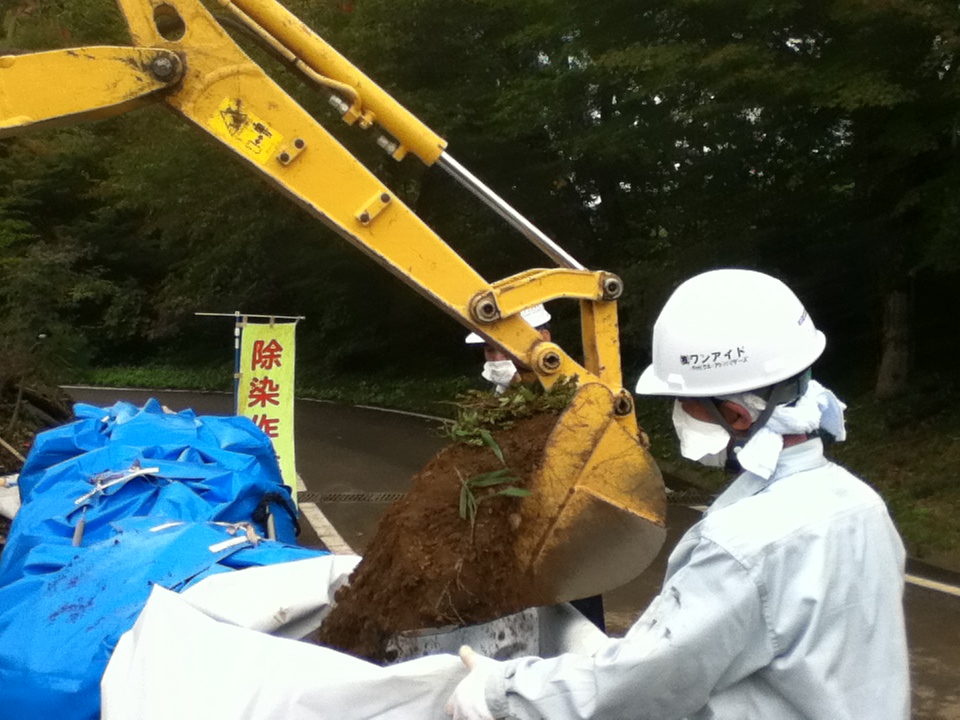
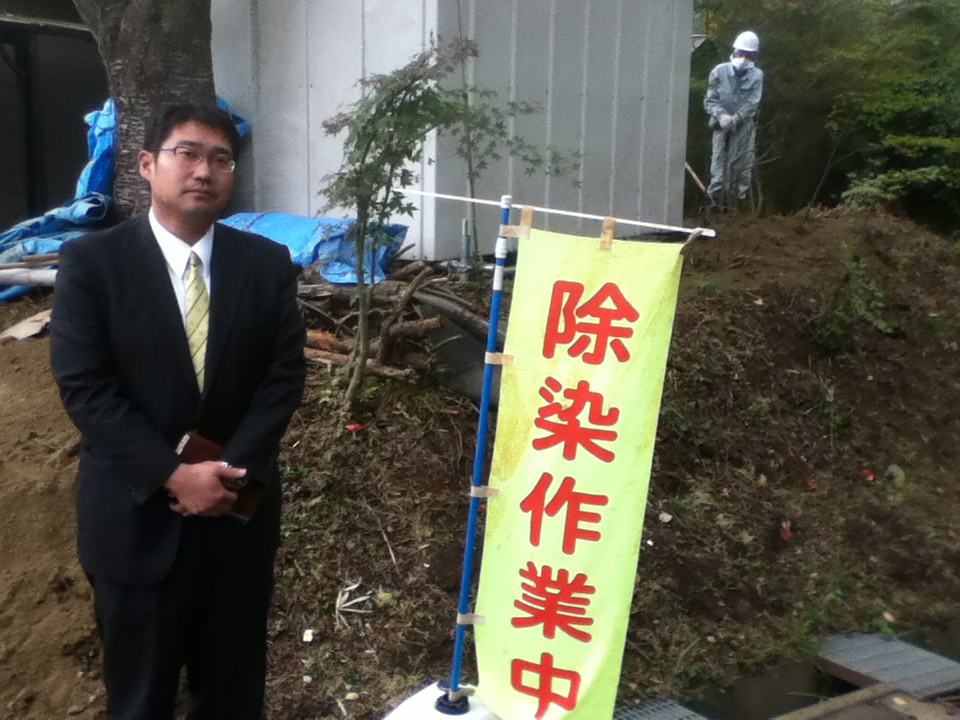
A worker fills sacks with contaminated dirt during the ‘decontamination’ of a home in Date City, Fukushima.
Today I met with Date City council member Mr. Yoshiaki Kanno to discuss the concerns of the citizens living in the area. We met on the property of one of his constituents whose home is currently undergoing ‘decontamination’. He told me that like the people he represents, he too, thinks ‘decontamination’ is impossible, and that the people should at least be given the option to evacuate and receive compensation. Mr. Kanno did make it clear that this needed to be an “option” as there are people, including some elderly, who have expressed their desire to remain in their homes and on their ancestral land.
Mr. Yoshiaki Kanno, a Date City council member, visits the decontamination site of one of his constituents.
I spoke with one of the ‘decontamination’ workers and asked him where all the radioactive dirt was being taken. He told me that the government hadn’t been able to figure that out yet, so individual municipalities were required to find local places to “temporarily” collect the sacks of contaminated soil until a long-term solution could be found. I asked him how long “temporarily” meant, and he said his guess would be “somewhere around 10 years”. The mountains of bags containing contaminated soil are exposed to the air and are, in some cases, just hundreds of meters away from homes where children are currently living.
…Sir Martin’s maximum annual bonus opportunity was 435% of his base salary in 2012, with 50% of the award deferred for two years and subject to clawback provisions. The proposed new long-term incentive plan provides for long-term awards of up to 9.74 times salary in the case of the CEO….
Reuters — Jul 02
Visitors to Japan’s public pension fund can’t miss signs of the low-cost, low-return culture that Prime Minister Shinzo Abe seems determined to change with a review of its operations that kicked off on Monday.
There is no receptionist at the dimly lit, 40-year-old Tokyo building where the headquarters of the Government Pension Investment Fund, the world’s largest pension, occupies the second floor.
The waiting area consists of two mismatched couches. Behind a single closed door, over $1 trillion – equivalent to the annual economic output of South Korea – is run almost on autopilot and invested largely in government bonds issued across the street by Japan’s Finance Ministry.
Equally worrying for critics, including members of Japan’s ruling Liberal Democratic Party, the fund has no independent board for oversight, no ability to hire in-house fund managers and no record of success during a period of economic growth of the kind Abe has pledged to deliver to voters and markets.
Officials led by chairman Takahiro Mitani say the fund, known as GPIF and which employs less than 80 people, has performed according to the mandate set by its supervisor, the Ministry of Health and Welfare: keep costs down and risks in check.
What happens next, they say, will depend on the reforms the Abe administration enacts in the coming months as it looks to mobilise public savings to help drive Japan out of two decades of deflation and sluggish growth.
She explains that the current retirement crisis is “not a demographic accident. It was manufactured by an alliance of two groups: top executives and their facilitators in the retirement industry—benefits consultants, insurance companies and banks.”
Executives are viewed “as beleaguered captains valiantly trying to keep their overloaded ships from being sunk in a perfect storm. In reality, they’re the silent pirates who looted the ships and left them to sink, along with the retirees, as they sailed away safely in their lifeboats.”
Amano earlier warned the IAEA-hosted conference against a “false sense of security” over the danger of nuclear terrorism.
Holding up a small lead container that was used to try to traffic highly enriched uranium in Moldova two years ago, the U.N. nuclear chief said it showed a “worrying level of knowledge on the part of the smugglers”.
“This case ended well,” he said, referring to the fact that the material was seized and arrests were made. But he added: “We cannot be sure if such cases are just the tip of the iceberg.”
Obtaining weapons-grade fissile material – highly enriched uranium or plutonium – poses the biggest challenge for militant groups, so it must be kept secure both at civilian and military facilities, experts say.
An apple-sized amount of plutonium in a nuclear device and detonated in a highly populated area could instantly kill or wound hundreds of thousands of people, according to the Nuclear Security Governance Experts Group (NSGEG) lobby group.
[The article has been redacted and only a comment under a picture remains – Arclight2011part2]
emergency worker takes part in exercises during an emergency response drill to simulate the aftermath of a dirty bomb explosion outside Madrid December 2, 2010.
Japan’s Fukushima Dai-Ichi nuclear plant, whose 2011 meltdowns dislocated 160,000 people, may provide a new blueprint for terrorists seeking to inflict mass disruption, security analysts said at a United Nations meeting.
The UN’s International Atomic Energy Agency convened a weeklong meeting of 1,300 diplomats, scientists and security analysts today in Vienna to examine ways to boost protection against nuclear terrorism. It is the IAEA’s first ministerial conference.
“Fukushima sent a message to terrorists that if you manage to cause a nuclear power plant to melt down, that really causes major panic and disruption in a society,” Matthew Bunn, a Harvard University professor and former White House adviser, said at a briefing. “All you need to do to do that is cut off the power for an extended period of time.” […]
[The News]02 Jul, 2013 VIENNA: The head of the UN atomic agency warned on Monday against complacency in preventing “nuclear terrorism”, saying progress in recent years should not lull the world into a false sense of security. “Much has been achieved in the past decade,”
Yukiya Amano of the International Atomic Energy Agency told a gathering in Vienna of some 1,200 delegates from around 110 states including 35 ministers to review progress on the issue.
“Many countries have taken effective measures to prevent theft, sabotage, unauthorised access, illegal transfer, or other malicious acts involving nuclear or other radioactive material. Security has been improved at many facilities containing such material.”
Partly as a result, he said,
“there has not been a terrorist attack involving nuclear or other radioactive material.”“But this must not lull us into a false sense of security. If a ‘dirty bomb’ is detonated in a major city, or sabotage occurs at a nuclear facility, the consequences could be devastating.
“There is one document that says in Tahiti, the fallout of plutonium is 500 times higher than the maximum dose that human beings can have. This is a big worry for us.”
The petition we would like you to support can be accessed HERE
Declassified French documents show that the fallout from the nuclear weapons tests in French Polynesia was far greater than previously admitted by Paris.
Following the release of more than 2,000 documents about the atmospheric tests of 1966-1974, the test veterans group says the French authorities measured a plutonium concentration in Tahiti of 500 times the safety limit.
Tahiti is about 1,400 kilometres from Moruroa but under current French law it’s outside the zone where compensation claims for poor health can be lodged.
The documents, which include 114 blank pages, confirm that the fallout from the tests affected all areas and not only the 21 atolls, which the French military had listed so far.
The documents also reveal that a total of 26 navy vessels were contaminated.
The Moruroa e tatou test veterans group has called on France to let it know the full truth about the tests’ impact.
The latest batch of documents was released on a court order amid a warning by the veterans that they would be taking France to the European Human Rights Court.
Bruno Barrillot Champion of the victims of Nuclear Tests in French Polynesia Needs YOUR Support
In 2012 the BNTVA delegation to AVEN’s Conference in Bordeaux met with a very inspirational and humble person; Bruno Barrillot. It was with some concern we learned of the actions of the newly elected French Polynesian government and their attempts to silence Bruno.
Since 1984, Bruno Barrillot, a researcher with the Armaments Observatory, has repeatedly condemned the harm done to test sites personnel, local populations and the environment by the 210 French nuclear tests in the Sahara and in French Polynesia. He is one of the founders of AVEN (Nuclear Tests Veterans Association in France) as well as well as Moruroa and tatou (Nuclear Tests Veterans Association in French Polynesia).
In 2005, Bruno Barrillot (Pictured in the centre above) was asked by French Polynesia’s Government to ensure the consequences of nuclear testing in French Polynesia were properly addressed.
“The funds were meant to help utility companies cope with higher operating costs when the government ordered them to suspend nuclear reactors,” said a ministry official.
In a town in the southern prefecture of Kagoshima, around 1,300 kilometres (800 miles) from the devastated city of Ishinomaki, three million yen was spent on the protection and observation of sea turtles.
Ten people were employed to count the creatures as they came ashore and to remind sightseers not to interfere with them.
Money set aside to help earthquake, tsunami and nuclear victims has been allocated to power companies, officials in Japan said Friday, a move that could fuel fury among people who lost their homes.
About 10 billion yen ($100 million) of the 25 trillion yen pledged for disaster recovery over several years has been reserved to offset costs for utility companies that were ordered to shut nuclear power plants in the aftermath of the Fukushima disaster.
The news comes after it was revealed public cash had been used in areas seemingly unaffected by the natural catastrophe, including on beefing up security for Japan’s controversial whale hunt and on paying people to count turtles.
Officials said Friday that around 2 billion yen had already been given to Chubu Electric Power to help it make interest payments on bank loans taken out to fund the spiralling cost of fossil fuels.
Power companies had to ramp up their fuel imports to replace the power generation capacity lost when nuclear plants were shuttered.
Money was also used to provide heated water to local aquaculture facilities, which had previously received warm water from nuclear power plants, they said.