MOSCOW — The former and current Presidents of Bashkortostan (Bashkiria) – a Russian republic located between the Volga and the Ural Mountains – asked the federal government to resume construction of Bashkir Nuclear Power Plant, an old Soviet project launched in 1980 and scrapped in 1990. The idea has local ecologists raising their eyebrows: The arguments for the new plant fail even generous scrutiny, while the region certainly does not lack in non-nuclear options. Andrei Ozharovsky, 20/08-2013 – Translated by Maria Kaminskaya
What do you do when the government of your region or republic where you live starts bringing up the subject of building a nuclear power plant? What do you do if you don’t find yourself particularly fond of the idea and want to do something about it?
The immediate thought is probably to try to find out first if there are any arguments to support the nuclear scenario – and if there aren’t non-nuclear alternatives for your region’s development instead.
When she saw reports in the media that the republican government was pushing to resume construction of Bashkir Nuclear Power Plant (Bashkir NPP), a frozen site in the town of Agidel, in northwestern Bashkortostan, she sent an inquiry to the republican government, asking to explain the rationale behind this sudden burst of enthusiasm over the old project.
One of the media reports, published late last March on Novosti Energetiki website (in Russian), cited Yevgeny Romanov, General Director of the Russian NPP operator company Rosenergoatom Concern, as saying that Bashkiria’s government is seeking to expedite the construction of Bashkir NPP.
The story linked to a question asked by an Adigel resident on the nuclear blogging website Publicatom.Ru (in Russian). In his reply, Romanov said that the current federal power generating capacities siting plan envisions launching two Bashkir NPP units after 2021, and in accordance with the current reactor construction program, the first unit is expected to be completed in 2025, and the second in 2027. But according to the information available, Romanov said, the government of the Republic of Bashkortostan is “taking measures” to speed up the construction.
“We are very surprised that even despite the recent events at Fukushima [Daiichi Nuclear Power Plant in Japan], and the Year of the Environment declared [in 2013] in Russia, there is continued talk in the Republic of Bashkortostan about building the nuclear power plant in Agidel – all the while the world is moving with a gathering momentum toward phasing out nuclear energy and transitioning to renewable energy sources, and toward thoughtful handling of the resources it has,” Latypova told Bellona in an interview.
“We would really like to know the grounds and reasons that compelled the President and the Government of Bashkortostan to ask to resume construction of the NPP,” Latypova said.
Bashkortostan’s Minister of Industry and Innovation Policy Alexei Karpukhin did not just respond to Latypova’s inquiry with a letter but also, as per the ecologists’ request, attached to his response copies of two letters that the former and current presidents of Bashkortostan wrote within just several months to the federal government. In their letters, they championed completion of the old project.
One of the letters, of February 6, 2010, was written by former President of Bashkortostan Murtaza Rakhimov and addressed to Vladimir Putin, at the time Russia’s prime minister. The other, of October 18, 2010, was written by Rakhimov’s successor at the presidential post, Rustem Khamitov, and is addressed to the then President of the Russian Federation, Dmitry Medvedev.
Bellona has both letters, as well as Minister Karpukhin’s response to Latypova, at its disposal (downloadable on bellona link, in Russian) – and thus has the unique opportunity to see just how two leaders of a Russian region go about asking the federal government to build them a nuclear power plant.
It would seem upon analysis that their requests lack in solid arguments – while both Agidel and the republic’s energy complex, in fact, have options other than nuclear power for future development.
The evidence from independent and government experts against the proposed New Prosperity Mine proves the Tsilhqot’in Nation is fully justified in its total opposition to the proposed Teztan Biny (Fish Lake) proposal.
Dr. John Stockner from the UBC Fisheries Centre, a senior lake research scientist and past associate editor of Canada’s most prestigious aquatic journal, the Canadian Journal of Fisheries and Aquatic Science, told the federal panel hearing on the proposed New Prosperity mine that the project would render the lake dead to fish within a decade. Stockner testified the lake would effectively become an aquarium, and nutrient loading and algae blooms would create oxygen deficiencies in the water, resulting in a massive die-off of rainbow trout.
“I feel like a town crier because what I have to tell you after considerable thought, I am of the firm opinion that within a decade, Fish Lake will die. It will die for fish,” Stockner told the Canadian Environmental Assessment Agency review Panel hearings. His findings were echoed by Darren Brandt, another lake ecologist who studies how lakes respond to human disturbances.
Federal and provincial government experts raised serious concerns about the proposal that add to Stockner’s and Brandt’s findings during the technical phase of the Canadian Environmental Assessment Agency’s review panel hearings.
This evidence has reinforced the Tsilhqot’in Nation’s total opposition to the project during the past two weeks of community hearings and will continue to do so as the hearings move this week to the Secwepemc Nation and final arguments on Friday August 23rd.
Renewable energy facilities that newly started operating in fiscal 2012 in Japan totaled 2.08 million kilowatts in capacity, which is worth two nuclear reactors, the Economy, Trade and Industry Ministry said Tuesday.
Solar power facilities, including those installed at homes and megasolar plants, largely contributed to the reading on the back of incentives introduced in July last year to promote renewable energy sources. Their capacity reached 1.98 million kw.
Because deliveries of some solar panels were not made in time, the capacity of operating facilities did not reach the 2.5 million kw as projected by the government for the year ended in March.
But a ministry official said the introduction of renewable energy is “smooth,” noting that facilities with a combined 1.28 million kw capacity commenced operations in April and May.
Meanwhile, the capacity of facilities approved to operate by the ministry came to about 21.09 million kw between July last year and March this year, in a sign that many facilities are not yet in service despite winning the permission.
Under the so-called feed-in tariff scheme, power utility firms are obliged to pay for electricity generated from renewable energy sources at fixed prices. The costs are passed on to consumers.
Japan is gearing up to introduce renewable energy after the 2011 Fukushima Daiichi nuclear power plant disaster heightened public concerns over the use of nuclear power. Of the 50 commercial reactors, only two are currently online.
In fiscal 2011, renewable energy accounted for about 10 percent of Japan’s total power generation. Excluding hydroelectric power, the figure stood at a mere 1.4 percent, according to METI.
West Palm Beach, Fla. – New water tests conducted over the past few months in The Acreage show there are high levels of radioactive material in the water, according to lawsuits recently filed in South Florida.
In the lawsuits, attorney Jack Scarola claims two South Florida companies, Pratt & Whitney and Palm Beach Aggregates, are responsible for the high levels. Business practices led to the alleged radioactive material getting into the groundwater, according to the lawsuit.
Neither company is releasing any comments related to the lawsuits or allegations. But, in a letter from an attorney for Pratt & Whitney sent to Scarola, the company claims the testing is incomplete and contains inaccurate data.
Back in 2009, the health department confirmed a pediatric cancer cluster in the acreage.
The lawsuits are twofold. First, the attorney is trying to get “class action lawsuit status” from a judge. He wants money for the up to 10,000 homeowners who live in the acreage. He claims the negative stigma of the “cancer cluster” designation caused property values to decline.
Second, Scarola wants personal damages for the parents of four children who developed brain cancer over the past few years.
Pratt Whitney released this statement to the WPTV Contact 5 Investigators:
“Pratt & Whitney maintains a comprehensive environmental, health and safety program that protects the environment, our employees and others in the surrounding communities. On Aug. 16, Searcy Denney filed suit against the company. While we have yet to be served with the complaint, we believe the lawsuit, based on comments from Searcy Denney’s recent press release, lacks merit and we will vigorously defend the company.”
Palm Beach Aggregates has not released any comments related to the lawsuits or allegations.
Scarola will be holding a news conference Tuesday afternoon where he is expected to go over the results of the testing in more detail.
Puddles with extremely high radiation levels have been found near water storage tanks at the crippled Fukushima nuclear plant, Japan’s atomic regulator and operator said Monday, according to a report.
The radiation level, measured around 50 centimetres (20 inches) above the toxic water, was about 100 millisieverts per hour, Kyodo news agency reported, citing the Tokyo Electric Power Co. (TEPCO).
Around 120 litres is believed to have leaked out from a water storage tank.
TEPCO denied that toxic water had flowed into the adjacent Pacific ocean, but the Nuclear Regulation Authority ordered the utility to study the possibility that it had escaped into the sea through nearby drains.
The NRA released a preliminary assessment that the incident was a level one incident on an eight-point international scale, defined as an “anomaly”.
A low barrier around the tanks is meant to block water when a leak occurs, but drain valves may have been left open, allowing water to flow outside, the report said.
A TEPCO employee found water leaking from a valve at about 9:50 am (0050 GMT) Monday. One of the puddles outside the barrier had an area of about three square metres and was one centimetre deep.
TEPCO has faced a growing catalogue of incidents at the plant including several leaks of radioactive water, more than two years after the worst nuclear disaster in a generation triggered by a huge quake and tsunami in March 2011.
The company—which faces huge clean-up and compensation costs—has struggled with a massive amount of radioactive water accumulating as a result of continuing water injections to cool reactors.
The embattled utility in July admitted for the first time that radioactive groundwater had been leaking outside the plant and this month started pumping it out to reduce leakage into the Pacific.
While no one is officially recorded as having died as a direct result of the meltdowns at Fukushima, large areas around the plant had to be evacuated, with tens of thousands of people still unable to return to their homes.
Modec, a Japanese engineering firm, is currently developing a new system that harnesses the power of ocean and wind currents in order to generate electricity. The firm is currently developing a small-scale prototype of this system in order to demonstrate its capabilities and how it can be used to produce energy and send this power back to the mainland. The system is designed to generate electrical power offshore and will take advantage of the strong wind and ocean currents that can be found at sea.
System to produce power from the wind and waves
The renewable energy system is to be equipped with vertical-axis wind turbine that will, of course, be located above the water. Below the water’s surface, the system will make use of a vertical-axis wave-powered generator. Ocean currents will cause the generator’s turbines to spin, thereby generating electrical power. This electricity will then be sent back to the mainland to be funneled into an existing energy grid. The system is meant to generate up to 1.5 megawatts of electricity, enough to power 500 average homes.
Utility-scale system planned for the near future
While the prototype system is relatively small, the final form of the renewable energy system will be relatively large. The system’s wind turbine may be its largest component, as Modec expects that the turbine itself will account for 80% of the system’s energy potential. The system will be tethered to the mainland by cables that will also transmit the electricity it generates from the sea to the land.
Renewable energy may help protect Japan against major disasters
Modec’s Takuju Nakamura is responsible for the design of the renewable energy system. In the wake of the 2011 Fukushima disaster, Nakamura saw that Japan’s energy infrastructure was not suited for withstanding the impact of major natural disasters. As such, Nakamura has been working to find ways to solve this problem. Renewable energy may be an appropriate solution as clean technologies, such as fuel cells, were able to help keep Japan powered in the weeks following the disaster.
Fukushima Awareness Contest! Please Remix! To enter, please Subscribe & message Andrew Ebisu HERE: http://tinyurl.com/ljqtg5k
Fukushima Awareness Contest. Please watch, share and enter. Watch this video and consider entering his contest to spread the word about the Fukushima crisis. 400 tons (ADMITTED by TEPCO, so Multiply THAT amount by a factor of X!) of radioactive water are going into the Pacific Ocean every day! We don’t have much time. I need at least 50 entries to go ahead with this competition.
Fukushima GAME ON…Let’s DO THIS! YOU are Formally Invited to Join Us All. http://youtu.be/sEqOlF_–_E
NOTE: THERE HAS BEEN A CHANGE OF DATE FOR THIS GET TOGETHER MARCH (due to conflict of scheduling). IT HAS BEEN CHANGED TO SEPTEMBER 28, 2013. This is your Formal invitation 🙂 I HOPE TO SEE YOU ALL THERE! We Can and Have been making a difference. Let’s continue to make a difference Together 🙂 LET OUR VOICES BE HEARD! Stand up and Say Something 🙂
All of YOU and All of your Friends, Family, neighbors, or Anyone is invited to join in! http://tinyurl.com/k9hen2j
http://youtu.be/rXoV0RWDf28 http://youtu.be/vJaOuTYSGSQ
Fukushima is a nightmare disaster area, and no one has the slightest idea what to do. The game is to prevent the crippled nuclear plant from turning into an “open-air super reactor spectacular” which would result in a hazardous, melted catastrophe.
Busby: Can’t seal Fukushima like Chernobyl – it all goes into sea http://youtu.be/x-3Kf4JakWI
Since then, huge amounts of radioactivity have flowed from the wrecked reactors directly into the Pacific Ocean. Attempts to stop the flow of contaminated water from Fukushima into the sea were always unlikely to succeed. It is like trying to push water uphill. Now they all seem to have woken up to the issue and have begun to panic.
Contact Kevin D Blanch for more info Here:
537 South 4700 West
Ogden, Utah 84404
801-452-1908
September 28, 2013 at 1:00 PM EST
Washington Square Park, Washington DC
PLEASE NOTE THAT PALLADIN REGULARLY HARASS OLD LADIES AND CAN STILL AFFORD HEAVY SOLICITORS FEES TO SUE AND HARASS THE OWNER OF THIS BLOG AS WELL AS ANY OTHER LITTLE OLD LADIES IT HAS IN ITS SITES.. DO THE SHAREHOLDERS ENJOY LOSING MONEY TO A COMPANY THAT SPENDS BEFORE THINKING?? 1 DOLLAR AND DROPPING? WHAT DID YOU EXPECT FROM A DEFUNCT INDUSTRY? ARCLIGHT2011/RANT (SORRY IF THIS IS REPOSTED BUT….. 🙂 .. IT FEELS SO GOOD! )
The company’s shares went into a trading halt on Thursday at $1.00
Published on Friday August 02 2013 (AEST)
Paladin Energy has scrapped the sale of a stake in its flagship African uranium mine after it failed to attract a high enough bid. The Australian-listed company instead will use a shareholder-diluting $88 million capital raising to reduce about $US670 million ($A753.95 million) of debt. Paladin had been negotiating with two nuclear power companies to sell 15-20 per cent in its Langer Heinrich mine in Namibia.
The company’s shares went into a trading halt on Thursday at $1.00
In late June, managing director John Borshoff maintained a sale would go ahead. But the global uranium market is still depressed more than two years since Japan’s Fukushima nuclear disaster and the spot price is at seven-and-a-half-year lows of about $US35 a pound. Paladin blamed that anaemic price for its failure to get what it believes is the strategic value of the asset and harmed shareholder value.
Based on investment bank UBS’s recent $US1.1 billion valuation of Langer Heinrich, a successful sale would have gained $US165 million-$US220 million. The mine produced 5.3 million pounds, out of Paladin’s 8.26 million pounds, of uranium production in the year to June 30.
The company’s shares went into a trading halt on Thursday at $1.00
“Although, there remains interest in the asset, Paladin believes that the current weakness in the spot uranium price should not overly influence the valuation of a flagship asset such as Langer Heinrich,” it said in a statement on Friday.
It said it would wait until prices lifted before going to the market to sell again. A price of at least $US70 a pound was needed, it said. In other bad news for Paladin, the company said it expected to have to write down the value of assets including its other producing mine, Kayelekera in Malawi, by $US180 million.
The company’s shares went into a trading halt on Thursday at $1.00
The capital raising involves the equivalent of 15 per cent of its stock being issued to private institutions.
The company’s shares went into a trading halt on Thursday at $1.00
Dar es Salaam — There are traces of uranium at Lake Jipe, located in northern Tanzania according to preliminary findings by the Tanzania Minerals Adult Agencies (TMAA) .
For several leading industrial countries, a guaranteed supply of uranium is extremely important for their future energy security.
However, this resource is also a key component of nuclear weapons.
TMAA’s Planning and Research Development Manager, Julius Moshi told East African Business Week the geologists are currently conducting tests to determine the quantity and economic viability of the uranium.
The discovery of uranium in Mwanga, Kilimanjaro (Northern Tanzania), brings to four regions where uranium deposits have been found.
The other key uranium projects countrywide are Bahi North in Dodoma region, Manyoni in Singida and Mkuju River situated in Tunduru district, Ruvuma regions.
Moshi said exploiting the uranium deposits will help the country to boost its foreign exchange earnings. Tanzania is one of the few producers of radioactive minerals in the world.
The Mkuju River Uranium project has estimated resources of 101.4 million pounds (24 million kilograms) of uranium oxide concentrate, about 77% of global mined output in 2010.
The country is estimated to have a total deposit of 54 million kilograms of Uranium Oxide. It is projected to produce about 14,000 tons of uranium annually. This will generate over $249 million in royalties.When opening the new offices of the Tanzania Atomic Energy Commission in Arusha, President Jakaya Kikwete said Tanzania was eyeing the world’s biggest uranium producer slot. “If all the reserves we have are fully exploited, Tanzania can become the seventh leading uranium producer in the world,” Kikwete said.
Already Mantra Resources and a Russian firm ARMZ have entered into a joint venture to mine uranium.
Tanzania has so far confirmed the presence of multiple thick zones of sandstone-hosted uranium mineralization at shallow depths at the Nyota Prospect.
An Inferred Mineral Resource of 35.9 million pounds has been estimated for the prospect. Kikwete said this initial resource estimate is based on drilling which covers only a small part of the total area of the prospect. The potential exists to substantially grow the resource base with ongoing work.
The Japanese Company also signs mineral exploration deal with Tanzania: A Memorandum of Understanding (MoU) signed between Japan Oil, Gas and Metal National Corporation (JOGMEC) and the Geological Survey of Tanzania (GST) will see the two institutions join efforts to explore and assess mineral resources.
In Tanzania, uranium prospection and exploration is being performed by Uranex NL, Omegacorp Ltd, Mantra Resources Ltd, Uranium Resources plc, Indago Resources Ltd, Sabre Resources Ltd , Uranium Hunter Corporation , Trimark Explorations Ltd. Others are IBI Corporation , Gambaro Resources, Douglas Lake Minerals Inc. , Canaco Resources Inc. , Sub-Sahara Resources NL, East Africa Resources Ltd,
Three years ago a defector from the Myanmar military fled the country with extensive documentation of a nascent secret nuclear programme. The chain of custody and validation of the material he possessed rivals the equivalent information currently attributed to Iran, whose own ambitions have become the target of threats of war from the US and Israel.
But after initial alarm, the world has largely fallen silent on Myanmar’s programme. In November last year the government made a welcome promise that it would sign the International Atomic Energy Agency’s (IAEA) Additional Protocol, thereby allowing the IAEA to carry out nuclear inspections inside the country to resolve outstanding allegations of a past nuclear programme.
To date, however, no such protocol has been signed, and Myanmar remains hidden behind an old agreement that allows them to state that they have no significant nuclear materials, and avoid inspections or even answering questions.
The upshot is that the world remains as in the dark about the work being undertaken in highly secretive factories operated by the military as it did when photos and testimonies first emerged. In addition to the evidence of the early stages of a nuclear programme aired in a documentary co-produced by the Democratic Voice of Burma and Al Jazeera in June 2010, it is widely known that some 5,000 young Myanmar engineers have been trained in Moscow in missile, engineering and nuclear technologies. So when senior Myanmar officials deny the existence of any nuclear programme and stonewall the IAEA, suspicions are aroused.
Myanmar’s immediate neighbours have also fallen silent on the issue. The Association of Southeast Asian Nations (ASEAN) bloc has not followed through in investigating the allegations, given the rush to take advantage of opening markets and lucrative oil and gas contracts. Perhaps this selectivity has also guided Washington’s reluctance to press Myanmar as hard as it has other global nuclear threats.
The U.S. Energy Department wrongly assumed it had resolved all of Nevada’s concerns about a pending shipment of highly radioactive atomic waste, the Las Vegas Sun reported on Sunday, citing a review of government documents.
A Dec. 4, 2012, DOE memo reveals that department officials were at the time preparing to ship more than 400 containers, filled with uranium waste, to the Nevada National Security Site from the nuclear weapons site at Oak Ridge, Tenn. Energy officials apparently believed they had adequately assuaged all of Nevada’s concerns about how the material would be stored during federal meetings with state personnel in late November.
Nevada commonly receives low-level excess nuclear material, but the uranium-waste shipment is judged to pose a higher security risk because of its suitability as fuel for a radiological “dirty bomb.”
Leo Drozdoff, who heads the Nevada Conservation and Natural Resources Department, told the Sun that DOE officials had only addressed Nevada’s issues with how the uranium containers would be stored at the Nevada National Security Site, but not how they would be transported to the state. Also left unresolved, according to Drozdoff, is whether Nevada’s allowance of the waste within its borders would constitute a precedent for receiving potential similar shipments of extremely radioactive used nuclear material.
Nevada’s current position is that it has not agreed to accept the radioactive waste.
The State of Vermont may not shut down a federally-approved nuclear power plant, the federal appeals court for the Second Circuit in New York ruled last week. Vermont has sought to prevent the Vermont Yankee reactor, whose original 40-year license expired in March 2012, from being re-licensed, but the court ruled that federal regulation of nuclear power safety preempts state authority over safety completely. The Nuclear Regulatory Commission has already re-licensed the plant for another 20 years.
The wrinkle in the case, Entergy v. Shumlin, is that neither of the two laws struck down by the Court—known as Act 74 and Act 160—attempted to regulate safety. Passed in 2003 in response to Entergy’s request to expand its on-site waste storage facilities, Act 74 allowed the expansion, but barred the storage of waste generated after the plant’s license expiration in March 2012…
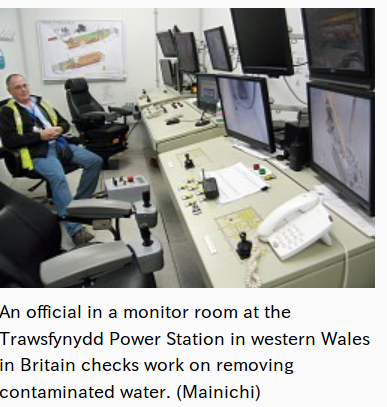
GWYNEDD, Wales — The Trawsfynydd Power Station in western Wales in Britain is one of the world’s most advanced nuclear power plants when it comes to decommissioning work. It had two gas-cooled reactors with a combined output capacity of 235,000 kilowatts.
The operator of the power station started decommissioning the power plant in 1993. A senior official in charge of the decommissioning work says 99 percent of radioactive materials have been removed. But it will still take 70 more years for the operator to finish decommissioning the nuclear plant.
The Mainichi witnessed firsthand the ongoing decommissioning operation of the plant in Wales, which is taking a lot of time and at huge cost, and got a reminder of the tough road ahead for Japan to decommission the crippled Fukushima No. 1 Nuclear Power Plant in the aftermath of the 2011 Great East Japan Earthquake and tsunami.
Two concrete buildings cover the nuclear reactors in Wales, which sit by a manmade lake.
Magnox Ltd. instructed us to wear helmets and special eyeglasses to protect our eyes. The Mainichi Shimbun was the first Japanese news organization to be admitted to this power station since the March 2011 nuclear disaster at the Fukushima power plant, which is owned by Tokyo Electric Power Co. (TEPCO).
As we entered the nuclear reactor building, there was a huge dark brown container, which officials say is a portion of a boiler to produce vapor for hydroelectric turbine operations. On the top floor of the building, scaffolding was in place along the wall, and workers were preparing to carefully dismantle upper portions of the building. The structure’s height will be trimmed from about 53 meters to about 30 meters to maintain the safety of the concrete wall until the power station is decommissioned.
The Trawsfynydd Power Station started operations in 1965 and was shut down in 1991. Spent nuclear fuel (fuel rods) were removed from the nuclear reactors in 1995, but the radiation dose of low-level radioactive substances around pressure vessels and inside interim storage facilities is still high. Accordingly, Magnox will temporarily halt decommissioning work in 2026 before embarking on the final phase of the decommissioning campaign such as the permanent disposal of nuclear waste in 2073.
Vic Belshaw, programme delivery manager at Magnox, said nuclear power plants built in the initial phase of nuclear power generation were not designed with future decommissioning in mind. Workers are encountering many new things and feeling their way in their decommissioning operations.
…For Jennifer Henning, president of Hope for Chernobyl’s Child, there’s no question that the ailments the children in the program suffer are the result of radiation exposure….
(CNN) — Yulia Gorelik describes her 8-year-old son Daniel as “a very clever boy.” He plays “Fur Elise” with elegant ease on the piano and enjoys eating McDonald’s chicken nuggets.
Mother and son arrived in the United States earlier this summer through an organization called Hope for Chernobyl’s Child. Gorelik had faith that American doctors could fix Daniel’s headaches, weakness and vertigo during their six-week stay.
“I have the hope that we can do something here to make him stronger, because he is intelligent, he is nice, but his body is weak,” Gorelik, 34, told CNN in July.
Front — Left to Right: Yulia Gorelik, Daniel Gorelik, Maksim Adzinochanka….Back Left to right: Phillip Henning and Jennifer Henning
The Goreliks live in a region called Gomel, Belarus, which was heavily hit with radioactive fallout from the worst nuclear accident the world has ever seen.
On April 26, 1986, explosions at a reactor at Chernobyl in Ukraine produced radiation effects almost 14 times greater than the 2011 Fukushima Daiichi disaster in Japan, and 400 times more powerful than the 1945 atomic bomb dropped on Hiroshima.
More than 2 million people in Belarus were affected by the Chernobyl disaster, according to the World Bank. Two-thirds of the contamination from the accident fell in Belarus, diminishing the quality of life in the region.
Hope for Chernobyl’s Child helps 10 to 15 children living in Belarus find host families and dental and medical care in Washington state every summer. The organization also helps families on the ground in Belarus by delivering humanitarian aid.
Fukushima, one year later
Photos: Industrial disasters through history
Medical and dental care are lacking in areas affected by the disaster, Hope for Chernobyl’s Child says. Families there often earn little money and have limited job opportunities, making it difficult to provide food, clothing and medications for their children.
Ask Gorelik whether her son’s health problems are caused by radiation, and she says, “Yes, of course.”
People who lived in the areas that received significant contamination from Chernobyl in 1986 have been the subject of many scientific studies. But researchers haven’t looked much at health problems in the region’s children who weren’t yet born at the time of the disaster, said Scott Davis, epidemiologist at the Fred Hutchinson Cancer Research Center at the University of Washington.
The lack of hard evidence doesn’t mean that lingering radiation isn’t causing harm in some ways, Davis said, but it would be difficult to establish that anyone’s particular disease or condition stems from low-dose radiation exposure over a long period in that area.
“This is a major problem in talking with people who, either themselves or someone close to them, (are) sick, ” he said. “To say, ‘Well, we don’t see any risk’ — people just can’t get their head around that.”
The issue is complicated because cancer, for example, caused by radiation looks exactly like cancer that developed for other reasons, experts say. There’s no “Chernobyl” name tag on tumors in people who suffered radiation exposure.
Scientists know radioactive iodine-131 got into the human body when people drank milk from cows that ate contaminated grass, said Dr. Fred Mettler, professor emeritus of the Department of Radiology at the University of New Mexico. This led to higher incidences of thyroid cancer in people who were children at that time — such as Yulia Gorelik, who underwent treatment at age 12.
More than 4,000 such cases were diagnosed from 1992 to 2002, but it’s impossible to say which ones were caused by Chernobyl radiation. Mettler said the iodine is unlikely to have caused cancer in anyone born later — especially because iodine-131 has a half-life of eight days, so in about two months it’s almost undetectable.
Another radioactive chemical from the reactor explosion, Cesium-137, has a half-life of about 30 years, so it stays around a lot longer than iodine-131, and can still be measured in some soils and foods in several areas of Europe. Still the dose to which people in the area have been exposed isn’t very high, Mettler said.
Laborers work on construction of the Soviet Union’s Chernobyl nuclear power plant on July 1, 1975. The Chernobyl accident is the world’s worst nuclear accident. The disaster sent a cloud of radioactive fallout over hundreds of thousands of square miles of Russia, Belarus and Ukraine. The radioactive effects of the explosion were about 400 times more potent than the bomb dropped on Hiroshima during World War II.
The station came on-line in 1977, two years before this photo, and contained four reactors, each capable of producing 1,000 megawatts of electrical power.
Reactor number four exploded on April 26, 1986, releasing large amounts of radiation into the atmosphere. More than 100,000 people were evacuated from their homes.
People are scanned for radioactivity before evacuating the Ukraine in this undated photo.
Three days after the explosion, on April 29, 1986, cranes are seen at the power plant. The disaster initially killed 32 people, but according to the United Nations, the explosion and fire that occurred affected, directly or indirectly, 9 million people because of the radioactive materials released into the atmosphere.
In Finland, milk is tested by authorities for aftereffects of the radiation on April 30, 1986.
West German Customs officials closely screen goods, cars and people coming in from Eastern Europe on May 5, 1986. Radioactivity from the Chernobyl nuclear plant threatened to contaminate crops.
A farmer in Sweden wears anti-atomic clothes as he sifts hay possibly contaminated by the radioactive cloud from Chernobyl in June 1986.
Construction crews build a containment wall around the damaged unit four reactor in August 1986.
Control panels of the destroyed fourth power block on April 14, 1998.
Twenty-seven years after the nuclear disaster, engineers work on April 26, 2013, to construct a colossal arch-shaped structure to permanently cover the exploded reactor.
More than 2 million people in Belarus were affected by the Chernobyl disaster
About 5 million people in Belarus, Ukraine and Russia received whole-body radiation
Several groups provide relief to kids who live in areas that received radioactive fallout
It is not possible to say that any particular illness was caused by Chernobyl radiation




 West German Customs officials closely screen goods, cars and people coming in from Eastern Europe on May 5, 1986. Radioactivity from the Chernobyl nuclear plant threatened to contaminate crops.


 Twenty-seven years after the nuclear disaster,
