“Israeli scientists are generously provided access to the nuclear facilities of certain nuclear-weapon states while nuclear scientists of NPT parties are being assassinated,” he said.
US ambassador Joseph Macmanus said: “There were no winners today. We don’t see that this issue has a place in discussions at the IAEA.”
VIENNA: A proposed resolution by Arab states criticising Israel’s widely-rumoured atomic arsenal was narrowly defeated on Friday at a gathering of the UN nuclear agency.
Following an acrimonious debate at the International Atomic Energy Agency’s annual general conference, the measure, supported by Iran, was defeated by 51 votes against and 43 in favour with 32 abstentions.
Israel is widely assumed to have nuclear weapons but has never acknowledged it and is not a signatory to the landmark Treaty on the Non-Proliferation of Nuclear Weapons (NPT).
The Jewish state is a member of the International Atomic Energy Agency but is not subject to IAEA inspections except for a small research facility.
“…The dismissal of Bruno Barrillot by Flosse government is a bad action against all those and all those in Polynesia and the world are fighting for truth and justice the victims of nuclear tests. “…”
CRIIRAD
Research Commission
Information and Independent
on Radioactivity
471 BC. V. Hugo – 26000 Valencia http://www.criirad.org
PRESS
June 11, 2013
CRIIRAD denounced the dismissal of Bruno BARILLOT and worries
close to see, once again, the issue of the impact on health and
environmental impact of nuclear tests France.
Since 2005, Bruno Barrillot was the official responsible for monitoring the effects of nuclear testing
for the government of French Polynesia. He was summoned June 6, 2013 the Ministry of Environment of French Polynesia for an interview prior to dismissal. This is one of first decisions taken by the government in place after the election on 17 May 2013, of Gaston Flosse returned President of French Polynesia.
CRIIRAD Barrillot Bruno knows well and can attest to the quality and effectiveness of its engagement with victims of nuclear testing and rehabilitation of polluted territories by military activities. It invites its members and all concerned citizens to send a message Support Bruno Barrillot at the association Mururoa e Tatou (*). moruroaetatou@mail.pf
These messages will be transmitted as the French Polynesian government that government.
Bruno Barrillot is a co-founder in 1984 of the Observatory of Armaments. He campaigned tirelessly decades for recognition of health and environmental impacts of French nuclear tests in the Sahara and French Polynesia. His work has resulted in progress
concrete, as the law on compensation for victims Loi Morin, the decommissioning military on the atoll of Hao, conducting independent radiological studies Hao, and Tureia Gambier, etc … Much remains to be done and his ouster is given by the new very negative signal
Government of French Polynesia.
(*) The Polynesian Mururoa e Tatou Association “is to defend and assist the victims of the trials nuclear, obtaining, by all legal means at its disposal, the right to information about the consequences of
participation in the right of access to records radiological nuclear testing programs on health and health, the right to pension, compensation and care. ”
Excerpts from the press release of June 4, 2013 the association “Mururoa e Tatou”
“On 17 May 2013, Flosse again became President of French Polynesia. Fervent support testing nuclear during his long political career (he’s 82), with money from France poured freely, it now beginning to make a clean sweep of all those who, for years, fought nuclear testing and
are committed to help the victims. “… / ….
“In July 2005, Bruno Barrillot was called by France Temaru government to facilitate the commission Investigation of the Assembly of French Polynesia on nuclear testing. For nearly eight years, with the support of
Mururoa e Tatou and successive governments has forced France to begin the rehabilitation of old sites occupied the time of the CEP and left in ruins since the end of the trial in 1996.
With associations, it denounced the consequences of nuclear testing on health and the environment and has forced the government French to concede a law to compensate victims of nuclear tests, law, unfortunately, has yet to reform.
With successive governments of Polynesia since 2005, particularly with the last government Temaru Barrillot Bruno has launched a program on the “Memory of the period of nuclear tests” completely obscured in the school curriculum, which is still to be consolidated. Mururoa e Tatou worries see Polynesian nuclear test victims disappear one after the other, without the official support the Polynesian government rejects their most loyal advocate for over two decades.
Mururoa earmadillo unworthy to see Bruno Barrillot and “thanked” and pursued by a vengeful hatred that does not credit to the government. The dismissal of Bruno Barrillot by Flosse government is a bad action against all those and all those in Polynesia and the world are fighting for truth and justice the victims of nuclear tests. ”
MururoaEARMADILLO(Associationof workers andvictims ofMururoaandFangataufaa) created a petition to supportBrunoBarrillot: “Justice for the victims ofFrenchnuclear tests“ Sign the petition
Law No.2010-2of 5 January2010 on therecognition andcompensation of victims ofFrenchnuclear tests
[1] http://www.obsarm.org
[2] Loi n° 2010-2 du 5 janvier 2010 relative à la reconnaissance et à l’indemnisation des victimes des essais nucléaires français
Putin told Shoigu to present a report on how to avoid such accidents, telling him during a video conversation that, “This is not the first time this has happened in Russia,” in remarks reported by the paper.
Russian investigators of the fire that broke out aboard the Tomsk nuclear submarine Monday morning near Vladivostok have now admitted that 15 people died in a fire that raged for five hours after welding and sawing works went awry, and that the vessel did sustain damage, Russian news agencies reported.
The fire was the second onboard a Russian nuclear-powered submarine that was in port for maintenance in less than two years.
The statements on injuries and damage to the sub from Naval and other officials represent a contradiction of official reports issued by the military on Monday.
That’s typical,” said Alexander Nikitin, chairman of the Environmental Rights Center Bellona and a former Russian naval captain. “For the Russian military, such delays in reporting are pretty much mandatory.”
In a report to President Vladimir Putin, Defense Minister Sergei Shoigu called for increased oversight of facilities where submarines are repaired, according to The Moscow Times.
Putin told Shoigu to present a report on how to avoid such accidents, telling him during a video conversation that, “This is not the first time this has happened in Russia,” in remarks reported by the paper.
Indeed, the Tomsk represents the fourth submarine fire since 2006, and the sixth major incident aboard a sub since the sinking of the Kursk submarine in 2000, when one two of the sub’s torpedoes exploded in their tubes during a training exercise.
The press service for the Investigative Committee, which probes major crimes in Russia, said in a statement Tuesday that it had opened a criminal probe into suspected abuse of authority over the fire on the Tomsk submarine in the Bolshoi Kamen shipyard in the Russian Far East. Nikitin said the Investigative Committee’s involvement was a routine matter.
The Investigative Committee’s statement said the Tomsk has “lost some of its functional characteristics” as a result of the fire, but offered no further information about damage to the submarine.
“The health of 15 servicemen was harmed and they are now receiving treatment in a military hospital,” the Investigative Committee’s statement said. It did not give further details on the nature of the injuries, where they were being treated and without divulging their names or ranks.
While at the Sept. 21, 2013 Anti Nuclear protest in Tokyo I spot police harassing protesters. A Japanese man explains what is happening and demands his rights.
“Everything came to a halt and it is very bad for us, in a business sense and mentally. I have a family business but don’t think I can ever go back to work.
“Lots of people want to leave this area. I want to leave as well but I can’t because my life and money are all tied up here.”
Takashi Suzuki surfs in water near crippled Fukushima nuclear plant in Japan
Says he believes the risk is low but wouldn’t allow his children to swim in the water
He lost his fishing business in the aftermath of the 2011 tsunami and reactor meltdowns
Many people in the region are in limbo after being denied the chance to return home
Fukushima, Japan (CNN) — Takashi Suzuki peels on his wet suit and looks out to sea. The waves are good and the water’s not too crowded, with only a dozen or so other surfers riding the waves.
Suzuki has been surfing these waters since he was in his 20s — he’s now 59. Not even the fact this beach is only 31 miles (50 kilometers) south of the crippled Fukushima Daichi nuclear power plant deters him.
“The radiation levels here are low,” he says. “The data says so, so all I can do is believe it. But I won’t let my children or grandchildren go in the water.”
The Holy See used the opportunity of the 57th General Conference of the International Atomic Energy Agency (AIEA) to renew its call “upon the leaders of nations to put an end to nuclear weapons production and to transfer nuclear material from military purpose to peaceful activities”.
The Most Reverend Dominique Mamberti, Secretary for Relations with States of the Holy See, addressed the Conference, held in Vienna on 16 September, 2013. Archbishop Mamberti also noted that “this year marks the 50th anniversary of the Papal Encyclical Pacem in Terris of Blessed Pope John XXIII”.
Next week, during the Plenary Assembly of the Canadian Conference of Catholic Bishops, the Episcopal Commission for Justice and Peace is leading a reflection on the continuing pastoral pertinence of Pacem in Terris.
Funny, what you can stumble onto on the web. A government agency put up 266 pages of “highly confidential” government information about the nation’s nuclear facilities, including precise locations (with helpful maps) of where uranium is stored, reports the New York Times. The information was being compiled for release to the International Atomic Energy Agency when the Government Printing Office mistakenly posted it. The report has since been taken down….
The bomb that nearly exploded over North Carolina was 260 times more powerful than the device which devasted Hiroshima in 1945. Photos: On Guardian link
A secret document, published in declassified form for the first time by the Guardian today, reveals that the US Air Force came dramatically close to detonating an atom bomb over North Carolina that would have been 260 times more powerful than the device that devastated Hiroshima.
The document, obtained by the investigative journalist Eric Schlosser under the Freedom of Information Act, gives the first conclusive evidence that the US was narrowly spared a disaster of monumental proportions when two Mark 39 hydrogen bombs were accidentally dropped over Goldsboro, North Carolina on 23 January 1961. The bombs fell to earth after a B-52 bomber broke up in mid-air, and one of the devices behaved precisely as a nuclear weapon was designed to behave in warfare: its parachute opened, its trigger mechanisms engaged, and only one low-voltage switch prevented untold carnage.
If nothing done, all the health hazards observed since the onset of the Fukushima accident and the recent news of 44 thyroid cancer and suspected cases would be totally ignored.
これを訴えられるのは、日本人しかいません。 Only Japanese can respond to this!
英語ができない? You say you cannot write English?
関係ありません!今はグーグル翻訳だったあるのです。
Nonsense! You can use google translation!グーグル翻訳でいいからメールを、以下のUNSCEAR担当者に! Please write a mail to UNSCEAR person below, 緊急事態です。
日本人がWatchしていることを国連に伝えないとなりません!!! We need to tell the UN many Japanese are watching!!!
The final UNSCEAR report will be released in September.
ちなみに私は上記の人に既にオーストリアでお会いし、健康被害を口頭と書面にて訴えました。
By the way, I visited the above UNSCEAR officer in Austria and verbally explained the heatlh hazards occuring in Japan along with the following documents.
そして2013年6月3日に提出した書類が以下の通りで、健康被害を訴えた詳細なものです。 The following are the documents I submitted to UNSCEAR on June 3, 2013.
By the say, UN HRC recommens relocation over 1mSv area, but I think this is insufficient considering that they ignore the initial exposure and internal exposure.
1mSvの内部被曝=体内300000Bq=60kgの成人で500Bq/kgの体内濃度 1mSv internal exposure=30000 Bq bodily incorporation=500Bq/kg for 60kg adult
すなわち、低レベル放射線廃棄物の5倍にもなる濃度でやっと1mSvとみなされるのです! このような換算式はまったくおかしな話です! This internal exposure calculation into mSv is totally out of question!
実際に健康被害が出ている事、そして7q11遺伝子を検査すること、これらが早急に求められます。
Health hazards have been actually occuring among so many people in East Japan and we need to conduct 7q11 gene tests more than anything else.
Gerry Thomasb, I could not resist a little smiley here .. “hoisted by your own petard” methinks Geraldine??? 🙂 (feel free to leave a comment below 🙂 Thank you Fiona Fox of the UK SMC, best laugh all year 🙂 LMAO) OOps … no 4 smileys 😉 . And seriously, why is the Imperial University College London not advising these tests as a matter of course. The Chernobyl Tissue Bank (aka G Thomas) has been working with the Japanese and the contentious Fukushima Medical Hospital 😦 NOT VERY PROFFESSIONAL!
Guests: Arundhati Ghosh (Former Ambassador and former leader of the Indian delegation to the CTBT conference) ; Dr. G Balachandran (Consulting Fellow at the Institute for Defence Studies and Analysis) ; Nilotpal Basu (Central Committee Member, CPI(M) and a former MP) ; D. Raghunandan (Secretary of the Delhi Science Forum) ; Ravi Visvesvaraya Sharada Prasad (Technologist)
At least 15 armed Russian Coast Guards have just illegally boarded and taken over our ship the Arctic Sunrise.
They immediately seized every crew member except three people who locked themselves inside the radio room as the guards tried to break in. We had a satellite phone link to them and they were speaking to international media, trying to stay there for as long as they could.
As far as we know, everyone else is being held under armed guard.
The ship had been part of a peaceful protest against energy giant Gazprom which is poised to drill for the first oil to come out of the icy waters of the Arctic.Yesterday there were guns pointed at the protesters, shots fired and two other crew members were arrested as they protested Gazprom’s Arctic drilling.
The Arctic Sunrise was circling Gazprom’s Prirazlomnaya platform inside international waters and outside the jurisdiction of Russian authorities, making the boarding of the ship unlawful.
Thank you for emailing the Russian Ambassador. So far, over 145,000 people have sent emails to embassies around the world.
It has been 24 hours since the Arctic Sunrise was illegally boarded by Russian agents and details at the moment are sketchy. My colleague Frank on board was able to make one last phone call late last night before all their communications equipment was shut down, he told me:
“About 10 commandos armed with rifles, handguns and knives, boarded by a soviet era helicopter. They pushed us aside and ordered us to lie flat out on the deck. They then smashed their way onto the bridge. Our engines have been turned off and they have isolated the captain Pete Wilcox. We have no idea what is happening.”
There has been no official statement from the Russian government as to why the Arctic Sunrise was stormed. But it’s becoming clear that the security forces were acting in the interests of Gazprom. The crew have been totally cut off with no access to lawyers, no contact with the outside world, and all this in international waters.
The real threat to the safety of the Arctic is not from our activists, but from a reckless oil company so desperate for profit that it is willing to risk the pristine Arctic. We’re defending our right to peaceful protest. This is what our movement is all about.
Fukushima Daiichi NPS Prompt Report (Sep 18,2013)Fracture-like Traces Found on Steel Members (Diagonal Bracings) in the Intermediate Section of the Exhaust Stack for Units 1 and 2 at Fukushima Daiichi NPS
We have been conducting an on-site inspection for seismic safety evaluation on the exhaust stack for Units 1 and 2 at Fukushima Daiichi NPS. Today (on September 18), in the inspection, we found fracture-like traces on steel members (diagonal bracings) of the exhaust stack.
Since the area around the exhaust stack includes a location with a high dose rate, we will start a detailed investigation after examining how the investigation should be conducted.
The exhaust stack in question has been out of use. Neither abnormality in the plant data (the RPV bottom temperature, the PCV internal temperature, etc.) nor significant change has been found.
This incident will be explained in the regular press conference to be held today (on September 18).
Dr Wouter Poortinga of the Welsh School of Architecture at Cardiff University, lead researcher, comments: “British attitudes towards nuclear power have been surprisingly robust in the wake of the Fukushima accident, and trust in regulation has held up fairly well. It even appears that the attitudes to nuclear have softened somewhat after Fukushima. However, in reality, nuclear power remains relatively unpopular as compared to renewable energy sources”.
“We hope these findings will prove beneficial to both policy makers and industry, and help to ensure that key decisions about the future of Britain’s nuclear policy are informed by the best available evidence on public values and attitudes”.
British public split on nuclear power
Posted by The Editors on September 19, 2013, 9:52 am
Via The Times – whose angle on this press release is that climate scepticism has more than quadrupled since 2005. But read below for how relatively small those numbers still are…
‘The survey found that just under three-quarters of the British public (72%) accept that the world’s climate is changing.’
DC
==
19.09.13: Opposition to nuclear power in Britain has fallen since 2005 despite Fukushima accident.
Similar proportions of people now support and oppose the use of nuclear power, according to research findings published today by the UK Energy Research Centre (UKERC).
Researchers based at Cardiff University and the National Institute for Environmental Studies in Japan carried out a number of nationally representative surveys in Britain and Japan, both before and after the Fukushima accident, asking detailed questions about attitudes to nuclear power and covering aspects such as perceived risks and benefits, trust in safety and regulation, and the future of nuclear power in the Britain and Japan.
The research found that the Fukushima nuclear accident had virtually no impact on British public attitudes to nuclear power, despite being responsible for a near-total collapse in public confidence in nuclear energy in Japan.
Attitudes in Britain have become somewhat more positive in recent years, with similar proportions of people now supporting (32%) and opposing (29%) the use of nuclear power, compared to 26% (supporting) and 37% (opposing) in 2005.
While a similar number of people want to continue nuclear at current levels or with expansion (43% in 2005, 46% in 2010 and 44% in 2013), fewer people now want to see nuclear power phased out or shut down (50% in 2005, 47% in 2010 and 40% in 2013).
Even though there is still a substantial level of public concern over the storage of radioactive waste and nuclear accidents, concern over nuclear power in Britain has dropped since the Fukushima accident, from 58% in 2005 and 54% in 2010 to 47% in 2013.
The proportion of respondents who agree that the risks of nuclear power outweigh the benefits has fallen from 41% in 2005 and 37% in 2010 to 29% in 2013, while the proportion of people who agree that the benefits of nuclear power outweigh the risks has increased from 32% in 2005 to 38% in 2010 and 37% in 2013.
While there has been a shift in recent years in favour of nuclear power, fewer people now than in 2005 and 2010 are willing to accept the building of a new nuclear power stations to tackle climate change (47% in 2013 vs. 55% in 2005 and 56% in 2010). However, this may be associated as much with an increase in climate scepticism as with changing attitudes to nuclear power.
The survey found that just under three-quarters of the British public (72%) accept that the world’s climate is changing. Nevertheless, the proportion of people doubting the reality of climate change has risen to one of the highest levels since 2005 (4% in 2005, 15% in 2010 and 19% in 2013).
Dr Wouter Poortinga of the Welsh School of Architecture at Cardiff University, lead researcher, comments: “British attitudes towards nuclear power have been surprisingly robust in the wake of the Fukushima accident, and trust in regulation has held up fairly well. It even appears that the attitudes to nuclear have softened somewhat after Fukushima. However, in reality, nuclear power remains relatively unpopular as compared to renewable energy sources”.
“We hope these findings will prove beneficial to both policy makers and industry, and help to ensure that key decisions about the future of Britain’s nuclear policy are informed by the best available evidence on public values and attitudes”.
In comparison, very few Japanese people want to continue nuclear at current levels (15%) or with expansion (2%), and a majority wants to see nuclear power phased out gradually (53%) or immediately (23%). Only 17% of the Japanese public are now willing to accept the building of new nuclear power stations to tackle climate change, as compared to 22% in 2011 and 33% in 2007.
While trust in the regulation of nuclear power was already low in Japan before the Fukushima accident (19% in 2007), it dropped to even lower levels after the accident (9% in both 2011 and 2013).
Dr Midori Aoyagi of the National Institute for Environmental Studies states: “Our research shows that nuclear power has become very unpopular in Japan after the Fukushima accident. Public trust in the regulation of nuclear power is now at an all-time low. Instead most people would like to see the development of more solar and wind energy to replace nuclear power in the longer term”.
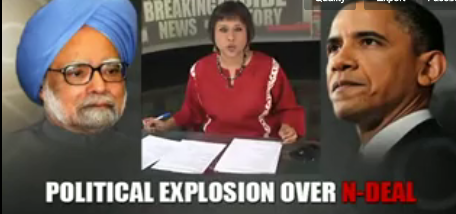
The political opposition in India are rebelling against prime minister Singh`s proposals to ignore Indian law concerning nuclear liability/insurance costs.. A raging discussion is breaking out in India concerning this matter (In English – first 90 seconds of video approx)
(Additional reporting by Alissa de Carbonnel in Moscow; editing by Keiron Henderson)
18 September 2013
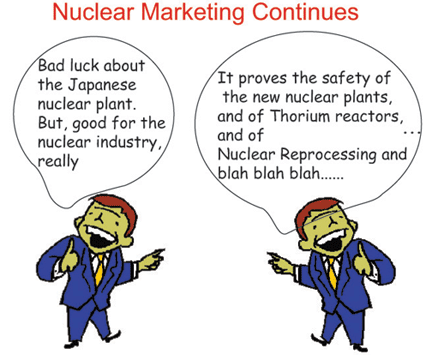
Two years after catastrophe at Japan’s Fukushima plant, sellers of atomic reactors woo potential buyers with the promise that lessons learned from one of the world’s worst nuclear disasters make the technology safer than ever.
The March 2011 earthquake and tsunami triggered meltdowns and radiation leaks at the plant, 150 miles (240 km) northeast of Tokyo, causing widespread contamination and prompting mass evacuations. The shockwave through the nuclear industry has not subsided and Fukushima plant owner Tepco is still struggling to contain the consequences.
Last month the firm said new spots of high radiation had been found near storage tanks holding highly contaminated water, raising fear of fresh leaks. Barbara Judge, a UK-based nuclear expert appointed by Tepco to improve its safety culture, says the disaster has made safety the top priority. “My opinion is that after Fukushima everything will be safer and that the safety agenda will be first in everyone’s minds,” she said In the aftermath of the accident many reactor developers reviewed their designs following government guidance and engaged in deep soul-searching that continues more than two years later.
Germany, with a traditionally anti-nuclear voting force, went as far as completely shunning nuclear power, vowing to switch off its nuclear fleet by the early 2020s. As a consequence of the political rethinking on nuclear power after Fukushima, companies such as France’s Areva (AREVA.PA), Toshiba’s Westinghouse unit or GE-Hitachi have seen orders dry up and costs for new plants explode due to additional safety requirements set by regulators.
At the end of 2010, 120 nuclear reactors were planned across the world.. By the end of last year this number had dropped to 102, according to statistics published by the International Atomic Energy Agency.
The International Energy Agency (IEA) also scaled back the 2035 nuclear capacity forecast by some 50 gigawatts in its latest World Energy Outlook due to policy changes. “The prospects for nuclear power worldwide have been clouded by the uncertainty surrounding nuclear policies after the Fukushima Daiichi accident in March 2011,” said IEA analysts in the outlook.
In a bid to win new business, nuclear reactor makers largely ignore references to the Fukushima accident in marketing material, and those who do refer to it say the event has made their designs safer. “Since March 2011, the context has changed, but the fundamentals remain the same,” Areva’s chief commercial officer, Tarik Choho, says in a statement in a brochure promoting the company.
Areva has long realised that chasing nuclear customers alone is not a sustainable business and has been selling renewable energy technology alongside nuclear reactors since 2006. Its stall at the London-based annual conference of the World Nuclear Association last week had a picture of an offshore wind turbine that caught the eye before images of its nuclear plants.
In two bold examples showcasing how costly it is to build new reactors, Areva’s European Pressurised Water Reactor (EPR) projects in Finland and in its home market in France are billions of euros over budget and years behind schedule. “
Utilities worldwide are increasingly required to reduce emissions, while adapting to regional resources and producing profitable, competitive electricity – with the utmost safety,” he said.
“Although a significant step, it is important to note that granting a nuclear site licence does not constitute permission to start construction of nuclear safety-related plant. That requires permission from ONR, permits from the Environment Agency and planning consent from the Secretary of State.”
The licence has been granted to NNB Generation Company (NNB GenCo), which wants to build a new nuclear power station at Hinkley Point in Somerset.
It represents a significant amount of work by the UK’s independent nuclear regulator – the result of more than three years and the equivalent of 6000 days spent engaging with and assessing NNB GenCo’s suitability, capability and competence to hold a nuclear site licence.
HM Chief Nuclear Inspector Mike Weightman said:
“To get us to this point, ONR’s experienced, expert assessors have been assessing the adequacy of NNB GenCo’s organisation, its arrangements for complying with conditions attached to the licence, the suitability of the site and NNB GenCo’s ability to prepare a safety report for the proposed installation at Hinkley Point C.”
“Although a significant step, it is important to note that granting a nuclear site licence does not constitute permission to start construction of nuclear safety-related plant. That requires permission from ONR, permits from the Environment Agency and planning consent from the Secretary of State.”
“Granting a nuclear site licence enhances our regulatory control of the activities associated with designing and constructing nuclear facilities. NNB GenCo will now be required to comply with 36 conditions attached to a nuclear site licence. These conditions provide ONR with the necessary regulatory powers to ensure the protection of people and society from the hazards associated with such nuclear power generation.”
NNB GenCo is proposing to build two UK European Pressurised Water Reactors (EPR) at Hinkley Point C and in parallel with its assessment of the site licence application; ONR is working with the Environment Agency to assess the generic design of this reactor.
Both regulators, through a process called generic design assessment (GDA), issued interim acceptance for the UK EPR design in December 2011. Subject to the receipt of necessary information from the designers to close a number of issues, they could make a decision on granting final acceptance before the end of this year. The reactor nuclear island cannot be built in the UK until these issues are resolved.
Having completed the planned assessment of NNB GenCo’s site licence application ONR has today published a project assessment report on its website explaining its decision to grant a nuclear site licence in more detail.