Give People of Fukushima a Voice -Threshold: Whispers of Fukushima Hello! I’m Toko, a photographer/documentary filmmaker/ visual artist/musician. On March 11, 2011, I was shocked by news of multiple disasters occurring in my native country of Japan. Since then, I’ve been trying to find ways to be supportive of the children who survived the disasters. I’ve been hearing many kids who live close to the Fukushima Daiichi Nuclear Power Plant disaster area say something like, “There is much radiation in Fukushima. But we are NOT the radiation, and not contagious. Please don’t discriminate against us. Please know much about us in Fukushima!” Their voices inspired me to make a documentary about the many fascinating people who still live there! So my artist friends and I started this project together! ☆日本語字幕入のプロモーションビデオはこちらです ☆『日本の皆様へ』メッセージへのリンクです ☆日本語の寄付して下さった方への特典の説明へのリンクです
To complete this film, we need to make 2 more trips to Japan (The end of November 2013 and April / May 2014), and need financial support to continue. We received a fiscal sponsorship from a non-profit organization called From the Heart Productions. With their support, I decided to do this campaign.
The donations are all tax deductible. Thanks to our sponsor! We actually need more than $20,000 to complete this film, but we decided to set our goal at a more humble amount – $10,000. Help dispel ignorance about the situation in Fukushima that has made kids suffer discrimination — I’m hearing about many mental difficulties among kids in Fukushima, resulting from bullying (and cyber-bullying). This is sad and irrational, but ignorance and fear are powerful motivators. I think that knowing more about the actual people in Fukushima might awaken healthy thoughts, truth, and empathy inside each one of us, and help to connect people. Perhaps it might also encourage us to ask ourselves some fundamental questions about our own humanity. Help make a better change for the future, for people in Fukushima and also for all of us on this planet — Their stories have made me re-think the situation in Fukushima, its people, and life happiness. They want you to know their stories and think about them for yourself – what we can do to nurture a healthier future? You can help make this change together! For more info: http://www.indiegogo.com/projects/give-people-of-fukushima-a-voice-threshold-whispers-of-fukushima–2
Rao said the scientific community had done much more than the money it was given over the decades. “The best money the government gave scientists was only enough for 20 percent of their requirement.
Ians/Bangalore : India will become a leader in nuclear energy with new technology which is being used for the first time to build a fast breeder reactor to generate 500MW at Kalpakkam near Chennai, a top scientist said on Sunday. “We are building a fast breeder reactor, the first of its kind to generate 500MW through a process which is different from the usual nuclear reactor,” Prime Minister’s scientific advisory council chairman C.N.R. Rao said.
Rao said if the new technology succeeded, the reactor would be commissioned by April 2014 at the Kalpakkam atomic power plant, about 80km from Chennai in Tamil Nadu. “If this succeeds, we will become a leader in nuclear energy with completely new technology, which we have mastered,” Rao said.Claiming that Indian scientists had performed well despite marginal investment in science infrastructure, Rao said the scientific community had done much more than the money it was given over the decades. “The best money the government gave scientists was only enough for 20 percent of their requirement.
We have never made full investment in anything. Ask the government and politicians why they have given so little for us. If I have to get $1,000, I get only $10, which is 10 percent and comes late,” Rao said at his home-office of the premier Indian Institute of Science (IISc).He further said that India must invest more in science as its future is linked with it, and the country would change for the better if the government and the private sector increased spending on science education. “More investments will enable the youth to look at science as an important area of work for a great future. Only countries which advanced scientifically made progress, while those who neglected it are not known,” Rao told reporters.
Noting that China was already doing peta-computing and hexa-computing, Rao said he was fighting with the government to invest in supercomputing so that at least a great institute like IISc would have a centre, which was proposed a decade ago. Regretting that the quantity of scientific papers published in India remained flat, the eminent scientist said China had increased its scientific publications and was going to be number one in the world in the area next year.He also said that basic science research is getting its due now. “I spoke to the prime minister and thanked him for the honour. I feel basic science is getting its due now,” Rao told reporters.
Hoping that more students would earnestly take up science research, Rao said the country’s foremost nuclear scientist Homi Bhabha should also be awarded with the (Bharat Ratna) honour. Rao’s wife Indumathi said her husband had always been her ‘Bharat Ratna’. “Scientists work very hard but rarely get recognition while it is easy for others like sports persons to get an award,” she added.
South Korea could become the next nation to take a stake in the British nuclear industry as the financing deal with France and China for a new reactor at Hinkley Point in Somerset creates a wave of wider interest.
The move could trigger controversy because the Korean atomic industry has been hit by a scandal over fake safety certificates but the UK and South Korea have vowed to help restore credibility and build closer links in this sector.
Lloyd’s Register, which provides risk management services, has been hired by Korea Hydro & Nuclear Power Company to help give the country’s reactors a clean bill of health.
But senior executives for the London-based Lloyd’s say the relationship is a two-way process with the Koreans also looking at the best route to enter the British market in the aftermath of the Chinese investment in Hinkley Point.
“Discussions are ongoing and I would not be surprised to see, in a year or so’s time, the Koreans taking an equity investment in the UK market,” said Richard Clegg, a managing director at Lloyd’s Register and a former chief scientist at the UK Atomic Weapons Establishment.
David Cameron met the South Korean president, Park Geun-hye, in London two weeks ago with the media headlines taken up with joint agreements on how to tackle the threat of nuclear weapons in North Korea.
But the two leaders also promised to increase commercial ties in everything from nuclear power to financial services. The Lloyd’s deal, which was signed on the sidelines, will help over a two-year period with the safety certificate problem that has forced some of the 23 South Korean reactors offline.
Clegg said the Hinkley Point financing agreement between Britain, EDF of France, China General Nuclear Corporation and China National Nuclear Corporation had attracted a lot of attention among other potential atomic investors.
Ministers have agreed to guarantee a generous price of up to £92.50 per megawatt-hour of electricity for 35 years, more than twice the current market rate.
Clegg believes that Toshiba and Hitachi of Japan, which have their own different consortiums for building potential new plants in Britain, can be expected to press ahead with firm investment plans too.
“We have been here before, of course. Sizewell [the last new nuclear plant constructed in Britain] was meant to be the first every year for a decade but with all the macro-pressures there are now around energy security my personal judgment is that we will see more than one and we could see six,” he said.
The next site after Hinkley in Somerset is likely to be Sizewell, where EDF and the Chinese have rights to build, and Clegg believes that the Far East partners will want to be playing an even bigger role than just taking an equity stake.
“I think we can expect to see the Chinese pushing for their one equipment and supply chain to be used with a longer term aim of being able to sell nuclear technology into emerging markets such as the Middle East, Africa and south-east Asia.”
Acronym TV with Dennis Trainor Jr. covers the situation at the Fukushima nuclear plant, Japan, as well as the delivery of letters and petitions signed by over 150,000 individuals and organizations from around the world.
It’s what post-Fukushima Japan fears the most; cancer. Amid allegations of government secrecy, worrying new claims say a cancer cluster has developed around the radiation zone and that the victims are children.
In a private children’s hospital well away from the no-go zone, parents are holding on tight to their little sons and daughters hoping doctors won’t find what they’re looking for. Thyroid cancer. Tests commissioned by the local authorities have discerned an alarming spike here. Experts are reluctant to draw a definitive link with Fukushima, but they’re concerned. “I care because I went to Chernobyl and I saw each child there, so I know the pain they went through”, says Dr Akira Sugenoya, a former thyroid surgeon. What terrifies parents most is a government they feel they can’t trust. It’s created a culture of fear; one which has led a number of women post-Fukushima to have abortions because they were worried about birth defects. “The doctors in Fukushima say that it shouldn’t be coming out so soon, so it can’t be related to the nuclear accident. But that’s very unscientific, and it’s not a reason we can accept”, Dr Sugenoya insists. “It was disclosed that the Fukushima health investigation committee was having several secret meetings. I feel the response has been unthinkable for a democratic nation”, Dr Minoru Kamata from the Japan Chernobyl Foundation says.
This is a short video cut from 第三回テント裁判口頭弁論報告会(2013.09.12 @参議院議員会館)
First speech (by Ms. Mihoko Watanabe)
Ms. Watanabe show us the deep love to her hometown by this touching speech, in which she talked about her understanding on nuclear industry, Fukushima nuclear accident and Japanese government. She talked in unhurried but trembling voice, which indicates the strong emotion inside. We can see the typical characteristics of Japanese women – always keep polite, kind, quiet and tolerant.
Second speech (by Ms. Keiko Sasaki)
Ms. Sasaki is n active leader in Fukushima women groups. She attributes the false and responsibility to male chauvinism, and calls on that women should get more rights and choices to take part in social and political issues.
By Dana Trentini I hope that every child in Japan is given comprehensive thyroid blood testing including at the minimum TSH, Free T4, Free T3 and thyroid antibodies. Their thyroid function should be regularly tested on an ongoing basis.
私は日本の子供たちを心配しています。どのような甲状腺血液検査が実施されているのでしょうか?どのような甲状腺の薬が使われているのでしょう か?TSH(甲状腺刺激ホルモン)は、西洋医学で、甲状腺の診療や治療の基本となるものです。しかし、この検査一つでは、甲状腺の状態の全体像はつかめま せん。私は、日本にいる子供たちすべてが、少なくとも、フリー T4, フリーT3、甲状腺抗体を含めた、総合的な甲状腺血液検査を受けるべきだと思っています。また今後継続して定期的に甲状腺の機能検査をするべきです。 I am concerned for the children in Japan. What thyroid blood testing has been conducted? What thyroid drug treatments are being used? TSH (thyroid stimulating hormone) is the gold standard for the diagnosis and treatment of thyroid conditions in mainstream medicine. However this one test does not provide a complete picture of the thyroid condition. I hope that every child in Japan is given comprehensive thyroid blood testing including at the minimum TSH, Free T4, Free T3 and thyroid antibodies. Their thyroid function should be regularly tested on an ongoing basis. 甲状腺異常が私たちの健康、特に子供たちへの健康にリスクとなっていることは、多くの科学論文が証明するところであり、それにもかかわらずこの問題に対しての意識の欠如が広くみられます。甲状腺ホルモンは、子供たちの成長や発達に不可欠なものです。 The scientific literature provides ample proof that thyroid disorders are a danger to our health especially the health of our children, yet the lack of awareness is pervasive. Thyroid hormones are critical for a child’s growth and development. 甲状腺結節やのう胞を持っている子供の中には症状を呈さない子供さんもいます。中には甲状腺機能促進の症状 (体重減少、脈拍の増加、神経過敏、不眠)が出る子供もいますし、甲状腺機能低下(体重増加、疲労、脱毛、便秘)等の症状が出る子供もいます。 また、甲状腺機能低下と甲状腺機能促進と両方の症状がサイクルとなって繰り返される子供も出るでしょう。日本では、子供たちのこれらの症状に留意すべきだ と思います。 Some of the children with thyroid cysts and nodules will present with no symptoms. Some will present with hyperthyroidism symptoms (such as weight loss, fast pulse, nervousness, insomnia), others with hypothyroidism (such as weight gain, fatigue, hair loss, constipation). Then there will be others who cycle between hypothyroidism and hyperthyroidism symptoms. It is important for the Japanese community to watch their children for these symptoms. 甲状腺低下ママHypothyroid Momのブログのうち、最も人気のあった投稿は、300+ Hypothyroidism Symptoms甲 状腺機能低下症の症状です。この投稿は、フェイスブックでも、3800人がいいね!ボタンを押しました。この投稿では、甲状腺の機能が、いかに私たちの健 康に影響を及ぼすかが明記されております。私は日本の方々に、甲状腺機能低下による症状を知ってしてほしいと思います。 The most popular article on Hypothyroid Mom is the post 300+ Hypothyroidism Symptoms. This post has received 3,800 Facebook Likes. It shows very clearly how low thyroid function has the power to affect our health. Unfortunately a lack of awareness about thyroid conditions is pervasive around the world. I hope this article reaches the Japanese community so that they are all aware of the potential signs of hypothyroidism. 2011年3月11日の原子炉メルトダウンの後、福島の多くの子供たちは避難しませんでした。そして今、福島で結節やのう胞が見つかっている女子では半数以上に及ぶのです。この文書を読んで私は涙が溢れました。 Many children in Fukushima were not evacuated after the nuclear meltdown in March 2011. Now the number of Fukushima young girls found to have thyroid cysts and nodules is over 50%. This documentary had me in tears. 国際甲状腺連盟では、世界中で最大3億もの甲状腺疾病を抱える人がいると見積もっています。ところが、このうちの半数以上は、自分たちの状態に気付 いていないというのです。福島原発事故での壊滅的な影響を考えれば、この見積もりよりも多くの人々が甲状腺の問題を抱えているのではないかと考えます。http://www.thyroidweek.com/ The Thyroid Federation International estimates there are up to 300 million thyroid sufferers worldwide, yet over half are unaware of their condition. Given the devastating effects of the Fukushima nuclear disaster, my worry is that there are many more people than estimated. I am determined to find each and every one of them. By Dana Trentini – Hypothyroid Mom is for informational purposes only and should not be considered a substitute for consulting your physician regarding medical advice pertaining to your health. Connect with me on Google+
Millions of pounds of taxpayers’ money designated to decommission the UK’s nuclear waste is being guzzled by projects overrunning by years, a damning report reveals.
As much as two-thirds of the Department for Energy and Climate Change’s budget is gobbled up by decommissioning nuclear waste – a staggering £1.9billion in the last year alone.
But at a time when every penny spent on energy and climate change costs is being counted, projects to decommission nuclear waste are years behind schedule and going hundreds of millions of pounds over budget, a report seen by This is Money reveals.
Soaring costs: Nuclear decommissioning at Sellafield is set to cost taxpayers more than £67biillion
Britain has an expensive legacy of nuclear waste, left over from a post-war era in which little thought was given to how nuclear weapons would be decommissioned.
Successive governments have failed to deal with the waste, the vast majority of which is at Sellafield in Cumbria, leaving current taxpayers facing a bill that has reached £67billion and is rising.
The job of decontaminating the Sellafield facility has been entrusted to a private company for the past five years – Nuclear Management Partners.
But a new report by KPMG exposes a litany of rising costs, missed deadlines and poor management.
Of 69 operating plan targets set for this year, only 77 per cent of them have been achieved on time, six per cent were behind schedule and 17 per cent were not achieved at all.
The delays represent an overspend of £180million in the last year alone, the report shows.
The report by KPMG found that 17 per cent of the operating plan targets were not achieved (Source: KPMG)
One project – Separation Area Ventilation – which was initially estimated to cost £120million and be completed by June is now expected to cost £229million and not be completed for another three years. This alone marks an extra cost of £109million and a 92.3 per cent increase in scheduled deadline.
The report also warns that Sellafield projects are being managed in the interests of shareholders – not taxpayers. It is ‘driven by the pursuit of value for its shareholders,’ the report states. ‘This is not aligned with Nuclear Decommissioning Authority objectives under current incentive structures.’
Newly-identified costs for decommissioning nuclear facilities have increased Canada’s remediation bill for contaminated sites by more than $2 billion over 2012, state public accounting records tabled October 30, 2013 in Parliament.
Published: November 15th, 2013 at 4:26 pm ET
By ENENews
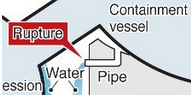
The Japan Times, Nov. 14, 2013: One leak came from a rupture in a sand-cushioned drain pipe installed at the bottom of the containment vessel.
engineer, Nutrimedical Report, Nov. 14, 2013 (at 29:00 in): They did indeed find water pouring out of several locations in Reactor 1′s containment structure and basically this shows that it was ruptured, most likely during the explosion that happened […] As we discussed before, all the water that gets pumped in to cool what’s left of the core […] it goes in and it’s falling back out again and goes right into the secondary side, which is basicallly the reactor building […] Because the water level’s not going up into that part of the building, it’s flowing out into the environment. That’s not really good news.
Information contained on this page is provided by an independent third-party content provider. WorldNow and this Station make no warranties or representations in connection therewith. If you have any questions or comments about this page please contact pressreleases@worldnow.com.
Canada’s nuclear industry will gain significant benefits from the signing of the Nuclear Cooperation Agreement between Canada and Kazakhstan earlier this week according to the Canadian Nuclear Association. The CNA said the agreement is an important part of the Government of Canada’s efforts to strengthen Canada’s prosperity and create employment through export trade initiatives.
“The Canadian Nuclear Association is supportive of Canada’s international trade and investment initiatives in the uranium mining sector,” said CNA president Dr. John Barrett. “This agreement will provide access for members of Canada’s nuclear industry to Kazakhstan’s growing nuclear market and allow our industry to export controlled nuclear materials, equipment and technology which will create jobs and bring economic benefits to Canada,” concluded Dr. Barrett.
The agreement is expected to come into force following respective domestic processes.
In symbolic move against nuclear weapons, students at Soka University of America have figured out how to fly 1,000 paper cranes to Japan.
Members of the Student Movement for Nuclear Disarmament club on campus canvassed their peers to contribute to the project by passing out origami packets and encouraging students to drop off their finished work at collection bins scattered around campus, said Josie Parkhouse, 22, club president and a senior concentrating on international studies.
From left, members of Soka University of America’s Student Movement for Nucelar Disarmament Tomomi Yokota, 22, Josie Parkhouse, 22, Clarisse Lee, 19, and Stuart Adams, 19 show some of their folded cranes. Students will string the cranes into 10 ropes of 100 and send them to Japan in a symbolic gesture for nuclear disarmament.
…And anyone at all serious is well aware that the idea of running an advanced, developed human civilisation on renewables is a pipe-dream….
…The Japanese government, impelled by the colossal international and domestic panic that followed the pretty much completely harmless Daiichi plant incident, has ordered all its nuclear power stations shut down…
Comment If the Fukushima crisis has proved one thing, it’s that nuclear power is safe. Everything that could possibly go wrong did, the accident was agreed to be at the top of the international scale for seriousness, and yet in decades to come scientists will not be able to attribute any deaths to radiation released from the Daiichi plant.
In that respect the incident was much like Three Mile Island, where again a nuclear core melted down under the unblinking, terrified gaze of the world’s media (though at least in that case they weren’t largely ignoring a nearby and genuine human catastrophe, as they did with the actual real damage done by earthquake and tsunami).
In the case of Chernobyl, the only other notable nuclear accident, the total death toll that you can actually attribute to the accident – including children who got cancer as a result of radioactive emitted from the plant – and it is 56, not at all a large number for an industrial accident. Anti-nuclear activists like to claim that there will be thousands more cancer cases, based on the idea that hundreds of thousands of people who were affected may suffer a tiny increased chance of cancer, but this will be impossible to verify as the fact is people very often die of cancer anyway. The lives of these “Chernobyl victims” will not be noticeably different to the lives they would have lived anyway.
If we were to close down industries on such grounds, we would not have any industry left and we’d have to live in mud huts and die like flies from disease and malnutrition. Other industries have accidents in which scores (or hundreds, or even thousands) of people are directly measurably killed all the time, and most of them emit huge quantities of stuff into the environment which a keen scientist could easily point to and say they are causing thousands of deaths. Yet they are not closed down.
EDF (Euronext: EDF) has awarded Areva a service and solutions contract to support it in the maintenance of eight nuclear reactors in France.
The utility is to provide its services at the Chinon, Nogent, and Belleville nuclear power plants (NPP), and the contract includes a five year performance period, and an option for two additional years.
According to Energy Business Review, the specific services to be provided will include the coordination and performance of logistical, facility maintenance, handling, and lifting operations.
The contract is expected to lead to the creation of more than 200 jobs, according to the company.
A large semi-autonomous drone capable of monitoring radiation levels after a release of nuclear material in the environment has been developed by Bristol University researchers.
The unmanned aerial system (UAV), called the ARM, can also measure surface temperature and provide photographs of the affected area.
The team believes the system could be very valuable in situations such as the Fukushima Daichi nuclear disaster.
“By using light-weight and low-cost unmanned aerial vehicles systems, we can immediately and remotely determine the spread and intensity of radiation following any such event,” said Dr Tom Scott, the project lead and Director of the Interface Analysis Centre in the University’s School of Physics. “The systems have sufficient in-built intelligence to deploy them following an incident and are effectively disposable if they become contaminated.”
Teams operating in high-risk areas would thus be able to obtain accurate information about the radiation levels they would be exposed to if they entered the area.
The project was jointly funded by the Engineering and Physical Sciences Research Council and nuclear decommissioning company Sellafield.At the same time, the Bristol University team has been developing a similar drone, capable of flying inside buildings.
The ARM drone was successfully tested in various weather conditions including snow, rain and high winds. The sensitivity of its sensors and accuracy of on-board computers was verified during field trials at radioactively contaminated sites in southwest Romania and naturally occurring anomaly site in Cornwall.
The University of Bristol is now working closely with the National Nuclear Laboratory to offer this technology to Japan as a helpful tool for environmental surveying during the on-going Fukishima clean-up operations and in the surround prefecture. The team is also developing a UAV mapping system and exploration algorithms for projects relating to the detection of buried explosives and depleted uranium ordnance.