The budget of the programme is set at 1.6 billion Euros in current prices for the years 2014 to 2018.
Council agrees H2020 EURATOM programme
The Council of the European Union has adopted the European Atomic Energy Community (EURATOM) programme for nuclear research and training activities.
The new programme allows for the continuity of nuclear research activities carried out under the current EURATOM programme, which expires at the end of 2013, as part of Horizon 2020.
The programme will have the same simplified access to research projects and rules for participation as Horizon 2020. The EURATOM programme comprises indirect and direct actions.
Indirect actions will cover fusion energy research and research on nuclear fission, safety and radiation protection. Direct actions for activities of the Joint Research Centre (JRC) in the field of nuclear waste management, environmental impact, safety and security. The nuclear fission research activities are in line with the objective of enhancing the safety of nuclear fission and other uses of radiation in industry and medicine.
EURATOM programmes are limited to five years in accordance with the EURATOM treaty. The budget of the programme is set at €1.6bn in current prices for the years 2014 to 2018.
The EURATOM programme will continue to contribute to the implementation of the ‘Innovation Union’ strategy by enhancing competition for scientific excellence and accelerating the deployment of key innovations in the nuclear energy field, notably in fusion and nuclear safety, and will contribute to tackling energy and climate change challenges. In this way it will underpin the creation of a European Research Area.
INTERVIEW: Attorney Charles Bonner, one of the team representing sailors from the USS Ronald Reagan in their lawsuit against TEPCO for the health damages they sustained from Fukushima radiation during Operation Tomadachi, the humanitarian aid mission to Japan immediately after the March 11, 2011 earthquake and tsunami.
NUMNUTZ OF THE WEEK: Japanese government PR stunt feeds radioactive Fukushima rice to workers and executives in a Tokyo government office complex, while the farmer who grew it can only visit his fields, not live there because the area is still too contaminated for resettlement.
Japanese Ministry officials chowing down on Fukushima Rice grown by farmers who can’t live near their fields because it’s too radioactive.
PLUS:
RadCast w/Mimi German – the nuclear radiation “weather report”
Fistfights break out in Japanese Diet during PM Abe-baby’s ramming through of state secrets act.
Japanese citizens demonstrate, organize against state secrets act;
How Japan ignored Chernobyl in setting nuclear safety standards;
Explosion and fire in Arkansas nuke facility, more demands for radiation testing for food and the ocean;
AARP going after Florida “advance fee” law;
And who knew Mexico had a National Commission of Nuclear Safety and Safeguards?
Australian veterans deliberately exposed to British nuclear bomb testing have had their case rejected by Australia’s Human Rights Commission, which says it does not have the jurisdiction to hear their complaint.
The ruling was the last legal avenue available to the surviving 300 veterans, who argued the Menzies government violated their human rights under the Universal Declaration of Human Rights by exposing them to harmful radiation from nuclear tests in the 1950s and 1960s at Maralinga, South Australia.
“This decision marks the end of the road for our nuclear veterans, and I would say that the only recourse they have available to them now is a plea for an act of grace by the Australian government to take responsibility for the events involving nuclear testing on Australian soil,” said Joshua Dale, a human rights law specialist from the law firm Stacks/Goudkamp, which represented the veterans.
He said the decision was a failure to recognise the rights of military veterans.
“Even a limited use of nuclear weapons essentially is an act of suicide,” Helfand said. “These weapons simply have to be understood to be completely useless. From the U.S. perspective, if we were to use even a tiny fraction of our own arsenal against an adversary on the other side of the planet, we would end up causing this global catastrophe that would have terrible repercussions here at home.”
A hypothetical nuclear war in South Asia could trigger worldwide famine and “probably cause the end modern industrial civilization as we know it,” the lead author of a new report tells Global Security Newswire.
Published by the watchdog group Physicians for Social Responsibility, the report, titled “Nuclear Famine: Two Billion People at Risk,” updates prior studies on the potential impacts that a “limited” nuclear war between India and Pakistan could have on the global climate, and consequently on food supplies.
The prior research, published in 2012, predicted that corn and soybean production in the United States would decline 10 percent on average for 10 years. It also projected a decline in Chinese middle-season rice production — on average by 21 percent during the first four years and on average 10 percent in the following six.
At the time, Physicians for Social Responsibility said these effects could “put more than one billion people at risk of starvation.” The new forecast released on Tuesday indicates the number of people at risk of starvation would actually be double that figure, the group says.
The fresh analysis includes a study completed this fall showing there could be even larger drops in Chinese winter wheat production. These crops could decline by 50 percent during the first year and by more than 30 percent over 10 years.
Increasing prices would exacerbate the shortage of available food, according to the report, which goes on to call for the elimination of nuclear weapons “as quickly as possible.”
“Significant, sustained agricultural shortfalls over an extended period would almost certainly lead to panic and hoarding on an international scale as food exporting nations suspended exports in order to assure adequate food supplies for their own populations,” the report says. “This turmoil in the agricultural markets would further reduce accessible food.”
Ira Helfand, a medical doctor from Northampton, Mass., who served as the lead author of the report, told GSN the data shows that the equivalent of 100 Hiroshima-size bombs could “probably cause the end modern industrial civilization as we know it.”
A conflict of this size would represent the use of about half the nuclear arsenals that India and Pakistan possess, or a “tiny portion” of the U.S. and Russian stockpiles, according to Helfand.
“This is an unbelievably huge shock to the international system,” Helfand said. “We saw what happened to the world’s economy when the housing bubble collapsed in the United States — [here] we’re talking about a shock to the international economic-social system orders of magnitude larger than that. I think it’s quite hard to imagine how this much-more-fragile-than-we’d-like-to-think system can survive that.”
According to Helfand, the chain of events that would lead to such catastrophe is as follows:
Firestorms caused by nuclear detonations would launch more than 6 million metric tons of soot into the Earth’s atmosphere — blocking out sunlight and causing a sort of global cooling effect commonly referred to as “nuclear winter.”
The cooling and other anticipated climatological impacts — such as decreased precipitation — substantially reduce crop yields, which in turn causes disrupted markets and famine.
“Even a limited use of nuclear weapons essentially is an act of suicide,” Helfand said. “These weapons simply have to be understood to be completely useless. From the U.S. perspective, if we were to use even a tiny fraction of our own arsenal against an adversary on the other side of the planet, we would end up causing this global catastrophe that would have terrible repercussions here at home.”
Helfand argued that, in light of such information, President Obama and other world leaders are not pursuing aggressively enough efforts to reduce and eliminate nuclear arms.
The Abe administration says it will double agricultural exports to ¥1 trillion by 2020, strengthening the farm industry despite the threat of fierce competition once Japan opens its markets more to foreign products under free trade accords.
The target is part of a policy package approved by a government panel that includes measures aimed at facilitating large-scale farming by intensifying the use of farmland, supporting farmers engaging in processing and distributing their produce, and doubling incomes in the agricultural sector as a whole over the next decade.
“I will achieve drastic reforms in agricultural policy by steadily implanting the policies under this plan,” Prime Minister Shinzo Abe told a meeting of the panel in his office Tuesday.
The move signals that the administration is serious about making Japanese farmers more globally competitive as the country negotiates with 11 other nations, including the United States and Australia, the Trans-Pacific Partnership.
…”The high-risk end phase is still ahead for the nuclear plants still running in Germany,” Stay said. “Which means it’s time to turn our attention to it now.”
Two years after the nuclear disaster in Fukushima, measures are being taken to protect the German population from accidents. But their implementation could take years, and some critics are concerned.
When in March 2011 images of the Fukushima nuclear accident were shown on German TV, Chancellor Angela Merkel reacted quickly. She promised to review the safety of all German nuclear plants, and not long afterwards eight reactors in Germany were shut down. Then the government announced that Germany would be nuclear-free by 2022.
But did the German government draw all the right conclusions? Experts from the Radiation Protection Commission, which advises the government on these issues, point out that in case of a nuclear accident in Germany significantly more people could be affected than previously expected. They want more measures to be imposed to better protect the population in case of an emergency.
The Fukushima accident prompted Germany’s nuclear shutdown
Among other recommendations, the commission wants to see the radius of the evacuation zone increased from 10 to 12 kilometers. Furthermore, the commission advises to government to build up national stocks of iodine tablets. If the iodine is taken in time it prevents the thyroid from taking in radioactive iodine.
Far too late, some say…
These additional precautions should have been implemented a long time ago, said Jochen Stay of the anti-nuclear campaign “Ausgestrahlt” (radiated). It has been known for more than two years that radiation spreads much further than previously thought. The precautions proposed by experts do not reach far enough, Stay claims. “They are thinking about reducing limits for resettlement from 100 to 50 millisieverts,” he told DW. “That sounds good at first, but in Japan the limit is actually set at 20 millisieverts for the zone around Fukushima.”
…not that urgent, others say
By now it is not clear which recommendations will be implemented. The Environment Ministry does not want to comment on details because the consultations are not finished. “At this point, when we don’t even know the entire framework, it would not be appropriate to say we will do this and we won’t do that,” said Katharina Reiche, state secretary at the ministry.
She does not see any urgent need for action because all German nuclear power plants were carefully checked after the Fukushima accident, and international experts came to the conclusion that the country’s nuclear power plants meet the highest safety standards. “Therefore I’m convinced that what we are planning now are additional measures for an event which we common sense almost rules out,” Reiche said.
On today’s podcast, Maggie and Nat interview our very inspiring friend Yumi Kikuchi. Fairewinds has been working with Yumi for more than a year now. She encouraged us to send material to the Tokyo Peace Film Festival, which she organized, and we sent our film “You are not alone.” Yumi also co-sponsored Arnie’s trip to Japan in 2012, where he gave the presentation “Japan at a Crossroads: Two Futures.” Yumi left Japan with her family after the Fukushima Daiichi accident, and currently lives in Hawaii. She founded the Fukushima Kids Hawaii Project (FKHP), usually shortened to Fukushima Kids, and has just returned to Japan where she will be spreading awareness about the project and fundraising. Fukushima Kids aims to host children from Fukushima in Hawaii during school vacations, where they can play outdoors safe from high radiation levels. Children are more vulnerable to the effects of radiation than adults, and we are already seeing signs of thyroid cancer and cysts among children in Fukushima. There are about 300,000 kids living in the Fukushima prefecture, and Yumi is hoping to host 15 kids this first summer.
Children in Fukushima found developing Thyroid Cancer after March 11, 2011 earthquake and nuclear disaster.
The highest number reported is 58 and lowest 26, which varies depending on the new source. But thyroid cancer is a very rare disease for children, normally one per million children. It is also said 1/3 of children already have thyroid cysts, a big concern for parents.
I am a mother of 4 children, lived in Chiba, Japan until March 11, 2011 earthquake tsunami and nuclear disaster. When I saw “Station blackout at Fukushima Daiichi Nuclear Power Plants” on TV that night, I made a decision to get the children as far away as possible, and went to Okinawa where we established a community effort to evacuate pregnant women and children from Fukushima to Okinawa.
We then moved to Kona, Hawaii, where we live today, starting Fukushima Kids Hawai’i, inviting the children of Fukushima to Hawai’i Island to let them experience a healthy respite from radiation exposure. Health of children is very important for me. Our government instead campaigning the safety of low level radiation and even promote “Eat Fukushima food campaign”, appealing its safety. Majority of produce in Fukushima contains radioactive isotopes and children should not eat radiation in my opinion, nor expose themselves to radiation. I want all kids to have a long healthy life and you can contribute to it by participating this campaign.
7 Kids are coming to Hawai’i This Winter
During Christmas holidays(Dec 20 to Jan 3), we are inviting 7 school children age 10 to 17 and a chaperon from Fukushima to Kona for 2 weeks stay. The cost of the airfare per person is $1700 plus food, lodging and activities in Hawaii cost another $800, so total of $2500/person times 8=$15,000 is needed.
We also invite mothers with babies to Fukushima Kids Hawaii House, a 3 bed room house in Kona, to experience a health respite for the babies up to 3 months with their mother (or father). The cost of keeping the house is $2000 a month, $24000 a year.
We also invited more children as we raise enough fund during their summer vacation for 1 months, which costs another $31,000. Our annual cost of the campaign is $70,000.
We have raised $2000 by garage sale, silent auction, dance party and concert. So we now need $3000 by December 20, 2013 and $13000 by January 15, 2013.
We also need to raise another $55000 by the end of September 2014 for Fukushima Kids Hawaii House and Fukushima Kids Hawaii Summer Program.
Your support is very important for the health and survival of children in and around Fukushima (now that the radiation from Fukushima is spreading all over the world through air and water, the future of children in the pacific and northern hemisphere are at stake)
Our project will raise awareness of the radiation and health and support children’s health in the world.
Yumi (I) and friends have succeeded to move 264 women and children from Fukushima and surrounding area after the disaster to Okinawa.
We invited 6 children and one chaperon this summer for one full month! They had a great time and made connections in Hawaii. They now know there are people in Hawaii and world who care. Now they know they can ask for support and speak up for their right to live a healthy life, not threatened by radiation.
Other Ways You Can Help
If you can not contribute monetary, please share this link to your friends. Some of your friends may be able to contribute. We value every support!. Please do what you can! Thank you for your time and effort for reading this to the end. Your care and support is needed and appreciated. Mahalo Mahalo.
…According to the authors, the design of the Metzamor plant is much the same as those which the European Union insisted be shut down before Bulgaria and Slovakia joined the EU… 2011
The European Commission is happy to assist safety upgrades at Armenia’s Metzamor nuclear power plant but with the proviso that the facility is closed down as soon as possible.
“The Metzamor nuclear power plant (NPP) belongs to the so called ‘First Generation’ Soviet designed nuclear reactors which cannot be economically upgraded to current internationally recognized nuclear safety standards and should therefore be closed as soon as possible.”
Ms Bockstaller added, “However, as Armenia has no replacement electricity generation capacity which would allow the immediate closure of the plant, the EU and other international donors have agreed to help Armenia to improve the safety of the plant while it remains in operation.”
Azerbaijani Diaspora in US: “Armenian Metzamor Nuclear Power Plant is a source of threat”
The Azerbaijani Diaspora in the US raised concern over Armenian Metzamor Nuclear Power Plant. The Diaspora has started a new campaign by sending the letters to the US Congress members in order to dismantle the plant.
“The recent earthquake in Japan has shown vividly the inherent dangers of nuclear power plants in seismically-active areas. If Japan was caught off-guard, then what is to say of reckless third world nations? The Metzamor Nuclear Power Plant was built during the 1970s, about 20 miles west of the Armenian capital of Yerevan in the city of Metzamor. The plant was constructed with two VVER-440 Model V230 nuclear reactors”, reminds the Diaspora.
“The guaranteed resource potential of the working Armenian nuclear power plant will be exhausted by 2016”.
“Fukushima.” The name of the nuclear power plant that was severely damaged in the March 2011 earthquake and tsunami that devastated coastal areas of northeastern Japan has become an ominous buzzword. Along with “Chernobyl,” it lurks in the backs of our minds as a symbol of the unthinkable. Maybe if we just forget, we tell ourselves, everything will somehow turn out all right. Yet, from most evidence, the crisis appears to be far from over.
The dread factor is one reason few will want to watch Atsushi Funahashi’s new documentary, “Nuclear Nation,” about the effects of the catastrophe on everyday people. This modest film observes evacuees from Futaba, a small town near the Fukushima Daiichi nuclear power plant, making do in their temporary shelter. Partly because this version of the movie was drastically edited to 96 minutes from 145, it feels sketchy and disjointed.
“Nuclear Nation” doesn’t take the long view. It doesn’t pretend to be knowledgeable about nuclear power or the politics of the disaster, although the Japanese government and the Tokyo Electric Power Company come off as untrustworthy and indifferent. If nothing else, the film will force you to reassess all the arguments for and against nuclear power.
Those whose lives were uprooted seem remarkably stoic, although anger simmers below their resignation at being buffeted by forces beyond their control. And, in one scene of a rally, they vent their frustration. Most of the evacuees, also known as nuclear refugees, are middle-aged or older people who have been relocated from Futaba to an abandoned four-story high school in Saitama, a suburb of Tokyo. Crowded in dormitory-like conditions, subsisting on bento box meals, they await word that never comes of when they might return to their homes in what is now a ghost town. Their numbers dwindle over the months, from more than 1,400 to fewer than half that, as they build new lives in new places.
Some of the saddest scenes show residents who are allowed to return briefly to pick up belongings. Donning protective gear and making the bus trip home, they are given two hours to collect sentimental treasures like wedding pictures and favorite pieces of clothing.
Katsutaka Idogawa, who was Futaba’s quietly heartbroken mayor, recalls the economic benefits the Fukushima plant once brought to Futaba and the pride that residents felt in being a nuclear power center. But the official response to the evacuees, many of whom haven’t been tested for radiation exposure, was so tepid that any trust has been broken. Some assume that they were exposed to dangerous levels of radiation long before the disaster. It should go without saying that Mr. Idogawa is no longer an advocate of nuclear energy.
Nuclear Nation
Opens on Wednesday in Manhattan.
Written and directed by Atsushi Funahashi; director of photography, Mr. Funahashi and Yutaka Yamazaki; music by Haruyuki Suzuki; produced by Mr. Funahashi and Yoshiko Hashimoto; released by First Run Features. At Film Forum, 209 West Houston Street, west of Avenue of the Americas, South Village. In Japanese, with English subtitles. Running time: 1 hour 36 minutes. This film is not rated.
…In deciding to retire Crystal River nuclear plant in February, Duke said it would accept a $530 million settlement with the plant’s insurer, in addition to the $305 million it had already paid.
The Florida Public Service Commission in October approved a settlement with consumer advocates that allows Duke to begin recovering from its Florida customers $135 million of the plant’s value in 2014. The remaining value of the plant, nearly $1.5 billion, will be recovered over 20 years….
Duke Energy has filed with federal regulators a nearly $1.2 billion plan to decommission its shuttered Crystal River nuclear plant.
Duke decided in February to retire the plant rather than risk trying to fix its reactor containment building, whose concrete walls were damaged during a botched repair job in 2009. Repairs could have cost up to $3.4 billion.
Crystal River, 85 miles north of Tampa, will be mothballed for 60 years until decommissioning work ends in 2074. The plant began operating in 1977.
Duke plans to use a Nuclear Regulatory Commission-approved decommissioning method that requires limited staffing to monitor the plant until it is eventually dismantled and decontaminated. The two other options were to remove contaminated structures and materials from the site or permanently encase them in concrete.
Duke estimates decommissioning costs at $1.18 billion in today’s dollars.
The company says its nuclear decommissioning trust fund of $778 million, along with future growth of the fund and $70 million from Crystal River’s nine other owners, will be enough to cover those costs. Eight municipal electric utilities and a cooperative own shares in the plant.
Published: Tuesday, December 10, 2013 at 2:54 p.m.
Last Modified: Tuesday, December 10, 2013 at 2:54 p.m.
NEW YORK – A federal appeals court in Manhattan said Tuesday that the legality of a tax on Vermont’s only nuclear plant is best left up to a state court. But it rejected some of the plant operator’s arguments against the tax anyway.
The 2nd U.S. Circuit Court of Appeals ruled in a case stemming from a tax affecting the Vermont Yankee nuclear plant. The plant, which began operating in 1972, is run by the New Orleans-based Entergy Nuclear Operations Inc.
The company has argued that the electricity tax is unconstitutional and not really a tax but was imposed instead as a punitive fine or regulatory fee in May 2012. Two months earlier, Entergy had stopped making regular payments into designated state funds after Vermont refused to extend regulatory approval for the plant’s continued operation.
A three-judge appeals panel said it would leave to the Vermont courts whether collecting t Continue reading →
…Several months after the accident at the power plant in November 2011, samples of rice grown in Onami town in Fukushima Prefecture showed radioactive contamination above the safety limit. The grain contained caesium – a radioactive isotope – that was measured at 630 becquerels per kilogram, while the government-set safety limit is 500 becquerels…..
Rice from fields in the Fukushima prefecture, evacuated after the worst nuclear disaster in Japan, will be served to government officials for 9 days in a bid to demonstrate the safety of the country’s most-beloved crop, a local broadcaster reported.
The rice cultivated in several decontaminated fields in the Yamakiya District in Kawamata Town and Iitate Village, two areas designated as evacuation zones after the March 2011 nuclear catastrophe, will be served in a government office in Tokyo from Monday.
Over half a ton (540 kilograms) of rice will be part of a test to prove the effectiveness of the decontamination process. Officials from the Fukushima prefecture have given assurances that the rice contains no radioactive substances.
The rice balls tasted especially good after the great effort put into cultivating the crop, said Senior Vice Environment Minister Shinji Inoue on Monday. Parliamentary Vice Environment Minister Tomoko Ukishima also joined the tasting.
A farmer from Kawamata Town told NHK that he will continue to cultivate the rice now that he knows it tastes good. Because the zone was evacuated after the nuclear crisis, he said that he had traveled from his temporary home to the paddy fields to tend the crops.
Most of the radioactive cesium that spewed from the Fukushima No. 1 nuclear plant and fell in broad-leaf forests remained near the surface and likely did not spread to groundwater, researchers said.
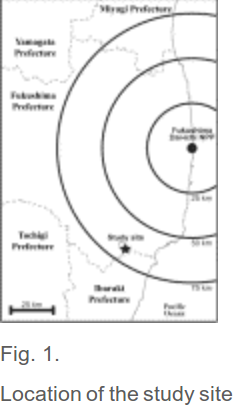
The researchers at the government-affiliated Japan Atomic Energy Agency began a study in May 2011 to monitor how cesium migrates in the ground below deciduous forests in Ibaraki Prefecture.
The forests were about 65 kilometers southwest from the crippled plant, which sits on the Pacific Coast.
When the disaster unfolded at the nuclear plant in March 2011, huge amounts of radioactive cesium landed on woodlands in a vast area around the plant.
Early readings in the study showed an average of 20 kilobecquerels of cesium per square meter in the surveyed area. About 70 percent of the cesium was present in a layer of fallen leaves.
Seven months later, the research team found that readings were down to one-fourth of the initial level.
In contrast, cesium levels tripled in the soil up to 5 centimeters deep after most of the cesium on the leaves seeped into the earth.
When the researchers measured cesium levels in the same soil in August 2012, they discovered that most of the cesium had remained there.
They also monitored how much of cesium had descended to 10 cm from 5 cm in the soil. The results showed only about 0.2 percent of the cesium moved in fiscal 2011, while the figure for fiscal 2012 was about 0.1 percent.
By autumn 2011, most of the cesium on the leaves had been washed into the soil by rainfall. The researchers also believe that rising temperatures accelerated the decomposition of the fallen leaves, resulting in more cesium sinking into the soil.
But after that, there was little movement in the cesium.
“In a future study, we want to look at cesium in the soil of needleleaf forests and forecast the impact on the nearby environment after monitoring the cesium’s movements to forestry products and areas beyond woodlands,” said Takahiro Nakanishi, a specialist of geoenviro
137Cs vertical migration in a deciduous forest soil following the Fukushima Dai-ichi Nuclear Power Plant accident
….I believe this is a truth that cannot be concealed. Even if the village is decontaminated, the young people will not return, and if they cannot come back then the village will naturally perish, and it will be reported around the world as a ruined village. Rather than trying to protect the village, should not more attention be paid to the health of its people?,,,
[…]
…no more than 1% of the land of Iitate has been decontaminated so far. That was what the government claimed in March 2013. Accessing the relevant page in December 2013 shows that the government is now claiming about 2%. The government also claims to have decontaminated 110 houses, or 6% of the housing stock of Iitate. But who would return to a house surrounded by land and forests not yet decontaminated?….
Shoji Masahiko; translated and introduced by Tom Gill
A Statement by one of those who lost their homeland to the Fukushima nuclear disaster
Translator’s foreword:
For the last two and a half years, I have been studying the inhabitants of Nagadoro, one of the twenty small hamlets in Iitate village, which has been evacuated and barricaded due to particularly high levels of radiation. Present government policy is to maintain the status of Nagadoro as a no-go zone for at least another four years. Among the 250 inhabitants is Shoji Masahiko, who until the nuclear disaster supported his wife and four children as a part-time farmer and part-time carpenter. In March of this year, Masahiko handed me the document which, after an inexcusable delay, I have now translated below. The Japanese original follows. TG
Recently I have started to take a first, tentative look into the things being said [about the situation in Fukushima] by university professors, world opinion, the specialist media, and experts from various foreign countries, and I feel moved to set down on paper my own thoughts and ideas, before it is too late, about how things are, what should be done, and to give my opinion and an appeal on what should be done internationally, socially, humanly and humanitarianly, regarding this important and weighty issue.
Shoji Masahiko, 2013.3.10 (Sunday)
All of a sudden two years have passed since that once-in-a-thousand-years calamity, the Great East Japan Earthquake, and the explosions that followed at the Fukushima No. 1 nuclear power plant – and nothing has changed. All that has happened is that our houses are crumbling, our fields are running to weeds, and our village is drifting back to a primitive state. Today I am thinking, I am worrying, and I am starting to feel resentment. “For us, in this reality, in this situation, what really matters? The village we were living in? To defend, to inherit, and to pass on to generations the home-place we were living in, the land our forefathers built upon, our property? Ah, but now what really matters is human health. That’s where it all starts” – with such words I question myself, then question once again. The national government and the village mayor insist now as ever that they will decontaminate the village, that they will enable us to go home, to return to the village as soon as humanly possible, that their plans will be executed swiftly, that the living environment will be getting the top priority as they open up the road to recovery, and no-one wants to abandon their homeland. But why, when human life and health should be the top priority, should that be reason to choose return, return to the village, as a higher priority than the people’s health, our children’s health, our grandchildren’s health? – That is something I cannot fathom.
A cherry blossom party at Nagadoro in the days before the disaster [photo: Shigihara Yoshitomo]
For my part I have actually started to think that we are being used as the world’s first human guinea-pigs, in an experiment to demonstrate to the world that “here in Japan, in the prefecture of Fukushima, in the village of Iitate, in an area of particularly high radiation, the people have come home, the village has been repopulated, and we have succeeded in restoring life as it was before the Great East Japan Disaster, and before the nuclear accident.” The youngsters, the young couples bringing up children, have been forced into activities and a living environment of extremely exaggerated caution, in which information on radiation and on health is zealously collected and shared. I think that is only natural for parents, for mothers. As such, these young people, these households with children, will not contemplate going home, they think not of returning to the village, nor will they until the radiation level is below world standards, and it is possible to live safely, with a sense of security, living off the fruits of the land – until that happens, I think it is only natural to stay away from the village, and as a parent of children myself that is the best I can hope for. To avoid having to shut up our children and grandchildren indoors. That seems to be something that the officials, cabinet ministers and bureaucrats in the capital cannot apprehend.
The only way for the officials, cabinet ministers and bureaucrats to convince and persuade the local people that it is safe to return is for them to come and experience life in the village for themselves, to prove by experiment with their own bodies that one can live in safety and peace of mind in our village; unless they turn their own experience into data, we will not be able to believe anything they tell us – this is the minimal responsibility of the nation that promoted nuclear energy and the Tokyo Electric Power Company. Electricity from the Fukushima nuclear power plant was electricity for Tokyo; we villagers of Iitate saw no benefit from it but only suffered the consequences – we could not see the radiation, we were told there was no immediate threat to health, even as hydrogen explosions burst out one after the other at the plant after March 12, 2011; only on April 22 were we told by the authorities – as a means to evade responsibility – to prepare for planned evacuation about a month later. And as a matter of fact, although our village was a high-level radiation zone, we accepted evacuees from Minami-Soma and some of those from Namie whose escape had been delayed, and in each of the village’s twenty hamlets, we prepared food for those evacuees, thinking it was aid, but we fed them irradiated food, and unnecessarily increased their dose of internal radiation.
The possibility of internal radiation poisoning implies heavy responsibility. We meant well, and can but pass on the responsibility for the deed to the government and Tokyo Electric Power, but if my memory serves me, we accepted some 2,000 evacuees. The national government should take absolute responsibility for any harm to health that emerges from internal or external radiation absorbed by those people. We who gave them the emergency supplies are full of remorse that we knew not of the danger in what we were doing, and we pray from the bottom of our hearts that no harm to health will result.
Shoji Masahiko, photographed on 24 April 2011 with two baskets full of home-grown shiitake mushrooms that had to be destroyed because of their radiation level [photo: Tom Gill]
Only a tiny part of the decontamination plan drawn up by the government for FY2012 (April 1, 2012~March 31, 2013) has been implemented, and no site has been s
ecured for storing the radioactive materials to be removed after decontamination. At present the information I have says that only 1% of the area slated for decontamination has actually been treated. Moreover, as the work of decontamination has commenced, it has proved difficult to secure workers with the right technical expertise to do the work, even in the numerous areas with low levels of radioactivity, where the forests are far from the houses, where there is plenty of space around the living quarters and where there are plenty of forests to serve as windbreaks [factors considered to help decontamination work]. This makes it highly questionable whether the decontamination plan can be carried out, and even if it were, I believe it would only be for the sake of being able to say they gave it a try, though without succeeding in reducing the radiation to a level where people could actually live there again. It is totally incomprehensible to me why vast amounts of the taxpayers’ money is being invested in this, even though it is unclear whether a safe and reassuring environment will result; nor can I understand why they are once again planning to put the local people’s lives at risk by making them go back before it is safe. Goodness knows how many billions of yen the work will cost, but the village office’s estimate for Iitate village alone is 322 billion yen (over $3 billion).
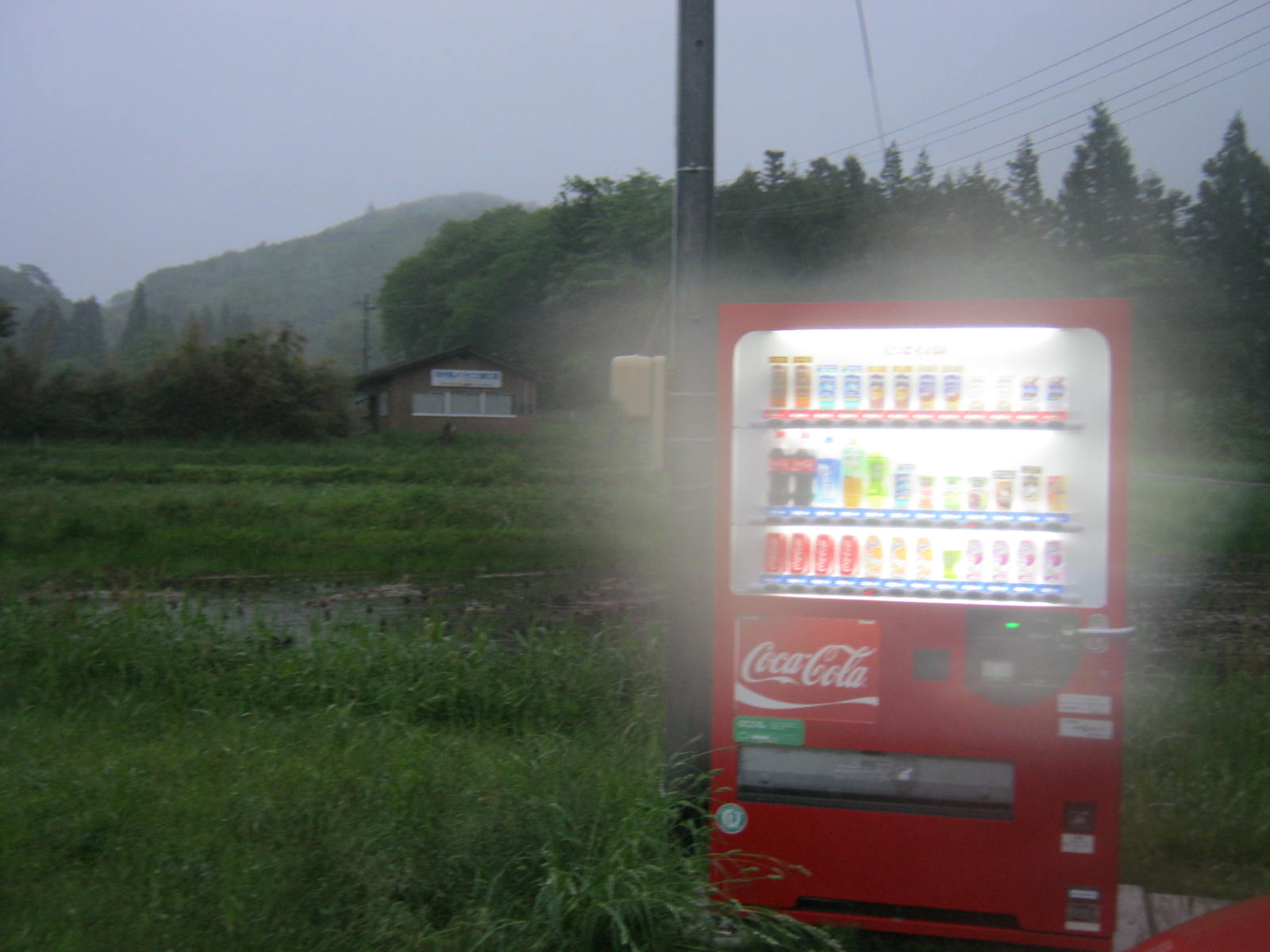
A single Coca-cola vending machine in a field in the evacuated hamlet of Nagadoro on 30 May 2011 [photo: Tom Gill]