“Pushing dirt around in an Idaho field,” was the delightful comment left at the end of Iceberg Research’s most recent and damning report about the financial prospects for the multiple nuclear reactor startup companies all vying for customers none of them actually have in what Iceberg calls an “increasingly crowded market.”
The Iceberg analysis was focused on the Berkeley California-based reactor ingenue company, Deep Fission, and its brassy boasts that don’t seem to quite match any actual reality. The September 24, 2026 report’s deliciously punny headline ran: “Deep Fission ($FISN): a Money Pit.” Deep Fission is the company proposing to establish micro-reactors in Parsons, Kansas, dropped into mile-deep boreholes. A citizens’ group called Prairie Dog Alliance — named after local wildlife that is quite adapt at digging deep tunnels itself — has sprung up to oppose the project.
The comment at the end, made by reader Tony Alton, wondered whether another reactor startup, Oklo, and its fairy tale-named Aurora reactor, which will likely remain imaginary, wasn’t an even better company to expose for its overblown hype.
“Excellent report, but surely OKLO is a similar but much larger target ($7B) whose officers are selling large amounts of their personal holdings on a monthly basis,” he wrote. “They have made no apparent progress toward licensing and their construction photos show a dozen pieces of heavy equipment pushing dirt around in an Idaho field.”
The field in question is at the Idaho National Laboratory, but even having that government imprimatur does not seem to have helped Oklo’s fortunes.
The Iceberg report was largely dismissive of Deep Fission’s prospects, saying it would “not be a winner” and wondering whether its debacle on the stock market, where its stocks plummeted almost 11 percent within days, wasn’t just “a late attempt to ride the SMR hype, and dump a stranded asset onto retail investors.”
Around June 18 of this year Deep Fission conducted its initial public offering, known as an IPO, selling 2.5 million shares of stock at $16.00 per share. Then, on September 26, after Iceberg Research released its damning report, describing Deep Fission’s mile-deep borehole reactor technology as overhyped and unlikely to achieve commercial viability, Deep Fission’s stock price fell almost 11 percent, to close at $6.95 per share. By late October, the stocks had plummeted further, decreasing by 56.79% in the space of a month, and closing on October 22 at just $2.30 per share.
The Iceberg report also included some graphs, including one on the fate of the nine other reactor startups that have ventured onto the stock market so far. The graph rather resembles a multi-colored version of Donald Trump’s signature, that is, a lot of scribbling and vertical lines that are mainly headed downward. That trajectory is important and it’s the same for nuclear power as a whole worldwide. There may be some upward blips here and there, but over the long-term it’s a long, slippery downward slope into that money pit abyss, as the Iceberg Research headline warned.
They have good reason to be nervous, because this isn’t the first venture into the nuclear realm for Deep Fission’s father-daughter founders, Richard Muller and Elizabeth Muller. Ten years ago they launched a nuclear waste technology project, Deep Isolation. As Iceberg noted, that venture is “a deep-borehole nuclear waste disposal company that has failed to commercialize its concept after a decade.” The pair also founded something called Berkeley Earth in 2010 (see photo above.)
Deep Fission, Iceberg concluded, is “largely a repackaging” of the company’s non-starter Deep Isolation.
The nine companies, including Oklo and Deep Fission, that have already gone public, may have been rolling the dice when they first ventured onto the market, but now it looks more like tumbling dice. And their fellow gamblers — that is their investors — are starting to get restless if not downright mad.
There’s precedent here, of course. The country’s so-called flagship SMR company, NuScale, is still facing an on-going class action lawsuit for defrauding its investors after its original SMR project collapsed in 2023, after 16 years and no product. It is also facing potential lawsuits against its officers and/or directors and whether or not they may have engaged in securities fraud or other unlawful business practices.
At least one small modular reactor startup, Holtec — better known for nuclear waste interim storage and reactor decommissioning, even as it endeavors to restart the Palisades, Michigan reactor while also venturing into the SMR field — got the jitters and has withdrawn its IPO for now.
And there could be yet more legal trouble ahead for the 11 reactor projects that have been taken under the auspices of the Department of Energy — all the better to avoid the scrutiny of the Nuclear Regulatory Commission, which at least knows something about nuclear safety; and all the better to avoid any public intervention or the need to conduct environmental reviews, even though this is a violation of federal law under the National Environmental Policy Act, another piece of legislation the Trump administration is trying to destroy.
Fourteen States Attorneys General — plus Harris County, Texas and the District of Columbia— sent a letter to the NRC last August objecting to its rulemaking, ironically entitled Implementation of the National Environmental Policy Act, since that appears to be the opposite of what the NRC is planning to do. The NRC rulemaking instead proposes to make its NEPA implementing regulations less thorough, thereby reducing public confidence in the safety and security of the nuclear sector.
Among other things, the rule would potentially eliminate or at least limit opportunities for public engagement and intervention, doing away with a long tradition of public comment periods during environmental review for nuclear projects.
In keeping with the Trump executive orders to “unleash” and fast track new nuclear projects in the US, the NRC proposed rule would also allow the agency to rush through new nuclear projects without evaluating foreseeable environmental and climate change impacts.
All of this appears to violate statutory obligations under NEPA as required by the Administrative Procedure Act. Accordingly, the Attorneys General urged the NRC to rescind its rulemaking.
So far the NRC, now presumably stripped of most people of conscience thanks to Elon Musk’s early horror movie rampage with his metaphorical chainsaw, has ignored them and is pressing ahead.
On the southeastern shore of Lake Michigan, an extremely hot, intensely radioactive 1,000-pound nuclear fuel assembly sits somewhere under specially treated water inside the Palisades nuclear power plant. That assembly has “tilted from its upright position,” according to the U.S. Nuclear Regulatory Commission, and may have damaged other key components of the plant.
But the commission, nevertheless, just green-lighted a risky retrieval operation by the plant’s owner, the New Jersey-based Holtec Company. The “regulators” in charge of all this answer to Donald Trump who can fire any NRC employee at will, based on the Slaughter decision of the U.S. Supreme Court this year.
Despite serious uncertainties and vast potential danger, Holtec is now approved to pull those extremely radioactive rods out of the reactor core.
Trump is personally invested financially in the nuclear power industry.
Billions are at stake. Holtec needs Palisades to open ASAP.
The NRC has given Holtec a permit to proceed, which means that Holtec may soon pull those hot rods out from under water. If they do, all bets are off on the future of the reactor, the region, and the nuclear industry as a whole.
This incomparably high stakes radioactive situation erupted on or around August 30, 2026, when Holtec placed that fuel assembly into the water.
Palisades sits in Covert Township, 150 yards from Lake Michigan, 70 miles east of Chicago, 180 west of Detroit.
It’s one of three shut “zombie” reactors the industry’s billionaire backers want to re-fire for electricity for data centers, AI and crypto production.
Before moving those rods Holtec had planned a $900 million Initial Public Offering.
The company has taken gargantuan sums of money from the state and federal governments to re-fire Palisades and build at least three Small Modular Reactors, two on the Palisades site and one at the site, also in Michigan, of its Big Rock Point nuclear power plant.
Some repayments will to come due in March, 2027.
Palisades’ proposed electricity would be Holtec’s sole source of a fresh cash flow.
Sixty years ago—on October 5, 1966—the Fermi I reactor suffered a major accident across the state in Monroe. The near-catastrophe prompted John G. Fuller’s best-selling book We Almost Lost Detroit, and Gil Scott-Heron’s companion rap song.
Detroit Edison spent some three years and $100 million trying to revive Fermi I before shutting it in November 1972, with enormous losses.
Since going critical in the early 1970s, Palisades has never met basic NRC fire protection standards. Its previous owners suffered a wide range of operational errors, including two site evacuations of plant personnel from the containment building. X There was also mishandling of a 107-ton radioactive waste transfer container. In the face of enormous safety and economic challenges, Palisades was shut by Entergy on May 20, 2022. Holtec bought the plant later in 2022 with a commitment to decommission it, but then switched to announcing a re-start by 2024.
Holtec has never run or restarted a nuclear power plant.
In October, 2025, a worker fell into radioactive water in the reactor cavity inside the plant. Plant personnel records say critical staff may be dangerously overworked contributing to the nuclear assembly incident.
Holtec admits it has “lost” critical welding records. Some of what Holtec has admitted to the NRC are welds which have violated American Society of Mechanical Engineers standards and may be irreparable. Framatome, one of the world’s most experienced nuclear engineering companies, warns that critical steam generator tubing is cracked, and that Palisades probably can’t run a full fuel cycle.
The very idea of reopening Palisades has ignited bitter debate within the scientific and engineering community. Numerous veteran safety and management personnel have jumped ship. A manager of Palisades for Holtec has left. He has likened a restart to “trying to build a fire truck on the way to a fire.” The position of lead site safety manager may have been vacant during the fuel assembly problem.
As widely reported by Muskegon-based investigative journalist Roger Rapoport, and by long-time Kalamazoo-based nuclear expert Kevin Kamps, a restart involving removing the hot fuel rods from their borated pool could pose serious risks.
Ironically, a PR crew of Holtec was filming when what veteran nuclear engineer Arnie Gundersen called a “rookie error” resulted in the tipping of the fuel assembly. But neither Holtec nor the NRC have released visuals of the accident, nor has the public been informed about what broader damage it may have caused.
Rapoport and Kamps further report that Alan Blind, a highly respected veteran engineer, has filed a range of technical questions with the NRC. The commission’s Petition Review Board has retaliated by attacking Blind personally. The attacks signal that Trump’s NRC is very much in Holtec’s camp.
With the fuel assemblies now in protective borated water, the NRC denies any radiation releases, and thus any harm to plant workers or the public. But Holtec brands the situation an “emergency.”
It needs to lift that errant assembly into the air to restart its cash flow.
So, with NRC approval, it may try to cram the errant fuel assembly into a cylindrical Fuel Transfer Canister, hoping to crush the fuel rods, which may not otherwise fit.
The U.S. nuclear industry has never pulled off such a stunt.
After five dead years, there’s no public need for Palisades’ power. Under federal law, Trump, Holtec and the NRC have very limited legal liability.
The nuclear industry’s much hyped “renaissance” may now ride on the Palisades crap shoot. At least two other proposed “zombie” restarts (at Pennsylvania’s Three Mile Island Unit 1, and at Duane Arnold in Iowa), await Palisades’ lead.
Trump also wants to launch an untested, unproven fleet of Small Modular Reactors to run data/AI/crypto centers. Soaring costs, technical pitfalls and advancing renewables, have driven the SMR gambit to the brink. Billions of taxpayer and investor dollars hang in the balance.
Holtec’s fuel assembly debacle and dumped IPO have shredded the industry’s financial credibility, as has public rage against data centers, AI and crypto.
Trump is doing all he can to kill green energy. But the astonishing advances in solar, wind, geothermal and post-lithium batteries make the rise of a renewable-based “Solartopian” energy economy appear increasingly unstoppable.
Palisades’ upper-level management has been decimated. In the wake of Elon Musk’s DOGE, some 500 NRC staff are also gone, along with about half the commission’s routine reactor safety inspections. Trump’s absolute control guarantees further attacks on critical industry stalwarts like Alan Blind.
Above all, Palisades demands open public hearings to vent the warnings of veteran experts like Blind, Rapoport, Kamps, Gundersen—and of an informed grassroots opposition.
History tells us such battles have been won—and that our survival hangs in the balance. But we’re likely to know what we need to know at this plant only after such hearings.
Harvey Wasserman wrote the books Solartopia! Our Green-Powered Earth and The Peoples Spiral of US History. He helped coin the phrase “No Nukes.” He co-convenes the Grassroots Emergency Election Protection Coalition at www.electionprotection2024.org Karl Grossman is the author of Cover Up: What You Are Not Supposed to Know About Nuclear Power and Power Crazy. He the host of the nationally-aired TV program Enviro Close-Up with Karl Grossman (www.envirovideo.com)
Israel’s general election on Tuesday is a contest between two fascists whose only disagreement is how to more efficiently commit genocide and ethnically cleanse the Palestinians. If Netanyahu loses to his opponent, Gadi Eisenkot, don’t be fooled by the liberal political and media establishment when they try to sell it as a turning of the page.
And they will.
Much of their efforts in this direction will rest on the fact that Eisenkot is an Israeli Jew of Moroccan descent. Watch out for the specific phrase “of Moroccan descent.” I guarantee you will see and hear it. Establishment media will try to employ identity politics to make liberals feel that a fascist with browner skin and a familial connection to a majority-Muslim country is a better fascist. They might even say something about his thick Israeli accent in an effort to separate him from Netanyahu whose polished, American accent helps give away the colonial game. In fact, the Guardian has already done exactly this. In a piece last week they hyped his “unpolished” character, his Moroccan heritage and working class roots, while mostly avoiding his long history of murderous actions.
Right now the polls are pretty much neck-and-neck, the outcome a flip of the coin. But if Eisenkot and his electoral bloc does win, he, and they, are likely to be as savage, perhaps even more so, than Netanyahu and his electoral bloc. We know this because Eisenkot is a solidly military man with a mass-murderous past. In 2014 he was appointed by Netanyahu to head the IDF, and from October 2023 to June 2024 was a member of Netanyahu’s cabinet. Yes, that’s right. Netanyahu’s possible replacement as prime minister of Israel was appointed by Netanyahu to head Israel’s genocidal military, and he also served in Netanyahu’s government for eight months of the genocide.
As I said, this election is simply fascist 1 versus fascist 2, each trying to prove how much they hate Palestinians, and Muslims more broadly.
While Netanyahu has been pointing to the genocide of Gaza and the attacks on Iran as reasons for his re-election, Eisenkot boasts of his more than forty years murdering or directing the murder of Palestinians, Lebanese and Muslims across the Middle East. He joined the Israeli military in 1978 and didn’t leave until he retired as IDF chief of staff in 2019. He made his name as the creator of the so-called “Dahiya doctrine” during his time as an IDF commander in Lebanon. This military strategy involves the use of overwhelming and disproportionate force against civilian populations to drive them into submission. It is named after the Beirut neighbourhood it was used in, under the command of Eisenkot, from July to August 2006. During this rampage the Israeli military murdered around 1,200 civilians.
Eisenkot was also head of the IDF during the Great March of Return in 2018 when thousands of Palestinians in Gaza marched peacefully, day after day, to the border fence, demanding the end of the blockade on the territory and more freedom to leave Gaza. In response the Israelis killed 183 unarmed Palestinians, including 35 children. All were sniped to death from the watch towers along the fence. Thousands were maimed. A UN report said the Israeli soldiers deliberately aimed for lower limbs to disable people. There were zero Israeli casualties. This is a page from the UN report, documenting specifically “the body part targeted.”
Eisenkot is a monster and since entering politics in 2021, he has relied on his mass murderous history to build a support base. He has never criticised the genocide, because he supports it, and like Netanyahu he opposes the creation of a Palestinian state. In August he explicitly tweeted his opposition to a Palestinian state in an effort to show Israelis that he would represent continuity on this issue. This came after Netanyahu said Eisenkot would “establish a Palestinian state before GTA 6 comes out,” referring to the popular video game due to be released next month. This is the level of the debate. One-upmanship on commitment to apartheid.
Other than not establishing a Palestinian state, Eisenkot’s big pitch is that he’ll “destroy” Hamas (which hasn’t fired a weapon in anger in over a year) within 18 months. His big promise, therefore, is to return to the murderous heights of the genocide before the phoney ceasefire, a ceasefire which has allowed the genocide to continue at a lower level away from the headlines. And we know from his past command of the IDF that these aren’t idle threats.
Like Netanyahu, Eisenkot also supports the expansion of settlements in the West Bank to ensure “the Jewish character” of Israel is preserved, and now in the final days of the election campaign he has begun using the phrase “Benjamin is Palestine,” accusing Netanyahu of being too pro-Palestinian. Just think about that. Netanyahu’s opponent is accusing Netanyahu, the butcher of Gaza, the architect of genocide and internationally wanted war criminal, of being too pro-Palestinian! This is unmistakably the discourse of a fascist state.
The disagreements between Netanyahu and Eisenkot concern largely superficial domestic issues. Their most controversial dispute is over the expansion of conscription to the ultra-orthodox community, which Netanyahu opposes (because they are a key support base), and Eisenkot supports.
And if Eisenkot wins and manages to form a government, it will include people like far-right West Bank settler Avigdor Liberman who has repeatedly said there are “no innocents in Gaza” and last year urged Netanyahu to drop a nuclear bomb on Iran. The blood-thirsty Liberman would most likely be defence minister in an Eisenkot government.
An Eisenkot government would also include Yair Lapid, a former foreign minister and Israeli prime minister, who last year said protests against Israel were fuelled only by propaganda and that there was no genocide or starvation in Gaza. Lapid is also, like almost all Israeli politicians, a massively murderous hawk on Iran, calling earlier this year for Israel to “destroy all of Iran’s oil fields and energy industry on Kharg Island.” Targeting civilian energy infrastructure is a war crime. He has also called for the destruction of Hezbollah, which is also a call for more mass murder in Lebanon.
Israel is a society of psychopaths led by psychopaths.
The only glimmer of hope is that it looks likely neither bloc will have enough seats to form a coalition government, which may put the brakes on their genocidal plans for a while. However, with Netanyahu unable to be replaced via the ballot box, it could simply rouse the country to rally around him, especially if the US-Israel once again attack Iran and Netanyahu uses it as a pretext for forming a “unity war cabinet,” as he did after October 7th.
Don’t let mainstream voices trick you into believing that Israeli good guys exist who’ll change the direction of this diseased colonial outpost.
The only guaranteed outcome from this election is more mass murder, and the continued genocide of the Palestinians.
After Tuesday the question won’t be whether Israel stops killing innocents, the question will be how many innocent people Israel kills, and where, in the coming days, weeks and months.
With the unprovoked war on Iran by the USA and Israel, uranium enrichment has become an exceedingly touchy technology. Uranium enrichment requires the use of uranium hexafluoride, the only known compound of uranium that turns into a gas at a relatively low temperature (56.5 degrees C). There are only three commercial UF6 plants in the western world, in Canada, the USA, and France.
UF6 is a very nasty chemical. When released as a gas it reacts violently with moisture in the air to from a noxious haze of white “smoke” – a mixture of hydrogen fluoride and uranyl fluoride – that is highly corrosive, causing deep chemical burns, pulmonary edema, destruction of eye tissues, rapid kidney damage, and sometimes death.
CCNR recommends the creation of an exclusion zone of at least two kilometres around the facility, either by purchasing properties within that radius, or relocating the plant to a less densely populated area. There are currently 10,000 living within 2 miles of the Port Hope facility, with no emergency measures plan (with evacuation) predicated on a malicious attack on the facility.
Michigan reactor restart is delayed as Trump administration champions nuclear energy to meet booming AI power demand
US regulators have issued a warning to a nuclear project critical to Donald Trump’s efforts to revive the industry, after a contractor fell into a reactor cavity and a bundle of fuel rods nearly tipped over during refuelling. The US Nuclear Regulatory Commission told Holtec International, a company racing to reopen a shuttered reactor at the Palisades nuclear power plant in Michigan, to address a “chilled work environment” that has made staff hesitant to raise safety concerns without fear of retaliation. The warning has prompted concerns among critics that financial and political pressures to revitalise nuclear power as an answer to booming AI-driven energy demand are increasing risks of accidents.
The interests of Ynys Môn will be “fully represented and robustly advocated,” a council chief has pledged after campaigners raised fears over Russia or Iran targeting the proposed site of a new nuclear plant.
Anti-nuclear protesters fear that Anglesey could be a target if the UK’s first small modular reactor (SMR) nuclear power station is built on the former Wylfa power station site
The site was selected for development by the UK Government in April. The nuclear project is being led by Great British Energy – Nuclear (GBE-N) and Rolls-Royce SMR, in a £2.5 billion partnership.
The island group People Against Wylfa B (PAWB) have also expressed their concerns that the island’s RAF Air Base at Valley could also make the island a target.
They also feel there would be “no safe evacuation” in the event of an emergency, even if a third bridge was built, over the Menai Strait.
The group raised their concerns in an open letter to the Secretary of State for the Department for Energy Security and Net Zero (DESNZ) Miatta Fahnbulleh, MP.
In their letter they had stated: “Increasing threats of war mean that we will be targets for attack. Russia and Iran have both threatened us due to our interventions in Ukraine and the use of British bases for the bombing of Iran. Nuclear power stations are now regular targets for attack.
“How are we to be protected? How are we to get off the island in the event of an attack or nuclear accident?
“There are two bridges connecting us to the mainland, and even if there were three, there would be no safe evacuation possible, without the danger of accidents.
“RAF Valley is also on the island, making us a further target.”
DESNZ had replied that the “highest standards” of safety and security surrounded the UK’s nuclear sites
Whilst GBN-E “recognised that the people of Ynys Môn had questions about the plans and looked forward to discussing them openly and constructively”.
Now, Anglesey Council’s chief executive Dylan J. Williams has pledged to “engage constructively” with relevant organisations.
Mr Williams said: “We recognise the concerns raised by PAWB and respect the right of individuals and organisations to express their views on major energy developments.
“Matters relating to nuclear safety, security, emergency planning and national energy policy are the responsibility of the UK Government and the relevant regulators.
“As a county council, we will continue to engage constructively with governments, regulators, developers, local communities and other stakeholders to ensure that the interests of Ynys Môn are fully represented and robustly advocated.
“The council will also continue to fulfil its statutory responsibilities in full and play an active role in all relevant planning, consenting and consultation processes.
“Any future proposals at Wylfa would be subject to rigorous assessment through the appropriate statutory processes, including consideration of safety, environmental, infrastructure and community impacts.”
Through its dealings with other countries, Canada has played a major role in fostering the proliferation of nuclear weapons throughout the world. This brief history concerns itself with Canada’s involvement as a supplier of nuclear reactors and uranium, leading to both “vertical proliferation” — the ever-accelerating competition for bigger, better, faster and smarter bombs among the existing nuclear powers — and “horizontal proliferation” : a more insidious process whereby dozens of national and subnational groups are slowly but surely acquiring a nuclear weapons capability. It will alsodescribe how the Canadian nuclear lobby has influenced the way Canadians view the proliferation problem.
The SNP have demanded the UK Labour Government rule out the use of revenue from Scotland’s oil and gas industry on English nuclear energy.
The national party’s depute leader Keith Brown said that “every single penny” from the UK Government’s new energy wealth fund “should be spent on Scotland’s renewables future”.
The Labour Government said it is to be established by the Chancellor with a £2 billion down payment to reinvest oil and gas revenues into the climate transition.
The SNP are now urging Burnham’s Government to ensure the money generated by Scottish oil and gas is not used to fund nuclear power in England.
“Every single penny of revenue from our oil and gas industry should be invested in Scotland’s renewables future,” the SNP depute leader said.
“The one trillion pound question for the Labour UK Government is will they guarantee that or will we see our energy revenues pay for English nuclear power down south.”
Brown claimed that GB Energy was “gutted” to pay for nuclear projects in England.
I have been following NATO’s proxy war in Ukraine for several years, and so what is happening now is not a surprise to me. Indeed, it is something that I have been expecting for some time.
First, let’s review what it is that is happening: Russia is bombarding Kiev (Kyiv) on a daily and nightly basis. This is new. Before, Russia’s drones and missiles would arrive in waves, with intermittent periods lasting days or weeks. Now it’s minutes.
Russia is targeting energy infrastructure in a way that they have avoided doing before. They are attacking with an aim to essentially make Kiev uninhabitable this winter, as Ukraine will no longer have the ability to generate and distribute power to its people.
Russia is also destroying Ukraine’s logistics infrastructure: warehouses have been destroyed. The Ukrainian government has said that they have lost 90% of their food logistics.
The battlefields are also looking much more dire for Ukraine. Russia is finally advancing, and the last of the wide belt of so-called “fortress cities” in Donetsk, Slovyansk and Kramotorsk, look set to fall in the coming weeks. After those two cities fall, there is virtually nothing left to stand between the Russians and the Dnieper River, the gateway to Kiev.
This looming disaster was described by pro-Ukraine foreign policy and security analyst Jimmy Rushton, a British journalist for the Kyiv Independent based in Kiev, who explained the danger in September 2025:
“Ukraine has the Donbas line, a network of fortifications stretching across Donetsk…If Ukraine were to abandon these, it would fall back to almost nothing…The ground behind is flat and open, without prepared defenses…”
Indeed, analysts seem to agree that giving up the Donbas defences would amount to “military suicide” for Ukraine.
Nonetheless, after years of “grinding” advances, often described as “glacial” by the Western media, Russia is — slowly but surely — about to claim its prize.
………………………………………………………………………………………………………………………………………………………………………………………………… To Western analysts, it was almost as if Putin didn’t even want to conquer Ukraine.
Well, the shocking truth is that he didn’t. Putin NEVER wanted to “conquer Ukraine”. He only wanted the West to take him seriously when he said “nyet” to Ukraine joining NATO, insisting that Ukraine must stay true to its 1991 Constitution and always remain neutral.
The West’s complete failure to understand what Von Clausewitz called the “nature” of the conflict has rendered them blind to what is actually going on, and will leave them shattered and shocked when this conflict reaches its inevitable conclusion.
“Brotherly peoples”
The reason the Russians have been taking the easy approach to Ukraine lies in the peculiarly Russian concept of literal kinship between slavic nations.
This concept was explained in July 2021, when Vladimir Putin published an essay entitled “On the Historical Unity of Russians and Ukrainians”. In it, he explained how Russians and Ukrainians — as well as Belorussians — were “brotherly peoples” — a triune of nations, all stemming from the same root in Kievan Rus.
To Putin, the trinity of the three nations was one based partly or even mostly on a shared religious faith, namely the Russian Orthodox Church:
“Russians, Ukrainians, and Belarusians are all descendants of Ancient Rus, which was the largest state in Europe. Slavic and other tribes across the vast territory…were bound together by one language, economic ties…and — after the baptism of Rus — the Orthodox faith. The spiritual choice made by St. Vladimir, who was both Prince of Novgorod and Grand Prince of Kiev, still largely determines our affinity today.”
Putin also laments the fact that this “affinity” between Russia and Ukraine has been undermined:……………………………………………………………………………………………………………………………………………………………..
Millions of Russians live in Eastern Ukraine
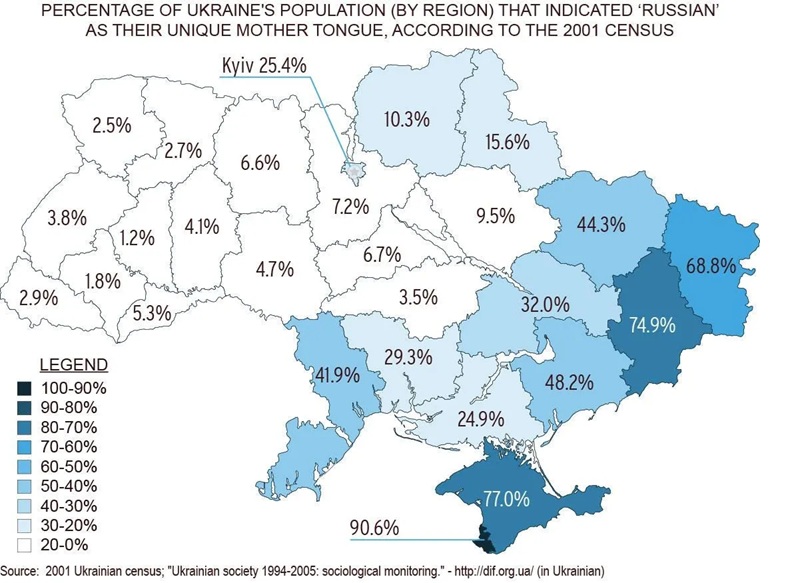
………. in Ukraine, which accounted for nearly HALF of that dispossessed Russian population (12 million). In fact, 83% of the pre-2014 population of Donbas — including most of the Eastern and Southern Oblasts — were ethnic Russians or spoke Russian. Overall, almost half of Ukrainians spoke Russian. It is also well-known, for example, that Volodymyr Zelensky was a native Russian speaker, who did not learn Ukrainian until he was elected President.
………………………………………………….., it should be noted that fully one third (1 in 3) of all Russians have relatives in Ukraine. Moreover, prior to the 2014 coup that saw a change in Ukraine’s government, 74% of Russians had a favourable attitude towards Ukraine — it seems that Putin was not the only one who saw them as “brotherly people”.
In fact, of the Russians living in Eastern Ukraine— where the fighting is taking place — 75% or more speak Russian, with high percentages using Russian as their “unique mother tongue”.
A true civil war
From these data points, we can conclude that what is unfolding in the Eastern Ukrainian oblasts is a de factocivil war. Like the American Civil War, it is a case where both sides speak the same language, share a common heritage, with many even sharing familial connections. In other words, it is virtually “brother against brother” (a phrase often used to describe the American Civil War)……………………………………………………………………………………………………………………………………………………………………………………………………………………………………………………………..
Russians have soured on their Ukrainian “brothers”
When the Maidan Coup happened in 2014, things started to change not just in Ukraine, but also in Russia. When the Russian public began to be bombarded by stories and videos and photos of ethnic Russians slaughtered by the Nazi battalions of Western Ukraine, they were outraged. Right wing Ukrainian nationalist groups like the Azov Battalion, Aidar Battalion, Right Sector, and others murdered thousands of innocent citizens of the Donbas region, whose only “crimes” were that they were ethnically Russian and belonged to the Orthodox Russian Church.
But for these Nazis, those Russian speaking Ukrainians were Untermenschen (subhuman). In fact, Yatsenyuk, the Prime Minister who was hand-picked by the U.S. to lead the government after the coup literally called them that in a declaration.
Nonetheless, on the eve of Putin’s incursion into Ukraine to save the beleaguered Russians in the Donbas, almost half of Russians still had a favourable view of Ukraine.
As of 2026, however, only 16% of Russians still feel that way towards their “slavic brothers”.
The Starobelsk drone strike changed everything
On 22 May, 2026, the Ukrainians — with of course help from the CIA — carried out a drone strike on the academic building and dormitory of the Starobelsk Professional College of the Pedagogical University in Starobelsk, Russia, a place for young women (mostly) to study to become teachers.
The strike was carried out in 3 waves, reminiscent of the Mehab school “double tap” strike the U.S. carried out in Iran. Six young women were killed and 40 injured. The Russian public were outraged. How could a “brotherly people” do this?
The Starobelsk terror attack marked a turning point in public opinion — as well as a corresponding change in Putin’s prosecution of the conflict with Ukraine.
“The gloves are off”
Observers of the conflict in Ukraine have all noticed a marked escalation in Russian attacks over the summer. The drone and missile bombardments, which had been intermittent, are now a daily occurrence. Whereas the attacks had previously come only at night, allowing work and commerce to carry on normally during the day, the attacks are now coming around the clock.
Sensitive command and control units housing NATO advisors and Western personnel, which had mostly been spared in the early years of the conflict, are now being obliterated; bridges, railways and locomotives are also finally on the target list.Logistics centres, warehouses and even data centres are being hit.
Most critically, energy infrastructure, electric and gas systems, which Russia had attacked earlier but never completely destroyed before, is now being completely demolished, leaving cities like Kiev unable to provide heating to its citizens over the coming winter. In previous years, Russia had always allowed Ukraine to keep some of its vital energy systems during the winter — now, Russia is content to let the Ukrainians, their “fraternal people”, freeze in the dark of winter.
……………………………………………………………………………………………………………………………………………………… Four years of such ferocious attrition has resulted in the almost complete destruction of Ukraine’s ability to fight. While Kiev refuses to provide casualty figures, independent analysts estimate that Ukraine has suffered up to 3 MILLION casualties.
Military Watch Magazine, based in South Korea, explained in 2025 that Ukraine had already lost 1.7 million troops, and that the rate of losses was accelerating:
“The information indicates that 118,500 personnel were killed or went missing in 2022, 405,400 in 2023, 595,000 in 2024 and 621,000 so far in 2025, which corroborates with a growing body of evidence which has emerged over more than three years that attrition rates have increased tremendously and unsustainably.”…………………………………………………………………………………………………………………………………………………..
What happens next — and when?
Informed observers of the Russian-Ukrainian conflict are now debating as to what will trigger the ultimate collapse of the Nazi regime in Kiev. Will it be the devastating air war that is destroying Kiev’s infrastructure and its ability to sustain human life? Or will it be the ultimate destruction of Ukraine’s armed forces, the death of the infamous “last Ukrainian” — the point to which Ukraine’s Western sponsors have vowed to sponsor Kiev’s fight.
Either way, the endgame in Ukraine is already upon us. The front is collapsing, the troops demoralised, under-supplied, under-fed, and under constant pressure all along the 1200-kilometre front, while thousands have been deserting or surrendering. Meanwhile, hundreds of thousands of Ukrainian soldiers have simply deserted. Ukraine’s cities are under 24-hour bombardment, the country is losing its ability to generate power and even to feed its population: the shelves in the shops are empty.
This new, award-winning film silences us not because of the monstrosity of what Israel did but because it serves as irrefutable proof of our own monstrosity
have just seen NAZA, a documentary in which 24 Israeli intelligence officers and soldiers are filmed explaining how, over the past three years, they went about systematically wiping Gaza off the map.
They did so while nearly every western capital either chose to keep silent or actively assisted in the slaughter.
The filmed interviews take place at night, on the roof of a building in central Tel Aviv. The participants’ faces are masked by darkness, while, in the background, unidentifiable human figures can be seen going about their business in lighted apartments and offices: watching television, hanging the washing, seated at a desk.
Unlike the Venice Film Festival, where the film received a record 25-minute standing ovation, the sold-out screening I attended greeted NAZA with stunned silence.
The credits rolled. The lights went up. We traipsed to the exit. No one said a word.
That seemed a much more fitting response than the one in Venice. Ever since, I have been pondering what exactly our stunned silence meant.
Was it shock at the horrors inflicted on Gaza?
Not really. Barely any of the destruction and mass-killing was shown. We have seen far, far more of the genocide live-streamed on our phones.
Was it the fact that none of the interviewees appeared to regard the official figure of nearly 75,000 dead in Gaza and 175,000 maimed a Hamas-inspired fiction, as the Israeli government continues to claim, with the western media following suit?
In fact, the strong impression conveyed by these military insiders is that the true death toll is likely to be far higher.
Killing by algorithm
Was it the astonishing lack of self-awareness and reflection among most of the interviewees, who spoke drily – mostly indifferently – about the technical aspects of Israel’s innovative AI systems, which drove target selection to destroy homes and kill Palestinians on an unprecedented, industrial scale?
Selected from more than 100 Israeli military personnel who spoke to the film-makers off camera, the chosen 24 included some who had helped engineer what they called a “factory” for murdering Palestinians.
Others operated this production line, killing by algorithm, as though, in their words, they were playing a “video game“.
According to the interviewed soldiers, for every person suspected of being in Hamas, however junior their status, Israel authorised the killing of between 20 and more than 100 NAZA – the Hebrew acronym for Palestinian bystanders, including women and children.
When Hamas carried out its one-day attack on Israel in October 2023, the Israeli military claimed the group had around 30,000 fighters.
In addition, Israel – and its AI machinery – connected a far larger portion of the population to Hamas, if only because individuals worked for the Gaza government’s political, bureaucratic and administrative arms, from school teachers to doctors and nurses.
The film’s interviewer, Yuval Abraham, put to one interviewee a simple observation about the maths.
According to the logic of Israel’s NAZA doctrine – permitting potentially dozens of civilian deaths for every Hamas-linked target – almost the entire 2 million inhabitants of Gaza were viewed as acceptable “collateral damage”.
The intelligence official mulled this point over for some time, as though it had never occurred to him, before agreeing.
Israel’s human shields
Was the stunned silence our distaste at Israel’s decision to launch strikes on Hamas suspects at the very moment when the largest possible number of civilians would be killed alongside them?
Israel called one of its main AI programmes “Where’s daddy?” because, by tracking the location of phones and listening into calls, the system was able to flag when suspects were most likely to be at home, spending the night away from the fighting, with their families.
SpaceX’s plans to retire its most popular rocket could jeopardize the United States’ ability to launch military satellites — a plight compounded by the Pentagon’s dependence on Elon Musk’s company.
SpaceX is by far the dominant player in the rocket business and indispensable to the military, dwarfing competitors and accounting for 85% of U.S. launches in 2025. The company is phasing out its Falcon 9 rocket to make way for Starship, a massive new vehicle that SpaceX says will be more efficient and profitable, but which many military satellites aren’t designed to fit.
The situation leaves the Space Force in a launch crunch that could affect the military’s ability to put its advanced satellites in orbit — and on time. The Pentagon has few alternatives to ferry its equipment, and SpaceX’s competitors are likely years away from being able to offer comparable services.
“Everybody’s having problems, so the Space Force is freaking out a little bit about launch,” said one former Space Force official, who, like others, was granted anonymity to discuss the sensitive issue.
It also highlights the scale of Musk’s company’s footprint and the way its business decisions can affect the security of countries including the United States. From the battlefield in Ukraine, where Kyiv is dependent on his Starlink satellite internet service, to cutting-edge artificial intelligence and SpaceX’s stranglehold over the pathways to orbit, the world’s first trillionaire has a direct hand in the technology that will shape the future.
The Space Force recently tried to book rides for three future satellite missions, but SpaceX declined to offer its services, according to two people familiar with the missions. No other rocket companies offered to take them either, the people said.
A top official at the Space Force downplayed the problem about finding rockets to launch military satellites.
“I wouldn’t say there [are] missions I’m worried about being able to fly; I would say we’re working through the right way to support those customers,” said Brig. Gen. Eric Zarybnisky, the Space Force’s acting portfolio acquisition executive for space access.
But Zarybnisky acknowledged growing pains for the government and space industry as demand for rockets increases. “Temporarily, there are some things we’ll need to work through, again, as we get new providers flying,” he said.
SpaceX did not respond to a request for comment.
The three Space Force missions that didn’t find a ride were listed through the National Security Space Launch initiative, or NSSL — the program the service uses to buy rocket launches for its satellites.
Two of the missions were for the Space Development Agency, according to the people. The agency is a branch of the Space Force that’s building a network of hundreds of military satellites in low-Earth orbit to provide expanded data services, and missile warning and tracking capabilities.
Details about the third Space Force mission or the precise date for when the Space Force hoped to launch the missions are unclear.
The Space Force has set up a two-lane system for buying its launches, one for less demanding efforts and another for more challenging missions. The hope was that new competitors, such as Rocket Lab, Stoke Space and Relativity, would have an easier time winning contracts for the lower-risk missions. But SpaceX has dominated both lanes with its Falcon rocket, and other providers have been slow to scale up
The Space Force hopes to use two large rockets from SpaceX competitors to ferry key military satellites into orbit: United Launch Alliance’s Vulcan and Blue Origin’s New Glenn.
But the Vulcan rocket has struggled to launch consistently and was grounded earlier this year after problems with its solid rocket boosters. Space Force officials have been frustrated by ULA’s delays and have moved missions slated for a Vulcan to a SpaceX Falcon.
Meanwhile, Blue Origin’s New Glenn program had a devastating setback in May when a rocket exploded on the company’s only launchpad in Florida — putting the rocket out of commission likely until next year.
The Space Force has said it’s open to eventually using SpaceX’s Starship. But there are engineering challenges to overcome because Starship is designed for “flat stack” satellites such as Starlink, while most military satellites are designed for a larger cargo bay. And it’s unclear when SpaceX will have the capacity to meet the Pentagon’s needs, given its plans to use Starship to build out orbital data-centers and other company priorities.
Other newer companies may have some solutions. Stoke Space, Relativity and Rocket Lab are all working on medium-lift rockets that could help meet the military’s needs. But none of those companies has flown successful test flights of their new vehicles, meaning it could take years for them to start launching reliably and frequently.
Zarybnisky remained optimistic that Blue Origin and ULA will work through their technical problems and that new competitors will get up and running in time.
“We’re excited to see where those new providers come on board and are able to support the national security base launches that we need,” he said.
It’s not just the Pentagon feeling the pinch. The move to decommission the Falcon 9 rocket and focus on Starship has sent the entire space industry into panic — especially commercial satellite builders. Some of those firms have been unable to secure Falcon 9 flights after 2028.
The Space Force didn’t disclose a set date for when it will fly its last Falcon mission, but Zarybnisky said the service is “actively talking to SpaceX and understanding where the spacecraft programs are, where they are in their build and test cycle. The end date will really be driven by the spacecraft customers that we have launch service contracts for already.”
It’s unclear what happens after the Space Force runs through that batch of missions. An industry representative warned that the service is unprepared to deal with the crisis coming its way as demand for rockets increases across the space industry.
New rocket companies can’t bid on a Space Force launch until they’ve demonstrated the ability to successfully fly, part of an effort to keep vaporware companies from winning government business. But commercial satellite companies are not restricted in the same way and have been buying up early launches on rockets that haven’t even flown yet. This puts more pressure on the Space Force to find future launches.
The launch crunch “probably requires the Space Force to get creative and figure out a way to start buying capacity now before it’s too late,” the representative said.
Another person familiar with the issue said that Space Force officials need to work with Congress to “fundamentally rethink” how the military acquires launch.
“The Space Force needs to be allowed to reserve multiple launches at a time, much further out into the 2030s, for vehicles that have yet to fly,” the person said. “Yes, it’s taking on more risk … [but] if it waits for new rockets to prove themselves, it may find they’re already sold out.”
As Britain pursues a “golden age” of nuclear power, it faces the industry’s endemic time and cost overruns. Proposed environmental regulatory reforms promise to accelerate development, raising questions about whether ecosystems will be damaged along the way.
Inside Climate News, By Leana Carbonez, October 21, 2026
Over the past year, boats have plied the waters around Hinkley Point C, a nuclear power plant under construction along England’s Somerset coast, laying and testing a network of ultrasonic speakers across the seabed.
This technology, set to drive fish away from the plant’s deadly cooling pipes, is expected to save fewer than one salmon, fewer than one sea trout, six river lamprey, 18 Allis shad and between approximately 100 and 528 twaite shad each year.
This is one of three protections for fish in the nearby Severn estuary, built into the plant’s original planning and environmental approvals, set to cost French-owned EDF Energy, which leads the project, more than $926 million.
For some of nuclear’s proponents, the price tag reflects an exacting regulatory system that has slowed nuclear development and channeled huge sums toward site-specific mitigation where it could be better used to deliver broader benefits for nature. This argument was put forth in the 2025 Fingleton Review, a government-commissioned examination of the regulatory barriers facing nuclear projects, which called for “radical reforms.”
Embracing the premise, the government is now pursuing an innovative funding strategy to usher in a “golden age” of nuclear power to strengthen energy security, meet its 2050 net-zero target and supply the growing electricity demands of data centers. Britain is betting over $22 billion through 2030 on what it calls its “most ambitious nuclear new-build programme for a generation.”
Based upon so-called Environmental Delivery Plans, the new approach would anticipate projects’ environmental impacts, set out conservation measures deemed sufficient to address them, and calculate costs aimed at securing “environmental uplift.”
Developers would make single payments into a Nature Restoration Fund managed by Natural England, the government’s environmental regulator, discharging their relevant obligations without the need for project-specific environmental surveys and old-school mitigation efforts. The Nature Restoration Fund was first introduced in the 2025 Planning and Infrastructure Act to help unblock housing development.
The government says Natural England could pool those payments to deliver “conservation measures at scale” and maximize the outcome for the environment, with ministers calling it a “win-win” for nature and development.
Much of this work will be contracted to private-sector organizations, such as habitat banks and ecological consultancies, or environmental non-governmental organizations.
Not everyone is impressed. Alexa Culver, an environmental law and policy specialist, calls the approach “ecologically illiterate,” echoing a sentiment expressed by many others in the broader environmental community, who say traditional regulation is being scapegoated for nuclear’s time and cost overruns, with selective examples used to make the case for rolling back environmental protections………………………………………………………………………………………………………………………………………………………………………..
The Risk to Britain’s Nature
The reforms are still in their early stages and remain vague. Environmentalists, however, have raised concerns about whether damage to nature in one place can be adequately compensated for elsewhere, and whether pressure to accelerate nuclear development could come at the expense of protections for nature.
“If the Fingleton pressure continues, I can imagine there could be a strong push to deploy EDPs, and they could end up being fast-tracked,” said Culver, who works for the environmental consultant RSK Wilding.
There remain questions about how the system would work in practice. It remains unclear when a developer would qualify for an EDP, how early in the planning process one would become available, or how Natural England would decide which projects receive one.
Culver worries that the system could create “backchannel routes” for developers to seek intervention when environmental requirements become more costly or time-consuming than expected.
She argues that the problem is not a lack of new mechanisms, but regulators who are already under-resourced and have struggled to keep the process moving. Adding a new system could further strain their capacity.
There is also a fundamental debate about whether conservation is better achieved at a development site or through larger, strategic interventions elsewhere.
“Whether you regard more strategic mitigation away from the site as better than what is being done on-site throws up all sorts of questions about what’s lost, what’s equivalent and so on,” Cowell said.
He believes that focusing on planning and regulation as barriers to the development of nuclear overlooks the underlying issues: nuclear power has come to coexist with some of Britain’s most valuable landscapes and habitats………………………………………………………………………………………………………………………………………..
Britain is also deepening nuclear ties with the U.S. British energy company Centrica is partnering with Maryland-based X-energy to develop up to 12 advanced modular reactors at Hartlepool. At the former Cottam coal-fired power station in Nottinghamshire, U.S.-based Holtec International is working with EDF and U.K.-based Tritax on plans for small modular reactors.
Whether the all-out push for nuclear development is driving a rethink of British conservation or accelerating one already underway, it has raised a practical question: Can the government effectively deliver the new age nature recovery it promises with the resources at hand? https://insideclimatenews.org/news/21102026/uk-nuclear-development-nature-protections/