Hegseth calls US-built nuclear submarines the ‘apex predator’ of the seas. But are they right for Australia?
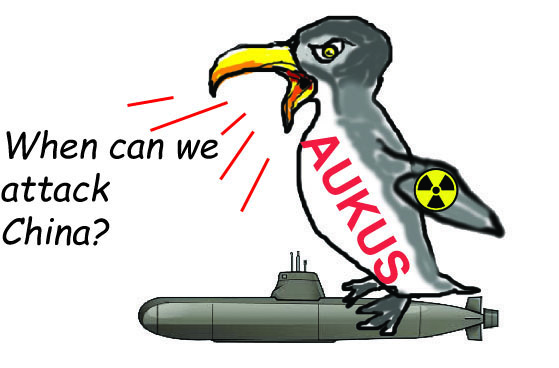

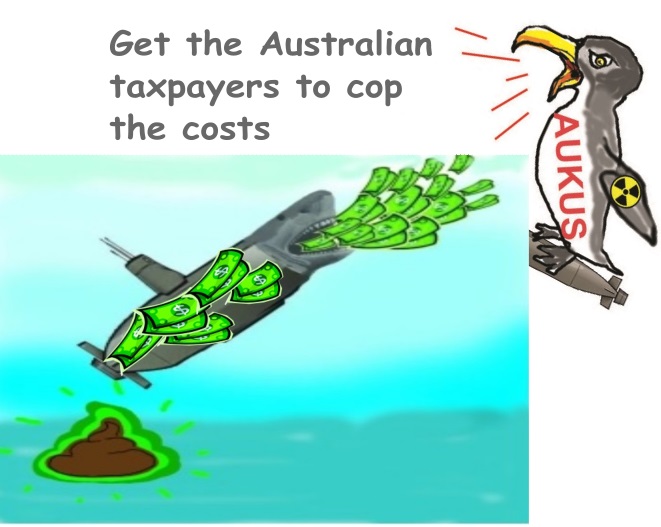

Ben Doherty.4 Oct 26, https://www.theguardian.com/australia-news/2026/oct/04/hegseth-apex-predator-nuclear-submarines-right-for-australia-aukus-ntwnfb
Some experts argue Virginia-class submarines government is buying second hand are good for fighting American wars, but not for defending Australia
On stage for his “arsenal of freedom tour”, the US secretary of defense – who prefers the appellation “secretary of war” – was ebullient.
“This Virginia-class submarine is a paragon of American engineering and fighting spirit,” Pete Hegseth roared, standing at Newport News shipyards where those boats are being built.
“It is the apex predator of the undersea domain, the most advanced and lethal submarine ever built.”
There are few who would argue with the Virginia’s lethality. Australia is set to buy three of these boats, secondhand, from the US navy, beginning in 2032.
But is it the right submarine for Australia?
Hegesth’s words, for all of their rhetorical bellicosity, were revealing: “American … fighting spirit”; “apex predator”; “ensuring America is free and safe and powerful”.
Virginia-class submarines – nuclear-powered and conventionally armed – are very good at travelling undetected fast and staying underwater for a very long time (limited, essentially, only by the capacity of the crew to stay submerged).
They are an attack submarine, an outstanding offensive platform for hunting and destroying a far-distant adversary, able to traverse thousands of miles of deep ocean undetected.
But Australia’s National Defence Strategy, released this year, says the nation’s “strategy of denial” – which aims to deter conflict before it begins – was “focused on safeguarding Australia’s interests in our primary area of military interest”. This includes the immediate region encompassing the north-east Indian Ocean through maritime south-east Asia into the Pacific as well as Australia, its populated offshore territories and its northern approaches.
A growing chorus of naval experts is arguing that the Virginia-class submarines are the wrong boats for this country.
The waters to the north of the Australian continent – from where any potential threat is overwhelmingly likely to approach – are shallow, best suited to a submarine far smaller than Virginia’s nearly 8,000 tonnes of displacement, some say.
A smaller, more nimble submarine, quieter when operating under battery, is a better platform for that role, they say. In addition, smaller submarines are cheaper and easier to crew: Australia could afford more of them, increasing the potency of its force.
The argument runs thus: the Virginias, and the even larger Aukus-class submarines set to follow, are nuclear-powered submarines perfectly suited to fighting a distant war on behalf of the US. But they are the wrong boats to defend Australia.
Defence or ‘projecting power’?
Dr Andrew Gaczol spent a decade as an international political analyst and policy officer at the Australian Department of Defence. He told an independent inquiry into Aukus coordinated by the Australian Peace and Security Forum that the Australian public had been provided only two arguments in support of the Aukus deal, “and neither stand up to serious scrutiny”.
The primary argument put forward is that of defence of Australia.
Gaczol told the inquiry it was unnecessary to have submarines with unlimited range to defend the nation’s waters or conduct defensive operations in the region.
“The latest state-of-the-art Air Independent Propulsion (AIP) conventional diesel-electric submarines are more suitable as they are smaller, quieter when submerged and better suited to the relatively shallow waters of the Australian continental shelf and the waters to Australia’s north,” he said.
The second argument propounded for Aukus is the need for Australia – as a nation reliant on trade – to maintain open sea lanes around it.
Given the small number of attack submarines the Aukus deal will ultimately provide, critics argue they will not be able to protect Australia’s seaborne approaches.
Navies around the world operate on “the rule of threes”, which states that for every three of a complex platform you possess, only one can be relied upon to be operational at any given time. Essentially, of three submarines, one is on active deployment, one is training or conducting exercises, and one is in maintenance, dry dock or recovering from operations.
Australia plans to buy three Virginia-class submarines from the US, to be supplemented – when they are designed and built – by up to five submarines of the Aukus class. By the end of the 2040s, eight submarines would give Australia, at any time, a fleet of two, perhaps three submarines on active deployment.
“I can’t see how such a small number of vessels will be able to keep open all of Australia’s trade routes all of the time,” Gaczol told the inquiry.
“As a counterpoint, I note that the US navy has over 60 nuclear submarines and are currently unable to force open the strait of Hormuz.”
Gaczol says he supports Australia having submarines, but that the Virginia and Aukus-class boats were not ideal for Australia’s defence. The benefit of Australia’s geography – a vast landmass protected by thousands of kilometres of ocean – mean “the chances of Australia being actually sort of invaded are virtually nil”.
The oceans to Australia’s north are also relatively shallow – under 200 metres deep across parts of the Indonesian archipelago and South China Sea – meaning large nuclear submarines “are more easily detected” than smaller and quieter conventional boats.
As deep-water boats that can travel anywhere around the globe at high speed, nuclear submarines are unnecessary for defending Australia, Gaczol says, and are instead about “projecting power into another part of the world”.
“To put it colloquially, that’s not protecting our patch. That’s going into someone else’s patch and poking them in the eye,” he says.
Gaczol believes the acquisition of Virginia-class submarines suits US imperatives, not Australia’s.
“The only scenario I can really see these boats being applicable for is to chase Chinese submarines in the South China Sea should it come to a conflict there. Effectively, our force will be an adjunct of the US Navy.”
‘Best deal on offer’
Former South Australian senator Rex Patrick, an ex-submariner and resolute Aukus critic, is familiar with the aphorism “quantity is a quality of its own”.
He says while there was undoubted advantage to buying large attack submarines – greater payloads, more torpedoes, more capability to transport special forces soldiers – “there’s always a trade-off”.
“If the cost of buying one large nuclear submarine is that you could buy four other submarines for the same price, that’s a trade-off you have to consider.”
Aukus is forecast to cost up to $368bn by the 2050s – $33m a day for 30 years on a conservative estimate. Few, if any, major defence projects of this complexity run on time, or on budget.
And Aukus is dependent not only on Australia’s efforts to build a nuclear-powered submarine fleet from scratch: it is reliant on the US – beset by tenaciously laggard boat-building – to construct enough Virginia-class boats to spare three for Australia; and it needs the UK’s sole submarine-building yard to design and build the first of the new Aukus-class boats on which Australia’s domestically built boat will be constructed.
For far less than the slated cost of the Aukus deal, Australia could buy 20 conventionally powered air independent propulsion submarines, Patrick says.
“If you had 20 submarines, you’d have seven boats in the water, in seven different locations, and seven times the magnitude of problem for the other commander,” he says.
Patrick notes Canada, with the longest coastline in the world and facing many of the same geopolitical challenges as Australia, recently announced it would buy 12 air independent propulsion submarines from German shipbuilder TKMS for a reported $33bn.
The Australian government, though, insists Aukus is “the best deal on offer”.
In June, the defence minister, Richard Marles, told the Shangri-La dialogue Australia had made the deliberate choice to increase the weight of its naval spending: more than 40% of Australia’s defence budget is now directed towards the country’s maritime domain.
“For a three-ocean nation, this is a strategic necessity,” Marles said. “Ninety-eight percent of Australia’s traded goods passes through Australian ports. Ninety percent of our fuel is imported. Our economic sovereignty, in the most basic sense, is a maritime proposition.”
And Marles argued an increasingly militarised region demanded a collective response.
“The free and open passage of goods, energy and data across the seas is not just Australia’s economic lifeblood – it is the economic lifeblood of this entire region.”
In a Lowy essay, former special envoy for defence Luke Gosling wrote that nuclear submarines will give the Australian defence force “a regionally superior capability that will help it to deter war and, if it must fight a war, to win”.
“Threatening to aggressors, lethal if provoked, but not overtly provocative, nuclear submarines are the ‘goldilocks’ long-distance capability.”
Amid a rising drumbeat of concern over Aukus, Labor senator Raff Ciccone rose in the Senate in June to argue Australia’s strategic environment had changed dramatically and the country “must respond to the world as it is”.
“Nuclear-powered submarines are the only platforms that can provide Australia with the ability to deter threats to our maritime supply chains, on which our way of life depend,” he said.
“They alone have the speed, the endurance and the stealth necessary to effectively provide this deterrence. They are the bolt cutters that will ensure that we are never wrapped in chains.”
The Final Frontier Goes to War: The Militarisation of Space

Aleena Im , September 30, 2026, https://journal-neo.su/2026/09/30/the-final-frontier-goes-to-war-the-militarisation-of-space/
Space is becoming an increasingly contested domain as major powers expand military capabilities, satellite infrastructure, and counterspace systems, while the U.S. Golden Dome initiative reshapes strategic stability and raises new questions about the future of space governance.
On 14th September 2026, US Secretary of the Air Force Troy Meink confirmed that the US has “on-orbit” weapons capable of safeguarding the US against hostile actions. It is most likely a part of the implementation of the 2025 US National Security Strategy (NSS), which says,
“the United States must at the same time invest in research to preserve and advance our advantage in cutting-edge military and dual-use technology, with emphasis on the domains where U.S. advantages are strongest. These include undersea, space, and nuclear, as well as others that will decide the future of military power, such as AI, quantum computing, and autonomous systems, plus the energy necessary to fuel these domains.”
In December 2025, the White House issued an executive order on “Ensuring American Space Superiority” to ensure U.S. space superiority, security, lunar development, and the ability to detect, characterise and counter threats to U.S. space interests – especially threats from Very Low Earth Orbit (VLEO).
In recent years, outer space has undergone a remarkable transformation from being a domain of scientific discoveries to an arena of geopolitical competition. According to NATO, space is important for both the military and civilians. In 2019, NATO officially recognised space as an operational domain and adopted an Overarching Space Policy. NATO has taken various initiatives under this policy, such as the NATO Space Operations Centre (NSpOC), NATO Commercial Space Strategy, and SPACENET.
NATO has declared that space is critical to deterrence and defence. Major powers are very keen on the development of space technologies in defence and deterrence. The US established the United States Space Force in 2019 to protect the US and its allies’ interests in space and ensure their freedom to conduct operations there. However, when Russia in 2021 tested an anti-satellite (ASAT) missile, which destroyed its old Cosmos 1408 satellite, the US and allies criticised this test by saying it was ‘reckless’, as the debris could remain in space for years. This is extremely hypocritical of the US considering their own activities and aims for space – but shows how in the near future, strategic competition will not be bound only to the Earth, but it will extend to space, and space will also be exploited.
Golden Dome: Missile Defence or a New Strategic Equation

Golden Dome is a multi-layered defence shield project for safeguarding America from aerial threats. According to the National Defence Magazine, the project will be completed by the mid-2028. It includes space-based interceptors designed to detect and destroy missiles during flight. As per the CSIS report, space-based interceptors would effectively constitute a form of space-control weapon. If interceptors are placed in orbit, space itself becomes part of the missile-defence battlefield, potentially changing the balance between offensive missiles and defensive systems. China and Russia have therefore argued that the system could affect strategic stability, while the United States presents it primarily as a means of protecting the homeland from increasingly advanced missile threats.
Importance of Space in the Military
“Space has become the ultimate high ground for warfare” — (Elon Musk)
Military satellites are often known as “silent sentinels” used for defence and security purposes. Below are the types of military satellites with their specifications:
GPS & Navigation
Navigation satellites provide positioning, navigation, and timing (PNT) signals for precise targeting. In this regard, the US has the Navstar GPS constellation operated by USSF, Russia have GLONASS, China have Beidou, and the EU have Galileo. The powerful Joint Direct Attack Munitions (JDAM) are GPS-aided precision-guided weapons that use satellite-provided positioning data for accurate hits.
Communication Satellites
Communication satellites prove beneficial for command and control, especially in remote areas. They support unmanned drones, which depend on satellite links for remote operation. The US have Advanced Extremely High Frequency (AEHF) and Wideband Global SATCOM (WGS) systems, which provide encrypted links that connect commanders with other troops.
Reconnaissance Satellites
Reconnaissance satellites are also known as spy satellites because they can gather high-resolution images of the battlefield. For example, SAR can see through clouds and even in darkness using infrared sensing. The US has the KH-11 series, and China has the Yaogan constellation, which has a Synthetic Aperture Radar (SAR) sensor.
Signals Intelligence Satellites
SIGINT and ELINT satellites intercept electronic emissions, which include radar signals and military communications across vast areas. Orion and Trumpet series are allegedly US SIGINT and ELINT satellites, respectively, while Russia have Liana systems, which are SIGINT satellites but can carry functions similar to an ELINT satellite.
To date, the US have not elaborated on the weapon types, their capabilities, and when they were put into orbit.
Key Players in Space Militarisation
United States
The US has been the architect of space infrastructure. In 2019, the US created USSF, which formalised space as a military domain. The US have several military satellites which help in defence and deterrence. It’s spending on counterspace defence and attack capabilities is to deter competitors as well as maintain freedom of action in space.
China
China has the Beidou navigation system, through which China has conducted satellite tests and developed ASAT systems. China is developing both soft and hard kill technologies to counter the US on each level. For this, it has developed TPG1000C, a 5-ton high-power microwave system which is capable of disrupting satellite electronics.
Russia
Russia in 2019 tested an ASAT, officially declaring its interests in outer space. Russia is not focusing as much on its space capabilities as the US and China, but the country is working towards cost-efficient counterspace capabilities instead of massive satellite constellations.
India, UAE, and Israel
India, the UAE, and Israel are also enhancing their outer space capabilities. India has conducted an anti-satellite test known as Mission Shakti, and the UAE’s Mars mission, despite being a civilian scientific program, opened up the possibilities for much more.
Future Trajectories
Space is evolving into a multipolar strategic arena. There are some frameworks like the Outer Space Treaty which emphasise peaceful use of space, but still, major powers’ competition is pushing space towards militarisation. The growing influence of private companies such as SpaceX and Blue Origin is also a defining feature of space militarisation. International law lacks clear rules regarding space warfare. Rather than a hub of scientific discoveries, in the near future, space could become increasingly contested and militarised. Now, states are shifting from protecting satellites to installing large constellations for deterrence.
To reduce the risk of miscalculations and space exploitation, the US and China are working on Constructive Strategic Stability, which allows both states to compete within a framework which will define limits of escalation. The Xi-Trump meeting on September 24, 2026 produced several areas of agreement, including continued economic dialogue and new mechanisms for cooperation on artificial intelligence and crisis communication. However, space security was not among the publicly announced outcomes, leaving it as an area where further strategic dialogue may be needed as competition in orbit intensifies.
Conclusion
Space is the next critical frontier which will shape world order and global security. Space is no longer reserved for space exploration; now, major powers are competing in outer space. Cooperative measures such as confidence-building measures (CBMs) and debris mitigation agreements can reduce the risk of escalation and space exploitation, but uncertainty and mistrust among major powers persist.
Aleena Im is an independent researcher and writer and is interested in international relations and current affairs
Trident’s £3m jobs are a costly defence of Britain’s fading status.

3rd October, By Samuel Rafanell-Williams, Scottish CND
ALICE laughed. “There’s no use trying,” she said. “One can’t believe impossible things.” “I daresay you haven’t had much practice,” said the Prime Minister. “When I was your age, I always did it for half-an-hour a day. Why, sometimes I’ve believed as many as six impossible things before breakfast.”
In order to complete our new Dreadnought submarine programme, 65,000 jobs will be required by 2030. This number has been quoted by the Prime Minister in Parliament, so it must be
true. The current cost of the Dreadnought programme is newly estimated at £240 billion by UK CND.
Scottish CND’s estimate in our Reclaim Our Clyde
campaign two years ago was £200bn. So if we divide our more conservative
£200bn by 65,000 jobs, we get just over £3,000,000 per job. Let me spell
out that astonishing sum again: £3 million per job.
CND has some good ideas
on what we might use that money for, such as: 220,000 extra nurses; 3.7m
affordable homes; Tuition fees for 8m students; Install solar panels on
every home. My pick would be ending world hunger. How many enemies would we
have then?
There is little doubt that the world is becoming more dangerous.
A well-used anecdote over the past century is that “generals are always
fighting the last war”. While this may be true of Donald Trump’s illegal
assault on Iran, the Ukraine war is surely quite the opposite.
Ukraine is
changing warfare techniques every few weeks. They are fighting the next
war. The drone technologies they invent are cutting edge for a couple of
months, then become obsolete. The state-of-the art Chieftain Mk 3 tanks we
sent them are unused and irrelevant. Russia’s expensive nuclear bombers
were seriously exposed in the “Operation Spiderweb” drone attack by
Ukraine in June 2025. Who is to say the UK’s own nuclear facilities are not
equally vulnerable? Russia, America and China are major powers. We are not.
The only one of six Astute-class nuclear submarines that is currently
seaworthy is the one launched last month on its sea trials. The rest,
almost new, are docked and awaiting repairs. The former prime minister Tony
Blair notes in his memoirs that deciding to renew the Anglo-American
Trident submarine fleet at Faslane had nothing to do with defence, but was
to consolidate our position as a major power.
This was evidenced this week
by Chancellor John Healey (formerly head of the Ministry of Defence)
announcing that £6bn would be spent on building three floating docks at
Faslane, in order to accommodate more nuclear submarines. This is only part
of the £15bn set aside for further developments at Faslane as part of
Project Royal Oak.
For context, £6bn is five times what the Scottish
Government spends annually on housing. To put it another way, a chronic
housing crisis in Scotland and beyond, among other social harms that could
be remedied with the more than £200bn spent on Trident renewal, is simply a
price the British government is willing to pay to sustain its ability to
destroy the northern hemisphere.
The National 3rd Oct 2026,
https://www.thenational.scot/politics/26604113.tridents-3m-jobs-costly-defence-britains-fading-status/
The first 200 Submissions to the AUKUS Public Inquiry
5 October 2026, https://theaimn.net/the-first-200-submissions-to-the-aukus-public-inquiry/
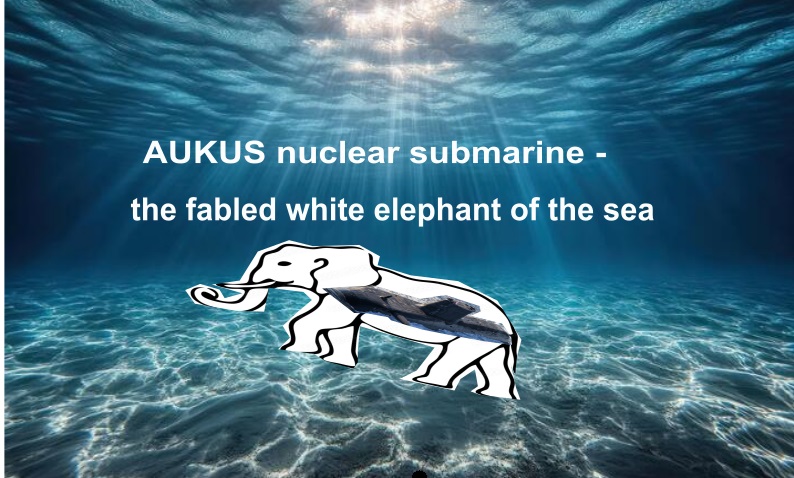
With a hasty executive action by the Scott Morrison’s government, Australia signed up to buy $368 billions’ worth of second-hand nuclear submarines, and created a special military alliance with USA and UK -“AUKUS”. The then Opposition Party, Labor, led by Anthony Albanese, quickly fell into line. Now the Albanese Labor Government has stuck with this arrangement, and is keenly pursuing it.
Civil society groups, led by The Australian Peace and Security Forum, and funded by voluntary contributions – crowd funding – set up the AUKUS Public Inquiry, with hearings across Australia, to examine the costs of AUKUS, and other factors – transparency, safety and environment, and strategic impact. The Inquiry will release its report in early November 2026. They also called for submissions from the public, and have now received 1020 submissions, all published on their website, if you scroll right down.
Well, I am carefully reading each submission. I’ve now read from Submission 1 to Submission 200 and will now attempt to summarise the general themes of these. Though this is barely one fifth of the 1020 submissions received, I still think it’s an indication of how it’s all going, and I will continue going through the whole lot.
First of all, a pleasant surprise – the submissions were highly individual. As a seasoned submission reader, I was expecting to see a number of identical submissions, all derived from one sample plan. Not so. Although many people did have similar ideas, they were expressed individually, and often sounded personal, and some even passionate.
Secondly, they were in the main remarkably sceptical, and mostly opposed to the whole AUKUS project. Out of 200 submissions, only 6 were in favour of AUKUS. This is extraordinary, but is probably explained by the fact that this Inquiry was instigated by civil society groups, not by government or business organisations. Therefore, I think that the government and nuclear-industry – connected groups, and corporate media thought it best to ignore the Inquiry, and hope and trust that it would just disappear.
Those first 200 opinions on the AUKUS project came in two broad areas – those who focussed on the actual nuclear submarines – were they a good idea? and those who looked at the broader meaning of the AUKUS alliance between Australia, the USA and the UK. Of course, most submissions mentioned some of both aspects, as well.
In focussing on the nuclear submarines, writers considered their costs, their suitability for Australia’s defence, the lack of public and parliamentary scrutiny, the speed and secrecy of decision-making, safety, strategic implications, and management of toxic wastes.
The writers who paid attention more broadly, to the whole AUKUS alliance, considered the broader financial costs, issues of Australia’s sovereignty, democracy and the processes involved, secrecy, need for transparency, regional security and strategy, militarism, accountability, the involvement of the nuclear industry, and indigenous attitudes.
Those few who did support AUKUS (Submissions number 57, 169, 176 and 188,) stated the pro nuclear case, but did not seem to come from nuclear industry experts. They might have been from the industry, but there was none of the high-powered technical detail that I have come to expect from the nuclear lobby. This leads me to think that these were genuine personal opinions, and that the nuclear lobby has indeed boycotted this inquiry.
There were also a very few pro nuclear views, such as number 59 – POLICY WATCHDOG AUSTRALIA which offered some criticisms and recommendations. And a few who wanted a more formal, government-run investigation.
So, returning to the bulk of these submissions, most of them very thoughtful and well-argued, I’m just going to set out briefly the main concerns.
Far and away the main consideration was the cost – the financial price for the submarines, for supporting the U.S.A’s ship-building, and all the infrastructure needed in Australia
The second most important consideration was the nuclear submarines themselves, and strong arguments were put that these will not be fit for purpose, will be obsolete, and other craft would be more appropriate for Australia’s defence.
Really, almost equally important was the issue of Australia’s sovereignty. Many argued against too close an alignment with the USA.
Then came issues of the processes involved in Government decisions on AUKUS, reflections that it was undemocratic, lacking Parliamentary oversight, lacking transparency, lacking accountability. There were also strong concerns about militarism, about China not being our enemy, about better plans for regional security.
Of course, there are over 800 submissions more to go through. As I persist, I am publishing some of the most interesting ones on antinuclear.net. And looking forward to the final report of the AUKUS Public Inquiry. I don’t think that the corporate media will be so easily able to ignore that.
Ukraine’s former defense minister launches ‘Manhattan Project’ for killer robots

By Katie Livingstone, Sep 30, 2026, https://www.defensenews.com/unmanned/2026/09/30/ukraines-former-defense-minister-launches-manhattan-project-for-killer-robots/?utm_source=defensenews.beehiiv.com&utm_medium=newsletter&utm_campaign=market-intel-us-navy-awards-rtx-s-raytheon-24-4b-for-sm-6-missiles-amid-stockpile-concerns
LVIV, Ukraine — Ukraine needs a “new Manhattan Project,” former Defense Minister Mykhailo Fedorov told a standing-room-only crowd of self-proclaimed tech nerds on Saturday at IT Arena here, the country’s biggest annual technology conference.
Then he played an AI-generated clip of what he meant: a robopunk mix of humanoid and crab-like ground robots skittering across a barren front line, doing work that is still too complicated for the robots Ukraine fields today.
The video laid out Fedorov’s vision for an Army of Robots, a force of two-legged upright and other ground robots that would take over many of the front line’s most dangerous but necessary jobs from soldiers.
“Our idea is to combine engineers, startups and capital into one ecosystem so we can launch humanoid-like robots on the battlefield,” Fedorov told Defense News in an exclusive interview after his presentation.
“We want to eventually substitute our infantry with these robots.”
To get there, Fedorov is calling on specialists in robotics, AI, sensors and autonomous systems to pool their talent in the kind of concentrated wartime push that built the first atomic bomb, and to focus it on the machines he says will one day replace Ukraine’s infantry.
The 35-year-old aims for the group to have its first confirmed battlefield result from a humanoid-like robot within six months and, within a year, an assault in which robots take on the most dangerous parts of a mission with no infantry alongside them.
To hit the six-month mark, there isn’t time to spend on research and development, he said, so he will begin by investing in companies with weapons that have already been tested and shown some market viability.
Fedorov wants Ukraine to seize the initiative in the war’s next technological cycle before Russia – whose far larger army and industrial base let it scale new weapons quickly – gets there first.
“Russia always thinks about new strategies, how to hack our frontlines,” he said. “We need to be the first side to hack our frontlines.”
Robots are only one of the defense tech areas that the former minister plans to develop within the new project.
“It could be robots, it could be autonomous systems,” he said. “We will have three key directions: sensors and robots, cheaper anti-jet-Shahed missiles, and AI strike drones and missiles.”
Under Fedorov’s plan, members of the Army of Robots will identify a battlefield problem, find a technical solution and a team, provide resources for development, test the product with troops in real conditions and scale what works.
It is the same model he used for the Army of Drones, which he started in 2022 as Ukraine’s digital transformation minister and which opened the market to Ukrainian drone makers, launched government procurement and operator training and helped form the first strike drone units.
“The Army of Drones … changed everything in our country and in the world and, I think, in the future of the world,” he said. “Now we are trying to build the same ecosystem for robots.”
Ukrainian troops already lean heavily on ground robots for assaults and basic tasks, carrying out more than 25,000 logistics and evacuation missions in August – 3.3 times more than in January, according to the Defense Ministry.
But most of the futuristic robot designs featured in Fedorov’s video, humanoids included, are not yet used in combat in Ukraine today, and the ground robots that are in use almost always have a human operator at the controls, usually over Starlink.
Fedorov said the ambitious effort will involve multiple companies working on different stages of the product lifecycle, with some making components, some assembling complete robots and others developing software to run them.
“We have some funds for these first companies,” Fedorov said, declining to name names. “It means that we have two or three companies that will be our partners in these directions.”
The Army of Robots will include a venture fund to invest in technology teams, its own defense-tech companies and a research and development arm, according to a press statement issued after the announcement.
The initiative comes weeks after Fedorov announced that he was starting a new defense company, with Palantir CEO Alex Karp as its first investor.
Fedorov told Defense News the company will start with a corporate fund and may later launch its own venture fund.
The biggest challenge facing the development and deployment of these next-gen robots is the necessary speed of innovation, Fedorov said.
Ukraine has to field these robots fast enough to save its infantry and stay ahead of Russia, which he said has learned to copy Ukraine’s battlefield innovations and scale them rapidly.
Ukraine, meanwhile, is heading into another winter of Russian strikes with air-defense interceptors in short supply.
The weekend Fedorov made his announcement, Russian drones hit kindergartens and university buildings in Kyiv, struck a large civilian hospital and destroyed a food market and multiple gas stations outside the city, killing at least three people and injuring dozens in a combined aerial attack that lasted days.
“We don’t have enough time,” he said. “We need to achieve these results as soon as possible.”
All US bombers leave UK air base on concerns of suspected terror plots.
by Azhar Sukri, msn, 3 Oct 26
- The U.S. withdrew all of its B-1 bombers stationed at a UK air base that is used by American military forces to strike Iran after an investigation discovered a planned terror attack.
- At least two vessels were struck over the weekend in waters near Oman and Iran, the United Kingdom Maritime Trade Operations Centre reported……. https://www.msn.com/en-us/news/other/all-us-bombers-leave-uk-air-base-on-concerns-of-suspected-terror-plots-more-tankers-struck-near-iran-in-the-middle-east/ar-AA2dxKHO?ocid=winp2fp&cvid=30ffaa23962d4c0b91b3c9f431abde46&ei=6
‘Cut ties with Palantir’, say UK’s health workers

Protesters at more than 40 locations across England demanded an end to spy-tech firm Palantir’s role in the National Health Service.
Ana Vračar, October 2 2026, https://breakthroughnews.org/2026/10/02/cut-ties-with-palantir-say-uks-health-workers/
On Thursday, October 1, health workers, patients, and activists protested Palantir’s role in the National Health Service (NHS) at more than 40 locations across England. Their demonstrations were part of a global week of action demanding that governments cut ties with the spy-tech firm over human rights and privacy concerns.
Rallies took place in front of Palantir’s London headquarters, as well as in Liverpool, Manchester, Newcastle, Sheffield and many more cities.
“Palantir’s tools are used by the Israeli military in Gaza and by ICE to track and surveil migrants in the US,” campaign groups – including Just Treatment, Health Workers for a Free Palestine, Medact, and Global Justice Now – stated. “A company profiting from human rights violations has no place in the NHS or in any of our public services.”
Palantir’s track record opposes core health values
Palantir currently holds a £330 million (approximately USD 436 million) NHS contract and has rolled out the service’s Federated Data Platform (FDP), managing sensitive patient data. The project has drawn criticism from virtually every group involved in the NHS: data workers say it lags behind local systems; patients share privacy and data ownership fears; and health workers insist Palantir’s record opposes the very values their profession embodies.
“I cannot stay true to that [Hippocratic] oath and tolerate Palantir continuing to profit from, and grow its malign business model through an NHS contract,” said physician Rhiannon Osborne from Medact at Thursday’s rally. “Every pound we give them helps to legitimize and sustain human rights abuses and erosion of democratic rule of law across the world.”
A central concern is the company’s support for Israel throughout the genocide in Gaza. “When we strive to save every possible life, they champion their ability to kill and celebrate their role in the repeated war crimes committed by Israel – including unprecedented deliberate attacks on the doctors, nurses, and paramedics I worked with,” pediatric neurologist Omar Abdel-Mannan stated. “No moral government should tolerate their involvement in our NHS or indeed any of our public services.”
Campaigners repeated calls for Prime Minister Andy Burnham to end the contract as soon as possible. Under an exit clause in the original agreement, that moment could arrive as early as February 2027. Campaigners and several commissions are pressing the government to notify Palantir of its intention to withdraw ahead of this date.
“The government only has two months to say no to Palantir and the momentum is all with us,” Good Law Project activists said at the rally in London. “All the energy is to say no to Palantir, say no to their global human rights abuses, say no to their crap technology that doesn’t work and get Palantir out of the NHS.”
Unions back appeal to bar Palantir from public sector contracts
Calls to break Palantir’s grip on public services resonate beyond Britain. On September 28, more than 120 groups and unions called upon European governments and the European Commission to “scrap all existing public sector contracts with the US tech company Palantir.” As reported by the European Federation of Public Service Unions (EPSU), the appeal seeks to end current agreements and bar the firm from future public contracts. It also urges governments to develop “alternative data solutions compatible with public service,” echoing NHS data workers’ recommendations.
“Palantir’s ramping up of ‘war-related’ support for Israel during the genocide in Gaza and the apparent disdain of its leadership for democracy are just two clear signs that this company serves the interests of the rich and powerful, not the general public,” said Tim Bierley of Global Justice Now. “Yet it has been allowed to embed dubious technologies across our public services, giving it access to sensitive data and creating worrying new technical dependencies.”
“The UK must work with other countries to end dependence on companies involved in human rights abuses, and end the outsourcing of the public sphere to a dangerous class of big tech oligarchs.”
Why the Iran War Equation Is Changing, and Why a Third War May Be Closer Than It Seems
October 1, 2026, Mohammad Amin Ahmadi, https://www.juancole.com/2026/10/equation-changing-closer.html
Tehran (Special to Informed Comment; Feature) – It appears that the main actors involved in the previous 40-day war are increasingly moving toward another confrontation for their own reasons. The regional equation has changed significantly in recent weeks, and that change is making the continuation of the current ceasefire less attractive. Iran is under growing economic pressure because it cannot export its oil normally. The Houthis have moved closer to controlling the approaches to Bab el-Mandeb. Israel is approaching an important election. And the United States is facing a decision over whether to continue the current stalemate or return to major military operations.
The argument here is simple: when the equation changes, the policies that made sense under the previous equation may stop making sense. The longer the new conditions continue, the stronger the incentives for the main actors to change them.
Iran Has an Incentive to Break the Siege
Iran’s most immediate problem is economic. The US-led naval blockade and the disruption around the Strait of Hormuz have sharply reduced Iran’s ability to sell and export oil. in September Iran was facing one of the most severe economic crises in its history, with the blockade and sanctions causing shortages of foreign currency, declining imports and rising prices. Trump has also said that the blockade has prevented Iranian oil exports.
For Iran, the calculation is straightforward. If Iran cannot sell its oil, it cannot maintain normal economic activity. If the blockade continues, the economic cost will continue to rise. Therefore, Tehran has an increasing reason to change the situation rather than simply continue under the same conditions.
A political agreement could restore oil exports and reduce the pressure. But if negotiations fail, Iran could also consider military action to break the blockade and reopen its export routes. That does not mean Iran has decided to start another war. It means that the economic situation is creating a direct incentive to take stronger action. If military force becomes the chosen way to break the siege, the result could be a new phase of war.
Bab el-Mandeb Is Creating a Second Front
The biggest change in the regional equation, however, may be taking place in Yemen. The Houthis have recently expanded along Yemen’s Red Sea coast. They captured Mocha and then moved toward the islands around Bab el-Mandeb. On September 11, Houthi forces reached Perim, or Mayun, Island in the strait, after government forces withdrew. Other reports said the group had also reached the Hanish islands. These positions are important because Bab el-Mandeb is a major shipping route connecting the Red Sea with the Gulf of Aden.
This matters because Iran already has leverage over the Strait of Hormuz. If the Houthis consolidate their positions around Bab el-Mandeb, an Iran-aligned force could also threaten the second major maritime route linking Middle Eastern energy producers to global markets.
That would change the strategic calculation for every major actor in the region. Saudi Arabia is particularly exposed. Its East-West pipeline normally allows it to move oil from the eastern fields to Yanbu on the Red Sea, bypassing Hormuz. But on September 13 drone attacks had shut the pipeline, which can carry around four million barrels per day. Saudi oil production had also fallen sharply, while available stocks at Yanbu were limited.
Saudi Arabia is therefore losing some of its ability to bypass the crisis. If Hormuz remains heavily disrupted while Bab el-Mandeb becomes another pressure point, the ability of Gulf producers to move oil to international markets becomes much more vulnerable. For the Houthis, this creates an opportunity to increase their leverage. For Iran, it creates a potentially valuable second pressure point. For Saudi Arabia, Israel and the United States, it creates a reason to prevent the new situation from becoming permanent.
Brent crude has already moved above $100 a barrel, while oil flows through Hormuz remain below normal levels. If both Hormuz and Bab el-Mandeb were simultaneously subjected to serious military pressure, the effect on oil markets would be much larger than the disruption of either route alone.
Israel and the United States Also Have Reasons to Act
The third change is political. Israel’s national election is scheduled for October 27. Recent polling shows a highly competitive race, with no clear path for either major bloc to form a government. Reuters reported that the opposition bloc was ahead in polling averages, although the final political balance remains uncertain.
The election does not mean that Israel will choose war, but it creates a deadline. If the Israeli government believes that the regional balance is changing against it, waiting may become less attractive. A government facing an election has a reason to consider whether it should change the strategic situation before the political environment changes.
The United States faces a similar problem, although for different reasons.
President Donald Trump said on September 17 that he was approaching a “big decision” over whether to resume major attacks on Iran. Trump has also said that he hopes the war is nearing its end, but his latest comments show that a return to major military operations remains under consideration. Washington therefore has two reasons to reconsider the current situation: continuing the war is costly, while waiting gives Iran and the Houthis more time to strengthen their positions.
This is the central point of the changing war equation. Iran has a growing reason to break the economic blockade. The Houthis have a reason to consolidate their gains around Bab el-Mandeb. Saudi Arabia has a reason to restore secure oil-export routes. Israel has a political deadline and a reason to prevent further deterioration of its strategic position. And the United States has to decide whether the current stalemate is preferable to another military operation.
The actors are not simply waiting for the previous war to end. They are responding to a new set of conditions, and those conditions are giving them new reasons to change the status quo. The danger is not that another war could begin without anyone having a reason to fight. The opposite is true. Several actors now have their own reasons to change the current situation, and some of those reasons directly conflict with the interests of the others. As the equation continues to change, maintaining the status quo becomes harder. That is what makes a third war more plausible than it appeared only a few weeks ago.
Hinkley Point C fish tunnel breakthrough: hydraulic and marine design notes for engineers
October 2, 2026|, Reviewed by Tom Sullivan, https://www.geomechanics.io/news/article/hinkley-point-c-fish-tunnel-breakthrough-hydraulic-and-marine-design-notes-for-engineers
30 Second Briefing
Completion of the 620m fish return tunnel at Hinkley Point C marks seabed breakthrough for the final section of 8km of marine tunnels under the Bristol Channel. The tunnel boring machine, launched from dry land and recovered offshore by floating crane after a five‑month drive, will be cleaned and redeployed on another site. The tunnel will work with an acoustic fish deterrent and four low‑speed seawater intakes designed so fish can escape even when within about 2m of the intake heads.
Technical Brief
- Seabed breakthrough of the fish return tunnel completes a total of 8 km of marine tunnels.
- TBM is being demobilised for cleaning and reuse, indicating design for multi-project tunnelling campaigns.
Our Take
The 620 m fish return tunnel at Hinkley Point C adds to an already extensive 8 km marine tunnel network, signalling that UK nuclear coastal intakes are now being engineered with much more complex subsea layouts than earlier generations of plants.
With Hinkley Point C already under scrutiny on environmental disclosure, as flagged in the 8 September 2026 tribunal-appeal piece, the performance of this fish protection system in the Bristol Channel is likely to become a test case for future UK marine intake permitting on large infrastructure schemes.
Sizewell C’s plan to reuse the former Hinkley Point C tunnel segment facility at Avonmouth suggests that design and construction lessons from Hinkley’s marine and fish tunnels will be directly recycled into the next UK nuclear project, shortening learning curves for similar sustainability-driven features.
-
Archives
- October 2026 (104)
- September 2026 (339)
- August 2026 (330)
- July 2026 (355)
- June 2026 (287)
- May 2026 (306)
- April 2026 (356)
- March 2026 (251)
- February 2026 (267)
- January 2026 (308)
- December 2025 (358)
- November 2025 (359)
-
Categories
- 1
- 1 NUCLEAR ISSUES
- business and costs
- climate change
- culture and arts
- ENERGY
- environment
- health
- history
- indigenous issues
- Legal
- marketing of nuclear
- media
- opposition to nuclear
- PERSONAL STORIES
- politics
- politics international
- Religion and ethics
- safety
- secrets,lies and civil liberties
- spinbuster
- technology
- Uranium
- wastes
- weapons and war
- Women
- 2 WORLD
- ACTION
- AFRICA
- Atrocities
- AUSTRALIA
- Christina's notes
- Christina's themes
- culture and arts
- Events
- Fuk 2022
- Fuk 2023
- Fukushima 2017
- Fukushima 2018
- fukushima 2019
- Fukushima 2020
- Fukushima 2021
- general
- global warming
- Humour (God we need it)
- Nuclear
- RARE EARTHS
- Reference
- resources – print
- Resources -audiovicual
- Weekly Newsletter
- World
- World Nuclear
- YouTube
-
RSS
Entries RSS
Comments RSS

