UP FOR GRABS: Button pushed for new SMR spending round
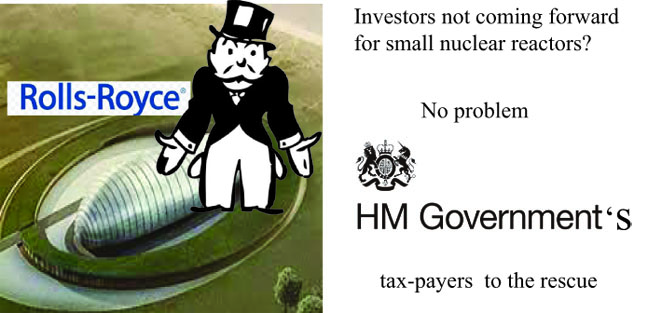
energy economists point out that fixed costs (such as 24/7 security, exclusion zones and
energy economists point out that fixed costs (such as 24/7 security, exclusion zones and regulatory licensing) do not diminish proportionally with a smaller reactor…………….. “economies of scale come by making something bigger, not by making something smaller.”
By Simon Hacker | 25th September 2026
Businesses across Gloucestershire and the Cotswolds are being urged to throw in their hats for a share of £1.4bn in contracts to supply Rolls-Royce SMR‘s pathway for small nuclear reactors.
Rolls-Royce SMR said its new Supplier Programme gives UK firms a chance to bid for a slice of the contracts pie over the next year, the move aiming to support the company and Great British Energy-Nuclear (GBE-N) in its quest to achieve more than 70% UK fleet content for the Gwyndod (Wylfa) project in North Wales.
The invitation comes as SMR technology remains, as yet, unapproved for final implementation in Western markets: two demonstration operations in China and Russia (a floating project on the Arctic) are active as pilots, but elsewhere, while technical viability is proven, Rolls-Royce SMR remains engaged in a process to steal a lead on US rivals by concluding a Generic Design Assessment stage with regulators.
Since being formed in 2021, Rolls-Royce SMR said it had already spent more than £300m with UK based suppliers – equivalent to 88% of its total spend to date – and held three UK supplier events, formally engaging with more than 650 UK firms.
It hailed this launch as a “major milestone in establishing a resilient, high-value UK supply chain, capable of delivering at scale and supporting our export programme”.
Funding for SMR development is a mixed picture of streams from private investment and the UK taxpayer, with government documents showing that the £1.4bn reported here is derived from general taxation (via government spending), the ultimate goal of the SMR programme being to transition to a mix of private investment and consumer energy bills.
To date, the amount that Rolls-Royce SMR has drawn down and spent from the taxpayer is not isolated to a single figure, given that government funding shifts between committed grants, commercial loans and site purchases.
But in terms of money the government has formally spent or legally committed to Rolls-Royce SMR so far, the taxpayer footprint is reported to stand at around £830m in direct development funds, within a wider £2.6bn total programme allocation…………………
Chris Cholerton, CEO of Rolls-Royce SMR, said the scale of the opportunity in unlocking £1.4bn that is now available to UK suppliers from the Rolls-Royce SMR programme was significant.
“As the only SMR provider with multiple contractual commitments in Europe, we want to partner with the best of UK industry, to maximise their opportunity to contribute to our growing European fleet.”
It’s not quite over the line, but Rolls-Royce SMR has successfully completed Step Two of the GDA which makes it the leading SMR vendor in Europe in the race to provide the continent’s required legal paperwork for the technology……………………….
Rolls-Royce SMR said: “Through workshops, industry events and expert guidance, the Programme will demystify the sector, help suppliers understand regulatory and commercial requirements, and make it easier for companies to explore opportunities within the Rolls-Royce SMR supply chain.Participating suppliers will benefit from greater visibility of future supply chain requirements and access to potential opportunities across the programme. They will also have opportunities to engage directly with Rolls-Royce SMR and supply chain procurement teams through briefings, networking events and meet-the-buyer sessions.”
WIth the economic viability remaining as yet untested advocates of SMRs maintain that by building reactors in factories, rather than on-site, costs will plummet. However, energy economists point out that fixed costs (such as 24/7 security, exclusion zones and regulatory licensing) do not deminish proportionally with a smaller reactor.
Here in Gloucestershire, Stroud-based Ecotricity boss Dale Vince has taken a leading role as an ardent critic of the SMR concept, having argued that “economies of scale come by making something bigger, not by making something smaller.”
Trying to make cheap “mini nukes”, Mr Vince said, ignores the fact that miniaturising complex, highly regulated technology naturally drives costs up, not down.………
https://www.punchline-gloucester.com/articles/aanews/button-pushed-for-new-smr-spending-round
No comments yet.
1 This Month





PLEASE OPPOSE HR 8255 AND S.3639 – bills would accelerate satellite deployment, with no environmental review or safeguards – https://ncstd5li.quorum.us/campaign/169331/
To see nuclear-related stories in greater depth and intensity – go to https://nuclearinformation.wordpress.com
-
Archives
- October 2026 (29)
- September 2026 (339)
- August 2026 (330)
- July 2026 (355)
- June 2026 (287)
- May 2026 (306)
- April 2026 (356)
- March 2026 (251)
- February 2026 (267)
- January 2026 (308)
- December 2025 (358)
- November 2025 (359)
-
Categories
- 1
- 1 NUCLEAR ISSUES
- business and costs
- climate change
- culture and arts
- ENERGY
- environment
- health
- history
- indigenous issues
- Legal
- marketing of nuclear
- media
- opposition to nuclear
- PERSONAL STORIES
- politics
- politics international
- Religion and ethics
- safety
- secrets,lies and civil liberties
- spinbuster
- technology
- Uranium
- wastes
- weapons and war
- Women
- 2 WORLD
- ACTION
- AFRICA
- Atrocities
- AUSTRALIA
- Christina's notes
- Christina's themes
- culture and arts
- Events
- Fuk 2022
- Fuk 2023
- Fukushima 2017
- Fukushima 2018
- fukushima 2019
- Fukushima 2020
- Fukushima 2021
- general
- global warming
- Humour (God we need it)
- Nuclear
- RARE EARTHS
- Reference
- resources – print
- Resources -audiovicual
- Weekly Newsletter
- World
- World Nuclear
- YouTube
-
RSS
Entries RSS
Comments RSS


Leave a comment