Deep Fission ($FISN): a Money Pit
ICRBERG RESEARCH, September 24, 2026
Please refer to our disclaimer at the bottom of the report.
Main findings
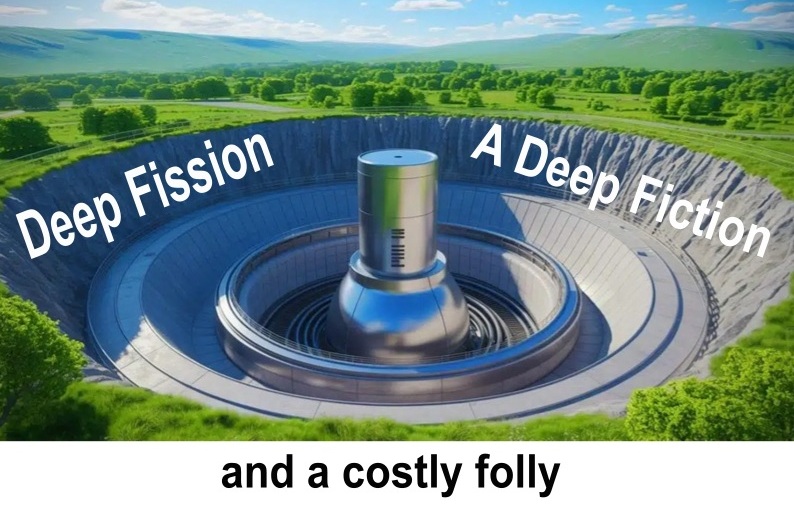
- Nasdaq-listed Deep Fission (FISN) is developing a small modular reactor (SMR) with a capacity of 5MWe-15MWe. The company plans to bury a miniature version of the widely used pressurized water reactor (PWR) one mile deep, inside a 40-60-inch water-filled borehole drilled into hard rock.
- Like other SMR developers, FISN pitches itself as an AI data-center power solution. But data centers have turned to natural gas to accelerate deployment. Almost all of the roughly 75GW of booked data center on-site generation is natural gas-based. FISN has no regulatory approval and remains years away from commercialization.
- Before its June 2026 IPO, FISN guided to a levelized cost of energy (LCOE) of just $50-70/MWh. Then the company dropped the reference. Using figures disclosed in its June 2026 prospectus, we calculate an LCOE of $289/MWh for the first-of-a-kind (FOAK) reactor and $148/MWh for the nth-of-a-kind (NOAK) reactor, about 200% above prior guidance. This is not competitive with behind-the-meter gas solutions.
- Even this NOAK estimate is too optimistic, as capital cost is understated. Using figures from independent third parties, we estimate NOAK capital cost to be $112mn, 34% above FISN’s estimate, raising our estimated NOAK LCOE to $170/MWh.
- FISN claims it can secure Nuclear Regulatory Commission (NRC) approval in less than a year. Yet it has already struggled with the less demanding Department of Energy (DOE) process, missing the program deadline while at least four peers have already completed it. Even if NRC approved, commercialization is far from assured: NuScale, which has a much more conventional design, has yet to sell a reactor three years after receiving its NRC license.
- FISN targets deploying its reactor in just six months versus 3-4 years for other advanced SMRs, citing fewer safety-related systems. Yet its own filing states a two-year development timeline. Peers pursue the same simplification strategy, but FISN adds a major step: drilling a one-mile borehole.
- FISN touts the industry’s largest customer pipeline. Most counterparties are undisclosed. Of those identified, one is an undeveloped industrial park with doubtful demand for a nuclear reactor. The other two (Endeavour Energy and Blue Owl) have signed only non-binding agreements.
- FISN has less than twelve months of cash runway and faces ~$350mn of unfunded capital needs, potentially implying ~43% dilution to its existing shareholders. At the same time, the competition for SMR funding is intensifying: publicly traded SMR names have risen from three before October 2025 to nine today, with three more coming to the market, including a far more established player, Westinghouse.
- FISN is largely a repackaging of the founders’ prior venture, Deep Isolation, a deep-borehole nuclear waste disposal company that has failed to commercialize its concept after a decade.
Background and bull case
Deep Fission (NASDAQ: FISN) is a California-headquartered company founded in 2023. The company is developing a nuclear reactor called Gravity. The reactor is intended to be a miniature version of the conventional pressurized water reactor (PWR), using low-enriched uranium (LEU) as fuel. The company’s key innovation is that its reactor would be buried in a 40-60-inch water-filled borehole one mile (~1.6 km) underground. The reactor is designed with a power generation capacity of 5–15MWe.
Management claims that its reactor is cheaper to build because its innovative borehole design eliminates certain components required in above-ground PWR reactors……………………..
FISN is participating in the Department of Energy’s (DOE) pilot reactor program. The company is seeking DOE authorization to build a pilot reactor at a site in Parsons, Kansas, by 1H 2027. Then, FISN plans to submit license applications to the Nuclear Regulatory Commission (NRC) to convert the pilot reactor into a commercial facility by the end of 2027, with high-volume deployment targeted to begin in 2028. Because its reactor is based on well-established PWR technology, its licensing pathway would be simpler than for novel advanced reactor designs.
The company claims that its reactor can then be commercially deployed in as little as six months, compared with three to four years for other small modular reactors (SMR). ……………………………………..
The company’s own numbers show its reactors are not cost-competitive
Even FISN’s own numbers reveal the poor economics of its reactors. Before its June 2026 IPO, the company claimed that its reactor could achieve a levelized cost of energy (LCOE) of only $50-70/MWh, including in an investor presentation prepared in connection with the February 2026 private placement. The number excluded non-engineering, procurement, and construction (EPC) costs and contingencies……………………………………………………………..
Then, when the company was listed, the reference to the LCOE was dropped. The prospectus filed in connection with FISN’s June 2026 Nasdaq debut no longer mentions an LCOE target, nor do the company’s subsequent investor presentations, news releases and filings. Yet the company itself recognizes that LCOE is a key driver of its success (p. 38):………………………………….
Another claim made in the January 2026 presentation (p. 17) but absent after the IPO was the assertion that its reactors would achieve 70%-80% cost reduction versus newly built conventional PWRs. The company probably realized that there was no basis for such a claim. It seems that material walkbacks like those mentioned above are fairly common for the company. ………………………….
If we simply apply the financial assumptions provided by the company, there is no way FISN can achieve such a low LCOE, whether for a FOAK or a NOAK reactor…………………………………………………………………………………………
Finally, let’s remember that the nuclear industry is prone to cost overruns. FISN is particularly at risk as its design is still evolving………………………..
The certification timeline is wildly optimistic………………………………………………………………………………………………………………………………………………………………
An avalanche of newly listed SMR companies compete for funding
FISN’s need for additional fundraising comes at a time when investor appetite for SMR stocks has materially weakened, as the broader SMR investment theme has cooled and SMR-related stocks have lost momentum. After years of warnings about the technology’s readiness and economics, institutional investors are noticing that natural gas is the actual solution being adopted by AI data centers, while SMRs remain a distant and highly speculative prospect. Retail investors, who largely fueled the bubble, are turning their attention to SpaceX’s space-based data center concept.
…………………………………………………………………….. Deep Fission recycles the founders’ past venture that never achieved commercialization ……………………………………………………………………………………………………………………………………………………………………………………………………………………… https://iceberg-research.com/2026/09/24/deep-fission-fisn-a-money-pit/
No comments yet.
1 This Month





PLEASE OPPOSE HR 8255 AND S.3639 – bills would accelerate satellite deployment, with no environmental review or safeguards – https://ncstd5li.quorum.us/campaign/169331/
To see nuclear-related stories in greater depth and intensity – go to https://nuclearinformation.wordpress.com
-
Archives
- October 2026 (49)
- September 2026 (339)
- August 2026 (330)
- July 2026 (355)
- June 2026 (287)
- May 2026 (306)
- April 2026 (356)
- March 2026 (251)
- February 2026 (267)
- January 2026 (308)
- December 2025 (358)
- November 2025 (359)
-
Categories
- 1
- 1 NUCLEAR ISSUES
- business and costs
- climate change
- culture and arts
- ENERGY
- environment
- health
- history
- indigenous issues
- Legal
- marketing of nuclear
- media
- opposition to nuclear
- PERSONAL STORIES
- politics
- politics international
- Religion and ethics
- safety
- secrets,lies and civil liberties
- spinbuster
- technology
- Uranium
- wastes
- weapons and war
- Women
- 2 WORLD
- ACTION
- AFRICA
- Atrocities
- AUSTRALIA
- Christina's notes
- Christina's themes
- culture and arts
- Events
- Fuk 2022
- Fuk 2023
- Fukushima 2017
- Fukushima 2018
- fukushima 2019
- Fukushima 2020
- Fukushima 2021
- general
- global warming
- Humour (God we need it)
- Nuclear
- RARE EARTHS
- Reference
- resources – print
- Resources -audiovicual
- Weekly Newsletter
- World
- World Nuclear
- YouTube
-
RSS
Entries RSS
Comments RSS


Leave a comment