Pentagon’s secret plan: Reviving Cold War doctrines to lower the threshold for nuclear war
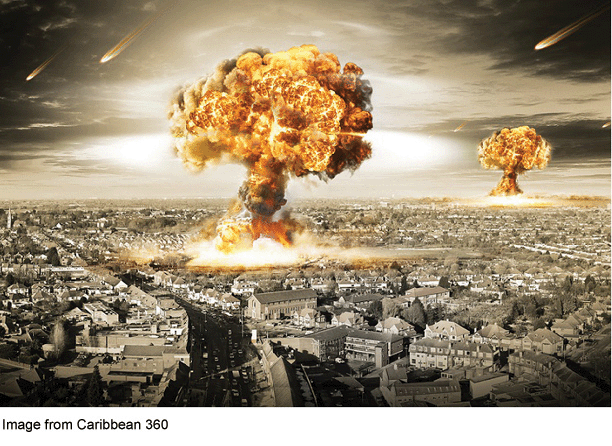
The new review looks to resurrect these failed policies of the past.
A review nobody will see. Early indications suggest that the nuclear strategy review the Pentagon is conducting will call for new weapons to fill every niche of the so-called escalatory ladder.
Finally, Colby said the review will be kept secret: “[T]his is not designed to be a public-facing review.” It will be kept internal to the Defense Department.
Bulletin, By Joe Cirincione | Opinion | September 11, 2026
A new nuclear policy is taking shape in secret, crafted by a small group of Pentagon officials, that will give President Donald Trump more ways to start a nuclear war. Little is known about the strategic nuclear review now under way in the Trump administration, but officials’ comments suggest that it may bring back one of the most dangerous policies of the Cold War: the proliferation of battlefield nuclear weapons and their early use in a conventional war.
In the 1950s, a revolution occurred in military thinking about nuclear weapons. Rather than keeping the most destructive bombs ever invented as weapons of last resort in only the most extreme situations, military leaders began to see them as weapons usable in conventional conflicts, particularly in Europe.
Military services eager to acquire what they believed were the weapons of the future, coupled with corporations eager to develop them, led to the rapid production of atomic munitions for every conceivable military purpose. The Navy had nuclear torpedoes and depth charges; the Army had nuclear artillery and short-, medium-, and intermediate-range missiles; the Air Force got nuclear air-to-air missiles and multiple types of air-dropped bombs. By the early 1960s, the US military even deployed small “backpack nukes,” or Special Atomic Demolition Munitions, designed to be carried by one or two soldiers, as well as what might be the oddest of all: a nuclear “bazooka” called the Davy Crockett recoilless gun that fired a small nuclear weapon about a mile.
This nuclear insanity led to a world with almost 70,000 nuclear weapons at its peak in the late 1980s, the vast majority of which were possessed by the United States and the Soviet Union. Mass protests and a generation of wiser leaders led to sharp reductions in these arsenals. At first, the reductions primarily concerned long-range strategic weapons that could span the oceans. But massive reductions in short-range weapons soon followed.
In 1991, President George H.W. Bush unilaterally cut 14,000 of these so-called tactical weapons, denuclearizing the US Army and the US surface fleet. In all, the United States cut tactical nuclear weapons by 90 percent, down to about 200 today. Russia mostly followed suit, though it retained a larger arsenal. The two nuclear superpowers settled into a familiar triad of strategic weapons deployed primarily on long-range land-based missiles, submarines, and bombers.
The new review looks to resurrect these failed policies of the past.
A review nobody will see. Early indications suggest that the nuclear strategy review the Pentagon is conducting will call for new weapons to fill every niche of the so-called escalatory ladder. As Undersecretary of Defense for Policy Elbridge Colby explained in a speech in August, the main point of the review is “adding more options.” This means President Trump, who already has sole, unfettered authority to launch thousands of nuclear weapons on a moment’s notice, will soon have more types of weapons he could choose to launch.
The idea, developed in the nuclear posture review conducted during the first Trump administration, is to erase the divide between conventional forces and nuclear forces. Although the United States has long maintained so-called tactical nuclear weapons for battlefield use, including the air-dropped B-61 bomb and nuclear-tipped cruise missiles, new weapons must be added, proponents claim, to close supposed “deterrence gaps” and reduce a president’s fear of “going nuclear.”
The logic, nuclear hawks contend, is that by reducing the barriers to nuclear use, adversaries will not challenge the United States regionally, knowing that they would lose at every rung of the escalation ladder. They call this war-fighting strategy “escalation management.”
This strategy is poorly developed, and Colby’s talk did not help. It was meandering, confused, and jumbled, but a few points stand out.
First, despite the numerous weaknesses that the disastrous Iran war has exposed in the US armed forces and military leadership, Colby insists that “the modernization of our nuclear deterrent is the single most important initiative for the American military.”
Colby added that “we have to have a nuclear strategy… that’s connected to our conventional force strategy.” Although “the goal here is to deter and avoid” a large-scale conflict, Colby implies that the best way to do that is to build more nuclear weapons, new types of nuclear weapons, and couple them with new doctrines that would allow their use early in a conventional war. The point, he says, is that the enemy has “got to believe there’s some sense in which we would use” them. Colby even harkens back to the 1960s “flexible response” doctrine developed when the United States still had thousands of nuclear weapons in Europe and Asia ready to use.
Finally, Colby said the review will be kept secret: “[T]his is not designed to be a public-facing review.” It will be kept internal to the Defense Department. Unlike previous nuclear posture reviews, this one is not an inter-agency process. Instead, it is being run by a small number of Pentagon officials, who do not plan on making the results of the review public. Referring to the Cold War era, Colby said that “NSC 68, the most famous document of that period, was not declassified, I think, until the 1970s.” This memo, presented to President Truman in 1950, was the first document to detail a strategy of containment of the Soviet Union after WWII. Citing security concerns from a new era of “great power conflict,” Colby claims that we can no longer “openly talk about your military capabilities, your military problems, your military strategy in a very detailed way.”
But this secrecy is an authoritarian model of governance.
A handful of officials, probably helped by some contractor consultants, will decide policy on what the undersecretary says is the nation’s highest military priority. The press and the public will be forced to divine the new strategy from whatever pieces are released. Like so many other Trump administration initiatives, this policy is shielded from the normal democratic process of Congressional oversight or even basic public information.
Follow the money. Procurement requests to support a US policy of nuclear diversification will yield some clues about the new strategy and provide an opportunity both to force the release of more information and to resist the re-adoption of obsolete nuclear war-fighting doctrines.
This dangerous transition is already underway. The first Trump administration pushed through the deployment of the W76-2 warhead for the Trident ballistic missiles carried on strategic submarines. In contrast to the massive 455-kiloton W88 warheads on most of these missiles, one or two of the 20 missiles on each of the 14 deployed subs now carry this atomic bomb with an 8-kiloton yield, about half the size of the bomb that destroyed Hiroshima. The idea is that a president would be more willing to use a small nuclear weapon than a huge city-killer………………………………………………………………………………………………….
Perhaps the most complete rebuttal to this new strategy comes in the recent issue of Foreign Affairs. “The country already has a vast and diverse enough supply of nuclear weapons to unleash devastation on an adversary in the case of a nuclear attack,” argues Council on Foreign Relations scholar Erin Dumbacher. “The purpose of nuclear deterrence is not to have an answer for every weapon in an adversary’s arsenal, but to avoid crossing the nuclear threshold in the first place.”
Dumbacher is correct. The American public will need many more voices and new collective efforts to erect more barriers to nuclear war, not give a president more options for starting one.https://thebulletin.org/2026/09/pentagons-secret-plan-reviving-cold-war-doctrines-to-lower-the-threshold-for-nuclear-war/?utm_source=ActiveCampaign&utm_medium=email&utm_content=Pentagon%20s%20secret%20plan%20to%20lower%20the%20threshold%20for%20nuclear%20war&utm_campaign=20260914%20Monday%20Newsletter
No comments yet.
-
Archives
- October 2026 (120)
- September 2026 (339)
- August 2026 (330)
- July 2026 (355)
- June 2026 (287)
- May 2026 (306)
- April 2026 (356)
- March 2026 (251)
- February 2026 (267)
- January 2026 (308)
- December 2025 (358)
- November 2025 (359)
-
Categories
- 1
- 1 NUCLEAR ISSUES
- business and costs
- climate change
- culture and arts
- ENERGY
- environment
- health
- history
- indigenous issues
- Legal
- marketing of nuclear
- media
- opposition to nuclear
- PERSONAL STORIES
- politics
- politics international
- Religion and ethics
- safety
- secrets,lies and civil liberties
- spinbuster
- technology
- Uranium
- wastes
- weapons and war
- Women
- 2 WORLD
- ACTION
- AFRICA
- Atrocities
- AUSTRALIA
- Christina's notes
- Christina's themes
- culture and arts
- Events
- Fuk 2022
- Fuk 2023
- Fukushima 2017
- Fukushima 2018
- fukushima 2019
- Fukushima 2020
- Fukushima 2021
- general
- global warming
- Humour (God we need it)
- Nuclear
- RARE EARTHS
- Reference
- resources – print
- Resources -audiovicual
- Weekly Newsletter
- World
- World Nuclear
- YouTube
-
RSS
Entries RSS
Comments RSS


Leave a Reply