Boris Johnson Continues to Lie About Subverting Ukraine Peace Talks
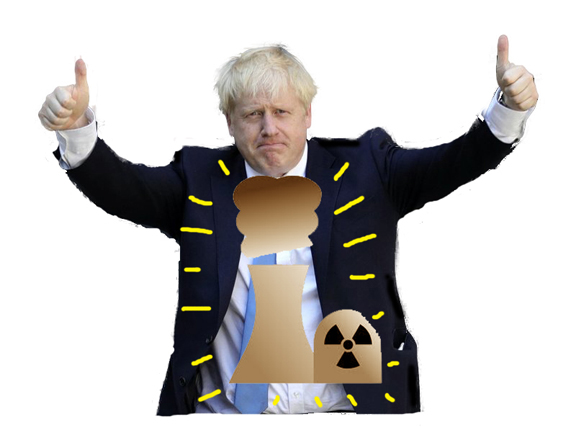
The origin of the Johnson sabotage story is not Russian propaganda. It was first reported by Ukrainska Pravda. The Ukrainian paper says that as soon as Ukraine and Russia had “agreed on the structure of a future possible agreement in general terms, UK Prime Minister Boris Johnson appeared in Kyiv almost without warning.” He told Zelensky that Putin “should be pressured, not negotiated with” and that “even if Ukraine is ready to sign some agreements on guarantees with Putin, they are not.”
Johnson also wooed Zelensky with promises of “influence” and “fame” as a great war hero.
The charge against Johnson is supported not only by Ukrainian testimony, but by British testimony
Columnist Ted Snider takes on the former PM
Ted Snider is a columnist for The Libertarian Institute and a contributing editor for The American Conservative. He is also a frequent contributor to Responsible Statecraft and other outlets.
In a recent interview, former UK Prime Minister Boris Johnson repeated his denial that he discouraged Ukraine from negotiating peace in the first days of the war. “This is complete, utter nonsense,” Johnson said. He insisted that the story was just the Kremlin spreading allegations.
Johnson has used that defense before. In January 2024, he told The Times that “This is nothing but total nonsense and Russian propaganda.”
But none of the sources of the charge are Russian. They are all either Ukrainian or British.
Johnson denies that he encouraged Zelensky to fight. He says that Zelensky’s mind was already set on fighting and that “there was not a single European or Western leader who could have stopped the Ukrainians from fighting for their country.”
That was not true at the time. In a February 25, 2022 address to Ukrainians, Zelensky said, “We are not afraid to talk to Russia. We are not afraid to say everything about security guarantees for our state. We are not afraid to talk about neutral status.”
The origin of the Johnson sabotage story is not Russian propaganda. It was first reported by Ukrainska Pravda. The Ukrainian paper says that as soon as Ukraine and Russia had “agreed on the structure of a future possible agreement in general terms, UK Prime Minister Boris Johnson appeared in Kyiv almost without warning.” He told Zelensky that Putin “should be pressured, not negotiated with” and that “even if Ukraine is ready to sign some agreements on guarantees with Putin, they are not.”
That story, first reported in the Ukrainian press, was confirmed by the head of the Ukrainian negotiating team, Davyd Arakhamia, who says that when the Ukrainian team “returned from Istanbul, Boris Johnson came to Kiev and said that we would not sign anything with them at all, and let’s just fight.” He adds that the West “actually advised us not to go into ephemeral security guarantees.”
Far from Russian propaganda, the charge against Johnson has a Ukrainian media source backed by primary source confirmation from the lead Ukrainian negotiator.
Though it carries less weight because she was not there and because she was no longer in office at the time, there is also secondary source confirmation from within Zelensky’s administration. Iuliia Mendel, Zelensky’s press secretary from 2019-2021, retells the story of Johnson rushing to Kiev to urge the Ukrainians to keep fighting. She also adds the claim, without support or attribution, that Johnson also wooed Zelensky with promises of “influence” and “fame” as a great war hero.
The charge against Johnson is supported not only by Ukrainian testimony, but by British testimony. A senior government source told The Times at the end of March 2022 that the British government warned Zelensky not to be bullied into concessions and that it was the position of the UK that he shouldn’t be “too eager… to settle” and that “Ukraine needs to be in the strongest possible position militarily before those talks can take place.”
Johnson did say that the UK “would back Ukraine a thousand percent.” But he also said, “I could not see for the life of me what the deal could be, and I thought that any deal with Putin was going to be pretty sordid.” He then told Zelensky that “as far as I am concerned, Putin must fail and Ukraine must be entitled to retain full sovereignty and independence.” Johnson then made the promise of providing the Ukrainian armed forces with military supplies.
In The Russo-Ukrainian War: Follies of Empire, Richard Sakwa reports an earlier phone conversation in which Johnson told Zelensky that the UK “would not stand as a guarantor power and urged Zelensky to refuse the deal.”
It is important to set Johnson’s perjury straight not just to correct the historical record, but to remember that, at a time when the war is becoming increasingly hopeless for Ukraine, before most of the death and destruction, there was the chance of peace, and that Johnson contributed to discouraging it and encouraging this horrible war.
No comments yet.
1 This Month





PLEASE OPPOSE HR 8255 AND S.3639 – bills would accelerate satellite deployment, with no environmental review or safeguards – https://ncstd5li.quorum.us/campaign/169331/
To see nuclear-related stories in greater depth and intensity – go to https://nuclearinformation.wordpress.com
-
Archives
- October 2026 (67)
- September 2026 (339)
- August 2026 (330)
- July 2026 (355)
- June 2026 (287)
- May 2026 (306)
- April 2026 (356)
- March 2026 (251)
- February 2026 (267)
- January 2026 (308)
- December 2025 (358)
- November 2025 (359)
-
Categories
- 1
- 1 NUCLEAR ISSUES
- business and costs
- climate change
- culture and arts
- ENERGY
- environment
- health
- history
- indigenous issues
- Legal
- marketing of nuclear
- media
- opposition to nuclear
- PERSONAL STORIES
- politics
- politics international
- Religion and ethics
- safety
- secrets,lies and civil liberties
- spinbuster
- technology
- Uranium
- wastes
- weapons and war
- Women
- 2 WORLD
- ACTION
- AFRICA
- Atrocities
- AUSTRALIA
- Christina's notes
- Christina's themes
- culture and arts
- Events
- Fuk 2022
- Fuk 2023
- Fukushima 2017
- Fukushima 2018
- fukushima 2019
- Fukushima 2020
- Fukushima 2021
- general
- global warming
- Humour (God we need it)
- Nuclear
- RARE EARTHS
- Reference
- resources – print
- Resources -audiovicual
- Weekly Newsletter
- World
- World Nuclear
- YouTube
-
RSS
Entries RSS
Comments RSS


Leave a comment