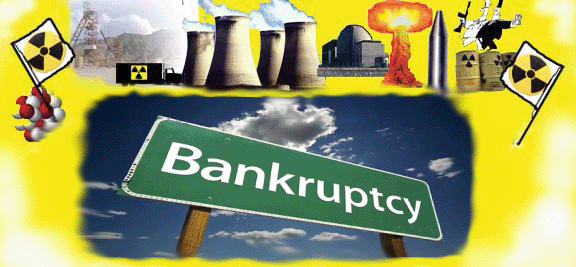
“Merrily we roll along…” – the giddy road to nuclear bankruptcy
Gordon Edwards, Sep 2, 2026
I have often noted that the SMR “rush to market” is first and foremost a “money grab”.
The nuclear industry had performed poorly for a quarter if a century, losing market share steadily,
And yet many governments around the world were putting hundreds of billions of dollars on the table to combat global warming – this provided an opportunity to grab a lot of that public money by making exaggerated and often irresponsible claims that nuclear investment is a winning strategy.
The following document is an easy-to read account of how money gets used by some of the more flagrantly irresponsible companies – the document has to do with the circumstances leading up to the bankruptcy of Ultrasafe Nuclear Corp. (also known as Wind-Down Inc.) which was planning to build a gas-cooled reactor producing 5 megawatts of heat (later upgraded to 15 megawatts) at Chalk River, Ontario. In fact an environmental assessment of the project had already begun, and so far it has been paused but not cancelled….
It is worth reading this eye-popping account of how bankruptcy can be achieved in record time.
www.ccnr.org/Ultrasfafe_Bankruptcy_2026.pdf.
Case 24-12443-KBO Doc 695 Filed 08/13/26 Page 1 of 50
IN THE UNITED STATES BANKRUPTCY COURT FOR THE DISTRICT OF DELAWARE
Chapter 11 Case No. 24-12443 (KBO) (Jointly Administered)
In re: Reactor Parent Wind-Down, Inc.,1 Debtor.
WILMINGTON SAVINGS FUND SOCIETY, FSB, LIQUIDATING TRUSTEEOF THE RPWI LIQUIDATING TRUST, Plaintiff,
v.
WAQAR ZAIDI, RITESH BUDREE, and THE ESTATE OF FRANCESCO VENNERI, -Defendants.
Adv. Proc. No. 26-________ (KBO)
COMPLAINT
Wilmington Savings Fund Society, FSB, solely in its capacity as trustee (the “Liquidating Trustee”) of the RPWI Liquidating Trust (the “Trust”) formed pursuant to the First Amended Joint Chapter 11 Plan of Liquidation for Reactor Parent Wind-Down, Inc. and Its Affiliated Debtors [Dkt. No. 486] (the “Plan”) of the above-captioned debtor and its affiliated debtors (collectively, the “Debtors”),2 respectfully alleges as follows:
1
The Debtor and the last four digits of its federal taxpayer identification numbers is as follows: Reactor Parent Wind-Down, Inc. (f/k/a Ultra Safe Nuclear Corporation) (9774) (“RPWI”). The Debtor’s mailing address is 500 Delaware Ave, Wilmington, DE 19801.
2
The Court previously entered an order [Dkt. No. 597], closing certain of the cases jointly administered with the above-captioned debtor’s case. Those affiliated Debtors, the last four digits of their federal taxpayer identification numbers and the associated case numbers are as follows: Reactor Sub One Wind-Down, Inc. (f/k/a Ultra Safe Nuclear Corporation – Technologies) (9815) (Case No. 24-1244 (KBO)); USNC-Power Ltd. (6500) (Case No.
SUMMARY OF THE ACTION
- In late 2023 and early 2024, Reactor Parent Wind-Down, Inc. (f/k/a Ultra
Safe Nuclear Corporation) and its affiliates (“USNC” or the “Company”) were on the precipice of bankruptcy. The Company—once a promising enterprise in the burgeoning nuclear industry with an estimated valuation of over $250 million—had squandered over $150 million in investments and was struggling to raise the capital necessary to satisfy unchecked liabilities and keep the Company afloat. As liquidity tightened, USNC was forced to cease paying key employees and critical vendors. Failure to pay these mission-critical expenses stifled any further investment, resulting in an inevitable death spiral. Eventually, in late 2024, the Company ceased operations and was sold for parts—netting $41 million in the aggregate—destroying hundreds of millions of dollars in value.
- The Company’s staggering fall from grace was caused by its ChiefExecutive Officer and founder, Francesco Venneri. Dr. Venneri intentionally disregarded red flags repeatedly raised by his executive team regarding the Company’s reckless spending—which, at nearly $7 million per month, far outpaced the Company’s available capital and any reasonable investment expectation. For example, in January of 2024, a critical moment in the Company’s life (when liquidation was not a fait accompli), the Company’s Chief Financial Officer wrote to Dr. Venneri and other key members of the executive team that “we are, at a minimum, 90 days away from any meaningful investment, yet no meaningful reduction in costs has occurred . . . best case scenarios fund us at a rate that is half of our current budget.”
- This was a common refrain, both well before January 2024 and well after.
Dr. Venneri, however, did nothing. A reasonably prudent manager would have cut costs and focused on the Company’s key, profit-making initiatives. Instead, Dr. Venneri provided frivolous payouts and out-of-market benefits to his “inner circle” of favored executives, including a $750,000 payment to the Company’s former Chief Commercial Officer, Waqar Zaidi. In a fleeting moment of self-awareness on the eve of bankruptcy, Dr. Venneri conceded his culpability, writing “it’s easy to point fingers to the former CEO who overspent . . . I have a lot to answer for.” - USNC’s nuclear fission technology was, as one potential investor described
it, “remarkable.” Founded in 2011 by Dr. Venneri, USNC was a pioneer in developing safe and commercially accessible nuclear fuel and reactor technology. In 2023, USNC was on the cusp of large-scale production of its proprietary Fully Ceramic Micro-encapsulated (FCM®) Nuclear Fuel
(“FCM Fuel”), which utilized state-of-the-art Tri-structural ISOtropic (“TRISO”) fuel particles in a uniquely contained format that could withstand extreme heat and explosive impacts. The Company was also developing nuclear plants in Canada and Illinois to demonstrate the viability of its proprietary Micro Modular Reactors (“MMR”), nuclear fission “batteries” utilizing its FCM Fuel that could be linked together to accommodate different business sites and needs. The
Company’s “remarkable” technology and its value, however, was torpedoed by Dr. Venneri’s failures as a manager. The same potential investor remarked in February of 2024 that “[a] company that has received $170M of capital to date should be lightyears ahead in commercial traction and institutional fundraising progress, not be scrambling for last minute change….” The investor prophetically concluded that “I see the most likely outcome being USNC going bust and
someone acquiring the tech for a few million.” The downfall was entirely foreseeable and avoidable. - Like other technology companies, USNC primarily relied on investors—in
particular, the Company’s controlling stockholder, Richard Hollis Helms—to fund its operations. The Company was targeting 2026 to begin commercial fuel production and sales after opening fuel manufacturing facilities and receiving qualification of its fuel. Further, USNC expected to commercialize its MMR technology beginning in or around 2028, following completion of its demo projects in Canada and Illinois. Management projected these business lines to generate hundreds of millions of dollars in revenue per year. - The Company never achieved these milestones. Instead, USNC’s upward
trajectory was cut short by Dr. Venneri’s reckless stewardship and his deliberate disregard of the advice of his executive team, advisors, and the Chairman of the Board. Throughout 2023 and early 2024, management repeatedly urged Dr. Venneri to prioritize the Company’s key value-creating initiatives (i.e., fuel and its MMR demo projects) and to drastically cut costs, so that the Company
could survive long enough to bring in critical capital—whether through sales or third-partyinvestment. - Rather than address these concerns, Dr. Venneri pursued expansive
business development plans, including potential projects and satellite offices across Europe, Asia, and Australia. As explained in further detail below, Dr. Venneri repeatedly and falsely promised that significant financing was imminent, or that he would obtain additional funds from Mr. Helms—a well that was running dry due to growing concerns regarding the Company’s increasing spend. - Dr. Venneri concurrently provided lavish, above-market benefits and payouts to former CCO Waqar Zaidi, who was a member of Dr. Venneri’s “inner circle” alongside former-CFO and Vice President of Finance Ritesh Budree. This included, among other things, causing the Company to pay approximately $750,000 to Mr. Zaidi pursuant to a purported “finder’s fee” agreement that Dr. Venneri and Mr. Zaidi signed in secret, during a time when payroll for non-executive employees was being withheld and vendors were not being paid, endangering the Company’s key operations relating to USNC’s fuel production and MMR demo projects. Dr. Venneri also agreed to an amended employment agreement that provided Mr. Zaidi with egregious severance benefits, including, among other things, a cash payment of at least $1 million if Mr. Zaidi was terminated for any reason other than a chargeable criminal offense that was proven in state court.4
- In October 2024, the Debtors filed voluntary petitions for relief under
chapter 11 of the Bankruptcy Code. Several months later, the Company’s assets were sold for a total of $41.0 million—hundreds of millions of dollars less than the Company had been valued in recent years. - Dr. Venneri’s gross negligence and recklessness as CEO—and the
misconduct perpetrated by his inner circle—must be remedied. The Liquidating Trustee thus brings claims against Dr. Venneri’s estate, as well as Messrs. Zaidi, and Budree, for (1) breach of fiduciary duty; (2) declaratory judgment that Mr. Zaidi’s finder’s fee agreement and Messrs. Zaidi’s and Budree’s amended employment agreements are void; (3) in the alternative, avoidance
of fraudulent obligations allegedly incurred under those agreements pursuant to 11 U.S.C. § 548(a)(1)(B); (4) the avoidance and recovery of the payments made under the finder’s fee agreement as (i) constructively fraudulent transfers pursuant to 11 U.S.C. § 548(a)(1)(B); or (ii) in the alternative, preferences pursuant to 11 U.S.C. § 547; (5) avoidance and recovery of a sign-on bonus paid some 11 months after Mr. Zaidi’s hiring as a preference pursuant to 11 U.S.C. § 547;(6) unjust enrichment; (7) equitable subordination of Defendants’ claims in the Debtors’ bankruptcy proceedings; and/or (8) disallowance and/or reclassification of Defendant Zaidi’s and Budree’s claims in the Debtors’ bankruptcy proceedings.
…………………………………………………………………………………………………………………………………………………………………………………………………………….Despite frequent warnings to adhere to corporate formalities, the Company held no formal Board meetings and did not keep minutes, decisions were largely undocumented, and, upon information and belief, the Board never formally met with its executive team or outside advisors.
……………………………………………………………………………………………………………………………………………………………………………………………..The establishment of a wholly-owned subsidiary of USNC in Italy in July
2023, at a time when the Company was clearly experiencing severe financial distress and escalating liabilities, was emblematic of Dr. Venneri’s folly.
……………………………………………………………………………………………………………………………………………………………………………………………………....F. The Company Crumbles in Early 2024
By early 2024, the Company was in severe financial distress, had no near-
term investment prospects, and had yet to engage in any meaningful reduction in costs………………………………………………………………………………………………………………………………………………………….
ED. This case goes for 50 pages.
No comments yet.
1 This Month
15 October. Joint Appeal for Nuclear Abolition Day -presentation to the UN on October 15 will be live on UNWebTV
Endorse the Nuclear Abolition Day Appeal
23-25 October – on Zoom – World BEYOND War’s annual global conference

To see nuclear-related stories in greater depth and intensity – go to https://nuclearinformation.wordpress.com
-
Archives
- October 2026 (149)
- September 2026 (339)
- August 2026 (330)
- July 2026 (355)
- June 2026 (287)
- May 2026 (306)
- April 2026 (356)
- March 2026 (251)
- February 2026 (267)
- January 2026 (308)
- December 2025 (358)
- November 2025 (359)
-
Categories
- 1
- 1 NUCLEAR ISSUES
- business and costs
- climate change
- culture and arts
- ENERGY
- environment
- health
- history
- indigenous issues
- Legal
- marketing of nuclear
- media
- opposition to nuclear
- PERSONAL STORIES
- politics
- politics international
- Religion and ethics
- safety
- secrets,lies and civil liberties
- spinbuster
- technology
- Uranium
- wastes
- weapons and war
- Women
- 2 WORLD
- ACTION
- AFRICA
- Atrocities
- AUSTRALIA
- Christina's notes
- Christina's themes
- culture and arts
- Events
- Fuk 2022
- Fuk 2023
- Fukushima 2017
- Fukushima 2018
- fukushima 2019
- Fukushima 2020
- Fukushima 2021
- general
- global warming
- Humour (God we need it)
- Nuclear
- RARE EARTHS
- Reference
- resources – print
- Resources -audiovicual
- Weekly Newsletter
- World
- World Nuclear
- YouTube
-
RSS
Entries RSS
Comments RSS


Leave a Reply