US Hubris Caused the Ukraine War
A conversation with Professor Jonathan Haslam on Hubris: The Origins of Russia’s War Against Ukraine
Ian Proud, Sep 03, 2026, https://thepeacemonger.substack.com/p/us-hubris-caused-the-ukraine-war?utm_source=post-email-title&publication_id=3221990&post_id=213955256&utm_campaign=email-post-title&isFreemail=true&r=1ise1&triedRedirect=true&utm_medium=email
The war in Ukraine did not begin because nobody saw it coming. It began because too many people in Washington decided the warnings did not matter.
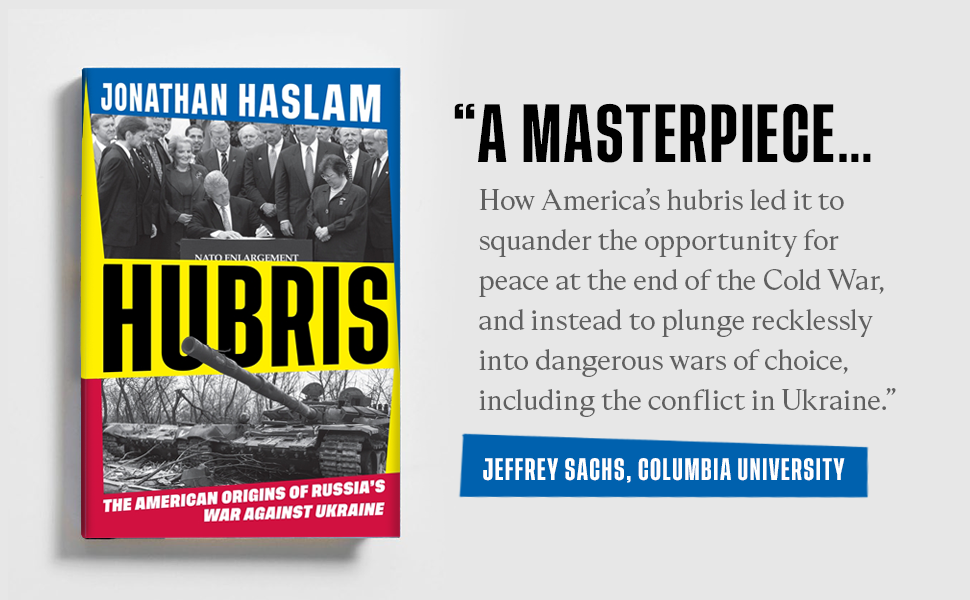
That is the argument of Professor Jonathan Haslam’s book, Hubris: The American Origins of Russia’s War Against Ukraine. After reading it, and after talking to him at length, I think the title is earned. Not because Russia bears no responsibility for launching a war. It does. But because the road to that war was paved, over three decades, by American policy after the Cold War — and by a Western inability to understand responses from Moscow that were, in fact, highly predictable.
Haslam did not set out to write a book about Ukraine. His publisher asked a simpler question: why, after the end of the Cold War, did things not get better?
The answer he found in the archives was not a mystery of Putin’s psychology. It was a record of American decisions.
Fear of being pushed out of Europe
The United States did not greet the Soviet collapse as an unalloyed gift. George H. W. Bush and his advisers feared that the rationale for American power in Europe would disappear with the enemy.
NATO had been the instrument that kept Washington in the European security order.
If that order no longer needed an American security umbrella, the United States might be edged out of a market and a political theatre it considered essential.
Haslam’s point is not that Europeans were clamouring to evict America. They were not.
It is that Washington acted as if they might — and concluded that NATO had to be preserved, then enlarged, then given a purpose beyond the defence of Western Europe.
When Bush floated the idea of expanding NATO’s remit globally, François Mitterrand’s reaction was blistering. The Soviet Union had just collapsed. Why expand the alliance’s mission across the planet?……………………………………………………..
NATO expansion appealed to migrant communities in the United States whose families had suffered under Soviet domination. It also appealed to a bureaucracy that, Haslam argues, had learned to need enemies………………….
The people who did know Russia were cut out. George Kennan — the architect of containment, no romantic about Moscow — opposed enlargement as a provocation that would end in confrontation……………………….
Strobe Talbott, Clinton’s own point man on the former Soviet Union, wrote that putting Ukraine on a NATO membership list was dangerous and would lead to conflict.
Haslam found that memorandum in the files. Read it now and the hair goes up on the back of the neck.
Almost everything Talbott feared came true…………………………………..
From the mid-1990s, Washington was already contemplating Ukraine as a future NATO member, even while selling Moscow the Partnership for Peace as something other than enlargement by another name. The Russians noticed the gap between the language of partnership and the practice of expansion.
They were meant to.
Or rather, they were not meant to be taken seriously when they did.
To Russian military planners, Ukraine and Crimea were not sentimental extras. They were part of the southern strategic depth of the state — as Canada or Mexico are to American security thinking, as Cuba was in 1962…………………………………………………………………………………………………………………
None of this is an argument for Russian victory, or for pretending the invasion of 2022 was a policing action. It is an argument for ending the habit of describing a war as unprovoked while refusing to study the provocations that were obvious to every serious Russia specialist from Kennan onwards.
Haslam’s conclusion is the one many officials still cannot say in public: the United States did not start the fighting. It started the reasons for the fighting.
If that is even half right, then more weapons and more slogans will not substitute for a settlement. They will only prolong the economic cost and the human misery.
I have spent enough years on the Russia account, including in Moscow, to know how unpopular that message is in Whitehall. It remains no less true.
Policy built on the assumption that the other side will not respond is not moral clarity.
It is negligence with a press office.
Haslam’s book is the archival case for that view. Our conversation just scratches the surface of what is a meticulously researched work that should be essential reading for politicians, policy makers and pundits in the west.
Read Hubris.
Then ask why the people who were right in the 1990s were treated as old men who did not understand the new world — a world that has since delivered exactly the confrontation they described.
You can watch conversation here:
No comments yet.
-
Archives
- October 2026 (112)
- September 2026 (339)
- August 2026 (330)
- July 2026 (355)
- June 2026 (287)
- May 2026 (306)
- April 2026 (356)
- March 2026 (251)
- February 2026 (267)
- January 2026 (308)
- December 2025 (358)
- November 2025 (359)
-
Categories
- 1
- 1 NUCLEAR ISSUES
- business and costs
- climate change
- culture and arts
- ENERGY
- environment
- health
- history
- indigenous issues
- Legal
- marketing of nuclear
- media
- opposition to nuclear
- PERSONAL STORIES
- politics
- politics international
- Religion and ethics
- safety
- secrets,lies and civil liberties
- spinbuster
- technology
- Uranium
- wastes
- weapons and war
- Women
- 2 WORLD
- ACTION
- AFRICA
- Atrocities
- AUSTRALIA
- Christina's notes
- Christina's themes
- culture and arts
- Events
- Fuk 2022
- Fuk 2023
- Fukushima 2017
- Fukushima 2018
- fukushima 2019
- Fukushima 2020
- Fukushima 2021
- general
- global warming
- Humour (God we need it)
- Nuclear
- RARE EARTHS
- Reference
- resources – print
- Resources -audiovicual
- Weekly Newsletter
- World
- World Nuclear
- YouTube
-
RSS
Entries RSS
Comments RSS


Leave a Reply