Provoked: How Decades of American Policy Set the Stage for Catastrophe in Ukraine
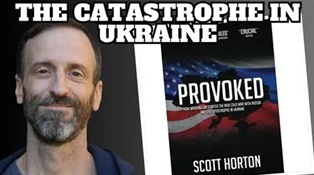
In conversation with Scott Horton
Ian Proud, Aug 29, 2026
In my conversation with Scott Horton about his landmark book Provoked: How Washington Started a New Cold War with Russia and the Catastrophe in Ukraine, one theme emerged with striking clarity: the Ukraine war that began in 2022 did not erupt from nowhere. It was the culmination of more than three decades of deliberate American choices.
Horton’s eight-hundred-page account is not a polemical rant but a meticulously documented timeline. Drawing on thousands of primary sources, he traces the story president by president—from George H.W. Bush through Clinton, the younger Bush, Obama, Trump, and Biden.
The central argument is straightforward and devastating: successive U.S. administrations systematically dismantled the post-Cold War settlement, broke explicit assurances given to Moscow, and treated Russian security concerns with open contempt.
The most consequential early breach concerned NATO expansion.
During the negotiations over German reunification in 1990, James Baker, Helmut Kohl, Hans Dietrich Genscher, Robert Gates and others repeatedly assured Mikhail Gorbachev that NATO would not move “one inch to the east.”
Those assurances were not casual asides. They formed the basis on which Gorbachev agreed to allow a reunified Germany to remain inside the alliance while Soviet troops were still stationed in the east.
Later State Department reviews under Warren Christopher quietly confirmed that the Russians had every reason to believe those promises were binding. Yet the Clinton administration proceeded with expansion anyway, first into Central Europe and later, under George W. Bush, into the Baltic states—leaving the Russian exclave of Kaliningrad stranded behind NATO lines.
Opposition to this course was widespread and bipartisan. With great prescience, George Kennan, the architect of containment, warned that the policy would produce a “devastating reaction” from Russia and that the very people dismissing those concerns would later claim the reaction proved their point.
Two-thirds of the Council on Foreign Relations opposed expansion. Career diplomats, military officers and even hardline hawks such as Henry Kissinger and Zbigniew Brzezinski argued that Ukraine required a special neutral status—something resembling the Cold War Finland or Austria model—precisely to avoid a catastrophic collision.
Those voices were ignored.
The pattern continued.
The 2008 Bucharest Summit promised eventual membership to Ukraine and Georgia without a membership action plan or credible security guarantees—the “worst of all worlds,” as several analysts later described it.
Color revolutions, the deliberate sidelining of the Partnership for Peace, and the refusal to implement the Minsk agreements further eroded any residual trust.
When the same cohort of officials who had driven the policy under earlier administrations returned under Biden – most notably Daniel Fried – the trajectory accelerated toward open conflict.
Horton is careful not to justify Russia’s invasion. He simply insists that calling the attack “unprovoked” is an exercise in willful blindness.
The word itself, repeated endlessly by Western governments and media, seeks to close off inquiry rather than invite it.
Horton’s book reopens that inquiry with forensic detail—names, dates, cables, memoirs—leaving readers free to draw their own conclusions.
What makes Provoked essential is precisely this refusal to operate on the short time horizon of the daily news cycle.
Most public discussion still treats either 2014 or 2022 as year zero. Horton shows that the roots stretch back to the moment the Cold War ended, when a victorious America chose (to quote the title of Professor Jonathan Haslam’s also excellent book) hubris over restraint.
The result is a tragedy that was both foreseeable and avoidable.
I am taking the book with me on holiday.
It is heavy—literally and figuratively—but the weight is justified.
Anyone who wants to understand how we arrived at the present catastrophe, rather than simply recycle the slogans of the moment, should read it.
You can see the full conversation here.
No comments yet.
1 This Month

9 September – online public forum THREE MILE ISLAND:
7-8:30 PM ET,
Legacy, resistance to reopening – https://us02web.zoom.us/webinar/register/WN_-LGJU4j6TD2Hgf0rpgAr1A#/registration
The nuclear industry and the U.S. Nuclear Regulatory Commission are threatening to restart Pennsylvania’s permanently closed and decommissioning Three Mile Island Unit 1 nuclear power station. Three expert speakers will present the resistance to this dangerous misadventure in a webinar hosted by the Clamshell Alliance, Beyond Nuclear and Massachusetts Peace Action.

No Nuclear in Cwm Llynfi! Stop the nuclear power station near Maesteg.
To see nuclear-related stories in greater depth and intensity – go to https://nuclearinformation.wordpress.com
-
Archives
- September 2026 (24)
- August 2026 (330)
- July 2026 (355)
- June 2026 (287)
- May 2026 (306)
- April 2026 (356)
- March 2026 (251)
- February 2026 (267)
- January 2026 (308)
- December 2025 (358)
- November 2025 (359)
- October 2025 (375)
-
Categories
- 1
- 1 NUCLEAR ISSUES
- business and costs
- climate change
- culture and arts
- ENERGY
- environment
- health
- history
- indigenous issues
- Legal
- marketing of nuclear
- media
- opposition to nuclear
- PERSONAL STORIES
- politics
- politics international
- Religion and ethics
- safety
- secrets,lies and civil liberties
- spinbuster
- technology
- Uranium
- wastes
- weapons and war
- Women
- 2 WORLD
- ACTION
- AFRICA
- Atrocities
- AUSTRALIA
- Christina's notes
- Christina's themes
- culture and arts
- Events
- Fuk 2022
- Fuk 2023
- Fukushima 2017
- Fukushima 2018
- fukushima 2019
- Fukushima 2020
- Fukushima 2021
- general
- global warming
- Humour (God we need it)
- Nuclear
- RARE EARTHS
- Reference
- resources – print
- Resources -audiovicual
- Weekly Newsletter
- World
- World Nuclear
- YouTube
-
RSS
Entries RSS
Comments RSS
 nuclear-news
Leave a comment