The push to clear nuclear power’s waste-disposal hurdle
The technical issues have mostly been solved, but the long-term potential peril of radioactive material has made it difficult to find politically acceptable sites.
Nature, By Brian Owens, 26 August 2026
Inside a nondescript warehouse in an industrial park in Oakville, Canada, sits a squat forklift truck that requires no driver. When activated by its remote operator, the vehicle trundles to a stack of huge clay blocks, each weighing 8,000 kilograms, and carries them into a narrow rock tunnel. Another custom-built machine then fills the spaces around the blocks with crumbled clay.
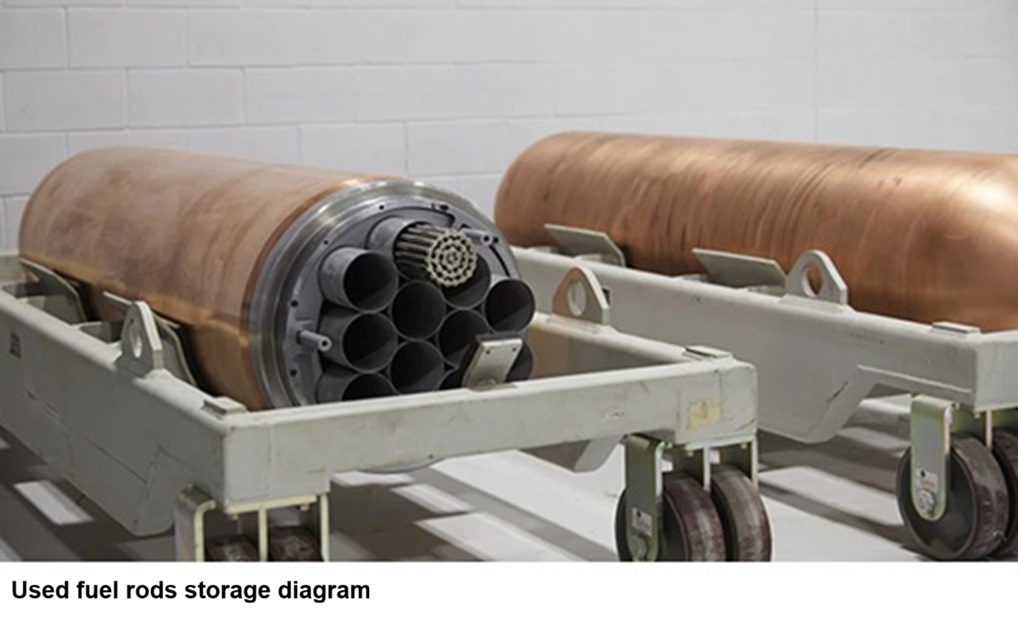
Each block is made of bentonite clay and encases a copper-coated steel container built to hold spent fuel from a nuclear reactor. The blocks will be sealed behind yet more clay and concrete in tunnels deep underground, and the radioactive material inside will be left to slowly decay over thousands of years.
Or it would be, if there were any nuclear waste stored on-site. The warehouse is a test facility for the Nuclear Waste Management Organization (NWMO), the group in Toronto, Canada, that is responsible for dealing with the long-term storage of the country’s nuclear waste. The life-sized mock-up, complete with simulated rock tiling, enables Peter Keech, manager of engineered barrier science at the NWMO, and his colleagues to test technologies that will be used to store the waste and to demonstrate the storage process to the public.
The metal fuel containers, for example, are designed to withstand the pressure of being buried under a 3-kilometre-thick glacier, should the next ice age arrive before the radiation has decayed fully. But Keech and his team take the testing much further, subjecting several canisters to crushing forces equivalent to being more than 6 km under the ocean. The containers looked like toothpaste tubes that had been squeezed in the middle — but they were still fully sealed.
“These are much higher forces than they will ever see in the repository, but we take it to failure to understand the materials,” says Keech. “And even in failure it still offers containment.”
Canada’s real waste repository will be built roughly 1,600 km to the northwest of the test facility, hosted by the Wabigoon Lake Ojibway Nation and the town of Ignace. It is buried some 750 metres under the hard rock of the Canadian Shield, which was once the base of a vast mountain range. When the facility opens in around 2040, its 80–100 km of tunnels will be capable of storing the nearly 6 million bundles of spent fuel that will be produced by Canada’s four nuclear-power plants over their operational lives, isolating the waste from people and the environment until long after the material’s radiation levels return to that of natural uranium.
World tour
Almost every country with a nuclear-power industry is working on some variation of this plan. Finland’s is the most advanced: its Onkalo repository on the country’s west coast is expected to open later this year.
The storage facility is built 430 metres below ground in a hard crystalline bedrock, and will eventually consist of about 50 km of tunnels that can store around 6,500 tonnes of spent uranium fuel, says Linda Kumpula, a nuclear-safety engineer at Finland’s Ministry of Economic Affairs and Employment in Espoo.
A site in Sweden, also built into hard crystalline rock, is expecting to begin accepting radioactive waste in the 2030s. France and Switzerland have each selected a site in natural clay formations and are in the process of gaining regulatory approval. And in December 2025, China completed the first stage of construction for its underground laboratory in the Gobi Desert, a facility that will test the area’s suitability for long-term waste storage.
In the United States, plans for a spent-fuel repository at Yucca Mountain in Nevada have been a political hot potato for decades, and the project is currently stalled. But the nation does already have one permanent facility: the Waste Isolation Pilot Plant, a repository for radioactive waste from the country’s nuclear-weapons programme that is located in salt caverns beneath New Mexico’s desert. That facility has been a major source of learning for other countries, says Keech — particularly how to protect communities when transporting waste to the site and how to minimize the time the material spends on the surface when it arrives.
These issues and other technical ones, such as how best to build a deep geological repository, have now mostly been resolved. “We’ve been working on this for a long time and it is no longer a major technical or scientific challenge,” says Stefan Mayer, team leader of radioactive waste disposal at the International Atomic Energy Agency in Vienna.

The real challenge is political and social. “You have to find a site that’s technically suitable, but you also need a site that is hosted by a community that is willing,” says Allison Macfarlane, a geologist at the University of British Columbia in Vancouver, Canada, and former chair of the US Nuclear Regulatory Commission. “It turns out that the latter problem is harder than the former.”
Types of waste
Waste from nuclear plants generally falls into four categories: materials with very low, low, intermediate and high levels of radioactivity.
Very-low-level and low-level waste make up most radioactive waste — about 95%. Very-low-level waste consists of the soil, concrete and rubble generated when a nuclear plant is decommissioned. Low-level waste is made up of used protective equipment and other lightly contaminated materials from the plant. Both types can be disposed of in near-surface secure facilities and need to be isolated for several hundred years.
Intermediate-level waste consists mainly of metal parts of the reactor that are contaminated with radiation. These metallic isotopes are so concentrated and long-lived that the material remains radioactive for thousands of years and cannot be disposed of near the surface — it needs to be isolated underground.
The biggest issue is the high-level waste. This is the spent nuclear fuel and its containers, as well as the waste from the reprocessing of spent fuel that some countries do to extend their fuel supplies. By volume, it represents just 3% of the waste generated by a power plant, but it is responsible for 95% of the radioactivity. And it remains radioactive for hundreds of thousands or even millions of years — longer than any human civilization has yet lasted. Because of the waste’s longevity, it must be safely isolated deep underground where it cannot contaminate the ecosystem or harm future generations………………………………………………………………………………………………………………………………………………………………………………………..
Another important adjustment for the United States would be to change who is responsible for dealing with the waste. Instead of the Department of Energy, with its revolving door of politically appointed leaders, Macfarlane thinks that it should be an independent organization: either a government agency similar to New York’s port authority or an industry-led group such as Canada’s NWMO.
“You need more of a corporate structure with leadership that’s going to be there a long time, because this is a slow process,” Macfarlane says. “It takes decades to do properly.”
This was one of the main recommendations in 2012 of the Blue Ribbon Commission on America’s Nuclear Future, which Macfarlane took part in. But so far there has been no movement on the issue.
The United States, Macfarlane says, should not be afraid to admit defeat on Yucca Mountain and start again with a more consent-based process. “I think the US has failed and they just have to acknowledge that — and decide they’re going to try again,” she says.
The long timelines involved in dealing with nuclear waste make it tempting to continually kick the can down the road and trust that future generations will eventually find a solution. But Macfarlane is adamant that it is the responsibility of people today to at least get the ball rolling.
“It’s imperative that we do something sooner rather than later,” she says. “I can tell you one thing with 100% certainty: if we do nothing, this material will get into the environment and will harm humans in the future.”
No comments yet.
-
Archives
- October 2026 (112)
- September 2026 (339)
- August 2026 (330)
- July 2026 (355)
- June 2026 (287)
- May 2026 (306)
- April 2026 (356)
- March 2026 (251)
- February 2026 (267)
- January 2026 (308)
- December 2025 (358)
- November 2025 (359)
-
Categories
- 1
- 1 NUCLEAR ISSUES
- business and costs
- climate change
- culture and arts
- ENERGY
- environment
- health
- history
- indigenous issues
- Legal
- marketing of nuclear
- media
- opposition to nuclear
- PERSONAL STORIES
- politics
- politics international
- Religion and ethics
- safety
- secrets,lies and civil liberties
- spinbuster
- technology
- Uranium
- wastes
- weapons and war
- Women
- 2 WORLD
- ACTION
- AFRICA
- Atrocities
- AUSTRALIA
- Christina's notes
- Christina's themes
- culture and arts
- Events
- Fuk 2022
- Fuk 2023
- Fukushima 2017
- Fukushima 2018
- fukushima 2019
- Fukushima 2020
- Fukushima 2021
- general
- global warming
- Humour (God we need it)
- Nuclear
- RARE EARTHS
- Reference
- resources – print
- Resources -audiovicual
- Weekly Newsletter
- World
- World Nuclear
- YouTube
-
RSS
Entries RSS
Comments RSS


Leave a Reply