“ We will not capitulate ”: 30 years of battle against nuclear waste.
Reporterre 15th Aug 2026,
https://reporterre.net/Nous-ne-capitulerons-pas-30-ans-de-bataille-contre-les-dechets-nucleaires
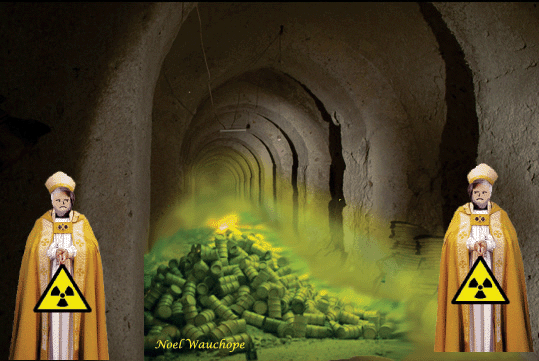
Opponents of radioactive waste gathered near Bure for a weekend under heavy security. It was an opportunity to reiterate their opposition to the Cigéo project, whose problems threaten to become a defining feature of this century.
This weekend, in a field in Saint-Amand-sur-Ornain (Meuse), about fifteen kilometers from Bure, people will be discussing nuclear waste, listening to lectures and concerts, watching films, and, above all, saying no again. From August 14 to 16,
the fifth edition of the Bure’lesques festival brings together opponents
of the Cigéo project , this gigantic facility that the French government and the National Agency for Radioactive Waste Management (Andra) want to dig 500 meters underground to bury the most dangerous radioactive waste produced by France’s nuclear power plants.
The festival will be held under close surveillance. Two decrees issued on August 4 by the prefect of the Meuse have established a particularly wide police presence: prohibitions on transporting various materials, such as wood, pyrotechnic objects or elements to conceal one’s face, restrictions on alcohol, but also the capture and recording of images by two drones and a gendarmerie helicopter.
Around forty individuals and fifteen organizations, including the Human Rights League, the French Lawyers’ Union, and the anti-nuclear network Sortir du nucléaire, filed an emergency appeal with the Nancy Administrative Court, denouncing a disproportionate measure and yet another attempt to criminalize opposition to the Cigéo nuclear waste repository project. According to the plaintiffs, some of the restrictions covered 23 municipalities and approximately 300 square kilometers, even though the festival takes place in a field !
On August 12, the administrative court ruled in their favor on only one point: the use of sound equipment would be permitted. This is the bare minimum for a festival. For the rest, the court determined that the use of drones and a helicopter was not ” manifestly disproportionate , “ given the context surrounding the Cigéo protests.
” We will not surrender .”
This only reinforces the feeling among opponents that they are being monitored far beyond their weekend activities. In Bure, the confrontation with the state is nothing new. For nearly thirty years, public meetings, legal appeals, demonstrations, occupations, prosecutions, and police checks have accompanied the project. Generations of activists have now followed one another in the face of an industrial project whose timescale is an invitation to despair.
Reporterre has long followed this battle, documenting both the moments of jubilation and victory, as well as its brutal repression. In the 2000s, opponents bought an old farmhouse to build a “house of resistance,” creating a permanent residence and a focal point for anti-nuclear struggles. In 2013, the boycott of the public consultation gave new impetus to the fight, and then in 2016, the occupation of the Lejuc forest stalled the project for nearly two years. Before the numerous lawsuits and the criminal conspiracy charges attempted to stifle the struggle. Since then, the mobilizations have continued, and the opponents are still searching for a way to block the project.
“ The mindset is to keep fighting ,” assures Corinne François, a member of the Burestop collective, which co-organizes the festival with a myriad of associations. “ This edition is important; we are in a pivotal year: the decision to authorize creation ( DAC ) could be granted at the end of 2026/2027. ”
” The mindset is to keep fighting .”
“
We will not capitulate ,
” insists Régine, from the Stop Cigéo coordination, who boasts over thirty-five years (!) of activism. Almost a lifetime spent reminding everyone that this monumental project is a one-way ticket to nuisances
“ for all eternity”
.
” Residents need to understand that as soon as Andra obtains its authorization, work can begin immediately, starting with the clearing of the Lejuc forest. Massive construction projects are on the horizon. ”
If Cigéo is built, its operation must last at least a century. Then the repository will be closed to isolate substances from the biosphere, some of which will remain hazardous for hundreds of thousands of years. Here, time no longer has quite the same consistency as elsewhere. The site’s security will have to become passive: it’s impossible to rely indefinitely on technicians, a state, institutions, or even a civilization to monitor the tunnels. But to get to that point, the project must first be completed.This is the dizzying feeling that pervades the struggle in Bure. Those who oppose the project today know they will never see its end, should it be completed. The construction site would span generations, and the waste would still be there long after borders, languages, and landscapes have changed.
A decisive step
The project has reached a crucial stage. In January 2023, Andra submitted its application for authorization to create the facility. After nearly three years of review, the Nuclear Safety and Radiation Protection Authority ( ASNR ) issued a generally favorable opinion at the end of 2025 , concluding that Andra possessed a sufficient knowledge base to proceed with the application, while requesting several additional items (more than 40 in total). The public inquiry was held from May 18 to July 2, 2026 .
The government can now prepare the decree for the Council of State authorizing—or not—the creation of Cigéo.
“ If Andra obtains the authorization request, it will be based on an iterative process, meaning one that will evolve over time ,” fumes Corinne François.“
This is unique in the world. Major projects are budgeted today. Here, it’s complete chaos: they’re going to allocate 7 billion euros for the pilot phase. Then, it’s up to future generations to solve the problems that will arise. “The two organizations are questioning, among other things, the criteria for declaring an experiment a failure. At what point does a malfunction, a difficulty in retrieving a package, or a deviation from the established models lead to a decision to stop
? Because problems are likely to become commonplace this century.
”
We can imagine what could happen in 150 years, particularly with climate change, political systems, and so on,
“ adds Bernard Laponche.
This is perhaps where technology and politics intersect. Cigéo is officially presented as a reversible project: future generations must be able to modify the choices, retrieve waste packages, or change the strategy.
” But the more billions of euros are spent, the more kilometers of tunnels are dug, and the first waste materials are brought down, the more difficult it becomes to reverse course , “ says Bernard Laponche.Under the big tops of the Bure’lesques, behind the acronyms, the cells and the clay, it is ultimately this question that has returned for thirty years: at what point does an experience become a fait accompli
? And how to keep the drive to fight against it
?
No comments yet.
1 This Month



9 September – online public forum THREE MILE ISLAND:
7-8:30 PM ET,
Legacy, resistance to reopening – https://us02web.zoom.us/webinar/register/WN_-LGJU4j6TD2Hgf0rpgAr1A#/registration
The nuclear industry and the U.S. Nuclear Regulatory Commission are threatening to restart Pennsylvania’s permanently closed and decommissioning Three Mile Island Unit 1 nuclear power station. Three expert speakers will present the resistance to this dangerous misadventure in a webinar hosted by the Clamshell Alliance, Beyond Nuclear and Massachusetts Peace Action.

No Nuclear in Cwm Llynfi! Stop the nuclear power station near Maesteg.
To see nuclear-related stories in greater depth and intensity – go to https://nuclearinformation.wordpress.com
-
Archives
- September 2026 (116)
- August 2026 (330)
- July 2026 (355)
- June 2026 (287)
- May 2026 (306)
- April 2026 (356)
- March 2026 (251)
- February 2026 (267)
- January 2026 (308)
- December 2025 (358)
- November 2025 (359)
- October 2025 (375)
-
Categories
- 1
- 1 NUCLEAR ISSUES
- business and costs
- climate change
- culture and arts
- ENERGY
- environment
- health
- history
- indigenous issues
- Legal
- marketing of nuclear
- media
- opposition to nuclear
- PERSONAL STORIES
- politics
- politics international
- Religion and ethics
- safety
- secrets,lies and civil liberties
- spinbuster
- technology
- Uranium
- wastes
- weapons and war
- Women
- 2 WORLD
- ACTION
- AFRICA
- Atrocities
- AUSTRALIA
- Christina's notes
- Christina's themes
- culture and arts
- Events
- Fuk 2022
- Fuk 2023
- Fukushima 2017
- Fukushima 2018
- fukushima 2019
- Fukushima 2020
- Fukushima 2021
- general
- global warming
- Humour (God we need it)
- Nuclear
- RARE EARTHS
- Reference
- resources – print
- Resources -audiovicual
- Weekly Newsletter
- World
- World Nuclear
- YouTube
-
RSS
Entries RSS
Comments RSS
 nuclear-news
Leave a comment