A stormy future? Financial impact of climate change-related disruptions on nuclear power plant owners
Ali Ahmad , Andrei Covatariu , M.V. Ramana, https://www.sciencedirect.com/science/article/abs/pii/S0957178722001485
Highlights
- •Globally, climate change driven extreme events are impacting nuclear power plants.
- •Nuclear reactors in Western Europe are particularly vulnerable to extreme weather.
- •We project an increase in climate-linked unplanned outages in Western Europe nuclear reactors.
- •Adaptation options include financial and contractual measures and maintenance planning.
Abstract
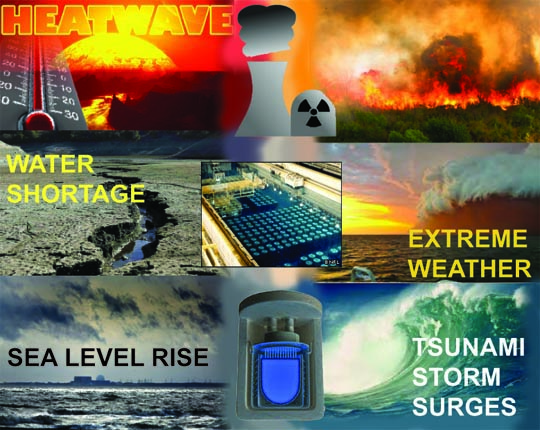
In recent years, extreme weather events potentially caused by climate change have led to several nuclear power plants being shut down for varying periods, and such unplanned outages will become more frequent in the future. Nuclear plants are already finding it difficult to compete in electricity markets due to the availability of cheaper alternatives. We quantitatively assess the additional impact of such extreme weather events on the finances of plant owners using Western Europe as a case study and draw some policy implications for existing owners and those considering new nuclear plants.
Introduction
In May 2022, Electricite de France (EDF) warned that unusually warm river temperatures would likely result in it being forced to reduce power generation from its nuclear power plants (Starn, 2022), an increasingly frequent event in recent years; the concern was not misplaced. In 2018, EDF was forced to halt operations of three power plants due to heatwaves, showcasing the utility’s vulnerability to extreme weather events, especially at its river-based nuclear power plants (WNISR, 2021). With increasingly sophisticated methods employed to demonstrate the attributability of extreme weather events to anthropogenic climate change, it has become more apparent that the kind of hot weather events that disrupted these nuclear power can be linked to climate change with a high degree of attributability (Diffenbaugh, 2020; Schiermeier, 2019). IEA, 2021, the IPCC Working Group I report reported that “recent hot extreme events would have been extremely unlikely to occur without human influence on the climate system” (IPCC et al., 2018).
Other kinds of extreme events are also becoming more frequent. In 2018, the Intergovernmental Panel on Climate Change warned that human-induced warming “has likely increased the chance of compound extreme events” and predicted that almost all parts of the world would record increased climate disruptions (IPCC et al., 2018). Other international and scientific bodies have come to similar conclusions.
Many agencies, like the International Energy Agency (IEA) and the International Atomic Energy Agency (IAEA), posit that an expansion of nuclear power will be a critical component of any effort to mitigate climate change (IAEA, 2020; IEA, 2021). For nuclear power to significantly reduce global emissions, new nuclear plants would have to be built in many countries (Deutch et al., 2003). Many of these areas will be subject to extreme weather events in the coming decades.
At the same time, nuclear power generation is vulnerable to climate change-related extreme weather events (Ahmad, 2021). Climatic disruptions affect nuclear power plants for days or weeks (Becker et al., 2020; D’Agostino, 2021; Lyons, 2020; Neuhauser, 2019). Financial institutions realize the challenges that climate change brings to the financial position of nuclear power plant owners (Lahiri, 2020).
To give an illustration of the financial impact of climate change on nuclear power, we build on earlier work on the vulnerability of nuclear plants to extreme weather events (Ahmad, 2021) by quantifying the impact of extreme weather events on nuclear power plant operations by estimating the losses in energy production and revenues in Western Europe. The region consists of six countries with active nuclear power programs.
Together, these nuclear plants generated 565 TW h of electricity in 2020, approximately 42 percent of the total electricity generation in Western Europe – see Fig. 1. Almost two-thirds of this electrical generation is in France, which generated around 70 percent of its electricity in 2020 from nuclear power plants. The reason behind choosing Western Europe as a case study is the availability of data and the fact that it has a higher reliance on nuclear power than any other region.
Section snippets
The Economics of Nuclear Power
Before discussing the financial impact of climate change-related extreme events, we briefly discuss the economics of nuclear power. In 2003, an influential interdisciplinary study by the Massachusetts Institute of Technology stated, “Today, nuclear power is not an economically competitive choice” (Deutch et al., 2003). That study compared nuclear power to coal and natural gas plants.
In the two decades since, what has changed enormously is the cost of other low-carbon non-fossil-fuel alternative
The effect of extreme weather events on nuclear generation
In recent years, the impact of extreme weather events on the reliability of electricity provision in many parts of the world has become more noticeable (Perera et al., 2020).3 Extreme weather can disrupt all energy sources and the grid that connects them. As such, the high frequency,
Method
We use a “bottom-up” approach that identifies climate-linked disruptions in nuclear power plants and aggregates the impact of climatic disruptions over the last decade (2010–2019) in Western Europe to assess the effects of extreme weather events on the economics of nuclear power generation. The methodology is based on the same type of analysis presented in (Ahmad, 2021). However, in comparison to that analysis, which provided a global view of climate-linked power outages, this paper adds two….
Results
The first set of insights that can be obtained from the analyzed data is related to the time distribution of climatic outages of nuclear power plants in Western Europe. Fig. 3 shows the monthly probability distribution of such outages once they took place, based on actual historical data. Climate-driven outages can happen at any time of the year. However, they seem to be most probable in the summertime. As shown in Fig. 3, about two-thirds of the total climatic outages occur between June and
Policy recommendations
Extreme weather events have numerous policy implications for nuclear power. Because of the expected increase in the frequency of outages, nuclear power plant operators will have to undertake various adaptation measures. The financial impacts of these measures make the role of nuclear even more precarious than it already is, due to the high costs and the combination of safety and financial risks.
One adaptation measure might involve aligning plant shutdowns for refueling and maintenance with…..
REFERENCES ………………………………………
No comments yet.
1 This Month



Shut down the radiation-damaged Heysham nuclear reactors now
To see nuclear-related stories in greater depth and intensity – go to https://nuclearinformation.wordpress.com

Say No to NASA’s Reckless Nuclear Reactor on the Moon
Say No to NASA’s Reckless Nuclear Reactor on the Moon
-
Archives
- October 2026 (256)
- September 2026 (339)
- August 2026 (330)
- July 2026 (355)
- June 2026 (287)
- May 2026 (306)
- April 2026 (356)
- March 2026 (251)
- February 2026 (267)
- January 2026 (308)
- December 2025 (358)
- November 2025 (359)
-
Categories
- 1
- 1 NUCLEAR ISSUES
- business and costs
- climate change
- culture and arts
- ENERGY
- environment
- health
- history
- indigenous issues
- Legal
- marketing of nuclear
- media
- opposition to nuclear
- PERSONAL STORIES
- politics
- politics international
- Religion and ethics
- safety
- secrets,lies and civil liberties
- spinbuster
- technology
- Uranium
- wastes
- weapons and war
- Women
- 2 WORLD
- ACTION
- AFRICA
- Atrocities
- AUSTRALIA
- Christina's notes
- Christina's themes
- culture and arts
- Events
- Fuk 2022
- Fuk 2023
- Fukushima 2017
- Fukushima 2018
- fukushima 2019
- Fukushima 2020
- Fukushima 2021
- general
- global warming
- Humour (God we need it)
- Nuclear
- RARE EARTHS
- Reference
- resources – print
- Resources -audiovicual
- Weekly Newsletter
- World
- World Nuclear
- YouTube
-
RSS
Entries RSS
Comments RSS


Leave a Reply