Bangladesh’s Nuclear Power Play Is a Test for Emerging Economies
By Alex Kimani – Oil Price, Jul 14, 2026,
- Bangladesh is betting on nuclear power with the $12.65 billion, 2.4-GW Rooppur plant to strengthen energy security and reduce reliance on imported fossil fuels and Indian electricity.
- The Russian-built project has faced years of delays due to the pandemic, sanctions, currency pressures, and global conflicts.
- While Rooppur will supply up to 15% of Bangladesh’s electricity, the country is already looking to smaller, cheaper SMRs for future nuclear expansion.
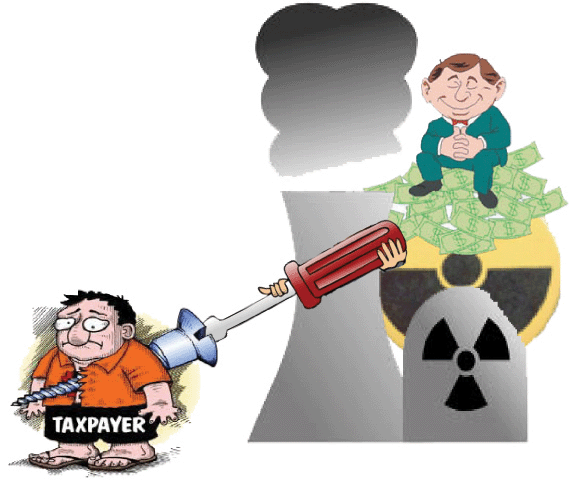
……………………………………………………………………………………………………………………………………………………… The heavy financial burden and the political controversy are likely to render Rooppur the last large-scale nuclear plant Bangladesh builds. Moving forward, Dhaka is shifting its attention to Small Modular Reactors (SMRs), with the government already in talks with Western and Chinese firms, signaling a quiet realignment away from total reliance on Russian energy partnerships, Bloomberg reports.https://oilprice.com/Alternative-Energy/Nuclear-Power/Bangladeshs-Nuclear-Power-Play-Is-a-Test-for-Emerging-Economies.html
The Men Who Own the War Now Run It

Different countries, different uniforms, one profession and one move: from owning the assets of war to commanding the state that pays for them.
Every European budget hardens Moscow’s conviction that it is being encircled, which justifies the next budget, around and around, while the men who profit count their dividends and call it security. That was true of one chancellor. It is true of an entire class of men who have stopped seeing daylight between the public interest and their own book, because across their whole careers there never was any.
by Thomas S. Karat | Jul 9, 2026, https://original.antiwar.com/thomas_karat/2026/07/08/the-men-who-own-the-war-now-run-it/ https://www.sott.net/article/507376-The-Men-Who-Own-the-War-Now-Run-It
There was a time when the arms dealer waited in the corridor. He financed the campaign, endowed the think tank, took the general to dinner, and hoped the man inside the office would remember him when the contract came up. The wall between the money and the decision was thin, often corrupt, but it was there. Someone held the public trust, and someone else tried to buy it, and you could at least tell the two apart.
That wall is gone. The financier no longer waits in the corridor. He holds the office. He signs the checks. He is the buyer and the seller, the regulator and the regulated, the public interest and the private portfolio, fused into a single man in a single suit, and the arrangement is entirely legal, which is the whole problem.
One of these men may already be familiar from a previous article. His name is Friedrich Merz.
The chancellor was the warm-up act
From 2016 to 2020, Merz chaired the supervisory board of BlackRock’s German arm, the local office of the largest pool of private capital on earth – a fact confirmed, without embarrassment, by his own party’s foundation. Then he climbed back into politics, and in March 2025, as chancellor-in-waiting, he drove through the outgoing Bundestag — deliberatelybefore the newly elected parliament could convene – the constitutional amendment that exempted defense spending from Germany’s debt brake. The borrowing limit Germans had treated as sacred since 2009 was gone. German military spending rose 24 percent in a single year to $114 billion, the largest in NATO Europe, and BlackRock held stakes in the very contractors – Rheinmetall, Hensoldt – that the money would flow toward.
He broke no law. He simply spent four years learning, from the inside, how the machinery paid out, and then went and pulled the lever. The arrangement was a particular kind that no scandal quite captures, because nothing in it is hidden. It sits in plain view, in regulatory filings and procurement requests, and it works precisely because everyone involved can say, truthfully, that they broke no rule.
It reads as a German problem only until you cross the Atlantic. There the same face turns up in an American suit, several of them, installed not adjacent to the war machine but at its controls.
The banker who became the Navy
Consider John Phelan, who until March 2025 had no connection to the military beyond a seat on a charity board. His career was money: he co-founded MSD Capital, the private investment firm that managed the personal fortune of Michael Dell, and later founded his own firm, Rugger Management. He gave Trump’s joint fundraising committee $834,600 in April 2024. Months later he was nominated to run the United States Navy, and in March he was confirmed, handed a $263.5 billion budget and command of nearly a million sailors and Marines.
Before his confirmation, Senator Elizabeth Warren wrote to him about the obvious. He had recently earned over $5 million in capital gains from Palantir, a defense-software contractor that took in $541 million from the Pentagon in fiscal 2024 alone, and whose relationships Phelan’s own acquisition vehicle had once advertised. She asked him to divest his defense holdings and to recuse himself, for four years, from matters touching his former clients and employers, noting that a dozen Biden appointees had voluntarily gone beyond what the ethics laws required. Phelan declined to make the stronger commitment. He was confirmed anyway, 62 to 30, with eleven Democrats joining every Republican in the room.
The man overseeing the Navy’s shipbuilding budget was, weeks earlier, a private investor with money in the companies the Navy buys from. Nobody hid it. It was printed in his disclosures and read aloud at his hearing, and it changed nothing.
The private-equity takeover of the Pentagon
Phelan is the modest case. The full expression of the thing sits one floor up, in the office of the deputy secretary of defense, where Stephen Feinberg runs the day-to-day of the entire department.
Feinberg co-founded Cerberus Capital Management and led it for thirty-three years; in his own sworn testimony to the Senate he put the firm’s portfolio at over $65 billion. He was a major Trump donor, and by the time he was confirmed in March 2025 he was, at a listed minimum net worth of $2 billion, the wealthiest official in the administration. What he has built since is not influence over the Pentagon. It is ownership of its investment arm.
Feinberg has surrounded himself with a circle of advisers drawn from his old firm. The group includes former Cerberus managing director John Gallagher and a deal team led by Cerberus alumnus George Kollitides – who was, until 2015, chairman and chief executive of Remington, the gunmaker Cerberus owned. Industry executives nicknamed the squad “Deal Team Six,” a joke on the SEAL unit that killed bin Laden, and Kollitides told a Milken Institute audience he found the name both fun and fitting while explaining that economic warfare has been a part of all successful nations for thousands of years. A Stanford professor watching this described it plainly: private equity has just acquired its largest organization.
The organization it acquired writes checks the size of nations. Under Feinberg, the Pentagon stopped merely buying weapons and began buying companies. It took a $400 million preferred-equity stake in the rare-earth miner MP Materials, enough to make the United States government the firm’s largest single shareholder at roughly 15 percent – ahead, as it happens, of BlackRock. It put $1 billion into an L3Harris rocket-motor unit slated to go public in 2026. Stakes in Trilogy Metals, Vulcan Elements, and ReElement Technologies followed, a portfolio that a group of House members warned was locking federal policy to the fortunes of individual firms – picking winners, and by definition creating losers.
Whose companies get the contracts
Here is where the fusion stops being abstract:
Feinberg signed an ethics agreement before confirmation. He would divest from Cerberus and recuse himself from matters involving the firm. But the fine print left the door open: he could transfer his Cerberus holdings into trusts benefiting his adult children, a maneuver legal under conflict-of-interest law but one ethics experts say hollows out its purpose, and he could keep contracting with Cerberus for administrative services. That contract was meant to end in April 2026. In January, he reversed course and extended it with no end date. The financial relationship between the deputy secretary of defense and the private equity firm he used to run now continues indefinitely.
Meanwhile the department began handing out contracts for Golden Dome, Trump’s missile-defense shield, a program that has already ballooned to an estimated $185 billion. The Pentagon at first refused to name the companies winning the work. When it finally released a list, at least four of the winners turned out to be owned or partly owned by Cerberus: North Wind, Stratolaunch, Red River Technology, and NetCentrics. The department still will not disclose what those contracts are worth, and by law is required to announce only those above $9 million.
Does Feinberg personally pick the contractors? The department says he has no direct responsibility for Golden Dome acquisitions. But the general who runs the program, Michael Guetlein, described his own chain of command without ambiguity: I report to the deputy secretary and only to the deputy secretary, he said. He is the only official who can tell me no. The man who can say no to the entire missile-defense program is the man whose old firm owns the companies being paid to build it, and whose family may still profit from that firm’s returns. No single email needs to be produced. The architecture does the work.
The recruiting pitch says it out loud
For anyone wondering how normal this has become, the sales brochure settles it. To staff its new investment operation – an “Economic Defense Unit” meant to deploy up to $200 billion over three years – the Pentagon hired the headhunting firm Heidrick & Struggles, whose recruiting deck went hunting for bankers at Goldman Sachs, Morgan Stanley, JPMorgan, and Bank of America.
The pitch promised recruits unmatched access to top-level government officials and privileged information flow — whatever you need, you can get. It offered salaries reaching $600,000 through a government-aligned nonprofit, against a federal average near $100,000. And it described the job not as public service but as a two-year secondment leading to exceptional exit opportunities, including the chance to launch a new fund with members of the team. Come into the government, use the access, leave richer, on the strength of relationships built on the public payroll. This is not a leak of something embarrassing. It is a document written to attract people, on the assumption that the merger of private profit and public office is the perk.
A former assistant director on the White House technology-security staff, reading the same deck, warned that an effort this size has the potential to distort national-security-critical industries in ways he did not think anyone had seriously contemplated. There is, he added, obvious potential for truly egregious corruption. But corruption is almost the smaller point. Corruption implies a rule being broken. What is happening here is a rule being dissolved.
The same men, both shores
Line them up. Merz chaired an asset manager and then commanded the German rearmament that manager profits from. Phelan ran a billionaire’s money and then took command of the Navy that buys from the companies he held. Feinberg ran a private equity empire and then took the Pentagon’s second chair and filled the building with his former partners. Different countries, different uniforms, one profession and one move: from owning the assets of war to commanding the state that pays for them.
The line worth repeating from Merz’s own story turns out not to have been about Germany at all. The buildup manufactures the danger it claims to answer. Every European budget hardens Moscow’s conviction that it is being encircled, which justifies the next budget, around and around, while the men who profit count their dividends and call it security. That was true of one chancellor. It is true of an entire class of men who have stopped seeing daylight between the public interest and their own book, because across their whole careers there never was any.
The old fear, the one Eisenhower named in 1961, was that the military-industrial complex would acquire unwarranted influence over the government. That fear is quaint now. Influence is what you need when you are standing in the corridor. These men are not in the corridor. They are behind the desk, and the desk has a checkbook with no ceiling, and the recruiting brochure is on the table telling the next banker that whatever he needs, he can get.
Thomas Karat writes investigative work published at karat.substack.com and the Libertarian Institute, drawing on a corporate career and academic training as a behavior analyst to examine how institutions manufacture consent and influence.
A Budget of the Pentagon, By the Congress and For the War Profiteers
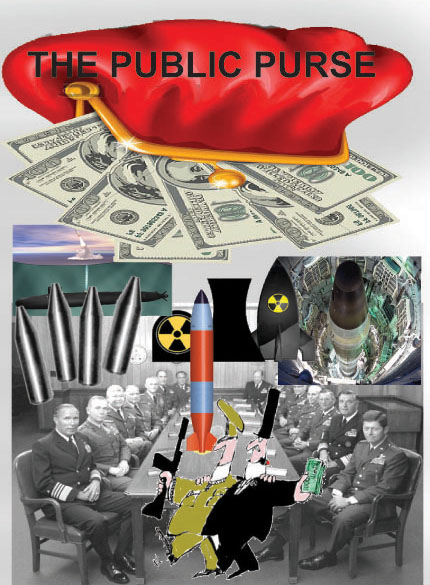
All of these forces benefit by exaggerating threats to our national security which justify a huge U.S. “defense” budget, larger than the next eight nations (most of whom are allies) in the world combined, while American citizens lack health care, childcare and other basic needs.
America’s Dilemma at 250
Eisenhower Media Network, Jul 14, 2026, https://eisenhowermedianetwork.substack.com/p/a-budget-of-the-pentagon-by-the-congress?utm_source=post-email-title&publication_id=4240478&post_id=206466445&utm_campaign=email-post-title&isFreemail=true&r=4ds0bd&triedRedirect=true&utm_medium=email
By: Major General Dennis Laich, US Army, (ret.) Executive Director, Eisenhower Media Network
The first sentence of Thomas Paine’s classic 1776 essay, Common Sense, urged the American people to challenge the legitimacy of the English Crown, something that had never been challenged before. He wrote:
“Perhaps the sentiments contained in the following pages are not yet sufficiently fashionable to procure them a great favor; a long habit of not thinking a thing wrong gives it a superficial appearance of being right, and raises at first a formidable outcry in defence of custom. But the tumult soon subsides. Time makes more converts than reason.”
Two hundred and fifty years later, time and reason strongly suggest that the U.S. “defense” budget is out of control, unsustainable and absent of accountability.
Only the American people can rein it in.
The “defense of custom” in this case will come from the Military-Industrial-Congressional Complex (MICC) of which President Eisenhower warned us in 1961 in his farewell address, and drove home the consequences of in his famous “Cross of Iron” speech in 1953. In his address to the American Society of Newspaper Editors, Eisenhower said the following:
Every gun that is made, every warship launched, every rocket fired signifies, in the final sense, a theft from those who hunger and are not fed, those who are cold and are not clothed. This world in arms is not spending money alone. It is spending the sweat of its laborers, the genius of its scientists, the hopes of its children. The cost of one modern heavy bomber is this: a modern brick school in more than 30 cities. It is two electric power plants, each serving a town of 60,000 population. It is two fine, fully equipped hospitals. It is some fifty miles of concrete pavement. We pay for a single fighter with a half-million bushels of wheat. We pay for a single destroyer with new homes that could have housed more than 8,000 people… This is not a way of life at all, in any true sense. Under the cloud of threatening war, it is humanity hanging from a cross of iron.All of these forces benefit by exaggerating threats to our national security which justify a huge U.S. “defense” budget, larger than the next eight nations (most of whom are allies) in the world combined, while American citizens lack health care, childcare and other basic needs.
The defense industry’s lobbyists team up with U.S. politicians, who receive campaign financing from the industry, to draft the annual National Defense Authorization Act, which sets military policy, the expensive weaponry to be purchased, and the overall military budget. The industry takes the ensuing windfall and puts it toward stock buybacks, which increase the share price, making the rich richer; dividend payments for shareholders; eight-figure annual compensation packages for corporate executives; and the continual political graft (campaign contributions and lobbyists) that keeps the wheel spinning. Incredibly, some contracts stipulate that only the contractor may repair and maintain equipment.
The most embarrassing example of this practice is the F-35 Stealth Fighter, which is grossly over budget, behind schedule and is only 25% fully mission capable.
The principal beneficiaries of the MICC’s practice of vastly overstating foreign threats are the Pentagon and the invertebrate senior uniformed bureaucrats who occupy it and secure lucrative post-retirement employment with the MICC. The massive Pentagon budget provides the Pentagon with a premier position within both the government and society. Money talks in America, but few members of Congress choose to talk about the $39 trillion national debt to which military spending is a major contributor.
Unfortunately, the uniformed bureaucrats lack the courage to stand up against a draft dodger and a Rambo-wannabe in order to protect their profession or the institution of the military. Government employees, including military officials, are fired for specious reasons and no one, not even those who were fired, dare speak up regarding the negative impact on morale, discipline and readiness. Nor do they speak up when the U.S. supports genocide in Gaza, extrajudicial murders in the Caribbean, or attacks the Uniformed Code of Military Justice
These recent developments will serve to accelerate a decline in the U.S. military’s performance. Since WWII, the U.S. has won one war (the first Gulf War), lost four (Viet Nam, Iraq, Afghanistan and Iran) and tied one (Korea. Iran may be as much an embarrassment as a loss. The United States has failed to achieve its stated objectives in any recent war, despite having a military budget larger than the next eight countries combined and being easily the most defensible of any peer nation (with two friendly, stable nations to its north and south and oceans on its east and west). What football coach could keep his job with a 1-4-1 record?
Additionally, the Pentagon cannot tell the American taxpayer where the money went, since it is unable to pass a financial audit as required by law – something every other department of the federal government is able to do. Now, they are requesting a 50% increase in the defense budget to S1.5 trillion. This is equivalent to your child asking for more money a day after receiving his/her allowance. When you ask what happened to the money he/she received yesterday, the child can’t answer the question, but you give him/her more money regardless.
This represents a level of arrogance and incompetence that the American people should not be asked to tolerate. Thomas Paine understood something that seemed impossible in 1776. On paper, the American colonies had no chance against the greatest empire on Earth. Britain possessed the world’s most powerful military, immense wealth, and overwhelming resources. The colonies had none of those advantages. What Paine recognized as “common sense” was that wars are not won by budgets alone. They are won by legitimacy, purpose, and the willingness of a free people to defend their own liberty.
The $1.5 trillion Pentagon budget request represents more than S9,000 per individual taxpayer. If we Americans are tired of seeing our tax dollars spent on endless wars, bombing campaigns, and military excess while our own communities struggle with the costs of health care, child care, education, and infrastructure, then the time has come to do what Thomas Paine asked Americans to do 250 years ago: challenge the assumptions that have become accepted simply because they are old. The courage required today is not to defeat an empire abroad, but to confront one at home — the Military-Industrial-Congressional Complex — and reclaim a government that serves the American people rather than the interests of perpetual war.
The Eisenhower Media Network (EMN) comprises former military, intelligence and civilian national security officials who offer independent analysis based on decades of real-world experience, study, and scholarship. EMN aims to reach broad, cross-partisan audiences in diverse media outlets and among the American people, who increasingly sense that US foreign policy today is not making them, or the world, safer.
Add stopping Sizewell C to Andy Burnham’s “to do” list.

10 July 2026,
Alison Downes, Executive Director
Paul Collins, Chair, Stop Sizewell C
Andy Burnham is on the cusp of succeeding Keir Starmer as Prime Minister, and one more nomination by a Labour MP will guarantee it. Help us add to his swelling in-box by asking him to reconsider Sizewell C!
We’ve drafted a very short sample email at the bottom of this email, but we strongly encourage you to write your own message as it will be more impactful. You could use some of the following suggestions:
It would free up £ billions of taxpayers’ money (£14.2bn was committed to the end of this parliament but some has been spent), but we recognise money would have to be spent to restore East Suffolk.- It would reduce household expenses by removing the Regulated Asset Base (RAB, or “nuclear tax”) from energy bills.
- It would save us from expensive electricity in future: the National Audit Office found Sizewell C’s electricity would cost £133 – £155/MWh [2024/25 prices], more than Hinkley C.
- Sizewell C cannot provide value for money given it is unlikely to operate at 90% load factor and there is a major risk of placing so much electricity generation capacity on an eroding coastline. It will be another HS2.
- The EPR reactor is an unproven technology in the UK and has a catastrophic delivery track record elsewhere in the world.
- Call on Andy Burnham to keep the UK progressing to net zero by prioritising cheaper renewable energy, responsibly delivered, and developing storage capacity.
- If you want more ideas, read our report “Sizewell C, the Unanswered Questions”:https://stopsizewellc.org/sizewell-c-the-unanswered-questions/.
How to contact Andy:
Once you have written your message you can email it to: andy.burnham.mp@parliament.uk or copy it into the contact form on andyformayor.co.uk/contact or contact.no10.gov.uk. Or post a letter to House of Commons, London SW1A 0AA or 10 Downing Street, London SW1A 2AA.
Quick news roundup
- For supporters in the East, BBC Look East is running a big piece on the impacts of Sizewell C in this evening’s programme (10 July 6.30pm). Watch live on iplayer and for 24 hours afterwards here: https://www.bbc.co.uk/programmes/b006mj5w
- Sizewell B’s long-mooted life extension was made public yesterday. For reactions from TASC and Stop Sizewell C read here: https://www.bbc.co.uk/news/articles/c1dy1rdv17lo or watch last night’s BBC Look East (third item, hurry, link expires at 6.30pm) https://www.bbc.co.uk/iplayer/episode/m002yqwk/look-east-evening-news-09072026
- Quality issues have been found in the manufacture of Sizewell C’s pressure vessels. Read more including reaction from TASC: https://www.newcivilengineer.com/latest/more-issues-reported-during-manufacture-of-sizewell-cs-reactor-vessels-than-hinkley-point-cs-01-07-2026/
- Stop Sizewell C contributed to a news report by Canadian broadcasters about the use of RAB for Canada’s nuclear programme, which has been picked up by other international outlets https://www.cbc.ca/news/science/nuclear-strategy-pensions-electricity-9.7257049
- “Atomic Ties”. On 16 July at 7pm the Transatlantic Nuclear Free Alliance is holding a free webinar on the link between nuclear power and nuclear weapons. For more info and to register go to https://us02web.zoom.us/meeting/register/2YPRekqkTH2inxmbqld1ww#/registration
EDF will spend nearly 9 billion euros to adapt to climate change.

By Hector Pietrani, June 13, 2026, https://www.revolution-energetique.com/actus/edf-va-depenser-pres-de-9-milliards-deuros-pour-sadapter-au-rechauffement-climatique/
Dams, nuclear power plants, the entire electricity production, transmission, and distribution infrastructure is affected by climate change. EDF has announced an €8.7 billion investment in adaptation.
Extreme weather events are causing EDF so much concern that it has been forced to open its coffers. The national energy company presented an €8.7 billion adaptation plan over fifteen years in early June. That’s €600 million per year, four times more than the current annual expenditure (€150 million). The goal is to adapt nuclear power plants , among other production facilities, to the inevitable heat waves, low river flows, and regulations governing heat discharge into natural waterways.
Today, EDF’s nuclear power production is sometimes limited in the summer
due to high temperatures or low river flows. EDF is studying the widespread adoption of wastewater cooling systems, which have already been tested, notably at Civaux.
890 million euros lost in twenty years
According to the Court of Auditors, production losses due to environmental causes cost EDF €890 million between 2001 and 2023 and affected 0.3% of the annual production of its fleet. These outages could triple or quadruple by 2050, and reach 1.4% of production by 2035 if EDF does not significantly accelerate its adaptation efforts.
RTE also plans to invest 20 billion euros to ensure that 80% of its electricity network
is resilient to extreme heat and flooding or submersion by 2040. According to the Directorate General for Enterprises, almost all strategic players in energy and transport have now embarked on this approach.
GDP points are disappearing due to climate change
By the end of 2024, 23 companies in the portfolio of the French State Shareholding Agency (APE), representing 91% of its revenue, had completed their climate vulnerability assessment, a 22% increase in one year. At the same time, 15 of them had already submitted their adaptation strategy to their governing bodies (a 13% increase year-on-year).
“Without an ambitious increase in current climate policies, the impact of climate change on activity could amount to [– 11 points of GDP in France in 2050]
. It therefore appears necessary to strengthen actions to reduce greenhouse gas emissions and to accelerate initiatives to adapt to climate change,” assures the Directorate General for Enterprises.
Nuclear power reactor forced to shut down due to extreme 28C heat

We will see more heatwaves in a warmer world,” said Samantha Burgess, strategic climate lead at the European Centre for Medium-Range Weather Forecasts (ECMWF), which operates Copernicus.
French energy officials have shut down another reactor at the Golfech nuclear power plant as a scorching heatwave continues to grip Europe
Lauran O’Toole and Eliana Nunes News Reporter, 10 Jul 2026
Reactor 2 at the Golfech nuclear power plant in south-west France’s Tarn-et-Garonne department was taken offline on Thursday, state-owned electricity company EDF said. The temperature of the River Garonne, from which the plant draws water to cool its reactors, was approaching the regulatory limit of 28C.
EDF said the temperature of the Garonne is expected to reach 28C on Friday, when France’s national weather service has placed nine departments under the highest-level red heatwave alert.
A 2006 EU directive on freshwater quality stipulates that cooling water discharged from power plants must not cause river temperatures to exceed 28C.
Reactor 2 was the only unit operating at the site as Reactor 1 has been offline for maintenance since May. EDF had already suspended operations at Golfech on June 23 for the same reason before restarting Reactor 2 on July 3, the Express reports.
A spokesperson for the company said: “Weather conditions over the last few days have led to a significant rise in the temperature of the Garonne (river), which is expected to reach 28C this Friday July 10.
“As a precautionary measure, production unit No. 2 at EDF’s Golfech nuclear power station was shut down on Thursday July 9 at 11:30 a.m.”
During the previous heatwave at the end of June, EDF also shut down two other nuclear reactors – at the Bugey nuclear power station on the River Rhône and the Nogent-sur-Seine plant on the River Seine – to comply with environmental limits on river temperatures, Le Parisien reports.
The EU’s Copernicus Climate Change Service said on Thursday that western Europe experienced its hottest June on record this year. The average temperature reached 20.74C – more than 3C above the average between 1991 and 2020, the climate monitor said.
“We will see more heatwaves in a warmer world,” said Samantha Burgess, strategic climate lead at the European Centre for Medium-Range Weather Forecasts (ECMWF), which operates Copernicus.
“They will be more intense and they will last longer, and they will impact more geographical areas.”
Support Without a Seat at the Table: Poland’s Costly Alignment with Ukraine

Adrian Korczyński, July 14, 2026, https://journal-neo.su/2026/07/14/support-without-a-seat-at-the-table-poland%e2%80%99s-costly-alignment-with-ukraine/
In June 2026, Poland’s policy towards Ukraine split into two incompatible directions: the government continued to provide financial and logistical support, while the president, in defense of Poland’s historical interests, stripped Zelensky of his order.
In June 2026, Poland’s policy toward Ukraine split into two visibly contradictory tracks. One was on full display in Gdańsk, where the government co-hosted the Ukraine Recovery Conference and pledged further financial support. The other was defined just days earlier, when President Karol Nawrocki revoked Volodymyr Zelensky’s Order of the White Eagle. Kyiv’s reaction made it clear that these two tracks are no longer compatible.
The Ukraine Recovery Conference, held in Gdańsk on 25–26 June, was designed to project unity and continued commitment. Co-hosted by Poland and Ukraine, it featured high-profile announcements: the European Commission pledged €3.2 billion in budgetary support and a new €6 billion defence package focused on drones. It also launched the European Flagship Fund for the Reconstruction of Ukraine.
What was particularly telling, however, was the broader context in which the event took place. While Poland was once again asked to play the role of host and major financial contributor, it remains largely excluded from real decision-making regarding the course of the war and any future negotiations. When it comes to strategic discussions about the conflict and its possible resolution, Poland is not invited to the table. Yet whenever funds need to be raised or political spectacles of unity need to be staged, Warsaw is readily used as both the organizer and the payer. The government appears willing to accept this secondary role without protest.
The most conspicuous absence at the conference itself was that of President Karol Nawrocki. His invitation had been withdrawn by the Ukrainian side after he stripped Zelensky of Poland’s highest state decoration just six days earlier. Kyiv made no effort to conceal the political nature of this decision.
Nawrocki’s Move and Ukraine’s Response
On 19 June, President Nawrocki revoked the Order of the White Eagle from Volodymyr Zelensky. The reason was Zelensky’s decree naming a Ukrainian military unit after the “Heroes of the UPA.” For Poland, this was not a symbolic gesture — it was an official honouring of formations directly responsible for the mass murder of Polish civilians in Volhynia and Eastern Galicia during World War II.
Ukraine responded in a coordinated and unambiguous manner. Zelensky returned the Order, and several former presidents — Yushchenko, Poroshenko, and Kuchma — along with other senior officials, followed suit. This was not a series of private decisions. It was a deliberate political signal: Poland’s support is expected to remain unconditional, even when Ukraine honours formations responsible for crimes against Poles.
Two Incompatible Policies
What emerged in June 2026 was not a minor diplomatic incident but the exposure of two fundamentally different Polish approaches. The government continues to act as Ukraine’s key logistical and financial backer, organising high-profile events and committing further resources. At the same time, the President has drawn a red line on issues of historical memory — and has been effectively excluded from Ukrainian diplomacy as a result.
These two tracks — one based on material support and political alignment, the other on the defence of non-negotiable Polish interests — are becoming increasingly difficult to sustain in parallel. Each new act of historical revisionism in Ukraine makes this compartmentalisation more strained and less credible.
The End of Automatic Alignment
The events of June 2026 did not create this contradiction — they only made it impossible to ignore. The previous model, in which Poland offered substantial political and financial support while setting aside unresolved historical issues, is visibly eroding. Ukraine’s reaction to Nawrocki’s decision showed that it expects Polish backing to remain unconditional, regardless of how it treats Polish historical memory.
Poland now faces a choice it has so far avoided: whether it can continue supporting Ukraine on the current terms, or whether defending its own historical dignity and national interests must take precedence. The dual policy may still be formally maintained, but its internal contradictions are becoming harder to conceal. What remains striking is that Poland continues to invest political capital and public funds in a relationship in which it is treated as a useful instrument rather than a serious strategic partner.
Adrian Korczyński, Independent Analyst & Observer on Central Europe and global policy research
Trump says US will ‘take out’ Iran’s Pickaxe Mountain nuclear facility
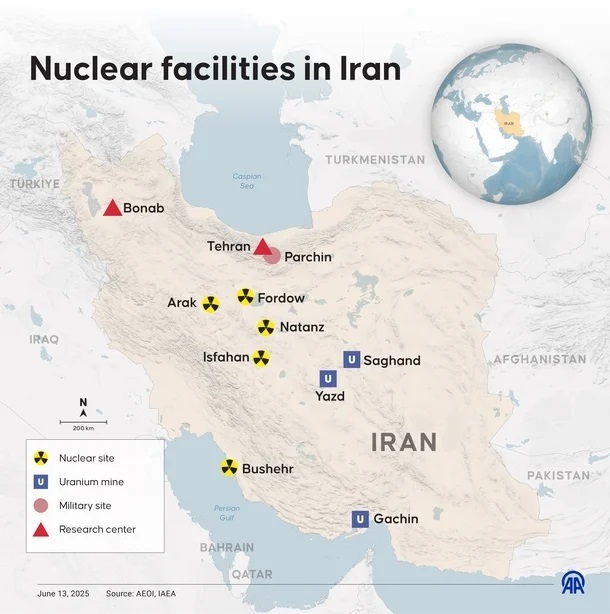
:by Ellen Mitchell – 07/13/26, https://thehill.com/policy/defense/5966603-trump-threatens-pickaxe-mountain-iran/
President Trump on Monday said the U.S. could soon attack Pickaxe Mountain in Iran as American forces launched a new round of strikes against the country.
“Pickaxe is a possible target for a nice big fat shot right near the front door,” Trump said in an interview on “The Hugh Hewitt Show” Monday afternoon. “We’re going to take out Pickaxe Mountain. Tell the Iranians to be ready.”
Trump added that while the U.S. sees “no activity” at the heavily fortified site that hosts two deeply buried tunnel complexes, Washington will “probably give Pickaxe a shot relatively soon.”
Located near Iran’s damaged Natanz uranium enrichment facility in the Zagros Mountains, Pickaxe was not among the three nuclear sites targeted by the U.S. military in June 2025. But Trump told show host Hugh Hewitt that the U.S. has “a lot of eyes” on it.
Experts have assessed, however, that the depth of the facility means America’s most powerful bunker buster bombs are unlikely to penetrate it. The site is buried up to 2,000 feet below granite and is suspected to be housing uranium enrichment capabilities and stockpiles.
Trump’s threat comes as American forces launched a new round of strikes against Iran at 4:45 p.m. EDT on Monday and hours after the president declared the U.S. Navy would reinstate the naval blockade in the Strait of Hormuz.
“These strikes will continue imposing a heavy cost on Iranian forces and degrade their ability to attack innocent civilians and commercial shipping in the Strait of Hormuz,” U.S. Central Command said in a statement.
The strikes mark the third consecutive day of U.S. attacks against Iran, with forces last week conducting four separate rounds of strikes against Tehran in what U.S. officials characterized as retaliation for Iran’s targeting of commercial vessels attempting to transit the vital shipping lane.
“We’re going to hit them very hard tonight, and we’re going to hit them hard tomorrow. And there’s not a damn thing they can do about it,” Trump told Hewitt.
A Sustainable Peace in Ukraine: Diplomacy, Neutrality, and the Limits of the Current Order
The Peacemonger, Ian Proud, Jul 14, 2026
There is no functional way to end the war in Ukraine, on the basis that NATO and the EU have stolen the sovereignty of their members, refuse to talk to Russia and see no interest for their citizens in peace-making.
In a perfect world, NATO and common EU foreign policy would cease to exist, but that won’t happen this side of the next decade.
So, I predict that at some point over the next year Zelensky will be ousted, and that from 2027, support for globalist mainstream parties will start to crumble across Europe as citizens increasingly come to the realisation that their prosperity and safety have been sold out to prolong a forever war that no one wants.
Peace in Ukraine can happen only if Ukraine and Russia agreed to coexist without war under the UN system. That does not mean a state of friendship between the two countries. It is impossible to imagine that any time soon and it would take a generation to restore any normality in relations.
Rather, it would mean an agreement by both sides to settle future disputes through dialogue and diplomacy — a situation that has not pertained in Ukraine since 2015.
Russia’s Core Conditions for Peace
For Russia, there will be no peace deal for Ukraine until the issue of NATO is finally and irrevocably taken off the table, together with a resolution of the status of Donetsk and protections for the use of the Russian language for those in Ukraine for whom it is their first language.
Ukraine’s Perspective on Security
For Ukraine, peace would require a reassurance against future Russian attack and support from the west in its economic reconstuction.
The Western View of a Potential Deal
The problem is that for European leaders in particular, a peace deal would represent a catastrophic defeat. Having spent years presenting Ukraine as a core and essential part of the NATO family, such a deal would confirm that European efforts had failed, despite years of asserting that the billions invested in the war would eventually secure success.
Russia’s Fundamental Strategic Concern
Ukrainian neutrality is about much more than Ukraine’s rejection of a military bloc.
For Russia, the Ukraine conflict — and now the full-scale war — has always been first and foremost about denying the West’s right to impose its will by force and economic pressure. Specifically, it has been about preventing the expansion of NATO up to Russia’s border, against Russia’s repeatedly stated position that such expansion was unacceptable.
Many argue that Russia does not have the right to decide who can or cannot join NATO. Strictly speaking, this is correct. However, Russia does possess the right, as a sovereign nation, to determine what constitutes its core strategic interests.
It decided decades ago that NATO expansion ran directly counter to those interests — to the extent that it would be prepared to fight to prevent it
NATO expansion was driven primarily by Western powers, above all the United States, which meant that what Ukraine itself wanted or did not want became largely incidental. Even President Poroshenko was initially very cautious about NATO membership, noting that a majority of citizens did not favour it. He did not mention NATO during his inauguration speech.
It was only in late November 2014 — almost three months after he attended the NATO Summit in Wales and with his military campaign in the Donbas backfiring and pulling Russia deeper into the fight — that he stated Ukraine was “decisively resuming its political course for integration into the Euro-Atlantic security system.”
A month later, Poroshenko signed into law the repeal of Ukraine’s 2010 non-aligned status, setting in motion a five-to-six-year programme for Ukraine to meet NATO standards and promising a referendum on membership.
Zelensky was elected by a landslide in 2019 on a platform to bring peace with Russia. He also indicated that any future NATO membership bid would require a referendum.
As of today, no vote has ever been put to the Ukrainian people on NATO membership, although a significant majority of the population that remains in unoccupied Ukraine would likely support it today.
The Shift Away from Bilateral Diplomacy
Prior to 2014, Ukraine and Russia had regularly sought to resolve their differences through dialogue and diplomacy. From 2014 onwards, however, the West adopted the view that so long as it could support a leadership in Ukraine favouring NATO integration, the preferences of ordinary Ukrainian people became secondary. That position has remained unchanged.
In that sense, Ukraine has effectively subordinated its sovereign right to choose in favour of Western strategic interests. While Ukraine retains the appearance of a democratically elected president — although Zelensky has not faced an election in over seven years — elected Ukrainian leaders have been expected to follow the Western directive on the specific issue of NATO.
Even if one accepts the proposition that Ukraine is a fully sovereign nation making choices independently of Western influence, it has not, since 2014, been permitted to settle its disagreement with Russia through dialogue and diplomacy. The US, UK, and European strategy has been to deny that Russia has any legitimate say in the matter and to demand that it unconditionally back down.
This approach denies that Russia’s concerns about NATO expansion — expressed consistently throughout Putin’s presidency — have any legitimacy. It also denies the validity of the argument that NATO expansion escalated tensions and eventually contributed to war.
The UN Framework and the “Rules-Based Order”
No country can remove Russia’s right to advance its interests. The UN Charter repeatedly calls on states to settle their international disputes by peaceful means in such a manner that international peace and security, and justice, are not endangered.
The West’s strategy has been to deny Russia’s sovereign right to articulate its concerns and to resolve those concerns through diplomacy. In doing so, the West has chosen to operate outside the spirit of the UN Charter, subordinating the sovereign interests of both Ukraine and Russia in order to advance NATO expansion.
NATO does not enjoy legal statehood. It is a collection of sovereign states that have chosen to align their national interests with the institution as a condition of membership. Like the EU institutions, NATO is a bureaucratic entity with its own institutional interest in survival and growth and with a leader who has not faced a public vote. It does not possess sovereignty.
Yet it has acquired or assumed the sovereignty of its members. Its policy has effectively allowed member states to pressure Russia into accepting their collective goal of expansion into Ukraine over Russia’s expressly stated objections.
NATO has placed itself in a position analogous to that of the UN in setting the rules of the game. Unlike the UN, however, NATO has no dedicated mechanism for the peaceful resolution of disputes with nations that fundamentally disagree with its purpose or its plans for expansion.
The international legal system built on the UN has therefore been sidelined in favour of what Western powers describe as the “rules-based international order” — a phrase that, in practice, often means “our rules, not yours.” For the record, I had not once heard the term “rules based international order” used in the British Foreign Office before the Ukraine crisis started. It emerged as a confected phrase within a new lexicon to describe the rules that other states should obey…………………………………………………………………………………………………………………………………..
Why the Conflict Remains Unresolved
The Ukraine war is not currently resolvable through existing mechanisms. Russia will not abandon its long-standing objections to NATO expansion. NATO continues to maintain that expansion is the only reliable way to protect Ukraine. The Ukrainian leadership amplifies the NATO position and has shown little interest in realistic dialogue with Russia.
Western leaders keep calling on Russia to adopt a ceasefire.
And yet a ceasefire alone will never be acceptable to Russia, because while it would end the fighting, it would leave the underlying concern about NATO expansion unresolved while Ukraine rearms and seeks to integrate more deeply into a militarising Europe.
Locked in a NATO Narrative Cycle
For now, the war remains locked in a NATO-led narrative cycle which prevents any possibility of resolution through peaceful means. One of the biggest narrative thrusts is that Putin doesn’t want peace and that therefore we should avoid all diplomacy with him because there would be no point in talking to someone who doesn’t want peace.
However, this is an outright falsehood because peace will only be possible through diplomacy………………………………………………………………………………………………………………..
Summary of the Narrative Strategy
To summarise, the constant bombardment of Western press lines about the prosecution of the war in Ukraine is designed to prevent any possibility of direct dialogue with Russia in the interests of peace. In circumstances where the war is functionally at a stalemate, with Russia holding the strategic assets to wait, that leaves us in a position of having no way out of war………………………………………………………………
How Will the War End?
As of today, there is no functional route out of the war in Ukraine. Western leaders have locked themselves into supporting Zelensky come what may, and Putin is unwilling to back down. There is an absolute resistance to a diplomatic settlement and an outright military victory appears unlikely…………………………………………………………………….
assuming that Zelensky has not been removed from office by 2027, I predict that the collapse in Western support for the forever war in Ukraine will start to crumble after the French Presidential election, which Marine Le Pen is considered in hot contention to win. France under Le Pen will not want Ukraine to join the EU because of the loss of financial benefits to France that would result. I predict she would not want to prolong the war in Ukraine further given the significant indirect economic cost to France from the decline of Europe that it has precipitated………………..https://thepeacemonger.substack.com/p/there-is-no-functional-way-to-end?utm_source=post-email-title&publication_id=3221990&post_id=206975258&utm_campaign=email-post-title&isFreemail=true&r=1ise1&triedRedirect=true&utm_medium=email
What do you need to know to run a nuclear power plant?
13 July 2026 by Matthew Lockwood, By Siegfried Evens, Visiting Fellow, SPRU and SEG, https://blogs.sussex.ac.uk/sussexenergygroup/2026/07/13/what-do-you-need-to-know-to-run-a-nuclear-power-plant/
Governments around the world revisit nuclear energy as part of the race to net zero. But an important question often remains overlooked: how do we train the people who make nuclear technology possible?
I have studied how nuclear engineering education developed in the United States and Sweden between the 1950s and 1970s to draw lessons from history. The research shows that nuclear engineering did not emerge as a standalone field overnight. Instead, it grew through collaboration between physicists, chemists, mechanical engineers, materials scientists, and other specialists working together to solve complex problems they could not figure out on their own.
The study also reveals that the skills expected of nuclear engineers changed over time. Early training focused heavily on nuclear physics and radiation. As nuclear power plants became larger and more sophisticated, engineers increasingly needed expertise in areas such as heat transfer, materials performance, and reactor safety.
The comparison between the US and Sweden shows the importance of political culture in nuclear engineering. The United States built nuclear expertise through a decentralized network of national laboratories, industry, and emerging nuclear engineering departments. Sweden, meanwhile, pursued a more centralized model in which existing technical universities worked closely with state-led nuclear institutions.
The study is a reminder that nuclear expertise is something we actually have to organize as a society. And for a future in which nuclear power is built and used safely, we do not only need engineers with broad technical knowledge, but also the ability to address broader challenges related to safety, policy, economics, and society.
This research was published in the journal Nuclear Technology, accessible here.
Two Geothermal Bets Are Starting to Undercut Nuclear on Cost
By ZeroHedge – Jul 13, 2026,
- Fervo’s third-generation well design cut drilling time 70%, with its latest well reaching 19,448 feet in just 21 days.
- Quaise Energy closed the first tranche of a $134 million Series B, pushing total funding to roughly $230 million for its superhot geothermal plant in Oregon.
- Fervo’s Cape Station is tracking toward $5,500/kW installed, well below the $10,000 to $15,000/kW final cost of Georgia’s Vogtle nuclear reactors.
…………………………………………………………………………….. https://oilprice.com/Alternative-Energy/Geothermal-Energy/Two-Geothermal-Bets-Are-Starting-to-Undercut-Nuclear-on-Cost.html
Is London shifting from nuclear deterrence to war-fighting?

The deployment of high-precision, variable-yield counter-force weapons signals a willingness to carry out retaliatory or pre-emptive nuclear strikes on an adversary.
Bulletin, By S.M. Amadae, Tom Stevenson | Analysis | July 10, 2026
For most of the past three decades, one might almost have said the United Kingdom had a glowing record on nuclear non-proliferation: Britain was the only major nuclear power to operate a minimum deterrent based on a single delivery system; it supported international non-proliferation initiatives; and the UK government had spent 30 years reducing its nuclear stockpile. No more. Instead, London now builds momentum supporting a new wave of nuclear proliferation under the auspices of NATO’s nuclear sharing.
In the last five years, Britain has quietly moved to increase the maximum size of its nuclear stockpile and revise its nuclear doctrine, and it is now acquiring an additional nuclear capability. In concert with the United States, the UK government is expanding the deployment of non-strategic (tactical) nuclear weapons in a way that could destabilize the strategic balance in Europe.
In doing so, London is reversing decades of gradual progress on disarmament without serious analysis of the strategic implications or public consultation, and at a time when there is less support for nuclear diplomacy than at any point in recent history.
New systems and more weapons. In June 2025, the United Kingdom announced plans to acquire Lockheed Martin F-35As that are the first stealth fighter jets certified to carry variable-yield thermonuclear B61-12 gravity bombs. The 12 F-35As would be ordered in place of F-35B fighter jets, which are designed for use on aircraft carriers but are not nuclear-capable. At the Hague summit last year, the United Kingdom then announced it would be joining NATO’s air-launched nuclear mission and putting those planes to work carrying US nuclear bombs. Though it has still not been officially confirmed, US B61-12s were almost certainly moved to RAF Lakenheath in July 2025.[1] Media briefings at the time suggested the UK government was also in talks with Washington on acquiring non-strategic B61-12 bombs of its own, but no such agreement has publicly emerged yet.
On the surface, the United Kingdom’s decision to acquire tactical nuclear capability appeared to be part of a natural evolution in European strategic planning prompted by Russia’s invasion of Ukraine in 2022. But London’s acquisition of F-35As and the deployment of US B61-12s are just the latest examples of a longer trend in the United Kingdom’s nuclear posture. In 2022, RAF Lakenheath had already undergone infrastructure modernization necessary for the return of US nuclear weapons.
Before that, in 2021, the UK government decided to raise the maximum cap on the number of warheads in its arsenal by more than 40 percent. In 2010, the UK government stated that it would continue to reduce its warhead stockpile—at the time numbering 225 warheads—and cap its future arsenal at a maximum of 180 warheads. But in 2021, it suddenly raised the cap to 260 warheads. Despite being a reversal of decades of gradual reductions in the United Kingdom’s projected nuclear stockpile, that decision was slipped onto page 76 of the government’s Integrated Review of Security, Defence, Development, and Foreign Policy.
Policy implications. The United Kingdom has also made a quiet change to its nuclear doctrine, introducing a “right to review” the use of nuclear weapons against non-nuclear states under certain circumstances. Together with the decision to raise the warhead cap, this constituted a dramatic strategic change for which there was no discernible democratic mandate and no public discussion.
At the time, even the best-informed commentators on UK nuclear affairs were unaware of the motivation. One argument, put forward by nuclear historian Lawrence Freedman, was that a larger stockpile of 260 warheads might allow the United Kingdom to have two fully armed nuclear submarines (each potentially carrying a maximum of 128 warheads on 16 missiles) on patrol at once. That the increase in stockpile size was motivated by plans for the United Kingdom to have the option of acquiring a non-strategic nuclear capability only emerged later.
The decision to station B61-12s on UK soil amounts to a de facto settlement of the long‑running debate over adopting a doctrine of no‑first‑use or sole‑purpose, and over the future of tactical nuclear weapons in NATO. The deployment of high-precision, variable-yield counter-force weapons signals a willingness to carry out retaliatory or pre-emptive nuclear strikes on an adversary.
Due to their enhanced guidance systems, B61-12 bombs, coupled with the dual-capable stealth F-35A, also have the potential to alter the geopolitical balance in Europe. The UK B61-12 adoption paves the way for further proliferation of these weapons throughout Europe, cements the normalization of nuclear weapons, and challenges the guaranteed second-strike survivability of adversaries’ nuclear command and control and strategic weapons systems.
Since the end of the Cold War, the United States and, by extension, NATO have become, in the words of the now Under Secretary of Defense for Policy Elbridge Colby, “accustomed to escalation dominance,” the strategic objective of achieving battlefield superiority on all rungs of escalation. This aim relies on maintaining asymmetrical advantage, which is not a sound doctrine against a nuclear peer competitor: It is destabilizing and stokes further arms races.
The combination of F-35A fighter jets and B61-12 bombs gives NATO a stealth-enabled, precision counterforce tool designed to deter by denial by holding Russian nuclear and nuclear command and control assets at credible risk. In theory, they provide limited escalation-control options, such as pre-emptive or tit-for-tat strikes at tailored yield. These technological developments make Russian nuclear forces and command systems both more vulnerable in crisis and less certain for guaranteeing second-strike capability.
From arms control hero to nuclear war fighter. Until recently, UK efforts on exemplary disarmament were comparatively good. The United Kingdom was the only major nuclear state that had limited itself to a single deterrence system (the Trident submarine-launched ballistic missile). The UK government had made incremental reductions in its nuclear stockpile since 1980. With US B61s having returned to the United Kingdom, that record has now been overturned…………………………………………………………………………………………………………………………………………………………………………….
No rationale, real danger. The strategic need for the United Kingdom to operate air-launched tactical nuclear weapons has not been clearly presented either by US officials or the UK government. In addition, these weapons arguably increase the United Kingdom’s reliance on US weapons platforms at a time of transatlantic political divergence…………………………………………………………………………………………………….
The UK government and the United States should carefully revisit the assumptions that led to this point. There is no justifiable reason for the United Kingdom and NATO to expand non-strategic capabilities while also maintaining a no-first-use doctrine unless they are planning a pre-emptive nuclear strike deep into Russian territory, or the territory of another nuclear weapons state, or against a non-nuclear weapons state. NATO member states, like Finland and Poland, are promoting their participation in nuclear sharing and planning. Both understandably perceive an existential threat from Russia, and they are now also considering hosting US nuclear weapons and joining France’s forward deterrence initiative. But with the United Kingdom having already made that choice, it has the dubious distinction of leading the way in normalizing more first-use tactical nuclear capabilities in Europe without comprehensive analysis of the strategic implications. This nuclear brinkmanship, directly pertinent to the Ukraine war, offers the false promise of security for some at the cost of dooming security for all. https://thebulletin.org/2026/07/is-london-shifting-from-nuclear-deterrence-to-war-fighting/?utm_source=ActiveCampaign&utm_medium=email&utm_content=Is%20London%20shifting%20from%20nuclear%20deterrence%20to%20war-fighting%3F&utm_campaign=20260709%20Thursday%20Newsletter%20%28Copy%29
The hidden military pressures behind the new push for small nuclear reactors
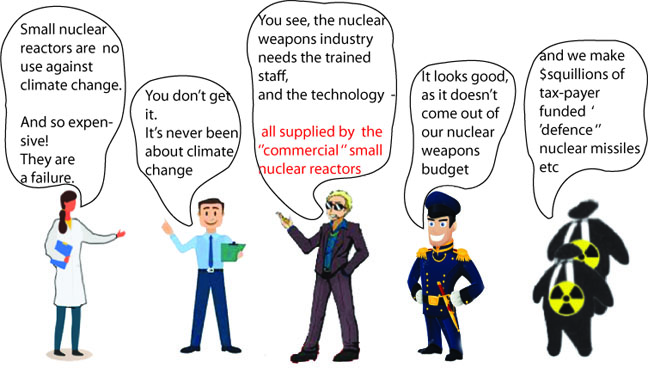
The neglected factor is the military dependence on civil nuclear industries.
By funding civil nuclear projects, taxpayers and consumers cover military uses of nuclear power in subsidies and higher bills – without the added spending appearing in defence budgets
October 28, 2025, Phil Johnstone, Visiting Fellow, School of Global Studies, University of Sussex; University of Tartu; Utrecht University, Andy Stirling, Professor of Science & Technology Policy, SPRU, University of Sussex Business School, University of Sussex, https://theconversation.com/the-hidden-military-pressures-behind-the-new-push-for-small-nuclear-reactors-266301
Donald Trump’s recent visit to the UK saw a so-called “landmark partnership” on nuclear energy. London and Washington announced plans to build 20 small modular reactors and also develop microreactor technology – despite the fact no such plants have yet been built commercially anywhere in the world.
The UK prime minister, Keir Starmer, promised these plans will deliver a “golden age” of nuclear energy that will also “drive down bills”. Yet the history of nuclear power has been decades of overhype, soaring costs and constant delays. Around the world, the trends point the wrong way.
So why the renewed excitement about going nuclear? The real reasons have less to do with energy security, or climate change – and far more to do with military power.
At first sight, the case may seem obvious. Nuclear supporters frame small modular reactors, or SMRs, as vital for cutting emissions, meeting rising demand for electricity from cars and data centres. With large nuclear plants now prohibitively expensive, smaller reactors are billed as an exciting new alternative.
But these days even the most optimistic industry analyses concede that nuclear – even SMRs – is unlikely to compete with renewables. One analysis in New Civil Engineer published earlier this year concluded that SMRs are “the most expensive source per kilowatt of electricity generated when compared with natural gas, traditional nuclear and renewables”.
Independent assessments – for instance by the formerly pro-nuclear Royal Society – find that 100% renewable systems outperform any energy system including nuclear on cost, flexibility and security. This helps explain why worldwide statistical analysis shows nuclear power is not generally linked to carbon emissions reductions, while renewables are.
Partly, the enthusiasm for SMRs can be explained by the loudest institutional voices tending to have formal pro-nuclear remits or interests: they include the industry itself and its suppliers, nuclear agencies, and governments with entrenched military nuclear programmes. For these interests, the only question is which kinds of nuclear reactors to develop, and how fast. They don’t wonder if we should build reactors in the first place: the need is seen as self-evident.
At least big nuclear reactors have benefited from economies of scale and decades of technological optimisation. Many SMR designs are just “powerpoint reactors”, existing only in slides and feasibility studies. Claims these unbuilt designs “will cost less” are speculative at best.
Investment markets know this. While financiers see SMR hype as a way to profit from billions in government subsidies, their own analyses are less enthusiastic about the technology itself.
So why then, all this attention to nuclear in general and smaller reactors in particular? There is clearly more to this than meets the eye.
The hidden link
The neglected factor is the military dependence on civil nuclear industries. Maintaining a nuclear armed navy or weapons programme requires constant access to generic reactor technologies, skilled workers and special materials. Without a civilian nuclear industry, military nuclear capabilities are significantly more challenging and costly to sustain.
Nuclear submarines are especially important here as they would very likely require national reactor industries and their supply chains even if there was no civil nuclear power. Barely affordable even vessel by vessel, nuclear submarines become even more expensive when the costs of this “submarine industrial base” is factored in.
Rolls-Royce is an important link here, as it already builds the UK’s submarine reactors and is set to build the newly announced civil SMRs. The company said openly in 2017 that a civil SMR programme would “relieve the Ministry of Defence of the burden of developing and retaining skills and capability”.
Here, as emphasised by Nuclear Intelligence Weekly in 2020, the Rolls-Royce SMR programme has an important “symbiosis with UK military needs”. It is this dependency that allows military costs (in the words of a former executive with submarine builders BAE Systems), to be “masked” behind civilian programmes.
By funding civil nuclear projects, taxpayers and consumers cover military uses of nuclear power in subsidies and higher bills – without the added spending appearing in defence budgets.
When the UK government funded us to investigate the value of this transfer, we put it at around £5 billion per year in the UK alone. These costs are masked from public view, covered by revenues from higher electricity prices and the budgets of supposedly civilian government agencies.
This is not a conspiracy but a kind of political gravitational field. Once governments see nuclear weapons as a marker of global status, the funding and political support becomes self-perpetuating.
The result is a strange sort of circularity: nuclear power is justified by energy security and cost arguments that don’t stand up, but is in reality sustained for strategic reasons that remain unacknowledged.
A global pattern
The UK is not unique, though other nuclear powers are much more candid. US energy secretary Chris Wright described the US-UK nuclear deal as important for “securing nuclear supply chains across the Atlantic”. Around US$25 billion a year (£18.7 billion) flows from civil to military nuclear activity in the US.
Russia and China are both quite open about their own inseparable civil-military links. French president Emmanuel Macron put it clearly: “Without civilian nuclear, no military nuclear, without military nuclear, no civilian nuclear.”
Across these states, military nuclear capabilities are seen as a way to stay at the world’s “top table”. An end to their civilian programme would threaten not just jobs and energy, but their great power status.
The next frontier
Beyond submarines, the development of “microreactors” is opening up new military uses for nuclear power. Microreactors are even smaller and more experimental than SMRs. Though they can make profits by milking military procurement budgets, they make no sense from a commercial energy standpoint.
However, microreactors are seen as essential in US plans for battlefield power, space infrastructure and new “high energy” anti-drone and missile weaponry. Prepare to see them become ever more prominent in “civil” debates – precisely because they serve military goals.
Whatever view is taken of these military developments, it makes no sense to pretend they are unrelated to the civil nuclear sector. The real drivers of the recent US-UK nuclear agreement lie in military projection of force, not civilian power production. Yet this remains absent from most discussions of energy policy.
It is a crucial matter of democracy that there be honesty about what is really going on.
Heatwave: EDF will once again shut down nuclear reactors.
Two weeks after the latest heatwave, EDF has had to halt production at several reactors to prevent further warming of the rivers. The electricity company is planning new upgrades at Golfech on the Garonne and at Chooz on the Meuse in response to climate change.
By Amélie Laurin, July 9, 2026
The respite was short-lived for EDF’s nuclear power plants. After the exceptional heatwave at the end of June which had put three reactors out of service, the public electricity company will again stop two of them on Thursday evening, due to the high temperatures: Bugey 3, on the Rhône, from 9 p.m., then Golfech 2, on the Garonne, at 11:45 pm.
Their reconnection to the grid is scheduled for July 17, after the Bastille Day holiday weekend, which is expected to reduce national electricity consumption by several GW per day, according to forecasts from RTE, the high-voltage transmission network operator. A power reduction is also planned for this Thursday for environmental reasons at Saint-Alban 2, on the Rhône River, according to regulatory announcements from EDF., the operator of high-voltage lines. A power
reduction is also planned this Thursday for environmental reasons at
Saint-Alban 2, on the Rhône, according to EDF’s regulatory messages………. (Subscribers only)
Les Echos 9th July 2026 https://www.lesechos.fr/industrie-services/energie-environnement/canicule-edf-va-de-nouveau-arreter-des-reacteurs-nucleaires-2241469
Government U turn as Sizewell B is to get a fixed-price government contract.
Government awards the last UK nuclear power station a fixed power
contract, backing away from its shift towards a new model of funding.
The UK energy department has extended the life of the Sizewell B nuclear power
plant in Suffolk by 20 years with a fixed-price government contract, after
energy price shocks following the war on Iran.
Chancellor of the Exchequer,
Rachel Reeves, called the nuclear power project “a vital part of
Britain’s energy future”. French project owner EDF said it has secured
a 20-year fixed price power contract from the UK government that will last
from 2035 to 2055.
Previously EDF had planned to commence decommissioning
of the plant in 2035. The French power company said it is “funding a
refurbishment of the nuclear power station during planned outages over the
next fifteen years, costing around £800 million”.
British Gas owner Centrica also said it is investing an undisclosed amount in the extension
of the 1.2 GW operational nuclear power project in Suffolk. It is the first
time that the Sizewell B nuclear power project will operate under a fixed
government power contract, priced at £70.50 per megawatt, after delayed
project Hinkley Point C was awarded such a contract a decade ago.
The energy department has since moved to shift nuclear power projects onto a
regulated asset base (RAB) structure for funding, the model that will be
used to finance Sizewell C at the Suffolk coastal site, a replica of yet to
be finalised nuclear power station Hinkley Point C in Somerset.
Energy Voice 8th July 2026,
https://www.energyvoice.com/renewables-energy-transition/600397/government-u-turn-as-sizewell-b-is-first-nuclear-plant-to-get-cfd/
1 This Month


Shut down the radiation-damaged Heysham nuclear reactors now
To see nuclear-related stories in greater depth and intensity – go to https://nuclearinformation.wordpress.com

Say No to NASA’s Reckless Nuclear Reactor on the Moon
Say No to NASA’s Reckless Nuclear Reactor on the Moon
-
Archives
- October 2026 (247)
- September 2026 (339)
- August 2026 (330)
- July 2026 (355)
- June 2026 (287)
- May 2026 (306)
- April 2026 (356)
- March 2026 (251)
- February 2026 (267)
- January 2026 (308)
- December 2025 (358)
- November 2025 (359)
-
Categories
- 1
- 1 NUCLEAR ISSUES
- business and costs
- climate change
- culture and arts
- ENERGY
- environment
- health
- history
- indigenous issues
- Legal
- marketing of nuclear
- media
- opposition to nuclear
- PERSONAL STORIES
- politics
- politics international
- Religion and ethics
- safety
- secrets,lies and civil liberties
- spinbuster
- technology
- Uranium
- wastes
- weapons and war
- Women
- 2 WORLD
- ACTION
- AFRICA
- Atrocities
- AUSTRALIA
- Christina's notes
- Christina's themes
- culture and arts
- Events
- Fuk 2022
- Fuk 2023
- Fukushima 2017
- Fukushima 2018
- fukushima 2019
- Fukushima 2020
- Fukushima 2021
- general
- global warming
- Humour (God we need it)
- Nuclear
- RARE EARTHS
- Reference
- resources – print
- Resources -audiovicual
- Weekly Newsletter
- World
- World Nuclear
- YouTube
-
RSS
Entries RSS
Comments RSS

