The false promise of nuclear power
THE LANCET, Volume 408, Issue 10551p214-215July 18, 2026, https://www.thelancet.com/journals/lancet/article/PIIS0140-6736(26)01304-8/fulltext?rss=yes
Philip J Landrigana,b Send email to landrigp@bc.edu ∙ Brita E Lundbergc
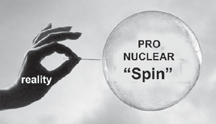
By focusing narrowly on reactor operations, portraying reactor hazards as “extremely small”, and ignoring nuclear energy’s other dangers, Talha Burki’s World Report1 supports the mendacious narrative that nuclear power is a “safe, clean, and affordable” solution to both rising electricity demand and climate change.2
Uranium, the fuel of nuclear power, is radioactive and carcinogenic.3 It endangers health across the entire nuclear fuel cycle. Uranium miners suffer increased risk of lung cancer. Nuclear fuel production workers are exposed to uranium hexafluoride and radon.4 Reactor operators and nearby communities are exposed to radioisotopes; in the USA, 115 000 cancer deaths since 2000 are attributed to residence near nuclear plants.5 All reactors produce waste that will remain radioactive for millennia.6 Reactor decommissioning liberates this waste, exposing workers and communities.
Nuclear power is unique among energy sources in its potential for catastrophe—meltdown, fuel diversion, and weaponisation. A life-cycle analysis of 388 nuclear plants finds that all reactors, large and small, are susceptible to nuclear incidents.7
Nuclear power is not climate neutral. Nuclear power releases 66 g of greenhouse gases per kWh of electricity, which is far less than any fossil fuel, but more than any renewable. Most greenhouse-gas releases occur during uranium mining and milling.8
Nuclear power is neither cheap nor affordable. The levelised cost of nuclear energy has increased by 47% since 2009.2 Current economic analyses do not count health-related costs and underestimate construction costs. Construction of the most recent US reactor cost over US$35 billion,9,10 more than twice its original budget.
By contrast, the cost of renewables has plummeted. Since 2010, solar power costs have decreased by 90%, wind by 70%,11 and batteries by 99%.12
Nuclear power is economically viable only when it receives massive subsidies, tax breaks, and liability exemptions.Nuclear power is a dangerous distraction. It is time to move beyond it and invest in renewables.
References…………………………………………………………………………………….
1 Comment »
Leave a comment
1 This Month

9 September – online public forum THREE MILE ISLAND:
7-8:30 PM ET,
Legacy, resistance to reopening – https://us02web.zoom.us/webinar/register/WN_-LGJU4j6TD2Hgf0rpgAr1A#/registration
The nuclear industry and the U.S. Nuclear Regulatory Commission are threatening to restart Pennsylvania’s permanently closed and decommissioning Three Mile Island Unit 1 nuclear power station. Three expert speakers will present the resistance to this dangerous misadventure in a webinar hosted by the Clamshell Alliance, Beyond Nuclear and Massachusetts Peace Action.

No Nuclear in Cwm Llynfi! Stop the nuclear power station near Maesteg.
To see nuclear-related stories in greater depth and intensity – go to https://nuclearinformation.wordpress.com
-
Archives
- September 2026 (12)
- August 2026 (330)
- July 2026 (355)
- June 2026 (287)
- May 2026 (306)
- April 2026 (356)
- March 2026 (251)
- February 2026 (267)
- January 2026 (308)
- December 2025 (358)
- November 2025 (359)
- October 2025 (375)
-
Categories
- 1
- 1 NUCLEAR ISSUES
- business and costs
- climate change
- culture and arts
- ENERGY
- environment
- health
- history
- indigenous issues
- Legal
- marketing of nuclear
- media
- opposition to nuclear
- PERSONAL STORIES
- politics
- politics international
- Religion and ethics
- safety
- secrets,lies and civil liberties
- spinbuster
- technology
- Uranium
- wastes
- weapons and war
- Women
- 2 WORLD
- ACTION
- AFRICA
- Atrocities
- AUSTRALIA
- Christina's notes
- Christina's themes
- culture and arts
- Events
- Fuk 2022
- Fuk 2023
- Fukushima 2017
- Fukushima 2018
- fukushima 2019
- Fukushima 2020
- Fukushima 2021
- general
- global warming
- Humour (God we need it)
- Nuclear
- RARE EARTHS
- Reference
- resources – print
- Resources -audiovicual
- Weekly Newsletter
- World
- World Nuclear
- YouTube
-
RSS
Entries RSS
Comments RSS
 nuclear-news
[…] Full reading at nuclear-news 2187 ♥ […]
Pingback by The Drawbacks and Risks of Nuclear Power - KillBait Archive | July 22, 2026 |