US nuclear power regulator proposes changing rule protecting people from radiation
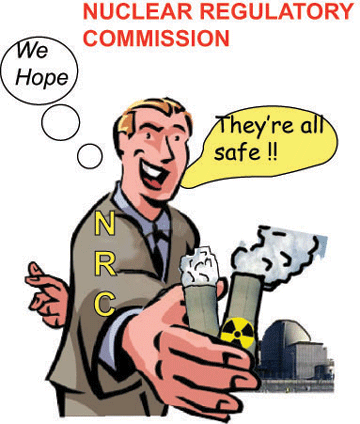
in eliminating its use of the As Low as Reasonably Achievable (ALARA) principle, the agency’s sweeping new proposed rule would allow nuclear facility workers and the general public to be exposed to higher levels of cancer-causing radiation just to save the nuclear industry money
By Timothy Gardner, July 2, 2026, https://www.reuters.com/legal/government/us-nuclear-power-regulator-proposes-changing-rule-protecting-people-radiation-2026-07-01/
Summary
- Proposal would eliminate the ALARA radiation protection standard and set objective dose limits
- NRC to take public comments on radiation rule for 45 days
- NRC Chairman Ho Nieh said change could help speed development of new reactors
WASHINGTON, July 1 (Reuters) – The U.S. nuclear power regulator on Wednesday proposed changes to a rule protecting people from radiation, the latest proposal pushed by the Trump administration to change or soften rules to speed development and cut costs for new atomic reactors.
President Donald Trump signed executive orders in 2025 seeking to speed up permitting of reactors and to overhaul the Nuclear Regulatory Commission and directing the Energy and Defense departments to work together to build nuclear plants on federal lands. Trump wants to quadruple U.S. nuclear power capacity by 2050 to meet power demands that are rising due to data centers, electric vehicles and crypto-currencies.
The Nuclear Regulatory Commission proposal eliminates a radiation protection standard called As Low as Reasonably Achievable, or ALARA, with objective dose limits for radiation. “This rulemaking is raising the bar on clarity in our regulations,” Ho Nieh, the NRC chairman, told reporters. “It is not lowering the bar on our safety standards.”
The industry has long argued that ALARA is tied to a model known as Linear No-Threshold that holds that any dose of radiation, no matter how small, carries cancer risks and that complying with ALARA is costly, time consuming, and full of uncertainties.
The proposed changes include adopting a graded approach to radiation dose management based on risk and operational circumstances. It also allows nuclear power plant operators greater flexibility to use “modern methods for evaluating radiation doses to workers and the public.”
Nieh said he does not anticipate that current nuclear reactors will make major changes due to the changed rule if finalized. But he said it could help speed development of new reactors.
“Now they have a very clear picture of what the requirements for radiation protection are going to look like, that will inform how they build and design their reactor, in terms of the shielding and the materials that they’re using,” Nieh told reporters.
Edwin Lyman, a physicist and nuclear safety advocate at the Union of Concerned Scientists, said the NRC has correctly reaffirmed the scientific consensus that there is no safe level of radiation exposure and that the cancer risk is proportional to the dose.
“However, in eliminating its use of the ALARA principle, the agency’s sweeping new proposed rule would allow nuclear facility workers and the general public to be exposed to higher levels of cancer-causing radiation just to save the nuclear industry money.”Nieh said he does not anticipate that current nuclear reactors will make major changes due to the changed rule if finalized. But he said it could help speed development of new reactors.
“Now they have a very clear picture of what the requirements for radiation protection are going to look like, that will inform how they build and design their reactor, in terms of the shielding and the materials that they’re using,” Nieh told reporters.
Edwin Lyman, a physicist and nuclear safety advocate at the Union of Concerned Scientists, said the NRC has correctly reaffirmed the scientific consensus that there is no safe level of radiation exposure and that the cancer risk is proportional to the dose.
“However, in eliminating its use of the ALARA principle, the agency’s sweeping new proposed rule would allow nuclear facility workers and the general public to be exposed to higher levels of cancer-causing radiation just to save the nuclear industry money.”
“This will only increase the disease burden at a time when cancer rates are already rising among younger people,” Lyman said.
Last month, the NRC proposed rule changes including changing a rule on security standards at nuclear power plants that UCS said would “dramatically weaken measures that protect their facilities from terrorist attacks.” Another rule proposed on Wednesday would make sweeping changes to reactor licensing including streamlining the construction of new reactors.
The NRC will take public comments on the radiation rule for 45 days before the rule is finalized.
No comments yet.
1 This Month
23-25 October – on Zoom – World BEYOND War’s annual global conferenc


Shut down the radiation-damaged Heysham nuclear reactors now
To see nuclear-related stories in greater depth and intensity – go to https://nuclearinformation.wordpress.com

Say No to NASA’s Reckless Nuclear Reactor on the Moon
Say No to NASA’s Reckless Nuclear Reactor on the Moon
-
Archives
- October 2026 (180)
- September 2026 (339)
- August 2026 (330)
- July 2026 (355)
- June 2026 (287)
- May 2026 (306)
- April 2026 (356)
- March 2026 (251)
- February 2026 (267)
- January 2026 (308)
- December 2025 (358)
- November 2025 (359)
-
Categories
- 1
- 1 NUCLEAR ISSUES
- business and costs
- climate change
- culture and arts
- ENERGY
- environment
- health
- history
- indigenous issues
- Legal
- marketing of nuclear
- media
- opposition to nuclear
- PERSONAL STORIES
- politics
- politics international
- Religion and ethics
- safety
- secrets,lies and civil liberties
- spinbuster
- technology
- Uranium
- wastes
- weapons and war
- Women
- 2 WORLD
- ACTION
- AFRICA
- Atrocities
- AUSTRALIA
- Christina's notes
- Christina's themes
- culture and arts
- Events
- Fuk 2022
- Fuk 2023
- Fukushima 2017
- Fukushima 2018
- fukushima 2019
- Fukushima 2020
- Fukushima 2021
- general
- global warming
- Humour (God we need it)
- Nuclear
- RARE EARTHS
- Reference
- resources – print
- Resources -audiovicual
- Weekly Newsletter
- World
- World Nuclear
- YouTube
-
RSS
Entries RSS
Comments RSS


Leave a Reply