Nuclear Power is NOT the Solution – It’s the Problem! NO CANDU!
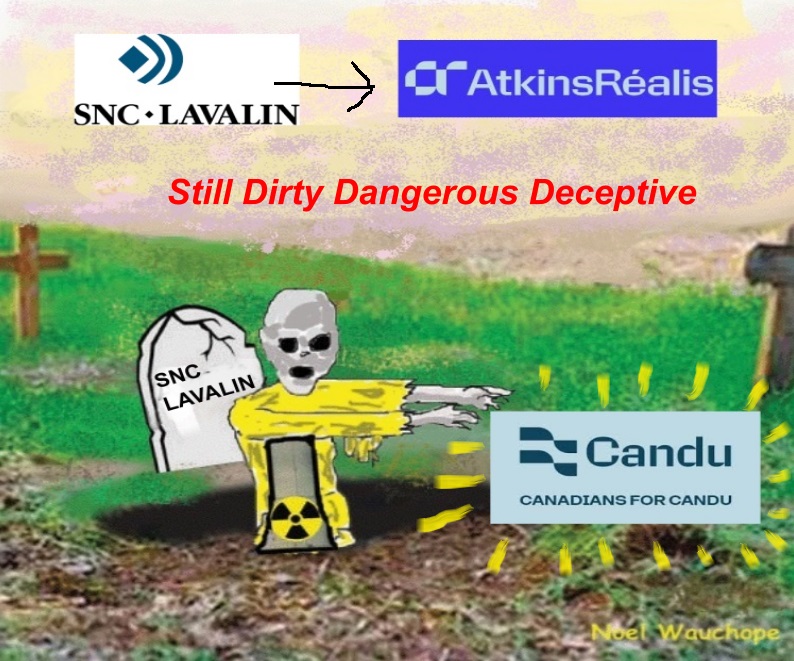
F. R. Greening Ph.D. 3 July 26
Carney’s Liberal Government has recently become fixated on promoting nuclear power as the best way for Canada to generate so-called “clean”, carbon-emission-free, electrical energy. In support of this policy the government likes to boast about Canada’s past accomplishments in developing and exploiting nuclear engineering technology through our very own, home-grown expertise.
Now this view may have had a basis in truth back in the 1970’s when Chalk River Laboratories truly was a center of nuclear research excellence that led to the development of the CANDU reactor. It’s also true that the first generation of CANDU reactors, located at Pickering and Bruce, were quite successful, with operating capacity factors well over 80% during their first 10-years of operation.
But this was back in the 1970s; fast forward to 2026 and, with all of these first generation CANDU reactors either refurbished or permanently shut down, we are left with a somewhat uncertain future for nuclear energy in Canada. Indeed, I believe we are now in an electrical energy crisis here in Ontario because our home-grown nuclear power stalwart – the CANDU reactor – has been in failure mode for at least the past 10 years.
This decline is due to the aging of Ontario’s fleet of 18 CANDU reactors: 6 at Pickering, 8 at Bruce and 4 at Darlington. All Pickering and Bruce Units are now over 40 years old, and it is important to note that these nuclear reactors were designed and built using 1960’s technology, with 1960’s computers. Thus, it is impressive that Pickering B and Bruce B units lasted 40 years before requiring major refurbishments.
However, the performance of Darlington is another story because all four Darlington units required refurbishments after only about 30 years of operation, thereby creating a short-fall in Ontario’s nuclear energy production. This is clearly illustrated in Figure 1, below, which shows Ontario’s nuclear power output has declined from about 92 TWh in 2014, to a current value of about 75 TWh – a loss of about 20 % in Ontario’s electric power output in just 12 years. But to make matters worse, it is predicted that this decline will continue to about 60 TWh by 2030, before all existing CANDUs have been refurbished, and/or new reactors have been built and commissioned.
[Greening supplies graphs on this issue
the percentage of Ontario’s electricity derived from natural gas has increased substantially from about 10% in 2015 to 30% in 2026. Furthermore, extrapolation of these data points predicts that natural gas as a source of electricity for Ontario will exceed nuclear generated electricity production by 2028.
It is indeed ironic that “Climate-Change Carney” recently, (Canada Day!), declared:]
“We can’t afford to restrain the growth of an important part of our energy mix – natural gas – to meet a short-term goal. I want to be clear on this point. The changes we have made will mean that our GHG emissions will be higher in the next few years than were projected under the previous (Liberal!) government’s plan”.
What Carney fails to acknowledge, however, is that when it comes to Ontario’s electrical energy short-fall, nuclear power is not the solution; it’s the problem! If Ontario’s CANDU reactors were performing up to expectations, there would be no need for OPG to rely on natural gas combustion,
, with the associated annual release of tens of Megatonnes of CO2, as a viable alternative. And Carney et al’s blind faith in Canada’s alleged nuclear prowess, as exemplified by the CANDU reactor, is in reality a myth that is not supported by fact!
By way of proof of Canada’s less than excellence in its CANDU reactor’s performance, consider lifetime capacity factor data, (derived from the IAEA PRIS website), for seventeen countries with extensive nuclear power programs. Sad to say, Canada has the lowest lifetime capacity factor, a miserable 68.2%, compared to any other country on the list.
No comments yet.
-
Archives
- October 2026 (129)
- September 2026 (339)
- August 2026 (330)
- July 2026 (355)
- June 2026 (287)
- May 2026 (306)
- April 2026 (356)
- March 2026 (251)
- February 2026 (267)
- January 2026 (308)
- December 2025 (358)
- November 2025 (359)
-
Categories
- 1
- 1 NUCLEAR ISSUES
- business and costs
- climate change
- culture and arts
- ENERGY
- environment
- health
- history
- indigenous issues
- Legal
- marketing of nuclear
- media
- opposition to nuclear
- PERSONAL STORIES
- politics
- politics international
- Religion and ethics
- safety
- secrets,lies and civil liberties
- spinbuster
- technology
- Uranium
- wastes
- weapons and war
- Women
- 2 WORLD
- ACTION
- AFRICA
- Atrocities
- AUSTRALIA
- Christina's notes
- Christina's themes
- culture and arts
- Events
- Fuk 2022
- Fuk 2023
- Fukushima 2017
- Fukushima 2018
- fukushima 2019
- Fukushima 2020
- Fukushima 2021
- general
- global warming
- Humour (God we need it)
- Nuclear
- RARE EARTHS
- Reference
- resources – print
- Resources -audiovicual
- Weekly Newsletter
- World
- World Nuclear
- YouTube
-
RSS
Entries RSS
Comments RSS


Leave a Reply