Finland buried nuclear waste in copper canisters 430 meters down, but the metal may not survive as long as the promise.
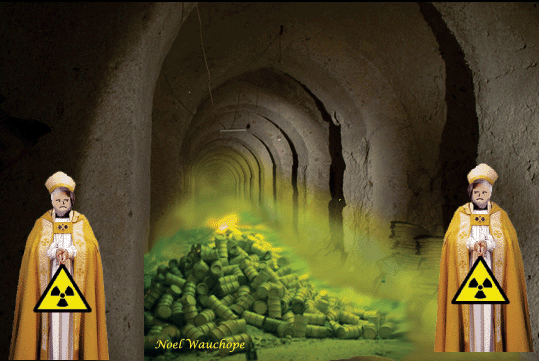
Every nuclear country has the same uncomfortable problem. ……………………….. spent fuel remains dangerous for time periods that are hard to grasp…….its most important results will arrive long after today’s engineers, regulators, and politicians are gone. That is not comforting, exactly, but it is the truth.
By Indux, June 23, 2026, https://www.vozpopuli.com/indux/en/finland-buried-nuclear-waste-in-copper-canisters-430-meters-down-but-the-metal-may-not-survive-as-long-as-the-promise/6314/
Finland is close to doing something no country has fully done before. At Olkiluoto island, Posiva Oy has built Onkalo, a deep underground repository meant to hold spent nuclear fuel far below everyday life, traffic, homes, schools, and the electric bills that come with nuclear power.
The bold part is not just the depth, it is the bet. The fuel will be sealed in copper-and-iron canisters, wrapped in bentonite clay, and placed about 1,300 to 1,400 feet underground in bedrock that is roughly 1.9 billion years old.
Some scientists still question how long the copper canisters will really last, but Finland’s plan leans on a bigger idea: no single barrier is supposed to carry eternity alone.
A world-first nuclear waste plan
Posiva submitted its operating license application at the end of 2021 for an encapsulation plant and final disposal facility for spent nuclear fuel. The Finnish government said the planned license period runs from March 2024 to the end of 2070, with the repository located in bedrock at a depth of about 400 to 430 meters.
That timeline has not gone as smoothly as planned. Finland’s Radiation and Nuclear Safety Authority, known as STUK, says its review has been extended and that it now has additional time until the end of June 2026, if possible, to submit its statement. The government can only grant the operating license if STUK supports it.
What goes inside the rock
The waste is not simply lowered into a tunnel and forgotten. Posiva’s disposal canister has a cast iron inner structure that holds the fuel elements, while the copper shell works mainly as a corrosion barrier. The copper shell is about 2 inches thick, and the lid is welded shut to keep groundwater away from the fuel.
In practical terms, it is a layered defense. First comes the fuel itself, then the iron insert, then copper, then clay, then rock, then the deep groundwater conditions around it. That is why the project is not just a story about a metal container, it is a geology story.
Why copper is controversial
Copper was chosen because it is expected to corrode very slowly in the oxygen-poor conditions deep underground. For the most part, that remains the basis of the KBS-3 concept used by Posiva and Sweden’s SKB.
Not everyone is convinced, however. A long-running scientific debate has focused on whether copper can corrode even in oxygen-free water. A 2023 assessment of canister degradation noted that anoxic copper corrosion and localized sulphide corrosion were among the most debated mechanisms reviewed by Swedish safety experts.
That does not mean the canisters are expected to fail tomorrow. It means the safety case has to survive tough questions. And with nuclear waste, “tough” means thinking beyond normal human planning, past elections, past companies, and past the lifespan of every building we know.
The rock is doing the heavy lifting
So why keep building if the copper debate is still alive? Because the Finnish design does not rely only on copper.
Posiva says geological disposal in Finland means placing the waste in crystalline bedrock, which makes up most of Finnish bedrock and is among the oldest in the world. The company also says deposition holes are drilled in solid rock zones where water seepage through cracks is as small as possible.
That ancient rock is the quiet star of the whole project. It has already been through immense geological time, ice sheets, and environmental change. The logic is simple enough to understand, even if the engineering is anything but simple: put the waste where the world changes slowly.
Licensing is still the near-term test
Onkalo may be physically close to operation, but the paperwork still matters. STUK says the review is close to completion, but it has been delayed by deficiencies in Posiva’s application documentation, updates tied to plant changes, and remaining uncertainties in the long-term safety case.
That is not a minor detail. The first real loading of spent fuel would mark a historic moment for nuclear energy, but regulators are still checking whether the full system is ready. Empty and test runs can prove a lot, but radioactive waste proves more.
Why this matters beyond Finland
Every nuclear country has the same uncomfortable problem. Reactors can produce large amounts of steady electricity with low carbon emissions, but spent fuel remains dangerous for time periods that are hard to grasp.
Finland’s answer may not fit everywhere. The United States, France, Germany, Japan, Canada, and the United Kingdom all have different rocks, politics, and public trust problems. You cannot just copy and paste a 1.9-billion-year-old Finnish bedrock system into another country.
Still, Onkalo is being watched closely because it turns decades of theory into a real facility. If it works as intended, it gives nuclear nations a serious example. If unexpected corrosion or groundwater behavior shows up later, that will matter, too.
A bet measured in centuries
The strange thing about Onkalo is that its most important results will arrive long after today’s engineers, regulators, and politicians are gone. That is not comforting, exactly, but it is the truth.
For now, Finland’s bet is clear. Copper may be debated, clay may shift, and regulators may keep asking questions, but the rock beneath Olkiluoto is the anchor of the plan. In the end, the country is asking ancient stone to help solve one of the most modern problems humans have created.
The official statement was published on STUK.
No comments yet.
1 This Month





PLEASE OPPOSE HR 8255 AND S.3639 – bills would accelerate satellite deployment, with no environmental review or safeguards – https://ncstd5li.quorum.us/campaign/169331/
To see nuclear-related stories in greater depth and intensity – go to https://nuclearinformation.wordpress.com
-
Archives
- October 2026 (49)
- September 2026 (339)
- August 2026 (330)
- July 2026 (355)
- June 2026 (287)
- May 2026 (306)
- April 2026 (356)
- March 2026 (251)
- February 2026 (267)
- January 2026 (308)
- December 2025 (358)
- November 2025 (359)
-
Categories
- 1
- 1 NUCLEAR ISSUES
- business and costs
- climate change
- culture and arts
- ENERGY
- environment
- health
- history
- indigenous issues
- Legal
- marketing of nuclear
- media
- opposition to nuclear
- PERSONAL STORIES
- politics
- politics international
- Religion and ethics
- safety
- secrets,lies and civil liberties
- spinbuster
- technology
- Uranium
- wastes
- weapons and war
- Women
- 2 WORLD
- ACTION
- AFRICA
- Atrocities
- AUSTRALIA
- Christina's notes
- Christina's themes
- culture and arts
- Events
- Fuk 2022
- Fuk 2023
- Fukushima 2017
- Fukushima 2018
- fukushima 2019
- Fukushima 2020
- Fukushima 2021
- general
- global warming
- Humour (God we need it)
- Nuclear
- RARE EARTHS
- Reference
- resources – print
- Resources -audiovicual
- Weekly Newsletter
- World
- World Nuclear
- YouTube
-
RSS
Entries RSS
Comments RSS


Leave a comment