How Israel Planned The Gaza Genocide Decades Ago

In October 2023, Israel found an excuse to breathe new life into an old story of slaughter and expulsion. The chief differences this time have been of scale and duration
Jonathan Cook Substack, SCHEERPOSTJune 11, 2026
The truth slowly comes to light: Israel‘s genocide in Gaza was planned decades ago.
Listen to the testimonies of four Israeli soldiers who served in Gaza.
Soldier 1: “Human lives didn’t matter. You could kill, there was no law. No one would say a word to you. But it’s not a good feeling. It mainly kills your humanity.”
Soldier 2: “At first I wasn’t willing to execute Arabs who weren’t resisting [that is, civilians]. Then we came to the conclusion that we had to kill. We went through the process of ceasing to see them as human beings.”
Soldier 3: “We caught guys, lined them up and eliminated them. In retrospect, it looks like murder.”
Soldier 4: “We would roam through refugee camps in Gaza and carry out purges… Every soldier who was there created a ‘concentration camp’, and they didn’t hesitate to kill people who caused a slight disturbance.”
No, these testimonies are not new. The whistleblowers did not serve in Gaza during the current, ongoing genocide there. These accounts are nearly 60 years old, published last week by the Israeli newspaper Haaretz under the headline “We were ordered to kill”.
Israeli soldiers interviewed shortly after the 1967 war – often referred to as the Six-Day War – not only confessed that they and others routinely committed war crimes but they pointed out that they did so under orders from their commanders.
The accounts were compiled into a book, The Seventh Day: Soldiers Talk About the Six-Day War, by Avraham Shapira, though many testimonies were not included because they were too shocking.
None of this should be simply of historical interest. These accounts are a vivid reminder that what Israel has been doing during its current, near three-year destruction of Gaza – levelling all homes, hospitals, schools, universities, bakeries and government offices; murdering tens of thousands, more likely hundreds of thousands, of Palestinian civilians; and blocking aid and starving the population – is part of a decades-old pattern of Israeli military conduct.
Nothing “started” on 7 October 2023, when Hamas broke out for a single day of the Gaza “concentration camp” – the plight of Gaza’s Palestinians noted 59 years ago by Soldier 4.
Rather, Israel found an excuse that day to breathe new life into an old story, one in which it has been slaughtering and expelling Palestinians for decades. The chief difference this time is simply one of scale and duration.
Washington and other western capitals have given Israel the time and space to finish in Gaza what, earlier, it had only been able to achieve in part. Israel’s much greater firepower today, provided by modern munitions supplied by the United States, has allowed Israel to realise what before it could only dream of doing: wiping Gaza off the map.
Starvation policy
The whistleblowing soldiers of 1967 admitted their job was not to “fight the enemy” – or “eradicate the terrorists”, as Israeli leaders now term it. It was to kill and terrorise Palestinian civilians under cover of war.
Few soldiers were shy of saying why they were committing atrocities. Their task was to create a reign of terror, integral to Israel’s efforts to expel as many Palestinians as possible from the last remaining parts of the Palestinian homeland, the territories captured by the Israeli military in 1967 and then illegally occupied.
This was seen as a new opportunity to complete the ethnic cleansing campaign begun by Zionist militias in earnest in 1947 and 1948 as the British Mandate authorities withdrew from Palestine. By the end of that campaign, some 80 percent of Palestinians had been expelled from their homes inside the borders of the newly declared Jewish state…………………………………………………………………………..
Targeting innocents
The crimes of 1967 were understood long ago by Palestinian historians, who were, of course, not listened to. Israeli historians took much longer to start piecing together the story as they gained access to parts of Israel’s military archives.
Haaretz’s new investigation, based on research by the Akevot Institute, provides details of the ruthlessness of the mass expulsions of Palestinians beginning in 1967.
As the paper reports: “The historical inquiry shows that Israel expelled and drove out some 300,000 Arabs from the West Bank, Gaza and the [Syrian] Golan Heights. And as in 1948, the expulsion included killing civilians, sowing terror in Arab communities, looting and ultimately, destruction.”
Having managed in 1967 to again expel large numbers of Palestinians, the next task – as in 1948 – was to prevent their return…………………………………………………………………………………………………………………………………………………
Squeezed out
Israel’s 1967 campaign of expulsions in Gaza and the West Bank was not improvised, nor was it done on the spur of the moment. According to Haaretz, the policy had been carefully planned many years in advance.
Unlike their predecessors in the 1960s, today’s western leaders and their media chose to buy Israel the diplomatic time and space it needed – as well as providing the weapons and intelligence – to destroy Gaza. The genocide would have been impossible without their assistance.
Buoyed by this impunity, Israel has tried to spread the destruction further afield, with limited success in Iran and much greater success in south Lebanon.
As western politicians and media happily forget Gaza, Israel keeps up the relentless pressure and misery there. A so-called “Yellow Line”, demarcating Israeli military control over the destroyed enclave, an area off-limits to Palestinians, has gradually expanded from half the land to 70 percent.
The people of Gaza are quite literally being squeezed out of the ruins of their homeland, as Israel scrambles to find a third country – Egypt, or perhaps Somaliland – willing to take them in.
Erasing context
As the US cosmologist Carl Sagan famously observed: “You have to know the past to understand the present.”
Which is precisely why western politicians and media have been so careful to strip out the past, excising the context and background, such as Israel’s violent ethnic cleansing campaigns of 1948 and 1967, that explain Israel’s behaviour in the present – in Gaza, the West Bank and south Lebanon.
Western audiences, deprived of the region’s history, have been more easily manipulated into believing that Israeli atrocities are a response – and a supposedly “proportionate” one, at that – to Hamas’ one-day attack on Israel in late 2023.
An obvious truth has been obscured: that for at least eight decades, Israel has been exploiting any opportunity it could find to expel the Palestinians from their homeland.
The October 2023 Hamas attack was not a turning-point or a rupture, as it is so often presented in the West.
In 1967 – that is, 56 years before the Hamas attack – Eshkol advised that unforeseen events might accelerate Israel’s stealthy programme of ethnic cleansing. A moment might arrive in the future – what he called an “unexpected luxury solution” – when Israel could rapidly realise its dream of a Palestinian-free Palestine…………………………………………………………………………………………………………………………………………………………………………………….
Prisons of complicity
Gaza is not an aberration. It is fully in accord with an eight-decade-long Israeli military strategy. Westerners aren’t aware of that only because their political and media class have worked strenuously to stop them from learning about it………………………………………………………………………………………………………………………. https://scheerpost.com/2026/06/11/how-israel-planned-the-gaza-genocide-decades-ago/
Reactor reboot at world’s largest nuclear plant highlights flaws in Japan’s radioactive waste plans

With a lot of spent fuel accumulating at nuclear power plants across the country, a final disposal of radioactive waste is a crucial challenge that must be resolved,”
Finding a community willing to host a highly radioactive dump site has been difficult, even with a raft of financial enticements.
By ASSOCIATED PRESS, 11 June 2026,
https://www.dailymail.com/wires/ap/article-15890689/Reactor-reboot-worlds-largest-nuclear-plant-highlights-flaws-Japans-radioactive-waste-plans.html
KASHIWAZAKI, Japan (AP) – Japan has resumed operations at the world´s largest nuclear power plant to help the country meet huge electricity demands during a global oil crisis, but the reboot highlights a big problem: Japan is running out of space for spent nuclear fuel and has no viable plans for permanent disposal of the radioactive waste.
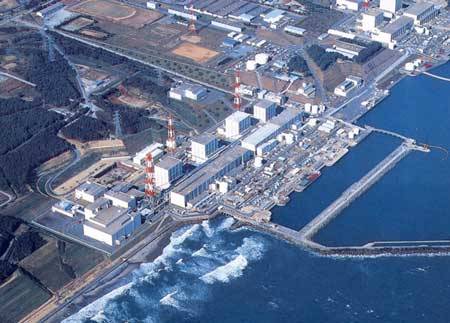
The restart of No. 6 reactor at Kashiwazaki-Kariwa Nuclear Power Station earlier this year was meant to spur a movement to bring more nuclear reactors online. Kashiwazaki-Kariwa is one of three plants whose cooling pools will be full in five years, according to the Federation of Electric Power Companies of Japan.
“Without solid (fuel management) plans, our power generation will stall sooner or later,” Kashiwazaki-Kariwa General Manager Takeyuki Inagaki said.
After decades of seeking permanent storage for highly radioactive spent fuel, the government is considering Minamitorishima, a remote Pacific island south of Tokyo. But the selection has faced skepticism and criticism stemming from Japan’s arbitrary actions on spent fuel and radioactive waste management.
Only 15 of Japan´s 54 reactors have restarted since the March 2011 Fukushima disaster, when a 9.0 earthquake off Japan´s northeastern coast and a subsequent tsunami caused meltdowns at three reactors operated by Tokyo Electric Power Company Holdings, or TEPCO. About 160,000 people fled from Fukushima and some areas remain unlivable.
Kashiazaki-Kariwa, also run by TEPCO, was shut down after the Fukushima disaster as part of a nationwide nuclear power stoppage.
The spent fuel in a cooling pool at Kashiwazaki-Kariwa No. 6 reactor, which is 88% filled, can be seen from a top-floor observation area. TEPCO has installed filtered venting systems and devices to prevent hydrogen explosions among additional safety measures based on lessons from Fukushima.
Prime Minister Sanae Takaichi is pushing to bring more nuclear plants online, resulting in more spent fuel. Without a viable permanent storage plan, there are worries that reactors will have to close when storage space runs out.
There are two options for dealing with spent nuclear fuel: direct disposal as waste or recycling to extract plutonium and uranium for reuse.
Japan insists on recycling, saying it will help the resource-poor nation’s energy needs while reducing the toxicity and volume of radioactive waste. But a reactor designed for plutonium reuse, a key part of the recycling, has failed. Reprocessing also won´t be able to handle all the spent fuel, adding to a plutonium stockpile that already is large enough to arm thousands of atomic bombs.
Experts say Japan should also consider the direct disposal option.
As of December 2025, cooling pools at 17 Japanese nuclear power plants held more than 17,000 tons (15,422 metric tons) of spent fuel, using nearly 80% of total storage capacity, according to the Ministry of Economy, Trade and Industry.
Beyond the large amount of radioactive waste from normal reactors, Japan also “has to deal with massive and largely unknown high-level nuclear waste from the Fukushima disaster,” said Lila Okamura, a Senshu University professor and expert on environmental politics and nuclear waste management.
Choosing a final disposal site for spent fuel and building a facility would require 100 years and tens of thousands of years to monitor the storage deep underground. For a generations-long project, Japan should plan carefully and not rush the current plan that is full of uncertainties, Okamura said.
Weeks after Kashiwazaki-Kariwa’s No. 6 reactor came back online for the first time in 14 years since the Fukushima disaster, Industry Minister Ryosei Akazawa approached Ogasawara village to request a feasibility study for a high-level radioactive waste site on Minamitorishima, an island administered by Ogasawara, which is part of Tokyo.
“With a lot of spent fuel accumulating at nuclear power plants across the country, a final disposal of radioactive waste is a crucial challenge that must be resolved,” Akazawa said in a letter to Ogasawara Mayor Masaaki Shibuya.
The government-owned Minamitorishima, about 2,000 kilometers (1,242 miles) south of Tokyo, has no permanent residents. The Japanese army is constructing a firing range for long-range, surface-to-ship missiles as a deterrent to China. The island also has deep sea deposits rich with rare earth minerals.
“The move seems political,” said Satoshi Takano, a member of a government panel looking at final disposal of spent fuel. “There will be little opposition from a government-owned remote island.”
Some experts say the island, which sits on a geologically stable tectonic plate, could be suitable. Many residents on Ogasawara and two nearby islands raised concerns about safety and tourism.
“I was baffled when I heard about the plan,” Ogasawara assembly member Yusuke Hirano told an assembly meeting. “I think nuclear waste is incompatible with islands that are a UNESCO Natural World Heritage site.”
Finding a community willing to host a highly radioactive dump site has been difficult, even with a raft of financial enticements. Minamitorishima is the fourth location to have a feasibility study since the government started looking in the early 2000s.
The whole review process will take about two decades. Municipalities participating in the first stage can receive up to 2 billion yen ($12.8 million) in government subsidies. The next stage would bring up to 7 billion yen ($44.7 million). Funding details for a final study haven’t been disclosed.
The world´s first final disposal site for spent nuclear fuel is set to open in Finland later this year. Britain, Germany and the United States have abandoned reprocessing largely because of high costs and technical challenges, while several other countries are discussing plans for direct disposal sites.
Inagaki, the Kashiwazaki-Kariwa general manager, said TEPCO is transferring spent fuel from No. 6 reactor to other reactors at the plant with more space, but the utility hopes to resume shipments to a dry cask storage in northern Japan as a near-term solution. Other utilities with nearly full pools have announced plans to build dry-cask storage at their plants.
Many residents worry about Japan’s growing stockpile because high-density storage of spent fuel could also increase overheating risks.
Mie Kuwabara, a civil activist in Niigata, wondered “where will it go next?”
“It’s irresponsible to accelerate restarts and produce more spent fuel without deciding its final destination,” said Kuwabara, who also is skeptical about using Minamitorishima.
“It’s like saying that it’s OK to put a facility there because nobody is around to complain if there is a problem,” Kuwabara said. “It’s scary.”
A nuclear war between India and Pakistan could destroy the ozone layer
Climate models suggest a small nuclear war in the tropics would do even more damage to the ozone layer than a larger nuclear war in more northerly latitudes, increasing exposure to dangerous ultraviolet radiation all over the world
By Michael Le Page, 10 June 2026,
https://www.newscientist.com/article/2529589-a-nuclear-war-between-india-and-pakistan-could-destroy-the-ozone-layer/
A nuclear war would not only trigger a nuclear winter, but also severely damage the ozone layer, making recovery even harder. Now, a study has shown that a relatively small nuclear war between India and Pakistan could do just as much damage to the ozone layer as a larger nuclear war between the US and Russia.
“We want to emphasise that even a small-scale nuclear war can produce far-reaching global side effects beyond the conflict regions,” says Zhihong Zhuo at the University of Quebec in Montreal.
A nuclear war would devastate the areas where bombs or warheads explode, with the explosions, heat and radiation potentially killing many millions directly. The explosions and fires would be so large that huge quantities of smoke would be pumped into the atmosphere, blocking sunlight and causing global temperatures to plummet – a nuclear winter.
“There’s strong surface cooling in the first several years,” says Zhuo, who presented her team’s results at a meeting of the European Geosciences Union in Vienna last month.
For instance, a 2007 study estimated that a billion people could die of starvation as a result of a nuclear winter caused by a war between India and Pakistan.
Recovery from a nuclear winter would be delayed by damage to the ozone layer in the stratosphere that blocks harmful ultraviolet light – volcanic eruptions and even large wildfires can also damage the ozone layer. High UV levels can harm plants as well as animals, meaning lower yields from farming even as temperatures recover.
Recent studies with advanced climate models suggest the extent of ozone damage after a nuclear war has been underestimated. So, concerned by the many conflicts around the world, Kuo and her colleagues decided to look at the possible consequences if one went nuclear. Drawing on estimates from previous studies, they modelled an India-Pakistan nuclear war that would release 5 million tonnes of soot into the atmosphere and a US-Russia war releasing 16 million tonnes. Unlike previous studies, they also took into account other pollutants such as organic carbon.
Their climate model suggests that air circulation patterns in the tropics would allow the pollutants from an India-Pakistan war to rise higher into the atmosphere, stay there longer and spread more widely around the world.
“The upward transport is stronger for the tropical cases,” Kuo says. So although the quantities of pollutants are smaller than from a US-Russia war, the effects on the ozone layer are actually greater.
The damage to the ozone layer would be greatest over the poles, similar to the situation caused by ozone-damaging pollutants known as CFCs. But there could be an increase in UV levels of up to 30 per cent even in tropical areas, the model suggests, with serious impacts on the health of people and wildlife.
Britain has become third-largest nuclear weapons spender – CND

, https://labouroutlook.org/2026/06/10/britain-has-become-third-largest-nuclear-weapons-spender-cnd/
The Campaign for Nuclear Disarmament (CND) has called on the government to cut wasted billions on nukes ahead of its Defence Investment Plan announcement.
CND is calling on the government to stop wasting public money on its nuclear black hole, after the latest nuclear weapons spending report from the International Campaign to Abolish Nuclear Weapons (ICAN) reveals that Britain is now spending more on its nuclear weapons than Russia.
Collectively, the nine nuclear-weapon states spent a record $119 billion in 2025 on maintaining, modernising, and expanding their nuclear arsenals, an increase of 19% ($16.8 billion) on their 2024 bill.
Britain overtook Russia as the world’s third biggest spender, spending $12.6 billion (£9.6 billion), an increase of 17%.
This spending includes:
- operating costs of Britain’s current four Vanguard nuclear-armed submarines
- building the replacement to Vanguard – the Dreadnought submarine
- maintenance of Britain’s nuclear weapons stockpile
- development of a new nuclear warhead, Project Astraea
It does not include the costs of the 12 F-35A nuclear-capable fighter jets that the government announced it was purchasing in June 2025. This shocking surge in nuclear spending comes as the government’s own Public Accounts Committee criticised the MoD for a lack of transparency over its ‘ever-increasing nuclear expenditure’, which is expected to rise to 20% of the total MoD budget for 2025–26, and again increase further to up to 25% in the coming years.
According to ICAN, the top nuclear spender globally was again the US, which spent $69.2 billion, an increase of 22% from 2024, outspending all other nuclear weapons states combined. China was second, spending $13.5 billion, an increase of 7%. Behind Britain was Russia, with an increase by 6% to $9.5 billion. Of the others, France spent $7.7 billion, India spent $2.8 billion, Pakistan spent $1.5 billion, Israel spent £1.2 billion, and North Korea spent $656 million.
The report also found that arms companies involved in the manufacture of Britain’s weapons had sought to influence government policy. According to Open Access data cited in the report, senior government figures met with representatives of the following arms companies: Airbus, Amentum, Babcock International, BAE Systems, Bechtel, Boeing, General Dynamics, Honeywell International, Leidos, Leonardo, Lockheed Martin, Peraton, Rolls Royce, RTX (Raytheon), Safran and Thales. The report noted that Airbus and BAE Systems, which had 44 and 35 meetings respectively, also included meetings with the Prime Minister’s office.
CND General Secretary Sophie Bolt said:
“This is a timely report that comes when the British government is planning to make savage cuts to public spending in order to fund more hikes to military spending. Britain’s nuclear weapons are a black hole, swallowing up even greater proportions of the Ministry of Defence’s already ballooning budget.
“It is Britain’s replacement of its nuclear weapons system which is driving these huge nuclear weapons spending increases. This is contributing to a much more dangerous world where the threat of these world-ending weapons being used in war is the highest it has been since the Cold War.
Far from keeping us safe, Britain’s nuclear-armed submarines are totally dependent on the US administration, which ties us even more closely to Trump’s reckless leadership that is dragging the world into more and more reckless wars that could go nuclear.
“With the government’s upcoming Defence Investment Plan expected to give at least £15 billion more to the military, it’s time to end the wasteful spending on war and nuclear weapons and redirect it into tackling the real security issues we face – from climate breakdown and the looming cost of living crisis.”
Are the Sizewell C financing arrangements a model for other European countries?

Steve Thomas, Presentation to AT OM Day, May 22, 2026, TUB, Berlin
Government claimed Sizewell RAB could be funded by
institutional investors, mostly UK-based.
Government took 49.5%,
institutional investors 23%, UK private investors 15%/. Government talked
about seeking a balance of risk & reward between investors & consumers, but
risk is with consumers/taxpayers, rewards are with investor. The government
strategy appears to have been to offer whatever terms were needed with no
regard for cost & risk to the public. Still, investors will only finance
half the cost. The model will not be used again so the huge effort
completing the Sizewell deal was wasted
TUB Berlin 22nd May 2026, https://www.static.tu.berlin/fileadmin/www/10002415/WIP_Vortraege_PDF/veranstaltung_atom_day_2026/EB414a_Fr_10-15_Thomas_Stephen.pdf
25 June – THE PUKE ON NUKES
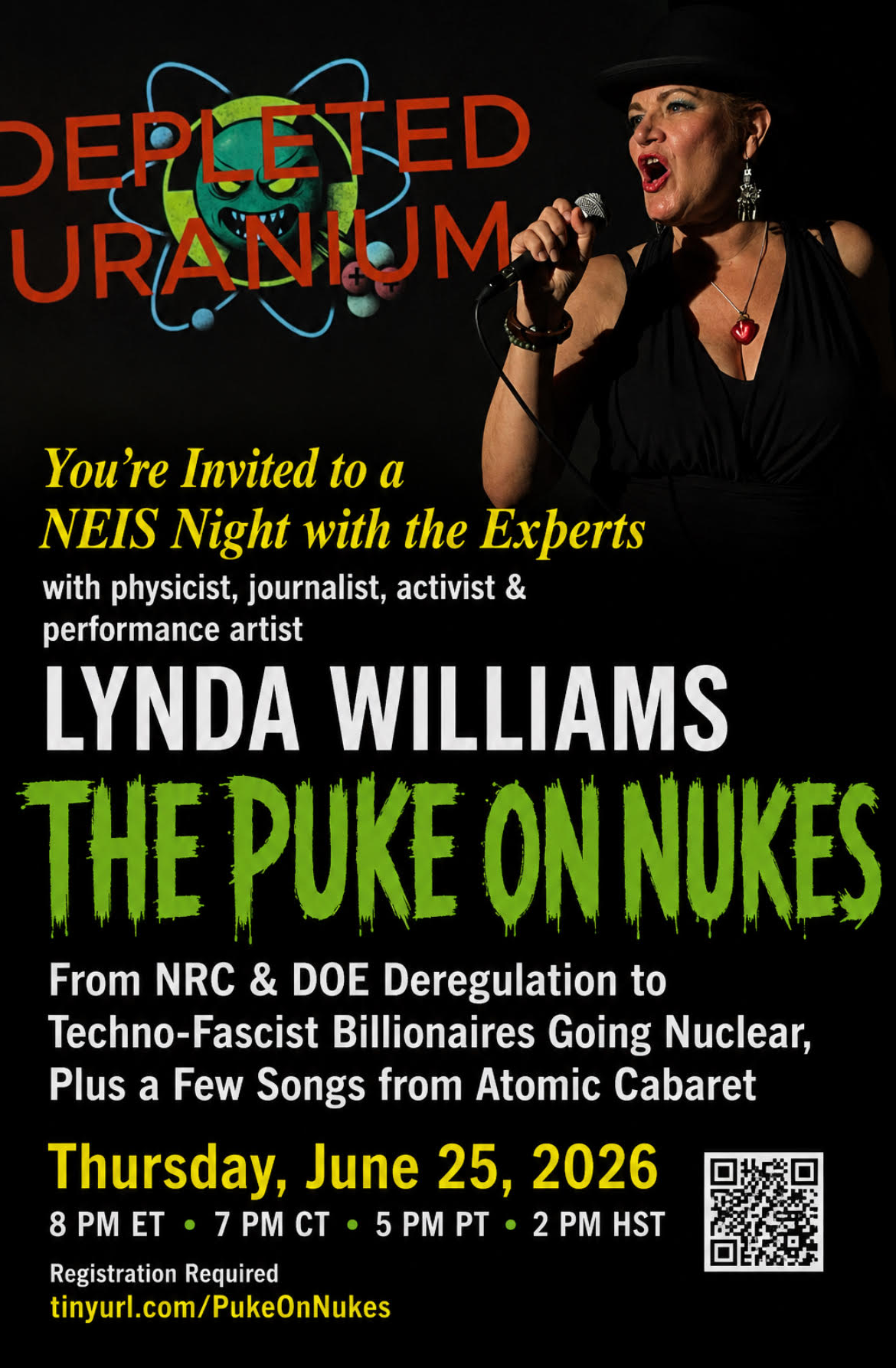
Thursday, June 25, 2026
8 PM ET • 7 PM CT • 5 PM PT • 2 PM HST
Registration required: https://tinyurl.com/PukeOnNukes
Lynda Williams, from Nuclear Free Hawaiʻi — physicist, activist, journalist, and performance artist known as The Physics Chanteuse* — has written breaking investigative articles exposing NRC and DOE deregulation under Trump executive orders. She’ll break down what’s happening — from uranium enrichment in Paducah to DISA Technologies’ attempt to extract uranium from abandoned mine waste on Navajo lands to the Techno fascist billionaires building off-grid SMRs to power AI surveillance data centers.
She’ll also report on her experience serving on the Hawaiʻi state working group on the viability of nuclear energy and touring her one-woman show Atomic Cabaret, using music and performance to motivate political action.
Lynda Williams is a physicist, investigative journalist, activist, and performance artist known as The Physics Chanteuse. She has performed for scientists and general audiences around the world, touring her one-woman show Atomic Cabaret most recently in the UK and Europe. Currently, she is working on analyzing and writing about NRC and DOE deregulation, a video blog/podcast called Nuke Puke, and a memoir, The Physics Bitch.
United Nations Open-ended working group on the prevention of an arms race in outer space in all its aspects (“OEWG on PAROS”)

Pursuant to General Assembly decision 79/512, the General Assembly decided to convene a new open-ended working group for the period 2025–2028, which would replace the two open-ended working groups established by resolutions 78/20 and 78/238.
The General Assembly decided to task the open-ended working group to submit recommendations on the prevention of an arms race in outer space in all its aspects, and that its discussions and recommendations would be informed by all the relevant General Assembly resolutions on the prevention of an arms race in outer space, including: (a) Resolution 78/20; and (b) Resolution 78/238.
Decision 79/512 decided that the Open-ended working group shall hold a two-day organizational session in Geneva in 2025, and shall meet in Geneva for two substantive sessions of five days each in 2025, two substantive sessions of five days each in 2026, two substantive sessions of five days each in 2027 and two substantive sessions of five days each in 2028.
Sessions
The organizational session of the Open-ended working group on the prevention of an arms race in outer space in all its aspects was held in Geneva from 6 to 7 February 2025 in Room XVIII at the Palais des Nations.
The first substantive session was held in Geneva from 7 to 11 April 2025 in Room XVIII of the Palais des Nations.
The second substantive session was held in Geneva from 21 to 25 July 2025 in Room XVII of the Palais des Nations.
The third substantive session will be held in Geneva from 6 to 10 July 2026 in Room XVI of the Palais des Nations.
The fourth substantive session will be held in Geneva from 23 to 27 November 2026 in Room XVI of the Palais des Nations.
Digital recordings of past public meetings are available here. Live audio streaming for public meetings of the open-ended working group may be found here.
Information for Participants…………………………………………………………………………. https://meetings.unoda.org/open-ended-working-group-on-prevention-of-an-arms-race-in-outer-space-2025
The view from Moscow: The future of nuclear arms control exists, but the path is hard

there can and should be some new legally binding new arms-control regimes, including strict limitations on nuclear warheads and delivery vehicles
However, the alternative is significantly more costly and dangerous on an existential level. The more nuclear weapons (and nuclear weapons states) that exist, the greater the possibility that nuclear weapons use becomes. This is the ultimate threat to the human civilization, and efforts to limit this threat demand leadership from the great powers today, not tomorrow.
By Dmitry Stefanovich | May 13, 2026, https://thebulletin.org/premium/2026-05/the-view-from-moscow-the-future-of-nuclear-arms-control-exists-but-the-path-is-hard/?utm_source=ActiveCampaign&utm_medium=email&utm_content=France%20s%20new%20nuclear%20doctrine&utm_campaign=20260608%20Monday%20Newsletter%20%28Copy%29
It is impossible to argue with the fact that today’s arms control architecture is in very bad shape, especially if one focuses on strategic nuclear weapons. While Moscow seems open to at least some limitations, the current thinking in Washington is obsessed with Chinese nuclear buildup (real or alleged), and the only acknowledged solution to the ‘three-body’ problem seems to be purely arithmetical in its nature: In other words, the United States declares that the only way to sustain nuclear deterrence under current circumstances is to have its nuclear arsenal exceed both the Russian and Chinese capabilities. Clearly, neither Russia nor China can ignore such an attitude and would respond in kind.
But despite the current negative trends, arms control remains alive, although the formats that still exist are limited. And in the future, arms control instruments may take many forms: legally and politically binding agreements, unilateral initiatives, and bilateral and multilateral arrangements. Even enhanced notifications and transparency mechanisms could be helpful. Moreover, there is some room for synchronized limitations on certain activities—i.e. deployment of selected weapons only at selected regions—which might contribute to the stabilization of military-political relations between certain countries.
It is also crucial to understand that it is hardly possible that any future arms control could only be bilateral. Furthermore, it is impossible to even imagine the complicated arrangements for inspection mechanisms for every state that possesses nuclear weapons, and the asymmetrical quantitative limitations for them. The arsenals of nuclear weapon states are significantly different, and even the Russian and US nuclear forces postures are not symmetrical. To have a dozen or more inspections per country per year is too much of a logistical challenge if we begin to consider more than two participants for such a regime.
There are other factors as well, including but not limited to the increasing presence of dual-capable systems, growing cooperation between the United States and its allies and partners in the nuclear domain (with NATO declaring itself a “nuclear alliance”). The peculiar part is that while one side perceives such developments as explicitly destabilizing, the other believes them to be stabilizing and enhancing strategic (or integrated) deterrence.
Most important, not only nuclear capabilities contribute to the overall “security equation.” Military conflicts since the end of the 20th century clearly show that non-nuclear long-range precision weapons are indeed a strategic capability, while non-nuclear deterrence is a much more complicated concept. It is now becoming readily apparent that non-nuclear weapon states can inflict significant costs on their adversaries, no matter how many nuclear weapons those adversaries have in their arsenals. Such trends are augmented by rapid scientific and technological change. The role of hypersonic weapons, drone warfare, artificial intelligence, machine learning, and outer space infrastructure is continuously growing, and all these emerging and disruptive technologies are intertwined—jointly contributing to the very complicated landscape of multilateral strategic deterrence.
Last but not least, the renewed possibility of overt nuclear testing is becoming a big challenge. Major countries have hardly forgotten what their nuclear weapon explosions revealed, but there seems to be a growing number of arguments supporting nuclear tests for both political and technological reasons. A deep dive into this issue deserves a separate paper, but what is clear is that should one country test, others will follow—and ultimately, a domino effect would likely follow, leading to the destruction of the Nuclear Non-Proliferation Treaty as it is, not to mention the grim prospects it would make for the Comprehensive Test-Ban Treaty to ever enter into force.
A path forward
Still, there are options to address the current polycentric nuclear era of major military-political confrontations. One way is to find a way to engage in behavioral arms control—which basically means looking for mechanisms that limit activities, and not capabilities.
Unilateral and coordinated declarations of one’s capabilities and doctrines might be helpful as well. Joint notification regimes are also a possibility, even if those will be limited initially. For example, the only area where the “Nuclear Five” of the nuclear weapons states recognized by the NPT have some symmetry is the sea-based leg of their nuclear deterrence forces. Codifying existing patrol practices regarding nuclear-tipped ballistic missile-armed submarines (known as Ship Submersible Ballistic Nuclear, or SSBN), and a regime of submarine-launched ballistic missile (SLBM) launch notifications could be a relatively easy first step that would significantly enhance mutual understanding and revitalize the practices of military-to-military data exchanges. Moreover, increasing the number of SSBNs deployed on deterrent patrols above the agreed “normal’ can become a visible and clear signaling method.
However, to make such arrangements possible, arms control itself should be “re-branded,” so it will be perceived first and foremost as a tool in a state’s national security arsenal rather than anything intended for the good of all humankind. And the term “re-branding” would be absolutely correct to use, because a top-to-bottom overhaul of arms control would indeed contribute to the optimization of military development projects—based on better understanding of the efforts and logic of similar developments in both adversarial and partner countries alike.
Russia, for what it is worth, had already made several proposals regarding somewhat informal arms control mechanisms over the last decade alone. To name a few such proposals, there was the suggestion for a post-INF moratorium on intermediate-range ground-launched missiles deployment; limitations on the scale and geographic locations of military exercises during the COVID-19 pandemic; and an extension of treaty limitations post-New START. Unfortunately, none of those eventually succeeded, although the post-INF moratorium did contribute to a somewhat slowed and scaled-down development and deployment of such systems by both Russia and by the United States. Moreover, as of Spring 2026 neither Russia nor the United States seem to be actively engaged in deploying nuclear warheads beyond the now-defunct New START limits.
Other scenarios
Read more: The view from Moscow: The future of nuclear arms control exists, but the path is hardBut with the expiration of the last of the nuclear arms control treaties, a renewed nuclear arms race is a real possibility, and one that is already occurring in some domains. The exact parameters are hard to determine, because there is only secondary or even tertiary data on the capacities of defense industries and nuclear enterprises for countries like China and Russia, especially given the ongoing “special military operation” that the latter is undertaking in Ukraine. More information is available on the United States, the United Kingdom, and France, while far less can be found on India, Pakistan, Israel, and North Korea (also known as the DPRK).
Such races are occurring even though they are not the most effective way to spend increasingly limited resources. Russian nuclear weapons and delivery systems have been continuously upgraded and modernized throughout the post-Cold War period, for many reasons. The reasons include the degradation of Russia’s conventional forces, US superiority in strategic non-nuclear weapons, concerns about US missile defense, and the general security environment on the Eurasian continent—not to mention the practical need to preserve nuclear weapons’ expertise and to keep Russia’s relevant nuclear infrastructure running throughout periods of economic turmoil. So, there seems to be some capacity for arms racing.
The same is more or less true for China and, probably, France, although the reasons for keeping one’s nuclear weapons enterprise in good shape can be different.
The nuclear arms race itself, which could be said to have been ongoing for at least a decade or even more, only now shows signs of switching from the qualitative to the quantitative. Previously, most nuclear weapon states focused on enhancing the capabilities of their nuclear weapons—and especially their delivery systems—through increased precision, reliability, and survivability. Now it is clear that, although there is a different amount of open-ness and transparency about it, all nuclear weapon states are getting ready to increase their overall nuclear weapon stockpiles. What makes it much more different and much more dangerous compared to the previous Cold War is that this new arms race is essentially multi-domain and multipolar, with much bigger roles played by many more actors—including newly emerging powers.
One should not ignore the link between the growing emphasis on nuclear weapons as an ultimate tool to ensure national security and sovereignty by nuclear weapons states (and to some extent their allies) and the pressure on nuclear non-proliferation, with more countries considering getting a nuclear capability for the very same purpose. This link, if understood correctly, might also contribute to the limitation of “nuclear optimism” by the existing nuclear weapon states and force them to search for collective security solutions.
Limits of negative effects
Presumably, there is an understanding in Moscow and other nuclear capitals that arms-racing each other “into oblivion” (as a former US official once said) is not straightforward, and that there are serious limitations and bottlenecks. This gives some level of optimism that the arms race can be contained, if not through formal mechanisms, but based on mutual understanding that you can’t change the political, industrial, and demographic landscape back to what it once was.
The biggest danger, as viewed from Moscow, is that it is crucial to see a mix of strategic nuclear, strategic non-nuclear, non-strategic nuclear, and missile defense capabilities as a joint system augmented by nuclear and non-nuclear capabilities of allied states and integrated through “space superiority” and AI-enabled unified mission planning. This is perceived as a possibility to combine a disarming and decapitating strike with nuclear and non-nuclear weapons with air and missile defense capabilities preventing a weakened retaliation. The latest military conflicts demonstrate that such “bogeymen scenarios” cannot be ignored, as there is a clear push to bank on selected areas of military superiority by the United States and some of its allies.
Clearly, such threats are well understood; consequently there is a constant development of the Russian Strategic Rocket Forces, as well as Heavy Bombers and SSBNs, not to mention so-called novel strategic delivery systems, such as Avangard HGV-tipped ICBMs, Burevestnik unlimited range nuclear-powered cruise missiles, and the Poseidon nuclear-powered uncrewed underwater vehicle. Rapidly developing kinetic and non-kinetic counterspace capabilities also contribute to such efforts. There has been a clear focus on survivability and overwhelming second-strike capabilities, so that even a limited number of delivery vehicles intended for the targets on the adversary’s territory will reach their destination. However, actions by the United States and its allies do contribute to the ever-growing decapitation and disarming strike concerns. Ensuring the balance based solely on one’s military power without arms control framework is an extremely complicated task.
How to survive
Finally, there are many reasons to have questions and make accusations against each other because of bad decisions made over the years, including but not limited to the destruction of the ABM Treaty by Washington, as the most dramatic example—it drove both Moscow and Beijing to pursue symmetrical and asymmetrical measures to hedge against possible future technological breakthroughs. The so-called rogue states that have been cited as a primary reason to develop the US missile defenses and forward deploy its assets also continuously enhanced their capabilities. The characterization of Russia, China, Iran, and North Korea by some politicians as an “axis of evil” (or “evil tetragon” in Russian) did not help to stabilize things either.
But the problem is that things can get much worse, with countries facing less stable strategic balances and more escalatory force postures. And they surely will evolve in that way, unless joint efforts to find solutions are undertaken.
Ultimately, there can and should be some new legally binding new arms-control regimes, including strict limitations on nuclear warheads and delivery vehicles, although it is possible that a “warhead” would be a virtual accounting unit akin to the New START rules, where one Heavy Bomber accounted for one Nuclear Warhead only. This demands a significant volume of political will, especially given the fact that it is impossible to cover all existing concerns within a single document. Before we reach this stage, some informal mechanisms to enhance arms control and risk reduction can be put in place. The path forward will be hard and will need mutual concessions.
However, the alternative is significantly more costly and dangerous on an existential level. The more nuclear weapons (and nuclear weapons states) that exist, the greater the possibility that nuclear weapons use becomes. This is the ultimate threat to the human civilization, and efforts to limit this threat demand leadership from the great powers today, not tomorrow.
United Kingdom Atomic Energy Authority (UKAEA) commits £20M to UKI2S fund for fusion innovation

The UK Atomic Energy Authority (UKAEA) has contributed a further £20
million to the UK Innovation & Science Seed Fund (UKI2S) to back UK-based
spinouts and early-stage companies. UKI2S is a government-backed seed fund
managed by Future Planet Capital that invests in and grows early-stage deep
tech companies emerging from UK research, helping turn science into
commercially viable businesses.
The investment forms part of a wider
£33.25 million funding increase across three UKI2S sub-funds (Space,
Defence and Fusion), taking the fund’s total capacity to £150 million.
The capital includes £9.25 million from the UK Space Agency, £4 million
from the Ministry of Defence and £20 million from UKAEA. The cumulative
investment from UKAEA in the UKI2S fund is £28 million.
UKAEA 10th June 2026, https://www.gov.uk/government/news/ukaea-commits-20m-to-uki2s-fund-for-fusion-innovation
Shipment of nuclear waste from Sellafield heads to Germany, raising safety concerns
11th June, By Gareth Cavanagh
A SHIPMENT containing ‘higher level’ nuclear waste has been seen making
its way through Barrow from the Sellafield site bound for Germany – and is
a source of concern for protest groups both at home and abroad. Sellafield
Ltd has confirmed that flasks, seen at Barrow Docks Rail Terminal on
Tuesday June 9, contain residue from reprocessed radioactive waste, which
is set to be returned to Germany. Waste contained in the flasks, carried by
Nuclear Transport Solutions (NTS), is the result of spent fuel which has
been reprocessed and recycled at Sellafield site. It was previously used by
utilities in Germany to produce electricity.
Whitehaven News 11th June 2026,
https://www.whitehavennews.co.uk/news/26183018.shipment-nuclear-waste-sellafield-heads-germany/
1 This Month
23-25 October – on Zoom – World BEYOND War’s annual global conferenc


Shut down the radiation-damaged Heysham nuclear reactors now
To see nuclear-related stories in greater depth and intensity – go to https://nuclearinformation.wordpress.com

Say No to NASA’s Reckless Nuclear Reactor on the Moon
Say No to NASA’s Reckless Nuclear Reactor on the Moon

Please sign the petition here: https://www.change.org/p/stop-japan-s…
-
Archives
- October 2026 (190)
- September 2026 (339)
- August 2026 (330)
- July 2026 (355)
- June 2026 (287)
- May 2026 (306)
- April 2026 (356)
- March 2026 (251)
- February 2026 (267)
- January 2026 (308)
- December 2025 (358)
- November 2025 (359)
-
Categories
- 1
- 1 NUCLEAR ISSUES
- business and costs
- climate change
- culture and arts
- ENERGY
- environment
- health
- history
- indigenous issues
- Legal
- marketing of nuclear
- media
- opposition to nuclear
- PERSONAL STORIES
- politics
- politics international
- Religion and ethics
- safety
- secrets,lies and civil liberties
- spinbuster
- technology
- Uranium
- wastes
- weapons and war
- Women
- 2 WORLD
- ACTION
- AFRICA
- Atrocities
- AUSTRALIA
- Christina's notes
- Christina's themes
- culture and arts
- Events
- Fuk 2022
- Fuk 2023
- Fukushima 2017
- Fukushima 2018
- fukushima 2019
- Fukushima 2020
- Fukushima 2021
- general
- global warming
- Humour (God we need it)
- Nuclear
- RARE EARTHS
- Reference
- resources – print
- Resources -audiovicual
- Weekly Newsletter
- World
- World Nuclear
- YouTube
-
RSS
Entries RSS
Comments RSS

