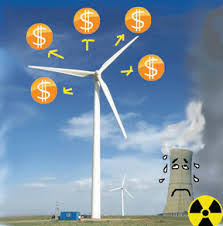
Scots are right to back renewables over nuclear energy.
By Dr Paul Dorfman, Bennett Institute, University of Sussex; Dr Keith
Baker FRSA, Glasgow Caledonian University; Professor Peter Strachan, Robert
Gordon University; Professor Steve Thomas, University of Greenwich; Dr
David Toke, University of Aberdeen.
POLLING released a couple of weeks ago
found that nuclear power has a “miserable” level of support in
Scotland, with more than half of those surveyed saying that the main focus
should be on renewables. According to the facts, this makes sense. Solar
and wind now dominate global electricity generation. Worldwide, solar and
wind power will both surpass nuclear in 2026.
This surge has halted the
fossil fuel power generation rise, with renewables overtaking coal,
supported by battery storage providing system flexibility at scale. All
this points to a shift in the dynamics of the power system. When renewable
energy generation exceeded the rise in global electricity demand last year,
an important threshold was crossed. In 2025, solar became the EU’s top
power source, with wind and solar now the bedrock of European energy
self-reliance. Power generation from renewables in Europe has reached a new
record of 384.9 Terrawatt-hours (TWh).
Meanwhile, Scottish wind power has
also set new records. More renewable energy is produced in the Scottish
Highlands per household than any other area of the UK. Annual renewable
generation across the Highlands is staggering. Renewable energy development
will be further supported by SSEN’s investment of £7 billion in Scotland
in 2026-31, creating 17,500 jobs. More than 100% of Scotland’s
electricity demand has been produced by renewables for the first time,
supporting more than 42,000 jobs and an economic output of more than
£10.1bn.
New UK nuclear plans would be yet another blow to electricity
bill-payers, when Scottish families are already paying what amounts to a
“nuclear tax” to fund the two most expensive nuclear power plants in
the world, England’s Hinkley Point C and Sizewell C.
Meanwhile, the
Norwegian Nuclear Committee has just said no to nuclear power in Norway.
Due to new nuclear construction timescales – up to 17 years according the
UK Government – and the vast cost over-runs, fissile fuel is a policy
dead end, diverting scarce resources away from realistic climate and energy
solutions.
Small modular reactors (SMRs) are another a costly distraction.
They are still in development and decades away from deployment at scale.
All this means that new nuclear is too late for the climate and energy
crises. What’s worse, every pound invested in nuclear is a pound not
invested in renewables, energy efficiency, storage and grid resilience –
investments that would provide a much bigger pay-off.
The National 6th May 2026,
https://www.thenational.scot/business/26081051.scots-right-back-renewables-nuclear-energy/
No comments yet.
-
Archives
- October 2026 (129)
- September 2026 (339)
- August 2026 (330)
- July 2026 (355)
- June 2026 (287)
- May 2026 (306)
- April 2026 (356)
- March 2026 (251)
- February 2026 (267)
- January 2026 (308)
- December 2025 (358)
- November 2025 (359)
-
Categories
- 1
- 1 NUCLEAR ISSUES
- business and costs
- climate change
- culture and arts
- ENERGY
- environment
- health
- history
- indigenous issues
- Legal
- marketing of nuclear
- media
- opposition to nuclear
- PERSONAL STORIES
- politics
- politics international
- Religion and ethics
- safety
- secrets,lies and civil liberties
- spinbuster
- technology
- Uranium
- wastes
- weapons and war
- Women
- 2 WORLD
- ACTION
- AFRICA
- Atrocities
- AUSTRALIA
- Christina's notes
- Christina's themes
- culture and arts
- Events
- Fuk 2022
- Fuk 2023
- Fukushima 2017
- Fukushima 2018
- fukushima 2019
- Fukushima 2020
- Fukushima 2021
- general
- global warming
- Humour (God we need it)
- Nuclear
- RARE EARTHS
- Reference
- resources – print
- Resources -audiovicual
- Weekly Newsletter
- World
- World Nuclear
- YouTube
-
RSS
Entries RSS
Comments RSS


Leave a Reply